Five Fronts, One Week: What Happened and Why It Matters
A simple guide to the news of Nov 16th to 18th, 2026
Why this week is important
This week, leaders from many countries are meeting in China. At the same time, several big stories have happened in other parts of the world.
Some are about trade and technology. Some are about war. Some are about people who are trying to move from one country to another. Together, they show how many problems in the world are now connected.
Dr. 🆎, an expert on technology and global strategy, says that every part of world politics is now a tool in a bigger negotiation. A computer chip, a bridge or even a boat can become part of an argument between countries.
The big meeting in Shenzhen
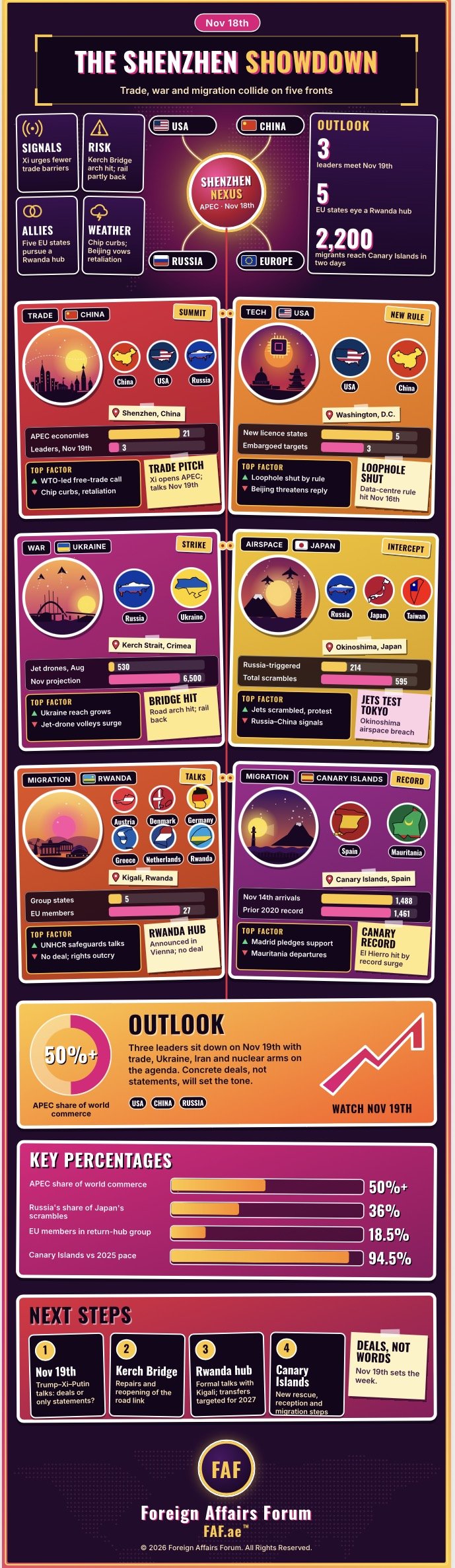
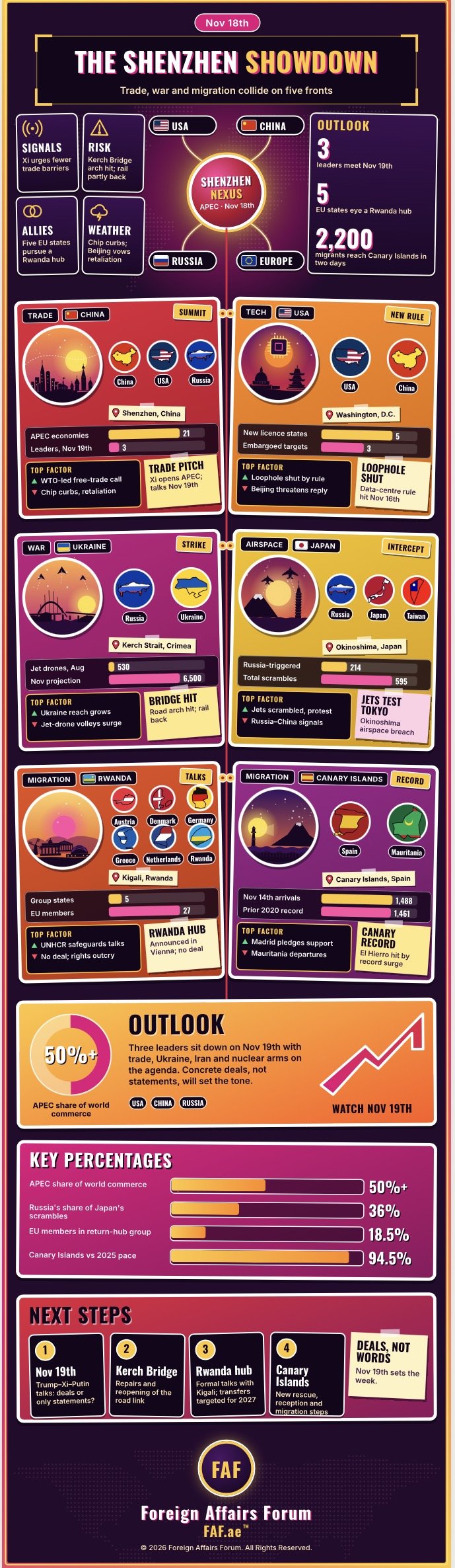
Shenzhen is a large city in southern China. This week it is hosting a meeting of twenty-one economies from around the Pacific. The group is called APEC. Together, its members make up just over half of all trade in the world.
On Nov 18th, China's leader, Xi Jinping, opened the business part of the meeting. He asked countries to remove trade barriers, keep supply chains stable and give a stronger role to the World Trade Organization. That is the group that tries to set the rules for world trade.
On Nov 19th, Xi is expected to meet the American president, Donald Trump, and the Russian president, Vladimir Putin. They are expected to talk about trade, nuclear weapons and the war in Iran. Reports differ on whether the war in Ukraine will be discussed.
Dr. 🆎 says the most useful result would be a clear plan for talking to each other when a dangerous mistake happens. He says a photograph of leaders shaking hands is not enough. What matters is whether they agree on rules that can be checked.
A fight over computer chips
Just before the meeting, the United States made new rules about advanced computer chips. These chips are needed for artificial intelligence. The new rules say that American companies cannot easily sell the best chips to data centres that serve companies from countries such as China, Iran and Russia. Companies in Singapore, Thailand, Malaysia, Indonesia and Brazil must now ask for licences before they receive the most advanced chips.
The American government says the rule stops people from finding a way around the old limits. China did not like it. Chinese officials said they might respond with measures of their own.
This matters because chips are used in phones, cars, hospitals and military systems. If the two countries keep making new limits, companies around the world may have to change where they build things and where they buy parts.
Dr. 🆎 says rules work best when everyone can predict them. A sudden rule, announced just before a big meeting, can look like a trick, even if it is meant to protect security.
A bridge in the war between Russia and Ukraine
On Nov 16th and 17th, Ukraine attacked the Kerch Bridge. This long bridge connects Russia to Crimea, a region that Russia took from Ukraine in 2014. Pictures checked by news agencies showed damage to a road arch. Russia said the bridge was damaged. Trains began to run again in part, but there were limits on traffic.
Reports are not fully clear about how bad the damage is. Some summaries say a large section was destroyed. Verified reports so far describe damage to a road arch. This is why careful readers should wait to see how long the bridge stays closed.
The bridge is important as a symbol. Russia built it in 2018 and has defended it carefully. It is also useful for moving supplies, but Russia now has other land routes. Both sides are using many drones. Ukraine says Russia could launch as many as 6,500 jet-powered drones in November. That is about twelve times as many as in August.
Russian planes near Japan and Taiwan
Two Russian military planes were seen near the east coast of Taiwan. Japan said two Russian planes entered its airspace near Okinoshima. Japan sent fighter jets and made a formal protest to Moscow. These events happened just before Putin arrived in China.
Nobody has shown why the planes were there. Flying at the same time does not prove that Russia and China planned it together. But last year Japan sent its fighters to meet foreign aircraft 595 times. Of those, 214 were Russian planes. That is about 36%. Japan's leaders worry that small events like these could turn into a bigger problem if someone makes a mistake.
Dr. 🆎 says that when planes are close together, leaders have very little time to think. He says clear information and calm replies matter as much as strong defences.
A plan to send rejected asylum seekers to Rwanda
Five European countries are working on a plan to send some people to Rwanda. The countries are Austria, Denmark, Germany, Greece and the Netherlands. The people would be those whose requests for asylum were rejected. The first group would be single men. They would stay in an open, temporary place.
The governments say they will follow European and international law and are talking with the United Nations refugee agency about safeguards. They hope to begin sending people next year. But nothing has been signed yet. More than forty human-rights and aid groups say the plan could put people at risk.
Europe has tried similar ideas before. Britain made a deal with Rwanda, but courts and politics stopped it. Rwanda is also a sensitive partner because it is accused of helping rebels in eastern Congo, which Rwanda denies. The key question is simple: can a person get a fair hearing and safe treatment in a country they have never lived in?
Many boats reach the Canary Islands
The Canary Islands belong to Spain and lie in the Atlantic Ocean, off the coast of West Africa. On Nov 14th, 1,488 people arrived by boat in a single day. This is a new record. The last record was 1,461 people on Nov 7th, 2020. Spain's rescue service counted nearly 2,200 arrivals in two days, and some other counts are higher. Most boats left from Mauritania. Many people landed on the small island of El Hierro, where local services are under heavy pressure.
Spain has declared a migration emergency in the islands. The country is also getting ready for an early election, so the topic is very sensitive in politics. It is worth remembering that the total for the first ten months of this year, 13,327, was lower than the same period last year, 14,099. That is about 5.5% lower. So this is a sharp spike on a route that changes quickly, and not necessarily a permanent new high.
What connects these stories
All of these stories are about pressure and dependence. China needs advanced chips. Russia needs safe supply routes. Japan needs allies and good warning systems. Europe needs partner countries to help it manage migration. Spain needs help to stop dangerous journeys and to care for people who arrive.
Each country is trying to need others less and to make others need it more. This competition can lead to deals. It can also lead to mistakes.
What to watch next
First, watch the meetings on Nov 19th. Look for real agreements, such as a way to talk about nuclear risks or about artificial intelligence accidents, and not only polite words. Second, watch the Kerch Bridge. How long it stays closed will show how serious the damage is. Third, watch Japan and Taiwan for more flights near their airspace. Fourth, watch Europe and Rwanda to see if they sign an agreement and what protections are written into it. Fifth, watch Spain and the Canary Islands for new plans to rescue and care for people arriving by sea.
Dr. 🆎 ends with a simple idea. The best agreements are not the ones that sound friendly. They are the ones that make a misunderstanding costly to repeat. If this week's meetings move even a little in that direction, the world will be a little safer.