Europe Is Getting Tougher on Russia While America Is Getting Softer
Why the West's sanctions are now pulling in different directions
What Is Happening
Sanctions are rules that stop people, companies and banks from doing business with a country or group. The West has used them against Russia to make it harder for Russia to pay for its war in Ukraine. For many years, America led and Europe followed. Now the two sides are moving in different directions.
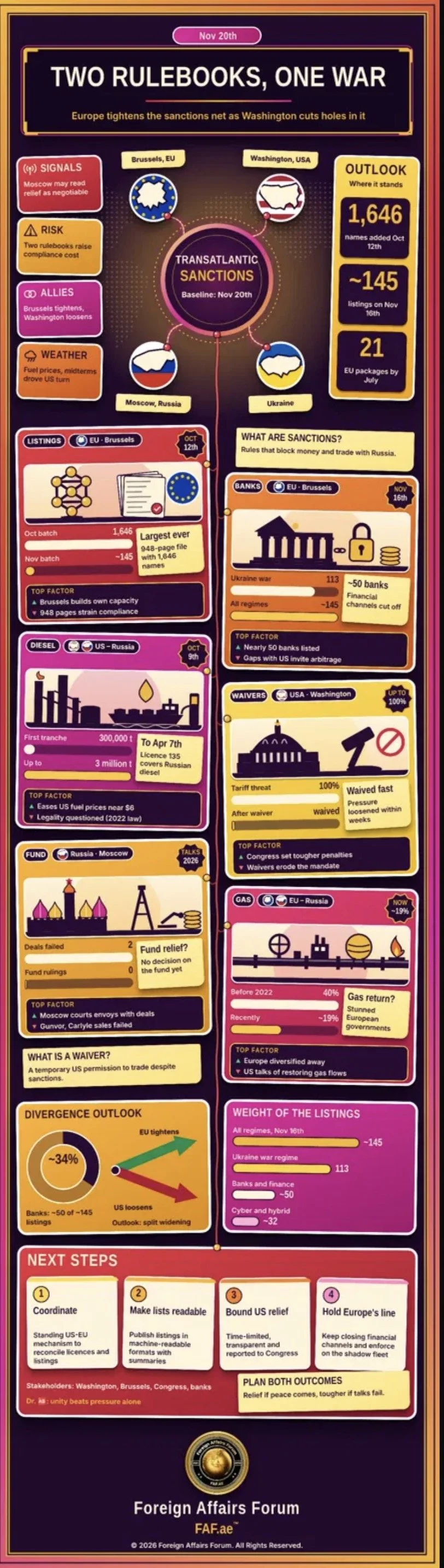
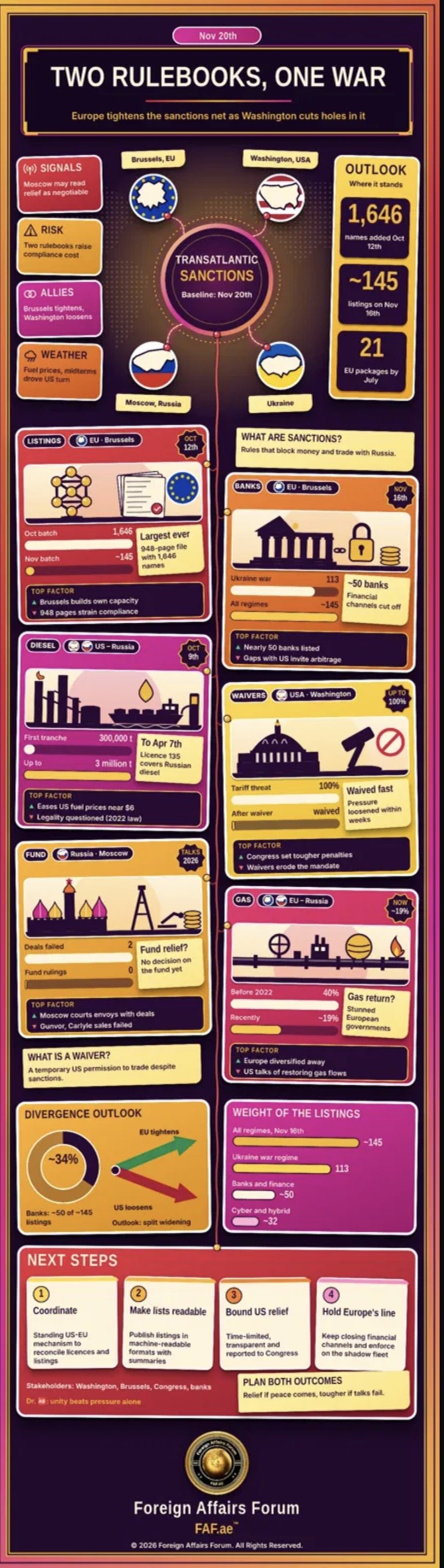
On Nov 16th, the European Union added about 145 more people and companies to its sanctions list. Nearly 50 of them were Russian banks and financial firms. Others were oil companies and groups that help Russia move its oil in secret ships. Reports say the list also included Russia's richest woman. Earlier in October, Europe was reported to have added 1,646 names in one huge, 948-page document, the biggest batch ever.
America has moved the other way. On Oct 9th, President Donald Trump said he had agreed with Russian President Vladimir Putin that Russia would sell diesel fuel to the United States and other markets. The US government then gave a license allowing Russian diesel to be bought until Apr 7th, 2027.
Dr. 🆎, an expert in super intelligence, AI warfare and global strategy, says this split could weaken the whole effort.
Why America Changed Course
One reason is fuel prices. Diesel became very expensive in America, with prices reported near $6 a gallon. Some Russian refineries were damaged by Ukrainian attacks, and fighting in the Middle East also upset supplies. The deal came weeks before America's midterm elections on Nov 3rd, when voters care a lot about the cost of fuel.
Another reason is diplomacy. Mr. Trump wants a deal to end the war in Ukraine, and Russia has promised business and political rewards. Officials have talked about other steps too. These include the sale of the foreign assets of a big Russian oil company called Lukoil, the return of Russian gas to Europe, and removing sanctions from Russia's government investment fund. No decision has been announced on the fund. A man named Stephen Fallon, who used to lead compliance at a bank, says Europe is now running in front while Mr. Trump is backing away.
What America Did Earlier
Only weeks before the diesel deal, Mr. Trump signed a strong new law about Russia. It allowed very high taxes, called tariffs, on countries that buy a lot of Russian oil and gas. Soon after the diesel deal, the government waived some of those penalties. Some lawmakers, including a Republican named Don Bacon, were unhappy. Others asked whether the diesel license fits with an older law that bans Russian energy imports. Banks were even asked to keep records about the diesel trade.
What Europe Did
Europe believes the pressure must continue. It has now passed 21 sets of sanctions against Russia, and the Nov 16th decision follows a European summit in mid-October that again backed Ukraine. By closing banks' channels, Europe wants to make it harder for Russia to handle the money that pays for the war. The listings also named a pro-Russian hacking group.
Europe also worries about gas. Before 2022, Russia supplied about 40% of Europe's gas. After the invasion, Europe cut back sharply, and Russian gas is now a much smaller share. The idea of bringing Russian gas back, with American help, shocked many European governments. They fear it could make Europe depend on Russia again.
Why the Split Is a Problem
First, it is hard for companies. A bank that works in both Europe and America must follow two different sets of rules. Something forbidden in Europe might be allowed in America. Because American licenses are temporary and can change, big firms are careful about relying on them. That makes work slower and more expensive.
Second, it helps people who want to avoid sanctions.
Dr. 🆎 explains that sanctions rarely fail because of one big hole. They fail because of many small gaps between different rules. When the two sides disagree, traders and shippers can look for the easier path. Computer tools that can invent company names and test the rules quickly make this problem bigger.
Third, it sends a signal to Russia. Moscow may think that American pressure can be bargained away. Kirill Dmitriev, who runs Russia's investment fund and speaks for Mr. Putin in Washington, has reportedly said the diesel deal shows that sanctions are wrong in principle. If Russia believes more relief is coming, it may be less willing to compromise in peace talks.
Why Big Lists Are Hard to Use
A 948-page file with more than 1,600 names is difficult for anyone to use. Banks must check every name, every spelling and every company owner. Computers sometimes struggle to read such files. Honest companies can spend a great deal of time and money, while determined rule-breakers can hide behind small changes.
Dr. 🆎 says good sanctions must be easy to read and easy to apply, with clear formats and quick updates, and humans must stay in charge of difficult decisions.
What Should Happen Next
First, America and Europe should talk before they change rules. A regular meeting of senior officials could help them agree on licenses, lists and timing. If America gives Russia any relief, it should tell its allies first and should ask Russia for clear steps in return, such as real progress toward a ceasefire.
Second, the lists should be published in clear, standard computer formats with simple summaries. This would help banks and reduce mistakes.
Third, any American relief should be limited in time, open to the public and easy to cancel. Congress should watch closely, especially any plan to remove sanctions from Russia's investment fund or to bring Russian gas back to Europe.
Fourth, Europe should keep closing financial channels, enforce its rules against the secret ships and keep looking for new energy suppliers. Fifth, governments should hire more experts and use modern tools, including artificial intelligence, to find people who dodge sanctions.
Dr. 🆎 stresses that human judgment must remain at the centre. Finally, both sides should plan together for two outcomes: relief if peace comes, and tougher action if talks fail.
The Main Lesson
Sanctions work best when allies act together and stay consistent. Right now Europe is tightening and America is loosening, so Russia can hope to benefit from the gaps. If the West trades away its pressure bit by bit, without a shared plan and without getting something real in return, it may lose the power it spent years building.
Dr. 🆎 believes the lesson is about wise teamwork. The leaders who succeed will treat sanctions as a system that must be clear, fair and enforceable, and who understand that machines will play a growing part in making them work. Whether America and Europe move back together will matter for the war in Ukraine and for how much the West can rely on economic pressure in the years to come.