Why Did So Many American Systems Fail in One Week?
What caused the outages, and why rushing to fix computer problems can create new ones
What Happened
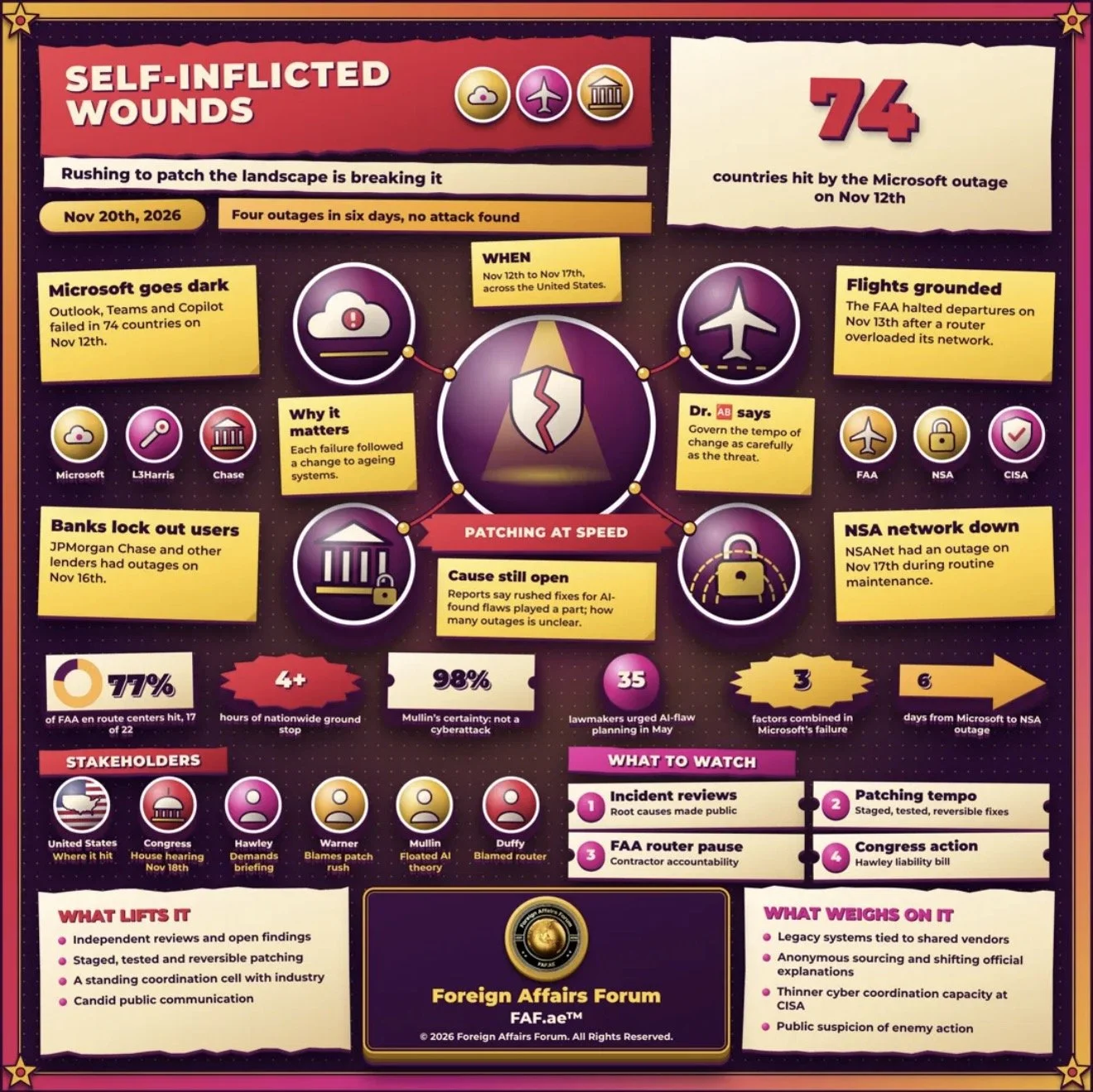
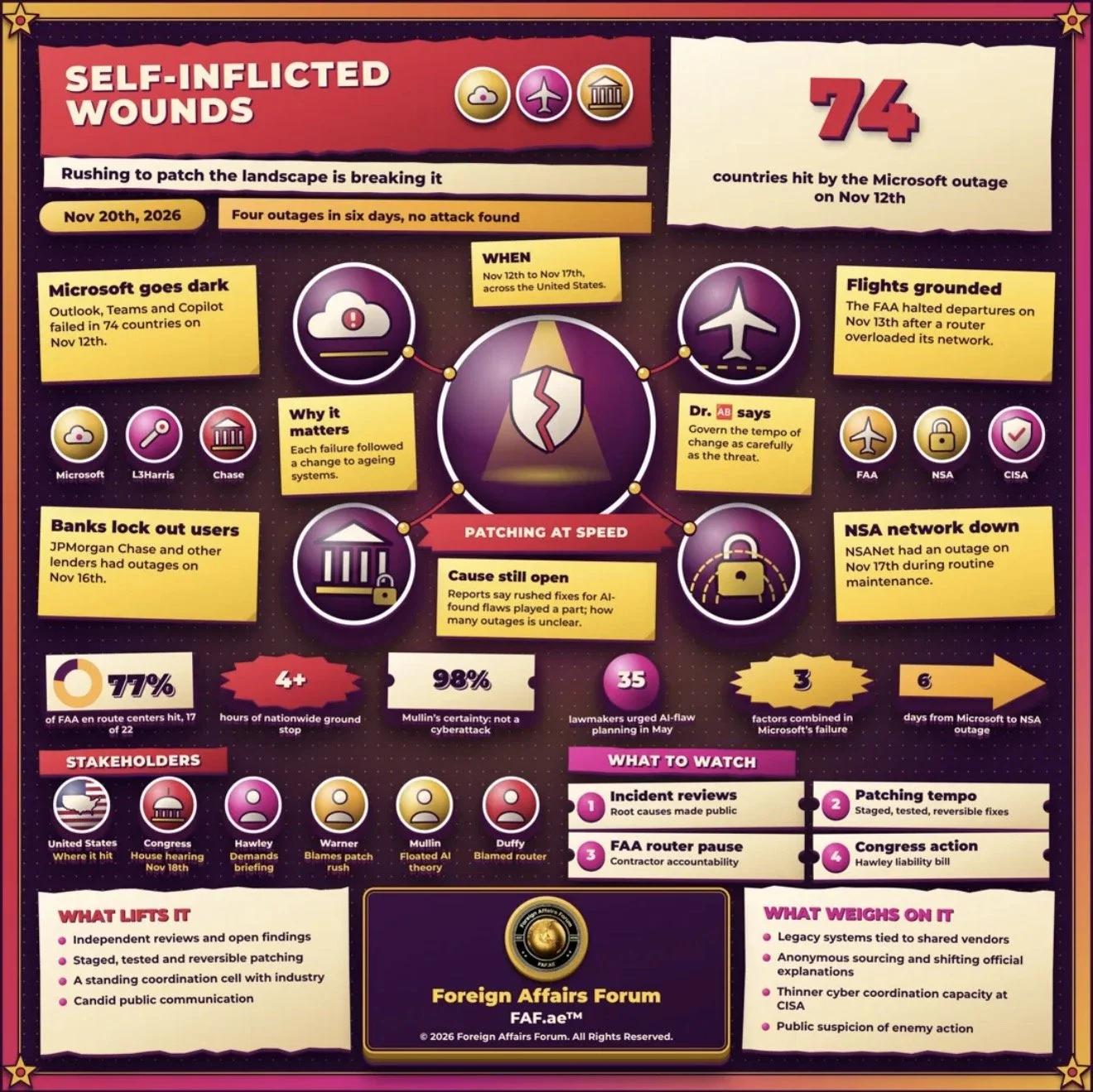
In just six days in November 2026, several important American systems stopped working. On Nov 12th, Microsoft services such as Outlook and Teams failed for people in 74 countries. On Nov 13th, the Federal Aviation Administration, or FAA, stopped all flights from taking off across the whole country. On Nov 16th, some big banks had problems, and customers could not use their accounts. On Nov 17th, a secret network inside the National Security Agency, or NSA, stopped working for a time.
Many people felt this could not be a coincidence. Senator Josh Hawley said that if it was all luck, it would be the greatest coincidence in history. He asked for the full Senate to be told what was going on.
Dr. 🆎, an expert on super intelligence, AI warfare and global strategy, says this reaction is natural, because people look for a single cause when many things break at once.
What Officials Say
So far, officials say they have found no sign of a cyberattack. Microsoft said the problem came from a network upgrade that left a hidden fault. Later, a Microsoft leader explained that three things combined: a flaw in a fix for some network servers, a problem left from an earlier upgrade and a sudden rise in demand.
The FAA said a router, which is a device that directs computer traffic, caused the flight stoppage. A company was replacing old copper cables with fiber cables at a remote site. A new router there sent so much data that it overloaded the network. The stoppage lasted more than four hours, and many flights were cancelled. The FAA has now paused installing new routers.
The NSA said its network had a temporary problem during planned maintenance. It said its most important work continued. Sources told reporters there was no sign of an attack. The banks said a software bug was behind their trouble.
The Strange Explanation From Washington
On Nov 16th, Markwayne Mullin, the Homeland Security Secretary, said the problems might come from AI that fixes its own code too fast. He said an expert in technology had told him this, but he did not name the person. He compared it to changing a house: when you change one part, other parts change too.
Many people found this idea unconvincing. Microsoft and the FAA said AI did not cause their outages.
Dr. 🆎 notes that a vague theory is not helpful when the public wants clear answers. Still, there was a more serious idea behind the comment, and it soon got more attention.
The Idea of Rushed Fixes
Some reports say that the NSA and bank leaders told Congress that rushed fixes caused some of the outages. These fixes were meant to close security holes that AI tools had found. Senator Mark Warner said that AI can now find weak points across huge numbers of systems very fast.
This idea makes sense. Think of a school that finds hundreds of broken windows, locks and doors in one week. If it tries to repair them all at once, with no careful planning, the repairs themselves may cause new problems. A computer system works in a similar way. A quick fix in one place can break something connected to it.
Not everyone agrees on how much this explains. The reports come partly from unnamed sources, and officials have not said how many outages were linked to rushed fixes. Per FAF analysis, the idea is possible and worth studying, but it is not yet fully proven.
Why Old Systems Make It Worse
Many American systems are old. Air traffic control still uses equipment designed many years ago. Banks use older software under their modern apps. Government networks have grown over decades. These systems work because experts know how to handle them carefully. When many changes happen quickly, hidden weaknesses can show up.
Another problem is that many organizations rely on the same few companies. If one large provider fails, many others fail too. That is why a Microsoft problem can affect banks, governments and courts in many countries. Some businesses even had to use fax machines to confirm trades.
Why Trust Matters
When people hear confident statements that later change, they begin to doubt everything. Some officials said there was no sign of an attack, but did not give a full explanation. Others gave theories without proof.
Dr. 🆎 says trust is slow to build and quick to lose, and that clear, honest information is as important as fixing the technical fault.
There is also a security risk. If a real attack happened, it might look like a normal technical problem at first. Enemies could use confusion to hide their actions or to spread false stories. That is why leaders need good ways to tell the difference between a failure and an attack.
What Should Happen Next
First, independent experts should study each outage and share their findings with the public and with Congress. Where information is secret, officials should still explain the main cause and the lessons.
Second, organizations should fix security holes in a careful order. The most dangerous problems should come first. Fixes should be tested before they reach important systems, and there should be a way to undo a bad fix quickly.
Third, the government needs enough skilled people to coordinate responses. Some leaders say cuts to the Cybersecurity and Infrastructure Security Agency, or CISA, have weakened this ability. A team that connects government, banks, technology companies and defenders could stop one sector's emergency fix from causing trouble in another.
Fourth, important organizations should avoid depending on one provider. They should have backup systems and practice using them. Fifth, America should work with its allies, share warning signs and agree on how to decide whether an event is an accident or an attack. Finally, any new laws about AI should aim at the real problem, which is how quickly and carefully changes are made, and should not only react to scary stories.
The Main Lesson
The evidence so far does not show that an enemy caused the outages. It shows something different and important: a country can hurt itself while trying to protect itself. The problem was not only old equipment or new AI. It was the speed of change in systems that depend on one another.
Dr. 🆎 believes the lesson is about wise leadership. The best leaders and organizations will be those who control the pace of change, protect the human skills that keep old systems safe, and tell the public the truth. Computers will keep getting more powerful, and they will keep finding weak points. The goal is to make sure the people and machines that repair those weak points move at a pace that makes the whole system stronger.