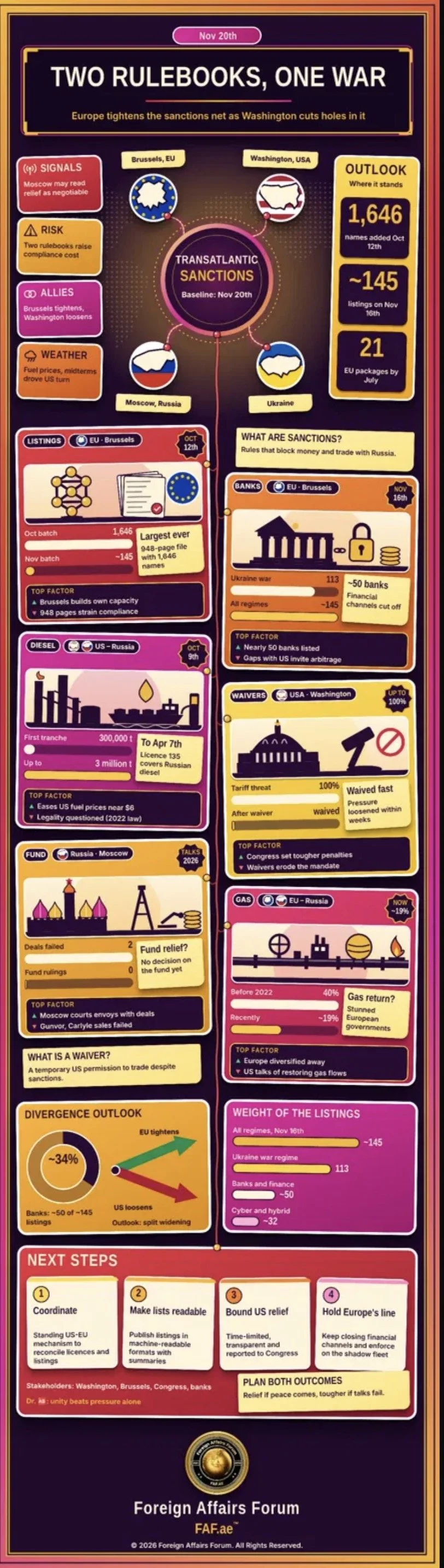
Two Rulebooks, One War: Europe Tightens the Sanctions Net as Washington Cuts Holes in It
Foreign Affairs Forum | Dr. Antonio Bhardwaj (Dr. 🆎)| Nov 20th, 2026
As Brussels blacklists Russian banks by the dozen and Washington trades waivers for diesel, the West's economic pressure on Moscow is splitting along the Atlantic
Executive Summary
The Western sanctions landscape against Russia is pulling in opposite directions.
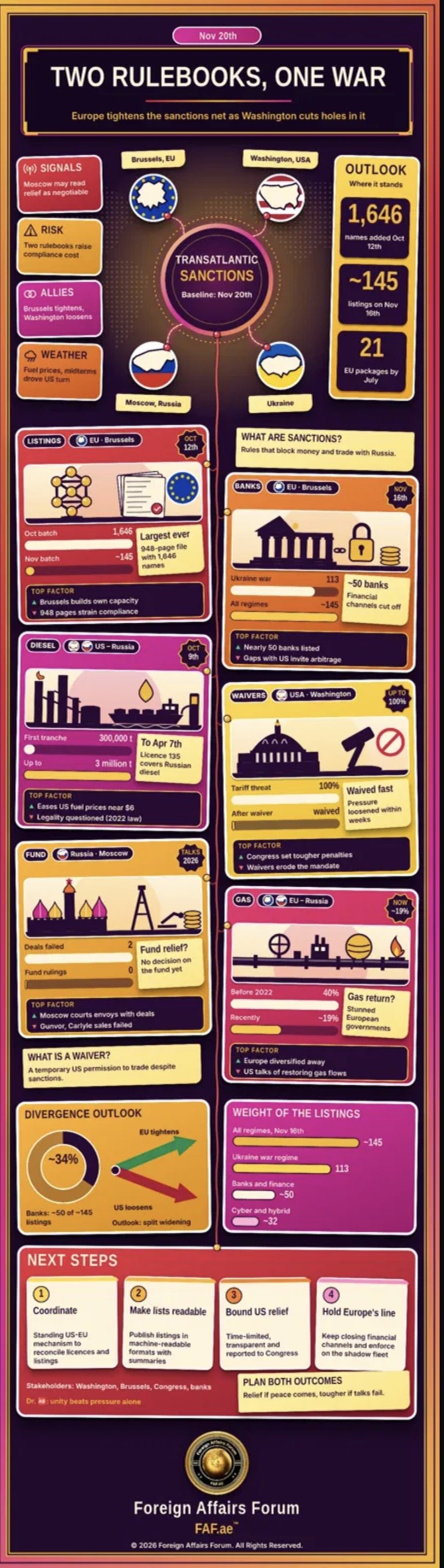
In Europe, the Council of the European Union adopted on Nov 16th a fresh set of listings that took in roughly 145 individuals and entities across several sanctions regimes, among them nearly 50 Russian banks and financial institutions, oil-sector companies and networks that support Russia's shadow fleet. Weeks earlier, European compliance officers had absorbed what was reported to be the bloc's largest single batch of listings, a 948-page document naming 1,646 Russia-linked people and firms. Brussels is escalating, and it is doing so at industrial scale.
Washington has moved the other way. On Oct 9th, weeks before the Nov 3rd midterm elections, President Donald Trump announced after a call with President Vladimir Putin that Russia would supply diesel to the American and global markets, and the Treasury Department's Office of Foreign Assets Control issued General License 135, authorizing Russian-origin diesel transactions through Apr 7th, 2027. Waivers of other Russia-related penalties followed. American officials have also discussed the sale of a Russian oil giant's international assets, the resumption of Russian gas sales to Europe and relief for Russia's sovereign wealth fund.
Per FAF analysis, the divergence is not an accident of timing. It reflects different vulnerabilities and different theories of leverage. A Europe that has largely severed its energy dependence and fears a negotiated settlement that leaves Russia strong is deepening financial pressure. An America confronting high fuel prices, a transactional presidency and an appetite for commercial rewards from Moscow is treating sanctions as bargaining chips. The consequence is a compliance burden, an evasion opportunity and a strategic signal, all arriving at once.
Dr. 🆎 argues that sanctions are ultimately a human-centered system of trust and predictability, and that machines will increasingly decide whether they work. A regime published in a 948-page file that automated tools struggle to parse, and then contradicted by an ally's waivers, invites exploitation by precisely the shadow networks it targets. This FAF article traces the history, dissects the developments, weighs the risks and sets out the steps that stakeholders on both sides of the Atlantic should take.
Introduction
Sanctions have been the signature instrument of Western policy toward Russia since 2014 and, far more intensively, since the full-scale invasion of Ukraine in 2022. Their power has always rested on two pillars: the size of the economies imposing them and the degree to which those economies act together. A restriction applied by one jurisdiction can be arbitraged through another, while a restriction applied by both leaves few places to hide. The coherence of the Atlantic alliance has therefore been as important as the content of any single measure.
That coherence is now under strain. Stephen Fallon, a former compliance chief who now advises banks, has observed that the European Union is running in front while President Trump, drawn by the Kremlin's promises of diplomatic and commercial rewards, is backtracking. The observation captures a reversal of the traditional order, in which Washington led and Brussels followed. It also captures a practical problem for every bank, trader and shipper that must now comply with two regimes whose direction of travel is no longer the same.
Dr. Antonio Bhardwaj (Dr. 🆎), a polymath with global expertise in super intelligence, human-centered approaches to geopolitical strategy, AI warfare and bioterrorism risk, has long warned that sanctions policy is becoming a contest of data and interpretation as much as of political will. In his assessment, the decisive questions are who can read, apply and enforce the rules fastest, and who can exploit the gaps between them. This FAF article examines the transatlantic split through that lens, moving from history and current status through key developments, latest facts and concerns, cause and effect, and future steps.
History and Current Status
For much of the 20th century and the early 21st, American primacy defined the sanctions landscape. Washington possessed the dollar system, the reach of its financial regulators and the willingness to use both. Europe, with its more fragmented decision-making and its dependence on Russian energy, generally followed American initiatives, sometimes reluctantly. The pattern held after Russia's annexation of Crimea in 2014, when coordinated but cautious measures were adopted, and it held in 2022, when the administration of Joe Biden built a coalition to hobble Russia's war effort in close partnership with European allies.
The interlude of divergence in 2018 is instructive. When President Trump withdrew from the Iran nuclear deal and reimposed sweeping American penalties, European governments objected, created workaround mechanisms and watched their companies retreat anyway for fear of American enforcement. The episode demonstrated that Washington could impose costs on allies as well as adversaries, and it left a lasting European determination to build its own sanctions capacity. That capacity has matured. By 2026 the European Union had adopted 21 packages against Russia, the most recent in July, alongside separate regimes covering hybrid threats and cyberattacks, and it had listed well over 100 Russian banks and financial institutions.
American policy in 2025 and 2026 has been less linear. In Oct 2025 Washington imposed sanctions on the oil giants Rosneft and Lukoil, a significant escalation intended to press Moscow toward a ceasefire. Yet the Trump administration also issued a series of waivers during 2026, partly in response to disruptions in oil markets linked to conflict in the Middle East, allowing transactions involving certain Russian oil cargoes already at sea. In Sept 2026, Congress passed and the president signed a sweeping Russia sanctions law that threatened tariffs of up to 100% on the largest importers of Russian oil and gas. Within weeks, the administration was loosening the very pressure the law was designed to intensify.
The current status, as of Nov 20th, is one of open divergence. The European Union has formal legal acts in force for its Nov 16th listings, published in its Official Journal, and has tied them to conclusions reached by the European Council in mid-October, which condemned Russian attacks on civilians and reaffirmed support for Ukraine. The United States, meanwhile, maintains a formal sanctions architecture while granting time-limited licenses that carve out diesel and enable negotiation over Lukoil's foreign assets. The two regimes are now in tension on energy, finance and diplomacy alike.
Key Developments
The first development was the European listing wave. Reporting indicates that on Oct 12th the bloc's foreign-policy arm circulated a 948-page document adding 1,646 Russia-linked people and firms, described as the largest single batch ever. Whatever the precise accounting, the direction was unmistakable. The document landed on compliance desks across the West as a practical burden before it was a political statement. Machines frequently struggle to read such formats, which means that firms must rely on human reviewers and specialized software to match names, spellings and corporate structures against their customer and counterparty data.
The second development was Washington's diesel deal. On the evening of Oct 9th, President Trump announced that, after a successful discussion with President Putin, Russia would immediately supply more than 300,000 tonnes of diesel to the American and global markets, followed by 500,000 tonnes in November and a million tonnes soon after, with up to 3 million tonnes possible depending on the condition of Russian refineries. Minutes later the Treasury issued General License 135. The context was a fuel-price squeeze, with American diesel reportedly near $6 a gallon, Russian refineries damaged by Ukrainian strikes and supply disrupted by conflict in the Gulf.
The third development was the cascade of related waivers. After the diesel license, the administration waived Russia-related penalties under the Lindsey Graham sanctions law, as well as tariffs that would have targeted major importers of Russian energy. Critics questioned the legality of the diesel authorization in light of a 2022 statute banning imports of Russian energy products, and lawmakers wrote to banks asking them to preserve records related to the imports. Representative Don Bacon, a Republican, argued that it was time to apply the new sanctions Congress had passed, not to lift pressure. The sequence showed how quickly a legislative mandate for toughness can be eroded by executive discretion.
The fourth development came on Nov 16th, when the Council of the European Union formally adopted the latest listings. Under the regime addressing actions that undermine Ukraine's territorial integrity, the Council designated 12 individuals and 101 entities, including nearly 50 Russian banks and financial institutions, as well as companies in the oil sector and networks supporting the shadow fleet. Further designations under the hybrid-threat and cyber regimes brought the total to about 145, and the cyber measures named the pro-Russian hacking group NoName057(16). Reporting also indicated that Russia's richest woman was among those listed, underscoring that the net now reaches prominent commercial figures.
The fifth development was the trail of American discussions with Moscow. Reporting indicates that officials have considered the sale of Lukoil's international assets, which the company has sought to divest since it was sanctioned. Earlier deals with the trader Gunvor and the investment firm Carlyle failed, and Treasury has repeatedly extended licenses permitting negotiation while reserving the right to approve any transaction. Officials have also discussed the resumption of Russian gas sales to Europe, including a proposal that stunned European governments, and the Trump administration has reviewed a request to remove the Russian Direct Investment Fund from the sanctions list.
The sixth development concerns the Kremlin's own strategy. Kirill Dmitriev, who heads the Russian Direct Investment Fund and serves as President Putin's envoy to Washington, has courted American envoys with promises of commercial opportunity, including joint energy ventures. Reporting indicates that he boasted the diesel deal was a concrete example persuading Americans that sanctions are philosophically wrong. The fund had also reportedly proposed serving as an intermediary for payments for Russian diesel while simultaneously seeking relief for itself. The pattern reveals a coherent Russian objective: to convert diplomatic access into the dismantling of financial restrictions.
Latest Facts and Concerns
The facts now firmly established are these. The European Union adopted large new listings on Nov 16th, targeting banks, energy-sector companies and shadow-fleet networks, and published the legal acts. The United States issued a license allowing Russian diesel transactions through Apr 7th, 2027, and has waived related penalties. American officials have discussed further concessions, though no decision on the sovereign wealth fund has been announced and the gas proposals remain under discussion. Several details, including the precise scale of the October European batch and the full roster of the November listings, are drawn from press accounts and should be treated with appropriate caution.
The first concern is compliance fragmentation. Financial institutions operating on both sides of the Atlantic must now reconcile obligations that diverge. A transaction that is prohibited in Brussels may be licensed in Washington, and the reverse may follow as waivers expire or are revised. Because the American licenses are temporary and politically contingent, large institutions are reluctant to rely on them, a point analysts have stressed. The practical effect is higher legal risk, greater cost and more conservative behavior, which dilutes the relief Washington intends to provide while multiplying the burden Brussels imposes.
The second concern is evasion arbitrage. Sanctions function by closing options. When one jurisdiction loosens and another tightens, intermediaries gain room to route transactions through the more permissive channel, and the shadow fleet and its financiers benefit from ambiguity.
Dr. 🆎 observes that adversaries rarely need to defeat a sanctions regime outright. They need only identify the seams between its parts, and the transatlantic split has just created a very long seam. Artificial intelligence amplifies the problem, since automated tools can generate corporate structures, vary names and test enforcement thresholds at a speed no human compliance team can match.
The third concern is strategic signalling. Moscow reads the diesel deal, the discussions of asset sales and the review of the fund's status as evidence that American pressure is negotiable. That reading may harden Russian bargaining positions in talks over Ukraine, reduce the incentive to compromise and encourage the expectation that further relief can be extracted by diplomacy rather than by concessions on the battlefield. European governments, by contrast, fear that a settlement negotiated over their heads could leave Russia strong and Europe exposed, which explains their determination to lock in pressure while they still can.
The fourth concern is legal and institutional. The diesel license sits uneasily with a statute banning Russian energy imports, and its tension with the new sanctions law raises questions about congressional intent and executive authority. Bipartisan unease on Capitol Hill suggests that the relaxation may face challenge. At the same time, the gas proposals strike at the core of European energy security. Russian gas supplied about 40% of the continent's demand before 2022 and, by reported estimates, roughly 19% more recently, a decline Europe has fought hard to sustain. Any American role in restoring flows would collide with European strategy.
The fifth concern is the credibility of the alliance itself. The United States has historically led by example, and its allies have followed in part because they trusted that commitments would endure. When Washington lifts penalties on a timetable shaped by fuel prices and elections, partners recalculate. Some may conclude that they must build autonomous capacity, while others may hedge by easing their own measures.
Dr. 🆎 cautions that the erosion of predictability is itself a strategic cost, since sanctions depend on the expectation that they will persist long enough to change behavior.
Cause-and-Effect Analysis
The causal chain begins with energy. Disruptions in oil markets, damage to Russian refineries and a surge in American diesel prices created acute political pressure on the White House ahead of the midterms. The administration responded with the instrument at hand, trading sanctions relief for supply. The effect was a direct reversal of pressure on Russian energy exports at precisely the moment when Europe was intensifying it. Energy politics, not strategic reassessment, produced the divergence, which is why it may prove reversible if prices ease and may prove durable if they do not.
A second chain runs from diplomacy to concessions. President Trump has been drawn to the prospect of a deal that would end the war and open commercial opportunities, and the Kremlin has cultivated that hope with offers of business and access. Each concession, from diesel to asset sales to the fund, is presented as a step toward peace and a down payment on future rewards. The effect is a process in which Washington spends leverage in advance, while Moscow retains the option of withholding the reciprocal steps. Per FAF analysis, the asymmetry is the central weakness of the American approach.
A third chain concerns European resolve. Fearing that American relaxation could unravel the broader pressure campaign, Brussels has accelerated. The 21st package in July, the cyber measures, the October batch and the November listings together form a deliberate attempt to build a structure that survives shifts in American policy. The effect is a Europe that is not merely following but legislating independently, with banks as the principal target. Closing financial channels is meant to constrain how Russia processes state revenues, a vulnerability that cannot be offset easily by diesel waivers.
A fourth chain links complexity to enforcement. A listing of 948 pages with more than 1,600 names is difficult to apply, and the number of potential evaders grows faster than the capacity to track them. Compliance relies on name matching, ownership analysis and transaction monitoring, all of which are strained by volume. The effect is that large listings can generate more friction for law-abiding firms than for determined evaders.
Dr. 🆎 argues that human-centered design, meaning machine-readable formats, clear guidance and rapid updates, is as important to effectiveness as the size of the list.
A fifth chain connects divergence to arbitrage. As Washington licenses activities that Brussels forbids, financial intermediaries and trading houses in third countries gain commercial incentives to serve the sanctioned flow. The shadow fleet, long a feature of Russian oil exports, benefits from every grey area. The effect is not merely leakage but normalization: if one half of the West treats a commodity as tradable, the stigma that deters counterparties weakens. Over time, that dynamic rewards the stakeholders most willing to operate in ambiguity.
A final chain runs through domestic politics on both sides. In Washington, Congress has passed legislation that constrains the executive in principle but leaves wide room for waivers in practice, and bipartisan criticism of the diesel deal indicates potential for pushback. In Europe, unanimity requirements and national sensitivities make each package hard-fought, yet the cumulative momentum has been strong. The effect is an uncertain equilibrium in which the direction of the Atlantic split depends on whether American legislators assert themselves and whether European governments sustain unity under economic strain.
Future Steps
The first step is to restore a minimum of transatlantic coordination. Washington and Brussels should establish a standing mechanism, at the level of senior officials and with technical staff, to reconcile licensing decisions and listings, share enforcement intelligence and announce changes in a synchronized way. Even where policies differ, predictability can be preserved if allies are consulted in advance.
Dr. 🆎 recommends that any American relief be conditioned on verifiable Russian steps and communicated to European partners before announcement, since surprise undermines the trust on which collective pressure depends.
The second step is to make sanctions machine-readable and navigable. Both jurisdictions should publish listings in structured, standardized formats with consistent identifiers, alongside human-readable summaries and frequently asked questions. The 948-page document that reached compliance desks in October illustrates the cost of neglecting usability. Better formats would reduce error, speed implementation and narrow the room for exploitation. They would also allow compliance tools, including those using artificial intelligence, to function reliably, with human oversight retained for ambiguous cases.
The third step is to keep American concessions bounded, transparent and reversible. If the administration pursues the diesel arrangement or the Lukoil asset sale, it should confine relief to specific, time-limited licenses with clear conditions, public reporting to Congress and automatic expiry. Proposals to delist the Russian Direct Investment Fund or to facilitate gas flows to Europe deserve particular scrutiny, because they would be difficult to reverse and would directly affect allies. Congressional oversight should insist that relief be traded for verifiable steps toward a ceasefire, not for promises of commercial opportunity.
The fourth step is to defend European energy security and financial pressure. The European Union should continue to close financial channels, enforce its measures against the shadow fleet and strengthen its anti-circumvention tools, including scrutiny of third-country intermediaries. It should also make clear that it will not accept the resumption of Russian gas on terms negotiated elsewhere, and should accelerate diversification so that its leverage does not depend on American policy. A Europe that can sustain pressure autonomously is less vulnerable to shifts in Washington.
The fifth step is to invest in enforcement capacity and technology. Governments should fund teams capable of analyzing ownership networks, shipping patterns and financial flows, and should equip them with advanced analytical tools. Cooperation with banks, insurers and shipping registries, and with allies beyond the Atlantic, would strengthen the net.
Dr. 🆎 emphasizes that adversaries will use artificial intelligence to design evasion, so defenders must use it to detect evasion, while keeping accountable human judgment at the center of decisions to list, license and penalize.
The sixth step is to prepare for scenarios. If the Ukraine talks progress, sanctions relief will become a central bargaining issue, and allies should agree in advance on sequencing, verification and snap-back provisions. If talks fail, they should be ready to intensify in unison. In both cases, clear criteria linking relief to behavior would reduce the temptation to improvise under political pressure. A shared playbook would also deprive Moscow of the opportunity to play capitals against one another.
Conclusion: Pressure Without Unity Is Only Friction
Sanctions succeed when they are credible, coordinated and persistent. The events of recent weeks show a West that is credible in Brussels, conditional in Washington and therefore uncoordinated across the Atlantic. Europe's large listings, including the Nov 16th designation of nearly 50 Russian banks, reflect a determined effort to cut the financial channels that sustain the war. America's diesel license and discussion of further concessions reflect a different calculation, shaped by fuel prices, electoral politics and the pursuit of a deal.
The risk is not simply that one approach is right and the other wrong. It is that the combination produces the worst of both: compliance burdens without commensurate pressure, and concessions without commensurate gains. Moscow benefits from the seams, the shadow fleet profits from the ambiguity, and allies lose confidence in one another. Per FAF analysis, the surest way to squander the leverage the West has built since 2022 is to let it be traded away piecemeal, without a shared strategy and without verifiable reciprocity.
Dr. 🆎 frames the challenge as one of stewardship. The stakeholders who will shape the next phase are those who treat sanctions as a human-centered system that must be coherent, readable and enforceable, and who recognize that machines, for good and ill, will increasingly determine its effectiveness. Whether Washington and Brussels can realign will help decide not only the course of the war in Ukraine but also the credibility of economic statecraft as an instrument of Western power in the decades ahead.