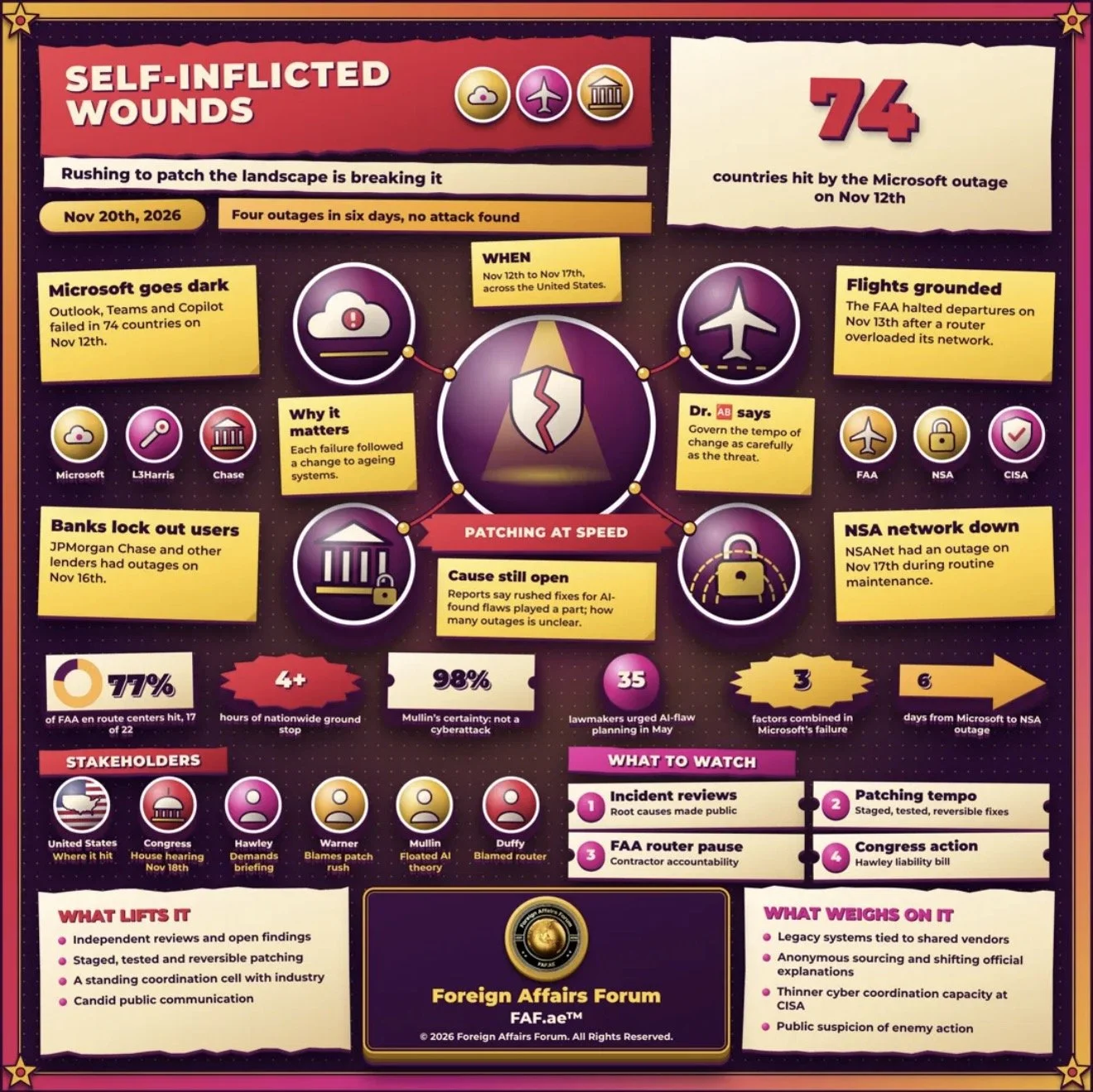
Self-Inflicted Wounds: How America's Race to Patch Its Digital Landscape Is Breaking It
Foreign Affairs Forum | Dr. Antonio Bhardwaj (Dr. 🆎)| Nov 20th, 2026
A week of grounded flights, frozen bank accounts and a silenced intelligence network suggests that the gravest threat to American infrastructure may be the speed of its own defence
Executive Summary
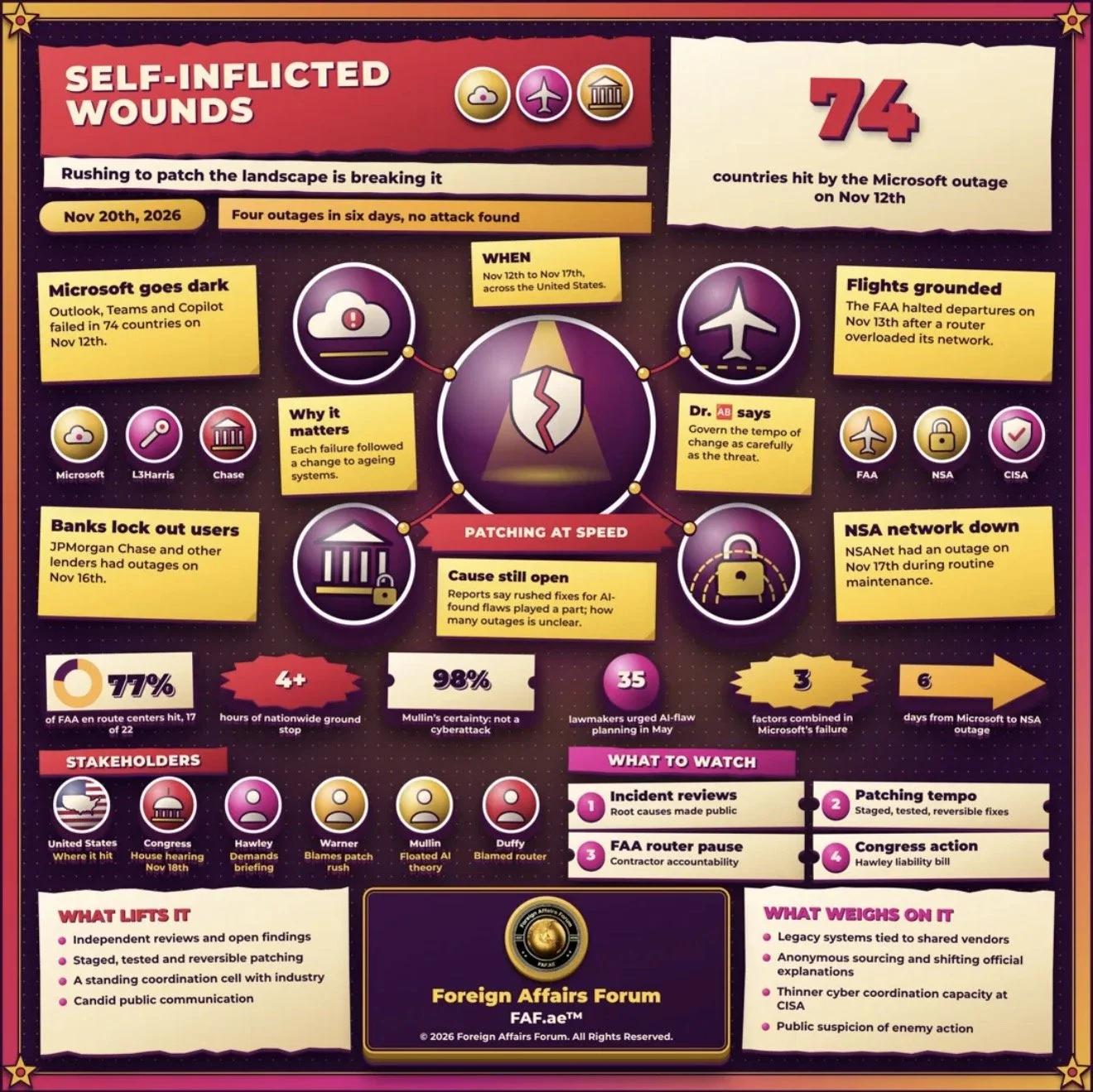
Between Nov 12th and Nov 17th, 2026, the United States endured a rapid sequence of technological failures. A Microsoft 365 outage on Nov 12th reached users in 74 countries and knocked out Outlook, Teams and Copilot.
On Nov 13th the Federal Aviation Administration ordered a nationwide ground stop, the longest in a quarter of a century, after communications instability spread across 17 of its 22 en route air traffic control centers. On Nov 16th JPMorgan Chase and other big lenders reported disruptions that locked customers out of accounts, and on Nov 17th the National Security Agency confirmed that its classified internal network had suffered an outage. Suspicion of enemy action followed almost instantly.
Officials have so far found no evidence of a cyberattack. Microsoft attributed its failure to a fault left behind by an earlier network capacity upgrade and exposed by a later change. The FAA pointed to a router that overwhelmed its network during a copper-to-fiber upgrade carried out by a contractor. The National Security Agency described a temporary degradation during scheduled maintenance. Per FAF analysis, the pattern that emerges is not a single hostile hand but a shared condition: each failure followed deliberate change to ageing, tightly coupled systems.
A further explanation has gathered force in Washington. Reports that the National Security Agency and Wall Street executives told Congress that rushed fixes for vulnerabilities discovered by artificial intelligence contributed to the instability have been echoed publicly by Senator Mark Warner. How many of the disruptions can be tied to this mechanism remains unclear, and the claim rests partly on anonymous sources. The logic, however, is coherent: when machines find flaws faster than institutions can safely repair them, defence itself becomes a source of risk.
Dr. 🆎 argues that the episode should be read as a lesson in human-centered resilience rather than a mystery to be solved by blame. The stakeholders who will fare best in the coming decade are those who govern the tempo of change as carefully as they govern the threat. This FAF article traces the history, dissects the developments, weighs the evidence and sets out the steps that Washington, industry and allies should now take.
Introduction
In Ian Fleming's novel, Goldfinger tells James Bond that once is happenstance, twice is coincidence and the third time is enemy action. That maxim has been invoked by many Americans in recent days, and understandably so. When an email platform, an air traffic network, several banks and a signals-intelligence agency falter within six days, the instinct to search for a single author is deeply human. Senator Josh Hawley gave that instinct a political voice on Nov 17th, demanding that the full Senate be briefed and describing the sequence as, if coincidence, the greatest in the history of the world.
Dr. Antonio Bhardwaj (Dr. 🆎), a polymath with global expertise in super intelligence, human-centered approaches to geopolitical strategy, AI warfare and bioterrorism risk, has long cautioned that complex societies are prone to two opposite errors when their systems fail. One is complacency, which dismisses patterns as noise. The other is conspiracy, which reads every failure as an attack. Both errors, he has argued, delay the harder work of understanding how modern infrastructure actually breaks.
This FAF article examines the November disruptions through that lens. It reconstructs what is known about each event, separates confirmed facts from reported claims, and evaluates the most consequential hypothesis now circulating: that frenzied preparations against AI-enabled cyberattack are creating their own hazards. The analysis proceeds from history and current status to key developments, latest facts and concerns, cause and effect, and finally the future steps that follow from the evidence.
History and Current Status
American digital infrastructure is a palimpsest. Air traffic control still relies on communications and surveillance equipment whose design dates to the 20th century, and the FAA has for years been replacing copper lines with fiber while contending with controller shortages and equipment failures. Banks run core processing on legacy platforms layered beneath modern interfaces. Even the most advanced agencies depend on networks that accumulate patches, workarounds and dependencies faster than anyone can document them. Such systems function because experienced engineers know which changes are safe, and they are fragile precisely when change is hurried.
Recent years have supplied warnings. The FAA grounded departures nationwide in 2023 after an outage in the system that sends safety messages to pilots, and until this month that was the only such stoppage since the attacks of Sept 11th, 2001. Cloud providers suffered high-profile disruptions in 2025, none of them security incidents. Microsoft itself had endured a days-long authentication failure in Sept 2026, making November the second major Microsoft 365 outage of the year. The lesson, available to anyone who looked, was that concentration and complexity create systemic exposure even without an adversary.
Superimposed on this fragile base is a new accelerant. In April 2026 the release of Anthropic's Claude Mythos Preview, a frontier model with striking capacity to discover software vulnerabilities, alarmed financial regulators. Access was restricted to a small group of organizations under Project Glasswing, and the Federal Reserve convened emergency meetings with bank chief executives. Senator Warner later testified that the National Security Agency had told him a model of this class identified vulnerabilities in nearly all classified systems within hours during a controlled exercise. In May, 35 lawmakers urged the White House to prepare for a surge of AI-generated vulnerability disclosures.
The current status, as of Nov 20th, is one of heightened anxiety and incomplete explanation. Services have largely been restored. The FAA has halted installation of new routers while the FBI's cyber teams assist investigators. Congressional hearings have begun, and administration witnesses at a House Homeland Security Committee hearing on Nov 18th repeatedly cited patching rather than hacking. No official has yet published a unified account linking the incidents, and none has demonstrated that they are connected beyond the shared pressure of change.
Key Developments
The first development was the Microsoft outage. Beginning on the afternoon of Nov 12th, users in the Americas reported failures in Exchange Online that spread to Outlook, Teams, SharePoint and Copilot, with reports eventually arriving from 74 countries and territories. Microsoft said at the outset that the disruption was not a cyberattack, and recovery proved slow, with the company reporting only marginal success more than 12 hours in and full restoration arriving by Nov 14th. Businesses reportedly fell back on fax machines to confirm trades. Banks, governments and courts were affected, underlining how a single provider's failure propagates into the wider economy.
Microsoft's later explanation was instructive. An executive described a cascading failure with three contributing elements: a latent defect traced to a fix prepared specifically for networking gateway servers, a fault left behind by an earlier capacity upgrade, and a surge in load that exposed the weakness once a later network change arrived. Per FAF analysis, the account is significant less for its technical detail than for its structure. Individually, none of the three factors would have caused a global failure. Their conjunction did, which is the signature of tightly coupled systems under change.
The second development was the air traffic stoppage. At about 3:36 p.m. Eastern time on Nov 13th, communications among air traffic control facilities showed what Transportation Secretary Sean Duffy called instability. The FAA grounded all departing flights nationwide, with the stoppage lifted at 8:19 p.m. Instability reached 17 of the 22 en route centers, though some radar feeds and frequencies remained available and all aircraft in the air landed safely. Estimates of cancellations vary widely, from several thousand to nearly 20,000 as airlines worked through the weekend, but the scale and rarity of the event were unmistakable.
The preliminary cause, offered by Duffy and later by the FAA, was mundane. A contractor, L3Harris, was replacing a section of copper wiring with fiber at a remote site, and a newly installed router began flooding the network with connection attempts until switches and routers overloaded. The FAA has since halted installation of new routers, and investigators are examining whether installer error or faulty equipment was responsible. Duffy acknowledged that the network did not lose all telecommunications or all radar, and that the ground stop reflected an abundance of caution. The episode illustrates how a routine modernization step can imperil a national system.
The third development unfolded on Nov 16th. JPMorgan Chase reported a software problem that locked customers out of accounts and appeared to affect other large lenders, with Wells Fargo and Bank of America reportedly among them, and United Airlines told passengers of a widespread system outage on the same day. Chase attributed its disruption to a software bug. The cluster fed a growing public perception that failures in finance, aviation and technology were connected. Because banks depend on shared vendors, common software and interlinked payment rails, a single flaw or a single rushed update can spread across institutions that compete in the marketplace but share infrastructure beneath it.
The fourth development, on Nov 17th, was the most politically charged. The National Security Agency's classified internal network, known as NSANet, experienced an intermittent outage that disrupted work and prompted staggered arrivals at the agency's Maryland headquarters. A US official described a temporary degradation during regularly scheduled maintenance, and the agency said its critical capabilities remained fully operational with multiple layers of redundancy. Sources told reporters there was no evidence of a cyberattack, and urgent intelligence communications could be carried on alternative secure systems. Yet an intelligence agency's own network failing in the same week as civilian systems naturally sharpened public anxiety.
The fifth development was the rhetoric. On Nov 16th Homeland Security Secretary Markwayne Mullin suggested on Fox News that the outages might have been caused by self-fixing AI rewriting its own code too quickly, a theory he attributed to one very smart person in technology, whom he did not name. He compared the process to a change order on a house, in which altering one element alters everything else. He later told CNBC that he was 98% certain a cyberattack was not responsible and that more outages might occur as new technology is layered on old systems. Microsoft and the FAA rejected AI as the cause of their own failures.
The sixth development was a more credible and more consequential claim. The Washington Sun reported, citing anonymous sources, that the National Security Agency and Wall Street executives told members of Congress that this week's outages stemmed from rushed fixes for flaws discovered by AI models that banks and agencies now employ on their own systems. Senator Warner, the senior Democrat on the Senate Intelligence Committee, publicly made the same case, writing that AI is making it possible to identify vulnerabilities across enormous numbers of systems at unprecedented speed. Cyber specialists have described a growing consensus, while cautioning that it is unclear how many disruptions can be directly attributed to the mechanism.
Latest Facts and Concerns
Several facts are now reasonably firm. No official has presented evidence of a cyberattack behind any of the four principal disruptions, and several have stated the opposite. Microsoft has publicly described a chain of technical causes. The FAA and the Transportation Department have identified a router fault during a fiber upgrade. The National Security Agency has acknowledged an outage connected to maintenance. These claims have not been independently audited, and post-incident reviews remain incomplete, but they are consistent with one another in an important respect: each locates the proximate cause in change management rather than in hostile intrusion.
The first concern is therefore epistemic. The administration's explanations have been inconsistent in tone and quality. A secretary's reliance on an anonymous adviser, and the vague invocation of AI that rewrites itself, invited ridicule and obscured the more defensible patch-pressure thesis. Meanwhile, the credible account rests on anonymous briefings and a single outlet's reporting. A public that hears confident assurances, followed by shifting rationales, will reasonably discount both. Per FAF analysis, the damage to trust may prove more durable than the damage to systems, because credibility is slower to restore than service.
The second concern is the tempo of vulnerability management. Traditional patching cycles assume that discovery is the bottleneck and remediation can follow at a measured pace. Frontier models invert that assumption. When a model can surface thousands of flaws in days, organizations face a queue they cannot clear safely, and the temptation is to accelerate testing, shorten maintenance windows and deploy fixes under pressure. Warner's own statement acknowledges that the breakneck pace of recent patching is vital to security even as it may produce more frequent outages. The trade-off is genuine, not rhetorical.
The third concern is institutional capacity. Critics, including Warner, have noted that reductions at the Cybersecurity and Infrastructure Security Agency have weakened the expertise needed to coordinate responses across sectors. Coordination is precisely what a patch surge demands: sequencing updates across interdependent systems, sharing indicators, validating fixes before wide deployment and communicating clearly to the public.
Dr. 🆎 observes that resilience is a human-centered capability as much as a technical one, because the people who understand how legacy systems fail are scarce, expensive and not easily replaced by automation.
The fourth concern is strategic exposure. Even if the November failures were innocent, their pattern reveals a landscape in which accidental failure and hostile attack are hard to distinguish in real time. Adversaries need not cause outages to benefit from them. They can observe response times, probe weaknesses revealed by recovery and exploit public confusion. The simultaneous degradation of an intelligence network and civilian systems, even if coincidental, shows how a coordinated campaign could be masked as technical noise.
Dr. 🆎 warns that AI warfare will exploit exactly this ambiguity, and that the same ambiguity could be weaponized for disinformation.
The fifth concern is political. Hawley has used the episode to press for AI regulation, announcing legislation that would make developers liable for reckless design and users for reckless deployment, and he earlier chaired a hearing on rogue AI agent attacks. Others in his party emphasize the need to outcompete China in AI. The outages have thus become ammunition in a broader contest over how fast America should build and deploy powerful systems. That contest is legitimate, but it risks being decided by narrative rather than evidence if the investigations remain opaque.
Cause-and-Effect Analysis
The causal structure begins with accumulated technical debt. Legacy systems, ageing communications equipment and deeply interdependent software create an environment in which small changes can have disproportionate effects. This is the foundation on which every other cause operates. Without it, a rushed patch or a misconfigured router would be a nuisance. With it, such events become systemic. The effect is a landscape of latent fragility, in which the probability of a cascading failure rises with the number and speed of changes introduced.
A second causal chain runs from AI-enabled discovery to patch pressure. Frontier models identify vulnerabilities at scale, regulators and legislators demand rapid remediation, and institutions that fear being the next victim accelerate. The effect is a compression of the safe testing window. Fixes that would once have been staged over weeks are deployed in days, and the conditions that Microsoft described, a latent defect combined with a surge of load, become more likely. Per FAF analysis, the irony is stark: the more effectively AI exposes weaknesses, the more disruptive well-intentioned repair becomes unless institutions adapt their processes.
A third chain connects concentration to contagion. A handful of cloud providers, vendors and network operators underpin banking, government and commerce. A failure at one node therefore cascades outward, as the Microsoft outage demonstrated across 74 countries and as the bank disruptions suggested across institutions sharing common infrastructure. The effect is that diversification at the surface, many banks, many airlines, many agencies, masks concentration beneath. Resilience planning that treats each institution in isolation will consistently underestimate the correlated risk.
A fourth chain concerns communication and trust. Because failures occur in public, and because the first official statements often reassure rather than inform, speculation fills the vacuum. The Mullin episode shows how an offhand theory can distort the debate, while the more substantive patch thesis surfaces through leaks. The effect is that citizens, markets and adversaries receive mixed signals. Markets may price risk inaccurately, adversaries may infer weakness, and citizens may conclude that officials are either incompetent or concealing something. Neither conclusion serves national security.
A fifth chain runs from institutional erosion to slower recovery. Reduced staffing at cyber coordination bodies, contractor dependence in critical modernization projects and the loss of senior engineers all lengthen the time needed to diagnose and repair. The FAA's reliance on a contractor for a delicate migration, and the open question whether installer error or faulty equipment caused the failure, exemplify the accountability gaps that arise.
Dr. 🆎 argues that outsourcing execution without retaining deep internal expertise leaves agencies unable to challenge, verify or reverse the work performed on their behalf.
Finally, the chain closes on policy. Each outage strengthens arguments for regulation, for speed or for restraint, depending on the speaker. If AI-driven patching is indeed implicated, the effect may be to reinforce the case for governance of AI cyber capabilities, including controlled access, disclosure coordination and liability. If hasty regulation follows, it could constrain defensive uses of AI just when they are most needed. The causal lesson is that policy responses must target the mechanism, the tempo and coordination of change, rather than the technology label.
Future Steps
The first step is to establish an authoritative, public account. The administration should commission independent post-incident reviews of each major disruption, publish findings on a fixed timetable and brief Congress in a form that distinguishes confirmed facts from working hypotheses. Where classified information limits disclosure, unclassified summaries should still identify root causes and corrective actions.
Dr. 🆎 recommends that such reviews be led by technical experts with no stake in the outcome, because credibility depends on independence as much as on accuracy.
The second step is to govern the tempo of patching. Organizations operating critical systems should adopt tiered remediation that prioritizes the vulnerabilities most likely to be exploited, stages deployment through representative test environments and uses rollback capability as a standard control. Regulators should accept that a managed delay in lower-risk fixes can be preferable to a hasty deployment, and should avoid imposing deadlines that incentivize recklessness. The objective is not to slow security but to ensure that fixes arrive in a form systems can absorb.
The third step is to rebuild coordination capacity. The Cybersecurity and Infrastructure Security Agency and sector regulators need the personnel and authority to manage a surge of AI-generated disclosures, including deduplication, verification and sequencing across interdependent sectors. The 35 lawmakers who wrote to the White House in May asked for precisely this kind of strategy. Implementation has lagged the warning. A standing coordination cell linking government, financial institutions, cloud providers and trusted defenders would reduce the chance that one sector's emergency fix becomes another's outage.
The fourth step is to reduce concentration risk. Financial institutions, airlines and agencies should map dependencies on shared vendors and cloud platforms, require demonstrated failover to independent alternatives and test those alternatives under realistic conditions. The fax machines that some firms reportedly used during the Microsoft outage are a reminder that manual fallback has value. For air traffic control, the FAA's pause on new routers should be accompanied by a transparent modernization plan that sets clear contractor accountability and independent verification of each migration stage.
The fifth step is to address the strategic dimension with allies. A coordinated disruption campaign could be hidden among accidental failures, so Washington should share indicators with partners, rehearse joint responses to ambiguous incidents and agree on attribution standards that avoid both premature accusation and prolonged denial.
Dr. 🆎 emphasizes that preparations for AI warfare must include protocols for distinguishing malfunction from attack, since the cost of misjudgment is escalation in one direction and vulnerability in the other. Allied governments also face the same patch surge and would benefit from shared practice.
The sixth step is to craft proportionate policy on AI cyber capabilities. Measures such as controlled access to the most capable vulnerability-finding models, structured disclosure channels and clear liability rules deserve serious consideration, but they should be designed with defenders in mind. Legislation that responds to the narrative of rogue machines, without addressing the operational question of how institutions absorb discovered vulnerabilities, would miss the mechanism that the evidence points to. Congress should hear technical testimony from operators who manage patching, not only from advocates on either side of the AI debate.
Conclusion: Resilience Is the Real Frontier of Cyber Defence
The November disruptions did not, on the available evidence, constitute enemy action in the sense Goldfinger meant. They were instead something more instructive: a demonstration that a society can injure itself while striving to protect itself. Microsoft's cascading failure, the FAA's overloaded network, the banking glitches and the National Security Agency's maintenance-related outage differ in detail yet share a theme. Each involved change to complex, ageing and interdependent systems, and each exposed how little slack those systems retain.
The more provocative claim, that AI-driven vulnerability discovery is accelerating patching beyond the capacity of institutions to manage it, remains partly unproven. It rests on anonymous briefings, on the public statements of a senior senator and on the consistent pattern of the incidents. It deserves rigorous investigation, not dismissal or exaggeration. If confirmed, it implies that cyber defence in the AI era will be judged less by how quickly flaws are found than by how safely they are fixed.
Dr. 🆎 frames the point as a question of stewardship. The stakeholders who will prove most resilient are those who treat tempo as a variable to be governed, invest in the human expertise that keeps legacy systems intact and communicate with a candour that earns public trust. America's digital landscape will not become less complex, and the machines that probe it will not slow down. The decisive task is to ensure that its defenders, human and artificial, move at a pace that strengthens the system rather than breaking it.