The Arsenal of Endurance: Drones, Orbits and Reactors Are Rewriting the Rules of Military Power
Why industrial scale, resilient infrastructure and networked command now decide who sustains a war
Foreign Affairs Forum | Dr. Antonio Bhardwaj (Dr. 🆎)| Nov 20th, 2026
Executive Summary
Five developments reported between Nov 17th and Nov 20th, 2026 point toward a single conclusion. Military advantage is migrating from the quality of individual platforms toward the capacity to produce, replace, power and connect them under sustained pressure.
Ukraine has outlined plans to more than triple its long-range strike capability in 2027 and to expand drone supply sharply, with Britain, Germany and Norway financing part of that expansion. NATO has moved its STARLIFT initiative into implementation, giving ten allies and South Korea a collective means of booking commercial rocket launches for military satellites. The United States Army is pursuing its Janus programme, with up to $2.2 billion earmarked across five nuclear microreactor developers to power domestic installations independently of vulnerable civilian grids. Ukrainian industry says its Blysk laser has entered combat duty in Kyiv, while a Ukrainian and Norwegian partnership has integrated the Raybird reconnaissance drone into a battle-management system.
Per FAF analysis, these are not five separate stories. They are five answers to one question: how does a modern force remain effective when its supply lines, satellites, power networks and communications are all contested? The answers share a logic. Cheap, mass-produced systems impose cost on adversaries. Responsive launch and distributed energy remove single points of failure. Integration shortens the interval between detection and decision. Each answer also carries caveats, because several of these developments are announced plans rather than delivered capability, and some performance claims remain unverified.
Dr. 🆎 observes that the decisive variable in the coming decade will be less the brilliance of any one weapon than the resilience of the system that sustains it, and that human judgement must remain firmly anchored at the centre of increasingly automated architectures.
Introduction
Every era of warfare produces a symbol of its anxieties. The early 20th century had the battleship, the mid-century had the bomber, and the late century had the stealth fighter and the precision-guided munition. The defining symbol of the 2020s may well be the humble, expendable drone, produced by the million, flown by a conscript with a few weeks of training, and capable of destroying equipment worth a hundred times its cost. The news cycle of Nov 18th to Nov 20th, 2026 confirms how far this logic has travelled. It now shapes not only the battlefield but also the sky above it, the power grids beneath it and the command networks that bind it together.
Dr. Antonio Bhardwaj (Dr. 🆎), a polymath with global expertise in superintelligence, specialising in human-centred systems for geopolitical strategy, AI warfare and bioterrorism risk, has argued consistently that this transformation should be read as an industrial and institutional story as much as a technological one. In his assessment, the headline weapons attract attention, but the factories, launch contracts, reactors and software interfaces determine whether those weapons matter in the fourth month of a conflict rather than the fourth day. That insight organises this FAF article.
The five developments examined here were selected for their strategic weight.
They are Ukraine's expansion of drone and long-range strike capacity, the NATO STARLIFT initiative, the US Army's microreactor programme, Ukraine's reported fielding of the Blysk laser, and the integration of the Raybird drone with the FACNAV battle-management system. Several were announced as intentions or commitments, and this FAF article treats them as such. Where independent verification is thin, that is stated plainly. The purpose is to separate what has happened from what is promised, to trace the causal links among the developments, and to assess what stakeholders in Kyiv, Brussels, Washington and beyond must do to convert announcements into durable capability.
History and Current Status
The strategic logic now on display has deep roots.
The 20th century taught industrial powers that wars of attrition are decided by production. The United States became the arsenal of democracy because its factories outproduced those of its adversaries, and the Soviet Union sustained its war effort through immense, if crude, manufacturing capacity. The Cold War then shifted emphasis toward qualitative superiority, in which smaller numbers of exquisite systems were meant to offset numerical disadvantage. That bargain held while the West faced adversaries who could not match its precision, and while conflicts remained short or geographically limited.
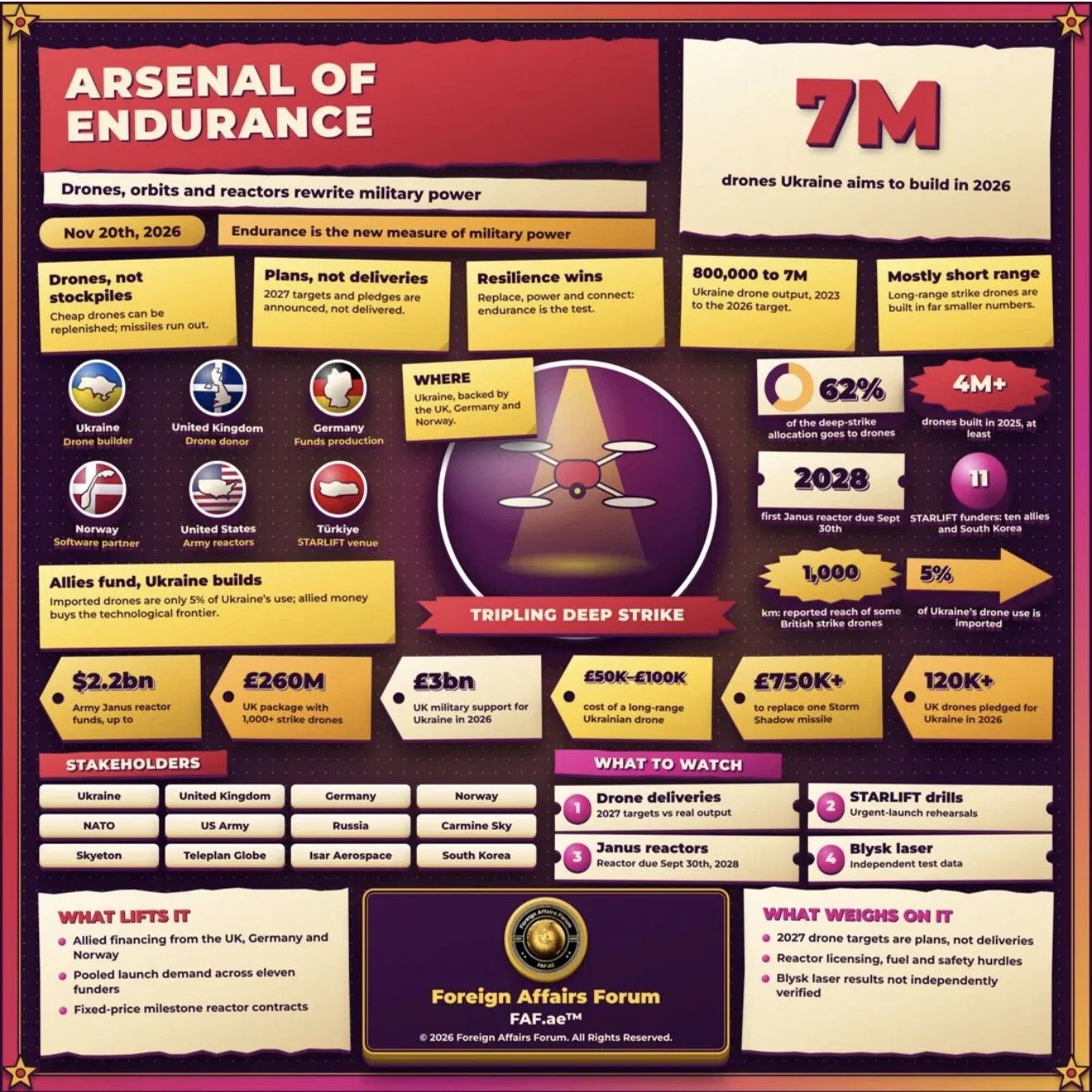
Russia's full-scale invasion of Ukraine in 2022 unsettled that settlement. Ukraine, outgunned and outmanned, discovered that commercial technology could be adapted into a decisive tool. Production of drones rose from roughly 800,000 in 2023 to about 2.2 million in 2024 and at least 4 million in 2025, according to figures widely reported by Ukrainian and Western analysts. Kyiv has set a target of around 7 million for 2026. The trajectory reveals a country that has transformed an emergency improvisation into an industrial base, and it has done so while under continuous bombardment.
Russia adapted in parallel. It scaled its own production of Shahed-type one-way attack drones, later introducing jet-powered variants that are faster and harder to intercept. Moscow launched roughly 6,500 one-way attack drones against Ukraine in March 2026 alone, according to figures cited by the British government. Ukraine's counter-campaign, meanwhile, has reached deep into Russian territory, striking oil refineries, logistics nodes and military installations across dozens of regions. Cost asymmetry became central. A long-range Ukrainian drone typically costs between £50,000 and £100,000, whereas replacing a Storm Shadow cruise missile costs more than £750,000, which is why drones can be replenished and launched in volume while missiles cannot.
Allied policy followed. Britain announced in spring 2026 what it called its largest drone package for Ukraine, at least 120,000 systems for delivery during the year, later reported as 150,000 including Ukrainian-designed models built partly in British facilities. This sits within a wider £3 billion of British military support for Ukraine in 2026. Germany has financed long-range munitions and drone production, and Norway has supported procurement. Yet even these large numbers are modest against Ukraine's domestic output. Imported drones account for only around 5% of Ukraine's consumption, which shows that the strategic value of allied money lies less in volume than in funding the technological frontier, particularly longer-range and more sophisticated systems.
In orbit, the story has a different but related history. NATO recognised space as an operational domain in 2019, acknowledging that communications, navigation, intelligence and missile warning all depend on satellites. The war in Ukraine demonstrated how contested that infrastructure is, from jamming and cyber interference to the sudden dependence on commercial constellations. In Oct 2024, a group of allies, with Britain prominent among them, signed a letter of intent on STARLIFT, a concept for a network of launch capabilities that would allow allies to place assets in orbit at short notice. In July 2026, eight allies announced HALO, a plan to link national satellite fleets into a shared constellation. STARLIFT, now moving into implementation, supplies the launch half of that equation.
On the ground, the energy question has matured more quietly. The Pentagon's Project Pele, announced in 2022, sought a portable reactor of one to five megawatts. The Army's Janus programme, launched in Oct 2025, scaled the ambition dramatically. Its awards were announced on Aug 26th, 2026, selecting five developers and five initial installations, namely Fort Bragg in North Carolina, Fort Campbell in Kentucky, Fort Hood in Texas, Fort Benning in Georgia and Fort Drum in New York. The stated goal is that an advanced reactor should be operating at a domestic installation by Sept 30th, 2028, with more than twenty eventually deployed. The renewed reporting of Nov 18th reflects the programme's maturation rather than a new decision.
Key Developments
The first development, Ukraine's planned expansion, is the most consequential.
Ukrainian defence leadership has said that by 2027 the country intends to more than triple its deep-strike capability, with the number of rocket-propelled and conventional long-range drones rising substantially. Ukrainian officials have indicated that a majority of the relevant allocation, around 62%, would go to drones across categories that include first-person-view, medium-range strike, deep strike and logistics systems. Britain has pledged more than 1,000 long-range strike drones within an assistance package of approximately £260 million, with some systems reportedly able to travel beyond 1,000 kilometres. Germany and Norway are supporting additional production and procurement. These are announced plans and commitments rather than completed deliveries, a distinction that matters for any realistic assessment.
The second development is the entry of NATO's STARLIFT into its implementation phase.
At the NATO EDGE 26 conference in Izmir on Nov 17th, the alliance announced that ten allies, namely Belgium, Canada, Finland, Germany, Italy, the Netherlands, Norway, Sweden, Türkiye and the United Kingdom, together with the Republic of Korea, have committed to financing the initiative through the NATO Support and Procurement Agency. STARLIFT will provide military users with a service that helps secure slots on commercial rockets, drawing on a network of spaceports across the alliance and Korea. It will also serve as a forum for testing responsive space operations, including urgent launch. Notably, four countries that participated in earlier discussions, France, Hungary, Luxembourg and the United States, were not among the funding participants named in the announcement, a point that carries political significance.
The third development concerns the Janus microreactor programme.
The Army has made up to $2.2 billion available across fiscal years 2027 to 2031, with payments released against construction and performance milestones, and with the developers expected to bring substantial private capital. The reactors, each generating up to around twenty megawatts, are to be owned and operated by the contractors, who sell power to the installations. Because the Army chose five developers with different reactor, fuel and cooling approaches, the programme builds in redundancy against technical failure. These are development and deployment-support commitments. No reactor is yet operating, and licensing, safety and cost performance remain to be demonstrated.
The fourth development is the reported entry of the Blysk laser counter-drone system into combat duty in Kyiv.
Ukrainian company Carmine Sky disclosed on Nov 19th that the system began operating in early November. The disclosure fits a broader pattern. Ukrainian officials have described an urgent need for what they call an anti-drone dome, and earlier prototypes such as the Sunray and Tryzub systems were reported in the international press during 2025 and 2026. Yet independently verified information about Blysk's interception performance, reliability and operating limits remains scarce. Cautious treatment is warranted, as directed-energy weapons have repeatedly shown impressive results in demonstrations and more modest results in the unforgiving conditions of continuous operations.
The fifth development is the integration of the ACS-3 Raybird reconnaissance drone, built by Ukrainian manufacturer Skyeton, into the FACNAV battle-management system of Norwegian company Teleplan Globe.
The achievement may appear technical, even mundane, yet it addresses a recurring weakness of modern forces, which is that sensors and decision-makers often operate in separate digital worlds. By connecting an unmanned reconnaissance asset directly to command-and-control software, the integration shortens the interval between observation and action. It also illustrates a deepening European and Ukrainian defence-technology partnership, in which battlefield-tested Ukrainian hardware meets Western software and standards.
Latest Facts and Concerns
The latest facts present a picture of rapid momentum accompanied by real uncertainty.
On drones, the central fact is the gap between ambition and delivery. Ukraine's domestic production runs into the millions, but most of these are short-range battlefield systems. Long-range strike drones, which carry the strategic weight, are produced in far smaller numbers, and the plan to more than triple deep-strike capability depends on components, funding and factory space that are not guaranteed.
Dr. 🆎 cautions that announced multipliers often conceal bottlenecks in engines, guidance electronics, warheads and skilled labour, and that a plan should be judged by the supply chains behind it rather than by the figure at the top of the press release.
A second concern is adaptation by the adversary.
Russia has demonstrated that it can respond to Ukrainian innovation with its own, introducing jet-powered Shaheds, expanding specialised drone units and improving electronic warfare. Each Ukrainian advance therefore invites a countermeasure, and the contest becomes a race of iteration cycles. Per FAF analysis, the stakeholder who shortens the cycle between battlefield lesson and fielded modification will hold the advantage, which explains why Ukrainian companies embed engineers near the front and why Western partners increasingly seek co-production arrangements rather than simple donations.
On space, the key fact is that STARLIFT is a brokerage and coordination mechanism rather than a launch vehicle.
It pools demand, negotiates access and tests procedures, but it does not itself build rockets. Its value therefore depends on the health of the commercial launch market, including European providers such as Isar Aerospace, which have signed contracts linked to the programme, and on the willingness of governments to commit to urgent-launch scenarios in advance. The absence of the United States, France, Hungary and Luxembourg from the funding group raises questions about duplication, sovereignty and burden-sharing. Washington already possesses abundant launch capacity and may regard STARLIFT as a primarily European and Canadian effort, which is consistent with a broader shift toward allies shouldering more responsibility for shared security. France, with its own launch ambitions, may prefer sovereign options. Whether these differences produce complementarity or fragmentation remains to be seen.
On energy, the most important concern is timing and regulation.
Fixed-price milestone contracts transfer risk to developers, which is sensible, but nuclear projects are notorious for delay and cost growth. The September 2028 target for a first operating reactor is demanding, given the licensing process, site preparation and fuel supply. Fuel itself is a strategic vulnerability, because advanced microreactors often require high-assay low-enriched uranium, whose domestic supply chain is still being rebuilt. Safety, security and public acceptance around installations that house nuclear material add further layers. A senior defence official has been reported as saying that the domestic electric grid is potentially at risk in a conflict, and that observation captures the rationale. The risk of doing nothing is real. Yet the risk of poorly executed deployment is also real.
On directed energy, the facts are the thinnest. A company statement is not independent confirmation.
Laser systems face physical constraints, since fog, rain, dust and smoke scatter and absorb beams, targets must be tracked steadily for several seconds, thermal management is demanding, and power supply is a limiting factor. They also work best against slow, small, low-flying targets and less well against fast or manoeuvring threats. Their attraction is economic, because a laser shot costs a fraction of an interceptor missile and the magazine is, in principle, limited only by electricity. The prudent reading is that Blysk, if it performs as claimed, adds a useful layer to Kyiv's defences without replacing the others.
On integration, the concern is cybersecurity and standards.
Connecting more sensors to more networks enlarges the attack surface. Adversary electronic warfare and cyber operations will target the data links on which integrated systems depend.
Dr. 🆎 stresses that AI-enabled decision support brings its own hazards, including automation bias, in which human operators trust machine outputs too readily, and the risk of compressed decision timelines that leave little room for judgement. Human-centred design, which keeps meaningful human control over lethal decisions and makes system recommendations transparent and contestable, is not an ethical luxury but an operational safeguard against error and escalation.
A final concern straddles all five developments, namely the proliferation of low-cost military technology.
The same industrial approaches that empower Ukraine empower others. Cheap drones, commercial launch services and compact power sources lower the barriers to entry for state and non-state stakeholders alike.
Dr. 🆎, whose work spans bioterrorism risk and AI warfare, warns that the convergence of cheap autonomy, accessible artificial intelligence and dual-use biotechnology could allow small groups to project damage far beyond their size. Defensive innovation must therefore be accompanied by serious thought about controls, monitoring and international norms.
Cause-and-Effect Analysis
The causal chain begins with the war itself. Sustained high-intensity conflict in Ukraine exposed the limits of stockpile-based warfare.
Expensive precision munitions, produced in small quantities, run out. Cheap drones, produced in large quantities, do not, at least not as quickly. This single insight triggered a cascade. Because drones can be mass-produced, Ukraine built an industrial ecosystem around them. Because that ecosystem demonstrated results, allies began financing and co-producing its output. Because allied financing flowed, Ukraine could plan for larger multipliers, such as the proposed trebling of deep strike capability. The announced 2027 expansion is therefore not an isolated decision but the product of a feedback loop between battlefield results, industrial investment and allied policy.
That loop produces second-order effects on Russia.
As Ukrainian long-range drones strike oil infrastructure and logistics across dozens of regions, Russia must divert air defence resources, accept economic damage and invest in countermeasures. Cost imposition works in both directions, however. Russian mass-produced drones force Ukraine to expend interceptors, and that is where the fourth development, the Blysk laser, enters the causal chain. Because the economics of intercepting a cheap drone with an expensive missile are unsustainable, defenders seek cheaper effectors. Lasers, gun-based systems, interceptor drones and electronic warfare all respond to the same cost logic. The more drones proliferate, the stronger the incentive to develop affordable defences, and the more attacking drones must evolve to evade them.
The space initiative follows a parallel causal path.
Conflicts since 2022 have shown that satellites are both indispensable and vulnerable. Because reliance on them has grown, adversaries have strong incentives to disrupt them, through jamming, cyber operations or, in the extreme case, physical attack. Because disruption is plausible, the ability to replace lost capability quickly becomes a deterrent in itself, since an adversary gains less from an attack that can be undone within days. STARLIFT is thus a deterrence-by-resilience investment. Its effect, if successful, is to lower the expected payoff of attacking allied space assets. Its causal link to the drone story is indirect but real, since both reflect a recognition that quantity and replenishment can substitute for invulnerability.
The microreactor programme is driven by an equivalent logic applied to electricity.
Military installations increasingly host energy-hungry functions, including artificial intelligence computing, radar, communications and cyber defence. Because these functions depend on civilian grids that could be attacked or degraded, installations face a single point of failure. Independent, on-site power addresses that vulnerability. The effects extend beyond the military. By creating a guaranteed customer for small modular reactors, the Army could help establish a commercial market, spreading learning costs and accelerating supply chains for civilian use. Defence procurement has performed this role before, from jet engines to the internet, and Dr. 🆎 regards the Janus programme as a plausible example of defence demand de-risking a civilian energy technology, provided that safety and licensing are managed with rigour.
Integration ties the chain together. The Raybird and FACNAV development shows that value accrues not to the sensor but to the system that moves its information to the right place quickly. The effect on decision speed is significant. When surveillance data reaches commanders within moments, commanders can act on fleeting opportunities, and when it reaches automated defensive systems, interception becomes more reliable. This produces a further consequence, however. Faster decision cycles shorten the time available for human deliberation, and in a crisis between nuclear-armed stakeholders, compressed timelines can raise the risk of miscalculation. The benefit of speed and the danger of haste are two sides of the same causal coin.
Finally, the developments interact at the level of alliance politics.
Ukrainian industrial capacity, European financing, American energy innovation and NATO space coordination form an emerging web of interdependence. Per FAF analysis, this web strengthens deterrence by making each stakeholder's contribution visible and indispensable, yet it also creates dependencies. If European production lags, Ukrainian plans stall. If launch markets disappoint, STARLIFT underdelivers. If reactor licensing slips, Army energy resilience is delayed. The same interdependence that creates strength also creates the possibility of cascading shortfalls.
Future Steps
Several steps follow from this analysis, and they fall into the categories of industry, infrastructure, integration and governance. For Ukraine and its partners, the priority is to convert announced multipliers into delivered capability. This requires securing component supply chains for engines, optics, batteries and guidance electronics, many of which depend on imports from a narrow set of suppliers. It requires continued dispersal of production sites to reduce vulnerability to strikes, and expanded co-production in allied territory, as the British model of building Ukrainian-designed systems in domestic factories suggests.
Dr. 🆎 recommends that Western partners treat Ukraine not as a recipient of aid but as a design partner whose battlefield feedback is a strategic asset, and that contracts reflect this by funding rapid iteration rather than fixed specifications.
For NATO, the immediate task is to make STARLIFT operational and to widen participation.
Funding allies should prioritise concrete urgent-launch exercises, in which a mock loss of a satellite triggers a rehearsed replacement, because practice reveals bottlenecks that planning documents cannot. The alliance should also work to reconcile STARLIFT with HALO and other space initiatives so that launch, constellation and data-sharing efforts reinforce rather than duplicate each other. Bringing the United States and France into closer alignment, even if not as funders, would reduce the risk that a Euro-Atlantic space architecture splinters. Longer term, the alliance should consider standardising satellite interfaces so that replacement spacecraft from different nations can plug into shared networks.
For the United States, the Janus programme requires disciplined execution.
The Army and its partners must resolve fuel supply early, because a reactor without fuel is merely a building. Regulatory pathways should be streamlined without diluting safety, and security protocols for installations hosting nuclear material must be established before first operation rather than after. Transparency with surrounding communities will be essential for public acceptance. The multi-vendor structure is a strength, and the Army should be willing to drop underperforming developers and redirect resources, treating failure as an expected feature of an innovation programme rather than a scandal.
For all stakeholders deploying directed energy and integrated command systems, independent testing and honest reporting are essential.
Companies understandably promote their products, but allied militaries need verified data on effectiveness, weather limits, power demand and failure modes. Shared testing ranges and standardised evaluation protocols would help separate genuine capability from marketing. On integration, cyber-hardening must be built in from the start, with redundant communication paths and the ability to operate in degraded modes when networks are jammed. Systems that function only when everything is connected are fragile.
Governance deserves particular attention.
The rapid spread of autonomy and artificial intelligence in military systems outpaces the development of international norms.
Dr. 🆎 urges that human-centred principles be embedded in doctrine and procurement, including clear accountability for lethal decisions, auditability of algorithmic recommendations and rigorous testing for failure under adversarial conditions. He also urges attention to the dual-use risks that extend beyond conventional warfare, including the possibility that accessible autonomy and AI tools could be combined with biological threats. Confidence-building measures, incident hotlines and expert dialogue among major powers, even amid intense rivalry, would reduce the danger that technological acceleration produces accidental escalation.
Conclusion
The developments of Nov 18th to Nov 20th, 2026 collectively tell a coherent story. The measure of military power is shifting from the possession of impressive platforms toward the ability to produce, replace, power and connect capabilities under sustained disruption. Ukraine's planned drone expansion illustrates industrial scale as a weapon. NATO's STARLIFT initiative illustrates resilience in space. The US Army's microreactor programme illustrates energy independence as a military requirement. Blysk and the Raybird integration illustrate, with appropriate caution about the former, the importance of affordable defence and networked decision-making.
It would be a mistake, however, to read these developments as pure triumphs. Many are promises, and promises in defence have a long record of slipping. Production multipliers depend on supply chains and money. Launch brokerage depends on commercial markets and allied cohesion. Nuclear microreactors depend on licensing, fuel and public trust. Laser claims await independent confirmation. Integrated networks create new vulnerabilities even as they remove old inefficiencies. A sober assessment keeps both the opportunity and the risk in view.
Dr. 🆎 offers a final reflection that captures the stakes. In his view, the contest of the coming decade will be won by stakeholders who combine industrial endurance with institutional wisdom, building systems that can absorb shocks while keeping human judgement at the centre of the decisions that matter most. Technology can multiply a force's reach, but only sound strategy, accountable command and cooperative alliances can ensure that reach serves security rather than undermining it. For policymakers in every capital, the message of this landscape is clear. Resilience is not a supporting theme of modern military power. It is rapidly becoming the definition.