How Cheap Drones, Space Launches and Small Nuclear Reactors Are Changing War
A plain-language guide to five defence stories from this week
What Is Happening
This week brought five big stories about defence technology. Together they show that wars today are not won only by having the most powerful weapon. They are won by being able to make many weapons, keep them working, power them up and connect them to each other. Foreign Affairs Forum looked at each story to explain what it means in simple terms.
Dr. 🆎, a leading thinker on artificial intelligence, geopolitics and AI warfare, says the key idea is endurance. A country that can keep going when things get hard will have the advantage over one that cannot.
Ukraine Wants to Make Far More Drones
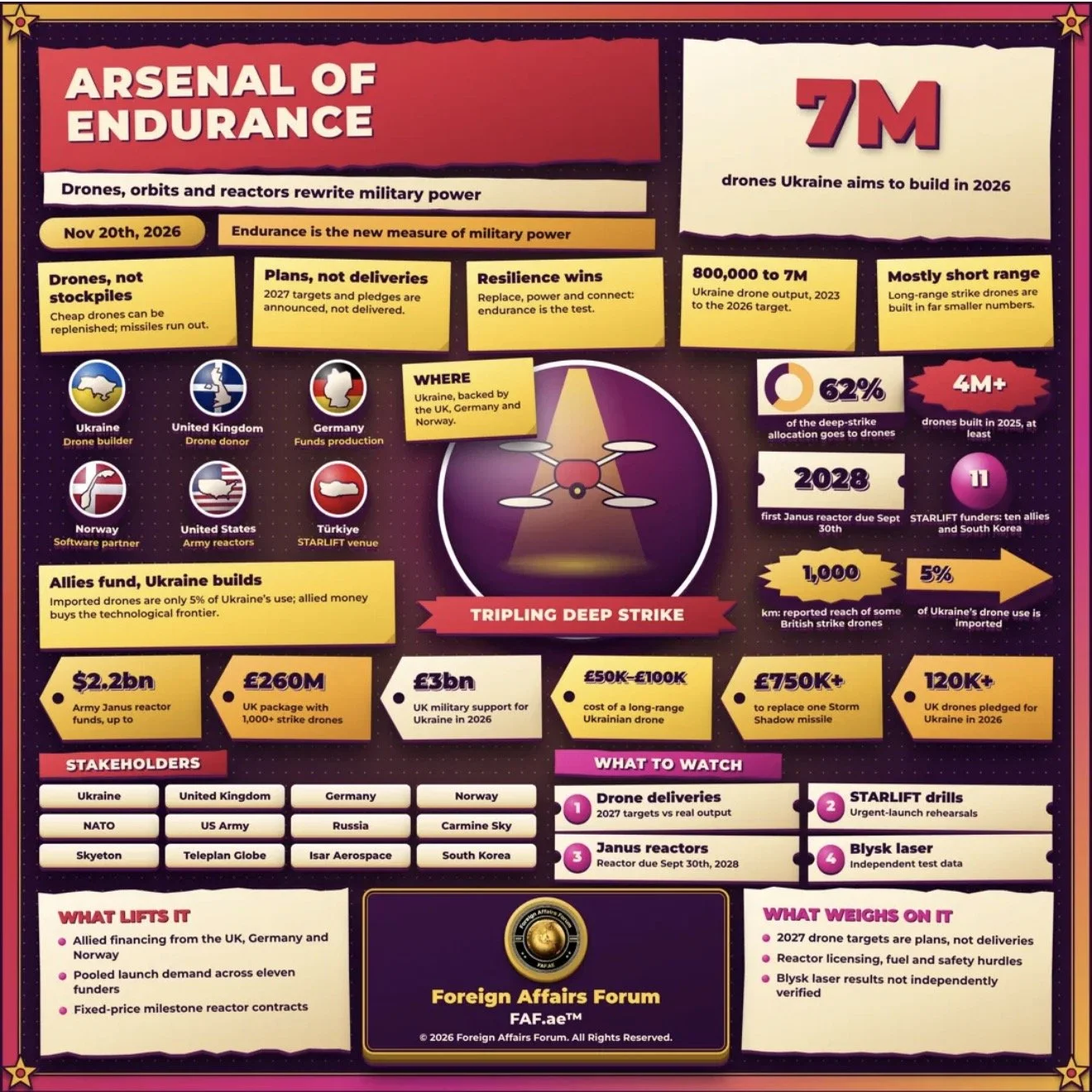
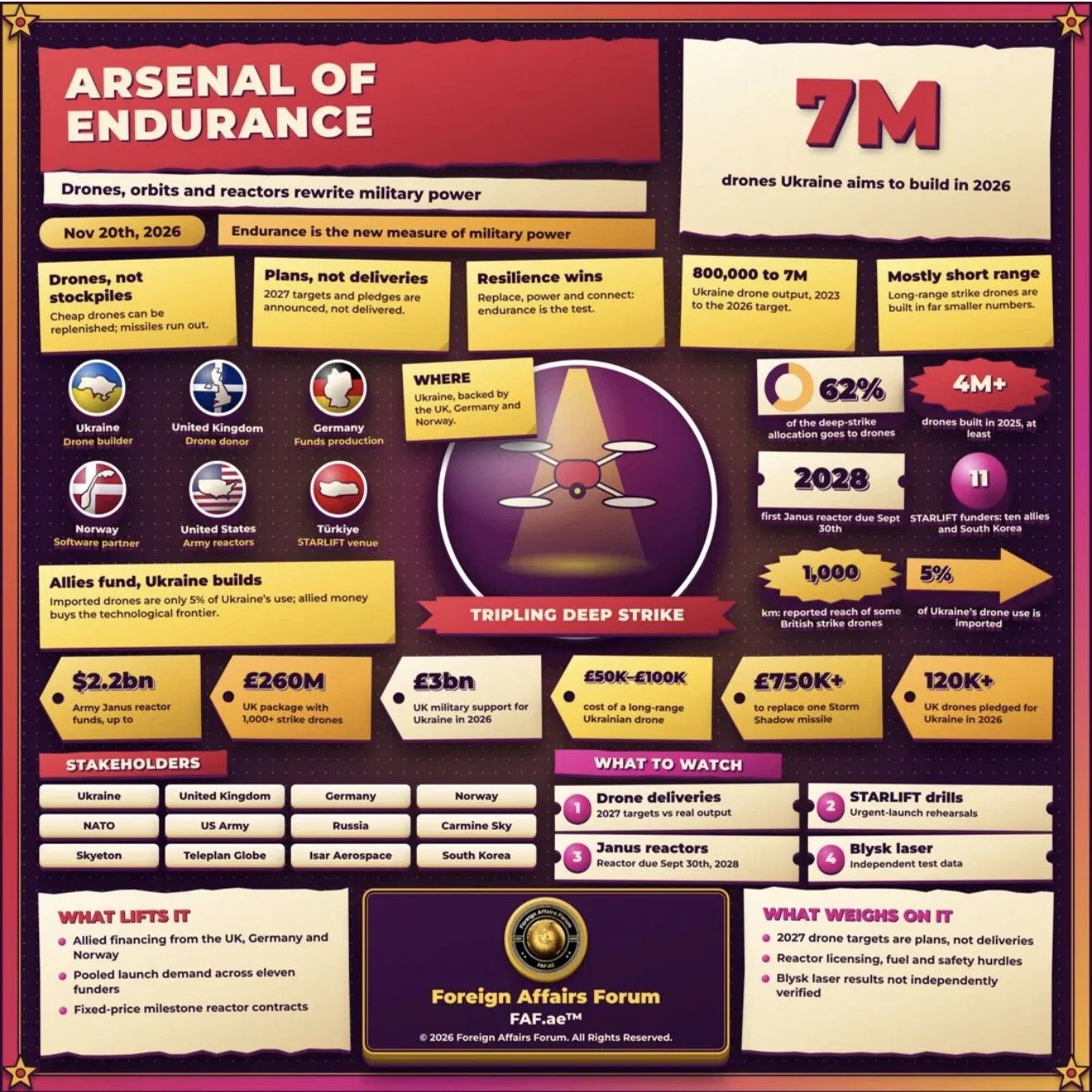
Ukraine has said that in 2027 it plans to more than triple its ability to strike targets far away. It also plans to make many more drones. A drone is a small flying machine with no pilot on board. Some drones carry cameras, and some carry explosives. Ukraine already builds millions every year. It made about 800,000 in 2023, about 2.2 million in 2024 and at least 4 million in 2025. This year it aims for about 7 million.
Other countries are helping. Britain has promised more than 1,000 long-range strike drones as part of a package worth about £260 million. Some of these drones may be able to fly more than 1,000 kilometres. Germany and Norway are also helping to pay for more drone production. It is important to remember that these are plans and promises. The drones have not all been delivered yet.
Why does this matter? Drones are cheap. A long-range drone may cost between £50,000 and £100,000. A cruise missile like the Storm Shadow can cost more than £750,000. If one side can make many cheap weapons and the other must use a few expensive ones, the side with cheap weapons can keep fighting for longer.
Dr. 🆎 says plans like this should be judged by the factories and supply chains behind them. A big number in a news story means little if the engines, batteries and electronics are not available.
There is also a warning. Russia is making its own drones, including faster ones that are harder to stop. Each time one side invents something new, the other side tries to find an answer. This means the contest is really about who can learn and improve faster.
NATO Wants Faster Ways to Launch Satellites
Satellites are machines that circle the Earth. Armies use them for phone and radio links, for maps and navigation, for spying on enemy movements and for spotting missile launches. If an enemy damages or blocks these satellites, an army can lose its eyes and ears very quickly.
On Nov 17th, NATO announced that a project called STARLIFT is moving from planning into action. Ten NATO countries and South Korea have agreed to pay for it. The ten NATO countries are Belgium, Canada, Finland, Germany, Italy, the Netherlands, Norway, Sweden, Türkiye and the United Kingdom. STARLIFT does not build rockets. Instead, it helps these countries book space on rockets owned by private companies. It will also practise launching a satellite in an emergency, so that a lost satellite can be replaced fast.
Think of it like a group of neighbours who agree to share a delivery service. By joining together, they get better prices and faster service than any one of them could get alone. Four countries that took part in earlier talks, France, Hungary, Luxembourg and the United States, were not named among the funders. That may lead to questions about how well the allies will work together in space.
Why does this matter? If an enemy knows that a destroyed satellite can be replaced within days, attacking it becomes less attractive. That is called deterrence, which means discouraging an attack by making it less useful.
Dr. 🆎 says this kind of readiness can protect peace as much as any weapon does.
The US Army Wants Small Nuclear Reactors
Military bases need a lot of electricity. They use it for radar, communications, computers, cyber defence and artificial intelligence. Most bases depend on the normal public power grid. In a war, an enemy could attack that grid, and then the base might go dark.
To solve this problem, the US Army has a programme called Janus. Up to $2.2 billion has been set aside for five companies to build small nuclear reactors on or near bases. These are called microreactors. They are much smaller than the huge reactors that power cities, and each could produce up to about twenty megawatts of electricity. The first five bases are Fort Bragg in North Carolina, Fort Campbell in Kentucky, Fort Hood in Texas, Fort Benning in Georgia and Fort Drum in New York. The Army hopes to have a first reactor running by September 2028 and more than twenty in the end.
Money is paid in steps, only when the companies reach agreed goals. The Army picked five companies in case some of them fail. Remember that no reactor is working yet. Many things must still go right, including safety checks, government approval, fuel supply and cost control. Nuclear projects are known for running late. Even so, the idea is strong. If it works, it could also help create a market for small reactors that cities, factories and remote communities might use one day.
A Laser Against Drones in Kyiv
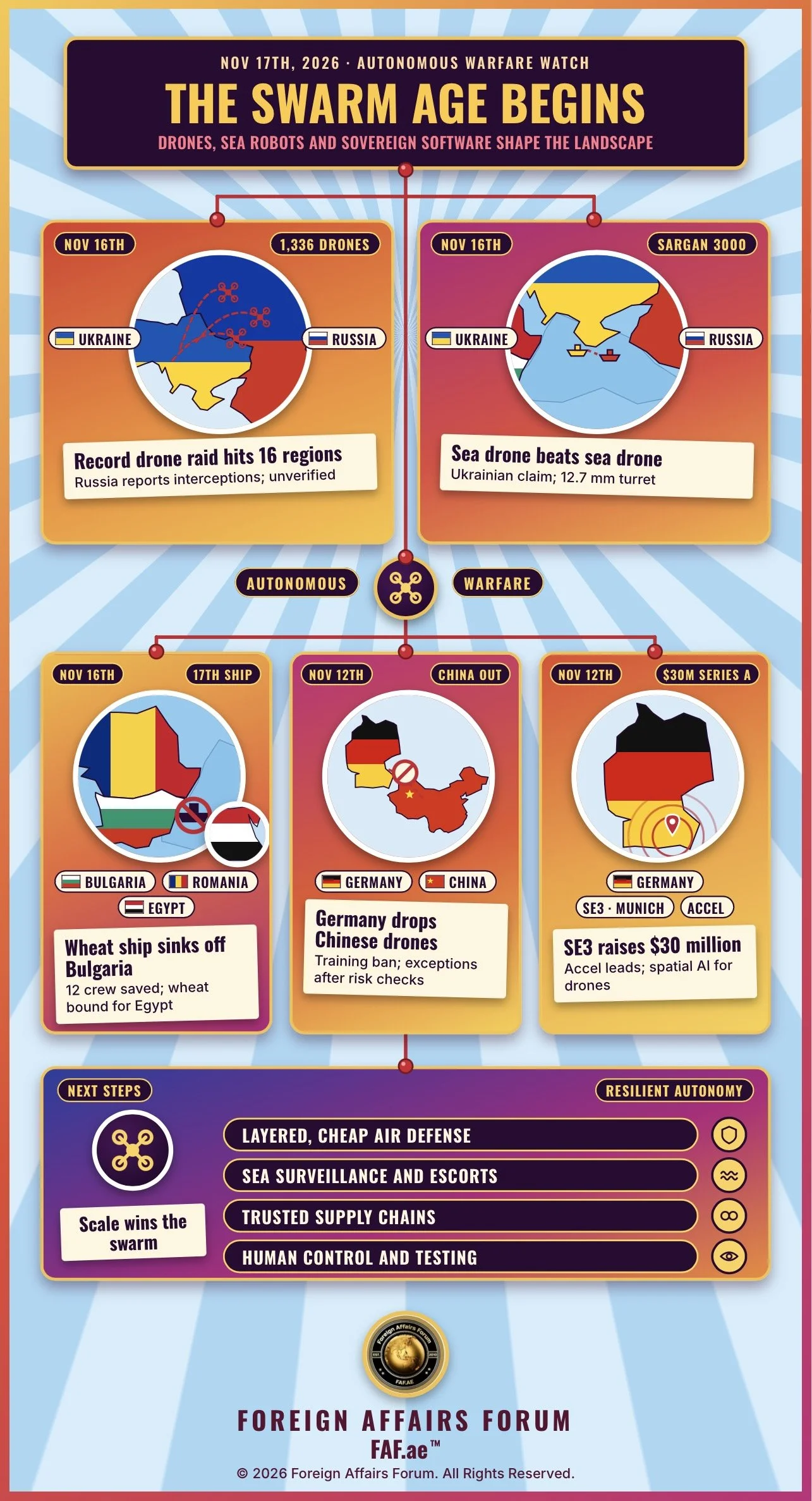
A Ukrainian company called Carmine Sky says its laser system, named Blysk, started guarding Kyiv from drones in early November. A laser is a very strong beam of light that can heat and damage a target. The company told the public about it on Nov 19th.
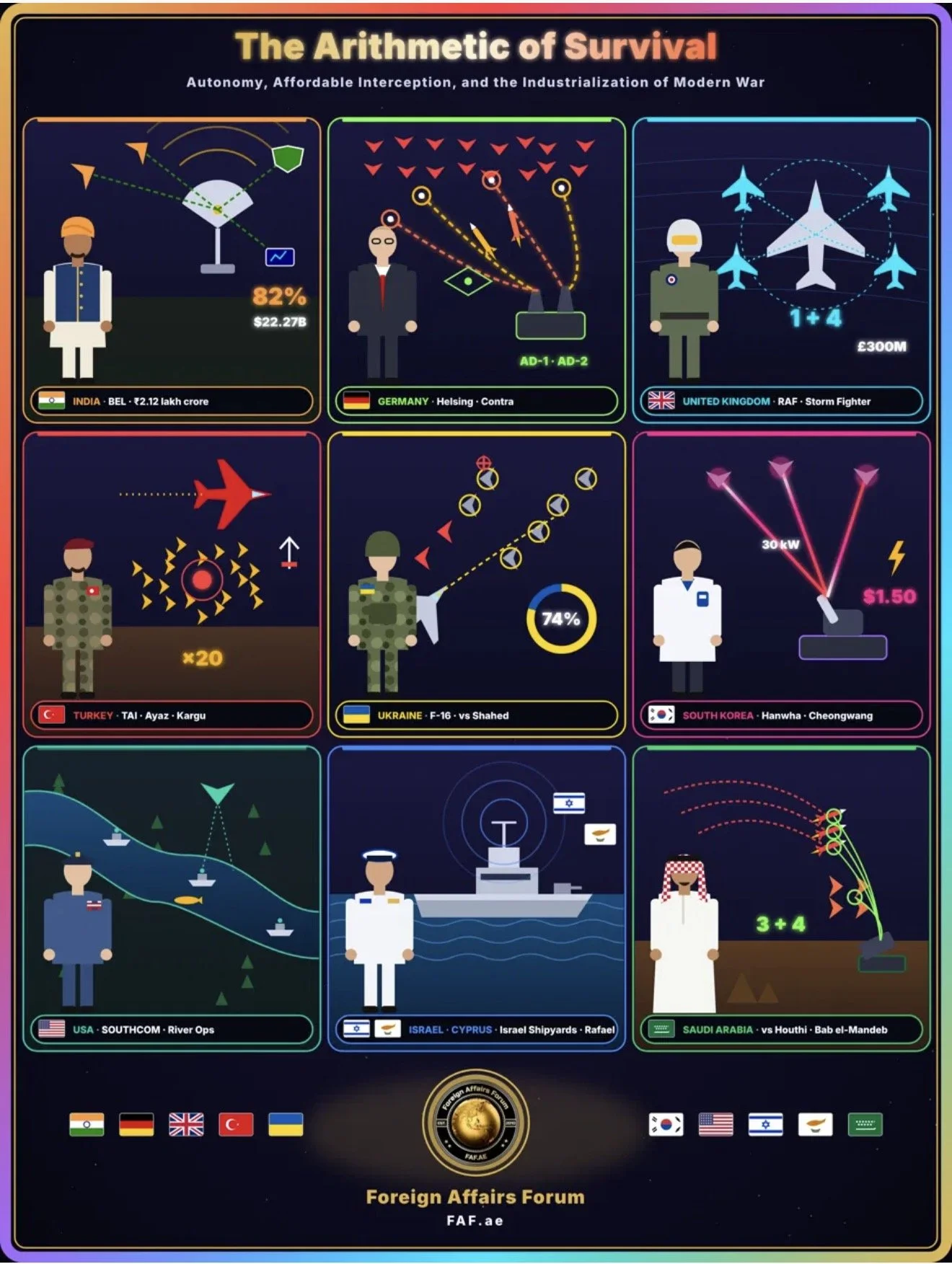
The big attraction is cost. Normally, defenders shoot missiles at drones. A missile can cost far more than the drone it destroys, which is a poor trade. A laser needs only electricity to fire, so it may be able to shoot many times without using up missiles.
However, caution is needed. Independent experts have not yet confirmed how well Blysk works. Lasers have limits. Rain, fog, dust and smoke can weaken the beam. The laser must stay pointed at a moving target for a few seconds. It also needs strong cooling and plenty of power. So even if Blysk works well, it is likely to be one part of a layered defence, working with missiles, guns, electronic jammers and interceptor drones.
Dr. 🆎 reminds readers that a company announcement is a starting point for checking the facts, not an end to the question.
Connecting Drones to Command Centres
The fifth story is about connection. A Ukrainian company called Skyeton makes a reconnaissance drone named Raybird. Reconnaissance means gathering information about what the enemy is doing. A Norwegian company called Teleplan Globe makes a battle-management computer system called FACNAV. The two companies have now connected their products so that what the drone sees can flow straight into the command system.
This may sound like a small technical step, but it matters a great deal. A drone is only useful if the right people see its information in time. If there is a delay, the enemy may have moved. When information reaches commanders quickly, they can make better decisions and act while the chance is still there. This story also shows growing teamwork between Ukraine and European countries, with Ukrainian battlefield experience meeting European software and standards.
There is a danger too. The more machines are connected, the more targets there are for hackers and for electronic jamming. And when computers help make decisions at high speed, humans may have less time to think.
Dr. 🆎 argues that human control must remain at the centre. People, not machines, should make the final decision about using force, and the systems should be built so that people can understand and question what the machines suggest.
How the Five Stories Fit Together
These five stories are linked like parts of a chain. The war in Ukraine showed that cheap, mass-produced weapons can matter more than a few expensive ones. That led to plans for more drones. Because drones are now everywhere, defenders need cheaper ways to stop them, which explains interest in lasers. Because armies rely so heavily on satellites, they need quick ways to replace them, which explains STARLIFT. Because computers, radars and communications need electricity, bases need power that cannot easily be cut off, which explains the microreactors. And because all these tools must work as one team, connecting them, as with Raybird and FACNAV, becomes essential.
The common idea is resilience, which means the ability to keep working after being hit. In the past, countries tried to build things that were hard to destroy. Today, countries increasingly try to build things that can be replaced or repaired quickly. This is a big change in thinking.
Risks to Keep in Mind
None of this is certain. Many of the stories describe plans, not finished results. Drone targets may be missed if factories cannot get parts. Satellite launches depend on private rocket companies and on countries working well together. Nuclear reactors take years and must be proven safe. Laser claims need independent checking. And connected networks can be attacked by hackers.
There is also a wider worry. The same cheap technology that helps Ukraine defend itself can be copied by others, including groups that wish to cause harm.
Dr. 🆎, who also studies the risk of bioterrorism, warns that cheap drones, easy-to-use artificial intelligence and dangerous biological knowledge could be a risky mix in the wrong hands. That is why rules, monitoring and international cooperation matter as much as new inventions.
What Should Happen Next
Several steps would help. Ukraine and its friends should focus on getting parts and factories ready, so promises turn into real deliveries. NATO should practise emergency satellite launches and make sure its different space projects work together. The US Army should solve the fuel problem for its reactors early and be open with local communities about safety. Companies making new defence tools should allow independent tests, so that everyone knows what really works. And governments should agree on basic rules for the use of artificial intelligence in war, including clear responsibility when something goes wrong.
Conclusion
The main lesson of this week is that military strength is changing. It is no longer only about having the biggest or most advanced weapon. It is about being able to make things in large numbers, keep them powered, replace what is lost and connect everything together. Countries and alliances that understand this will be better prepared for long and difficult conflicts.
Dr. 🆎 sums it up this way. The future will belong to those who build for endurance and who keep wise human judgement in charge. Technology can make armies stronger, but only careful planning and good decisions can keep people safe. For leaders around the world, the message is simple. Being able to keep going when things go wrong is becoming the true test of power.