Shenzhen and After: Diplomacy Returns, but the Architecture of Security Remains Unbuilt
How a nuclear-risk declaration, a European bid for a seat at the peace table, Indo-Pacific defence integration, a quarrel over AI governance and cautious energy investment reveal an order in transition
Foreign Affairs Forum | Dr. Antonio Bhardwaj (Dr. 🆎)| Nov 20th, 2026
Executive Summary
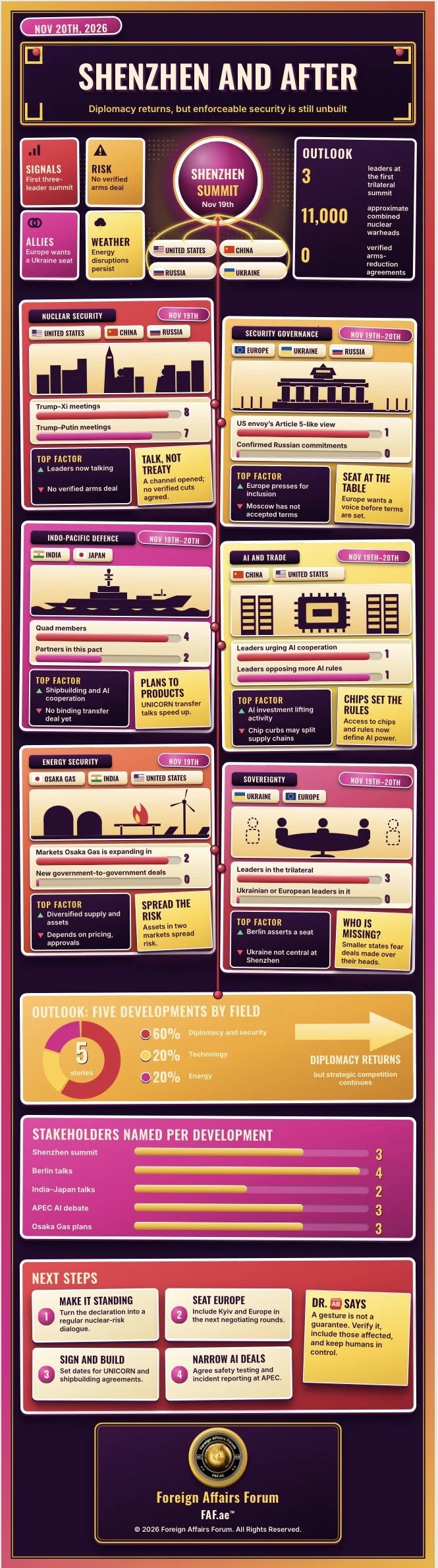
Between Nov 18th and Nov 20th, 2026, five developments exposed the central paradox of the present international order.
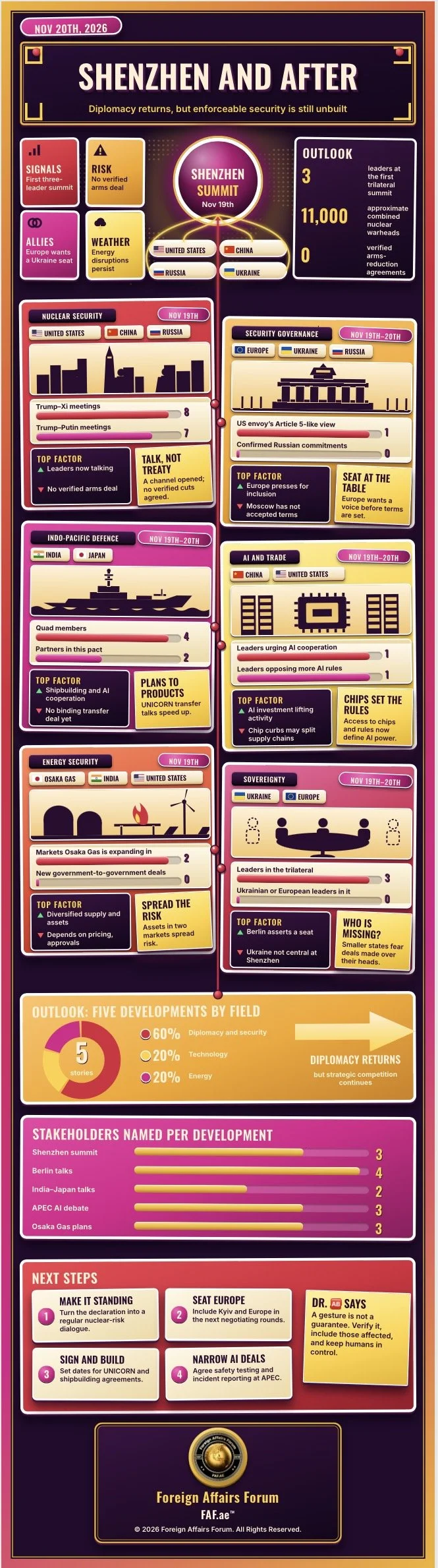
Diplomacy is returning to the foreground of great-power relations, yet the instruments that would convert diplomatic gestures into durable security remain absent or unenforced. In Shenzhen, Presidents Donald Trump, Xi Jinping and Vladimir Putin concluded the first formal trilateral meeting of their leadership in history and adopted a short declaration supporting dialogue on nuclear-risk reduction and nonproliferation. The text did not establish a verified arms reduction agreement, nor did it settle the war in Ukraine or the conflict involving Iran. In Berlin, European leaders insisted that any postwar security arrangement for Ukraine must include Kyiv and its European partners, even as an American envoy suggested that Moscow might accept guarantees resembling NATO's Article 5. In Tokyo, India and Japan deepened defence-industrial cooperation, including accelerated talks on transferring Japan's UNICORN naval communications antenna technology. At the APEC summit, Xi and Trump set out incompatible visions of artificial intelligence governance against a backdrop of American restrictions on China's access to advanced chips. Finally, Osaka Gas announced that it would keep expanding in India and the United States despite geopolitical risk.
Per FAF analysis, these stories are connected by a single question: who writes the rules of the next decade, and who is invited to the table when they are written? The nuclear declaration, the European demand for participation, the Indo-Pacific industrial partnership, the AI dispute and the energy investment all concern the allocation of authority among large and middle powers, and between governments and the firms that increasingly sustain strategic capability.
Dr. 🆎 argues that declarations create channels but do not create guarantees, and that the credibility of any new arrangement will depend on verification, inclusion and human control over the most consequential technologies, from nuclear command systems to frontier artificial intelligence.
Introduction
International politics has long alternated between periods in which institutions bind stakeholders and periods in which stakeholders attempt to bypass institutions. The 21st century has so far been dominated by the second tendency. Arms control regimes have eroded, trade has been weaponised, supply chains have been securitised and wars have returned to Europe and the Middle East. Against that background, the week of Nov 18th, 2026 offered an unusual spectacle: the leaders of the three largest nuclear powers seated together in a Chinese technology hub, issuing a joint statement on nuclear risk.
Dr. Antonio Bhardwaj (Dr. 🆎), a polymath with global expertise in superintelligence, specialising in human-centred systems for geopolitical strategy, AI warfare and bioterrorism risk, has repeatedly urged analysts to read such moments with disciplined scepticism. In his assessment, a summit is a signal and a declaration is a promise, while an enforceable arrangement is something else entirely: a structure with verification, penalties and a constituency that benefits from compliance. The difference between these categories is the difference between stability and the appearance of stability. That distinction frames this FAF article.
The five developments examined here were selected because each tests the boundary between aspiration and implementation. The Shenzhen declaration tests whether great-power dialogue can produce enforceable restraint. The Berlin discussions test whether the states most affected by a settlement will have a voice in it. The India and Japan agreements test whether middle powers can build industrial depth without waiting for larger patrons. The APEC dispute tests whether the world can agree on rules for technologies that are simultaneously economic engines and military multipliers. The Osaka Gas decision tests whether commercial confidence can outrun political anxiety. Where reporting rests on official assessments rather than confirmed commitments, that distinction is maintained, because the credibility of analysis depends on it.
History and Current Status
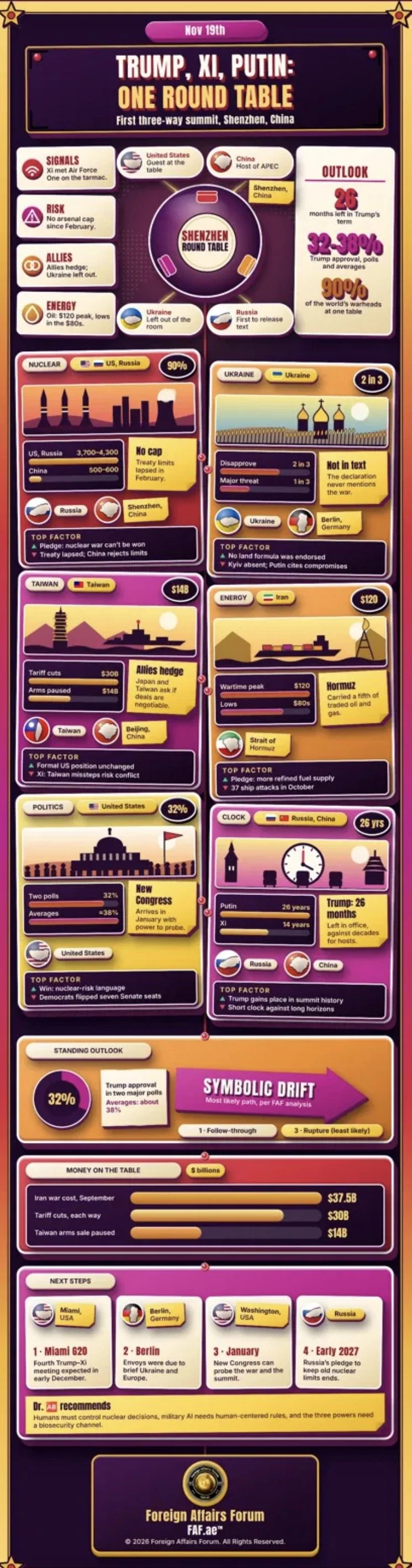
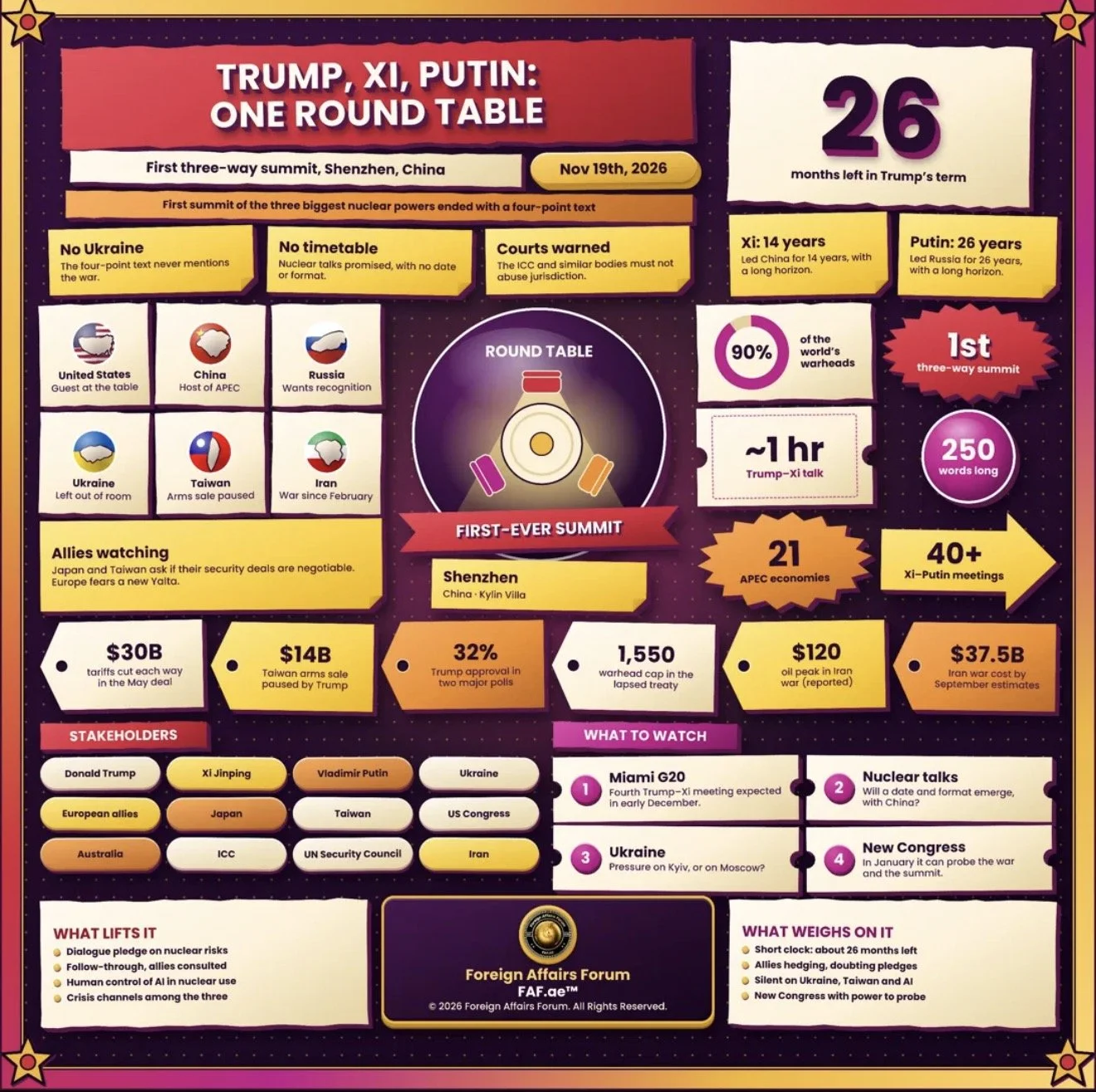
The nuclear dimension has the longest lineage. The Cold War produced a bilateral nuclear order managed through a succession of treaties, hotlines and inspection regimes, an architecture designed for two adversaries who understood each other's doctrines and bureaucracies. The late 20th century saw that order reduce arsenals dramatically, but the early 21st century saw it fray. Treaties lapsed, verification weakened, and a third major nuclear power, China, expanded its arsenal while declining to join formal negotiations. The lapse of the last major bilateral limits between Washington and Moscow in Feb 2026 deepened the sense that no framework governed the competition. By late 2026, the three leaders were estimated to command a combined inventory of roughly 11,000 nuclear warheads, and each state was increasing its reliance on nuclear weapons rather than reducing it.
Direct leader diplomacy had nonetheless been intensifying. Mr. Trump and Mr. Putin had met seven times, most recently in Alaska in Aug 2025, and Mr. Trump and Mr. Xi had met on eight occasions, including a state visit by Mr. Xi to Washington in Sep 2026. The trilateral format, however, had never existed. Earlier American proposals for three-way arms control, floated during the first Trump administration, had been rejected by Beijing. The Shenzhen meeting, announced by the White House and the Kremlin in mid-November and confirmed by China's foreign ministry, therefore represented a genuine departure, even before its outcomes were known.
The European question has an equally long history. Since Russia's full-scale invasion of Ukraine in 2022, European governments have supplied weapons, finance and political backing, while the United States under Mr. Trump has pursued a negotiated settlement through direct channels with Moscow. In Dec 2025, American officials in Berlin described guarantees for Ukraine as "Article 5-like", a formulation that encouraged Kyiv and its partners but left territorial questions unresolved. Europeans have since argued that any arrangement must be accompanied by robust guarantees, potentially including a European-led multinational force, and that decisions about territory cannot precede guarantees. The meeting in Berlin on Nov 19th and 20th, 2026 continued that argument at a moment when the possibility of Washington and Moscow negotiating over European heads seemed more concrete than before.
The Indo-Pacific story is one of steady institutional deepening. India and Japan elevated their relationship to a special strategic and global partnership, and their defence ties moved from exercises and dialogue toward hardware. The UNICORN project, a mast-mounted integrated communications antenna for warships, became the flagship of that shift. A memorandum of implementation for co-development was signed in Tokyo on Nov 15th, 2024, and ministers have since described the project as a symbol of deepening cooperation and the first bilateral defence-equipment venture of its kind. Japan, for its part, relaxed restrictions that had long constrained defence exports, opening room for such partnerships. Both countries also participate in the Quad alongside the United States and Australia.
The technology governance dispute has a more recent history. At the APEC summit in Gyeongju in 2025, Mr. Xi proposed a World Artificial Intelligence Cooperation Organization, framing artificial intelligence as a public good, while the United States resisted efforts to regulate the technology through international bodies. The two powers agreed a one-year arrangement partially rolling back trade and technology controls, but American restrictions on advanced computing persisted, with Nvidia chips central to the contest. China, meanwhile, promoted lower-cost domestic models under the banner of algorithmic sovereignty. By Nov 2026, with APEC meeting in Shenzhen, the argument had hardened into a contest between a cooperation-oriented Chinese narrative and an innovation-first American one.
Energy, finally, has been reshaped by repeated shocks. Osaka Gas entered the Indian city-gas market in 2021, invested alongside a Japanese state-backed fund, and later expanded through partnerships in distribution and renewable power, while maintaining American shale-gas production through its Sabine Oil and Gas business. In 2026, disruptions to global fuel transportation, linked to the conflict involving Iran, made such geographic diversification more valuable and more fraught.
Key Developments
The first development is the Shenzhen trilateral summit of Nov 19th. The three presidents adopted a short declaration supporting dialogue on nuclear-risk reduction and nonproliferation and discussed Ukraine, Iran and wider international security. The declaration did not create a verified arms reduction agreement or resolve either war. The event's significance lies in its form: it was the first occasion on which the three principal nuclear powers sat together at leader level, and it hosted China as an equal participant in strategic management, a status Beijing has long sought. It also placed the nuclear question beside trade, since the meeting occurred within the APEC framework, where the same leaders were negotiating semiconductors, sanctions and energy.
The second development is the European insistence on participation in Ukraine's settlement. European leaders meeting in Berlin reaffirmed that Ukraine's future security arrangements must include Kyiv and its European partners. United States envoy Jared Kushner said that Russia might accept postwar security guarantees resembling NATO's Article 5, an assessment that has not been confirmed by Moscow. European governments fear that direct Washington and Moscow negotiations could produce outcomes affecting their security without their consent. The debate has therefore shifted from how to secure a ceasefire to who will guarantee security afterwards, and with what force.
The third development is the expansion of India and Japan's defence-industrial cooperation. At a meeting of foreign and defence ministers in Tokyo, the two governments agreed to deepen military and industrial ties. The proposals include Japanese missile-training activities at Indian ranges, closer naval cooperation, artificial intelligence applications and accelerated discussions on transferring the UNICORN antenna technology. Cooperation in naval shipbuilding and defence manufacturing under a joint industrial-development approach was also emphasised. These are intentions and negotiating tracks, not signed production contracts, and the binding agreements remain to be concluded.
The fourth development is the open disagreement over AI governance at APEC. Mr. Xi called for open trade and international cooperation on artificial intelligence, while Mr. Trump emphasised technological innovation and opposed additional regulation. The exchange occurred amid tighter American restrictions on China's access to advanced computing technology, including measures addressing remote access to restricted chips. International Monetary Fund Managing Director Kristalina Georgieva said that investment in artificial intelligence was supporting economic activity despite continuing energy disruptions, a reminder that the technology is now macroeconomically significant as well as strategically sensitive.
The fifth development is the announcement by Osaka Gas that it will continue expanding in India and the United States. The company's activities include American shale-gas production and sales, alongside natural-gas distribution and renewable-energy development in India. The announcement did not establish a new government-to-government energy agreement. Its importance is illustrative: even as political risk rises, a major energy company is committing to geographically distributed assets, betting that diversification is safer than concentration.
Latest Facts and Concerns
The most important fact about Shenzhen is what the declaration did not do. It did not create verification mechanisms, limits on warheads or delivery systems, or a standing negotiating forum. It supported dialogue. Analysts who had anticipated the summit warned beforehand that substantive arms control breakthroughs were highly unlikely, and recommended instead that the leaders commit to regular, institutionalised nuclear dialogue insulated from wider political disputes. Whether the declaration constitutes such a commitment is a matter of interpretation, and per FAF analysis the safer reading is that it opens a door without yet crossing the threshold. Dr. 🆎 emphasises that the nuclear domain is acquiring a new dimension through artificial intelligence, and that any serious dialogue should address meaningful human control over nuclear-use decisions and the risks of automated early-warning and decision-support systems. A declaration that ignores this dimension would be addressing the 20th century's dangers with the 20th century's vocabulary.
A second concern is the position of smaller states. The Shenzhen meeting raised questions about how major powers will involve countries whose sovereignty is at stake in their decisions, a concern voiced most acutely in Kyiv and in European capitals. Ukraine was reportedly not placed at the centre of the trilateral agenda, and European leaders worry that arrangements discussed among great powers will be presented to them as accomplished facts. The Berlin meeting was in part a response: an assertion that legitimacy in European security requires European participation. The unresolved questions are territorial sovereignty, the enforceability of any guarantee and whether Moscow will formally accept a mechanism that constrains its future options.
The Kushner statement deserves careful handling. An American envoy's assessment that Russia might accept an Article 5-like guarantee is not a Russian commitment. Moscow has consistently said that the root causes of the conflict, including NATO's eastward expansion and Ukraine's potential membership, must be addressed. A guarantee that Russia accepts only because it contains concessions on Ukrainian territory or alliance membership might prove politically unsustainable in Kyiv and unreliable in practice. The credibility of any guarantee depends on its military substance, on the identity of the guarantors and on the clarity of the trigger for action.
On the Indo-Pacific, the central concern is execution. India and Japan have declared intent for years; the test is whether negotiations produce binding agreements and whether joint projects enter production. Technology transfer in defence is politically sensitive, bureaucratically slow and commercially complex. Japanese officials have at times urged faster Indian approvals for UNICORN, which indicates that friction exists even within a warm partnership. The strategic logic is strong, since both countries depend on secure sea lanes for petroleum imports and manufacturing supply chains, and both seek options in a region shaped by competition between China and the United States. But logic alone does not build ships or integrate antennas.
On technology, the American restrictions on China's access to advanced chips and remote computing have a stark implication: artificial intelligence competition is increasingly a competition over infrastructure. Chips, data centres, electricity and cloud access define who can train and deploy the most capable systems. Divergent approaches to governance, with China promoting multilateral cooperation and the United States resisting additional regulation, threaten to produce incompatible standards and fragmented supply chains. Dr. 🆎 warns that the absence of agreed guardrails is especially dangerous in military applications, where artificial intelligence is becoming central to intelligence analysis, cyber defence and targeting, and where the same capabilities that accelerate science can accelerate harm, including in biological domains. He argues that human-centred principles, including accountable command and auditable systems, should not be treated as obstacles to competitiveness but as preconditions for trustworthy deployment.
On energy, the facts are subtler. Osaka Gas's announcement is a corporate decision, not a strategic treaty. Its benefits depend on project execution, pricing and regulatory approvals. Yet the pattern it represents, diversification of supply and assets amid disruption to fuel transportation, is a strategic response to vulnerability. The risk is that heavy exposure to any single geography, whether a shipping chokepoint or a market, can be punished by events beyond a firm's control. Meanwhile, the energy demands of artificial intelligence data centres add a new source of electricity demand, linking the technology dispute and the energy story more tightly than the headlines suggest.
Cause-and-Effect Analysis
The causal chain begins with the erosion of the old nuclear order. As bilateral treaties lapsed and a third power rose, no single framework could manage strategic stability. This created two pressures. One was a rational incentive for leaders to seek some form of dialogue, since uncontrolled competition among three arsenals multiplies the pathways to miscalculation. The other was a strategic temptation: each leader could use the prospect of arms control as a bargaining instrument in other disputes. The Shenzhen declaration is the product of both pressures. It reflects genuine shared interest in avoiding catastrophe and a shared reluctance to accept constraints that would reduce flexibility. The effect is a statement broad enough for all three to sign and thin enough that none is bound.
That thinness has downstream consequences for Europe. Because the declaration is non-binding, and because Mr. Trump reportedly intended to avoid detailed discussion of Ukraine at the trilateral, European governments cannot be certain what understandings exist between the great powers. This uncertainty is itself a cause of behaviour. European leaders respond by asserting a seat at the table, as in Berlin, and by seeking to define the guarantee architecture before it is defined for them. The effect is a hardening of the European position and a pressure on Washington to coordinate, because an American-brokered settlement that Europe will not underwrite is a settlement that cannot be implemented. Europe's financial and military capacity is the practical foundation of any guarantee, which converts a diplomatic grievance into real leverage.
The Indo-Pacific developments follow a parallel logic of hedging. When great-power relations appear unpredictable, middle powers diversify their partnerships. India and Japan are both aligned with the United States through the Quad yet both wish to retain freedom of manoeuvre, and bilateral defence-industrial cooperation provides precisely that. Joint development of communications systems and shipbuilding builds industrial capacity that is not dependent on a single patron. The effect is a more networked and less hub-and-spoke security landscape, in which bilateral and minilateral arrangements supplement alliances. The same logic explains why a Japanese company would expand in India and the United States simultaneously: diversification across partners reduces exposure to any one political relationship.
The AI dispute is driven by the interaction of economics and security. Because advanced computing underpins both commercial advantage and military capability, access to chips has become a strategic instrument. American export controls respond to the security risk of enabling a rival's military artificial intelligence. Chinese advocacy of multilateral governance responds to the disadvantage of being excluded from technology flows, and presents China as a champion of openness. The effect is mutual reinforcement of fragmentation: restrictions encourage indigenous substitution, indigenous substitution encourages further restrictions, and the result is parallel technology ecosystems with different standards. That fragmentation raises costs, reduces interoperability and complicates any future agreement on military uses of artificial intelligence.
Energy forms the connective tissue. Artificial intelligence requires electricity at unprecedented scale. Disruptions to fuel transportation raise prices and anxiety. Firms respond by diversifying, and governments respond by securing supply. The effect is that energy policy and technology policy have become aspects of the same strategic problem. A country that cannot power its data centres cannot lead in artificial intelligence, and a country that depends on a single source of fuel can be coerced. Osaka Gas's decision to spread its assets across India and the United States is a small example of a larger structural trend.
Taken together, these chains produce a distinctive equilibrium. Diplomacy is reopening because the costs of unmanaged competition are rising. Yet binding agreements are limited because stakeholders prefer flexibility, and because trust is thin. In this environment, enforceable arrangements, reliable partnerships and diversified supply chains become the real instruments of stability, while declarations serve as signals of intent. The danger is that observers mistake signals for structures, and that the absence of enforcement is revealed only in a crisis.
Future Steps
Several steps follow from this analysis. The first concerns nuclear risk. If the Shenzhen declaration is to matter, the three governments should convert it into a standing mechanism: regular senior-level meetings, agreed channels for crisis communication and a work programme on transparency and verification. Initial steps could be modest, such as exchanging information on doctrine, notification of exercises and commitments regarding command-and-control security.
Dr. 🆎 recommends that the agenda explicitly include artificial intelligence in nuclear systems, with commitments to maintain meaningful human control over nuclear-use decisions and periodic reviews of automated components. Institutionalisation matters more than ambition, because a modest mechanism that survives political turbulence is worth more than an ambitious one that collapses.
The second step concerns Ukraine and Europe. European governments should specify what they are prepared to contribute to any guarantee, in forces, finance and political commitment, so that their demand for participation rests on substance. Washington should ensure that European and Ukrainian representatives are included directly in the next negotiating rounds rather than briefed afterwards. Any guarantee should specify triggers, command arrangements and consequences, and should be tested against the question of whether it deters Russia as well as reassures Ukraine. Without Russian acceptance, a guarantee is a unilateral declaration; with acceptance obtained under duress, it may be fragile. The negotiating task is therefore to align military credibility with political sustainability.
The third step concerns the Indo-Pacific. India and Japan should convert intentions into contracts, with timelines for UNICORN transfer, designated projects for shipbuilding cooperation and transparent mechanisms for resolving approval delays. They should also ensure that defence-industrial cooperation is integrated with wider economic security efforts, including supply chains for critical components. Cooperation with other Quad partners, where compatible with national interests, can reinforce interoperability, but bilateral momentum should not wait for multilateral consensus.
The fourth step concerns technology governance. APEC members should identify areas where cooperation is feasible even amid rivalry: safety testing, incident reporting, standards for transparency and agreed prohibitions on specific high-risk uses. A universal regulatory regime is unrealistic in the near term, but narrow agreements on shared risks are achievable and valuable.
Dr. 🆎 stresses that bioterrorism risk and autonomous weapons should be priority subjects, because they are areas in which every state has an interest in preventing misuse by others. Confidence-building measures between the United States and China on military artificial intelligence, even if modest, would reduce the danger of accidental escalation.
The fifth step concerns energy. Governments should support the diversification that companies are already pursuing by streamlining approvals, protecting critical infrastructure and coordinating on resilience of sea lanes. India, Japan and the United States could explore frameworks that reduce regulatory friction for cross-border energy investment without creating new dependencies. Energy security should be planned together with technology policy, since the power demands of data centres will shape both competitiveness and vulnerability.
Conclusion
The developments of Nov 18th to Nov 20th, 2026 describe a world in which renewed diplomacy coexists with persistent military, technological and economic competition. The Shenzhen summit has opened a channel for nuclear-risk dialogue, but the Ukraine war remains unresolved and the declaration's practical content is limited. Europe is asserting its stake in the shape of postwar security, India and Japan are building industrial depth, APEC economies are quarrelling over the governance of artificial intelligence, and energy companies are spreading their bets. None of these trends points toward a settled order; all of them point toward a negotiated, contested and layered one.
The central lesson is that stability will depend less on declarations than on enforceable security arrangements, reliable technological partnerships, diversified energy supplies and institutions capable of managing disputes.
Dr. 🆎 captures the point in terms that policymakers would do well to heed: the most dangerous moment in diplomacy is the one in which a gesture is mistaken for a guarantee. A declaration can open a channel, but only verification can sustain trust, only inclusion can sustain legitimacy, and only human accountability can sustain control over technologies whose speed and scale exceed the capacity of traditional oversight.
For stakeholders in Washington, Beijing, Moscow, Brussels, Berlin, Kyiv, Tokyo and New Delhi, the practical task is to convert momentum into structure. The landscape that emerges from Shenzhen will be judged not by the warmth of its handshakes but by the durability of its commitments. Diplomacy is returning, and that is welcome. Whether it returns as a performance or as a discipline is the question on which the security of the coming decade will turn.