A Seat at the Table, a Smaller Office: What the Shenzhen Trilateral Says About America's Standing
The first three-way summit of the United States, China and Russia produced a historic photograph and a four-point declaration, while a shrinking political clock and anxious allies test how much leverage Washington carries home
Foreign Affairs Forum | Dr. Antonio Bhardwaj (Dr. 🆎)| Nov 19th, 2026
Executive Summary
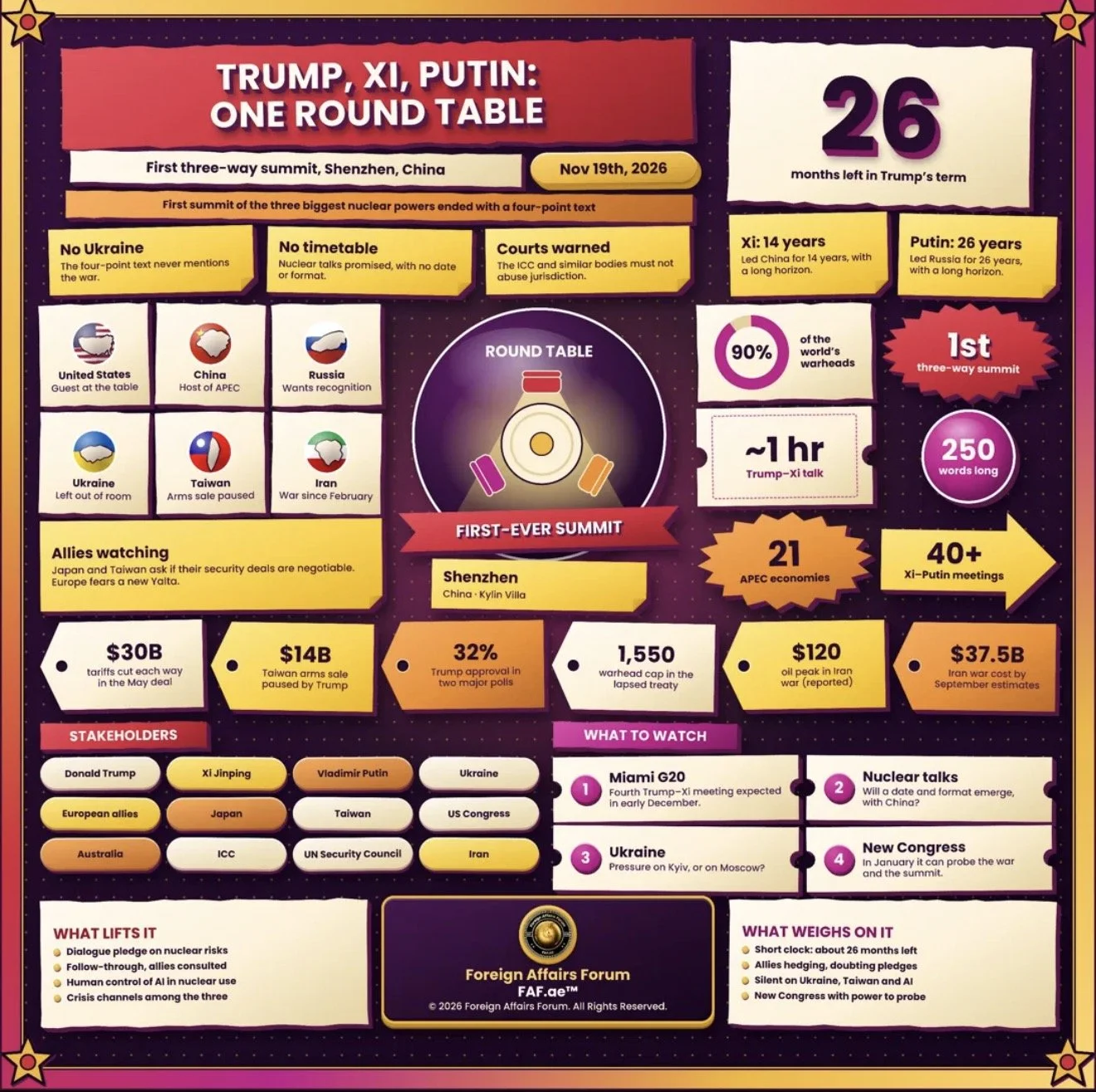
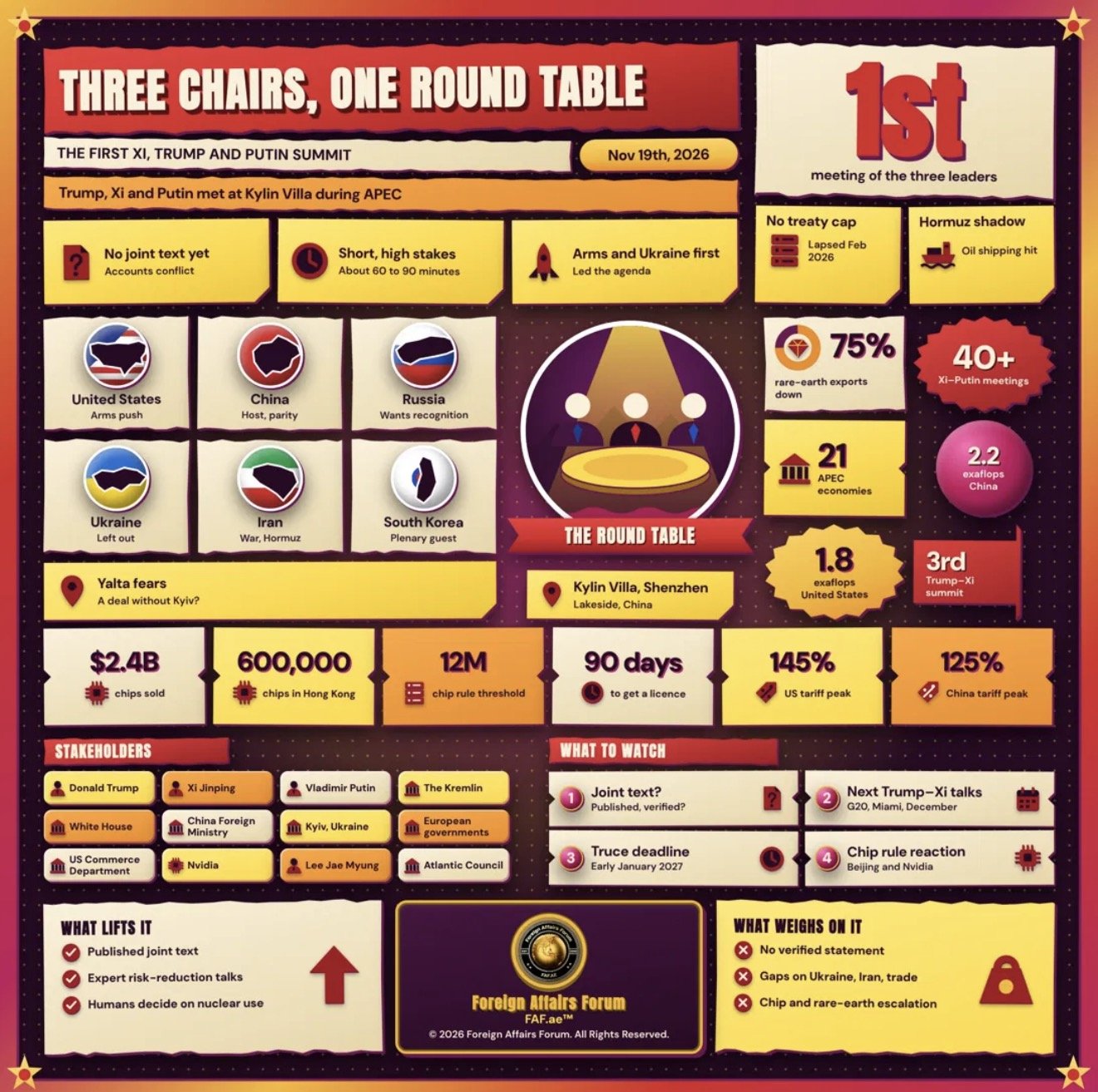
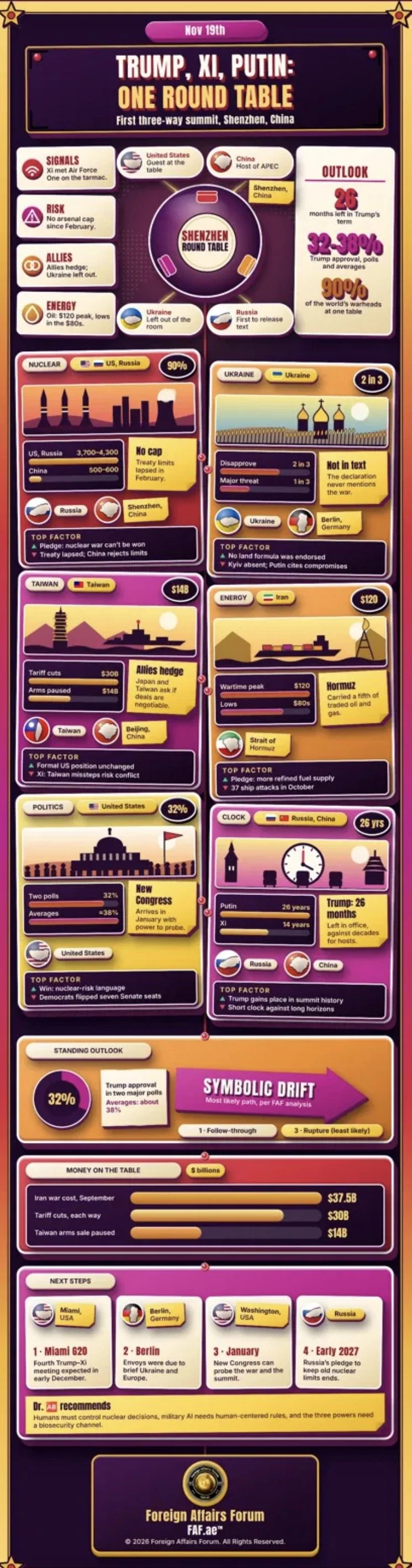
This week, on the margins of the 33rd Asia-Pacific Economic Cooperation leaders' meeting in the Chinese technology hub of Shenzhen, Donald Trump, Xi Jinping and Vladimir Putin held the first trilateral meeting in the history of their three countries. They sat at a circular table in a villa known as Kylin. Trump told the other two leaders that they were really making history, and on the narrow question of imagery he was right. The leaders of the three largest nuclear powers, which together hold roughly 90% of the world's warheads, had never before shared a room.
The outcome was a declaration of about 250 words with four points. It pledged United Nations reform, more production and supply of refined petroleum products, a warning that the International Criminal Court and similar bodies must not abuse their jurisdiction, and dialogue on nuclear risks under the principle that a nuclear war cannot be won and must never be fought. It was first published by Chinese state media and the Kremlin. The White House said nothing at first, and a later American readout echoed the Chinese and Russian versions. The declaration did not mention Ukraine. Trump left Shenzhen about an hour after the meeting ended.
The question for this FAF article is whether the summit enlarged or diminished American standing. Critics argue that Trump has secured an outsized place in history while shrinking the office he holds. He sat beside two leaders who measure their tenures in decades, while he has about 26 months left. His party lost both chambers of Congress earlier this month, his approval stands near 32% in two major polls, and the Iran war that began in late February continues to weigh on prices and politics at home. Supporters answer that talking to adversaries is overdue, that the nuclear language is real, and that nothing was conceded on Ukraine or Taiwan.
Per FAF analysis, the evidence supports a narrower conclusion than either camp offers. The summit delivered symbolism that Beijing and Moscow value highly, modest text for Washington and visible unease among allies. Its lasting effect will be decided by what follows, beginning with the Group of 20 summit in Miami in early December and the first weeks of a divided Washington in January.
Dr. 🆎 reads the summit as a test of whether great-power diplomacy can still produce guardrails for the technologies that now shape war. The declaration is silent on artificial intelligence, and that silence is the strategic gap that matters most.
Introduction
Summits are judged by what they leave behind. The Shenzhen trilateral left behind a photograph that will be reproduced for decades, a short text that says little new, and a set of questions about the direction of American power. The first-ever meeting of the three leaders was billed in advance as a possible new Yalta, a phrase that European officials used with evident anxiety. It ended instead as a spectacle of lofty rhetoric and thin results, which is its own kind of finding.
This FAF article examines what happened, what the declaration says and omits, how allies and analysts have reacted, and what the next twelve months are likely to bring. It draws on the reported record of the summit, official statements, polling and published estimates of nuclear forces. Where figures differ across sources, ranges are stated. The article also treats the central claim of the debate fairly. The argument that the summit diminished America is a serious one, and so is the argument that engagement with rivals is a legitimate instrument of statecraft.
Dr. Antonio Bhardwaj (Dr. 🆎), who follows human-centered AI, geopolitical strategy, AI warfare and bioterrorism risk, offers three observations that frame the analysis.
First, Dr. 🆎 notes that the three states in the room are the three leaders in military artificial intelligence, yet the declaration contains no commitment on human control over lethal and nuclear decisions, even though the United States and China affirmed such a principle for nuclear weapons two years ago.
Second, Dr. 🆎 observes that influence in this landscape belongs to stakeholders who can set agendas and write texts, and that the text of this declaration was first released by Beijing and Moscow.
Third, Dr. 🆎 argues that a world in which arms control is being replaced by photographs invites hedging, and that hedging by allies is the most reliable early indicator of declining confidence in a patron.
The sections that follow cover the background, the events of the day, the latest facts and concerns, the chain of cause and effect, three scenarios for the coming year and a conclusion.
History and Current Status
Three-way diplomacy among Washington, Beijing and Moscow has a long pedigree. In the 20th century, the American opening to China in the early 1970s reshaped the Cold War by exploiting the split between the two communist powers. For half a century the triangle was managed in pairs, with each capital talking to one of the others and never to both at once. The Shenzhen meeting broke that habit. It also reversed the older logic, because the two partners in the room today are closer to each other than either is to Washington. Putin has led Russia for 26 years and Xi has led China for 14. The two leaders have met more than 40 times since 2013, and Xi received Putin in Beijing only days after Trump left the Chinese capital in May.
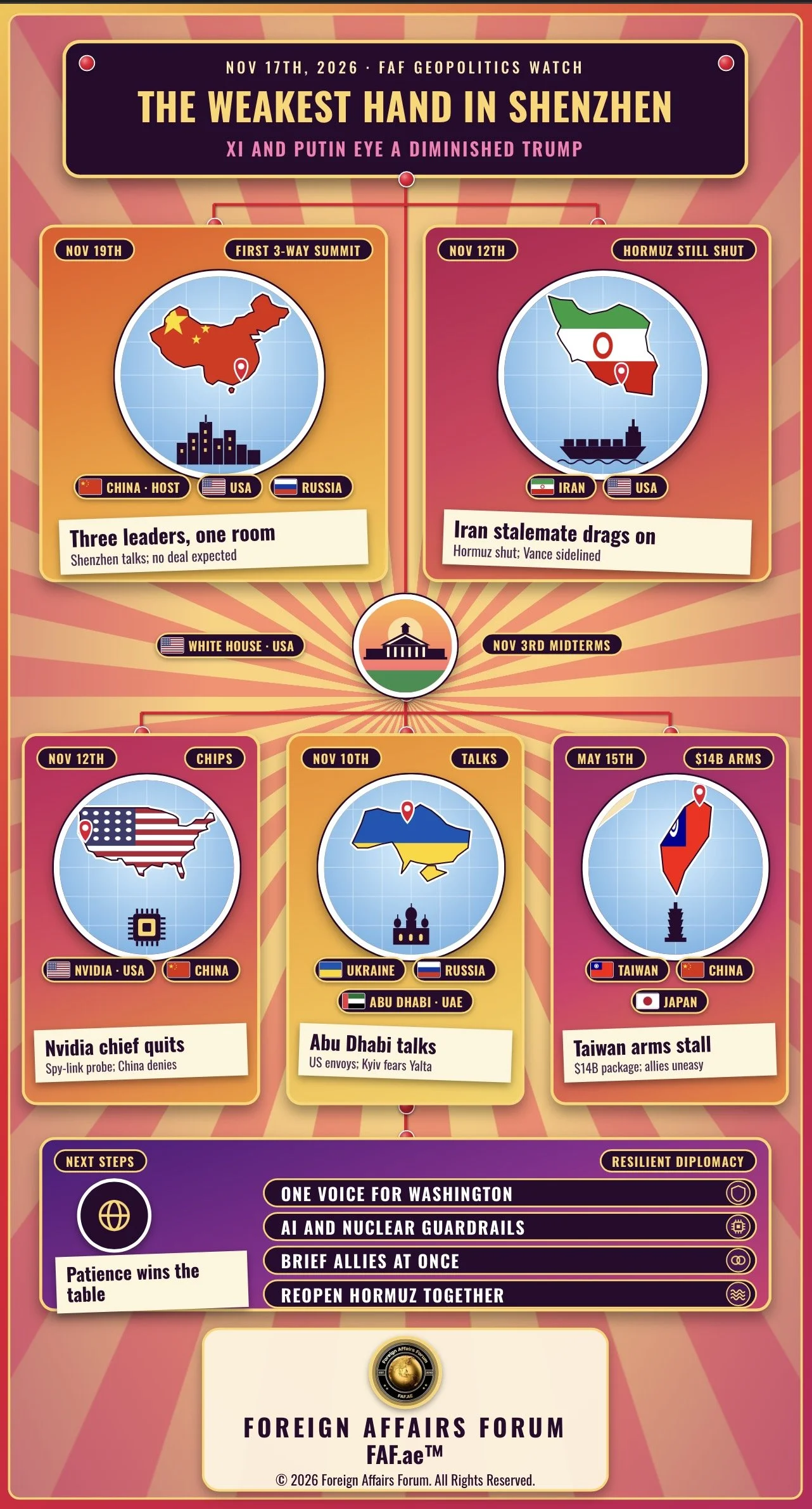
The immediate path to Shenzhen ran through a crowded year. A tariff truce struck at the Busan summit in 2025 steadied the trade war without ending it. The last face-to-face meeting between Trump and Putin took place in Alaska in 2025 and made no progress toward ending the war in Ukraine. In early February, the last treaty limiting American and Russian strategic nuclear forces lapsed, removing for the first time in decades any binding cap on the largest arsenals. At the end of February, the United States and Israel launched a war on Iran. The war closed or throttled the Strait of Hormuz, which before the conflict carried roughly a fifth of the world's traded oil and gas, and it has since become a struggle over who controls that waterway.
Trump's state visit to Beijing in May produced pageantry and a modest package. The two sides agreed to create a Board of Trade and a Board of Investment, to cut tariffs on about $30 billion of non-sensitive goods in each direction and, according to one account, to arrange Chinese purchases of 200 Boeing aircraft. They did not extend the tariff truce, and the two governments issued contradictory accounts of what had been promised. Xi warned Trump that mishandling Taiwan could lead to clashes and even conflict. After the visit, Trump paused a $14 billion arms sale to Taiwan. Xi visited Washington in September, and the Shenzhen encounter was their third meeting this year, with a fourth expected in early December.
The domestic backdrop has darkened. The Iran war has cost American taxpayers more than $37.5 billion by September estimates and left 18 service members dead, according to one tally. Fuel prices rose sharply, with the national average above $4 a gallon in the weeks before the midterm elections. In the early-November vote, Democrats won control of both chambers of Congress, flipping seven Senate seats in what may be the largest popular-vote victory for either party since 1976. The new majorities take office in January with powers to investigate, to challenge the legislative agenda and to block nominees. Trump's approval stands at 32% in the latest Reuters and Ipsos survey and in the Economist and YouGov series, which also records 63% disapproval and a net rating of minus 31. Averages that smooth many polls are higher, near 38% in early November, so the range of credible readings runs from about 32% to 38%.
The setting itself carried a message. APEC has grown from 12 members at its founding in 1989 to 21 economies, and it was hosted this year by Xi in a city of about 18 million people that has become a symbol of Chinese industrial ambition. About 115 Fortune Global 500 companies sent executives, with American firms accounting for almost 20% of them, the largest share after Chinese firms. Xi greeted Air Force One on the tarmac a day before the summit and embraced Trump, and Trump remarked that Xi had never before gone to an airport to meet a visitor. A China correspondent cautioned against reading it as a sign that the two leaders are now close. The scene was nonetheless set. Xi was the host, and the guest was grateful.
Key Developments
The second day of the leaders' meeting began with the family photograph of all 21 delegations, which Trump, Xi and Putin stood in together. Before the trilateral, Trump held two separate encounters. The first was a brief, unscheduled meeting with Putin that American officials described as a pull-aside rather than a formal bilateral. It was their first face-to-face contact since Alaska. Trump greeted Putin warmly, called him a friend and predicted that wonderful things could come of the occasion. The Kremlin's foreign-policy aide, Yuri Ushakov, said they discussed Ukraine and bilateral issues, that the conversation went well and that Putin left in an excellent mood. He added that there were no particularly significant statements.
The second encounter was a bilateral meeting with Xi that lasted about an hour. Trump called Xi a friend and said the two countries share a special relationship. He said that as long as the two of them are in charge, he does not expect a problem. Xi spoke of respect, fairness and reciprocity and described relations as stable and improving. Trump also credited the Board of Trade created in May with bringing balance to the relationship. At the APEC plenary he told leaders that artificial intelligence is almost completely good and should face minimal regulation, and he described America as a Pacific power for hundreds of years.
The trilateral followed at the villa, and it concluded in the late afternoon local time. Trump called the meeting an honor and told the other two they were making history. Xi called it positive, constructive and fruitful, said the three countries share a common perspective on safeguarding world peace and predicted that the seeds sown would take root and bear fruit. Putin said at a press conference that he had discussed Ukraine, blamed the war on the refusal of eastern regions to accept what he called a coup in Kyiv, said Russia had accepted certain compromises proposed by the United States and indicated that Ukraine and Europe were not yet ready for the concessions required. Trump departed for Washington roughly an hour after the meeting ended.
The four points of the declaration deserve reading one by one. The first commits the three permanent members of the United Nations Security Council to reform the organization so that it can respond more effectively to global challenges, without saying what the reforms would be. Analysts note that reform in this setting could mean smaller budgets for bodies that the three governments see as limiting their freedom of action. The second says the three countries plan to increase the production and supply of refined petroleum products and stresses the importance of stable energy flows. It does not name Iran, Hormuz or sanctions, though each lies behind the sentence.
The third point is the most unusual for an American signature. It affirms the principle of state consent and the immunity of state officials, and it says that the International Criminal Court and similar bodies must not abuse their jurisdiction. The court issued a warrant for Putin in 2023 over the deportation of Ukrainian children, and the Trump administration has imposed sanctions on the court and called it rogue. The fourth point reaffirms that a nuclear war cannot be won and must never be fought and pledges dialogue on reducing nuclear risks and preventing proliferation. It sets no timetable, no format and no inclusion of China in any negotiation.
Equally telling is what the text leaves out. It omits Ukraine altogether, and none of the published accounts of it mention Taiwan, Iran or artificial intelligence, the subjects that dominate the anxieties of allies and the agendas of the three governments. The absence of Ukraine will be read in Kyiv as relief that no territorial formula was endorsed and in Moscow as a sign that the war is not yet a subject of three-way pressure.
Reaction was swift and mostly cool. Australia's prime minister, speaking at the summit before the trilateral, told Putin directly to end his war. An Australian analyst predicted pomp and photographs without much outcome. European officials had spent days bracing. One diplomat said that each time Trump meets Putin the result is bad news for Ukraine and Europe, and others compared the prospect to Yalta. Poland's foreign minister recalled that the first Yalta recognized Soviet domination of areas the Red Army controlled. Ukraine's president said questions concerning Ukraine must be decided with Ukraine involved, and Kyiv's envoy in Washington said European security requires European participation. On the same day, the American envoys Jared Kushner and Steve Witkoff were due in Berlin to brief Ukrainian and European officials on the talks. Nine Democratic senators had urged Trump to press Xi on China's support for Russia's war effort.
Latest Facts and Concerns
The numbers that frame the summit are contested, and the ranges matter. On American approval, two major polls place Trump at 32%, while averages near 38% reflect different methods and earlier fieldwork. On nuclear forces, estimates of the active stockpiles of the United States and Russia range from about 3,700 to about 4,300 warheads each, while China is estimated at about 500 to 600 and is projected by the Pentagon to reach about 1,000 by the end of the decade. The three together hold roughly 90% of all warheads. The treaty that lapsed in February had capped deployed strategic warheads at 1,550 for each of the two older powers. Russia has said it would observe those limits unilaterally for one more year, until early 2027, and the United States has not reciprocated. On the Iran war, oil has swung between wartime highs reported near $120 and lows in the $80s at points this year, and attacks on ships in the strait reached 37 in October, the highest monthly total since the war began.
The first concern is Ukraine. The declaration is silent on the war, though the Kremlin says Ukraine was discussed and Putin says he left satisfied. A weakened American president who needs a foreign-policy success may be tempted to accept a deal that serves Moscow's aims. Two-thirds of Americans disapprove of his handling of the war, and only about a third regard the invasion as a major threat to American interests, which gives him limited domestic cover in either direction. Per FAF analysis, the absence of a concession is not the same as the absence of risk. The next negotiating round, prepared by the envoys in Berlin, will show whether the Shenzhen mood translates into pressure on Kyiv or on Moscow.
The second concern is Taiwan and the wider Pacific. Xi urged the three countries to avoid confrontation over Taiwan, and American partners in Asia are asking whether their own security commitments are now negotiable. Analysts expect many allies to hedge, toward Beijing, toward strategic autonomy, or both. The paused arms sale and Trump's earlier comments about Taiwan's independence and its payment for protection add to that anxiety. Washington's formal position has not changed, but the gap between formal positions and perceived intentions is where hedging begins.
The third concern is the legal landscape. By signing a text that says international courts must not abuse their jurisdiction, the United States aligned itself with the two governments most exposed to international criminal proceedings. That alignment will complicate efforts to rally support for accountability in Ukraine and elsewhere, and it will be cited by states that want to resist the reach of international tribunals. Supporters of the clause reply that the language restates long-standing American objections to jurisdiction over non-members.
The fourth concern is arms control without a framework. China has consistently rejected trilateral limits, citing the size of its arsenal relative to the other two. Beijing says it will not join talks until it approaches parity. The declaration's dialogue pledge therefore changes little in practice, and the vacuum that followed the treaty's lapse remains. A race to expand deployed numbers is possible once the unilateral Russian restraint expires.
The fifth concern is technology, and here Dr. 🆎 offers the sharpest observations. In the view of Dr. 🆎, three issues were left outside the room. The first is AI warfare. The three states lead in military applications that compress decision time, from automated targeting to autonomous surveillance, and Trump's own remarks at the plenary favored minimal regulation. A commitment that a human must control any decision to use nuclear weapons, which Washington and Beijing affirmed in 2024, would have cost nothing and signaled responsibility. The second is human-centered AI, the principle that systems should be built and governed to serve people and remain accountable to them, which is absent from a text on peace and stability. The third is bioterrorism risk.
Dr. 🆎 warns that advances in biological design and AI-assisted synthesis lower the barriers to engineered pathogens, that no single state can contain that danger, and that a summit of the three powers with the largest biotechnology and defense sectors was a natural place to start a biosecurity channel. None of these appears in the declaration.
The sixth concern is energy. The declaration's petroleum pledge is welcome on its face, but refined products are not the binding constraint in a market where tanker traffic through a contested strait is the bottleneck. Higher Russian and Chinese output cannot substitute for safe passage, and a settlement on Hormuz remains a matter for Washington and Tehran. The seventh concern is the American political calendar. The new Congress arrives in January with a mandate shaped by cost-of-living anxiety and by the war. Its committees can examine the Iran war, the summit's preparation and any commitments made in Shenzhen. A president facing that scrutiny has a strong incentive to seek visible foreign-policy successes, and counterparts know it.
Cause-and-Effect Analysis
The chain of causes that led to Shenzhen starts with necessity rather than design. The Iran war created an energy shock that Washington could not end alone and that China and Russia, as large energy producers and consumers, could ease or aggravate. The expiry of the nuclear treaty left the American president wanting a framework that included China, and he pressed the point repeatedly. The Kremlin, for its part, is reported to have proposed the three-way format and used it to seek recognition as a great power. Beijing, hosting APEC, gained the chance to be the broker. Each of the three had a reason to attend, but the reasons were not symmetrical.
The asymmetry is the heart of the matter. Xi and Putin act with decades of continuous authority and plan around Trump's remaining 26 months. A leader with a short horizon is more likely to prize a text that can be announced than a negotiation that must be sustained. Xi and Putin, by contrast, can afford to flatter and wait. They gain recognition, the stage and a declaration drafted in terms that suit them, such as state immunity and skepticism of international courts. Putin gains the appearance of normality without conceding on Ukraine. Xi gains the role of host and the status of a peer to Washington and Moscow, while insulating himself from the burden of an outcome. Trump gains a place in the history of summitry and an argument that he is willing to talk to adversaries.
The effects fall into four groups. The first is strategic. Allies that fear abandonment have more reason to hedge, and hedging is self-reinforcing, because every capital that diversifies its security ties reduces American leverage and prompts others to follow.
Dr. 🆎 argues from a geopolitical strategy perspective that middle powers will respond by building coalitions among themselves, in areas such as technology standards, energy security and defense procurement, and that those coalitions will reduce the value of American patronage. The second is normative. Language on state immunity and on courts, signed by the United States, shifts the baseline for debates over accountability. The third is institutional. The arms-control gap persists, and the declaration's dialogue promise will be tested by the first meeting that fails to occur. The fourth is domestic. A president with a low approval rating and a hostile Congress has less capacity to make binding commitments abroad, and counterparts understand this. Treaties require Senate consent, and a Democratic Senate majority will not be a rubber stamp.
Not every effect is negative, and an even-handed reading must say so. The nuclear sentence is not trivial. A statement that nuclear war cannot be won and must never be fought, endorsed by all three leaders, restores a Cold War principle at a moment when arms limits have lapsed, and it gives later negotiators a hook. Dialogue is better than silence. A shared interest in energy supply could also relieve pressure on consumers in many countries, if it translates into higher output. Supporters of the president argue that being in the room is how concessions are extracted and that an unpredictable negotiator is a stronger one.
Dr. 🆎 adds that crisis channels among nuclear powers are a public good, and that the larger risk lies in treating the existence of a channel as the achievement itself.
The legacy question follows from these effects. A presidency is judged by its lasting arrangements, and the arrangements of this term are mostly personal ones: summits, boards and declarations that depend on the continued attention of the leaders who made them. A legacy built on relationships is vulnerable to the end of those relationships. A legacy built on institutions, treaties and alliances survives its author. The summit's imagery points to the first kind, and its text does not yet point to the second.
Future Steps
Three scenarios describe the plausible paths over the next year. Each depends on the interplay of American politics, great-power behavior and the war in Ukraine. FAF analysis marks the second as the most likely.
The first scenario is stabilization through follow-through. The declaration's nuclear and energy language is turned into working groups, with the first sessions held early in the new year. The G20 meeting in Miami in early December produces a fourth Trump and Xi encounter and a modest trade announcement. Washington, Berlin, Paris and London keep their coordination on Ukraine close, and Kyiv remains at the table for any discussion of its future. The new Congress cooperates on a bipartisan approach to arms control. Russia's unilateral observance of the old limits is extended in exchange for American reciprocity. In this scenario the summit is remembered as an awkward but useful opening. It requires sustained attention from all three leaders and a degree of American domestic consensus that is not visible today.
The second scenario is symbolic drift. The declaration remains a text without machinery. The dialogue on nuclear risks stalls over Chinese refusal to accept limits, the energy pledge changes little in an Iran-dominated market, and the criticism of international courts is quoted in capitals that want weaker accountability. Allies continue to hedge quietly, and the American position on Ukraine and Taiwan remains formally unchanged while its credibility erodes at the margins. The Congress investigates the war and the summit, and the White House seeks another headline event. This scenario is the most likely, because it requires no decision from anyone and builds on the current balance of incentives.
The third scenario is rupture and bargaining against allies. A frustrated president, short of results, accepts a settlement formula on Ukraine that Kyiv and Europe regard as unacceptable, or trades Taiwan-related concessions for Chinese help on Iran. Allied governments respond with open resistance, accelerated European defense integration and independent diplomacy in Asia. The Senate balks, and the executive-legislative conflict spills into foreign policy. In this scenario the summit becomes the first step in a realignment that leaves the United States with fewer partners and more entanglements. The scenario is the least likely in the near term, because both Washington's formal commitments and the pressure of the new Congress restrain it, but allies cannot ignore it.
Across the scenarios, several steps are within the control of stakeholders. The White House should publish the full American readout and identify what Washington committed to. Congress should use its new powers to ask what was said about Ukraine, Taiwan and the courts. Allies should coordinate their positions before the next round of talks, so that no capital is negotiated over alone. Arms-control diplomats should seek a hotline and data-exchange arrangement that does not depend on Chinese acceptance of limits. Technology firms and research institutions should press for a human-control commitment on lethal and nuclear decisions.
Dr. 🆎 recommends three practical measures. The first is a trilateral commitment, however modest, that no artificial intelligence system will be given authority over the use of nuclear weapons, building on the 2024 American and Chinese affirmation and extending it to Russia. The second is a human-centered standard for military AI, requiring auditable decision trails, tested fail-safes and clear lines of command accountability. The third is a biosecurity channel among the three powers for sharing early warning of engineered biological threats, with technical experts rather than diplomats at the table.
In the view of Dr. 🆎, these are low-cost steps that would convert the summit's symbolism into protection.
Conclusion
The Shenzhen trilateral will be remembered for its photograph. The three leaders at a circular table are an image of how power is now arranged: three nuclear states, three long horizons or short ones, and a world watching to see what they decide. Whether the image marks a diminishment of American standing depends on a judgment that evidence can inform but not settle. The case for diminishment is that Washington sat as a guest in a Chinese-hosted meeting, signed a text first released by Beijing and Moscow, and did so with a short political clock and a shrinking base at home. The case against is that the president kept the conversation open, conceded nothing visible and secured language on nuclear risk that his predecessors struggled to obtain.
Per FAF analysis, the more durable answer lies in what comes next. A summit is a beginning, and an administration earns standing through follow-through, consultation with allies and agreements that outlast the people who signed them. The coming weeks will show whether the dialogue pledges become working groups or fade, whether Ukraine remains part of its own future and whether the new Congress becomes a partner or an adversary in foreign policy. Allies will watch each step.
Dr. 🆎 concludes that human-centered AI, disciplined geopolitical strategy and honest preparation for AI warfare and biological threats belong on the agenda of every summit between powers that can destroy the world. A legacy shrinks when the biggest questions go unasked. It grows when leaders use their moment to build guardrails that outlast them.