War by the Thousand: How Cheap Drones Are Changing Who Wins
A FAF article in simple English on the week that showed autonomous warfare has grown up
Summary
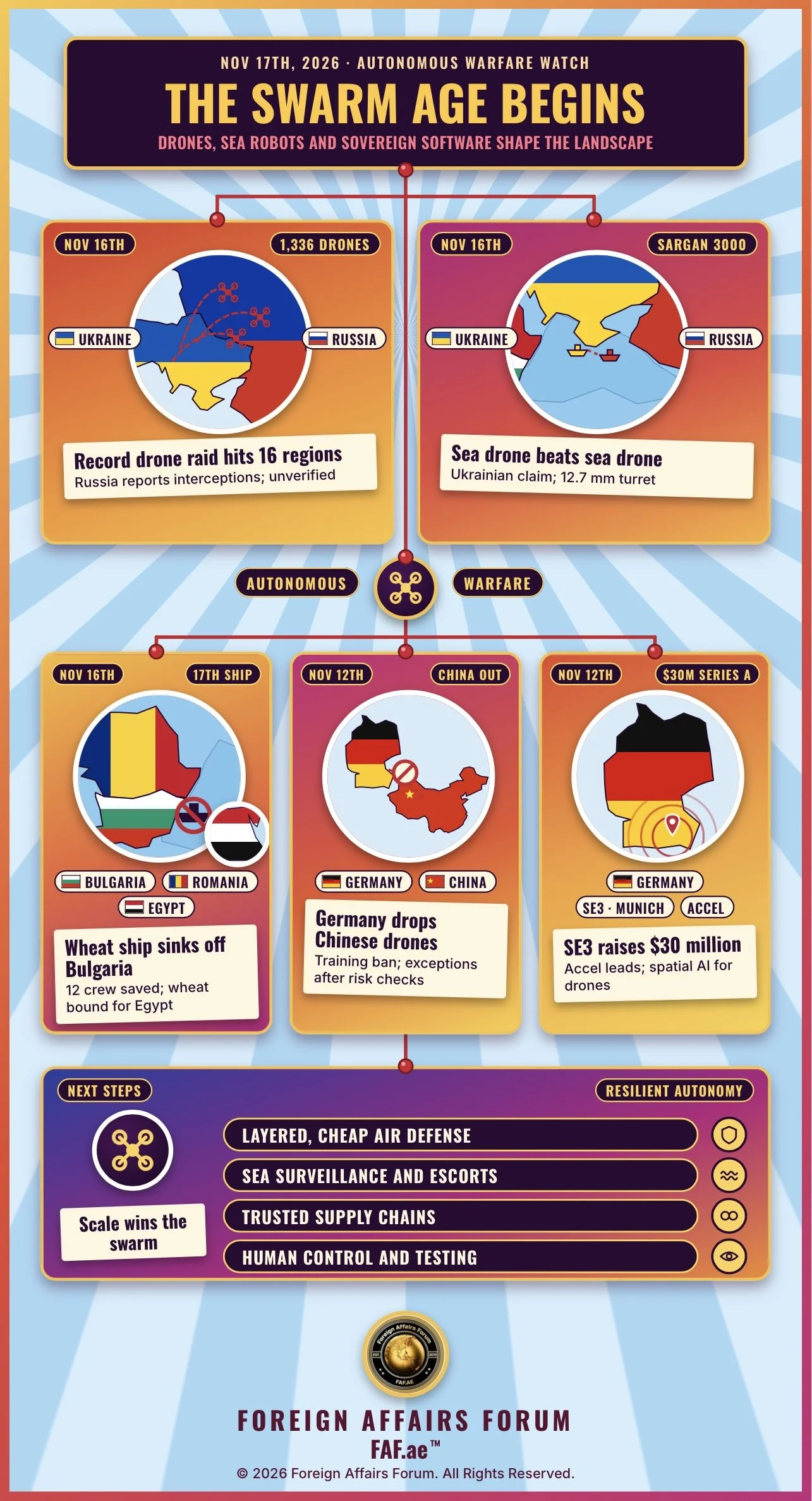
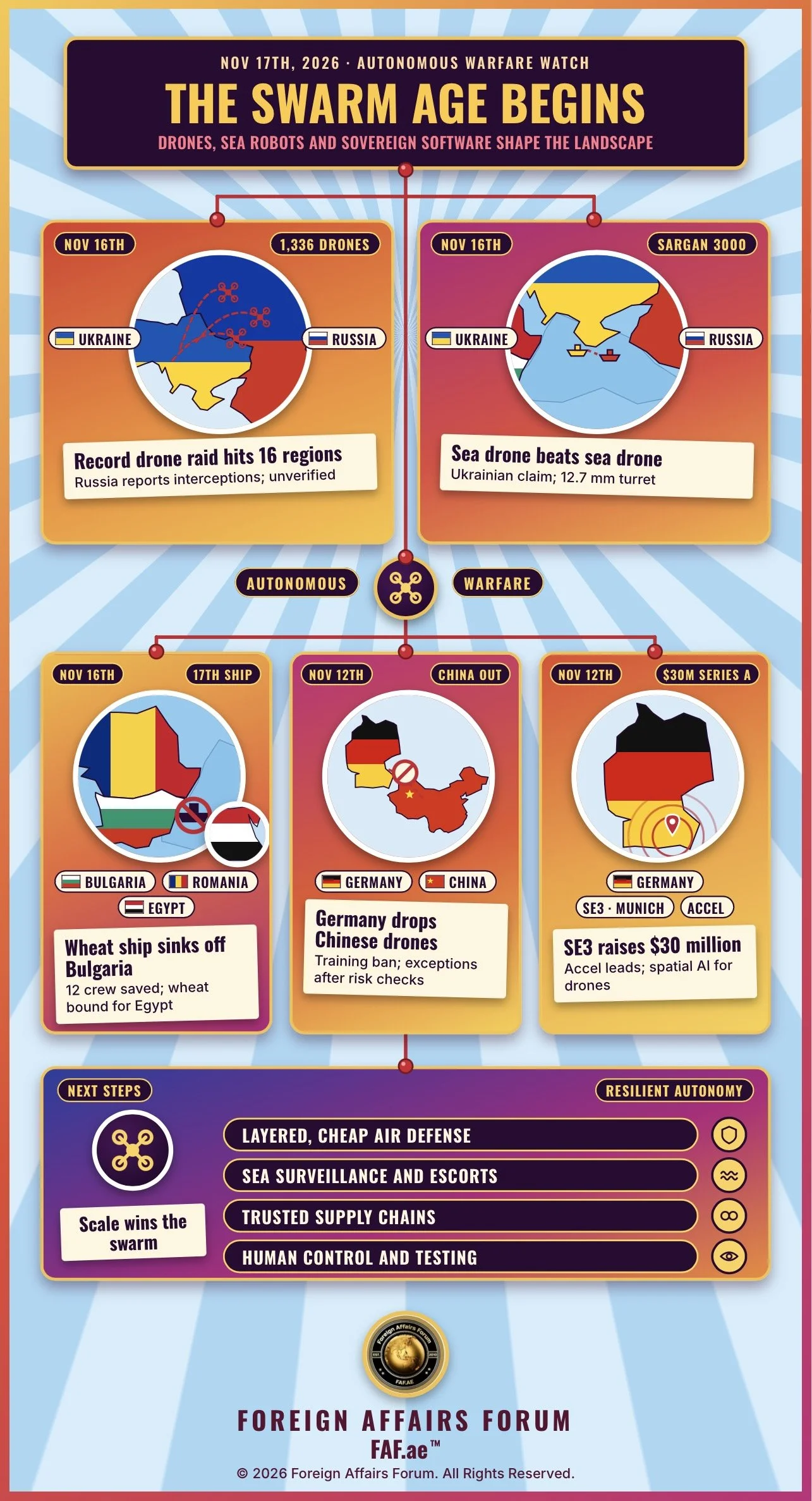
Between Nov 12th and Nov 17th, 2026, five news stories showed how war is changing. Russia said it stopped 1,336 Ukrainian drones in one night, the biggest number it has ever reported. Ukraine said one of its armed sea drones destroyed a Russian sea drone. A cargo ship full of wheat sank in the Black Sea after what looks like a sea-drone attack. Germany said its army will stop using Chinese-made drones for training. And a German start-up called SE3 raised $30 million to build smarter navigation software for military robots.
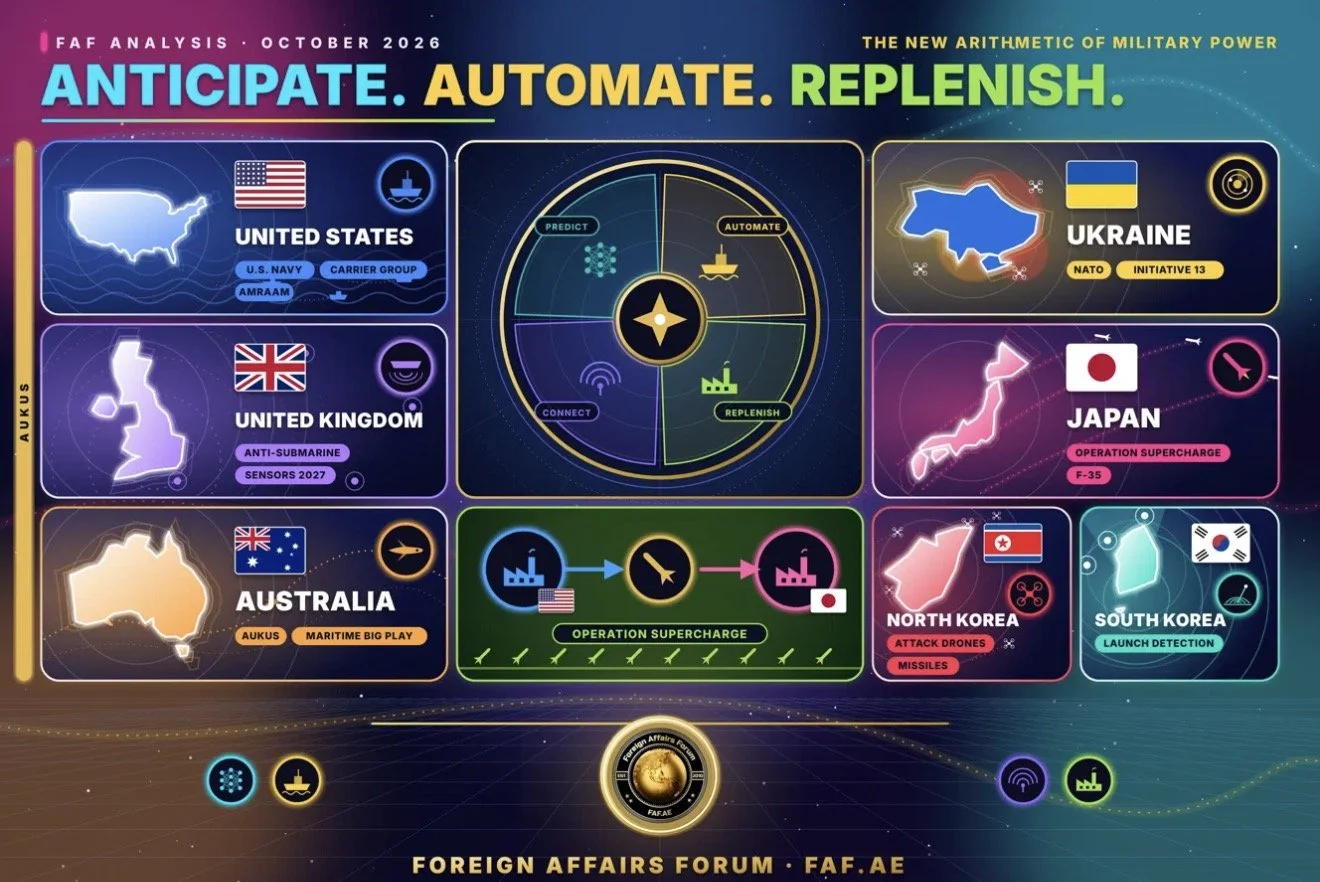
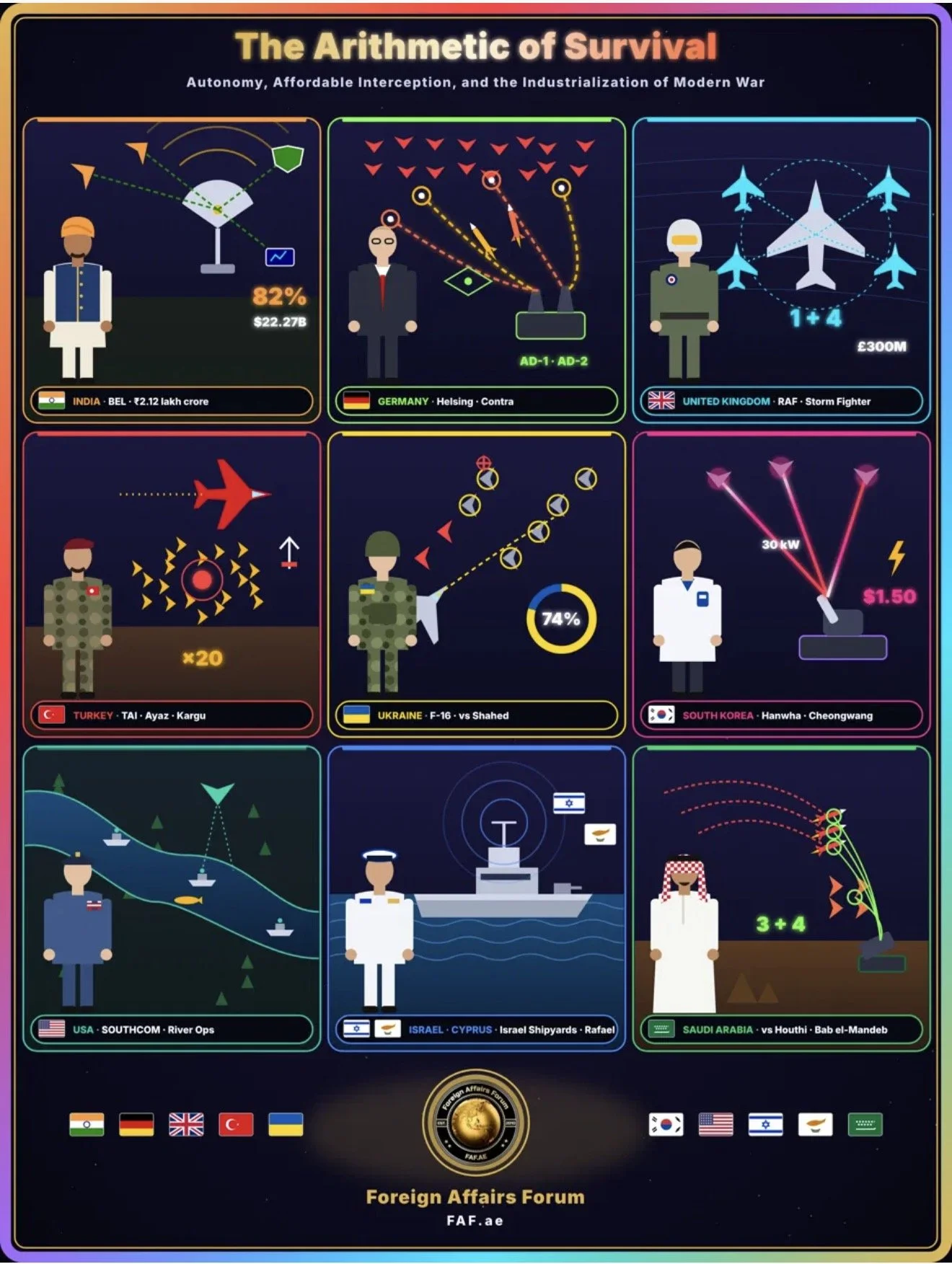
Per FAF analysis, the message is simple. War is no longer only about owning the best tank, ship or plane. It is about who can build thousands of cheap machines, guide them without help from satellites, defend against them without going broke, and protect ordinary shipping from getting caught in the middle.
Why This Week Matters
Dr. Antonio Bhardwaj (Dr. 🆎), an expert in human-centered artificial intelligence, geopolitical strategy and AI warfare, puts it this way: the winner will not be the side with the single best machine, but the side with the strongest whole system, from the factory to the software to the people who make the final decisions.
The Biggest Drone Attack Yet
On the night before Nov 16th, Russia's Defense Ministry said it had stopped 1,336 Ukrainian drones across 16 Russian regions. This is the largest number Russia has reported since the full-scale invasion began. The targets reportedly included energy sites, factories and the transport link between Crimea and the Russian mainland. Ukraine said it hit oil refineries and fuel storage sites.
It is important to be careful here. Nobody outside the two governments has confirmed the exact numbers or the full damage. Each side has reasons to tell the story in its own way. Still, even if the true number was a little lower or higher, the size of the attack tells us something. Ukraine can build large numbers of drones, plan their routes, and send them far across enemy territory at the same time.
Think of it like a football goalkeeper facing one hundred balls at once instead of one. Even a great goalkeeper will miss some.
Dr. 🆎 calls this the saturation problem: defenders must be perfect every time, while attackers only need to be numerous.
Sea Drones Fighting Sea Drones
The second story comes from the Black Sea. Ukraine says its sea drone, the Sargan 3000, destroyed a Russian drone boat using an automated gun turret. This is said to be the second time Ukraine has beaten a Russian unmanned boat without losing one of its own. The Sargan carries a remotely controlled 12.7 mm machine gun. These reports come mainly from Ukraine and have not been fully checked by others.
This matters because the first sea drones were basically floating bombs. They were built to crash into a ship and explode. The Sargan is different. It is a reusable armed boat that can protect itself and fight other drones. That means unmanned boats now need to spot, follow and defeat other unmanned boats, not only attack big ships.
Dr. 🆎 compares this to the first fights between airplanes in the sky. The early battles looked simple, but they showed that a whole new kind of warfare was coming. The Black Sea may be giving us an early look at what future naval battles in the Baltic Sea, the Persian Gulf and the Indo-Pacific could look like.
A Wheat Ship Goes Down
The third story shows how war at sea can hurt people who are not fighting. A cargo ship carrying about 3,000 metric tons of wheat sank inside Bulgaria's economic zone after what appears to have been a sea-drone strike. The ship was travelling from Romania to Egypt. All twelve crew members were rescued, which is good news. A maritime-security company said this was the 17th ship attacked off Bulgaria and Romania since mid-July. Nobody has said who carried out the latest attack.
Sea drones are cheap, hard to trace and easy to deny. This means a dangerous area can stay dangerous even when no one admits responsibility. When ships are attacked, insurance becomes more expensive, voyages get delayed and fewer companies want to sail. Countries that depend on imported food, such as Egypt, can end up paying more for bread. A weapon built for a battlefield can quickly become a problem for the whole world economy.
Germany Pulls Chinese Drones From Training
The fourth story comes from Europe. On Nov 12th, Germany's Defense Ministry said the Bundeswehr will stop using Chinese-made drones for training and some exercises. It will use German or other European drones instead. Some commercially available drones may still be allowed after a security check, as long as no sensitive military information is put at risk.
You might ask why a training drone matters. The answer is that a drone is not only a flying machine. It is also software, radio links, cameras and data. A drone that sends information to a foreign company, or needs updates from a foreign supplier, could leak secrets or be switched off at a bad moment. Germany is saying that it wants to know who controls the machine from top to bottom.
A Start-Up Teaches Drones to See
The fifth story is about money and ideas. The Munich start-up SE3 raised $30 million in a funding round led by the investor Accel. The company is building software that helps drones and other robots understand the three-dimensional world around them, almost like giving them better eyes and a better sense of direction.
This matters because enemies often jam satellite signals and radio links. A drone that depends on them can become lost or useless. A drone that can look at the ground, spot obstacles and find its own way can keep working even when signals fail. That is why this kind of software is becoming so valuable.
Still, a note of caution is needed. Raising money does not prove that a product works in the real world. A system must be tested in mud, smoke, bad weather and heavy jamming before anyone can trust it in a real conflict.
Dr. 🆎 warns that exciting announcements must never replace honest testing.
What Could Go Wrong
There are several real dangers. The first is escalation. If one side can hit energy and transport sites across many regions in one night, the other side will want to answer in the same way. Attacks on power and transport can hurt ordinary people far more than soldiers.
The second danger is losing human control. When signals are jammed and decisions must be made in seconds, there is pressure to let software choose targets alone. There are no firm international rules about how much freedom machines should have in deadly situations.
Dr. 🆎 believes the answer is human-centered design, meaning people must always be able to understand, check and overrule what the machine does.
The third danger is to ordinary shipping. Seventeen ships attacked in a few months is a pattern, not an accident.
The fourth danger is misuse by others. The same technology that helps armies can also be copied by criminals, terrorists and extremist groups.
Dr. 🆎, who has studied the risks of AI and terrorism for many years, warns that cheap, smart machines make it easier for bad stakeholders to attack buildings, power systems or crowds. Governments must prepare for that now.
What Should Be Done
Several steps would help. Governments should build layered defenses that are cheap enough to be used in large numbers, such as interceptor drones, rapid-fire guns and electronic jamming, together with better sensors that can spot low-flying machines. Important sites like refineries, power stations, rail hubs and ports should be hardened and made easy to repair.
European countries should treat drone supply chains as part of national security. They should know where parts and software come from, set strong security rules, and support factories that can build in large numbers at fair prices. Working together with allies would save money and speed up progress.
Finally, countries should agree on basic rules that keep humans in charge of life-and-death decisions, demand serious testing of navigation systems, and make someone responsible when automated systems cause harm.
The Bottom Line
The lesson of this week is that future military strength will depend on more than having advanced weapons. It will depend on building them in large numbers, making sure they work when enemies jam signals, and linking them into strong and secure networks. A country with many drones but weak software will struggle. A country with good software but few factories cannot keep up a long campaign. A country with both but with parts that come from rivals can be pressured. And a country with all of these but no cheap way to defend itself will keep paying a heavy price.
Dr. 🆎 ends with a simple thought. Speed is tempting, and more automation can feel like more safety, but the opposite can be true. The stakeholders who combine large-scale production with careful human judgment will lead the next era.
The Black Sea is only the first chapter. The questions it raises about cost, control, trust and responsibility will soon be asked in every sea and sky where unmanned machines operate.