Why Trump's Asia Trip Matters More Than It Looks
A simple guide to the president's journey to the Philippines and China, and what could come of it
Summary
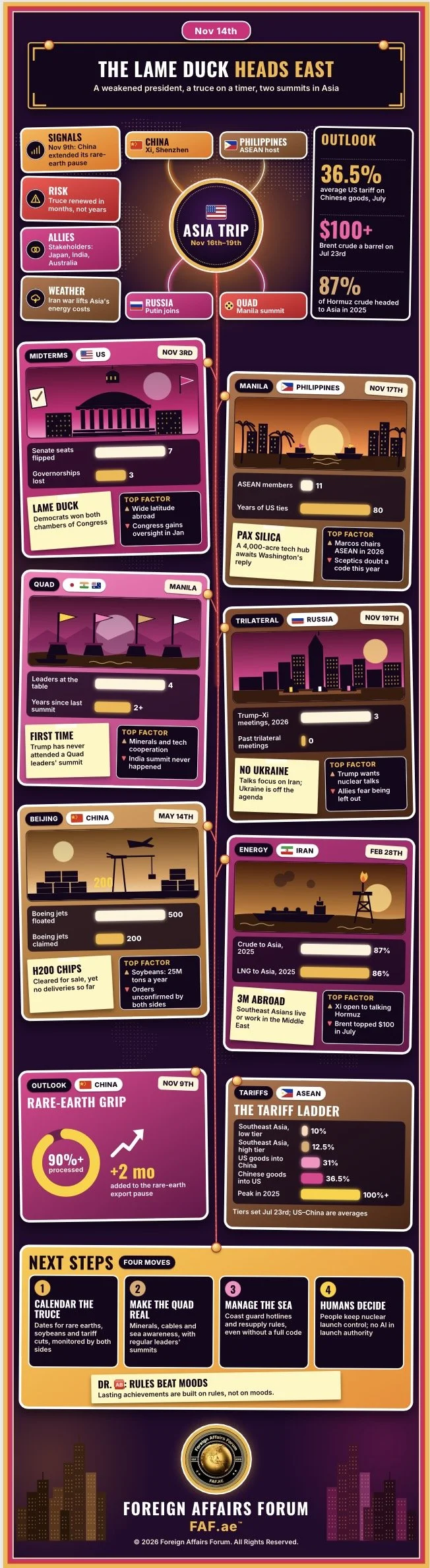
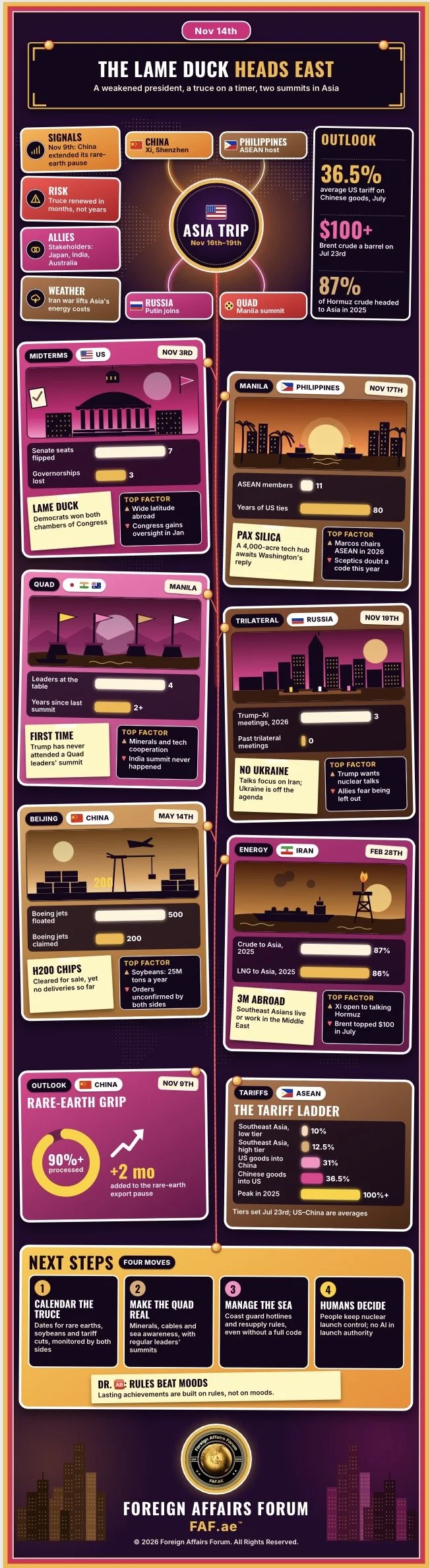
President Donald Trump leaves for Asia on Nov 16th. This is his first trip abroad since the midterm elections on Nov 3rd, when his party lost both the House of Representatives and the Senate. He will go first to Manila, in the Philippines, for a meeting of Southeast Asian leaders, and then to Shenzhen, in China, for a large meeting of Pacific economies. He will meet Chinese President Xi Jinping for the third time this year. The White House says he will also take part in the first-ever meeting of the leaders of the United States, China and Russia.
Many presidents travel abroad after losing a midterm. At home they face criticism and a new Congress that will not simply follow them. Abroad, they are still treated as the leader of the world's most powerful country.
Dr. 🆎 says the trip is also a test. It will show whether a weaker president can still win lasting promises from other countries.
What Happened at Home
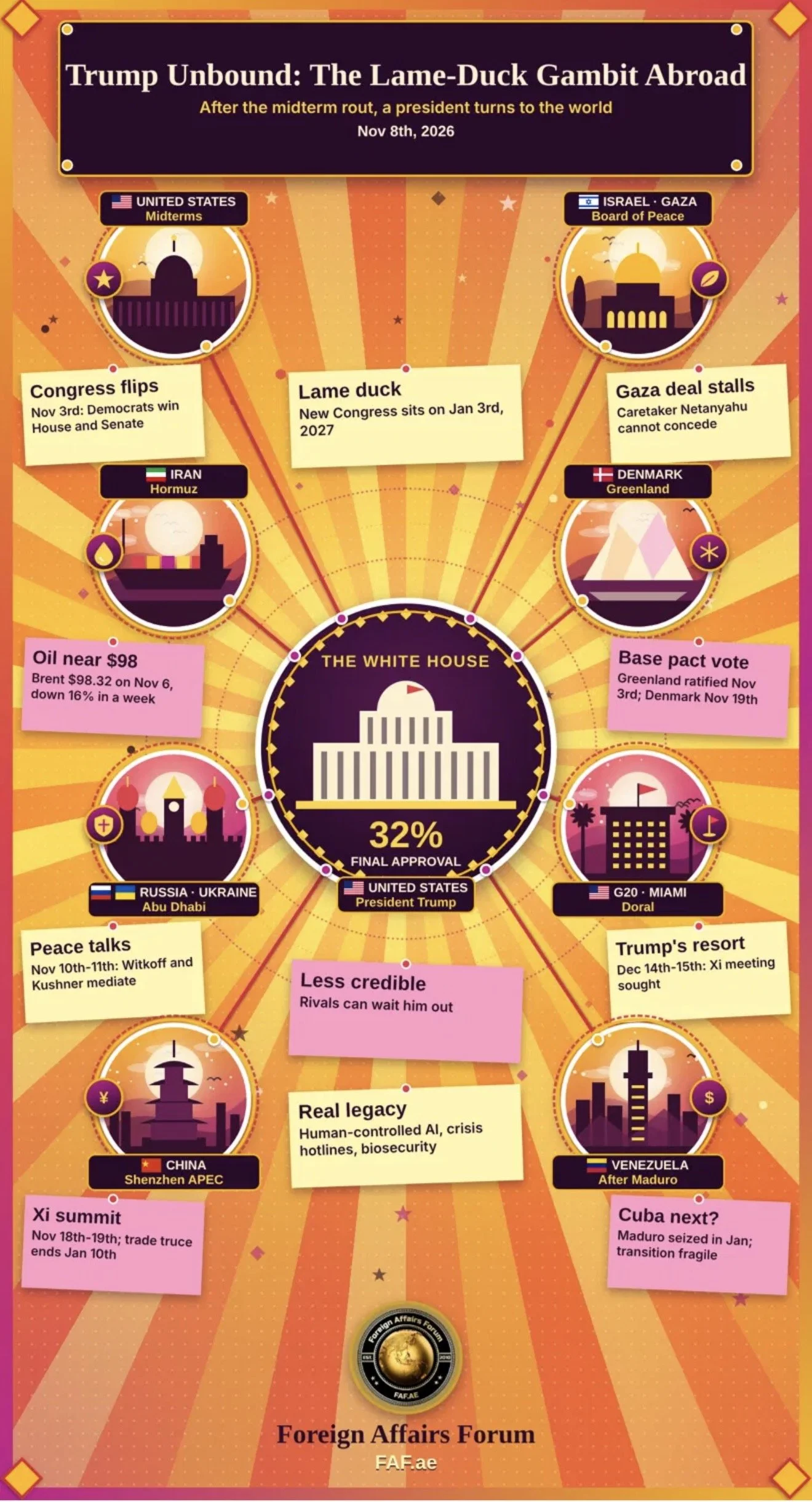
On Nov 3rd, voters gave Democrats control of the whole Congress. Democrats won seven Senate seats that Republicans had held, and they won a large majority in the House. Republicans also lost the governors' offices in Ohio, Georgia and Texas. Voters said they were worried about high prices and about the war with Iran. Trump has said he may use his veto power against bills from the new Congress.
This matters for foreign policy. From January, Congress will be able to ask hard questions, control spending and slow down some appointments. Other leaders know this. They may wait to see which promises Trump makes now will still stand in two years.
First Stop: Manila
Trump will arrive in Manila on Nov 17th. The Philippines is the host of this year's meeting of ASEAN, a group of eleven Southeast Asian countries. Trump will meet Philippine President Ferdinand Marcos Jr., and he will attend a summit between ASEAN and the United States. He is also expected to sign a trade deal with Thailand.
The Philippines is the oldest treaty ally of the United States in Asia. The two countries signed a defense treaty in 1951, and this year they mark 80 years of their relationship. China and the Philippines have had many tense moments at sea in the South China Sea, where both claim areas of water. Marcos wants ASEAN and China to finish a Code of Conduct, a set of rules to prevent accidents and conflict, before the end of this year. Many experts doubt that it will be ready in time.
The Quad Meeting
While in Manila, Trump will meet the leaders of the Quad. The Quad is a group of four countries: the United States, Japan, India and Australia. The other three leaders are Prime Minister Sanae Takaichi of Japan, Prime Minister Narendra Modi of India and Prime Minister Anthony Albanese of Australia.
The Quad has not held a leaders' summit for more than two years. The last one was in Delaware in Sept 2024. A planned meeting in India in 2025 never happened, and relations between Trump and Modi became tense. Some people in Japan and India worried that the United States no longer cared about the group. This meeting is a chance to show that the Quad is still alive.
Dr. 🆎 expects the leaders to focus on practical work, such as protecting supplies of critical minerals and strengthening technology links, since these matters are easier to agree on than military promises.
Second Stop: Shenzhen
After Manila, Trump travels to Shenzhen for the Asia-Pacific Economic Cooperation summit on Nov 18th and Nov 19th. APEC brings together 21 economies. On Thursday, Nov 19th, Trump will have a meeting and a working lunch with Xi. Later that day, he will meet both Xi and Russian President Vladimir Putin. American officials say they will talk mainly about Iran. They do not plan to discuss the war in Ukraine. Trump has also said he wants to talk about nuclear weapons.
Elon Musk is expected to travel with Trump to China, but he will not take part in the meetings between the leaders.
The Trade Truce
The United States and China have been fighting over trade for years. In 2025, tariffs on both sides went above 100% at one point. In Oct 2025, Trump and Xi agreed to a one-year truce in South Korea. China promised to buy American soybeans and to pause new limits on exports of rare earths. These are special minerals used in phones, cars and weapons. China makes more than 90% of the world's processed rare earths, so it has a lot of power over them.
Trump visited Beijing in May, and Xi visited Washington in Sept. Each time, the two sides agreed to keep the truce going, but they did not solve the big problems. Last week, China extended its pause on rare earth limits for two more months. American officials say China must still keep all of its promises. At the moment, American goods entering China face an average tariff of 31%, and Chinese goods entering the United States face an average of 36.5%.
Why Southeast Asia Is Worried
Southeast Asian countries sell many goods to the United States. In July, Washington set new tariffs of 10% to 12.5% on goods from 60 countries. Indonesia, Malaysia and Cambodia face 10%, while Singapore, Thailand, the Philippines and Vietnam face 12.5%. This came just one day after the American secretary of state told ASEAN ministers that the United States was with them "100 per cent". Many people in the region felt the message did not match the action.
Energy costs are another worry. The war with Iran has disrupted shipping through the Strait of Hormuz. In 2025, 87% of the crude oil that passed through the strait was going to Asia. Oil prices went above $100 a barrel in July. Around three million people from Southeast Asia work or live in the Middle East, so the war also affects their families.
Because of this, many countries in the region are trying to keep good relations with both Washington and Beijing. They do not want to choose a side. They want trade, safety and stable prices.
Technology and the Philippines
The Philippines has joined a US-led group called Pax Silica. Its aim is to protect supply chains for artificial intelligence, computer chips and critical minerals. The two countries plan to build a very large technology hub of about 1,620 hectares in New Clark City, north of Manila. A deal on how the hub will be run is still a draft. Manila is waiting for the American reply, and some groups in the Philippines worry that the project could pull the country into the rivalry between Washington and Beijing.
What Dr. 🆎 Says to Watch
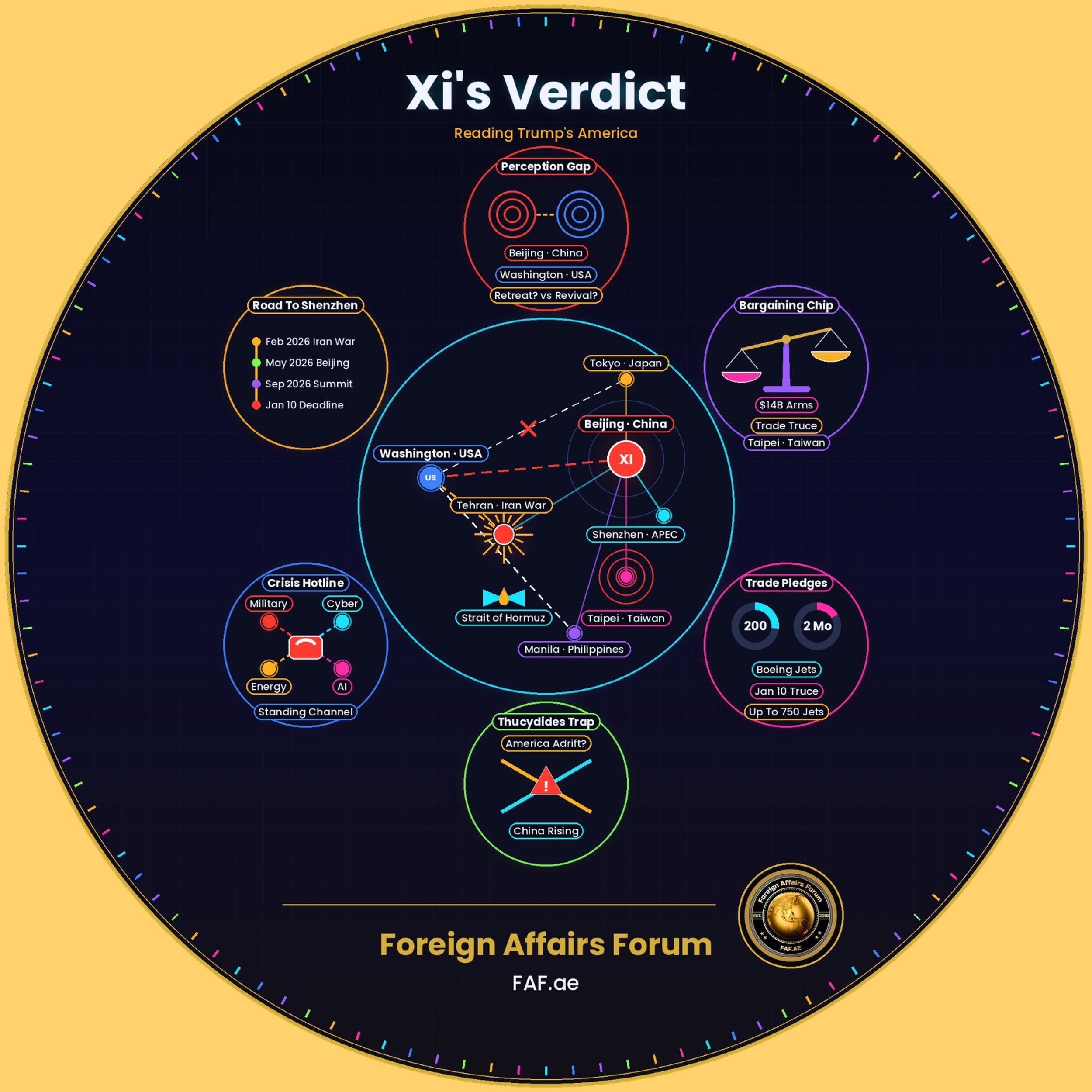
Dr. 🆎 believes that the biggest risks are not only about trade. He points to three dangers. First, artificial intelligence now helps armies find and attack targets very quickly. In busy waters like the South China Sea, a small accident could become a crisis before leaders can talk.
Second, the three leaders in Shenzhen control huge nuclear arsenals. Dr. 🆎 hopes they will agree that only humans, never machines, should decide on the use of nuclear weapons. Third, artificial intelligence could make it easier to design dangerous diseases. He says countries should set up an early warning channel on risky biological research.
What Could Come Next
If the trip goes well, we could see several results. The United States and China might agree on clear dates for the next steps in the trade truce. The Quad might announce small but real projects on minerals, undersea cables and maritime safety. ASEAN and China might agree on better ways to avoid accidents at sea, even if the full code is not finished. And the three leaders in Shenzhen might make a short statement about keeping humans in control of nuclear weapons and artificial intelligence.
If the trip goes badly, the truce could break down, allies could feel ignored, and Southeast Asian countries could move closer to China. Much will depend on whether Trump's promises are seen as lasting or only as a show.
Final Thought
Trump arrives in Asia with less political power than he had a year ago. The truce he depends on is short, his tariffs have upset friends, and many partners are quietly preparing for any outcome. Yet a president abroad can still set the tone, and the leaders he meets want stability.
Dr. 🆎 says the real prize is not a single trade deal. It is a set of simple rules that keep powerful countries, and powerful machines, under human control. If the leaders in Shenzhen can agree even on that, the trip will be remembered for more than its ceremonies.