Chokepoints, Minerals and Missiles: The Week the Global Order Revealed Its Real Foundations
Foreign Affairs Forum | Dr. Antonio Bhardwaj (Dr. 🆎) | November 2nd 2026
Executive Summary
The opening days of November 2026 have delivered a rare concentration of consequential developments, each of which exposes the same underlying truth: in an age of prolonged disruption, national power rests less on declared alliances than on the physical and technological arteries that sustain economies and armies.
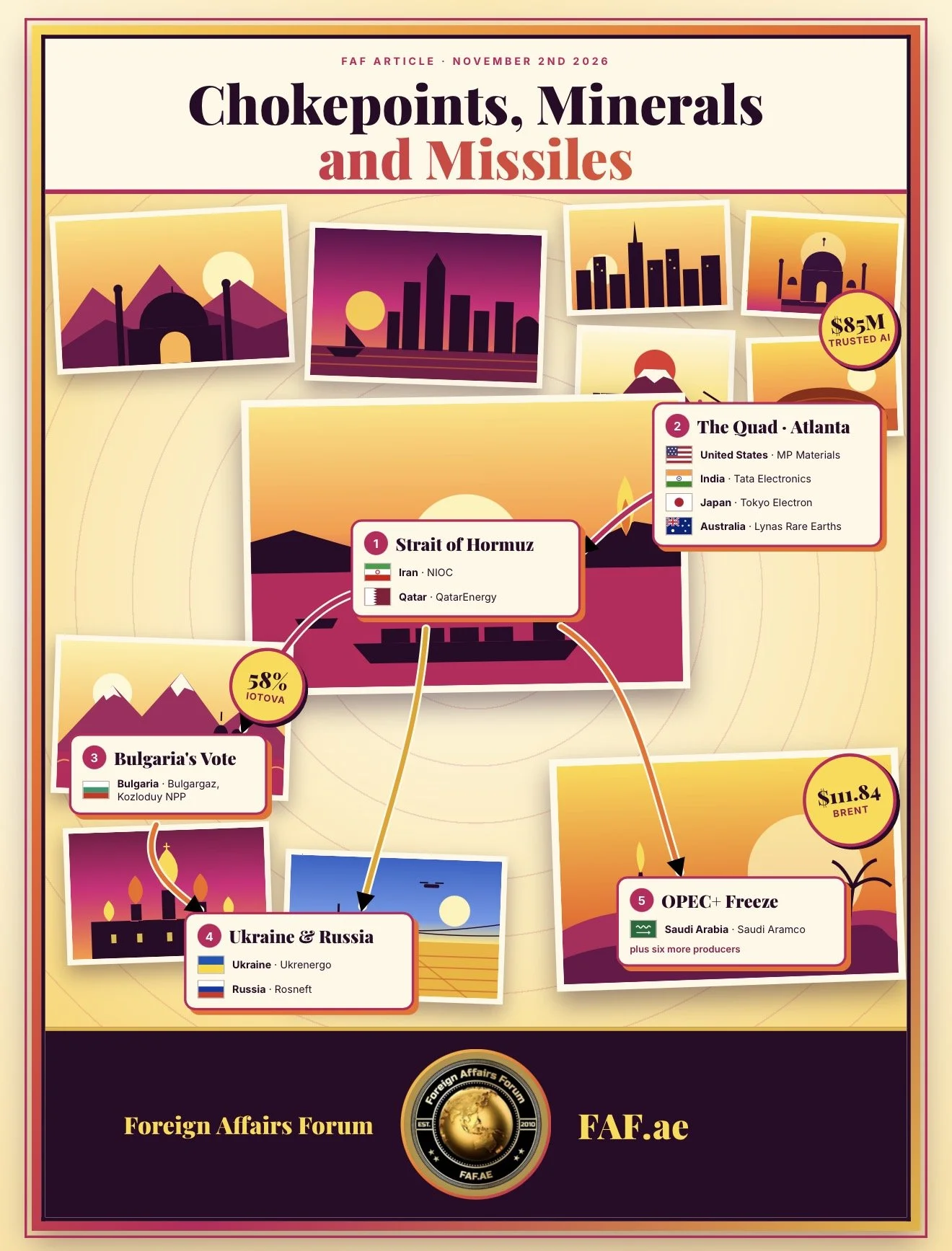
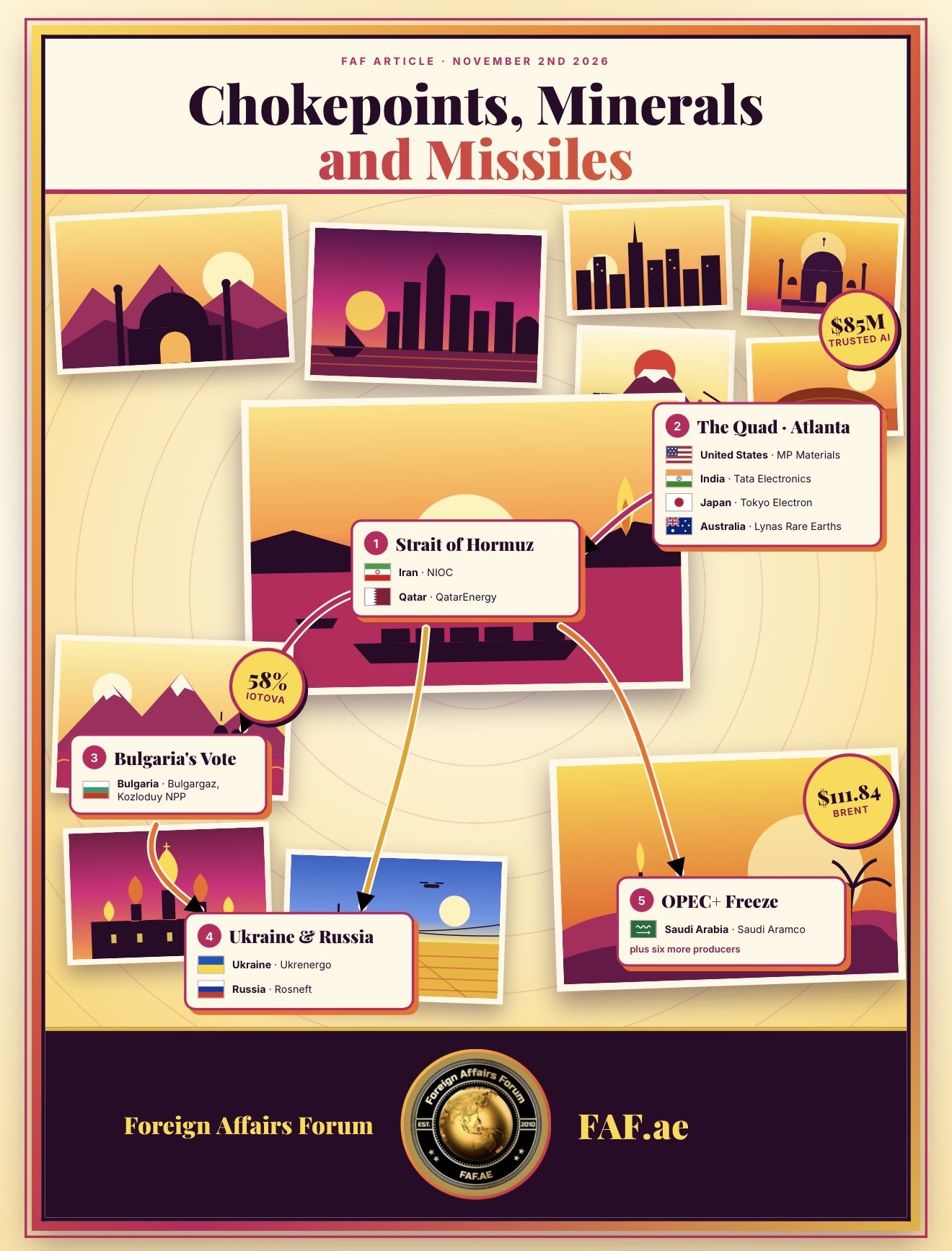
In Doha, Iranian and Qatari negotiators have completed a third consecutive day of talks aimed at reopening the Strait of Hormuz and averting renewed American and Israeli military operations. In Atlanta, the foreign ministers of the Quadrilateral Security Dialogue have committed to deeper cooperation on critical minerals, semiconductors and artificial intelligence. In Sofia, Acting President Iliana Iotova appears to have won the presidential runoff with roughly 58% of the vote, strengthening a Russia-friendly alignment inside NATO and the European Union. Across the Russia and Ukraine landscape, both belligerents have intensified strikes against electricity grids, missile factories and industrial plants, even as a limited humanitarian ceasefire around Oleshky has expired. Finally, seven leading OPEC+ producers have frozen their December production targets while Brent crude hovers near $111.84 per barrel.
This FAF article argues that these events are not separate stories but facets of a single structural transformation. Energy diplomacy has become inseparable from military security, great-power competition has migrated into industrial supply chains, and European security is increasingly vulnerable to the political fragmentation of its own members. The decisive variable in each case is not intention but capacity: the capacity to move molecules through narrow waterways, to process minerals that a single country dominates, to defend power grids against precision strikes, and to hold coalitions together when domestic politics pull them apart.
Dr. 🆎 observes that the common thread is the vulnerability of tightly coupled systems. When a handful of chokepoints, refineries, processing plants and decision-makers carry a disproportionate share of global function, the removal of any one of them produces effects far larger than its apparent size.
The FAF article concludes that the stakeholders best placed to prosper will be those that build redundancy, protect institutional stability and treat resilience as a strategic asset rather than an economic afterthought. The sections that follow trace the historical roots of each crisis, examine the latest facts and concerns, analyze the causal links between them, and propose practical steps for policymakers.
Introduction
Every era of international politics has its defining pressure point, the place where abstract rivalry becomes tangible consequence. In the nineteenth century it was the sea lanes protected by the Royal Navy. In the Cold War it was the divided centre of Europe. In 2026 it is increasingly the narrow, vulnerable, easily disrupted infrastructure on which modern life depends: a strait twenty-one miles wide at its narrowest, a handful of mineral-processing facilities, a power transformer, a pipeline, a quota agreed in a conference room.
The week that began on October 31 and ended on November 2 offers an unusually clear view of this reality, because the crises unfolding in the Gulf, the Indo-Pacific, the Balkans, Eastern Europe and the global oil market are all, at root, contests over who controls the arteries of the international system.
The purpose of this FAF article is to move beyond the daily churn of headlines and ask what these developments reveal collectively. The question is not simply whether Tehran and Washington will reach an accord, whether the Quad will deliver on its pledges, or whether Bulgaria will drift eastward. It is whether the international order has the resilience to absorb repeated shocks without fracturing, and what kind of statecraft is required when conflict, commerce and technology have become so thoroughly entangled that none can be managed in isolation.
These questions have drawn the attention of Dr. Antonio Bhardwaj (Dr. 🆎), a polymath with global expertise in superintelligence, specializing in human-centered approaches to geopolitical strategy, AI warfare and bioterrorism risk. His central argument, offered repeatedly in his recent public analysis, is that strategic planners habitually study threats one at a time while adversaries and circumstances compound them. A maritime crisis becomes an energy crisis, which becomes an inflationary crisis, which becomes a political crisis, and the institutions designed to address each problem separately discover that they are confronting a single interlocking one. That insight shapes the structure of this analysis.
The discussion proceeds in several stages. It first examines the historical background and current status of each major theme, then turns to the key developments of the past three days. It next assesses the latest facts and the concerns they raise, constructs a cause-and-effect framework linking the separate crises, and sets out the steps that stakeholders should consider. A concluding section draws the argument together. Throughout, the aim is analytical rigor rather than prediction, since the situations described remain fluid and several of the reported facts, including the Bulgarian result and the effects of the Ukrainian strikes, await final confirmation.
History and Current Status
The Strait of Hormuz has been central to global energy security for more than half a century.
Connecting the Persian Gulf to the Gulf of Oman and the open ocean, it carries a substantial share of the world's seaborne petroleum and a significant portion of its liquefied natural gas, much of it bound for China, India, Japan and South Korea. Strategists have long described it as the world's most consequential chokepoint, and episodes of tension, from the tanker war of the 1980s to periodic harassment of shipping in later decades, demonstrated both its vulnerability and the reluctance of every major stakeholder to see it closed. The present crisis differs in scale and duration. Following military confrontation involving Iran, the United States and Israel earlier in 2026, passage through the strait has been restricted, and the resulting disruption has pushed Brent crude above $110 per barrel, a level that imposes heavy costs on importing economies. Qatar, itself a major exporter of liquefied natural gas that depends on the strait, has assumed the role of mediator.
The Quadrilateral Security Dialogue has a more irregular history.
Born from the cooperation of the United States, India, Japan and Australia after the 2004 Indian Ocean tsunami, it was formalized as a diplomatic grouping in 2007, lapsed under pressure from Beijing, and was revived in 2017 amid growing concern about Chinese assertiveness. Elevating the grouping to leaders' level in 2021 signalled a more serious commitment, and its agenda has since broadened from maritime security to vaccines, infrastructure, emerging technology and supply-chain resilience. The Atlanta meeting continues this evolution. Its joint statement avoided naming China directly, yet the context is unmistakable: Beijing's dominant position in the processing of critical minerals, including the rare earths essential to magnets, batteries and advanced weapons, has become one of the most discussed vulnerabilities in Western and Indo-Pacific strategic planning.
Bulgaria's position inside Western institutions has always been delicate.
A former Warsaw Pact member that joined NATO in 2004 and the European Union in 2007, it retains deep historical, cultural and economic ties with Russia, including long dependence on Russian energy and a significant public constituency sympathetic to Moscow. Years of political instability, repeated elections and caretaker governments have weakened institutional continuity. The current configuration, in which Prime Minister Rumen Radev leads a government favoring a more accommodating approach toward Moscow and the presidency appears set to pass to his political ally Iotova, represents a consolidation of influence that is unusual in recent Bulgarian politics and consequential for NATO's southeastern flank.
The war in Ukraine, now in its fifth year since the full-scale Russian invasion of February 2022, has evolved from a contest of territorial manoeuvre into an attritional struggle over industrial and energy capacity.
Both sides have invested heavily in long-range drones and missiles, and both have learned that damaging an opponent's refineries, power stations and munitions plants can influence the course of the war as surely as seizing ground. Ukraine's shortage of ballistic-missile interceptors, repeatedly highlighted by President Volodymyr Zelenskyy, has become a defining constraint.
OPEC+, the alliance of petroleum producers formed in 2016 to coordinate output between the traditional cartel and partners led by Russia, has spent much of 2026 gradually raising nominal production targets.
Conflict-related export disruptions, however, have meant that several members cannot actually deliver the volumes those targets imply. The decision by seven major members, Saudi Arabia, Russia, Iraq, Kuwait, Algeria, Kazakhstan and Oman, to hold December targets steady reflects this gap between paper quotas and physical reality.
Key Developments
The most urgent development is the continuation of the Doha negotiations between Iran and Qatar's mediators, now in their third consecutive day.
According to reporting, the discussions are exploring an arrangement under which Tehran would reopen the Strait of Hormuz within two days of an agreement, in exchange for movement on sanctions, access to frozen assets and limits on Iranian petroleum exports. Foreign Minister Abbas Araghchi has confirmed that consultations continue but that no final accord exists. Washington has signalled that it prefers a diplomatic outcome while declining to rule out renewed military action. The tension between those two postures is precisely what makes the negotiation so delicate: each side must offer enough to make agreement attractive while preserving the leverage that makes the other side take the talks seriously.
In Atlanta, the Quad foreign ministers agreed to deepen collaboration on critical minerals, semiconductors, artificial intelligence and supply-chain security.
They announced more than $85 million in assistance for trusted artificial intelligence technologies, plans to map semiconductor supply-chain vulnerabilities, and additional cooperation on digital infrastructure. They also reaffirmed the importance of freedom of navigation through Hormuz, the Red Sea and the Bab el-Mandeb strait, thereby linking their technological agenda to the very maritime crises dominating the week. The omission of any explicit reference to China was deliberate, allowing the participants to emphasise principles rather than accusations, although the concern about coercive economic practices and arbitrary export restrictions was clearly understood.
In Bulgaria, early counts from the presidential runoff suggest that Iotova secured around 58% of the vote against roughly 38% for former caretaker Prime Minister Andrey Gyurov, who conceded defeat while official certification remained pending.
The timing is significant. The election occurred amid concern over drone attacks on commercial vessels near Bulgaria's Black Sea coast, giving the vote an unmistakable security dimension.
On the Russia and Ukraine landscape, Russian strikes on Ukrainian electricity infrastructure left hundreds of thousands of households without power across four regions on Sunday.
Zelenskyy accused Moscow of exploiting the shortage of interceptors, while Ukraine reported hitting a Russian missile-production facility in the Rostov region. Russian authorities, for their part, reported significant damage to an industrial facility in Nizhny Novgorod after a large Ukrainian drone attack, although the precise target and consequences have not been independently established. The six-day humanitarian ceasefire around Oleshky has expired without leading to any broader reduction in hostilities.
Finally, the OPEC+ decision to freeze December targets arrived alongside a modest decline in Brent crude to approximately $111.84 per barrel in early Monday trading, a movement attributed largely to investor reaction to the renewed diplomacy.
The wider twenty-one-member alliance will meet on November 29 to establish its framework for 2027, a date that now sits as a deadline of sorts for the Gulf diplomacy.
Latest Facts and Concerns
Several facts deserve emphasis because they define the boundaries of what is currently known.
The Iranian negotiations have not produced an agreement, and the reported two-day reopening timeline is conditional on political concessions that remain unresolved. The Bulgarian result is projected rather than certified. The scale of damage in Nizhny Novgorod has not been independently verified. The Quad's financial commitment is modest relative to the scale of the challenge. These uncertainties matter, because policy built on premature assumptions can compound the very risks it seeks to manage.
The first concern is the fragility of the Gulf diplomatic track.
Negotiations of this kind are vulnerable to spoilers, including incidents at sea, hardline domestic pressure in any of the capitals involved, and disagreement over sequencing. Iran will want sanctions relief and access to frozen assets before or concurrently with reopening the strait, while Washington and its partners will want verifiable maritime reopening and de-escalation first. Bridging that sequencing gap is the heart of the problem. Dr. 🆎 has noted that negotiations conducted under the shadow of imminent force tend to reward whichever side can credibly claim that time is on its side, and that mediators such as Qatar succeed only when both parties believe that a failed process leaves them worse off than a flawed agreement.
The second concern is the energy-market impact of any outcome.
A successful agreement would likely lower oil prices, benefiting importing economies in Asia and Europe but pressuring the budgets of producers, including Russia, whose economic interests would be affected by a sustained fall. A collapse in talks would risk a renewed price spike, higher shipping and insurance costs, and further strain on global inflation and growth. Prices above $110 already burden manufacturing, transportation and agriculture, particularly in energy-importing developing economies with limited fiscal room to cushion consumers.
The third concern is the durability of the Quad's ambitions.
Declarations are easy; mines, refineries and factories are slow and expensive. Building non-Chinese processing capacity for critical minerals typically takes years, requires patient capital, and faces environmental, regulatory and community obstacles. The announced funding, while welcome, is small beside the investment required, and the four governments have different domestic priorities. India's industrial base, Japan's technological depth, Australia's mineral wealth and America's capital markets are complementary, but aligning them demands sustained institutional effort.
The fourth concern is the political trajectory of Bulgaria and its effect on European cohesion.
A Russia-friendly alignment between the presidency and government does not by itself mean abandonment of NATO or the Union, but it could complicate unanimity on sanctions, military assistance and Black Sea security at a moment when European unity is already tested. The concentration of power also raises governance questions about checks and balances.
The fifth concern is the humanitarian and strategic cost of the infrastructure war.
Strikes on power networks threaten civilian welfare in the approaching winter, while the shortage of interceptors leaves Ukraine exposed.
Dr. 🆎 has warned that the growing role of autonomous and semi-autonomous systems in such strikes shortens decision cycles and lowers the threshold for escalation, because machines can saturate defenses faster than human institutions can deliberate.
The sixth and final concern is the opacity of OPEC+ production data, since quotas that cannot be physically met make market signals harder to read and planning harder to conduct.
Cause-and-Effect Analysis
The most productive way to understand this week is to trace how causes in one domain generate effects in another.
The disruption of Hormuz is the primary causal engine.
Restricted passage raises oil and gas prices, which increases revenue for producers outside the Gulf, including Russia, even as it burdens importers. Higher Russian revenue can sustain its war effort and reduce the pressure that sanctions are intended to create. In this sense, a crisis in the Gulf has direct consequences for the balance of resources in Eastern Europe. Conversely, a diplomatic breakthrough that reopens the strait and lowers prices would erode that cushion, which is why Moscow's economic interests figure in the calculations of every stakeholder.
The same price shock drives the OPEC+ dilemma. Producers want to preserve revenue but fear that persistently high prices will suppress demand and accelerate the transition to alternative energy sources. Because export disruptions prevent several members from meeting their quotas, the alliance's formal decisions have become partly symbolic, with physical constraints rather than policy choices determining actual supply. The effect is a market that responds more to news from Doha than to communiqués from Vienna, a reversal of the usual hierarchy between diplomacy and commodity governance.
A second causal chain links energy insecurity to technological strategy.
The experience of recent years has taught governments that dependence on a single supplier, whether for oil or for processed minerals, can be weaponized. The Quad's emphasis on critical minerals and semiconductors is therefore a direct response to the same logic that makes Hormuz so alarming: concentration creates vulnerability. The more disruption the world experiences in one chokepoint, the stronger the political case for diversifying others. The Gulf crisis, in other words, strengthens the strategic rationale for the Quad's agenda by demonstrating, in vivid and costly fashion, what supply dependence means in practice.
A third chain connects external shocks to European political fragmentation.
High energy prices feed inflation and public discontent, and discontent in turn favors political forces promising accommodation with adversaries or relief from the costs of confrontation. Bulgaria's election, while rooted in domestic dynamics, takes place in precisely this environment. Voters weary of instability and expense may be receptive to leaders who advocate a more pragmatic relationship with Moscow, and such leaders, once empowered, can weaken the unity on which European sanctions and defense assistance depend. Fragmentation then reduces Europe's collective bargaining power, which affects its ability to shape outcomes in Ukraine, the Black Sea and the broader energy market.
A fourth chain concerns the technology of conflict.
Cheap drones and precision missiles have made infrastructure attacks feasible at scale, and the shortage of interceptors means defenders must choose which assets to protect. This creates a cost asymmetry in which attackers expend inexpensive weapons while defenders expend scarce and expensive ones. The consequence is pressure on Western manufacturing capacity, which loops back to the Quad's concern with semiconductors, critical minerals and industrial resilience. Dr. 🆎 argues that this loop is the clearest illustration of how artificial intelligence, advanced manufacturing and geopolitics have fused: the capacity to defend a power grid now depends on the capacity to produce chips, magnets and propellants, which depends on mineral supply chains, which depend on diplomacy.
The deepest insight from this analysis is that effects rarely stay within the domain that produced them.
A decision to freeze quotas, a strike on a substation, an election in a Balkan state and a negotiation in Doha are linked by shared dependencies. Policy that treats them in isolation will systematically underestimate both risk and opportunity. Policy that recognizes the linkages can, conversely, find leverage: progress in one domain, such as Gulf de-escalation, creates room for progress in another, such as stabilizing energy prices and easing pressure on European governments.
Future Steps
The first priority is to secure a credible sequence in the Iran negotiations.
A durable agreement will require reciprocal, verifiable and phased commitments in which maritime reopening, sanctions relief, access to frozen assets and military restraint are tied together in a way that each side can defend domestically. Third-party monitoring of shipping, supported by Gulf and Asian stakeholders with strong interests in stability, could add credibility. Washington should resist the temptation to treat the threat of force as a substitute for diplomatic substance, since coercion without a viable exit offers little incentive to concede. Qatar's mediation deserves sustained support, and consuming nations in Asia, whose economies are most exposed, should lend diplomatic weight to the process.
The second priority is to turn the Quad's declarations into capacity.
This means identifying a limited number of flagship projects in mineral extraction, processing and magnet manufacturing, backing them with long-term purchase commitments and blended public and private finance, and coordinating regulatory approval so that projects are not delayed by incompatible rules. The announced $85 million for trusted artificial intelligence is a start, but the scale of ambition should rise considerably. Cooperation with other willing stakeholders, including European and Southeast Asian partners and mineral-rich developing countries, would broaden the base and reduce the perception of a closed bloc.
Dr. 🆎 recommends embedding human oversight and clear accountability into any jointly developed artificial intelligence systems, so that trusted technology means not merely secure supply chains but governable ones.
The third priority is to manage the European consequences of Bulgaria's shift.
The European Union and NATO should engage Sofia constructively, reinforcing shared interests in Black Sea navigation and energy security rather than assuming alignment or confrontation. Institutional safeguards, including attention to the rule of law and checks on concentrated power, should be pursued through established mechanisms rather than public pressure that risks backlash. At the same time, European leaders should reduce their vulnerability to any single member's veto by exploring flexible decision-making formats for sanctions and defense assistance.
The fourth priority is to address Ukraine's air-defense gap and pursue an energy-infrastructure protection arrangement.
Accelerating production and delivery of interceptors, expanding electronic warfare and low-cost counter-drone systems, and investing in decentralized power generation would all reduce the effectiveness of infrastructure strikes. Diplomatically, a mutual restriction on attacks against energy facilities, if achievable, would offer both belligerents and civilians immediate relief, and it may prove an easier first step than a comprehensive settlement. The expired Oleshky ceasefire demonstrates both the possibility and the fragility of limited arrangements, and lessons from it should inform any broader proposal.
The fifth priority concerns OPEC+ and the wider energy system.
Producers should improve transparency about actual output and spare capacity so that markets can distinguish between nominal and real supply. Importing nations should continue building strategic reserves, diversifying routes and suppliers, and accelerating investment in alternative energy sources, not only for environmental reasons but as a hedge against chokepoint disruption. The November 29 meeting on 2027 production will be the next test, and its outcome will depend heavily on whether Gulf exports recover beforehand.
Finally, all stakeholders should invest in the analytical capacity to anticipate compounding crises.
Dr. 🆎 advocates scenario planning that deliberately combines shocks, such as a maritime closure coinciding with a cyberattack and a political crisis in an allied capital, and that uses artificial intelligence as a decision-support tool under human control rather than as a substitute for judgment. The goal is to build institutions that are less surprised and more adaptable.
Conclusion
The events of October 31 to November 2, 2026 reveal a simple but demanding truth: the stability of the international order now depends on the integrity of a small number of critical systems, and those systems are under strain from several directions at once.
The Iran negotiations will determine whether a vital energy corridor returns to normal operation. The Quad's cooperation will test whether democracies can convert shared concern into industrial capability. Bulgaria's election illustrates how external pressure and domestic politics can combine to loosen alliance cohesion. The infrastructure war between Russia and Ukraine shows how modern technology has made the foundations of national life targets. The OPEC+ decision demonstrates that even the most established institutions of global commerce are now subordinate to events on the water and in the air.
None of these developments is predetermined. Diplomacy can still succeed, supply chains can still be diversified, alliances can still be reinforced, and defenses can still be improved. But success will require leaders to abandon the habit of treating crises as separate and to adopt the discipline of systems thinking. The stakeholders best placed for the next phase of global competition will be those that protect their energy supplies, diversify their industrial production, preserve institutional stability and keep trade flowing through prolonged uncertainty.
As Dr. 🆎 has argued, the defining strategic question of this decade is not who possesses the most advanced weapons or the largest economy, but who can sustain function under stress while keeping human judgment and accountability at the centre of decision-making.
That is the standard by which the stakeholders now meeting in Doha, Atlanta, Sofia and beyond should measure their choices. Economic resilience, in the end, has become the foundation of geopolitical power.