Mines, Missiles and Vetoes: The Week the Global Order Revealed Its Breaking Points
Foreign Affairs Forum | Dr. Antonio Bhardwaj (Dr. 🆎) | October 31st 2026
Executive Summary
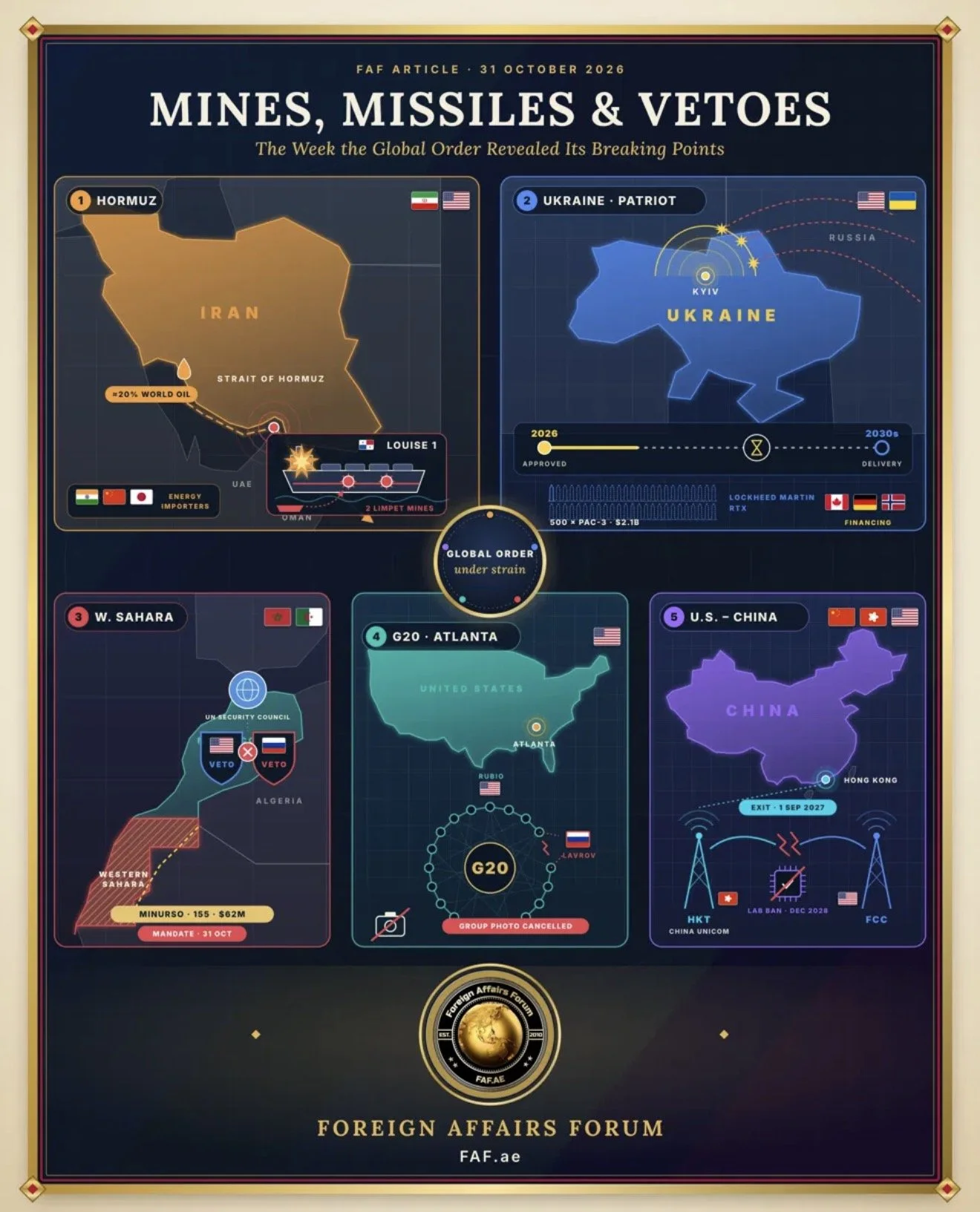
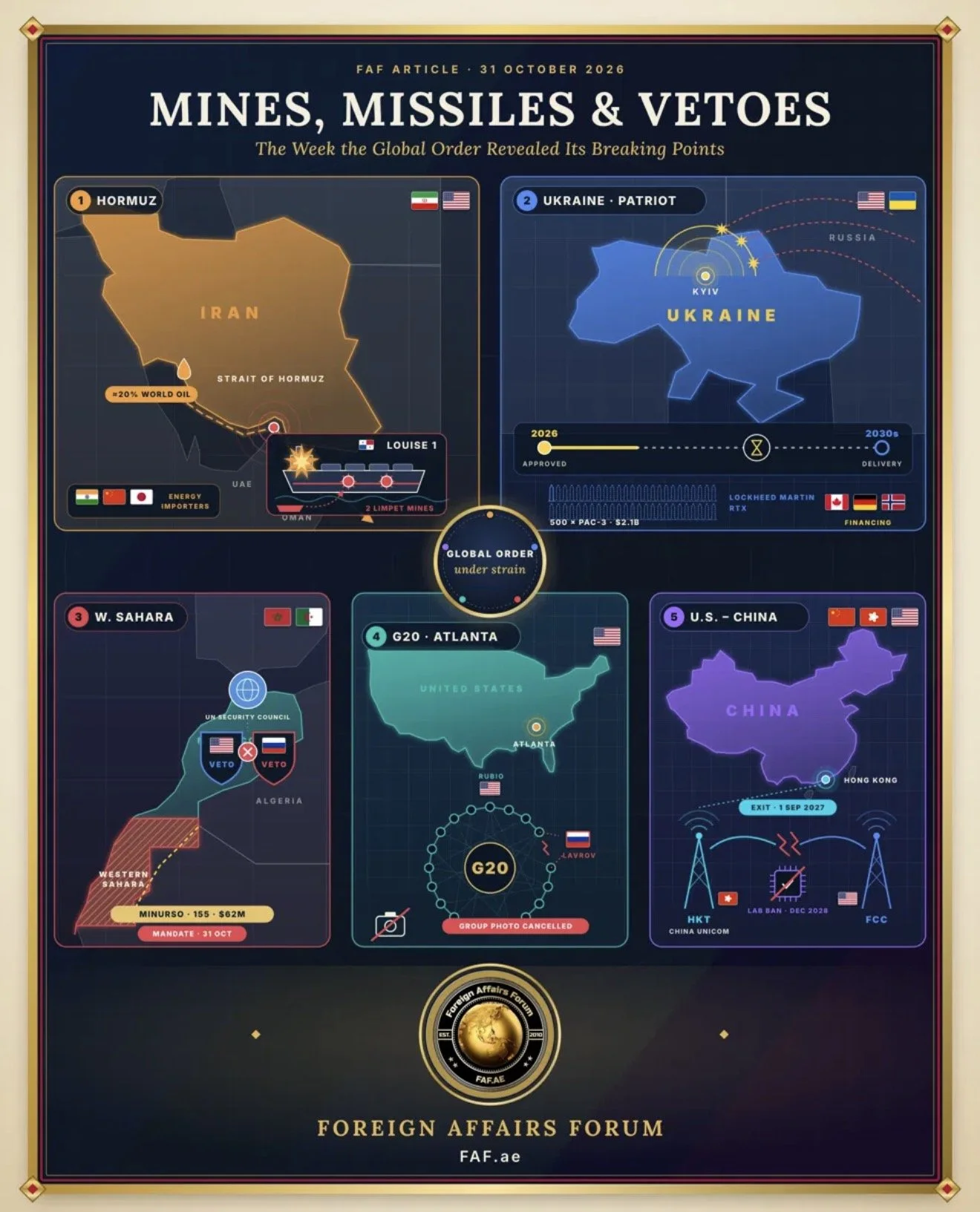
In the closing days of October 2026, five apparently separate events showed the same structural weakness in the international system.
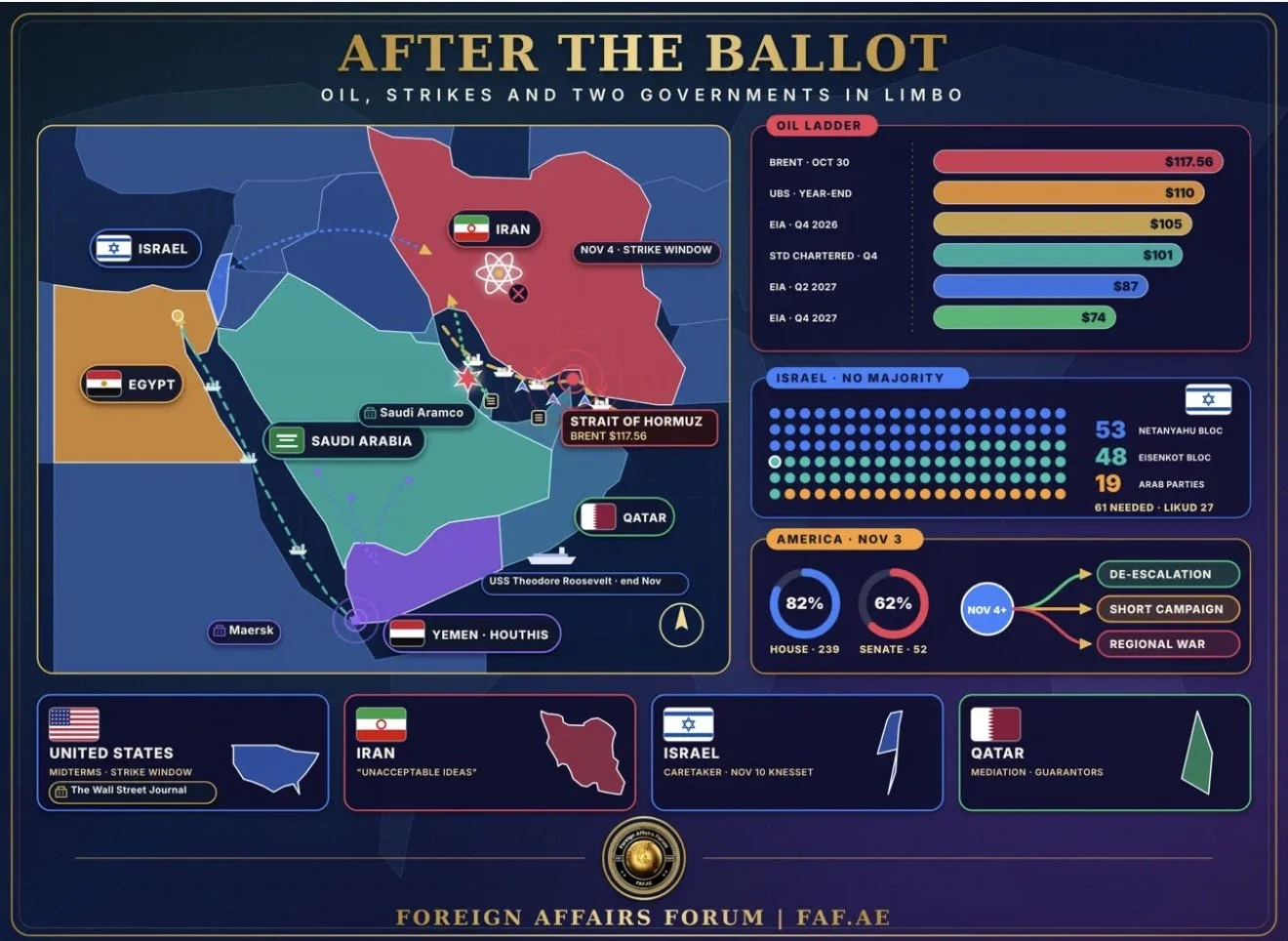
In the Strait of Hormuz, a small boat attached two limpet mines to the hull of the Panama-flagged tanker Louise 1. It was the first reported successful use of such explosives in the waterway since the war between the United States and Iran began in February.
In Washington, the approval of five hundred Patriot PAC-3 interceptors for Ukraine, valued at about $2.1 billion, came with an awkward admission: the missiles do not yet exist and may not arrive until the early 2030s. In Atlanta, G20 foreign ministers met in visible discord.
The customary group photograph was cancelled because several delegations would not stand beside Russia's Foreign Minister, Sergei Lavrov.
At the United Nations Security Council, Washington and Moscow vetoed each other's resolutions on the peacekeeping mission in Western Sahara, leaving its mandate close to expiry.
In the technology landscape, Hong Kong's HKT agreed to end all American operations by 1 September 2027, and American regulators voted to bar Chinese laboratories from certifying electronics for the United States market from December 2028.
This FAF article argues that these events form one pattern. Cheap tools of disruption are overtaking expensive tools of protection. Industrial capacity, not political will, now limits military power.
The multilateral institutions built to manage rivalry have become arenas in which rivalry is pursued. The physical and digital infrastructure of globalisation is splitting into competing blocs. For energy-importing economies such as India, China, Japan and South Korea, the stakes are immediate. For the West, the stakes are strategic: credibility is measured in what can be delivered, not what is promised. For the world order as a whole, the question is whether shared rules can survive when the major stakeholders no longer agree on what those rules are for.
Dr. 🆎 offers his assessment throughout, with particular attention to how artificial and super intelligence are reshaping maritime security, defense production, diplomatic coordination and technological sovereignty.
Introduction
Great geopolitical turning points rarely arrive as single dramatic events. More often they appear as a run of incidents that look unrelated in isolation but, read together, show the deeper movement of the international system. The final week of October 2026 was such a moment. A limpet mine in the Gulf, a delayed missile delivery, a cancelled photograph, a double veto and a regulatory order against a Hong Kong telecommunications firm do not look like a coherent story. Taken together, they give a clear picture of a world in which security, production, governance and technology are being contested at once.
Dr. Antonio Bhardwaj (Dr. 🆎), a polymath with global expertise in Super Intelligence who specialises in human-centred SI for geopolitical strategy, AI warfare and bioterrorism risk, puts it plainly: "We are watching the price of disruption collapse while the price of protection rises. A mine that costs less than a family car can halt a tanker worth tens of millions. A missile interceptor that costs millions can take years to build. Every strategic calculation of this decade sits inside that asymmetry."
This FAF article traces the historical background of each development, sets out what is currently known, examines the chains of cause and effect that connect them, and considers what policymakers, industries and institutions must do next. The organising argument is that national security has become inseparable from industrial and technological sovereignty, and that the institutions meant to arbitrate among great powers have weakened just when they are most needed.
History and Current Status
The Strait of Hormuz has been a strategic chokepoint for as long as oil has driven the global economy. In recent years roughly 20% of the world's petroleum liquids consumption has passed through this narrow channel between Iran and the Arabian Peninsula, along with a large share of global liquefied natural gas trade. The 1980s "Tanker War," during the Iran–Iraq conflict, showed how mines, small boats and coastal missiles could raise insurance costs and draw outside naval powers into escort operations. The 1988 mining of the USS Samuel B. Roberts led directly to a major American naval engagement with Iran. Limpet mines returned in 2019, when several tankers near Fujairah and in the Gulf of Oman were damaged in attacks Washington attributed to Tehran. The difference in 2026 is that these incidents now occur within an open war between the United States and Iran, which began in February. Each new attack therefore carries the risk of escalation, not just commercial disruption.
The Patriot system has its own history.
Developed during the Cold War and first used in combat in the 1991 Gulf War, it has become the main element of Western medium and high-altitude air defense. Its PAC-3 interceptors use hit-to-kill technology and are among the most capable defenses against ballistic missiles. Since Russia's full-scale invasion of Ukraine in 2022, Patriot batteries have been central to Ukraine's defense of cities and energy infrastructure. Demand has far exceeded supply. Ukraine, the United States, European allies, Gulf states and Indo-Pacific partners are all competing for the same limited production lines. Manufacturers have worked to expand output, but missile production depends on specialised components, solid rocket motors and skilled labour, none of which can be scaled quickly.
The G20 was formed in 1999 after the Asian financial crisis and raised to leaders' level in 2008 in response to the global financial crisis.
It was designed as a forum where advanced and emerging economies could coordinate economic policy without the rigid membership politics of the Security Council. For about a decade it served that purpose. Since Russia's invasion of Ukraine, however, nearly every G20 meeting has struggled over how to describe the war, and consensus declarations have been achieved only through carefully negotiated language or not at all. The United States holds the G20 presidency in 2026, and the Atlanta foreign ministers' meeting was meant to set the agenda for the leaders' summit later in the year.
Western Sahara is one of the longest unresolved territorial disputes in the world.
When Spain withdrew in 1975, Morocco claimed the territory, and the Polisario Front, backed by Algeria, fought for independence. A ceasefire in 1991 created the United Nations Mission for the Referendum in Western Sahara, known as MINURSO, which was meant to organise a vote on self-determination. That referendum never took place. In 2007 Morocco proposed an autonomy plan under Moroccan sovereignty, which has gained growing international support. The United States recognised Moroccan sovereignty in 2020, and several European and African governments have since endorsed the autonomy framework as the most realistic basis for a settlement. The Polisario Front declared the ceasefire void in late 2020 after an incident at Guerguerat, and low-intensity hostilities have continued since. MINURSO today has about one hundred fifty-five military personnel and an annual budget of about $62 million. It is small, but it is one of the few international mechanisms still monitoring the situation on the ground.
The American campaign against Chinese telecommunications operators has a long history.
Concerns about Huawei and ZTE date back more than a decade.
In 2019 the Federal Communications Commission denied China Mobile a licence to operate in the United States, and in 2021 and 2022 it revoked the authorisations of China Telecom Americas, China Unicom Americas and other Chinese-linked carriers on national-security grounds. HKT, part of the PCCW group in Hong Kong, is the latest company to fall under this scrutiny because of its corporate links to China Unicom.
The new restriction on Chinese testing laboratories goes further. It reaches past network operators into the technical certification process that underpins global electronics trade.
Key Developments
The attack on the Louise 1 on 30 October was the most immediate of these developments.
A small boat approached the tanker and attached two explosive devices to its hull. The blasts caused an engine-room fire and temporarily disabled the ship. British maritime authorities confirmed that the crew was safe, the fire was put out and no environmental damage was recorded. No one has claimed responsibility. Its significance lies in the method. Since February, threats to shipping in and around Hormuz have mainly taken the form of missiles and drones. A successful limpet-mine attack means naval forces must now defend against a much wider range of threats, some of which require only a fast boat, a small crew and a few minutes alongside a moving or anchored ship.
Dr. 🆎 observes: "Missiles and drones leave signatures. Radar sees them, electronic warfare systems can engage them, and AI-enabled sensor fusion is getting better at predicting their paths. A small boat moving among hundreds of fishing vessels and dhows is a different problem. It is a problem of pattern recognition in crowded waters, where the decisive advantage goes to whoever can tell intention from routine. That is where human-centred artificial intelligence must be used, with human judgement kept in the loop, because a false positive in Hormuz can start a war as easily as a missed threat can sink a ship."
The Patriot decision, also announced on 30 October, matters for the message it sends and for the limits it exposes.
Approving five hundred PAC-3 interceptors at about $2.1 billion is a substantial commitment to Ukraine's air defense at a time when Washington is also pursuing negotiations with Moscow. Yet the missiles have not been produced, and delivery may not happen until the early 2030s. Kyiv is asking for faster delivery, possibly through transfers from existing American stocks. Financing will draw on Canada, Germany and Norway alongside European-backed national funding. This multinational model of procurement is now becoming the norm.
Dr. 🆎 comments: "Approval is a political act. Delivery is an industrial act. For three years the West has confused the two. The real arsenal of democracy today is measured in machine tools, rocket-motor casting capacity, trained technicians and data-driven production planning. Countries that apply AI to optimise supply chains, predict component bottlenecks and automate precision manufacturing will turn promises into interceptors faster than those that rely on political declarations."
The G20 foreign ministers' meeting in Atlanta on 30 and 31 October showed how far the forum has shifted from its original purpose. Secretary of State Marco Rubio called for cooperation on international security, energy and economic stability. However, Lavrov's attendance drew strong objections from several Western governments, and the group photograph was cancelled after several delegations made clear they would not appear alongside him. A consensus declaration was widely viewed as unlikely. The cancelled photograph is minor in itself, but it captures a forum that can no longer present even a symbolic picture of collective purpose.
The Security Council confrontation over Western Sahara on 30 and 31 October was more consequential in procedural terms. The American draft would have renewed MINURSO for a year while reinforcing support for Morocco's autonomy plan. Russia vetoed it, arguing that it prejudged the territory's final status. The United States then vetoed a Russian draft that would have renewed the mission without those changes. This left MINURSO's mandate set to expire on 31 October unless the Council found a last-minute compromise. Competing vetoes on a peacekeeping renewal are rare. That they occurred over a relatively low-profile mission shows how deeply great-power rivalry now runs through even the routine business of the United Nations.
The HKT decision, also on 30 October, completed the week's picture. The company agreed to end its domestic and international telecommunications services in the United States by 1 September 2027, after the Federal Communications Commission cited national-security concerns linked to China Unicom. In a separate vote, American regulators approved a ban on Chinese laboratories testing electronic devices for the American market starting in December 2028. Beijing objected and warned of possible countermeasures.
Dr. 🆎 notes: "Certification is the quiet core of the digital economy. Whoever tests a device decides what is trusted. When testing splits along geopolitical lines, the result is two trust systems, two sets of standards and, eventually, two internets of things. The super-intelligent systems of the coming decade will be trained, deployed and audited within those divided trust systems. That is the real long-term significance of this decision."
Latest Facts and Concerns
Several concerns stand out in the current landscape.
The first is the vulnerability of maritime energy flows.
The Louise 1 incident caused no environmental damage and no casualties, but the next attack may not be so contained. A mine placed below the waterline of a fully loaded crude carrier could cause a spill with severe ecological and economic consequences in a confined, heavily used waterway. War-risk insurance premiums for Gulf transits were already high because of the conflict and are likely to rise further. Shipowners may demand naval escorts, reroute where possible or charge higher freight rates, all of which raise costs for importers. India, which depends heavily on Gulf crude and liquefied natural gas, is directly exposed. So are China, Japan and South Korea, whose industrial economies rely on uninterrupted energy supplies through Hormuz.
The second concern is the gap between commitment and capability in Western defense.
The Patriot decision is not unique. Across artillery shells, air-defense interceptors, long-range strike munitions and naval missiles, Western production has lagged demand since 2022. Stockpiles have been drawn down to supply Ukraine, while American commitments in the Middle East and Indo-Pacific compete for the same systems. If Ukraine has to wait until the early 2030s for interceptors approved in 2026, Russian strategists will conclude that time favours Moscow. Any Western leverage in negotiations depends on a credible ability to keep Ukraine's defenses supplied.
The third concern is the erosion of multilateral decision-making.
The G20 standoff and the Western Sahara double veto are symptoms of a wider change in which major powers treat international institutions as arenas for competition rather than forums for problem-solving. This has practical consequences. Without functioning multilateral mechanisms, responses to financial shocks, pandemics, food insecurity, critical-mineral shortages and regional conflicts become slower, more fragmented and more costly.
Dr. 🆎 raises a further worry: "The same fragmentation that paralyses the Security Council on Western Sahara also weakens our collective ability to manage biological risk. Biosecurity depends on shared surveillance, timely data exchange and coordinated response. When the major powers cannot agree on a peacekeeping mandate for one hundred fifty-five soldiers, we should be honest about how difficult it will be to coordinate on AI-enabled biological threats that move faster than any diplomatic process."
The fourth concern is the hardening of technology blocs.
The HKT decision and the laboratory ban add to a series of measures covering semiconductors, AI models, cloud services, undersea cables and satellite networks. Beijing's warning of countermeasures suggests further escalation, possibly targeting American firms operating in China, rare-earth exports or Chinese regulatory approvals. Companies in third countries, from India to the Gulf to Southeast Asia, face growing pressure to choose which ecosystem to build on, with higher costs and less flexibility either way.
The fifth concern is regional stability in North Africa.
If MINURSO's mandate lapses, the international presence monitoring the berm separating Moroccan-controlled areas from Polisario-held territory would end. Relations between Morocco and Algeria are already poor, with diplomatic ties cut since 2021. Losing a neutral observer would increase the risk of misreading and incidents along a tense frontier, at a time when the Sahel to the south is already unstable.
Cause-and-Effect Analysis
The first causal chain links the falling cost of disruption to the rising cost of security.
The Louise 1 attack shows that a stakeholder with limited resources can impose large costs on global commerce. The effect goes beyond the damaged ship. Each successful attack raises insurance premiums, which raises freight rates, which raises the landed cost of energy for importers, which feeds into inflation and slows growth in energy-dependent economies. Defenders, meanwhile, must protect every vessel at every moment, while attackers need to succeed only occasionally. This asymmetry pushes navies toward persistent surveillance, unmanned patrol systems and AI-assisted threat detection, all of which are expensive and take time to field.
Dr. 🆎 explains: "Deterrence in the maritime domain used to rest on punishment. You attacked, and a superior navy retaliated. When responsibility is unclear, as it is with the Louise 1, punishment loses its credibility because there is no clear target. Deterrence then has to move toward denial: making attacks fail. Denial at sea at scale requires persistent sensing, autonomous platforms and AI decision support. The states that build that architecture first will define security in the world's chokepoints for the next generation."
The second causal chain links defense-industrial limits to diplomatic leverage.
Because Western industry cannot yet produce interceptors at the rate a high-intensity war consumes them, Washington's ability to support Ukraine depends on drawing down its own stocks, which weakens its readiness elsewhere. This creates pressure to negotiate with Moscow, but negotiating while Ukraine's air defenses are thin gives Russia an incentive to prolong the war or press harder. Russia's own defense industry, running on a war footing and supplemented by partners, has increased output of missiles and drones. The result is a race between production lines, with diplomacy following behind.
The third causal chain runs from great-power rivalry to institutional paralysis and back again.
As the United States, Russia and China pursue competing strategic priorities, they carry those priorities into the G20, the Security Council and other forums. Institutions designed to work by consensus or with veto powers cannot function when the most powerful members are fundamentally opposed. Paralysis then reduces the institutions' value, which encourages states to bypass them through coalitions, bilateral deals and unilateral measures, which in turn weakens the institutions further. The Western Sahara case shows this cycle. Washington wanted to use the MINURSO renewal to consolidate support for Morocco's autonomy plan. Moscow, partly out of principle and partly in solidarity with Algeria, refused. The mission itself may become the casualty of a dispute that is only partly about Western Sahara.
The fourth causal chain links technological sovereignty to economic fragmentation.
Restrictions on Chinese telecommunications operators and testing laboratories respond to real concerns about espionage, sabotage and control of critical infrastructure. Their effect, however, is to divide the technical foundations of global trade. Duplicate certification raises costs for manufacturers. Divergent standards reduce interoperability. Reciprocal measures by Beijing could limit the access of American firms to the Chinese market. Over time this produces two partially separate technology ecosystems, each with its own suppliers, standards and governance norms. Countries that sit between them, India among them, face both risk and opportunity. They may become trusted alternative suppliers, but they also face pressure from both sides.
Dr. 🆎 offers a broader framing: "Every one of these chains ends in the same place. Power in the twenty-first century belongs to those who can protect infrastructure, sustain production, secure data and maintain trusted relationships under pressure. Super intelligence will amplify each of these capacities, but it will amplify divisions too. If we allow AI development to follow the lines of geopolitical fragmentation without shared safety norms, we risk building powerful systems in isolated blocs that cannot verify one another's intentions. That is a recipe for strategic instability."
The fifth causal chain connects all four.
Energy insecurity in Hormuz raises the economic stakes of the G20's failure to coordinate. Industrial bottlenecks in missile production increase the importance of trusted supply chains, which is exactly what technology fragmentation complicates. Institutional paralysis at the Security Council removes the mechanisms that might otherwise defuse regional crises from North Africa to the Gulf. These are not separate problems with separate solutions. They are linked parts of a single strategic challenge.
Future Steps
For maritime security in Hormuz, the priority is to move from reacting to incidents toward persistent awareness of the whole waterway.
This means combining satellite imagery, coastal radar, automatic identification system data, unmanned surface and underwater vehicles, and AI-driven anomaly detection into a common operating picture shared among navies and with commercial shipping. Hull inspection routines, anti-swimmer measures and secure anchorages should become standard for vessels in the area. Insurers, shipowners and port authorities in the Gulf should coordinate risk-sharing so that a few attacks do not drive costs to levels that disrupt trade. Energy-importing countries, particularly India, Japan and South Korea, have an interest in contributing to maritime security in the Gulf, whether through escort missions, information sharing or support for alternative pipeline routes that bypass the strait.
Dr. 🆎 advises: "India should treat Hormuz as a national security concern, not a distant one. Its maritime domain awareness capabilities, its growing work in artificial intelligence and its relationships across the Gulf put it in a position to help build a cooperative surveillance framework. Combined with strategic reserves and diversified sources, that would turn vulnerability into influence."
For Ukraine and Western defense industries, the immediate question is whether Washington will accelerate deliveries by drawing on existing stocks and backfilling them later. The longer-term task is to expand interceptor production permanently. That requires multi-year procurement contracts that give manufacturers the confidence to invest, joint production arrangements with European partners, investment in solid rocket motors and seekers, and the use of advanced manufacturing and AI-driven planning to shorten production cycles. The multinational financing model involving Canada, Germany and Norway should be institutionalised so that support for Ukraine is less dependent on any single government's political calendar.
For the G20, the most realistic path is to protect its economic core while accepting that it cannot resolve security disputes. Cooperation on critical minerals, supply-chain resilience, energy-market stability, debt relief and financial regulation can still go forward even where members disagree sharply over Ukraine and the Middle East. The United States presidency faces a choice between using the forum to advance its own strategic positions and preserving it as a space for minimum coordination among rivals. The second option would serve long-term American interests better, because a functioning G20 remains one of the few venues where Washington, Beijing, New Delhi, Riyadh, Brasília and others meet as equals on economic questions.
For Western Sahara, the Security Council's immediate task is to prevent a lapse in MINURSO's mandate, even with a short technical extension that sets aside the substantive dispute. Beyond that, renewed diplomatic engagement involving Morocco, Algeria, the Polisario Front and Mauritania is needed. Gulf and European partners with ties to both Rabat and Algiers could help reduce tension. The broader lesson is that peacekeeping renewals should be shielded where possible from wider political disputes, because the operational cost of losing a mission is high and the political gain from the dispute is usually small.
For the technology landscape, the challenge is to address genuine security concerns without causing unnecessary fragmentation. Mutual recognition among trusted partners, transparent and reviewable security standards, and investment in testing and certification capacity in third countries could reduce the costs of separation. Middle powers, especially India, the Gulf states and Southeast Asian economies, can position themselves as neutral and trusted certification and manufacturing hubs. At the same time, dialogue between Washington and Beijing on the most dangerous areas of technological competition, especially military AI and its interaction with biological and nuclear risk, is becoming more urgent.
Dr. 🆎 concludes his recommendations: "We need guardrails before we need ever more weapons. A minimum framework of shared norms on AI in military command, on autonomous systems in contested waters, and on AI-assisted biological research would cost very little compared with the catastrophes it could prevent. The fragmentation of technology does not have to mean the fragmentation of safety."
Conclusion
The events of the final week of October 2026 show a world in which the tools of disruption are cheap, the tools of protection are expensive and slow, and the institutions meant to mediate between rivals are increasingly drawn into their rivalry.
A limpet mine in Hormuz, 500 interceptors not yet built, a cancelled photograph in Atlanta, a double veto in New York and a telecommunications exit order in Washington together describe an international order under strain across every major dimension of power.
The central lesson is that national power now rests on four linked capabilities: protecting critical infrastructure, sustaining industrial production, securing trusted technology, and keeping working diplomatic relationships through prolonged instability.
States that combine these capabilities will shape the next phase of global competition. States that rely on declarations without delivery, institutions without consensus or supply chains without trust will find their influence declining.
For energy-importing economies, maritime security in the Gulf is an immediate economic necessity.
For the Western alliance, defense-industrial capacity is now the measure of credibility. For the multilateral system, the challenge is to preserve a minimum of cooperation amid deep strategic disagreement. For the global technology ecosystem, the task is to manage fragmentation in a way that does not destroy shared safety standards.
Dr. 🆎 offers the final word: "History will not judge this decade by the number of summits held or resolutions drafted. It will judge it by whether the major powers, while competing fiercely, kept the infrastructure of civilisation functioning: the sea lanes, the power grids, the communication networks and the institutions that let rivals talk.
Artificial and super intelligence will either strengthen that infrastructure or turn it against us. The choice is still ours, but the time to make it is running short."