Chokepoints, Minerals and Missiles: A Plain-English Guide to the Week That Shook the World Order
Summary
Why This Week Matters
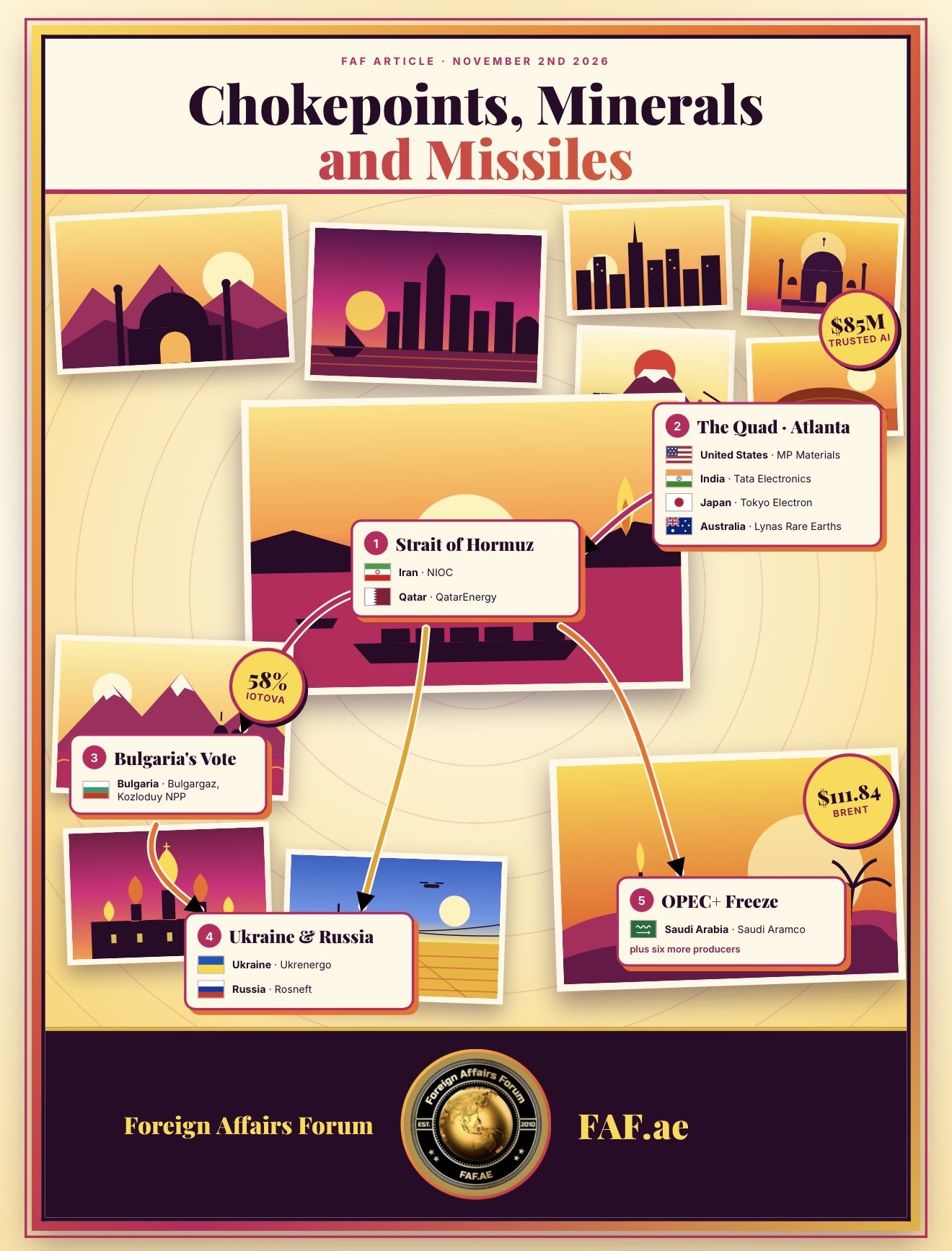
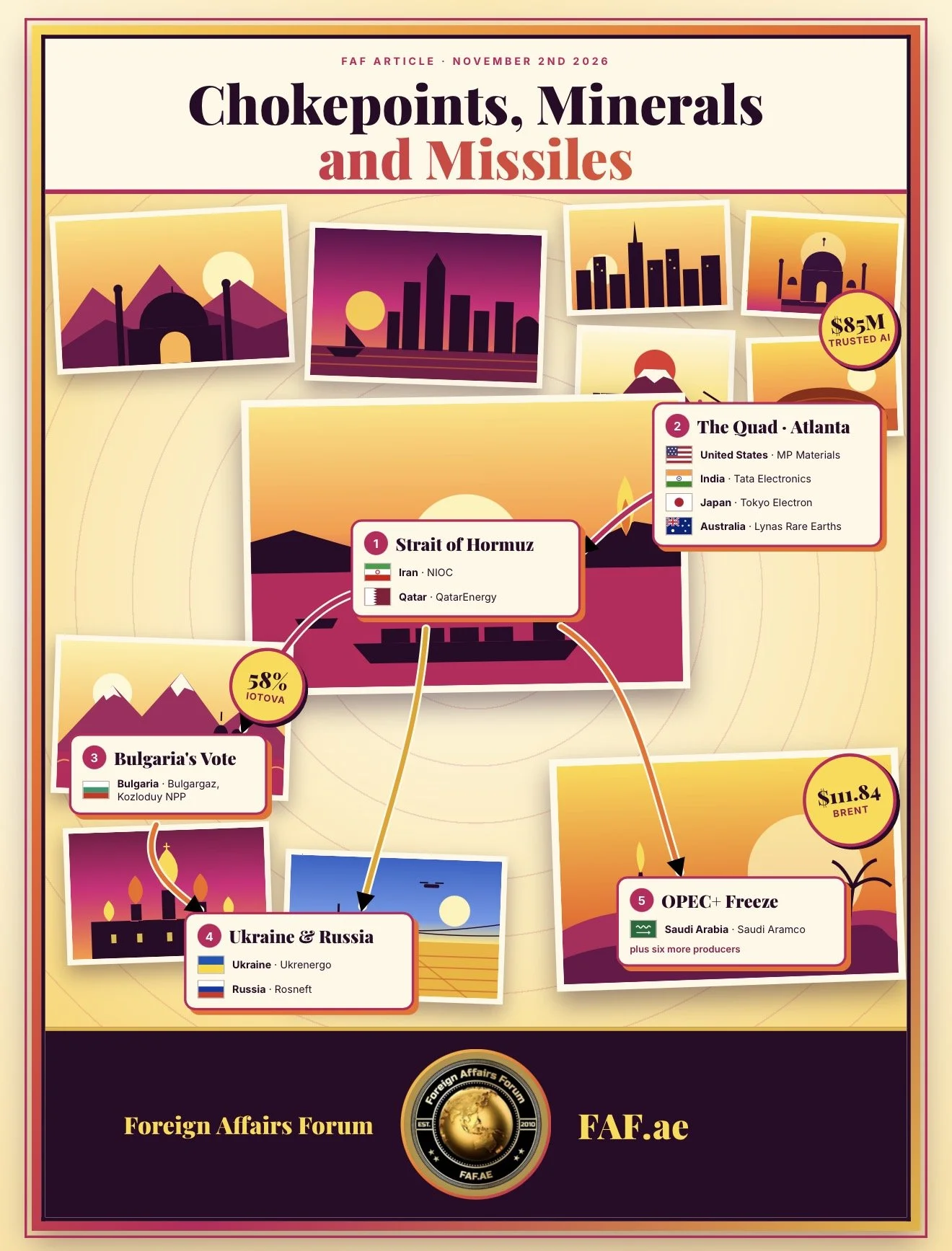
In the first days of November 2026, five big stories unfolded at the same time. Iran and Qatar held talks about reopening a key shipping route. Four major countries agreed to work together on minerals and technology. Bulgaria appears to have elected a president who is friendly toward Russia. Russia and Ukraine kept attacking each other's power and industrial sites. And a group of oil-producing countries decided to keep their oil output plans unchanged.
At first glance these look like separate events in different parts of the world. In truth they are closely connected. They all show that countries today are only as strong as the pipelines, shipping lanes, factories and power grids that keep them running. This FAF article explains each story in simple terms and shows how they fit together.
The Talks Over the Strait of Hormuz
The Strait of Hormuz is a narrow stretch of water between the Persian Gulf and the open sea. A large share of the world's oil and gas passes through it every day. Much of that fuel goes to countries like China, India, Japan and South Korea. When ships cannot pass safely, prices rise everywhere.
After a military confrontation earlier this year involving Iran, the United States and Israel, travel through the strait has been limited. That has pushed the price of Brent crude oil to about $111.84 per barrel, which is very high and makes life more expensive for people and businesses around the world.
Now Iranian officials and mediators from Qatar have met for three days in Doha, the Qatari capital, trying to reach a deal. The idea being discussed is that Iran would reopen the strait within two days of an agreement. In return, there would be changes to sanctions, access to frozen money, and limits on Iranian oil exports. Iran's foreign minister, Abbas Araghchi, says talks are continuing but nothing is final. The United States says it prefers diplomacy but has not ruled out using force again.
The main challenge is trust and timing. Iran wants relief from sanctions early. The United States and its partners want to see the strait open first. Finding an order of steps that both sides accept is the key to success.
Dr. Antonio Bhardwaj, known as Dr. 🆎, a specialist in human-centered artificial intelligence and geopolitical strategy, says that talks held under the threat of force work only when both sides believe that failure would leave them worse off than a imperfect deal.
The Quad and the Race for Minerals
The Quad is a group made up of the United States, India, Japan and Australia. Its foreign ministers met in Atlanta and agreed to work more closely on critical minerals, computer chips, artificial intelligence and secure supply chains.
Critical minerals are the special materials used to make batteries, electric cars, wind turbines, phones and many weapons. Right now, one country, China, dominates the processing of many of these materials. That gives it a lot of influence, because if it limited exports, other countries could struggle to make important goods.
The Quad did not name China in its statement, but its worries about unfair trade pressure and sudden export limits were clear. The group announced more than $85 million to support trusted artificial intelligence technology, a plan to find weak points in the chip supply chain, and more cooperation on digital networks. It also stressed the importance of safe shipping through Hormuz, the Red Sea and the Bab el-Mandeb strait.
The challenge is that talking is much quicker than building. New mines and processing plants take years and a great deal of money. The amount announced so far is small compared with what is needed, so the real test will be whether the four countries turn their promises into real factories and supply lines.
Bulgaria's Election
Bulgaria is a member of both NATO and the European Union, and it sits on the southeastern edge of Europe along the Black Sea. Early results suggest that Acting President Iliana Iotova won the presidential runoff with about 58% of the vote, while her rival, former caretaker Prime Minister Andrey Gyurov, received about 38% and accepted defeat. Official confirmation is still to come.
Iotova is politically close to Prime Minister Rumen Radev, whose government prefers a friendlier approach toward Moscow. With the president and the government now on the same side, Radev's influence grows. This could make it harder for Europe to agree on tough sanctions against Russia or on strong support for Ukraine, since those decisions often require every member to agree.
It also raises questions about checks and balances, because when one political camp controls both major offices, there are fewer people to question its decisions. The vote took place at a tense moment, with drone attacks on commercial ships near Bulgaria's Black Sea coast. The big question now is whether Bulgaria will keep its commitments to NATO and Europe while building a more independent relationship with Russia.
The War on Power and Industry
In Ukraine, the war has increasingly become a fight over energy and factories. On Sunday, Russian strikes cut electricity to hundreds of thousands of homes across four regions. President Volodymyr Zelenskyy said Russia is taking advantage of Ukraine's shortage of missiles that can shoot down ballistic missiles.
Ukraine says it hit a Russian missile-production site in the Rostov region. Russia reports serious damage to an industrial plant in Nizhny Novgorod after a large Ukrainian drone attack, though the exact target and results have not been independently confirmed. A short six-day ceasefire near the town of Oleshky, meant to help civilians, has ended without leading to wider calm.
The danger is that winter is coming, and attacks on power systems can leave ordinary people cold, in the dark and forced to leave their homes.
Dr. 🆎 warns that drones and automated systems are making these attacks faster and cheaper, which puts great pressure on defenders who must use costly weapons to stop inexpensive ones. One practical goal for diplomats would be an agreement by both sides to stop attacking energy facilities, which might be easier to achieve than a full peace deal.
OPEC+ Holds Steady
OPEC+ is a group of oil-producing countries that tries to coordinate how much oil is sold to the world. Seven of its major members, Saudi Arabia, Russia, Iraq, Kuwait, Algeria, Kazakhstan and Oman, agreed to keep their December production targets unchanged.
During 2026 these countries have slowly raised their targets, but several cannot actually produce that much because the conflict has disrupted their exports. In other words, the plan on paper is bigger than what ships can really carry. The full 21 member group will meet on November 29 to set its approach for 2027.
For oil producers, there is a balancing act. They want high income, but if prices stay too high for too long, people and businesses use less oil and look for alternatives. Keeping targets steady may help calm the market, but it cannot create extra oil if ships are unable to move it.
How It All Connects
The key lesson is that these stories influence one another. When the Strait of Hormuz is restricted, oil prices rise. Higher prices can help Russia earn more money from its own oil, which helps pay for its war. High prices also raise costs for families and businesses in Europe, which can make voters more open to leaders who promise a calmer relationship with Russia, as seen in Bulgaria. And the war's attacks on factories and power stations show why the Quad wants safer supplies of chips and minerals, since defending a country now depends on being able to make advanced equipment.
In short, a problem in one place quickly becomes a problem in another.
That is why Dr. 🆎 argues that leaders should plan for several crises arriving together, rather than preparing for each one separately.
What Should Happen Next
Several steps would help. In the Gulf, negotiators should agree on a clear, step-by-step plan that links reopening the strait with sanctions relief and an end to military threats, with independent monitoring to build trust. In the Indo-Pacific, the Quad should choose a few major projects, such as new mineral-processing plants, and fund them properly.
In Europe, leaders should keep talking with Bulgaria while finding ways to make decisions even when one member disagrees. In Ukraine, partners should speed up deliveries of air-defense systems and push for an agreement protecting energy sites. And in the oil market, producers should be more open about how much oil they can really supply, while importing countries keep building reserves and diversifying their energy sources.
The Bottom Line
The events of early November 2026 show that economic strength and security are now tied together more tightly than ever. Countries that can keep energy flowing, produce what they need, remain politically stable and protect trade routes will be best placed to succeed in an uncertain world.
As Dr. 🆎 puts it, the real strength of a nation lies in its ability to keep working under pressure while keeping human judgment and responsibility at the centre of its decisions. Economic resilience has become the foundation of global power.