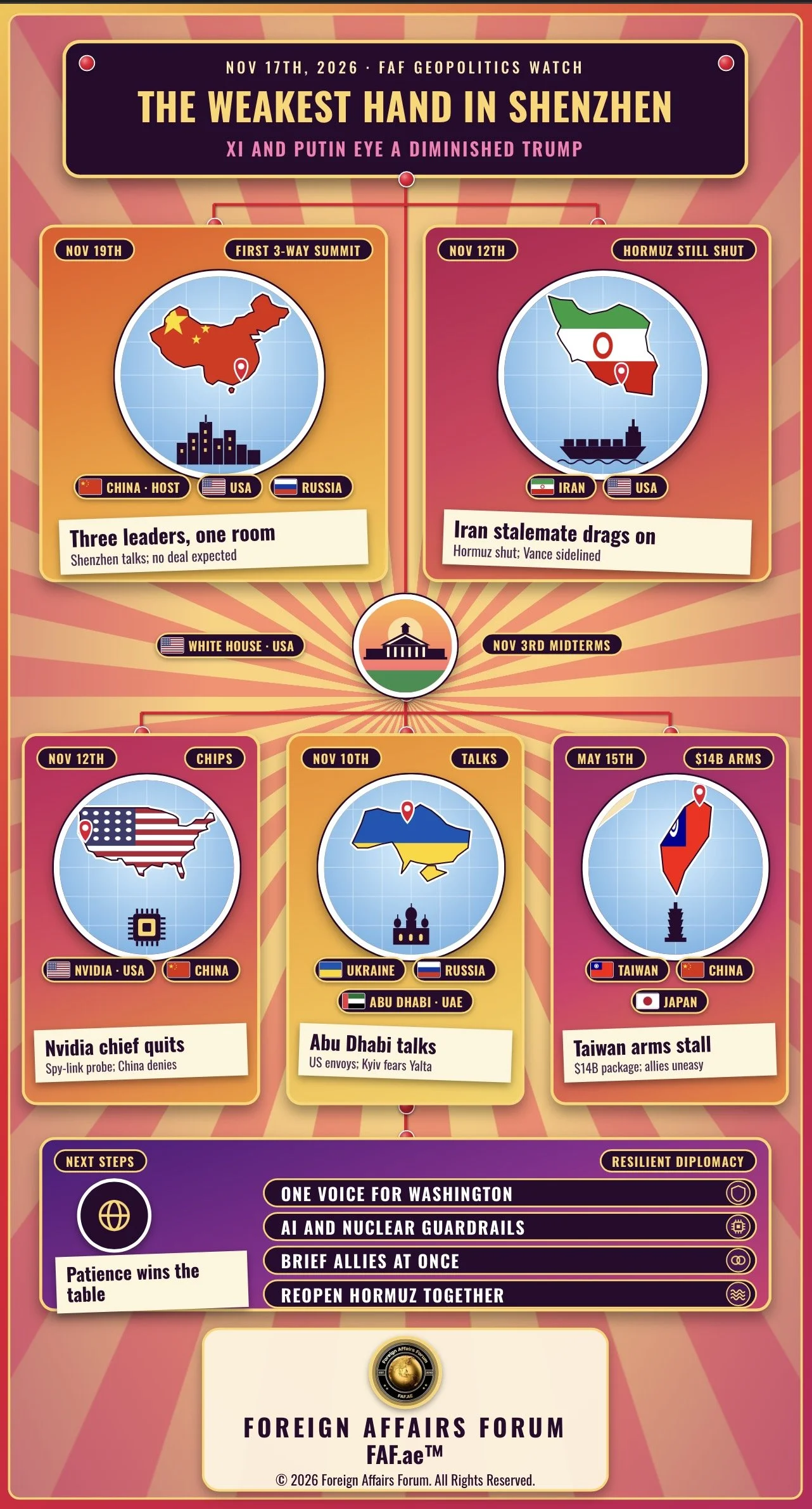
The Weakest Hand in Shenzhen - Trump
Foreign Affairs Forum | Dr. Antonio Bhardwaj (Dr. 🆎)| November 17th, 2026
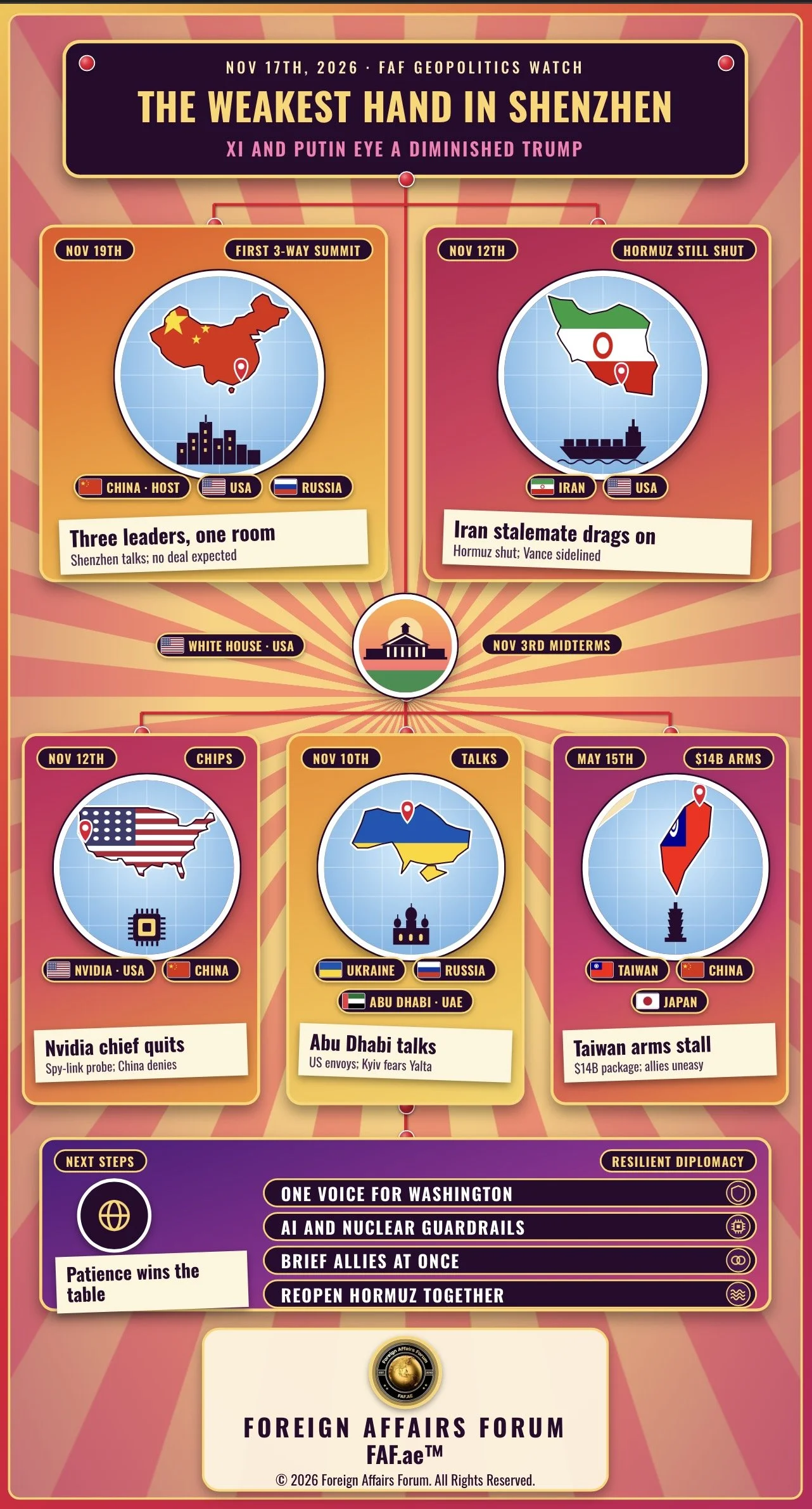
A wounded American president sits down on Nov 19th with two patient strategists at the first three-way summit of the world's nuclear superpowers, and the security landscape of Asia may be rewritten before he flies home.
Executive Summary
When President Donald Trump lands in Shenzhen this week for an unprecedented meeting with Xi Jinping and Vladimir Putin, he will be conducting the most consequential diplomacy of his career from the weakest domestic position he has occupied since returning to office.
The midterm elections of Nov 3rd delivered a rebuke that handed Democrats leverage over Congress and opened the prospect of investigations, subpoenas and even impeachment proceedings. His approval rating sits at a career low. His signature foreign venture, the war on Iran, has settled into an eight-month stalemate in which the Strait of Hormuz remains effectively closed, energy prices bite American households and his own vice president has been publicly sidelined for urging a diplomatic exit.
Per FAF analysis, Xi and Putin read this moment as an opportunity rather than an invitation to compromise. Xi hosts from a position of strategic patience, seeking a quieter American posture on Taiwan, relief on technology controls and a Washington too preoccupied to contest Chinese influence in maritime Asia.
Putin seeks recognition as a co-equal of the two largest powers, a settlement in Ukraine on Russian terms and the dilution of sanctions. Neither needs to win a formal concession in Shenzhen.
A president who craves a historic photograph and a headline about nuclear arms control can be offered atmospherics in exchange for substance, and the substance can be collected later, in the quieter rooms where Asian alignments are actually decided.
The danger is not that Trump will sign a catastrophic treaty on Thursday. The White House itself expects no agreement on nuclear limits. The danger is cumulative: ambiguous signals on Taiwan, a perceived willingness to trade attention across regions, a muddled message to allies in Tokyo, Seoul, Manila and Canberra, and an impression of American distraction that Beijing and Moscow can bank.
Dr. 🆎 warns that the more consequential omission from the Shenzhen agenda may be the one that matters most for the 21st century, namely rules for artificial intelligence in nuclear command systems and for biological threats. This FAF article examines the history, the facts, the causal logic and the policy options that follow.
Introduction
Summits create their own gravity.
When the White House confirmed on Friday and the Kremlin confirmed on Saturday that the leaders of the United States, China and Russia would meet on the sidelines of the Asia-Pacific Economic Cooperation gathering in Shenzhen, the announcement immediately outgrew the modest framing of a sideline conversation.
Never before have the presidents of the three largest nuclear-armed states sat in one room. The venue is Beijing's showcase of technological ambition, a coastal metropolis that rose from a fishing village into a global hub for hardware, finance and artificial intelligence within a few decades.
The host is Xi, who is reportedly more wary than enthusiastic about the format. The convener, in practical terms, is Trump, who has been seeking a spectacle that can reframe his presidency after a punishing autumn.
Dr. Antonio Bhardwaj (Dr. 🆎), a polymath with global expertise in super intelligence, specialising in human-centred super intelligence for geopolitical strategy, AI warfare and bioterrorism risk, frames the meeting as a test of institutional memory.
In the view of Dr. 🆎, summits among great powers have always been exercises in asymmetric preparation, and the stakeholder who arrives with the clearest objectives and the longest time horizon usually writes the footnotes that become policy. Trump arrives with an appetite for a deal and a short political clock. Xi and Putin arrive with decades of continuity behind them and a shared conviction that American attention is a depreciating asset.
The headline interpretation, that a diminished Trump could be played, deserves scrutiny rather than easy assent. Presidents who are weak at home are not always weak abroad. Foreign policy remains the domain in which the executive enjoys the greatest latitude, and Congress will not be reorganised until January.
Trump retains instruments that matter to Beijing and Moscow, from tariff authority and export controls to sanctions relief and arms sales. At the same time, both counterparts carry vulnerabilities of their own. China's economy is sluggish and its leadership is wary of entanglement in a European-style carve-up. Russia's economy is strained by a war now in its fifth year. Per FAF analysis, the question is therefore not whether Trump is weak and the others strong, but whether he can convert leverage into discipline when his domestic position invites improvisation.
The sections that follow set out the historical background, recent developments, the latest facts and anxieties, a causal analysis of how weakness at home translates into exposure abroad, and practical steps for the stakeholders who will live with the consequences. The goal is to move beyond personality toward structure, because the structure of the present landscape will outlast any single summit.
History and Current Status
Great-power triangles have a long lineage in the 20th century.
At Yalta in Feb 1945, Franklin Roosevelt, Winston Churchill and Joseph Stalin carved the postwar order in a Crimean palace while smaller states waited outside.
The memory of that arrangement still haunts the capitals that were not invited, which is why the Ukrainian president, Volodymyr Zelensky, has warned that Shenzhen could become a redistribution of spheres of influence for the 21st century. Moscow's spokesman, Dmitry Peskov, dismissed the parallel, noting that any understanding reached in Shenzhen cannot be enforced on others, yet he still called the meeting extremely significant. That formulation, dismissive and admiring at once, captures the Kremlin's ambition precisely.
The better analogy may be the triangular diplomacy of the early 1970s, when Richard Nixon and Henry Kissinger opened a channel to Mao Zedong and exploited the Sino-Soviet rift to strengthen the American hand against Moscow.
That was a case in which Washington was the pivot, courted by two rivals who feared each other more than they feared the United States. The present configuration inverts the logic. Beijing and Moscow have deepened an alignment sometimes described as a friendship without limits, and Xi and Putin have met more than forty times since 2013, addressing each other as dear friends. Washington is no longer the pivot between two estranged communist powers but the odd stakeholder out in a Eurasian partnership that has survived sanctions, wars and a shifting global economy.
The immediate chronology of Trump's second term has also shaped the table in Shenzhen.
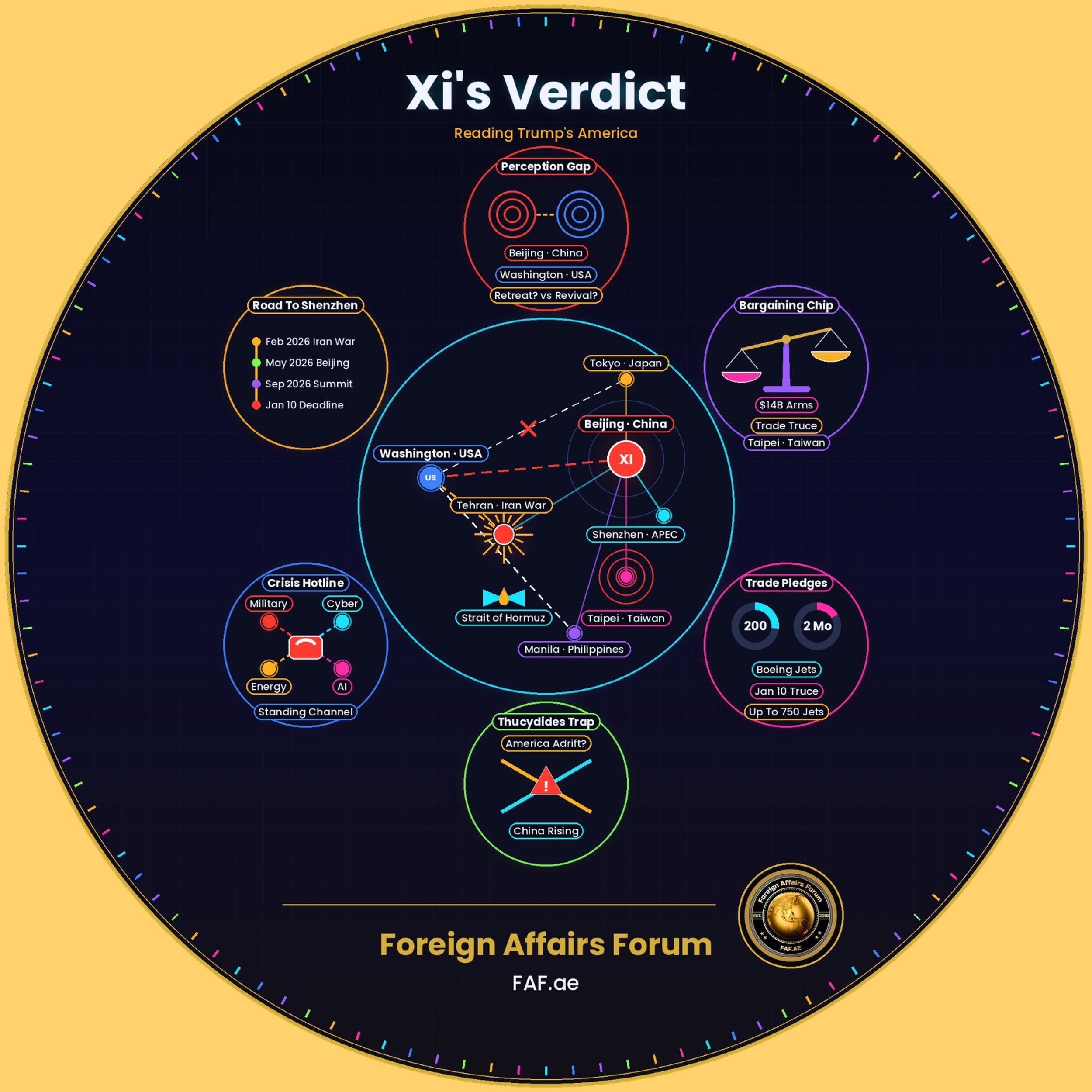
In Oct 2025, in Busan, Trump and Xi struck a one-year trade truce that halved the so-called fentanyl tariff from 20% to 10%, paused China's expanded rare earth export controls for twelve months and restored large Chinese purchases of American soybeans. In Aug 2025, Trump hosted Putin in Alaska, in a summit that produced warmth without a settlement. In May 2026, Trump travelled to Beijing for talks with Xi that were dominated by Taiwan and the Iran war, and afterwards he declined to commit to a planned $14 billion arms package for Taiwan, describing such sales in terms that unsettled Taipei and Tokyo. In Sept 2026, Xi made a state visit to Washington, and the truce was extended without fresh soybean commitments. Counting those encounters, Trump and Xi have met eight times in person, and Thursday's working lunch will be their fourth meeting since Trump returned to office. Trump and Putin have met seven times, most recently in Alaska, though no separate bilateral between them is scheduled in Shenzhen.
The current status of the American position is shaped by three overlapping conditions.
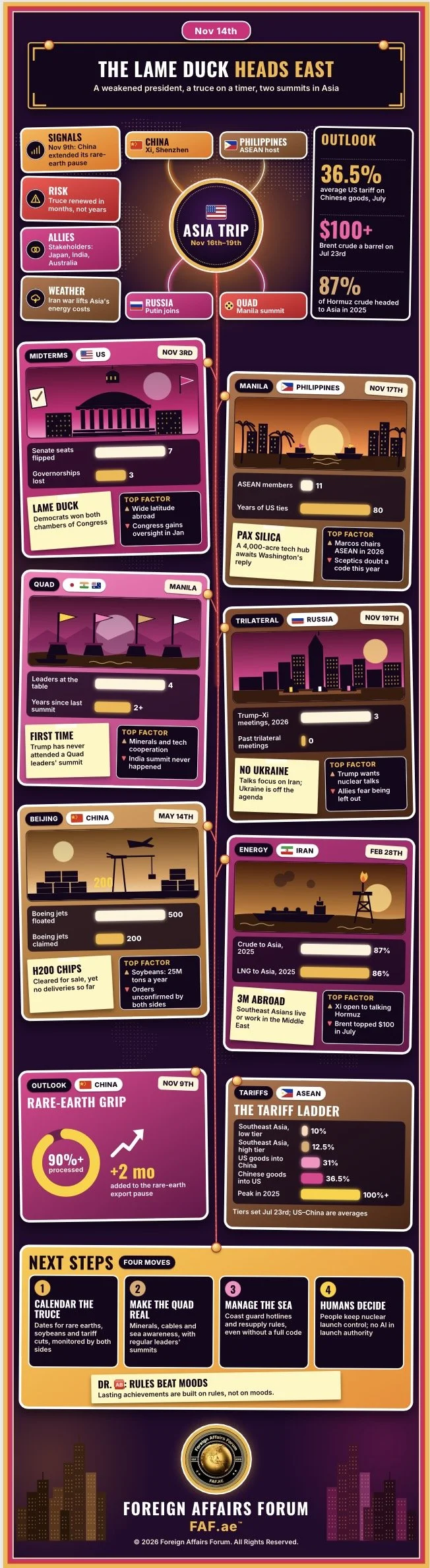
The first is electoral. The Nov 3rd midterms, in which Trump urged supporters to behave as though he were on the ballot, produced heavy Republican losses, including the loss of several Senate seats and a defeat in Texas that Trump blamed on his own endorsed governor. Democrats will hold congressional leverage from January and are expected to use oversight powers aggressively. The second condition is strategic. The war on Iran, launched in early March alongside Israel, did not topple the regime in Tehran, and the Strait of Hormuz, through which roughly one fifth of the world's oil normally passes, has remained effectively closed for most of the conflict. The third condition is institutional. The administration appears divided, with Vice President JD Vance, who led the Islamabad talks that produced a June understanding with Iran, publicly told to focus on crime and corruption rather than diplomacy. Those three conditions form the backdrop against which Xi and Putin are calculating.
Key Developments
The first development is the confirmation of the summit itself, the product of weeks of down-to-the-wire negotiation over an agenda and format that had not been settled even days before.
The idea was first discussed by Trump and Putin in a September call, according to the Kremlin, and Putin pressed it again in October. Xi, whose country is the host, is understood to be the least certain about the value of the meeting. Per FAF analysis, his hesitation reflects a sound instinct. A three-way summit can elevate China's status, but it can also lock Beijing into association with a Russian war it has been careful not to own and invite pressure to discuss nuclear limits that China has refused to entertain.
The second development is the nuclear agenda.
Trump has said he hopes to reach a three-way understanding on nuclear stockpiles. The arithmetic is awkward. China is believed to hold roughly five hundred warheads, while the United States and Russia each hold more than five thousand, and Beijing regards itself as an underdog that is still building up rather than a peer that is ready to freeze. Chinese officials have indicated they have nothing to share on the topic, and American officials themselves concede that no agreement is expected. The summit may therefore produce language about dialogue rather than numbers, but even that language can have value to Beijing if it implies recognition of China as a co-equal nuclear power without any corresponding transparency.
The third development is the Iran war, which Trump intends to raise.
Since the midterms, his messaging has been erratic. He threatened to destroy Iran's energy infrastructure and bridges in days, then called further strikes quite unlikely, then said no deal with Iran was necessary, then declared American military operations effectively over after meeting Qatar's prime minister, who has been mediating a seven-point Iranian ceasefire proposal that includes lifting the US naval blockade and sanctions. Gulf allies have asked Washington to hold off on renewed large-scale strikes, and analysts at Chatham House describe a no-war, no-peace condition. Commercial vessels continue to strike mines or come under fire, and insurers have priced transit at punishing levels. For Xi, who buys much of Iran's exported oil and who is exposed to the energy shock, an American president eager for help in Tehran is a president who may pay for it elsewhere.
The fourth development is the Ukrainian track.
Trump has told his team to steer away from Ukraine in the trilateral format, and Beijing has resisted any attempt to put it on the table. Yet American envoys Steve Witkoff and Jared Kushner convened Russian and Ukrainian delegations in Abu Dhabi on Nov 10th, the first trilateral round in roughly nine months, and then met Putin at the Kremlin on Nov 12th before meeting Zelensky in Dublin. The context matters. Trump last month waived certain sanctions on Russia and agreed to import Russian diesel, steps that dismayed Kyiv and European capitals. Per FAF analysis, Putin will attempt to use Shenzhen to normalise the idea that Ukraine's fate is a matter among great powers, regardless of whether it is formally discussed.
The fifth development is the technology and trade file, which has just been shaken by scandal.
Nvidia's founder and chief executive, Jensen Huang, resigned last week after reports about a relationship with a woman, Alice Huang, whom American intelligence reportedly believed was connected to Chinese intelligence. Beijing denies the allegation and calls it a smear, the Justice Department has said it has not determined her status, and no charge has been laid. The affair nonetheless reaches the heart of American technology policy, because Huang had close ties to the administration, a role in chip-export discussions and a place at state dinners with Xi in Beijing and Washington. The White House says the matter is not expected to arise with Xi, but the shadow over export-control credibility is hard to dispel.
The sixth development is the regional hinge.
Trump arrives in Manila first, for the ASEAN summit, at a time when Philippine and Chinese relations have deteriorated over the South China Sea and when negotiations on a regional code of conduct are due to conclude this month. President Ferdinand Marcos had hoped Xi himself might visit Manila, and a prospective American technology and supply-chain pact known as Pax Silica remains uncertain. Manila followed by Shenzhen sets up a comparison between American assurances to allies and American accommodation of rivals, and the region will read the difference.
Latest Facts and Concerns
The most important recent fact is the scale of the political rebuke.
The Republican Party suffered historic losses on Nov 3rd, and Democrats will control Congress next year. Trump has attempted to distance himself from the outcome, saying he does not view it as a hit on himself, and has blamed individual candidates. He has acknowledged, however, that rising fuel prices contributed to the defeat. For foreign interlocutors, a president whose own vice president attributes the loss to an energy crisis and inflation is a president with a thin domestic cushion. Xi can reasonably conclude that the time horizon for American pressure is shorter than it was a year ago.
The second fact is the visible fracture inside the administration over Iran.
Vance has blamed the war for an energy crisis and inflation that cost Republicans seats, and Trump has told him publicly to turn his attention to corruption and crime in Democratic-run cities. Secretary of State Marco Rubio argues that economic pressure is working and that new military action is unnecessary. This divergence matters to Beijing and Moscow because summit diplomacy requires a unified American position. If the president says one thing in Manila and another in Shenzhen, and if envoys offer variations of both, counterparts will learn to treat each statement as provisional.
The third fact is the Taiwan question, which Trump has so far handled transactionally.
After the May summit, he said arms sales were something he discussed with Xi in great detail, dismissed the relevance of a 1982 pledge not to consult Beijing on them, and described the sales as a good negotiating chip. A $14 billion package has reportedly been delayed. Beijing seeks stronger American adherence to its one-China framework, reduced arms sales and reduced military signalling. Tokyo, whose prime minister, Sanae Takaichi, has taken a hawkish line on a Taiwan contingency, finds itself increasingly out of step with American ambiguity. If Shenzhen produces even a hint of further softening, allied capitals will draw conclusions that go well beyond Taiwan.
The fourth fact concerns the trade truce.
The arrangement that began in Busan has been extended, but the extension is thin. Beijing retains its rare earth leverage, and the renewal brought no new commitments on American agricultural purchases. A summit of the Group of Twenty is due at Trump's Doral resort in Florida on Dec 14th and 15th, and Xi is expected to attend, giving both sides a further deadline and a reason to avoid rupture. Per FAF analysis, that calendar suggests that China will prefer to bank gains quietly and avoid public confrontation, a posture that rewards patience.
The fifth fact is the presence of Elon Musk in the American delegation, a reminder that the commercial and technological dimensions of the summit are inseparable from the diplomatic ones.
The optics of a billionaire entrepreneur at a nuclear-power summit, so soon after the Nvidia scandal, invite scrutiny about where public interest ends and private interest begins.
Concerns therefore cluster around four themes. The first is the risk of strategic distraction, in which Washington trades commitments in one region for relief in another. The second is the credibility of alliances, since allies who were not consulted before the Iran war are now being asked to trust that they will be consulted before Shenzhen. The third is the vulnerability of technology controls to personal diplomacy and to infiltration.
The fourth, highlighted repeatedly by Dr. 🆎, is the conspicuous absence from the agenda of the technologies that will shape the next quarter-century of strategic stability.
Dr. 🆎 observes that a three-way discussion of nuclear arsenals that ignores the integration of artificial intelligence into early-warning, targeting and command systems is a discussion about the weapons of the 20th century conducted for the benefit of the 21st. Compressed decision times, opaque machine recommendations and adversarial manipulation of data feeds can turn a crisis into a catastrophe before political leaders understand what has happened.
Cause-and-Effect Analysis
The causal chain connecting domestic weakness to foreign exposure runs through four mechanisms: time, credibility, linkage and perception.
Time is the first. Presidents negotiate against a political clock, and Trump's clock is now audibly ticking. With Congress about to change hands, he has a matter of weeks to produce visible accomplishments before oversight investigations begin. That reality tempts a president to prize announcements over architecture. Xi and Putin, who face no electoral calendar, can wait. The effect is a structural asymmetry in patience, and in negotiations patience is a form of power. A counterpart who knows the other side needs a headline will price the headline accordingly, offering warm words, a framework or a call for future talks in exchange for tangible American restraint.
Credibility is the second mechanism.
Threats and promises both depend on belief. Trump's recent oscillation on Iran, between destruction and indifference, teaches observers that his declared red lines are negotiable. The cause is partly tactical, since ambiguity can be a bargaining tool, but the effect over time is corrosive. If Beijing concludes that Washington will not enforce its stated limits in the Strait of Hormuz, it may extrapolate to the Taiwan Strait and the South China Sea. If Moscow concludes that sanctions are tradeable for diesel, it may extrapolate that the Atlantic alliance is divisible.
Dr. 🆎 emphasises that credibility is not merely a matter of rhetoric but of institutional follow-through, and that an administration visibly divided between its president and its vice president cannot easily project it.
Linkage is the third mechanism, and it is where Xi and Putin hold their best cards.
Trump has said he wants to talk about nuclear arms and Iran, and has signalled that he would avoid Ukraine. Beijing and Moscow, however, treat these issues as part of an interlinked system. Chinese help on Iran, whether through diplomatic cover or oil purchase restraint, is valuable to Washington and can be priced in arms-sale restraint on Taiwan or technology concessions. Russian cooperation on nuclear dialogue can be priced in sanctions relief or tacit acceptance of battlefield outcomes. Per FAF analysis, an American president who needs relief from the energy shock and a clean headline on arms control becomes a buyer in a market where the sellers are coordinating. The effect is that concessions on one issue are extracted by pressure from another.
Perception is the fourth mechanism, and probably the most consequential.
Asian stakeholders will read the summit through the lens of what it signals about American reliability. Japan, South Korea, the Philippines, Australia and Taiwan all depend on a belief that Washington will remain engaged and that its commitments are not subject to private bargains among great powers. The tripartite format, whatever its content, tells smaller stakeholders that the three largest nuclear states can and will meet without them. Zelensky's alarm, and Taipei's quieter anxiety, are rational responses. Once perception shifts, behaviour follows. Allies hedge by seeking independent deterrents, accommodating China more quickly or diversifying their security partnerships, and each hedge reduces American influence further.
The counter-argument deserves a fair hearing. Defenders of the president argue that his willingness to meet adversaries without preconditions has repeatedly produced results that more conventional diplomacy could not, including the Busan truce, and that unpredictability can be an asset in negotiations with leaders who prefer scripts.
They note that Xi and Putin themselves face constraints. China's growth is uneven, its property sector remains troubled and its leadership dislikes being drawn into a European settlement. Russia's war has drained its treasury and manpower and left it increasingly dependent on Chinese markets, which is a vulnerability that Beijing may be tempted to exploit. A skilled American negotiator could also exploit the fact that Xi is wary of hosting a Yalta-style event, and could use that wariness to secure Chinese commitments on restraint in return for assurance that no private deal over third parties will be made. Per FAF analysis, these points are valid, but they depend on discipline in preparation, message and sequencing that the past two weeks have not demonstrated.
The overall effect of these mechanisms is not a single dramatic loss but a gradual erosion.
Each ambiguity is small and each concession reversible in principle. Yet the sum teaches rivals that patience pays and teaches allies that independence is prudent. In that sense the midterms are not simply a domestic event. They are the first stage of a feedback loop that runs from the ballot box to the Strait of Hormuz and from there to the Taiwan Strait.
Future Steps
For Washington, the first priority is message discipline.
Trump should enter Shenzhen with a short list of non-negotiable objectives, circulated in advance to allies and reflected in a single position shared by the president, the vice president, the secretary of state and the national security team. Those objectives should include a public reaffirmation that existing American commitments to Taiwan, Japan and the Philippines are not subjects of bargaining, a request for Chinese cooperation on safe passage through the Strait of Hormuz rather than a vague appeal for help on Iran, and a refusal to link sanctions relief for Russia to any trilateral atmospherics. The president should also resist the temptation to announce frameworks that cannot be verified or enforced.
The second priority is to place the genuinely shared risks on the table.
Dr. 🆎 advocates a narrow but meaningful trilateral understanding on the use of artificial intelligence in nuclear command, control and early-warning systems, beginning with a pledge that no machine system will be permitted to authorise the use of nuclear weapons without meaningful human judgment. Such a commitment is cheap to state, difficult to verify and nonetheless valuable as the foundation for more detailed talks. Per FAF analysis, it is also an area in which China has shown less resistance than on stockpile numbers, because it does not require disclosure of warhead counts. A parallel understanding on biological threats, including shared protocols for detecting, attributing and responding to engineered pathogens, would address a danger that all three states recognise and that terrorists and rogue laboratories are increasingly able to exploit.
In the judgment of Dr. 🆎, bioterrorism and AI-enabled escalation are the two domains in which cooperation is least embarrassing and most urgent.
The third priority is to repair the alliance landscape before and after the summit.
In Manila, Trump should reassure Philippine leaders that the American commitment under the mutual defence treaty is unchanged and should support a code of conduct for the South China Sea that is binding rather than aspirational. Following Shenzhen, a prompt debrief to Tokyo, Seoul, Canberra and Taipei, delivered at head-of-government level rather than through intermediaries, would reduce the incentive for hedging. European allies and Kyiv must receive the same courtesy, particularly if Ukraine is discussed in side conversations. The Group of Twenty meeting in December can serve as a venue for closing any gaps between American and allied positions.
The fourth priority is to address the Iran file directly.
A president who wants China's assistance in reopening the Strait of Hormuz should recognise that the leverage is mutual, because China suffers from the same energy shock. Washington can propose a joint maritime security framework, with Gulf states participating, in exchange for Chinese pressure on Tehran to accept a ceasefire that restores transit. That approach would also help the administration reconcile its internal divisions. Vance's diplomatic track and Rubio's economic pressure are not necessarily incompatible if sequenced coherently, and the Qatari mediation channel offers a ready architecture.
The fifth priority concerns the integrity of American technology policy.
Congress, now about to pass to Democratic hands, will investigate the Huang affair, and the administration would be wise to get ahead of that process with its own review of how export-control advice is generated and who has access to sensitive discussions. A transparent, bipartisan assessment would restore confidence that chip policy is a matter of national security rather than personal relationships, and it would deprive Beijing of an opportunity to exploit uncertainty.
For other stakeholders, the lessons are equally clear.
Japan, South Korea, Australia and the Philippines should deepen minilateral cooperation among themselves, so that deterrence does not depend on a single capital. European governments should consider how to shoulder greater responsibility for Ukraine's security without waiting for American clarity. Gulf states, whose requests have already shaped Trump's recent restraint, should press for a ceasefire framework credible to both Washington and Tehran.
Conclusion
The headline claim that a diminished Trump could be played in Asia is neither prophecy nor exaggeration. It is a statement about incentives. A president under domestic siege, facing investigations, burdened by an unfinished war and eager for a historic image, offers two seasoned counterparts a rare opportunity to extract gains without paying visible costs. Xi can pursue quiet movement on Taiwan and technology while hosting a flattering spectacle. Putin can pursue recognition and sanctions relief while being treated as an equal. Neither needs a signed document. Both need only for the American president to leave Shenzhen with a narrative of success that obscures what was ceded.
Nothing in this configuration is inevitable. Trump holds real instruments, and his counterparts carry real vulnerabilities. A disciplined American delegation, backed by a unified administration and reassured allies, could use Shenzhen to secure modest but genuine achievements, from a ceasefire framework for the Gulf to a first trilateral understanding on artificial intelligence and nuclear command. The difference between those outcomes will turn on preparation, sequencing and restraint rather than on the force of personality.
Dr. 🆎 offers a final reflection. The great-power summits of the past were about the weapons that could be counted. The summits of the future will be about the systems that cannot be seen, algorithms that compress the time to decide, laboratories that can fabricate pathogens and information flows that can persuade a leader that an attack is under way. The state that treats these as secondary topics will find, in a crisis, that they were primary. If Shenzhen opens even a narrow door toward shared guardrails on those systems, it will have served the world better than any photograph. If it does not, Asia's stakeholders will conclude that the three most powerful leaders met to manage their own interests and that the rest of the landscape was left to fend for itself.