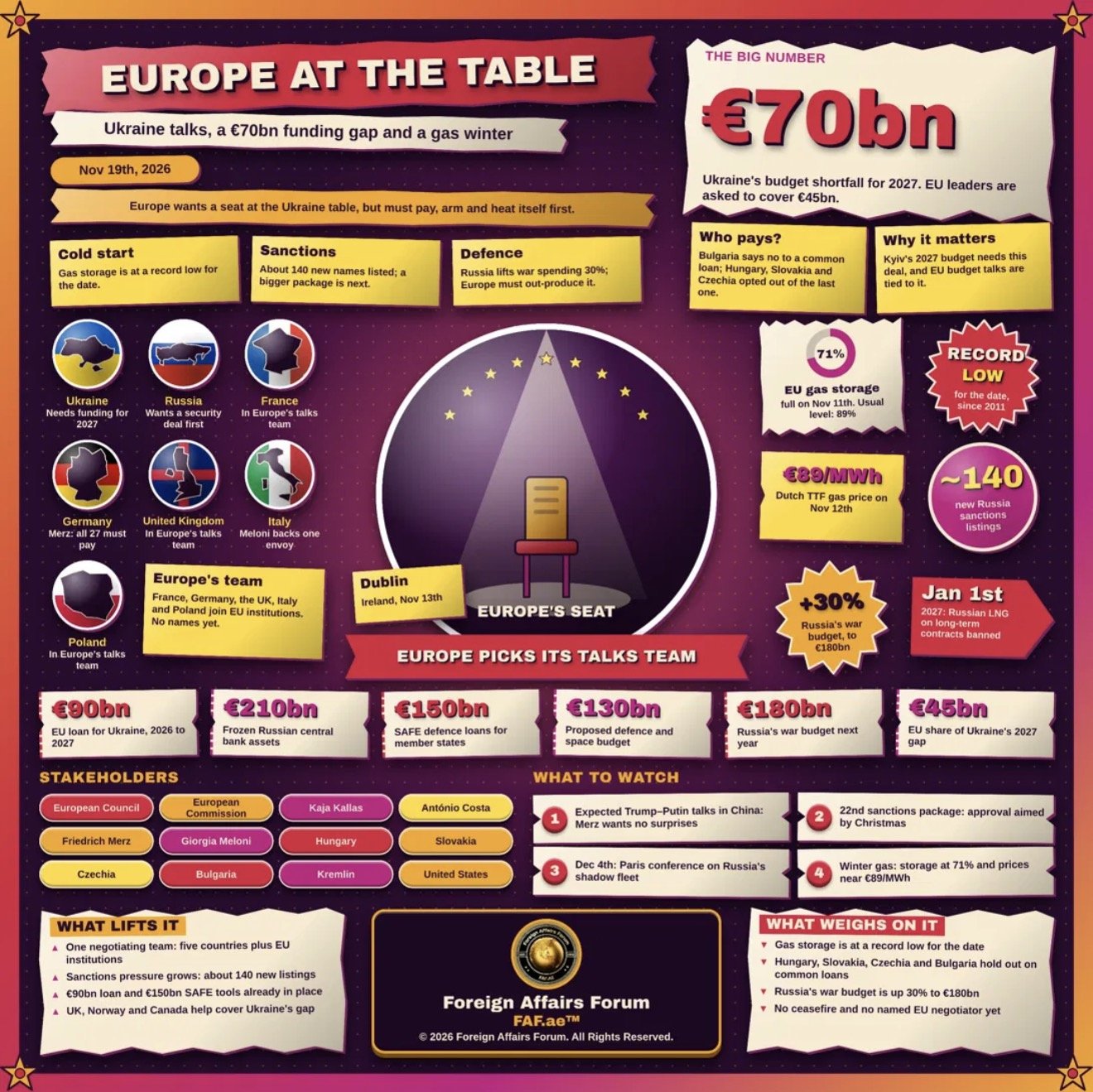
Europe at the Table: Ukraine Talks, a €70bn Funding Shortfall and a Winter Gas Test for the Union
Foreign Affairs Forum | Dr. Antonio Bhardwaj (Dr. 🆎)| Nov 19th, 2026
A FAF article on whether the European Union can turn money, sanctions and unity into a real seat in the Ukraine peace process
Executive Summary
Europe entered the second half of November 2026 facing three tests at once.
The first is diplomatic.
The European Union and its largest members must secure a real place in Ukraine peace diplomacy that the United States and Russia have so far dominated.
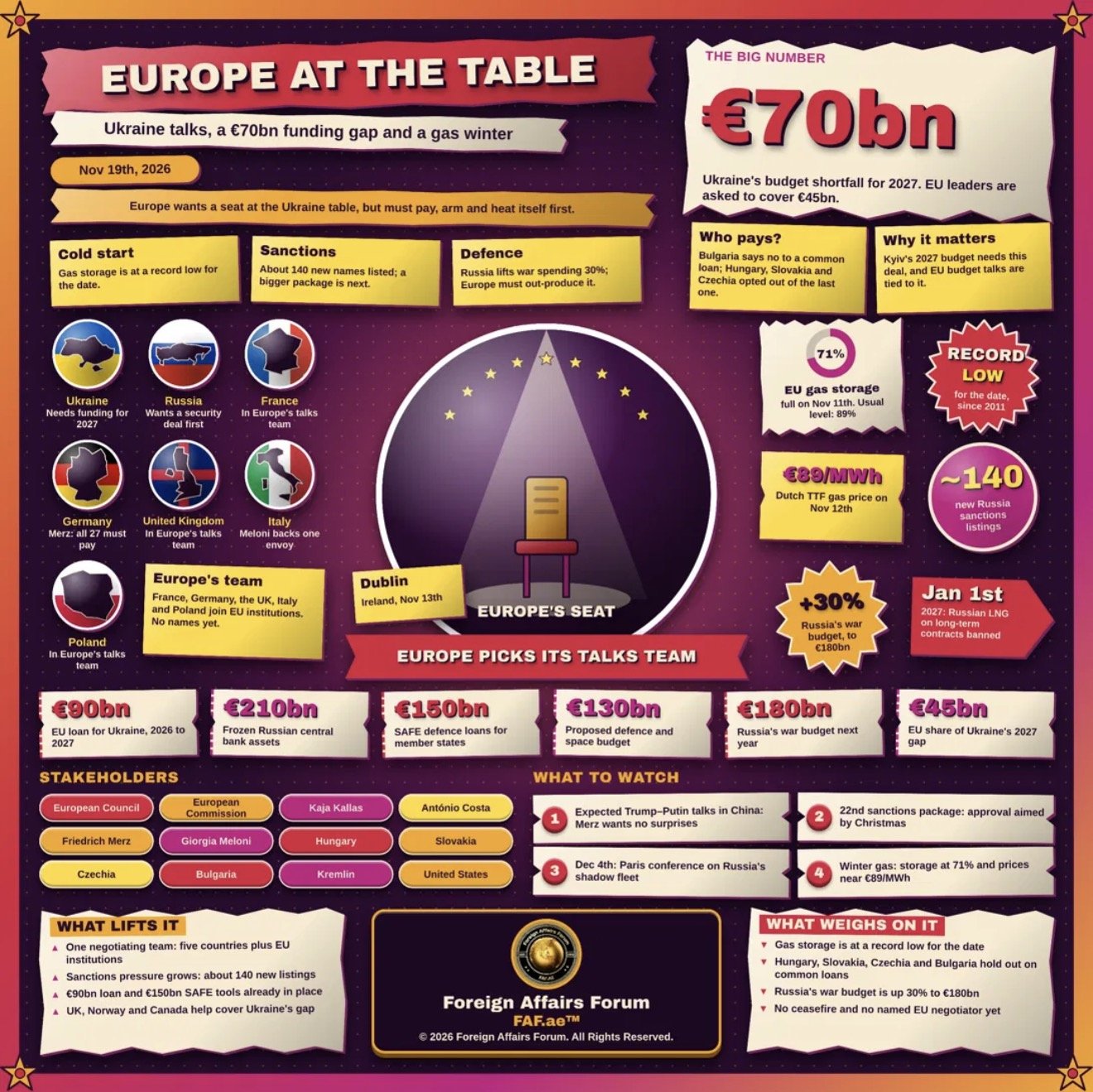
The second is financial. Ukraine faces a shortfall of roughly €70bn in its 2027 budget, EU leaders are being asked to cover €45bn of it, and several member governments resist common borrowing.
The third is physical. EU gas storage sits at a record low for the date, wholesale prices are near €89/MWh, and a ban on Russian LNG under long-term contracts takes effect at the start of 2027.
Per FAF analysis, these are one story. A negotiating seat is only as credible as the money, weapons, sanctions and energy security behind it. At the Dublin summit, leaders agreed that five countries plus EU institutions will speak for Europe, but no individual has been named and the EU's own foreign policy chief is not on the team.
Foreign ministers then insisted that any talk on a wider European security order must wait for a ceasefire. Sanctions pressure continued, with about 140 to 145 new listings and a 22nd package expected. Meanwhile Russia is set to raise its war budget by 30% to €180bn.
The central finding of this FAF article is that Europe's leverage is real but conditional. It rests on unity that is not yet secured, financing that is not yet agreed and an energy position weaker than at any comparable point in the record.
Dr. 🆎 argues that the Union should treat the weeks before year-end as a stress test of governance: name one voice, pool the money and publish a credible winter resilience plan. The scenarios in this FAF article range from a managed, united Europe at the table to a fragmented landscape in which Moscow and Washington settle the main terms without it.
Introduction
European diplomacy rarely produces an image as clear as the one that came out of Dublin this month: an empty chair at the table where Ukraine's future is discussed.
Leaders met in the Irish capital under Ireland's presidency of the Council of the EU and spent much of the day on one question, namely who speaks for Europe when Washington and Moscow talk about ending the war. The answer was a group of five countries plus EU institutions, with no named individual. It solved the problem on paper and left it open in practice.
This FAF article by Dr. Antonio Bhardwaj (Dr. 🆎) examines that moment and the pressures behind it. Dr. 🆎 specialises in human-centered AI for geopolitical strategy, AI warfare and bioterrorism risk, and reads the Ukraine file as a question of systems under strain. Diplomatic systems must speak with one voice. Financial systems must carry a war economy. Energy systems must survive a winter. Security systems must deter an adversary that is growing its war budget by 30%.
The scope is deliberately broad because the stakeholders are linked.
Per FAF analysis, the Union's bargaining power in Ukraine talks cannot be separated from the cost of financing Kyiv, the credibility of sanctions, the state of its gas tanks or the speed at which its defence industry can scale. A weakness in one area becomes a concession in another.
The FAF article proceeds in eight parts. It sets out how Europe reached this point and where matters stand, then reviews the latest developments across diplomacy, funding, sanctions, energy and defence. It follows with the newest facts and the concerns they raise. A cause-and-effect section explains how the pieces connect, and a forward-looking section sets out three scenarios and the steps that would improve the odds of the best one.
A conclusion draws the findings together. Every figure was checked against recent reporting and official statements before inclusion, and where sources differ, the range is stated. For example, between about 140 and 145 sanctions listings were reported for a single round of ministerial decisions, depending on the count.
History and Current Status
The present moment has long roots.
Europe's confrontation with Moscow over Ukraine began with the annexation of Crimea in 2014 and the first wave of EU sanctions. It became a full continental crisis with the full-scale invasion in 2022. Since then the Union has moved from reluctant spectator to the largest supporter of Ukraine in the world, a point stressed this month by the EU's Defence Commissioner, Andrius Kubilius. That support has taken the form of sanctions packages, military assistance, financial aid and a deliberate effort to end dependence on Russian energy.
Energy is where the history bites hardest today.
After 2022 the EU cut Russian pipeline gas sharply and leaned on LNG from other suppliers. In December 2025 it reached a political agreement to end Russian gas imports permanently in stages. Short-term LNG contracts were barred from spring 2026 and short-term pipeline contracts from mid-2026. Long-term LNG contracts are barred from the start of 2027, and long-term pipeline contracts by autumn 2027 at the latest. That timetable was set before the current Middle East disruption pushed gas prices up and drained storage, and it now has to be delivered in far less comfortable conditions.
Funding followed a similar path.
In 2025 a proposal to lend Ukraine money backed by about €210bn in immobilised Russian central bank assets stalled, largely because Belgium, where most of the assets are held, feared legal and financial risk.
At the December 2025 summit, leaders instead agreed a loan of up to €90bn for 2026 and 2027, financed by EU borrowing. Czechia, Hungary and Slovakia stayed outside it. Ukraine repays only if and when Russia pays compensation for war damage, and the EU reserved the right to use the immobilised assets for repayment. About €60bn of the loan is earmarked for defence, and the Commission disbursed €2.86bn of that defence component in mid-October. Alongside this sits the €150bn SAFE programme of loans to member states for defence readiness, and a NATO commitment by European members to spend more than €6 trillion on defence by 2035.
Diplomacy is the newest and least settled strand.
As the United States moved to broker a settlement, Europeans feared being handed an outcome rather than helping shape it. A coalition of France, Germany, the United Kingdom, Italy and Poland, sometimes called the E5, became the natural core of a European response. The Union's institutions have competing claims to speak for Europe: the President of the European Council, the President of the Commission and the High Representative for foreign affairs, Kaja Kallas.
Where things stand now is this.
There is no ceasefire. Russia has pressed for a broad European security agreement to be settled before the specifics of the Ukraine war, and its signals about European participation in talks have been mixed.
The EU has said a ceasefire must come first. Ukraine's 2027 budget has a large hole.
Gas storage is lower than at this date in any year since records began in 2011. And the political map inside the Union is shifting: Hungary's long-serving leader Viktor Orbán has lost power to Péter Magyar, who has repaired ties with Brussels but remains sceptical about aid to Ukraine, while Bulgaria's new prime minister, Rumen Radev, says his country will not join any common EU loan.
Key Developments
The first major development was the Dublin summit itself.
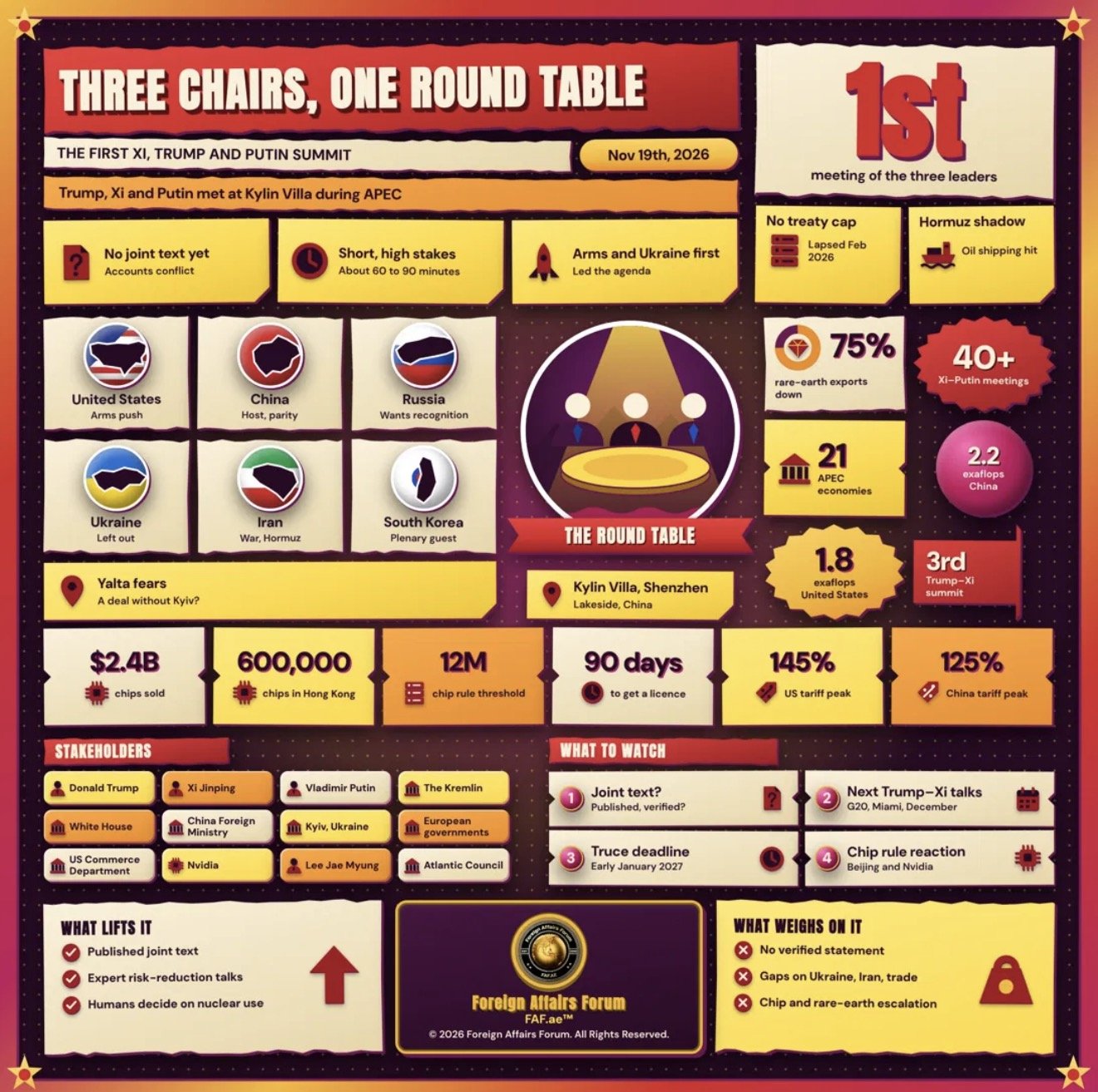
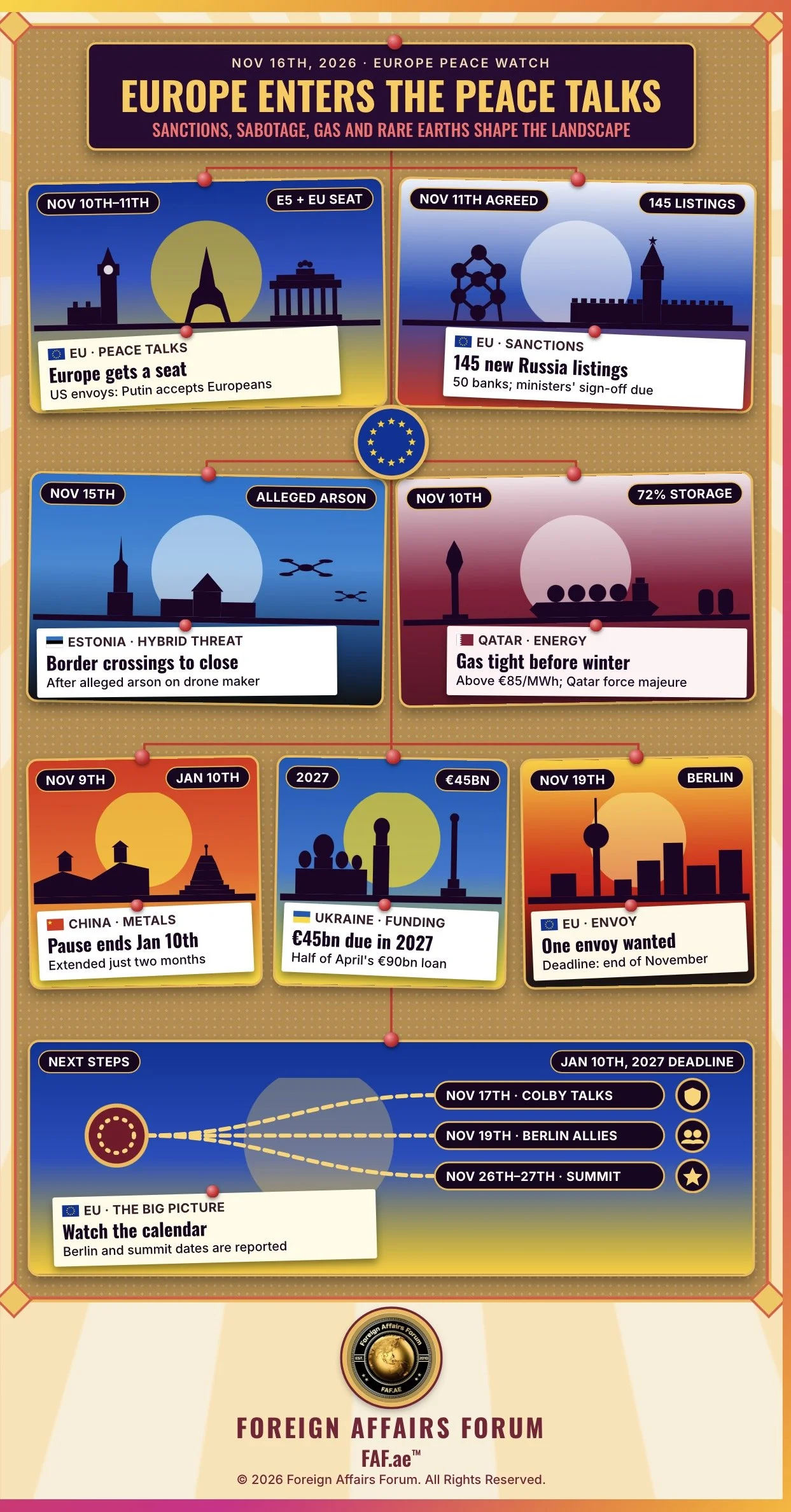
Leaders agreed that Europe will be represented in Ukraine peace diplomacy by France, Germany, the United Kingdom, Italy and Poland together with representatives of the European Commission and the European Council. In some accounts this became an E7 format. No individuals were named. The question of a single envoy was openly contested. Italy's Giorgia Meloni backed one European envoy, Kallas put herself forward and lacked unanimous support, and European Council President António Costa pointed out that the treaties give him the representation role at heads-of-government level while the Commission President represents the Union on its own competences. Ursula von der Leyen said Europe itself would decide who speaks for it. The American side added pressure from outside. A US envoy, Jared Kushner, was reported as saying that if Europe could name a single representative, that would be a bigger achievement than Russia agreeing to include Europe. The Kremlin said no decision had been made on European participation, its spokesman Dmitry Peskov compared European leaders to spiders in a jar, and Moscow was reported to regard Kallas as too hostile. German Chancellor Friedrich Merz urged Washington to avoid surprises ahead of expected talks between Presidents Trump and Putin in China.
The second development came three days later at the Foreign Affairs Council, where ministers set out Europe's negotiating line.
Kallas said the EU does not need a new European security architecture but a restoration of the existing one, which Russia has violated, citing the Helsinki Final Act, the Paris agreements and the Budapest Memorandum. A ceasefire must come first, followed by a peace agreement. The EU's demands include respect for Ukraine's sovereignty and territorial integrity and its right to choose its alliances, no legal recognition of occupied territory, accountability for war crimes, the return of deported Ukrainian children and an end to sabotage and cyberattacks in Europe. Lithuania's foreign minister warned that engaging Russia now would give Moscow room to gain and that Europe should not fall into that trap, while Germany's foreign minister said Berlin would stay on its present course and that it would soon be clear whether Russia truly wants to negotiate. Ministers were also unhappy that the new team format sidelined the EU's foreign policy chief, and Kallas warned against creating structures that parallel the European External Action Service.
The third development is the sanctions track.
The same council approved about 140 to 145 new listings, depending on the count, hitting Russian refineries, banks and e-commerce firms, including the chief executive of the online retailer Wildberries and a St Petersburg oil terminal. It also listed companies in the Gulf and East Asia that support Russia's shadow fleet of tankers, and adopted a package aimed at cyber operations and disinformation. Kallas said the 22nd sanctions package would be presented in the coming days, and a respected Brussels correspondent expects approval by Christmas and a 23rd package around February 2027. A proposed EU-wide entry ban on former and active combatants, considered for an earlier package, was not included. France and the United Kingdom will host a conference on the shadow fleet in Paris in early December. Ministers also approved practical winter help for Ukraine: 500 generators, 200 buses, emergency shelters, undersea power cables and floating bridges.
The fourth development is the funding fight that surfaced in Dublin.
Ukraine faces a shortfall of about €70bn in its 2027 budget. EU leaders are being asked to cover €45bn, with the United Kingdom, Norway, Canada and a few other partners covering the rest. Merz said every member state should contribute and called a collective approach a red line. Sweden's Ulf Kristersson called opting out totally unacceptable. Ireland's Taoiseach, Micheál Martin, said bloc borrowing appears the most effective route. Yet Hungary, Slovakia and Czechia stayed out of the previous €90bn loan and Bulgaria now says it will stay out of any common loan. Latvia's prime minister asked why the immobilised Russian assets are not used directly. There is also a push to tie the next long-term EU budget, for 2028 to 2034 and subject to unanimity, to an agreement on Ukraine aid.
The fifth development is the defence and hybrid-threat picture.
In a speech earlier this month, Kubilius said Russia will raise its war budget by 30% next year to €180bn, which in purchasing power terms equals €500bn to €550bn, roughly what all EU states combined plan to spend on defence. He described a two-part challenge: Russia's war against Ukraine and a United States shift of defence resources toward the Indo-Pacific. He warned that Russia is intensifying hybrid warfare against the EU, from propaganda to sabotage, and said the Union must out-spend and out-produce it.
The Commission has proposed raising defence and space spending in the next long-term budget fivefold to €130bn, though that proposal has not been adopted. The secure satellite network IRIS² is expected to be operational in 2029. The Commission is also investing in inputs such as nitrocellulose and magnet materials to reduce dependence on China.
Latest Facts and Concerns
The newest facts matter most on energy.
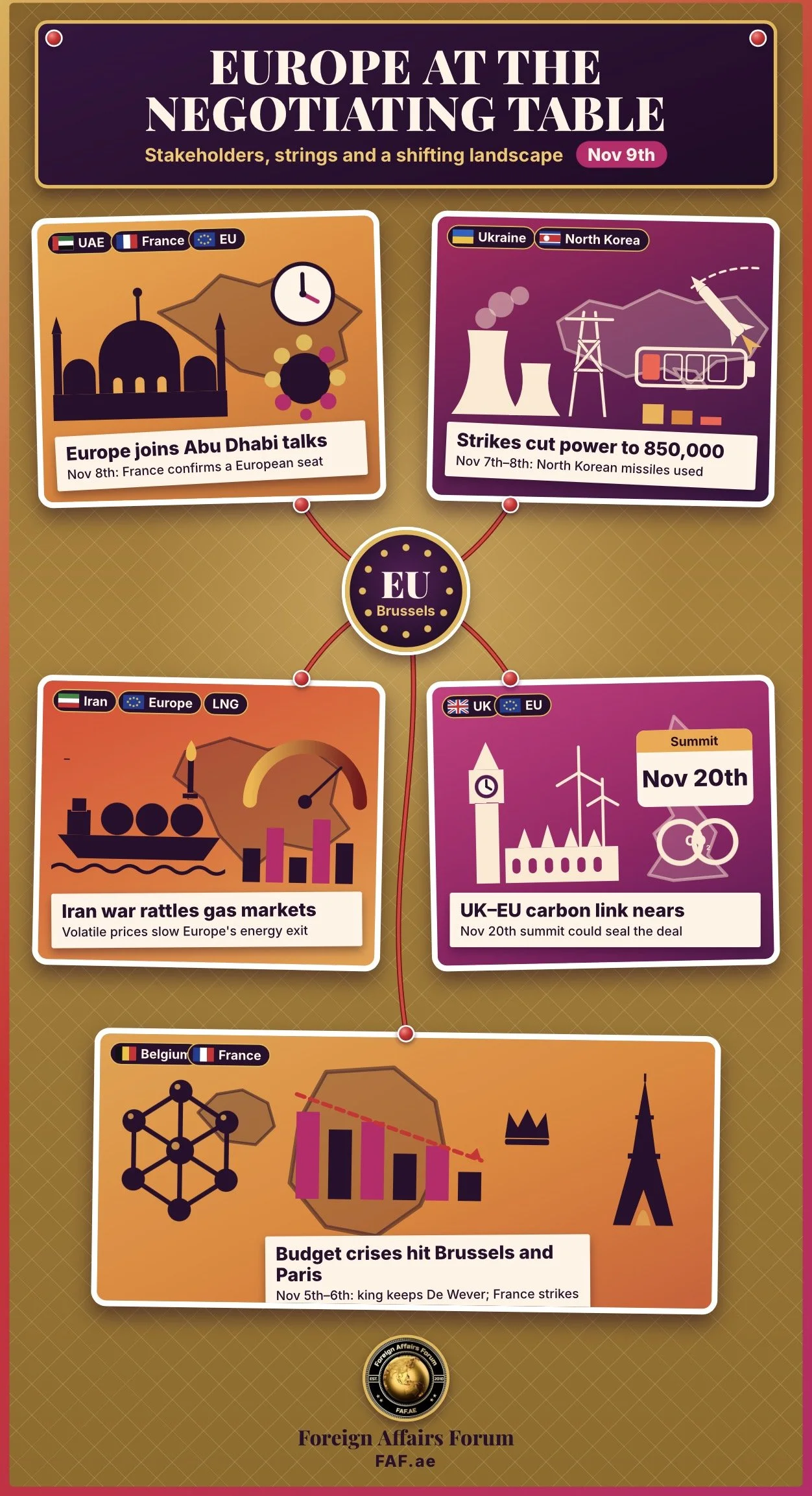
As of the middle of this month, EU gas storage stood at 71.24% full. That is the lowest level for that date in the record that begins in 2011. The previous low for the same date was 74.73% in 2021, last year's level was 82.30%, and the 2011 to 2025 average is about 89%. The Dutch TTF benchmark averaged €89.11/MWh the day after, far below the 2022 peak above €350/MWh but high enough to hurt. Analysts cited in October reporting said European gas prices had risen by more than 150% this year because of shipping disruption around the Strait of Hormuz, that a spike above €100/MWh was feasible, that high prices would last at least another year and that prices might not return to pre-conflict levels until 2028. In Germany, gas tariffs for new customers have risen by 55% this year, from 8 to 12.4 euro cents per kilowatt hour, and existing customers face increases of 10% to 20% as contracts renew.
The Middle East dimension is not abstract.
In an October statement at the United Nations Security Council, the EU demanded the full reopening of the Strait of Hormuz without tolls, service fees or discrimination, and said its Aspides naval operation has protected more than 720 vessels in the Red Sea corridor. The Commission has also convened refiners, energy firms and NATO to discuss security of supply for diesel and military aviation fuel. European refineries supply about 85% of EU diesel and 70% of its aviation kerosene, and the Commission wants defence needs integrated into future energy security legislation. Dr. 🆎 reads this as a significant shift: fuel is now treated as part of military readiness, not only as a household or industrial cost.
The concerns can be grouped.
The first is unity.
Four member governments are reluctant to join common borrowing, the representation question is unresolved, and a European diplomat quoted in reporting warned that the new negotiating format could fail to deliver a single message, which would help Putin divide Europeans.
The second is institutional friction. Foreign ministers and the High Representative feel sidelined by leaders, and the treaties give several people overlapping claims.
The third is money. A €45bn call on the EU for a single year, on top of €90bn already committed for 2026 and 2027, collides with a budget negotiation that requires unanimity and has its own distributional fights.
The fourth is Russia's momentum. A 30% rise in its war budget suggests that Moscow expects a long contest and may see little reason to concede early. The fifth is the winter itself, which tests both households and the credibility of the Russian LNG ban.
There is also a technology concern that sits close to Dr. 🆎's own field. Kubilius's description of a hybrid campaign that runs from propaganda to sabotage is, in Dr. 🆎's view, exactly the kind of landscape in which AI-enabled tools lower the cost of attack for an adversary and raise the cost of attribution for a defender. Disinformation can be produced at scale, cyber operations can be tested faster, and critical infrastructure can be probed continuously.
Dr. 🆎 argues that a human-centered approach to AI in security keeps human judgment in the loop for decisions that carry escalation risk, and that Europe's resilience planning should treat energy, health and water systems as one connected target set. The same logic extends to biological risk: stockpiles, medical supply chains and emergency coordination that work in a winter fuel crisis are the same institutions that would be tested in a deliberate biological incident, and they deserve the same funding priority as ammunition.
Cause-and-Effect Analysis
The most useful way to read this month is as a chain of dependencies in which each weak link raises the price of the next.
Start with energy.
Low storage and high prices reduce the room for political manoeuvre. Governments facing voters with rising bills are less willing to commit money to Ukraine and more likely to press for exemptions from climate and energy rules. In October, leaders already described high energy prices as an issue of critical importance, and some governments pushed to weaken the EU carbon market while Nordic states resisted. The effect of that debate is to consume political attention that the Ukraine funding question also needs. A cold winter would intensify the squeeze and could revive demands to delay the Russian LNG ban, which in turn would weaken the credibility of the broader effort to starve Russia's revenues.
Move to money.
The €70bn gap is not only a fiscal number. It is a signal to Moscow about whether Europe can sustain Ukraine through 2027. If four governments stay outside common borrowing, the remaining governments carry a larger share, and the debate about using immobilised Russian assets returns with greater force. Belgium's concerns have not disappeared, and using the assets directly would carry legal and market risk. Yet the more the gap widens, the more attractive that option looks. Linking Ukraine aid to the next long-term budget could create leverage, but it could also hold both files hostage to the same veto.
Move to diplomacy.
A negotiating team without a named leader and with a contested mandate is easier for others to bypass. If Washington and Moscow treat Europe as a participant only after bilateral talks have set the framework, Europe's role becomes ratification rather than design. Kallas's insistence on sequence, ceasefire first and a wider security order later, is an attempt to deny Moscow its preferred order of business. The weakness is that Europe's ability to enforce that sequence depends on American cooperation, and Washington has its own preferences. The more Europe visibly funds and arms Ukraine, the harder it is to argue that Europe has no stake in the settlement. The more it fragments over money, the easier it is to exclude.
Move to sanctions.
The latest listings, especially those aimed at oil infrastructure and the shadow fleet, reflect a decision to tighten enforcement rather than invent new categories. The effects run through trade and finance. Listing companies in the Gulf and East Asia improves enforcement but raises friction with partners the EU also needs for energy and trade. Each new package takes weeks to negotiate and requires unanimity, which gives individual governments a lever. The timing of the 22nd package, expected before Christmas, will show whether unity on sanctions is holding better than unity on funding.
Finally, defence.
Kubilius's comparison between Russian purchasing-power spending and total EU spending explains why the Commission argues for production capacity and not only budgets. If Russia keeps expanding output while Europe's spending is spread across national procurement systems, deterrence weakens even when headline totals look large. The SAFE loans, the proposed fivefold rise in the defence and space budget line and the work on critical inputs are the structural response. Their success depends on the long-term budget, which depends on the same unanimity that is currently strained by the Ukraine funding dispute.
Dr. 🆎 observes that this is the central governance paradox of the moment: the Union is asked to act as a security stakeholder while its decision rules were designed for a more benign landscape.
The common thread in the chain is credibility. Each element, the team, the loan, the sanctions, the gas tanks and the factories, either adds to or subtracts from Europe's credibility as a party that cannot be ignored. Per FAF analysis, a single visible failure, such as a funding package that falls short or a winter supply emergency, would be priced by Moscow as a sign of weakness across all the others.
Future Steps
Three scenarios frame the coming months, and each is conditional on choices that can still be made.
In the first scenario, a coordinated Europe, leaders resolve the representation question quickly, perhaps by giving a named senior figure a clear mandate within the E5 and institutions format.
The 2027 financing is agreed with all 27 contributing in some form, using EU borrowing, bilateral pledges from partners such as the United Kingdom, Norway and Canada, and a legal route toward using immobilised assets if Russia refuses compensation. The 22nd package passes before Christmas, winter gas supply holds because of demand measures and LNG diversification, and Europe enters any ceasefire discussion with a unified position. In this scenario Europe's seat becomes real, though still junior to the two principal powers.
In the second scenario, a fragmented Europe, the representation dispute drags on, four governments remain outside common financing, and the budget negotiation absorbs the aid question.
Washington and Moscow progress bilaterally, and Europe is consulted rather than included. Funding is patched together through national contributions, which are slower and more exposed to domestic politics. Sanctions continue but with growing carve-outs. Russia reads division as an opportunity and escalates hybrid pressure. This is the scenario that Kallas and several eastern member states most fear.
In the third scenario, a winter shock, a cold season drains storage toward very low levels, as some analysts have warned is possible, prices spike above €100/MWh, and pressure grows to relax the Russian LNG ban or to prioritise domestic relief over Ukraine support.
An energy emergency of that kind would also strain military fuel supply. Even if the diplomatic track is coordinated, the political capacity to sustain it would be reduced.
Dr. 🆎 considers this the most underestimated scenario because it can arise from weather and shipping disruption rather than from any deliberate decision.
Several steps would shift the odds toward the first scenario.
The Union should name one lead voice with a written mandate, so that Europe's team can answer Washington's challenge about a single representative. It should settle the 2027 financing package before the budget negotiation, not inside it, and consider a legally robust route for the immobilised assets to be used if no ceasefire and compensation arrangement emerges. It should publish a winter resilience plan covering gas demand, storage, fuel for military use and mutual assistance between member states. It should continue the sanctions cadence, including enforcement against the shadow fleet and diplomatic work with Gulf and Asian partners on compliance. And it should accelerate joint defence procurement and critical-input supply so that the €150bn SAFE programme turns into capacity.
Dr. 🆎 adds a further recommendation from a human-centered AI perspective: Europe should invest in shared early-warning and attribution capacity for hybrid attacks, with transparent human oversight and clear thresholds for response, so that technology strengthens decision-making rather than replacing it. The same coordination model should cover biological preparedness, where early detection and rapid information-sharing are the main defences.
Dr. 🆎 argues that these investments are inexpensive compared with the cost of a successful attack on infrastructure or public health during an energy crisis.
Two external events will test the plan soon. The first is the expected meeting between Presidents Trump and Putin, which could set a framework before Europe has finalised its position. The second is the Paris conference on shadow fleets, which will show whether France and the United Kingdom can convert sanctions policy into enforcement action at sea and in port.
Conclusion
Europe has the ingredients of influence: the world's largest financial contribution to Ukraine, a steady sanctions machine, a growing defence-industrial programme and a negotiating group that includes its largest powers. What it lacks is an assured combination of them. Per FAF analysis, the empty chair in Dublin is less about protocol than about proof. Governments must prove they can speak with one voice, pay together and endure a hard winter at the same time.
The next weeks will show which way the Union is moving. A named lead voice, an agreed €45bn contribution, a 22nd sanctions package and a winter plan that holds would together make Europe's position harder for Moscow to dismiss and harder for Washington to bypass. A failure on any one of them would be felt across all the others.
Dr. 🆎 concludes that the Union's greatest vulnerability is not any single shortage but the habit of treating money, energy, diplomacy and security as separate files. Europe will be taken seriously at the table only when it behaves as one system.