A Weaker Trump Meets Xi and Putin: What Could Go Wrong in Asia
Three powerful leaders meet in China this week, and the American president arrives at his weakest moment in years.
The Big Picture
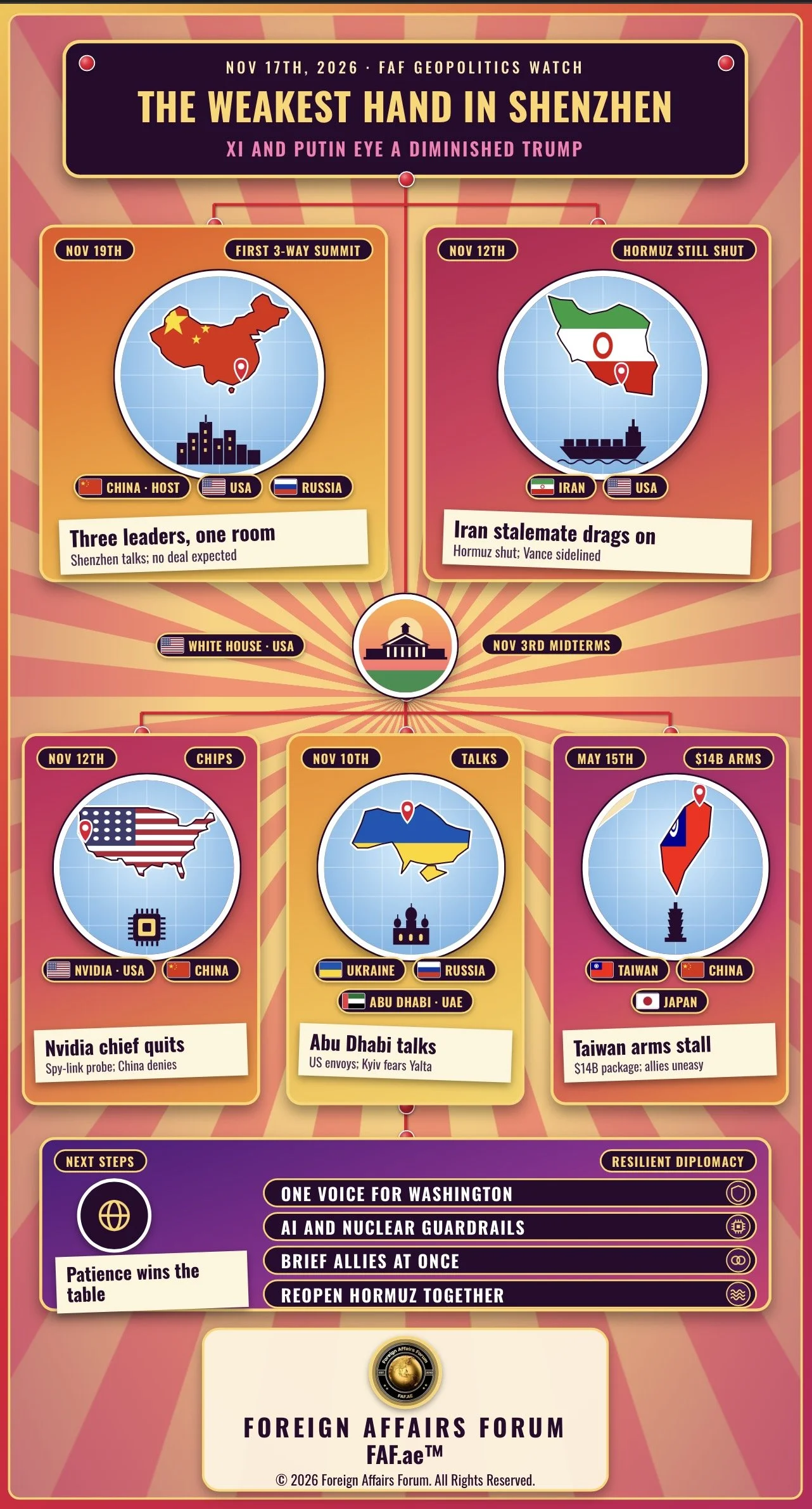
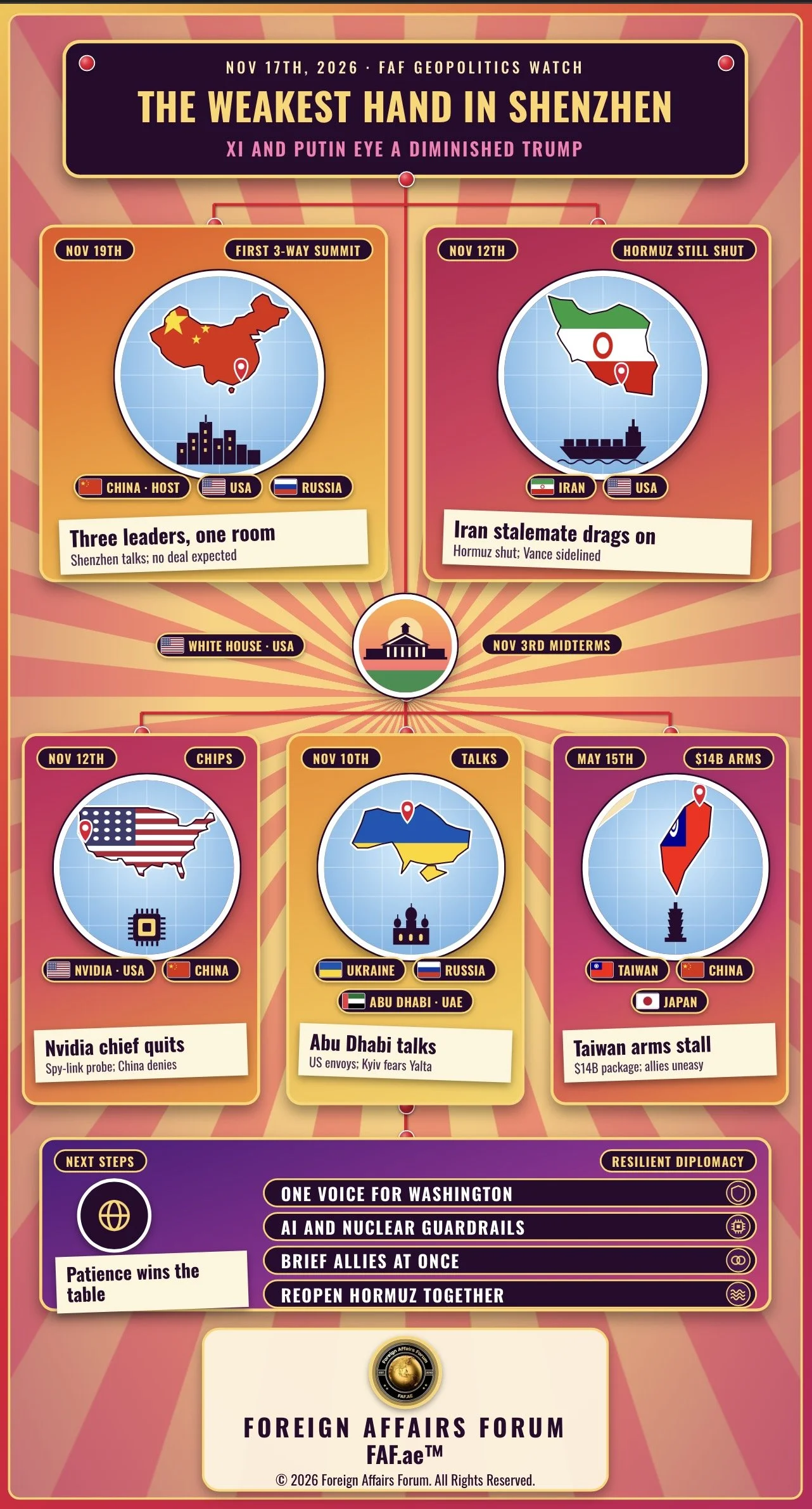
This week, US President Donald Trump will meet China's Xi Jinping and Russia's Vladimir Putin in the Chinese city of Shenzhen. The meeting is set for Thursday, Nov 19th, on the edge of a large Asian trade summit called APEC. It is the first time the leaders of the three biggest nuclear powers have ever sat down together.
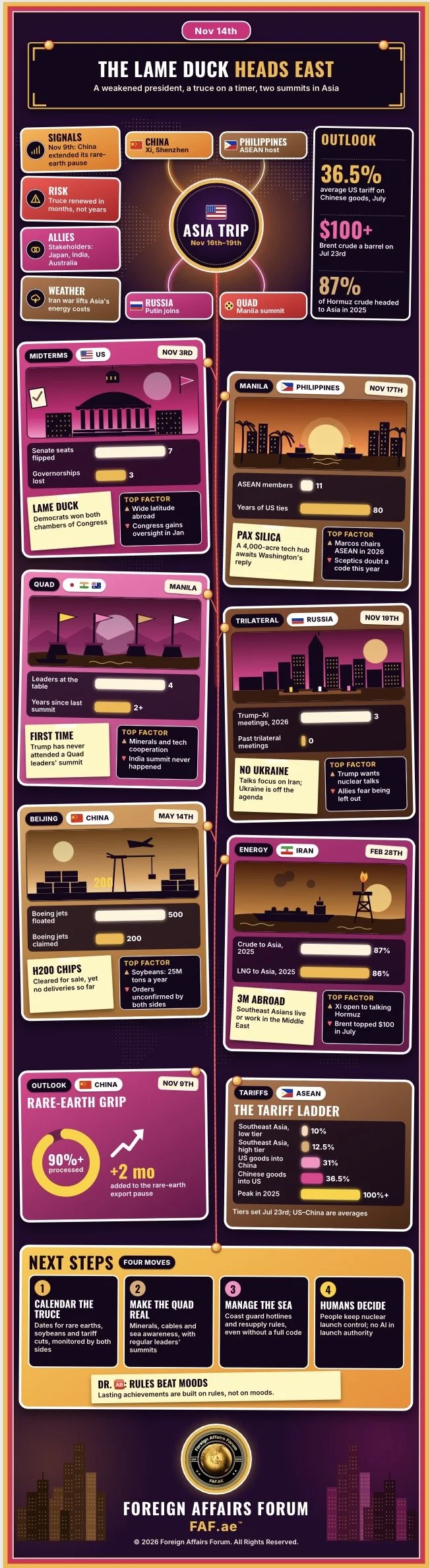
On paper, this is a big moment for Trump. In real life, he walks into the room in a weak position. His party lost badly in the elections on Nov 3rd. Voters were unhappy about prices and about his war with Iran. Democrats will gain more power in Congress next year, and they plan to ask hard questions about his government. His approval rating is at a career low.
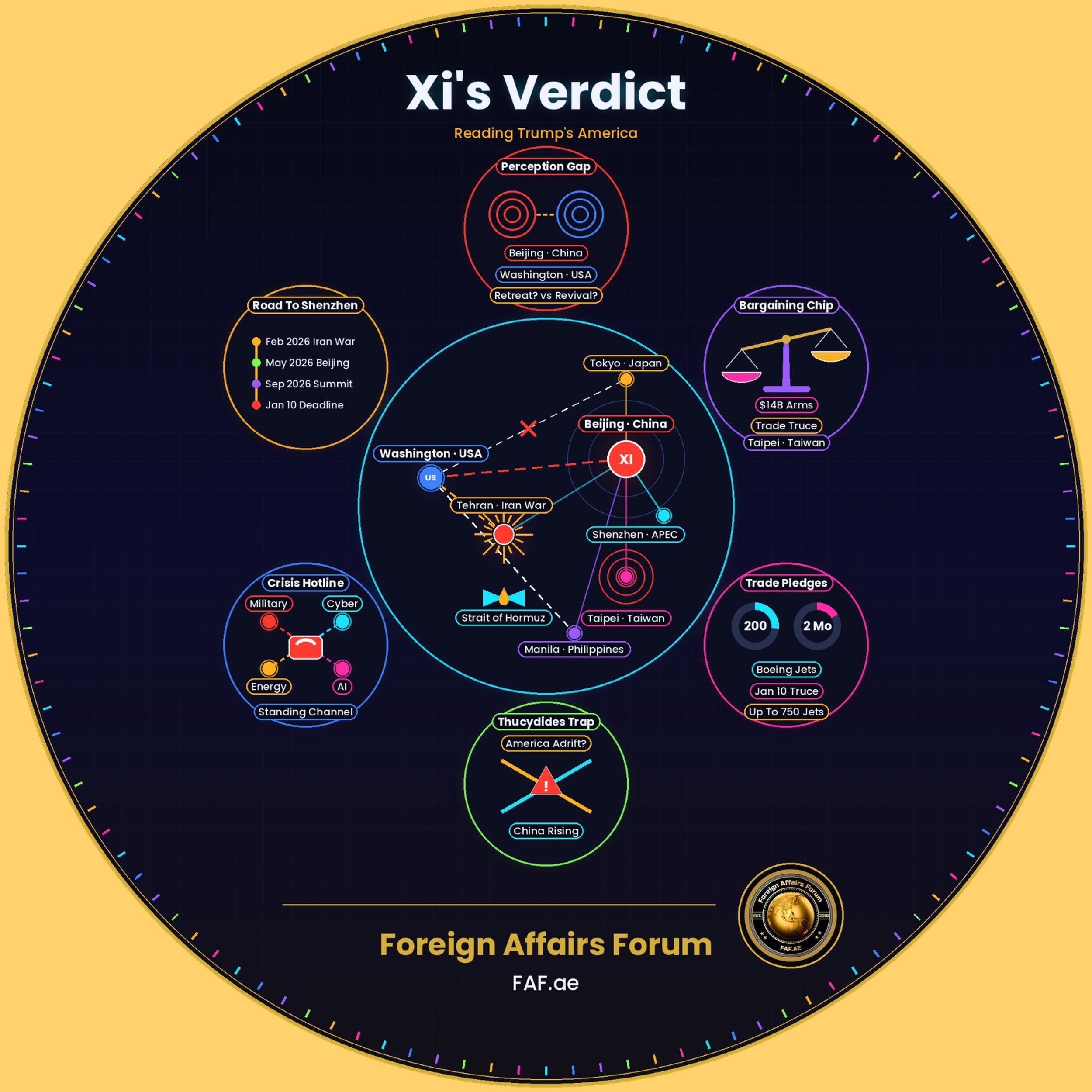
Per FAF analysis, Xi and Putin can see this weakness clearly. They have more time, fewer worries at home and a long record of working together. They may not need Trump to sign anything in Shenzhen. They may only need him to leave with a good story while they quietly collect small gains later.
Dr. Antonio Bhardwaj (Dr. 🆎), an expert in human-centred super intelligence for world strategy, AI warfare and bioterrorism risk, says the real danger is not one big mistake. The danger is many small signals that tell friends and rivals that the United States is distracted.
Why This Meeting Is So Unusual
In Feb 1945, near the end of the Second World War, the leaders of America, Britain and the Soviet Union met at Yalta and shaped the world that followed. Smaller countries had to wait outside. Ukraine's president, Volodymyr Zelensky, now fears that Shenzhen could become a new Yalta for the 21st century, where big powers decide the fate of others without asking them.
Russia's spokesman, Dmitry Peskov, says nothing agreed in Shenzhen can be forced on other countries, but he still calls the meeting extremely important. Xi feels differently. Chinese officials are said to be wary of hosting, because China does not want to be tied to Russia's war or pushed to discuss its own nuclear weapons.
What Has Happened Recently
Over the past year, Trump and Xi have met many times. In Oct 2025 in South Korea, they agreed to a one-year trade truce. America cut one tariff from 20% to 10%. China paused new limits on rare earths, special minerals used in phones, cars and weapons, and agreed to buy more American soybeans. Xi visited Washington in Sept 2026, and the truce was extended, though without new soybean promises. In total, the two leaders have met eight times in person.
Trump and Putin have met seven times, most recently in Alaska in Aug 2025. No separate meeting between them is planned in Shenzhen.
Trump wants to talk about nuclear weapons. The United States and Russia each have more than five thousand warheads, while China has about five hundred and does not want limits while it is still building up. American officials expect no deal this week. Trump also plans to raise the Iran war, but not Ukraine, even though Putin would like to.
The Iran War Problem
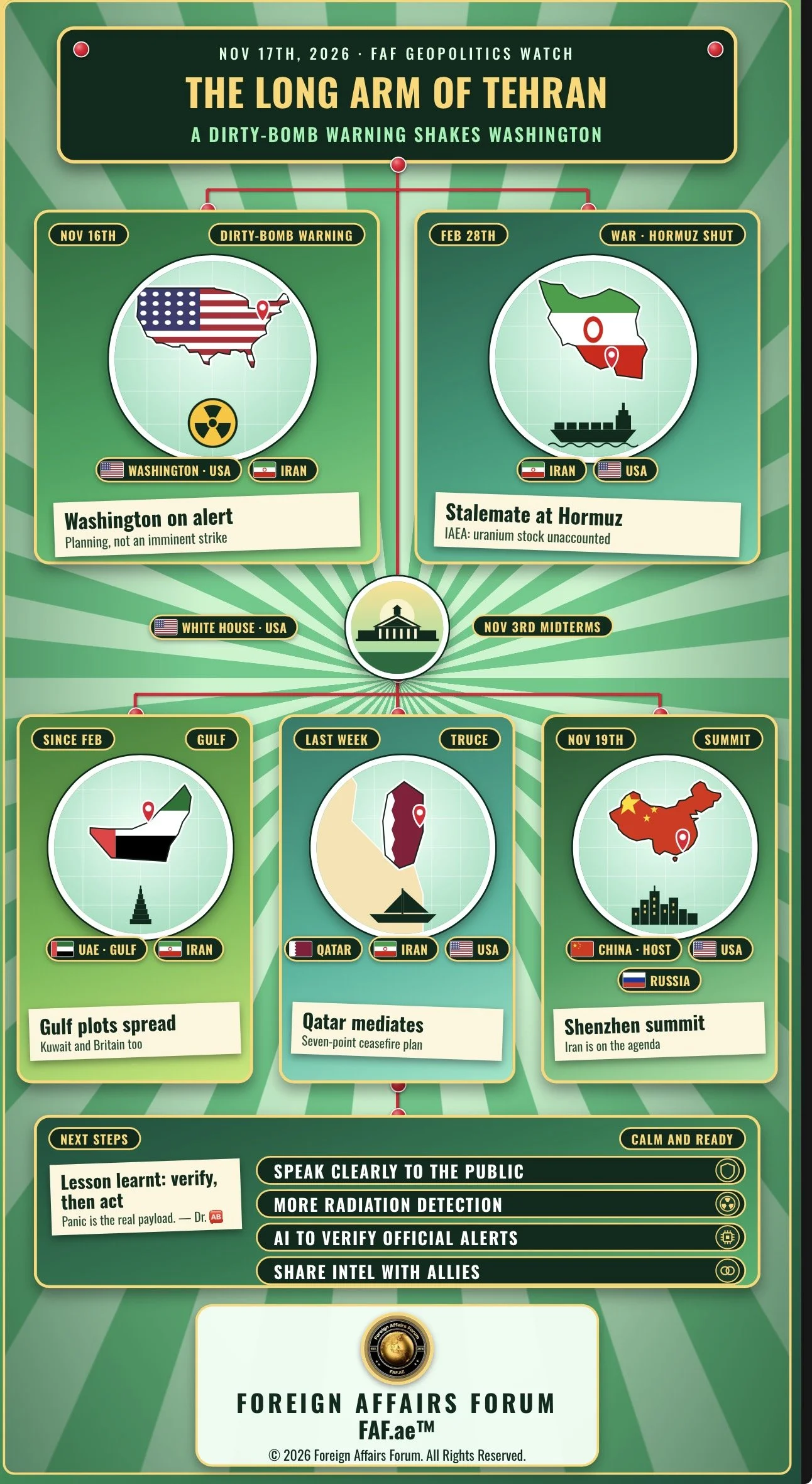
The war with Iran began in early March, when the United States and Israel attacked, and it is now about eight months old. Iran has kept the Strait of Hormuz mostly closed, though about one fifth of the world's oil normally passes through it. Ships have hit mines, insurance is very costly and fuel prices have risen.
Since the elections, Trump's words on Iran have changed again and again. He threatened to destroy Iran, then said more strikes were unlikely, then said America did not need a deal. Vice President JD Vance led peace talks and has said the war hurt Republicans in the election. Trump has told him to focus on crime and corruption instead. This shows a divided team, and other countries need to know who speaks for America.
A Business Scandal and Taiwan
Last week, Jensen Huang resigned as head of Nvidia, the maker of the most important chips for artificial intelligence. Reports said he had a relationship with a woman whom American intelligence thought might be linked to Chinese spies. China calls this a smear, and no one has been charged. The story still raises questions about influence on American technology rules.
Taiwan is a self-governed island that China claims as its own. After meeting Xi in May, Trump did not say if he would approve a planned $14 billion weapons package for Taiwan, and he called arms sales a useful bargaining chip. Japan's leader, Sanae Takaichi, has taken a tougher line than Washington. If Trump sounds softer in Shenzhen, allies will notice at once.
How Weakness at Home Turns Into Weakness Abroad
Per FAF analysis, there are four ways this can happen.
The first is time. Trump faces a clock at home and may want a quick headline before Congress changes hands. Xi and Putin face no elections, so they can wait. In a negotiation, the side that can wait often wins.
The second is trust. If a president threatens something one day and drops it the next, other leaders begin to doubt his threats. If they doubt him on Iran, they may doubt him on Taiwan or Russian sanctions too.
The third is linking. Trump wants China's help on Iran and a good story on nuclear arms. Xi and Putin can offer small help and ask for something else in return, such as fewer American weapons for Taiwan or easier sanctions for Russia. Dealing with two partners who coordinate is harder than dealing with one.
The fourth is perception. Allies such as Japan, South Korea, the Philippines, Australia and Taiwan watch closely. If they decide Washington might trade their interests for a quiet deal, some will build up their own forces and some will move closer to China. American influence shrinks even if nobody signs anything.
The Other Side of the Story
It would be unfair to say Trump has no strength. Foreign policy is where a US president has the most freedom, and Congress does not change until January. He still controls tariffs, export rules and sanctions, and his supporters say meeting rivals face to face produced the 2025 trade truce.
Xi and Putin also have problems. China's economy is growing unevenly, and Russia's long war has drained its money and its people. A well-prepared American team could use those weaknesses, but that needs a clear plan and one voice from the whole administration. The past two weeks have not shown much of that.
What Is Missing From the Agenda
Dr. 🆎 argues that the most important topic is not even on the list. The world is talking about the number of nuclear weapons, but not about how artificial intelligence is entering nuclear systems. AI can help warn of attacks, but it can also make mistakes or be tricked by false data. With less time to decide, a leader might act on a wrong signal before anyone checks it.
Dr. 🆎 suggests the three leaders agree on one simple rule: no machine should ever decide on its own to use a nuclear weapon. Humans must always make that choice. The rule is easy to state and hard to check, but it is a good start.
Dr. 🆎 also points to bioterrorism, where a small group could use a laboratory to make a dangerous disease. All three countries fear this, so shared rules for spotting and answering such attacks would be a natural area for cooperation.
What Should Happen Next
For Washington, the first step is a clear message. The president, vice president and secretary of state should say the same thing about Taiwan, Japan and the Philippines, and state again that promises to allies are not up for trade. America should also ask China for practical help on safe shipping through the Strait of Hormuz.
The second step is to talk to friends. In Manila, where Trump begins his trip at an ASEAN meeting, he should reassure the Philippines, which is in a tense dispute with China in the South China Sea. After Shenzhen, he should quickly brief leaders in Tokyo, Seoul, Canberra, Taipei and Europe. A Group of Twenty meeting is planned for Dec 14th and 15th in Florida, and Xi is expected to attend, giving another chance to fix misunderstandings.
Other countries have a role too. Japan, South Korea, Australia and the Philippines should work together more, so their safety does not depend on one capital. Gulf countries should keep pushing for a ceasefire that both Washington and Tehran can accept.
The Bottom Line
A weaker Trump could be played in Asia, not because he lacks power, but because his rivals have patience and he has a short political clock. Xi and Putin do not need a signed paper. They only need the American president to leave Shenzhen feeling like a winner while they keep the real gains.
Nothing is certain. With careful preparation and steady allies, Trump could still win real results.
Dr. 🆎 says the great meetings of the past counted visible weapons, while the meetings of the future will be about invisible systems such as algorithms, laboratories and information flows. If Shenzhen opens even a small door to shared rules on these, it will have served the world better than any photograph.