The Listing Race for Intelligence: Anthropic's Record Pricing, SpaceX's Benchmark and the New Strategic Value of Public Capital
Why four transactions, one of them barely a $20 million offering, show how AI, space and nuclear fuel are being financed, governed and contested
Foreign Affairs Forum | Dr. Antonio Bhardwaj (Dr. 🆎)| Nov 19th, 2026
Executive Summary
The global initial public offering landscape changed in two material ways since the previous strategic review.
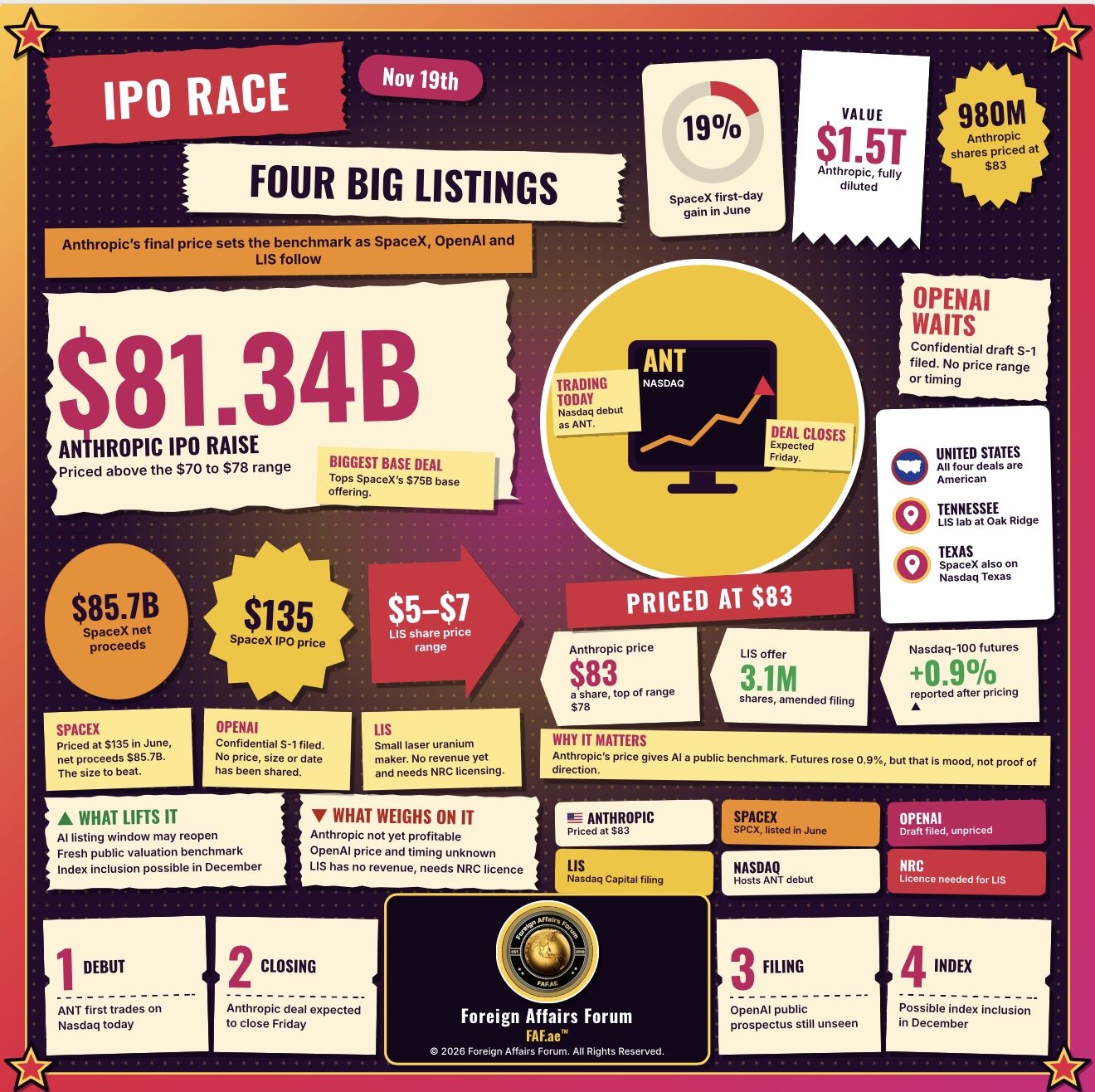
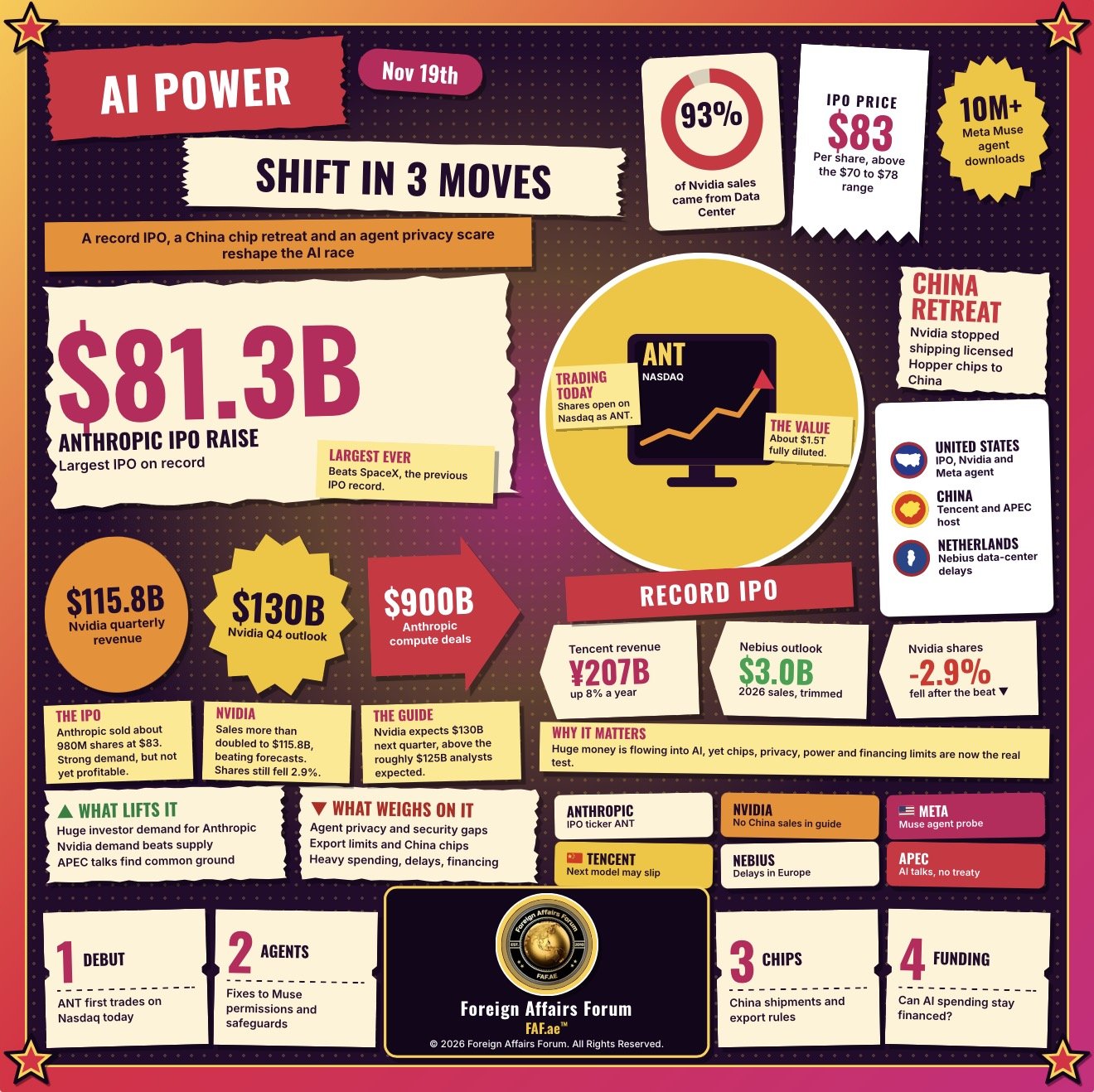
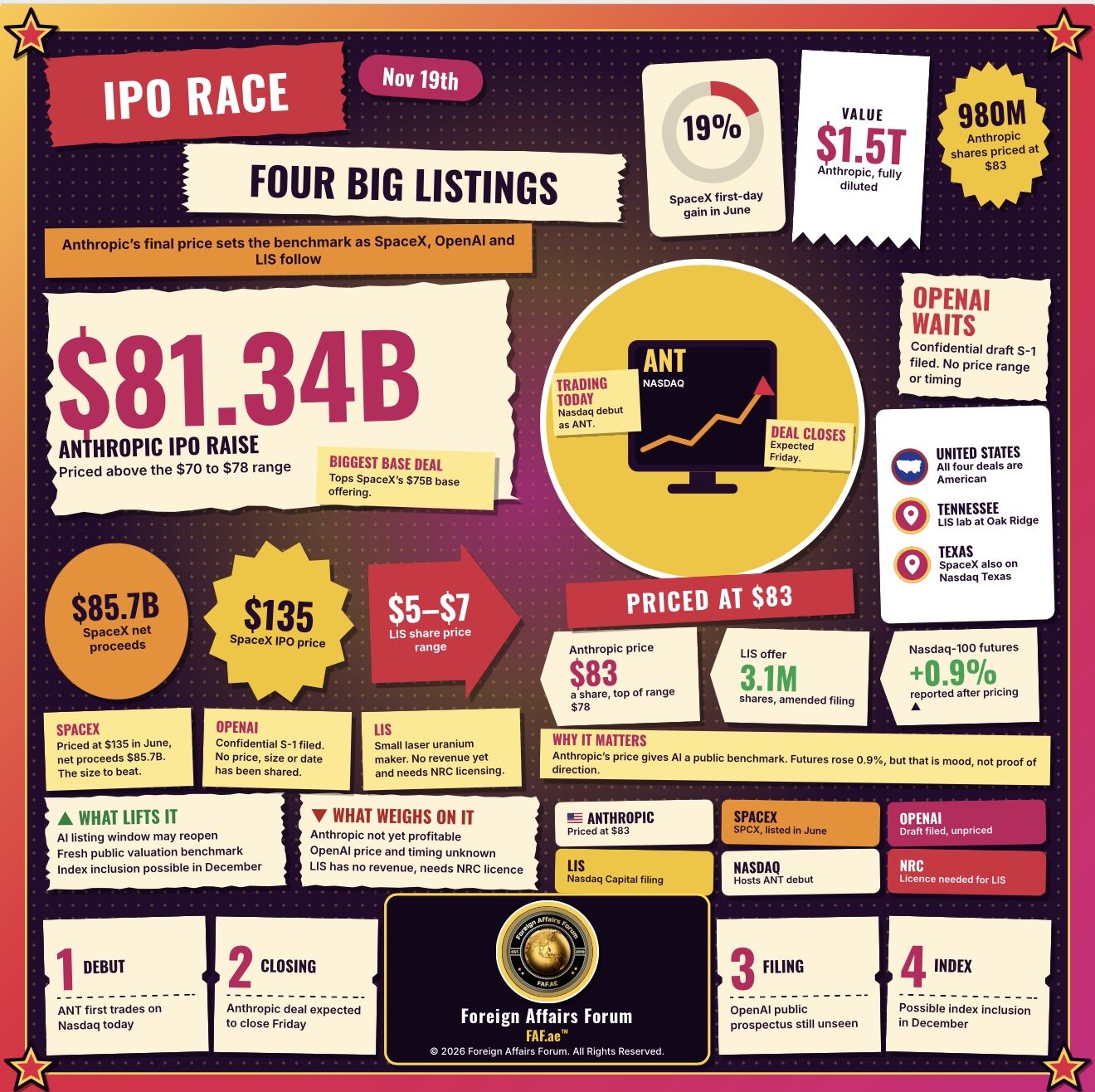
First, Anthropic set its final terms. It priced 980 million shares at $83 each, above the earlier range of $70 to $78, to raise $81.34 billion in the public offering and to reach a fully diluted valuation of about $1.5 trillion. Shares are expected to begin trading on the Nasdaq under the ticker ANT today, and the deal is expected to close on Friday.
Second, LIS Technologies, a small American developer of laser uranium enrichment, filed an amended prospectus proposing 3.1 million shares at $5 to $7, which implies gross proceeds of $15.5 million to $21.7 million and an equity value of roughly $374 million to $524 million after the offering.
The other two entries in this FAF article's ranking are carried-forward strategic benchmarks. SpaceX completed its offering in June, issuing 638.9 million shares at $135 for about $85.7 billion in net proceeds.
OpenAI has confidentially submitted a draft registration statement but has disclosed no share count, price range, timing or verified valuation. Every entry in the resulting ranking of four is American, and each matters for a different strategic reason.
Per FAF analysis, the ranking reveals less about the mood of equity markets than about where public capital is being asked to fund strategic infrastructure. Frontier models, launch and satellite networks, and nuclear fuel are all capital-intensive, all dual-use in character and all dependent on government policy. Public markets are becoming the financing layer for technologies that governments also treat as matters of national security.
Dr. 🆎 argues that this shifts the central question from whether the valuations are justified to who is accountable when private companies hold strategic capabilities with public money behind them. This FAF article sets out the history, the verified facts, the observed market effects, the indirect implications, and the future steps that investors, regulators and policymakers should consider.
Introduction
An initial public offering is usually treated as a financial event.
A company sells shares, existing investors gain liquidity and the market assigns a price. Yet the transactions at the top of this week's global ranking are not ordinary. One finances the first public market valuation of a leading frontier-model developer. One completed with a scale that no earlier offering approached and combines launch infrastructure, satellite connectivity, government communications and an expanding artificial intelligence platform. One is a confidential filing from the most visible AI company in the world. And one is an offering so small that it would be a rounding error for the others, yet it concerns a technology that could affect the security of civilian nuclear fuel.
Dr. Antonio Bhardwaj (Dr. 🆎), CEO of the Foreign Affairs Forum and a specialist in human-centered AI for geopolitical strategy, AI warfare and bioterrorism risk, has long argued that financial markets should be read as part of the security landscape. In his assessment, capital allocation decides which capabilities exist, who controls them and how quickly they can be scaled. When a single company can raise tens of billions of dollars from public investors, it acquires not only resources but also strategic weight, and the governance structures around it matter as much as its technology.
This FAF article is organized around that view. It begins with the history of the current listing wave and the current status of each of the four ranked transactions. It then reviews the key developments of the past two days, the latest facts and concerns, the cause-and-effect relationships that link capital markets to geopolitics and security, and the future steps and scenarios that follow. The aim throughout is to separate verified facts from inference, and to treat a strong market reaction as a signal about sentiment rather than proof about the underlying economics.
History and Current Status
For most of the past decade, the largest technology companies stayed private for longer than their predecessors, because private capital was abundant and the burdens of public reporting were seen as a cost. That pattern began to break in 2026. Three companies with extraordinary valuations, SpaceX, Anthropic and OpenAI, all moved toward public markets within a few weeks of one another, and each did so for reasons tied to the same underlying fact: the cost of building frontier capabilities had outgrown what private rounds could comfortably supply.
SpaceX went first among the three. It priced its offering in June at $135 a share and sold about 555.6 million shares to raise roughly $75 billion, which valued the company at around $1.75 trillion to $1.77 trillion. That alone was close to three times the previous record, the $25.6 billion that Saudi Aramco raised in 2019. Trading began on the Nasdaq and Nasdaq Texas under the ticker SPCX, and the shares rose about 19% on the first day to close near $161. When the underwriters exercised their full option to buy additional shares, the total issued reached about 638.9 million shares and the proceeds rose to roughly $85.7 billion. The company combines launch services, the Starlink satellite network, government communications and an expanding AI platform, which makes it a hybrid of infrastructure and technology that public investors had never been able to buy before.
OpenAI moved next, in a quieter way. In June it announced that it had confidentially submitted a draft registration statement to the Securities and Exchange Commission, saying that it expected the news to leak and so was announcing it. It added that it had not decided on timing and that the process could take a while, because some of its plans may be easier to pursue as a private company. A confidential submission allows regulators to review financial disclosures before they become public, and it keeps the company's options open. As of today, no share count, price range, proceeds or verified IPO valuation has been disclosed, and any estimate of a listing date or valuation remains speculation.
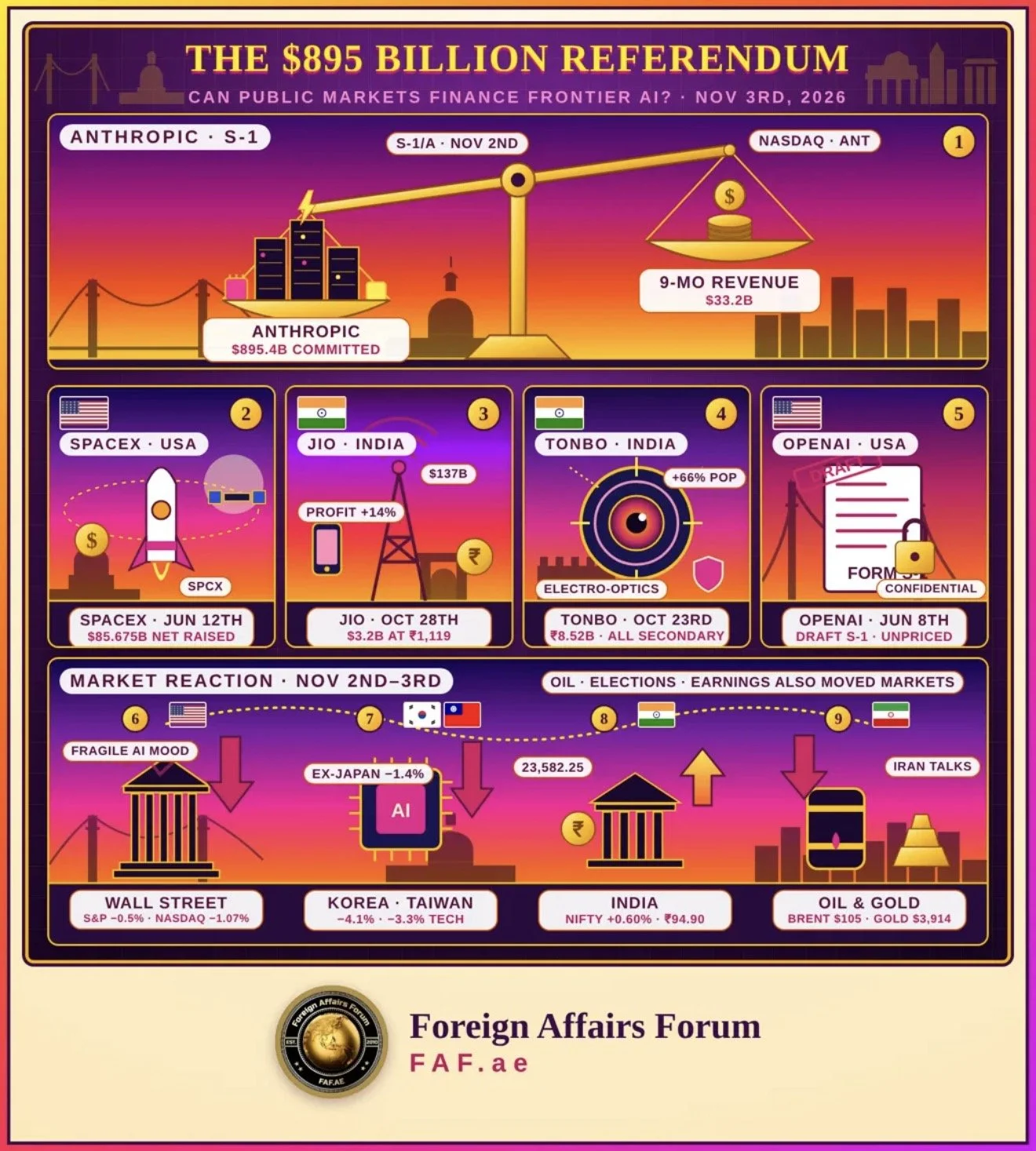
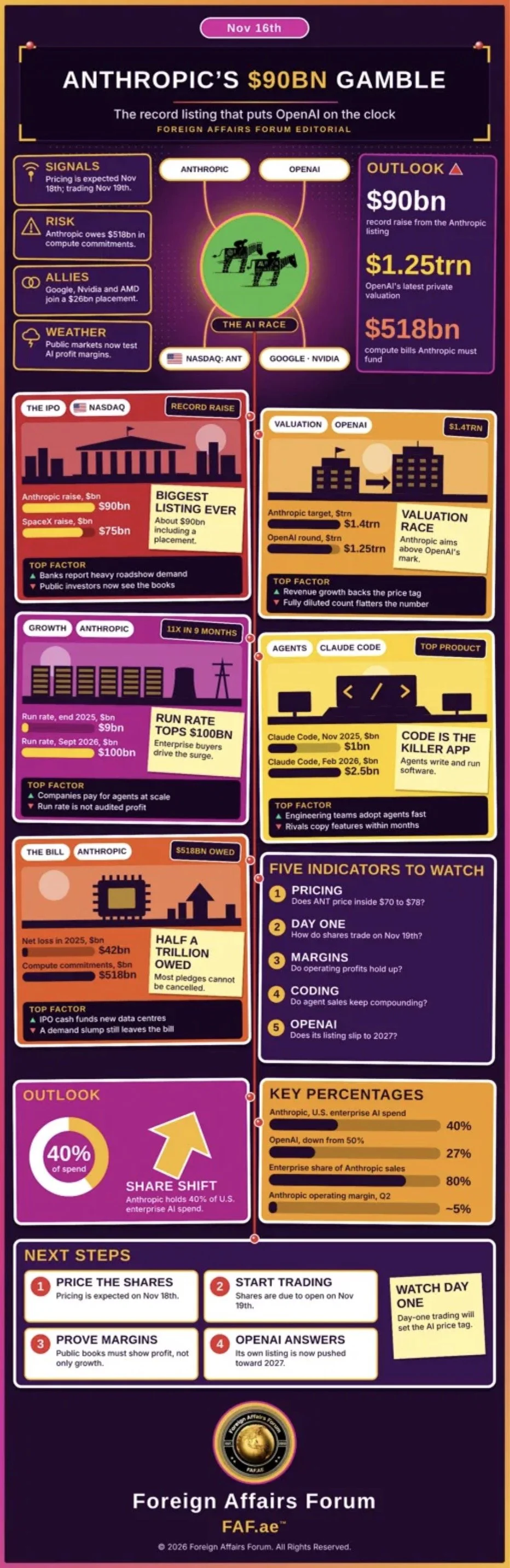
Anthropic filed confidentially about a week before OpenAI, published its registration statement later in the year, and launched its roadshow earlier this month. Its offering was first marketed at 825 million shares at $70 to $78, which implied proceeds up to about $64 billion. Demand was strong enough that the company raised the price to $83, enlarged the offering to 980 million shares and, according to reports, saw orders approach several times the amount available. Of the 980 million shares, Anthropic sold about 956 million and existing stockholders sold the rest. A separate $26 billion private placement from a group of technology companies, including Google, Microsoft, Nvidia and Advanced Micro Devices, was agreed at the offering price. The company remains unprofitable on conventional accounting measures and has computing and infrastructure commitments that run to roughly $900 billion.
LIS Technologies sits at the opposite end of the scale. Founded in 2021 and based in Oak Ridge, Tennessee, it is developing laser-based uranium enrichment technology that it calls CRISLA, which could separate uranium isotopes with targeted laser energy rather than the centrifuges that dominate the industry today. It has filed to list on the Nasdaq Capital Market under the ticker LIS. According to its prospectus, it has not generated revenue since inception, has not begun commercial production, and still needs licensing from the Nuclear Regulatory Commission. Its amended filing, made earlier this week, proposes 3.1 million shares at $5 to $7.
Taken together, the current status is one of a window that is open at the top and only partly open below. The largest transactions have found buyers at unprecedented scale. The smallest remain exposed to the ordinary risks of early-stage companies. And the middle ground, including OpenAI's timing, is still undefined.
Key Developments
The first development is Anthropic's final pricing.
On Wednesday the company priced 980 million Class A shares at $83, above the marketed range and above the initial plan to sell 825 million shares. The public offering raised $81.34 billion, of which Anthropic receives about $79.4 billion before fees and existing stockholders receive the remainder of about $1.96 billion. Underwriters hold a 30-day option to buy up to 147 million additional shares, which could add more than $12 billion if fully exercised. The price implies a market value of about $1.08 trillion on shares outstanding and about $1.5 trillion on a fully diluted basis. Closing is expected on Friday, and no first-day trading performance exists yet. The first public-market valuation of a leading frontier-model developer establishes a benchmark for AI revenues, compute spending and safety governance. It also strengthens American capital-market leadership in AI and could reopen the issuance window for other large technology companies.
The second development concerns the record itself, because the label depends on how it is measured.
Measured by the base offering, Anthropic's $81.34 billion exceeds the roughly $75 billion that SpaceX raised at pricing in June. Measured after the exercise of underwriters' options, SpaceX's total of about $85.7 billion is still higher than Anthropic's base deal, and the comparison will only be settled if and when Anthropic's underwriters exercise their own option. If they take all 147 million shares at $83, the Anthropic total would rise to roughly $93.5 billion. Either way, both transactions dwarf anything that came before them, and the ranking is best understood as a statement about scale rather than a contest over a single number.
The third development is the SpaceX benchmark itself.
The June offering issued 638.9 million shares at $135 and generated $85.675 billion in net proceeds after costs. SpaceX combines launch infrastructure, Starlink, government communications and an expanding AI platform. For public markets, it set a pattern for how a very large, tightly held company can be listed and quickly added to major indexes. For national security, public funding capacity supports American space resilience and dual-use capabilities, while it also increases scrutiny of strategic infrastructure that is concentrated in a single company.
The fourth development is OpenAI's status.
The company has officially filed, but the filing is confidential and unpriced. It announced the submission of a confidential draft registration statement in June, and nothing about share count, price range, timing, proceeds or verified valuation has been disclosed. A transaction would create a second public frontier-AI benchmark and sharpen comparisons of model economics, enterprise adoption and capital intensity. Until a public prospectus appears, reported valuation or listing-date estimates should be treated with caution.
The fifth development is the amended LIS Technologies prospectus.
The filing proposes 3.1 million shares at $5 to $7, which implies gross proceeds of $15.5 million to $21.7 million and a post-offer equity value of about $374 million to $524 million. Nasdaq approval is still pending. The company is small financially but important strategically, because it is developing American-origin laser uranium-enrichment technology. That aligns with efforts to reduce dependence on Russian enriched uranium, although the filing says that commercial production has not begun and that Nuclear Regulatory Commission licensing is still required. One independent review of the filing noted that the company's cash needs over the next twelve months are well above the proposed net proceeds, which means that further financing is likely.
The sixth development is the market reaction.
Anthropic's pricing was followed by a reported 0.9% rise in Nasdaq-100 futures and a 0.5% rise in S&P 500 futures, while Asian technology shares remained mixed or weak. This is evidence of a short-term sentiment response, not proof that the offering will determine the direction of the cash market after the open. Other prices moved for other reasons. Gold weakened, the dollar was firm and oil traded near $92, all in response to expectations about Federal Reserve policy and risks linked to tension between the United States and Iran. A sharp decline in copper was associated with the unwinding of broader AI-demand trades and not specifically with Anthropic's issuance.
Latest Facts and Concerns
The verified facts can be stated briefly.
Anthropic priced 980 million shares at $83 and raised $81.34 billion in its public offering. Its fully diluted valuation is about $1.5 trillion. Closing is expected on Friday and trading is expected later today. SpaceX completed its offering in June with 638.9 million shares at $135, producing $85.675 billion in net proceeds. OpenAI has submitted a confidential draft registration statement and disclosed nothing further. LIS Technologies has proposed 3.1 million shares at $5 to $7 and has no revenue, no commercial production and no final licensing.
Against those facts, several concerns deserve equal weight. The first is valuation discipline. A frontier-model developer that is not yet profitable and has roughly $900 billion in computing commitments is being valued at about $1.5 trillion. The valuation assumes that revenue will grow into those commitments, and that assumption is a forecast rather than a fact.
Dr. 🆎 notes that public markets are good at pricing growth stories and less good at pricing the risk that the story changes, which is why the first earnings reports after listing will matter as much as the first day of trading.
The second concern is concentration.
Anthropic, OpenAI and SpaceX concentrate AI, computing and dual-use infrastructure inside American public markets. That has advantages in capital depth and transparency, but it also concentrates strategic capabilities in a small number of companies, which increases the relevance of export controls, procurement rules and governance oversight. Per FAF analysis, the more a company's technology matters to national security, the less appropriate it is to treat its listing purely as a financial transaction.
The third concern is mechanical demand.
Index providers have adopted fast-entry rules for very large new listings. FTSE Russell has said it will determine whether Anthropic is eligible for fast entry after the first day of trading, and because the debut falls close to the American Thanksgiving holiday, any inclusion would be implemented with the December reconstitution rather than within days. Reports also indicate that Nasdaq's rules could bring Anthropic into the Nasdaq-100 later in December, provided that trading begins as planned. Eligibility is not confirmed, and the potential index demand should not be mistaken for organic investor appetite. Inclusion can add real buying, but it also ties the stock's early trading to the calendar of index funds rather than to the company's fundamentals.
The fourth concern is the gap between filing and disclosure.
OpenAI's confidential submission has made it a candidate in the minds of investors, yet no verified information about its price, size or timing exists. Reports of valuations near $1 trillion are unconfirmed. Treating speculation as a data point can distort the benchmark that Anthropic's pricing is supposed to establish.
The fifth concern is technological and regulatory risk at the small end.
LIS Technologies is attempting to commercialize a method that has not yet reached production, in an industry where licensing takes years and where the largest customers prefer proven suppliers. The strategic logic, reducing dependence on Russian enriched uranium, is real, but the timeline is long and the funding needs are larger than the offering itself. A listing can raise visibility and provide initial capital, but it cannot replace regulatory approval or technical proof.
The sixth concern is interpretive.
A rise in futures after a major pricing is easy to attribute to the offering. The evidence says otherwise. The dollar, oil and gold were being driven by rate expectations and geopolitics, copper by the unwinding of AI-demand trades, and currency markets showed no measurable move linked to the offering. Attributing market moves to a single event is tempting, and it is usually wrong.
The seventh concern is the use of proceeds and the discipline that surrounds it.
Anthropic expects to receive about $79.4 billion before fees, an amount larger than the annual output of many national economies. Investors will want to know how much will go to computing capacity, how much to research and talent, and how much to a reserve against the commitments that run to roughly $900 billion. A company that raises so much so quickly faces a real risk of overbuilding, and the discipline of spending on contracted demand rather than on hoped-for demand will be an important test of management.
Dr. 🆎 observes that abundant capital can be as dangerous as scarce capital, because it removes the pressure that forces hard choices, and that the strongest companies are usually those that behave as if money were still tight.
Cause-and-Effect Analysis
The cleanest way to trace the effects is to start with capital and follow it outward.
Anthropic's offering brings roughly $79 billion in new money to a company whose business consists of building and operating frontier models. That money will largely be spent on computing capacity, which flows to chip designers, cloud providers, power suppliers and construction firms. The effect is therefore not limited to Anthropic's balance sheet. It raises demand across the physical supply chain of AI, which is why equities in semiconductors, storage and data-center equipment often move when a major AI financing is announced.
The SpaceX offering also changed the mechanics of listing, and Anthropic is following that playbook.
Because index providers shortened their seasoning requirements for very large new companies, passive funds can be forced to buy within weeks of a debut, which turns the first days of trading into a contest between concentrated supply from early holders and scheduled demand from index funds. Berenberg's head of index events described Anthropic as a mirror image of SpaceX in this respect, with the same index-related drivers over the first 15 days. The practical effect is that early price moves can reflect the calendar of index rebalancing as much as the company's prospects, which is a reason for caution when interpreting them.
A second effect runs through valuation benchmarks.
Until this week there was no public market price for a leading frontier-model developer, and private rounds were the only reference. The offering price and the trading that follows will now serve as a reference for the entire sector, from model developers to cloud providers to chipmakers. If trading is strong, other companies will find it easier to raise capital and to justify their own valuations. If trading is weak, the reverse will happen, and the benchmark will work as a constraint instead of a catalyst.
Dr. 🆎 expects the first weeks of trading to be unusually informative, because the mix of index demand, retail interest and insider selling will make the early price a noisy signal.
A third effect is geopolitical.
The companies at the top of the ranking depend on government decisions about export controls, procurement, spectrum and safety standards. When capital is concentrated in American public markets, the American government gains leverage over the global distribution of frontier capabilities, because those capabilities are held by companies that are subject to American law and that rely on American investors. Other governments will notice, and some will respond by funding their own champions, by tightening rules on foreign cloud dependence or by pursuing sovereign computing programs. The effect, over time, is to make capital markets a component of strategic competition.
The dual-use character of the leading names deserves its own note. Starlink and launch capacity serve commercial customers and governments alike, frontier models are used in coding, analysis and increasingly in defense and intelligence settings, and nuclear fuel supports both civilian power and, in principle, weapons programs.
Dr. 🆎 has warned that the speed at which capital can now be raised for such technologies may outrun the speed at which institutions can write rules for them, and that the gap is where the greatest risks to security and to public trust are likely to appear. A listing makes that gap visible, because it forces disclosure, but it does not close it.
A fourth effect concerns nuclear fuel and the less visible parts of the AI economy.
Large AI deployments require electricity at a scale that is driving interest in nuclear power, and nuclear power requires enriched uranium. The United States and its allies have been trying to reduce dependence on Russian enrichment, and LIS Technologies represents one possible route. Its small offering is therefore connected to the large ones, because the demand that supports the AI buildout also supports the case for new fuel supply. At the same time, enrichment is a technology with obvious proliferation sensitivity, which is why the filing stresses security procedures and why licensing will be demanding.
Dr. 🆎 emphasizes that any technology that changes the economics of enrichment deserves safeguards commensurate with its dual-use character, whatever the size of the company that develops it.
A fifth effect concerns financial linkages.
Large issuances can temporarily attract dollar demand, and the evidence suggests that such effects are small relative to interest-rate differentials and energy-import costs. Commodities are similarly connected only indirectly. AI funding can support demand for electricity, copper and data-center equipment over time, but proceeds from a listing do not immediately change physical supply, and spot-price movements on a given day should not be attributed to a listing. Treating the offering as the cause of every move in a busy market is a failure of analysis, not a sign of insight.
The final effect is on governance.
A public company must disclose risks, report results and answer to shareholders, which can improve transparency about computing commitments, revenue concentration and safety practices. It also creates pressure to meet quarterly expectations, which can tempt management toward short-term choices. For companies whose products carry safety implications, that tension is real.
Dr. 🆎 argues that the governance of safety, including who has the authority to delay a release and under what conditions, should be explicit in the structures that accompany a listing and should not be left to the goodwill of management.
Future Steps
For investors, the first step is to separate three questions that are easy to blur.
The first is whether Anthropic's shares trade well on the first day. The second is whether the company can grow revenue fast enough to support its commitments. The third is whether the broader AI financing cycle remains healthy. A strong debut answers only the first. Investors should read the first quarterly disclosure closely, with attention to contracted revenue, customer concentration, gross margins on computing, and the schedule of commitments.
For regulators and index providers, the priority is clarity.
Fast-entry rules for very large listings produce mechanical demand that can distort early trading and expose passive investors to concentrated, newly listed positions. Index providers should keep their eligibility decisions transparent, and regulators should watch whether lock-up expirations, index inclusions and underwriter options create clusters of supply and demand that destabilize the stock. For OpenAI, the next relevant step is the public release of its prospectus, which would end the period in which speculation substitutes for information.
For policymakers, three steps stand out.
The first is to review the governance of strategic infrastructure held by listed companies, so that national-security obligations are clear and enforceable. The second is to coordinate on export controls and procurement rules so that companies can plan around them. The third is to support the supply chains behind AI, from power to fuel, with licensing processes that are rigorous and timely. For LIS Technologies in particular, the Nuclear Regulatory Commission's licensing and security reviews are the milestones that matter more than the offering price.
For companies, the lesson is that a public listing raises the cost of ambiguity.
Disclosure of computing commitments, safety practices and dependence on a small number of customers will be tested by investors and, eventually, by litigators. Companies that build that discipline early will be better placed when conditions change.
Three scenarios frame the next few months.
In the first, a constructive debut, Anthropic trades well, index inclusion proceeds in December, and the window reopens for other large technology companies, possibly including OpenAI. Capital remains available, valuations hold and the benchmark is accepted. The risk in this scenario is that success encourages overreach, and that weaker companies use the open window to raise money on terms that later prove unsustainable.
In the second, a sentiment reversal, trading is weak or volatile, perhaps because early investors sell, because rate expectations rise or because AI-demand trades unwind further, as the move in copper hinted this week. The issuance window narrows, OpenAI's timing slips, and smaller companies such as LIS find financing harder. This scenario would be uncomfortable but not catastrophic, because it would reprice risk without removing the underlying demand for computing.
In the third, a governance shock, a safety incident, a disclosure problem or a security breach at one of the large companies draws regulatory attention and shakes confidence in the whole group. In that case the concentration that looked like a strength becomes a vulnerability, because the same few companies carry the sector's reputation.
SpaceX's own record offers a cautionary reference for the second scenario. Its shares jumped about 19% on the first day and the stock was added to the Nasdaq-100 within roughly three and a half weeks, yet one report noted that by mid-July the shares had slipped back to around the offer price, which showed that a strong first day tells traders very little about the weeks that follow. Anthropic's investors should expect the same noise, and should not read any single session as a verdict.
A final thread cuts across all three scenarios. The macro environment, including Federal Reserve expectations and the tension between the United States and Iran, will shape the cost of capital regardless of what happens to any single listing. Companies and investors should therefore stress-test their assumptions against a world in which rates stay higher for longer and in which energy prices remain volatile.
Conclusion
The central insight of this week's ranking is that public capital has become part of the strategic infrastructure of AI, space and nuclear fuel. Anthropic's pricing establishes the first public benchmark for a leading frontier-model developer. SpaceX shows what scale is possible when markets are receptive. OpenAI shows that the largest companies are prepared to wait. LIS Technologies shows that even very small offerings can touch questions of national energy security.
Per FAF analysis, the right posture for investors and policymakers is neither enthusiasm nor alarm but disciplined attention to what is verified. The verified facts are impressive: record sums raised, strong demand, and a benchmark that will inform decisions across the sector. The unverified elements are equally important: OpenAI's timing, LIS's path to production, and the durability of the valuations.
Dr. 🆎 closes with a question that every stakeholder should ask of every large listing: when capital this large flows into a technology this consequential, who is accountable for how it is used? Answering that question well, in disclosure, in regulation and in corporate governance, will matter more over the coming years than the opening price of any single stock.