The Big Share Sale Race: Anthropic, SpaceX, OpenAI and a Tiny Uranium Company
A simple guide to who is selling shares, how much money is involved and why it matters
Foreign Affairs Forum | Dr. Antonio Bhardwaj (Dr. 🆎)| Nov 19th, 2026
The Short Story
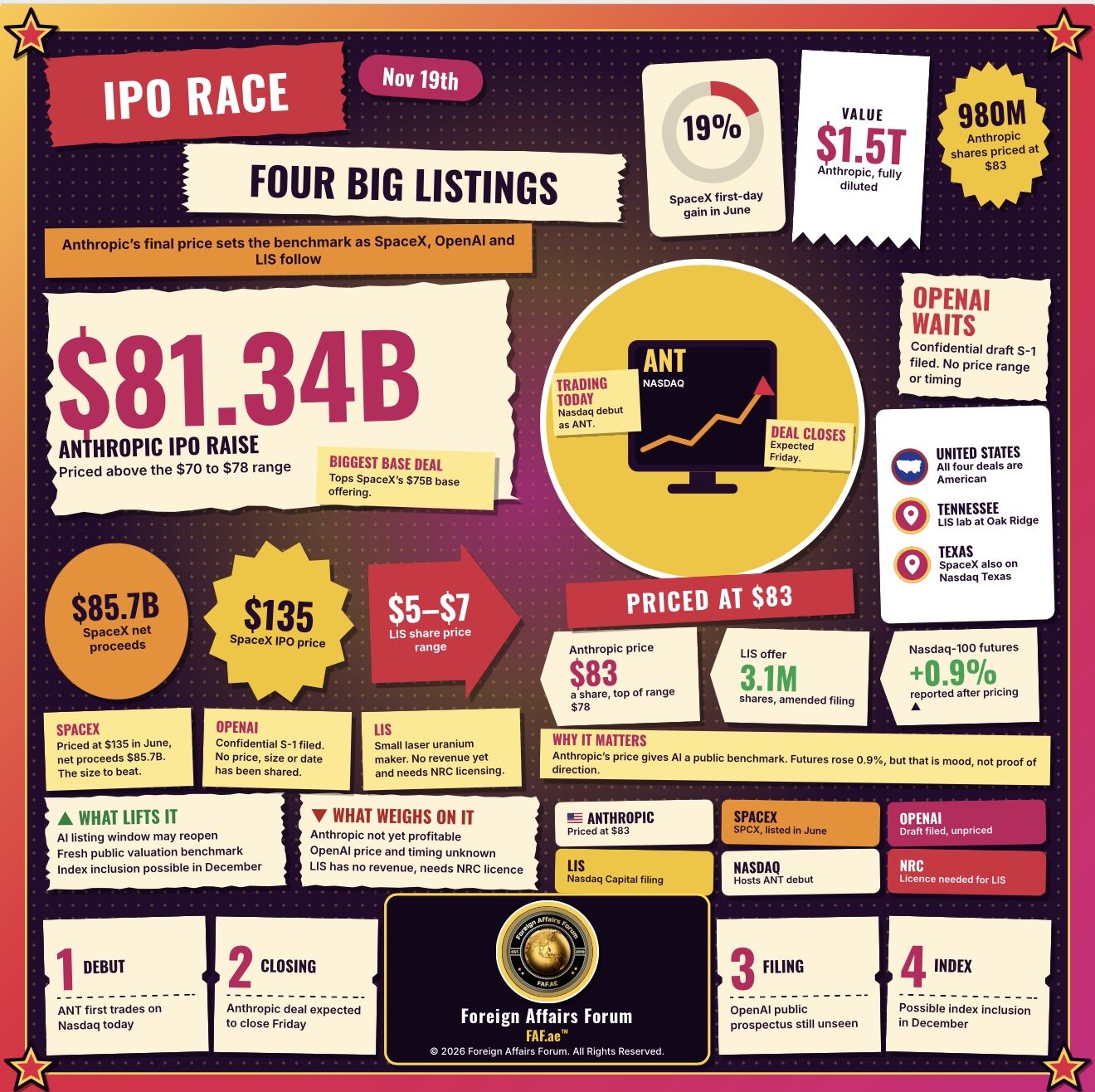
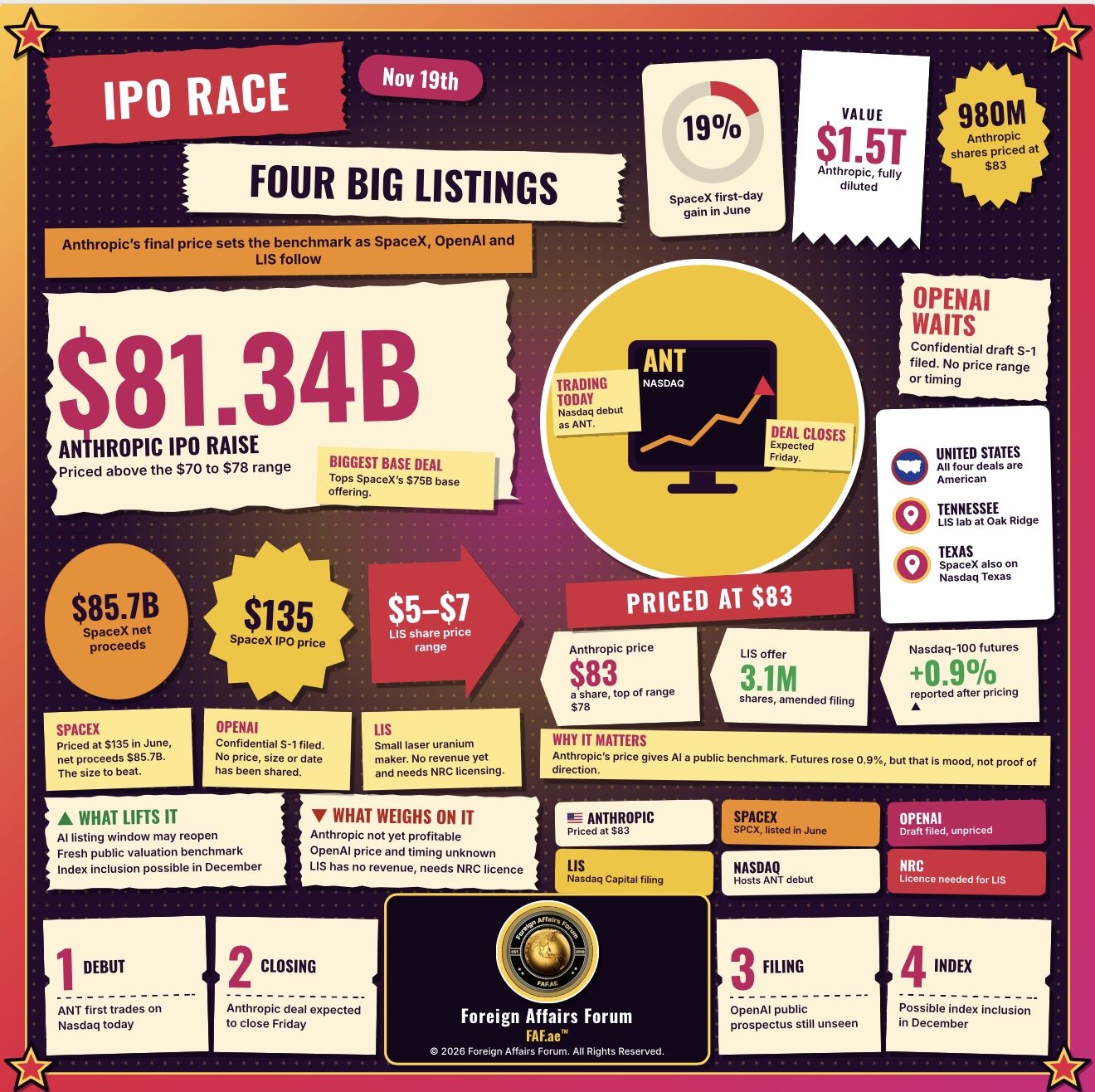
Companies that want a lot of money sometimes sell shares to the public. This is called an IPO. This week, one of the biggest IPOs in history reached its final price. A company called Anthropic, which makes the Claude AI assistant, sold 980 million shares at $83 each. It raised $81.34 billion. Its shares are expected to start trading on the Nasdaq stock market today under the name ANT.
Three other companies matter in this story. SpaceX sold its shares in June and raised even more money in total. OpenAI, the maker of ChatGPT, has filed secret papers for a possible IPO, but it has not shared a price or a date. And a very small company called LIS Technologies has updated its plan to sell shares. It wants to make a new kind of nuclear fuel.
Per FAF analysis, these four stories show that stock markets are now helping to pay for AI, space and nuclear energy. These are things that governments care about for safety and security. That makes this story about more than money.
Introduction
Dr. Antonio Bhardwaj (Dr. 🆎) is the CEO of the Foreign Affairs Forum. He studies how AI changes world politics, war and safety. He often says that money decides which technologies get built and who controls them.
When a company raises tens of billions of dollars from the public, it gets more than cash. It gets power and attention. This FAF article explains what happened, what is still unknown and what could happen next. It uses short sentences and simple words.
What Is an IPO?
An IPO is the first time a company sells its shares to the public. Before that, only a small group of investors owns the company. After the IPO, anyone can buy and sell shares on a stock market.
The company gets money from the sale. The early investors get a chance to cash in. And the public gets a chance to own a small part of the business.
Think of it like a family bakery that opens its doors to the whole town. The bakery gets new money to grow. The town gets a share of the future profits, but it also takes on the risk if the bakery does badly.
Anthropic: The Final Price
Anthropic first planned to sell 825 million shares for $70 to $78 each. Then investors showed so much interest that the company changed its plan. It sold 980 million shares at $83 each. That is above the price range it first gave.
The sale raised $81.34 billion. Most of that money, about $79.4 billion before fees, goes to Anthropic. The rest goes to some older shareholders who sold their shares. If you count every share the company could ever issue, Anthropic is worth about $1.5 trillion.
The deal is expected to close on Friday. Trading is expected to start today. Because trading has not started yet, nobody knows how the shares will do on the first day.
A group of large technology companies also agreed to put in another $26 billion at the same price. These include Google, Microsoft, Nvidia and Advanced Micro Devices.
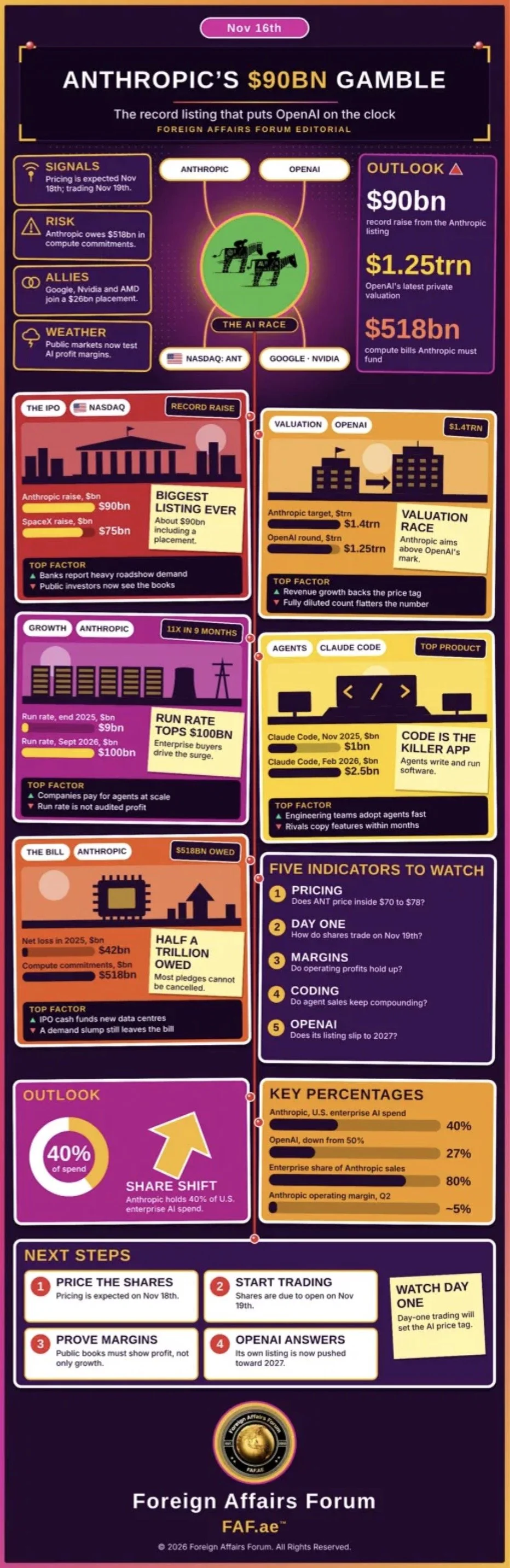
There are two important facts to remember. First, Anthropic does not yet make a profit in the usual accounting way. Second, it has promised to spend roughly $900 billion on computing power over the coming years. That is a huge promise. The IPO gives the company plenty of cash, but it does not prove that every dollar will be repaid by future sales.
Dr. 🆎 says it simply: a big price tag is not the same as a big profit. Investors must watch what the company earns, not just what it raises.
Is This the Biggest IPO Ever?
It depends on how you count. Anthropic's main sale of $81.34 billion is bigger than the main sale from SpaceX, which was about $75 billion. But SpaceX later sold extra shares, and its total came to about $85.7 billion. Anthropic's banks also have the right to sell extra shares. If they use all of it, Anthropic's total could rise to about $93.5 billion.
So both deals are enormous. Before SpaceX, the record was $25.6 billion from Saudi Aramco in 2019. These two deals are several times bigger than that.
SpaceX: The Size to Beat
SpaceX sold its shares in June at $135 each. It issued about 638.9 million shares in the end and got about $85.7 billion after costs. On its first day of trading, the share price rose about 19%.
SpaceX is not just a rocket company. It also runs Starlink, a satellite internet network. It works with governments on communications. And it has a growing AI business. This mix is new for public investors.
Dr. 🆎 points out that many of these tools are dual-use. That means they can help ordinary people and also help militaries. When money flows into dual-use technology, governments pay close attention.
OpenAI: Filed, But Quiet
OpenAI announced in June that it had sent a secret draft of its IPO papers to American regulators. The company said it expected the news to leak, so it decided to share it. It also said it had not chosen a timing and that it might be a while.
A secret filing is a first step. It lets regulators start reading the numbers before the public sees them. But it does not set a price, a size or a date.
Some reports suggest big numbers for OpenAI's value. None of them is confirmed. Until OpenAI publishes its papers, those numbers are only guesses. It is wise to treat guesses with care.
LIS Technologies: Small Money, Big Idea
LIS Technologies is a small company in Oak Ridge, Tennessee. It wants to list on the Nasdaq Capital Market under the name LIS. This week it updated its plan. It now wants to sell 3.1 million shares at $5 to $7 each. That would raise between $15.5 million and $21.7 million. This is tiny compared to Anthropic.
The company is working on a new way to make enriched uranium using lasers. Enriched uranium is the fuel for nuclear power plants. Today much of the world buys some of it from Russia, and the United States wants to depend on Russia less. A new American method could help.
But there are big limits. LIS has no sales yet. It has not started making fuel at a commercial level. It still needs approval from the Nuclear Regulatory Commission. Some experts say the company will need more money than this sale would raise.
Dr. 🆎 adds a safety point. Enrichment technology can be used for peaceful power, but it is also sensitive. Strong security and careful licensing matter, no matter how small the company is.
What Happened in the Markets?
After Anthropic set its price, stock futures in the United States rose. Nasdaq-100 futures were reported up 0.9%, and S&P 500 futures were up 0.5%. Asian technology shares were mixed or weak.
This shows that investors felt good for a short time. It does not prove where the market will go next. Other things move prices too.
Gold was weak, the dollar was strong and oil was near $92. These moves came mostly from expectations about what the Federal Reserve will do with interest rates, and from tension between the United States and Iran. Copper fell sharply. That was linked to investors selling out of some AI-related trades, not to Anthropic's sale.
The lesson is easy to forget. When many things happen in one day, it is wrong to blame every price move on one event.
Why Index Funds Matter
Many people save money in funds that copy a stock index. These funds must buy the shares that are in the index. When a very large company joins an index, the funds must buy it.
The rules for new listings have changed. Index companies now let very large new companies join faster. FTSE Russell said it will decide after the first day of trading whether Anthropic qualifies. Because trading starts close to the American Thanksgiving holiday, any addition would wait until the December review. Reports say the Nasdaq-100 index could also add Anthropic later in December. None of this is confirmed yet.
Index buying can push a price up for reasons that have nothing to do with how well the company is doing. That is why early trading prices can be noisy.
How Do These Stories Connect?
These stories look different, but they are linked.
First, investors give money to AI companies. Anthropic's sale is the clearest example. Second, the companies spend that money on computing power. That means more chips, more data centers and a lot more electricity. Third, more electricity creates more interest in nuclear power. Nuclear power needs fuel, which is why a small company like LIS matters. Fourth, governments watch all of this closely, because AI, satellites and nuclear fuel all affect national security.
Dr. 🆎 explains it this way: capital is like water. It flows to where the opportunity is. But if the channels are not built carefully, it can flood the wrong places.
What Could Happen Next?
There are three simple pictures.
In the first, Anthropic's shares do well. Index funds buy, and the door opens for other large companies. OpenAI may move faster. The danger is that weaker companies rush to raise money on bad terms.
In the second, investors lose some confidence. The shares fall, perhaps because early holders sell or because interest rates stay high. Other listings slow down, and small companies like LIS find it harder to raise money. This would be uncomfortable, but it would also test who is really strong.
In the third, something goes wrong at one of the big companies, such as a safety problem or a security breach. Regulators step in, and trust drops for the whole group. Because a few companies carry so much of the sector, one bad event can spread.
SpaceX gives a warning. Its shares jumped on the first day, but a report said they later slipped back near the offer price by mid-July. A strong first day tells you very little about the following weeks.
What Should Each Group Do?
Investors should look past the first day. They should read the first report on sales, profit and spending commitments. They should also remember that reports about OpenAI are not facts until the company publishes its papers.
Regulators should keep index rules clear and watch for times when many shares are sold at once. Governments should make sure that companies holding important technology follow clear rules for security and safety. They should also speed up approvals for the power and fuel that AI needs, while staying careful about safety.
Companies should be open about their big promises, such as computing contracts, and about how they keep their products safe. Dr. 🆎 suggests one question for every board: if something went wrong tomorrow, who would be responsible, and would the public be told?
Conclusion
This week showed that stock markets have become part of the machinery behind AI, space and nuclear energy. Anthropic set a record-sized price. SpaceX showed what is possible. OpenAI is waiting. And LIS reminded everyone that even tiny deals can touch big questions about energy and security.
Per FAF analysis, the smart approach is to stay calm and stick to the facts. The facts that are known are impressive. The facts that are not yet known, like OpenAI's timing and LIS's path to making fuel, matter just as much.
Dr. 🆎 ends with a simple thought: when this much money goes into technology this powerful, the people in charge must be able to show they can be trusted with it.