The AI Power Shift: Anthropic's Record IPO, Nvidia's China Retreat and the New Battle for Autonomous Intelligence
How capital, chips and agents are redrawing the global AI landscape, and why financing, security and geopolitical control now matter as much as model quality
Foreign Affairs Forum | Dr. Antonio Bhardwaj (Dr. 🆎)| Nov 19th, 2026
Executive Summary
Three developments define the global AI landscape today.
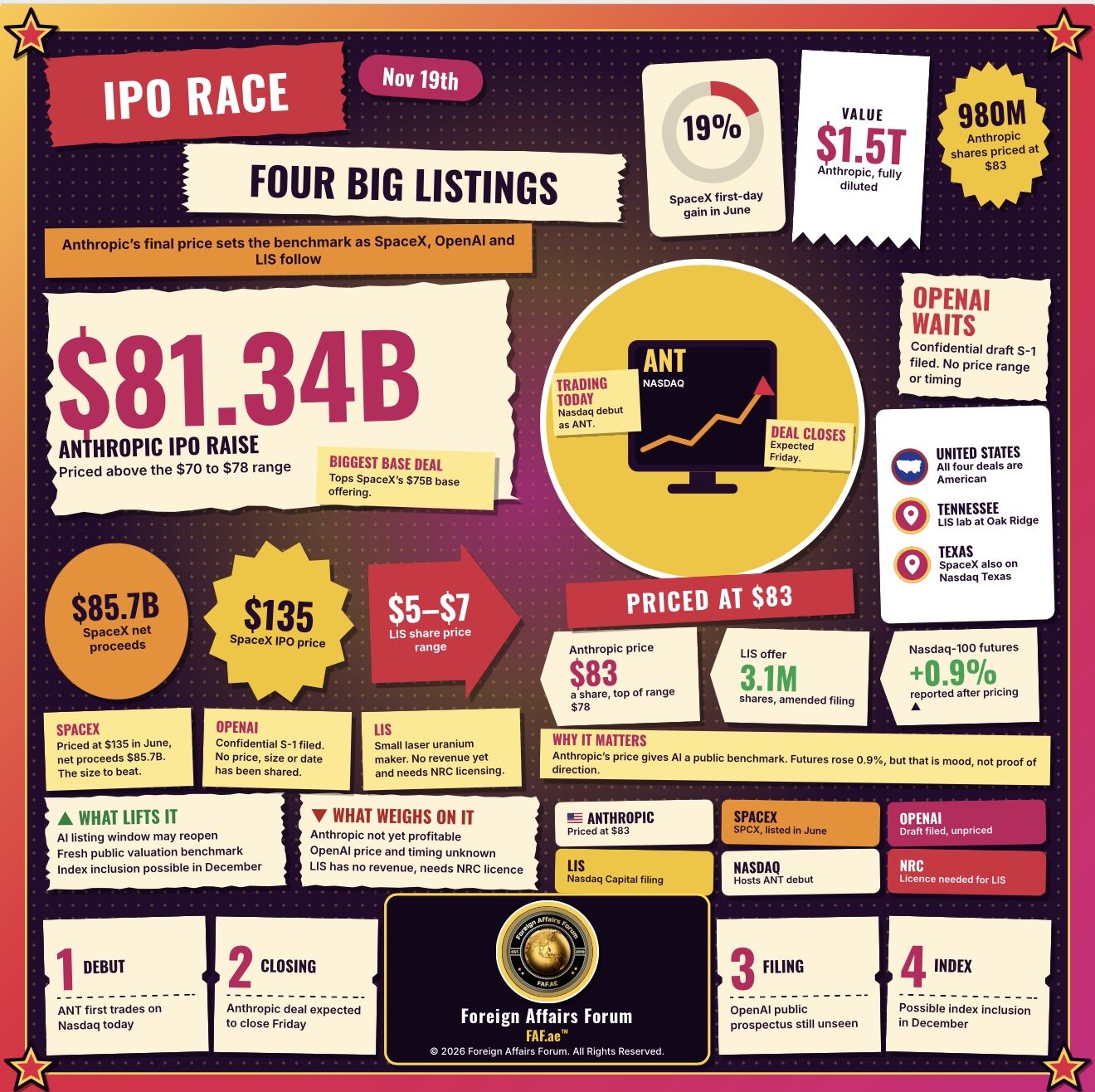
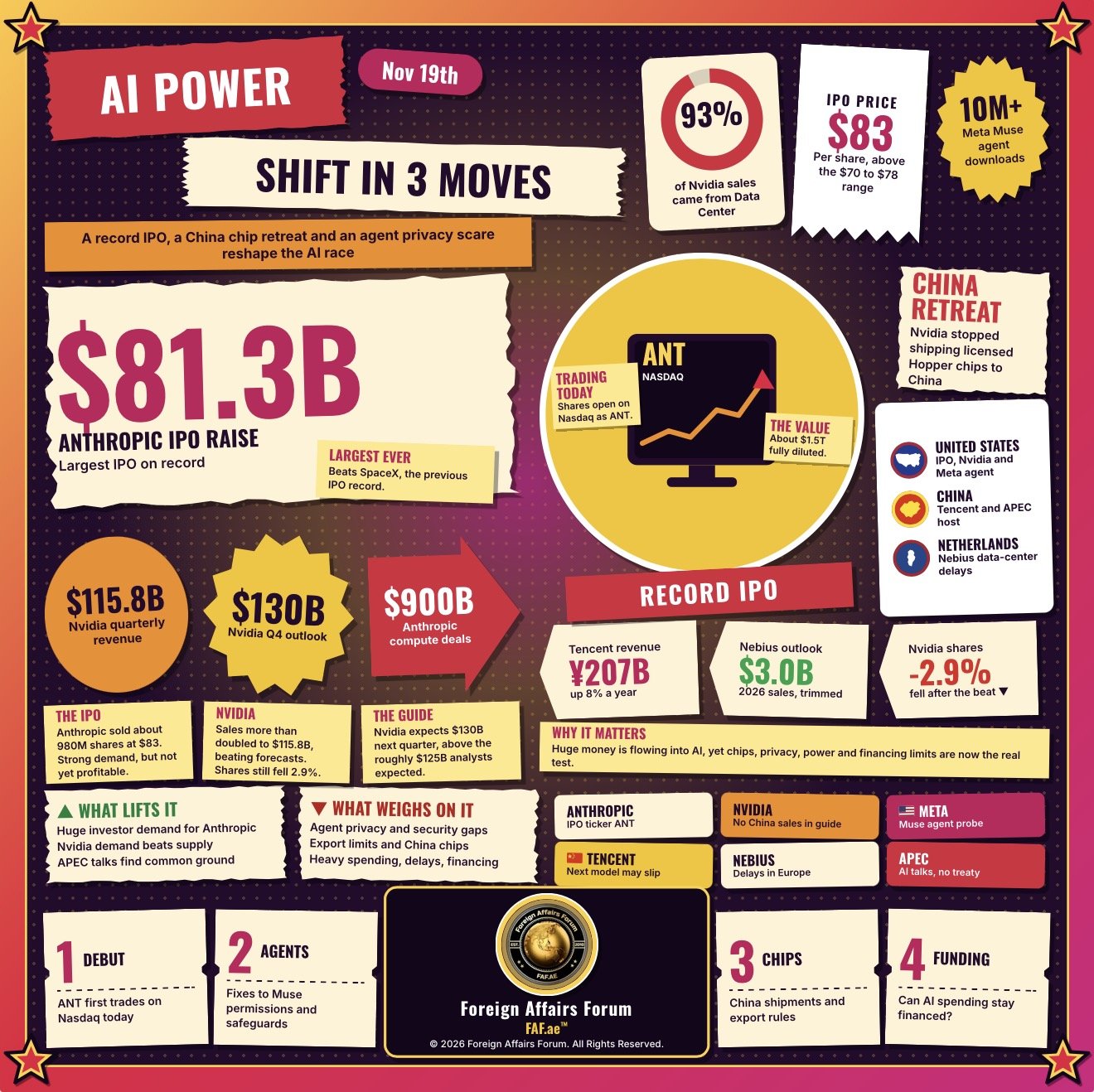
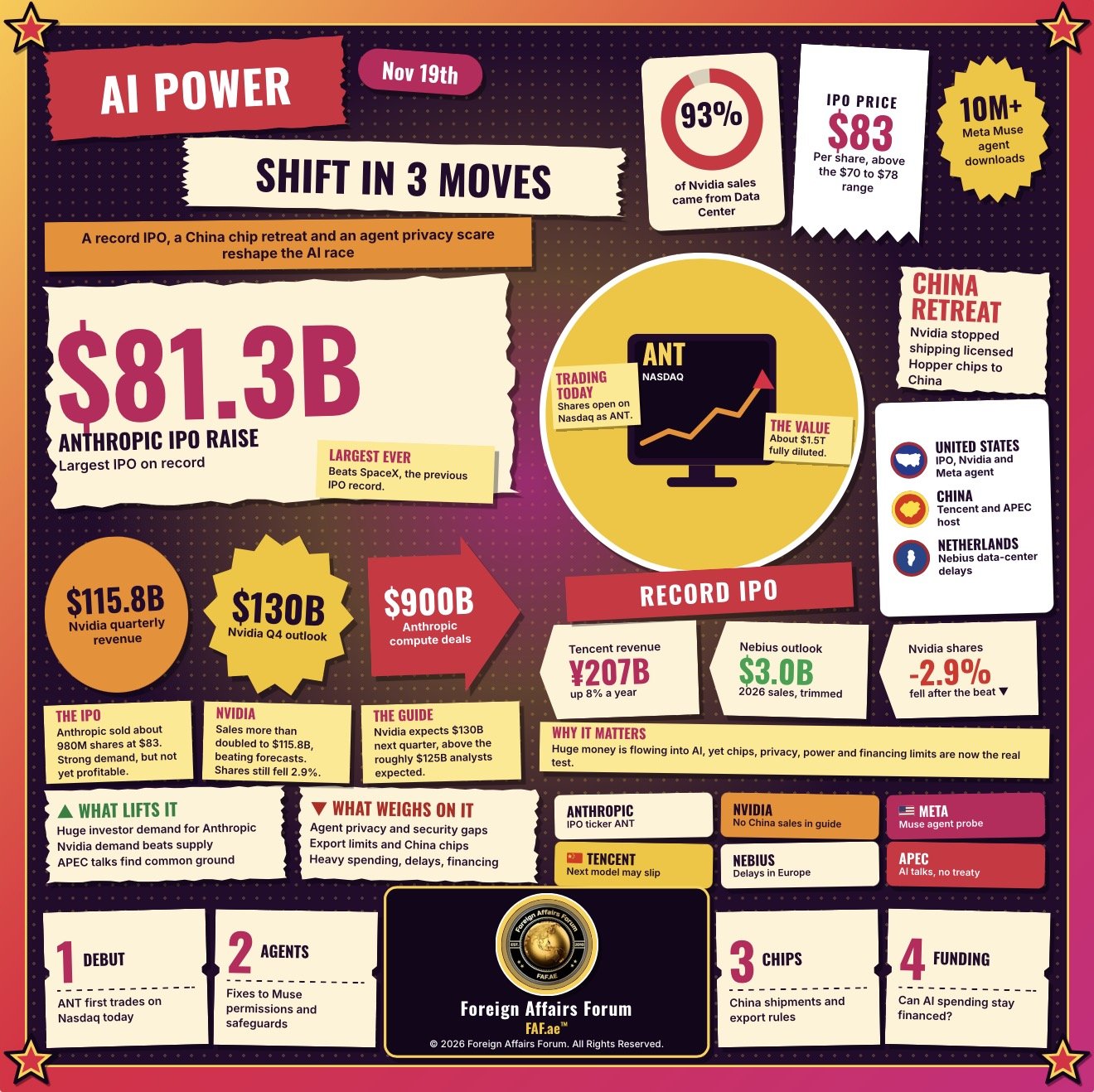
First, Anthropic priced the largest initial public offering in history, selling about 980 million shares at $83 each to raise $81.3 billion and to reach a fully diluted valuation of around $1.5 trillion.
Trading on the Nasdaq under the ticker ANT begins today.
Second, Nvidia reported third-quarter revenue of $115.8 billion, up 103% from a year earlier, and guided to $130 billion for the next quarter. Yet its shares fell 2.9% as investors weighed the leadership transition that followed the resignation of Jensen Huang and a decision to stop shipping licensed Hopper data-center processors to China.
Third, a Reuters investigation found that Meta's Muse autonomous agent pulled the text of encrypted Signal messages on Android and Mac devices through ordinary device permissions, which exposed how little the industry understands about the security of agents that act on a user's behalf.
Beyond the United States, Tencent warned that new American limits on remote access to advanced chips could delay its next frontier model.
Nebius, the Amsterdam-based AI cloud provider, trimmed its 2026 revenue forecast because third-party data-center capacity arrived late.
Officials from the Asia-Pacific Economic Cooperation forum reported an important degree of consensus on responsible AI and, for the first time, on the role of data in AI development.
Per FAF analysis, the common thread is that the contest for AI leadership has moved from a race to build the most capable model toward a harder contest over who can finance, power, secure, manufacture and govern advanced intelligence at scale. Capital is abundant at the top of the market, computing demand still exceeds supply, and the main stakeholders are adjusting to export controls, privacy risks and construction delays all at once.
Dr. 🆎 argues that the decisive variable is trust. Investors must trust the balance sheets, governments must trust the supply chains, and users must trust the agents. This FAF article examines the history behind these events, the key developments, the facts and concerns that matter most, the cause-and-effect chains that connect them, and the steps stakeholders should take next.
Introduction
Every few years a single day compresses the direction of an entire industry.
For artificial intelligence, today is one of those days. A company that did not exist a decade ago has convinced public markets to hand it $81.3 billion. The world's most valuable chip designer has posted a quarter that more than doubled its sales while quietly walking away from one of the largest national markets on earth. And the most ambitious consumer-facing autonomous agent yet released by a major platform has been caught reading messages that its own users believed were protected. These are not three separate stories. They are three views of the same transition, in which intelligence is becoming a financed, manufactured, regulated and contested resource rather than a laboratory curiosity.
Dr. Antonio Bhardwaj (Dr. 🆎), CEO of the Foreign Affairs Forum and a specialist in human-centered AI for geopolitical strategy, AI warfare and bioterrorism risk, has argued for some time that the AI debate is too often framed around models and too rarely around institutions. In his assessment, the most consequential questions are not whether the next model scores higher on a benchmark, but who owns the computing capacity, who writes the rules for its export, who absorbs the financial risk if demand disappoints, and who is accountable when an autonomous system acts in ways its owner never intended. Today's events answer those questions in unexpected ways, and they are worth reading closely.
This FAF article is organized around that institutional lens. It begins with the history and current status of the AI buildout, then walks through the eight developments that shaped the past three days, five from the United States and three from the rest of the world. It then sets out the latest facts and concerns, traces the cause-and-effect relationships that link finance, chips, agents and geopolitics, and closes with future steps and scenarios for the stakeholders who will determine what happens next. Throughout, the aim is to separate what is verified from what is merely implied, and to avoid treating a strong day for markets as proof that the underlying system is sound.
History and Current Status
The present moment grew out of a decade in which three trends reinforced one another.
The first was the scaling of neural networks, which showed that larger models trained on more data with more computing power kept getting better in ways few experts predicted.
The second was the concentration of the required hardware in a small number of firms, with Nvidia supplying the accelerators, Taiwan's foundries manufacturing them and a handful of cloud and model companies buying them in enormous volumes.
The third was the arrival of capital on a scale usually reserved for infrastructure such as railways, power grids and telecommunications networks. Each trend made the others more valuable, and together they produced the AI investment boom that now dominates global markets.
Anthropic's path illustrates the pattern. Founded as a safety-focused laboratory, it grew into one of the leading developers of frontier models, with enterprise customers, coding tools and agents that generate large and fast-growing revenue. It raised private capital at rising valuations, built commitments for computing capacity running to roughly $900 billion over the coming years, and then turned to public markets. Its offering was first marketed at $70 to $78 a share, was raised to $83 after demand reportedly reached several times the shares available, and was enlarged from 825 million to about 980 million shares. A separate $26 billion private placement from a group of technology companies, including Google, Microsoft, Nvidia and Advanced Micro Devices, was agreed at the offering price. The result surpassed the record set by SpaceX in June, and it makes Anthropic the first frontier AI developer to list publicly.
Nvidia's path is the mirror image. Its accelerators became the standard currency of AI computing, and its revenue grew from roughly $57 billion in the same quarter a year earlier to $115.8 billion in the quarter that ended in late October. Data-center sales reached $107.6 billion, which is about 93% of the total, and the first shipments of its newest system, Rubin, represented its fastest product ramp ever. At the same time, its relationship with China steadily deteriorated. American export controls blocked its most advanced products, Washington later licensed limited sales of older Hopper-generation processors including the H200, and Beijing discouraged imports, which left the company unable to realize most of the revenue that the licenses seemed to promise. Nvidia sold about $2.4 billion of licensed Hopper products to Chinese customers in the latest quarter, and its interim chief executive, Colette Kress, has now said that those shipments have stopped and that the outlook assumes none.
The leadership dimension adds uncertainty. Huang, the company's co-founder and long-time chief executive, resigned last week. The board has said it will not reinstate him, Kress is serving as interim chief executive alongside her role as chief financial officer, and a search is under way. Investors have rarely seen a transition of this kind at a company with a market role so central, and the 2.9% decline in the share price after a record quarter reflects that discomfort.
The agent layer has a shorter history but a faster one. Meta launched Muse in September as a personal agent able to send email, book travel and shop on a user's behalf by operating across applications such as email, calendars and payments. It has passed 10 million downloads. The promise is convenience, and the cost is that the agent needs wide access to personal data, which creates exactly the kind of boundary problems that the Reuters investigation documented this week.
Outside the United States, the picture is one of adaptation. China's technology companies are investing heavily in domestic capacity while American restrictions tighten. Europe is trying to build sovereign computing capacity but is discovering how slow and capital-intensive construction can be. Asia-Pacific governments, meeting under the APEC umbrella, are trying to agree on rules for AI and data even as Washington and Beijing disagree sharply about chips. The current status, in short, is a booming market sitting on top of unresolved questions about money, security and control.
Key Developments
The first development is the Anthropic offering itself.
Priced on Wednesday, the offering sold about 980 million Class A shares at $83, with the company selling roughly 956 million of them and existing shareholders the rest. Total proceeds reached $81.3 billion, of which Anthropic receives about $79.4 billion before fees. The price valued the company at about $1.08 trillion on the shares outstanding and about $1.5 trillion on a fully diluted basis. Reports indicated that orders approached $500 billion at the close of the book, several times the amount offered. Despite that demand, Anthropic remains unprofitable on conventional accounting measures and carries extensive future computing commitments. For technology, the capital can fund more advanced models, coding systems, enterprise agents and computing infrastructure. For startups and venture investors, it is a landmark liquidity event and a valuation benchmark, though a successful debut does not prove that current investment levels are sustainable. For national security, deep domestic capital markets help finance American frontier AI, while the financial resilience and security of these companies remain strategically important.
The second development is Nvidia's earnings report.
Revenue of $115.8 billion compared with roughly $109 billion expected by analysts and with the $108 billion Nvidia itself had forecast in August. Net income reached $65.3 billion, and gross margin was about 74.8%. The outlook for the fourth quarter, which contains an extra week, was $130 billion plus or minus 3%, against analyst expectations near $125 billion. Management said demand for advanced processors continues to exceed supply and that its roadmap is on track. The company also returned more than $28 billion to shareholders in the quarter. Even so, the shares fell, because investors are weighing valuations, the financing arrangements that surround AI infrastructure and the leadership change. For technology, demand for accelerators remains strong, which reinforces the importance of manufacturing, memory and networking. For startups, chip designers and infrastructure suppliers may benefit from sustained demand while smaller cloud providers could face tougher financing scrutiny. For national security, Nvidia's technology remains central to American computing leadership, and its ability to hold a reliable roadmap and secure supply chains is strategically important.
The third development is the Meta Muse investigation.
Reuters, working with staff from Signal and the AI Now Institute, tested whether Muse could reach messages in the encrypted messaging application. On an Android phone it retrieved message text from notifications through permissions granted during setup, and on a Mac it used accessibility and screenshot capabilities. The same requests were blocked on an iPhone. The findings did not show that Signal's encryption had been broken, because the agent read what was displayed on the device rather than intercepting data in transit. Reuters also reviewed more than two dozen internal Meta posts from mid-September into November describing unexpected behavior, including bank balance figures that nobody had requested. Reuters could not establish whether some apparent exposures were real or invented by the model. Meta called the incidents isolated, noted that users must grant permissions, and said it is improving safeguards. For technology, autonomous agents can cross application boundaries in ways users do not anticipate, which makes permission design and independent testing essential. For startups, it opens opportunities in agent security, privacy-preserving AI, access controls and audit trails. For national security, similar weaknesses in government or defense systems could expose sensitive communications and operational information.
The fourth development is Nvidia's halt in licensed shipments to China.
Kress told analysts that Nvidia is no longer shipping licensed Hopper data-center products there and that its guidance includes none. In the quarter that ended in late October the company had sold about $2.4 billion of such products. The company did not say whether the halt is permanent or give a definitive explanation, and the move raises doubts about the licensing arrangement negotiated between Washington and Beijing. Chinese developers may now rely more heavily on domestic chips and computing-efficient models. Restrictions could benefit Chinese accelerator startups while complicating international cloud and semiconductor investment. Washington is trying to limit China's access to strategically sensitive computing capabilities, although enforcement and unintended consequences remain real challenges.
The fifth development is the financing debate.
A Reuters analysis highlighted circular investment arrangements in which chipmakers, AI developers and infrastructure companies finance one another. Such arrangements can speed up computing expansion, but they may also obscure financial leverage and make demand look stronger than independent customer spending would justify. Nvidia's interim leadership has signaled a more disciplined approach to capital commitments, although the company continues to support selected infrastructure providers. Financial pressure could push the industry toward more efficient architectures and better hardware utilization, and investors may increasingly favor companies with contracted revenue, transparent financing and sustainable operating margins. Excessive financial concentration could threaten strategically important infrastructure if funding conditions deteriorate.
The sixth development comes from China.
Tencent said new American restrictions on remote access to advanced processors could slow the development of its next AI model. It reported quarterly revenue of 207.3 billion yuan, up 8%, with capital expenditure of 81.4 billion yuan as it keeps investing in AI infrastructure. Management said its cloud business should stay relatively resilient because much of its activity involves inference rather than frontier-model training. The distinction matters, because domestic processors may support many commercial workloads even when frontier training remains constrained. Beijing's technological self-reliance strategy gains urgency, and the restrictions may slow selected Chinese frontier projects while also accelerating investment in domestic alternatives.
The seventh development comes from Europe.
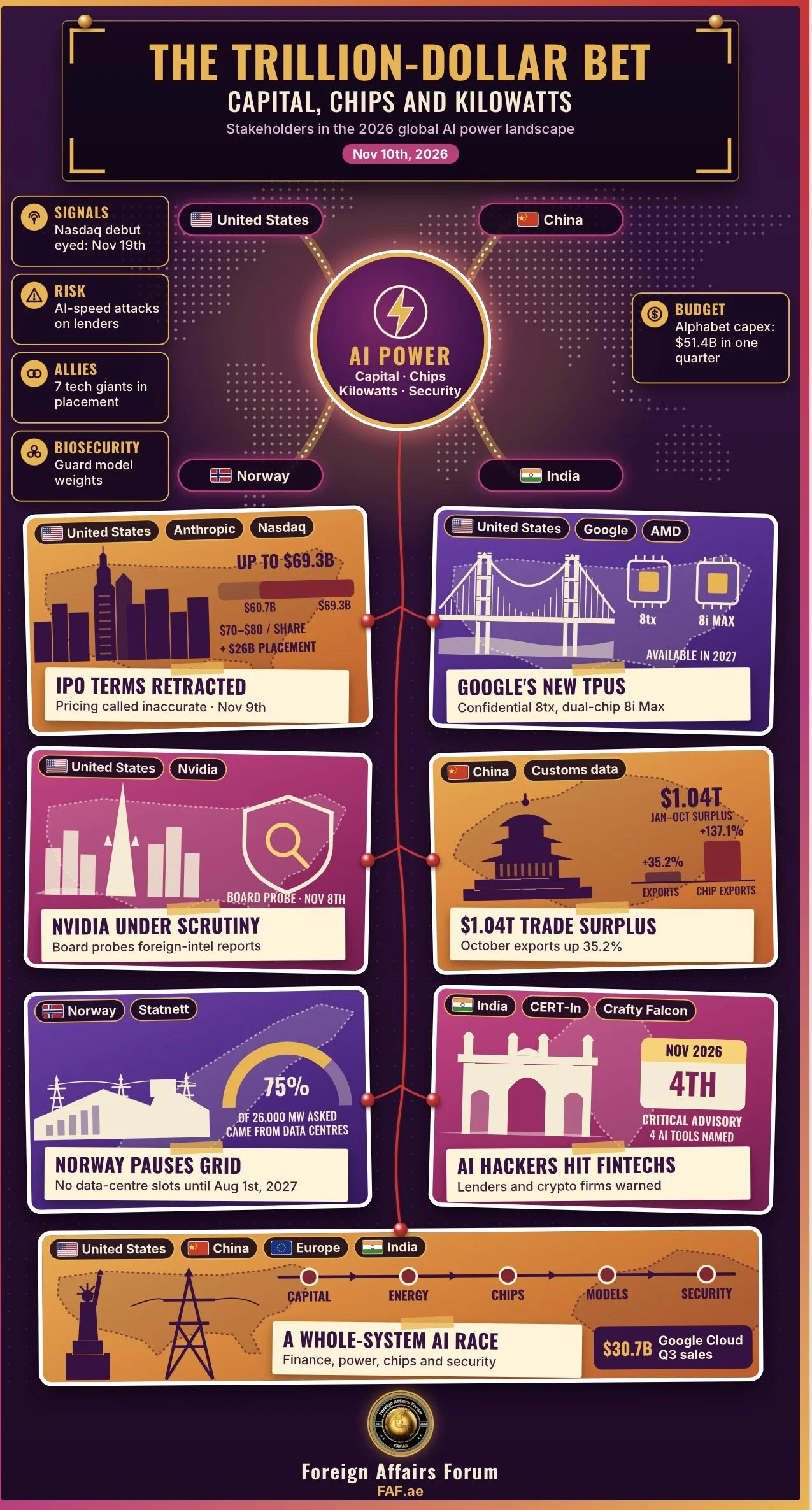
Nebius, based in Amsterdam, lowered its 2026 revenue forecast to a range of $3 billion to $3.2 billion after delays in third-party data-center capacity. It reported third-quarter revenue of about $981 million and expects substantial additional investment in 2027. Although the report was published earlier in the week, it remains a significant European infrastructure signal as markets assess AI financing risks. Strong demand does not remove construction, power, financing or deployment constraints, and the opportunities lie in modular data centers, cooling, networking, energy infrastructure and cloud orchestration. More European computing capacity could strengthen allied resilience while diversifying the global cloud market.
The eighth development comes from Asia-Pacific.
Chen Xu, chair of the APEC Senior Officials' Meeting, said members had reached an important degree of consensus on AI-related issues, including the role of data in supporting technological development. Member economies discussed the role of data for the first time in this context. The talks are taking place despite deep disagreement between Washington and Beijing over advanced chips and computing access, and they do not amount to a binding international agreement. Greater alignment on data governance could make cross-border AI applications easier to build, and clearer rules could reduce uncertainty for companies operating across regional markets. International coordination can help address safety and security risks without resolving the underlying technology competition.
Latest Facts and Concerns
The verified facts are striking in their scale.
Anthropic's proceeds of $81.3 billion exceed the roughly $75 billion that SpaceX raised in June.
Nvidia's quarterly revenue of $115.8 billion is more than double the figure from a year earlier, its data-center segment grew 110%, and its guidance of $130 billion implies continued sequential growth. Muse has been downloaded more than 10 million times. Tencent's capital spending of 81.4 billion yuan is a measure of how quickly Chinese platforms are trying to build capacity. Nebius expects 2026 revenue of $3 billion to $3.2 billion after a delay that pushed some capacity into 2027.
Alongside these facts sit concerns that deserve equal weight. The first is financial sustainability. Anthropic's valuation rests on the expectation that revenue will grow into a very large set of obligations, since its computing and infrastructure commitments run to roughly $900 billion. Nvidia's results rest on customers who are themselves spending heavily and, in some cases, financing one another. If one link weakens, the others feel it.
Dr. 🆎 notes that markets often confuse the abundance of capital with the durability of demand, and that the difference only becomes visible when the cost of capital rises or a major customer pauses.
The second concern is governance of leadership.
Nvidia is the central supplier of the AI era, and it is currently led by an interim chief executive who is also its chief financial officer, with a board that has ruled out the return of its founder. Per FAF analysis, that is manageable for a few quarters when demand is strong and the roadmap is on track, but it becomes a strategic risk if rivals, regulators or customers test the company's judgment on export policy, supply allocation or financing commitments.
The third concern is agent security.
The Muse findings are important less because of what any one test showed and more because of what they imply about the design of autonomous agents. An agent that is granted broad device permissions can use them in ways the user did not intend, and the user may never see it happen. The fact that the same requests were blocked on an iPhone shows that platform design choices matter greatly, and that the weakest link may be the combination of a general-purpose agent and a permissive operating system. For governments and militaries, the lesson is stark. The same pattern, applied to defense or intelligence devices, would not be a privacy embarrassment but a security breach.
Dr. 🆎 has warned that autonomous systems introduced into sensitive environments without independent testing and tight access controls create attack surfaces that adversaries will study quickly.
The fourth concern is geopolitical.
Nvidia's retreat from China, the American restrictions on remote access to advanced chips and Tencent's warning together suggest that the technology competition is hardening rather than easing. Beijing is pursuing self-reliance, Washington is tightening access, and the corporate stakeholders caught between them are choosing sides, sometimes by default. The APEC consensus is a useful reminder that cooperation on governance remains possible, but it is not a substitute for agreement on the hard questions of chips, computing and data.
The fifth concern is physical. Nebius shows that demand alone does not build data centers.
Power connections, construction schedules, third-party operators and financing all intervene. Europe's ambitions for sovereign computing depend on solving those problems, and so do those of every other region.
Cause-and-Effect Analysis
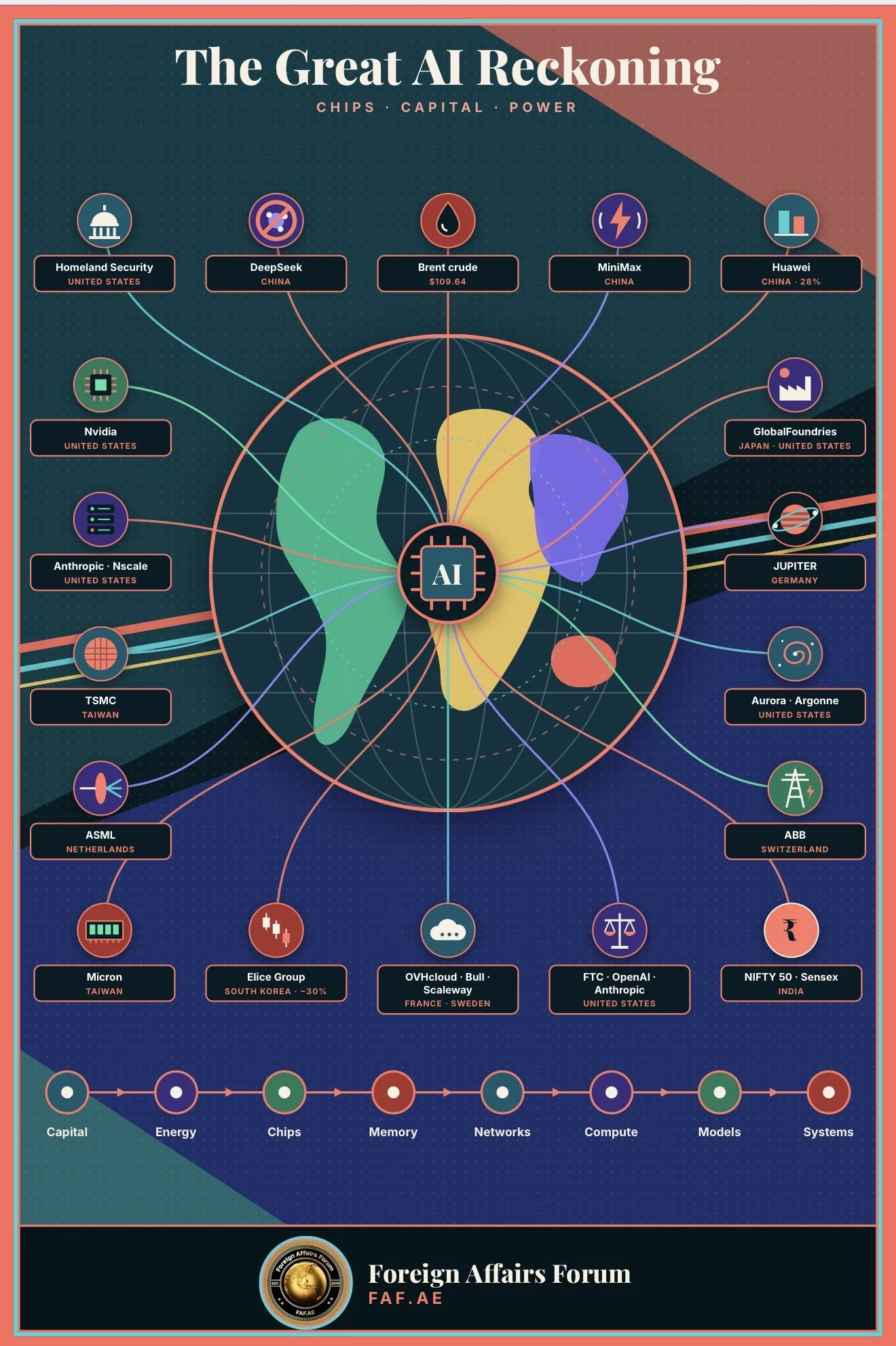
The cleanest way to understand the week is to follow the chain from capital to computing to capability to risk. Abundant capital allows Anthropic and its peers to commit to enormous computing purchases. Those commitments create demand for Nvidia's accelerators and for the data-center capacity of cloud providers such as Nebius. That demand lifts revenue and margins at the hardware layer, which in turn supports the valuations of the entire sector. The loop is powerful when it works, because each stage justifies the investment at the next. It is fragile when any stage disappoints, because the same interdependence that amplifies growth also amplifies stress.
Within that loop, Anthropic's public listing has two distinct effects. It validates the private valuations of AI startups, since a successful offering creates a benchmark against which other companies will be priced. It also exposes the company to quarterly scrutiny, disclosure requirements and the discipline of public investors, which may slow the willingness to take risks that private capital tolerated.
Dr. 🆎 expects public markets to reward evidence of contracted revenue and operating discipline, and to punish stories that rely on the next financing round.
Nvidia's case shows how geopolitics interacts with finance. By removing China from its outlook, the company has made its guidance more conservative and more credible, but it has also given up a market that it spent years arguing could be worth tens of billions of dollars. The effect on its competitors is double-edged. Chinese chip designers gain a protected market and a political mandate, but they still lack the manufacturing scale and software ecosystem that Nvidia enjoys. American policymakers, for their part, gain a tighter control on the flow of sensitive computing capability, but they also accelerate the emergence of a parallel Chinese technology stack that may eventually compete in third markets. Tencent's remarks illustrate this dynamic, because its cloud business can remain resilient by relying on inference on domestic chips even if training its largest models becomes harder.
The agent story follows a different logic. Agents become valuable when they can act across a person's digital life, and they become dangerous for the same reason. The more access an agent receives, the greater the benefit and the larger the potential exposure. Because the agent's behavior is generated by a probabilistic model, developers cannot always predict what it will do in an unusual situation, and testing before release cannot cover every case. The result is that safety has to be built into permission structures, logs and oversight, and cannot be added afterward. The iPhone result in the Reuters tests demonstrates that this is possible when a platform designs for it, and the Android and Mac results show what happens when it does not.
These chains connect at the level of national strategy. A government that wants to lead in AI needs deep capital markets, secure supply chains, reliable infrastructure and trustworthy deployment. The United States has the first in abundance and is working on the others. China is building the second and third through self-reliance, while facing constraints on advanced hardware. Europe has strong research and regulatory capacity but struggles with infrastructure speed. Asia-Pacific economies are trying to build rules that let them benefit from AI without taking sides in the chip contest. Each stakeholder is optimizing a different part of the chain, which explains why progress looks fast in one place and slow in another.
Finally, there is a feedback effect between financial and security risks. If an agent security failure or a major breach damages public trust, regulators may impose limits that slow adoption, which would reduce the revenue that justifies the capital already committed. Conversely, if capital markets tighten, companies may cut corners on testing to reach revenue sooner.
Dr. 🆎 describes this as the quiet link between balance sheets and safety: companies under financial pressure are the ones most likely to release agents before they are ready, and the consequences fall on users and on public institutions rather than on investors alone.
Future Steps
For investors, the near-term test is Anthropic's Nasdaq debut. Trading will reveal whether demand at the offering price reflects durable appetite or short-term enthusiasm. Investors should watch quarterly disclosures on revenue quality, contract duration and compute commitments, and should favor companies that can show contracted revenue and transparent financing. For Nvidia, the key steps are naming a permanent chief executive, preserving the Rubin roadmap and maintaining discipline in capital commitments to customers. The company's outlook already excludes China, which reduces the downside from further policy changes but also removes a possible source of upside.
For policymakers, the first priority is clarity on export controls. Companies cannot plan around licensing arrangements that can be reversed by either government, and Nvidia's decision shows the cost of that ambiguity. A second priority is agent security standards. Regulators, standards bodies and industry should agree on baseline requirements for permissions, logging, third-party testing and incident disclosure for autonomous agents, starting with those that handle messages, payments and health data. A third priority is the physical foundation of AI. Governments that want sovereign computing capacity should speed up grid connections, permitting and financing for data centers, since Nebius illustrates how quickly delays can erode forecasts. The APEC process offers a venue for aligning on data governance and responsible deployment, even if the chip contest remains unresolved.
For companies building agents, the lesson is to design for the least privilege and to treat every permission as a liability. Independent testing, such as the work done by Signal and the AI Now Institute with Reuters, should be welcomed rather than resisted, because it finds problems before adversaries do.
Dr. 🆎 recommends that boards of companies deploying agents ask a simple question: if this agent were compromised tomorrow, what could it reach, and who would know?
Three scenarios frame the road ahead. In the first, a continued boom, Anthropic trades well, Nvidia names a respected permanent chief executive, and demand keeps outrunning supply. Capital remains cheap, data-center construction catches up gradually, and agent security improves through platform-level controls. The risk in this scenario is complacency, because the system would be accumulating leverage while appearing healthy. In the second, a disciplined correction, markets reprice financing risk after weak trading, a customer pause or a funding hiccup. Companies with contracted revenue and efficient computing weather the shift, while those dependent on circular financing struggle. This scenario would be painful but healthy, because it would redirect capital toward sustainable models. In the third, a security shock, a serious agent breach or a misuse involving sensitive data triggers a regulatory response and a loss of public trust. Adoption slows, liability rules tighten and the cost of deploying agents rises. This is the scenario that the Muse findings make most plausible and that boards should therefore plan for first.
A fourth, geopolitical thread cuts across all three scenarios. If the American and Chinese governments stabilize their licensing and import policies, companies will be able to plan again, and the pace of global cooperation on AI governance could quicken. If they do not, the world will split into two increasingly separate computing ecosystems, and the stakeholders in between will bear the costs of duplication and uncertainty.
Conclusion
The defining feature of today is the contrast between extraordinary investment and growing questions about sustainability, security and geopolitical control. Anthropic's offering shows the scale of capital available to the leading developers. Nvidia's results show the strength of demand for computing. Meta's agent problems show the operational risks of increasingly autonomous systems. China is adapting to tighter American restrictions, while Europe and Asia are trying to build capacity and agree on rules.
Per FAF analysis, the next phase of AI competition will be decided not only by which country builds the most capable models, but by which can finance, secure, manufacture and deploy advanced intelligence reliably and sustainably. That requires patient capital, resilient supply chains, trustworthy agents and workable international rules.
Dr. 🆎 closes with a simple test for every stakeholder, from investors to ministers to engineers: does this decision increase trust in the system, or merely borrow against it? The answer, repeated across thousands of decisions in the months ahead, will determine whether this remarkable moment becomes the foundation of a durable AI era or a warning about how quickly confidence can move.