Five Fault Lines, One Region: How War at Sea, War in Yemen, Occupation Politics and Nuclear Ambition Are Redrawing the Middle East
A FAF analysis of the Gulf escalation, the Houthi advance, Israel's indefinite security zones, Iran's nuclear debate and the Saudi nuclear bargain
Foreign Affairs Forum | Dr. Antonio Bhardwaj (Dr. 🆎)| November 19, 2026
Executive Summary
The Middle East has entered a week in which five separate crises are feeding one another.
In the Gulf, the United States and Iran have returned to open tit-for-tat strikes after a lull, and the targets now include air bases in Bahrain and Kuwait, an ADNOC vessel in the Strait of Hormuz and a tanker off Oman.
In Yemen, a Saudi-led coalition has struck 60 Houthi military targets while Houthi forces push toward Aden and Yemeni government forces pull back from the Bab al-Mandeb area.
In Israel, Defense Minister Israel Katz has declared that security zones in Gaza, Lebanon and Syria will stay in place indefinitely.
In Tehran, the Assembly of Experts has said that a review of the country's defense doctrine, including possible withdrawal from the Non-Proliferation Treaty, has become an "unavoidable necessity".
In Vienna, the head of the International Atomic Energy Agency has praised the safeguards in a planned US-Saudi civilian nuclear agreement, even as Washington links the deal to Saudi recognition of Israel.
Per FAF analysis, these are not five stories but one system.
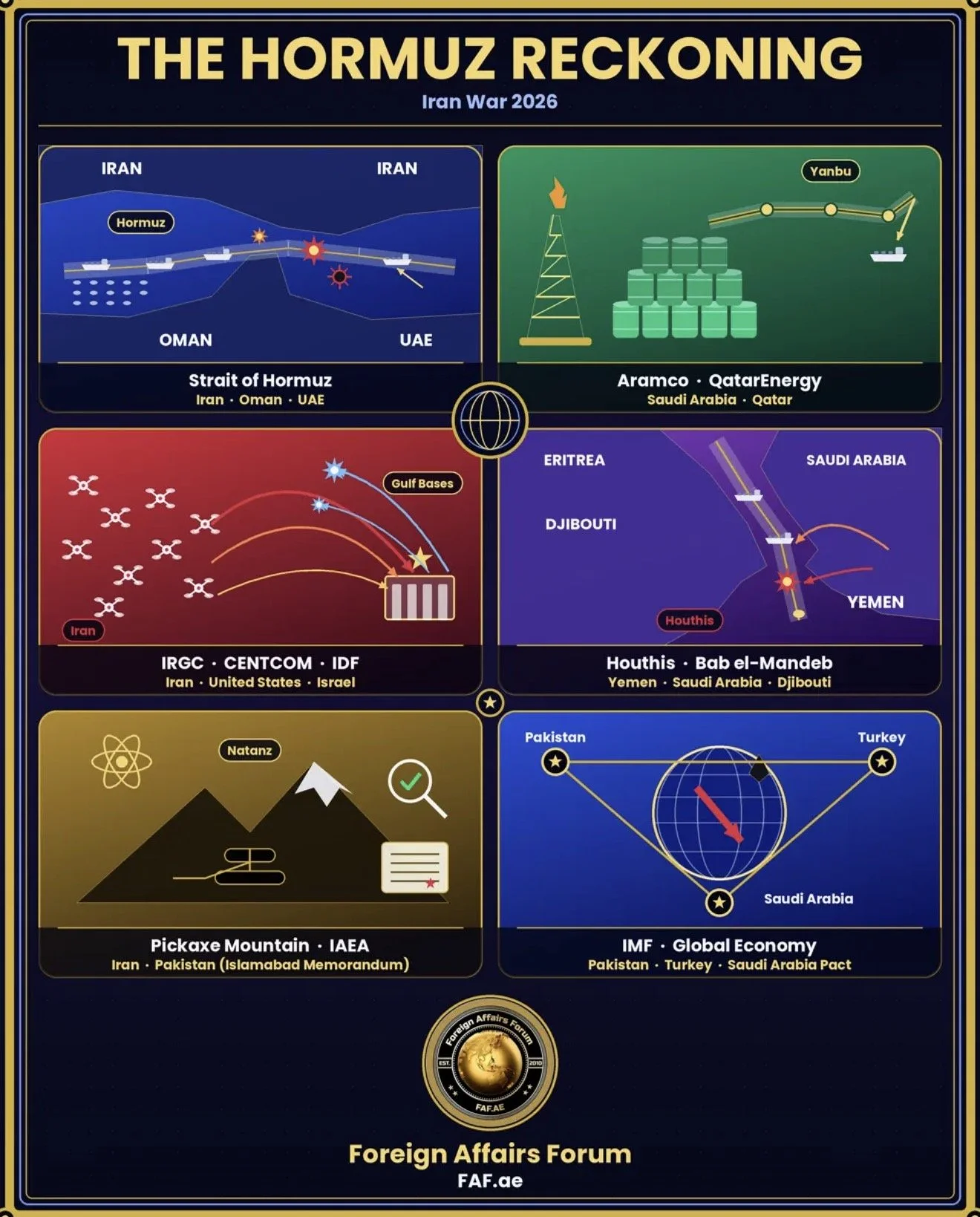
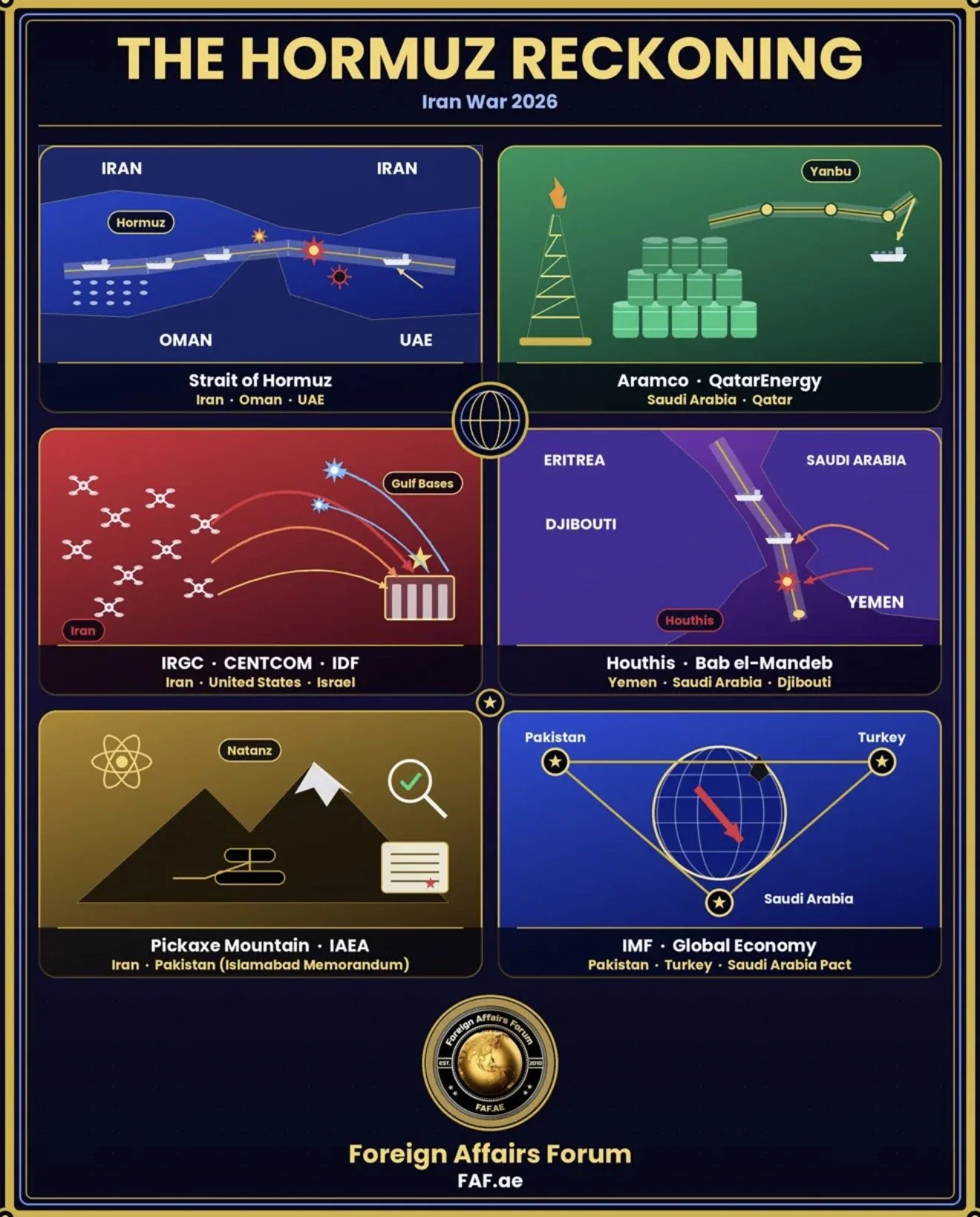
Hormuz and Bab al-Mandeb, the two maritime gates of the region, are now both under pressure at once.
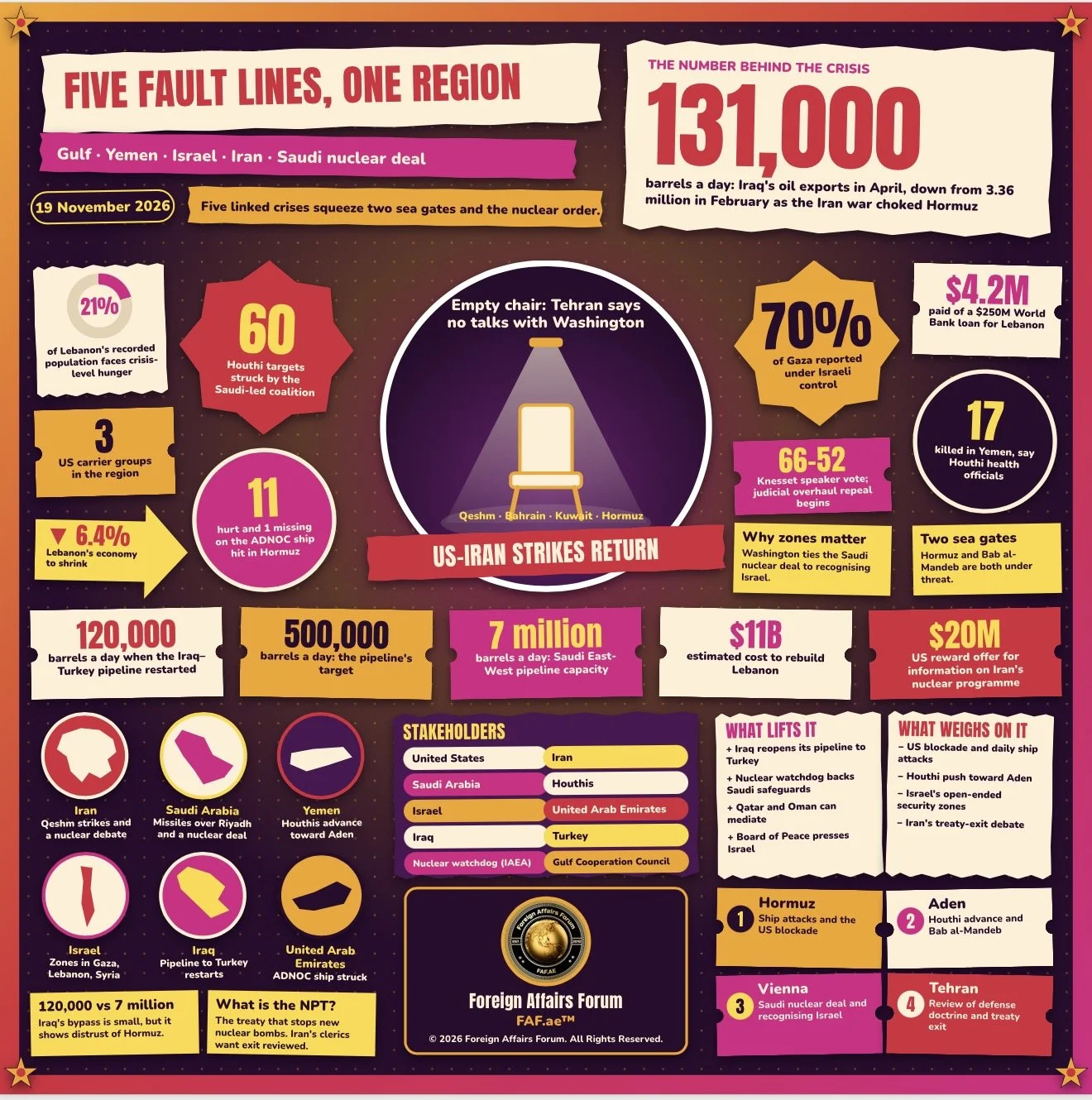
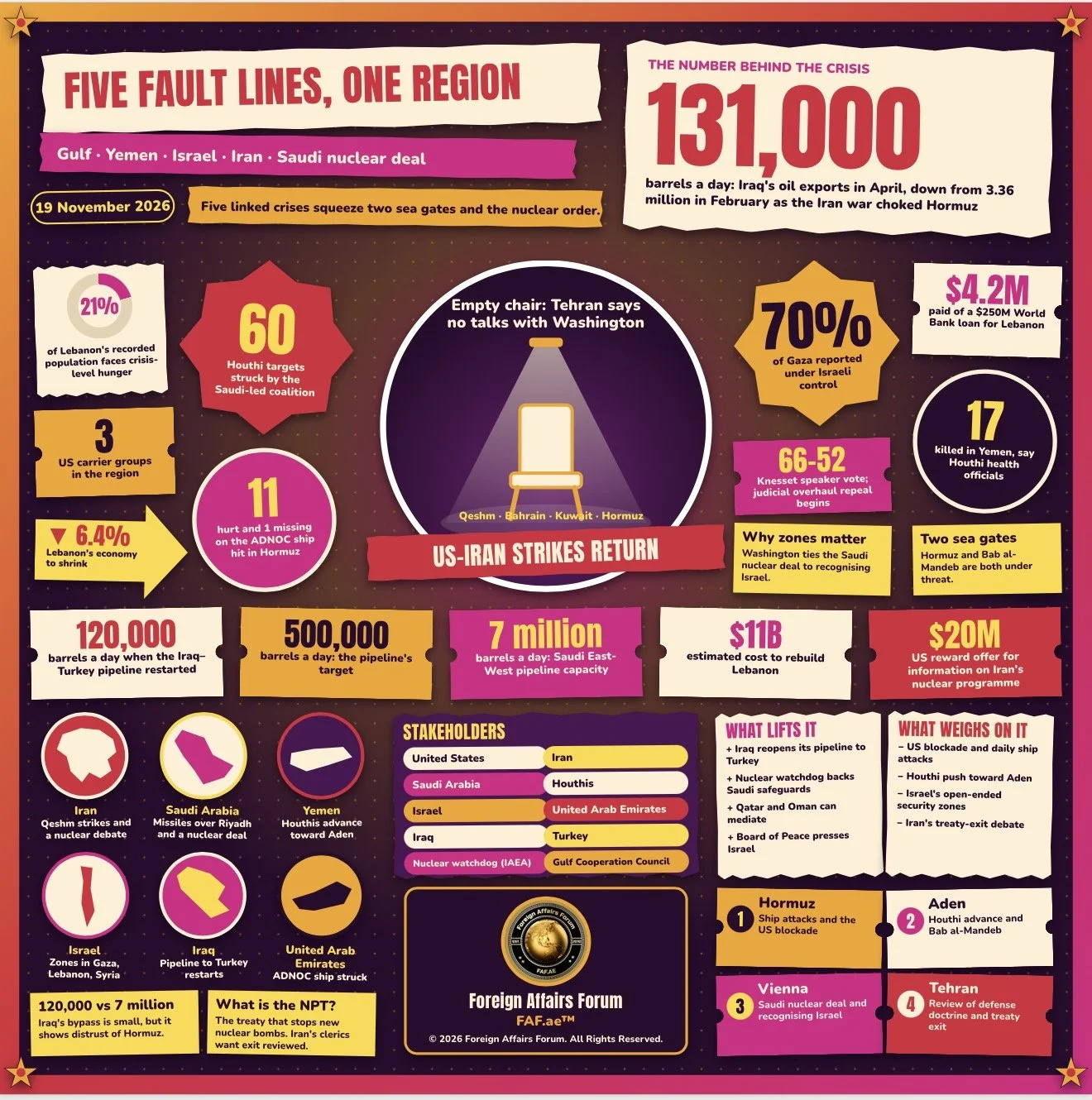
Iraq, whose oil exports collapsed from 3.36 million barrels per day in February to 131,000 barrels per day in April, has restarted the 960 km Kirkuk-Ceyhan pipeline to Turkey at 120,000 barrels per day, a sign of how far stakeholders will go to route around chokepoints.
Israel's open-ended presence in three neighbouring territories shrinks the diplomatic space needed for any normalization bargain, yet that bargain is exactly what Washington has made the price of Saudi nuclear cooperation.
Meanwhile Tehran's clerical establishment is edging toward the one step that would transform every other file.
Dr. 🆎 offers the central judgment of this FAF article: the region is moving from managed conflict to compounding conflict, and the speed of that shift is being set by cheap drones, automated targeting and information operations rather than by diplomacy. The sections below set out the history, the latest verified facts, the cause-and-effect chains and three scenarios for the months ahead.
Introduction
Wars rarely end with a single signature. They end when the costs borne by every stakeholder exceed the benefits of continuing, and for most of 2026 that point has not been reached in the Middle East. The conflict that began in late February with US and Israeli strikes on Iran has passed through a peak, a lull and a renewed flare-up, and each phase has widened the landscape of risk.
This FAF article by Dr. Antonio Bhardwaj (Dr. 🆎) examines the five developments that now define that landscape and explains why they must be read together.
The method is simple. Each development is established from verified reporting, placed in its historical context, and then traced forward through its likely consequences for the Gulf, the wider Middle East and the global economy. Where figures are used, they are the figures reported by the governments, agencies and monitors involved, and where claims are disputed, that is stated plainly. Several of the most dramatic claims of the week remain unverified, including Iran's statement that it shot down a US drone over Hormuz and an unconfirmed report of a plot against an embassy in Southeast Asia, and neither is treated here as established fact.
Dr. 🆎 brings to this analysis three lenses that are often missing from regional commentary. The first is geopolitical strategy: who gains leverage when a chokepoint is threatened, and who loses it. The second is human-centered AI: the question of whether the algorithms now used for surveillance, targeting and air defense keep human judgment in the loop or quietly replace it. The third is the risk that AI-enabled warfare lowers the barriers to catastrophic weapons, including biological ones, in a region where several stakeholders are discussing deterrence in explicitly nuclear terms.
The article proceeds in the order the analysis requires. It begins with the history that produced the present crisis, moves to the key developments of the past week, sets out the latest facts and concerns, traces the causal chains between them, and closes with scenarios and a conclusion.
History and Current Status
The present crisis has deep roots, but its immediate architecture dates from the last three years.
The Gaza war that began in 2023 opened fronts against Israel in Lebanon, Yemen, Syria and Iraq. Houthi attacks on commercial ships in the Red Sea from late 2023 forced carriers onto the long route around the Cape of Good Hope and showed that a lightly armed movement could tax global trade. A 2024 war in Lebanon left Hezbollah badly weakened and Lebanon with reconstruction needs that the World Bank now puts at around $11 billion. The fall of the Assad government in Syria in 2024 removed a core link in Iran's land bridge to the Mediterranean and reshaped relations between Damascus, Beirut and Israel.
In 2025 the confrontation with Iran escalated into direct warfare, including the brief Twelve-Day War and its ceasefire, and in October 2025 a US-sponsored ceasefire framework for Gaza was agreed, with a Board of Peace charged with overseeing implementation. That framework required, among other things, at least a partial Israeli withdrawal from Gaza. It has never been fully carried out. Israel today is reported to control roughly 70% of the Gaza Strip, and Israeli forces have remained in the northern West Bank camps of Jenin, Tulkarem and Nur al-Shams since January 2025.
The war that began in late February 2026 with US and Israeli strikes on Iran is the decisive event of the year. It reached a peak during the operation known as Epic Fury, and it has since settled into a pattern of blockade, harassment and episodic strikes. The United States now enforces a naval blockade of Iranian ports and says it has struck and halted ships it considers to be violating that blockade. Iran says it has attacked vessels transiting the Strait of Hormuz without its permission, and monitoring agencies report attacks on shipping in or near the strait almost daily. Iran's supreme leader is now Mojtaba Khamenei.
The war's economic consequences have been severe and uneven. Iraq, which depends on Hormuz for the overwhelming share of its exports, saw shipments fall from 3.36 million barrels per day in February to 131,000 barrels per day in April, and monthly oil revenue that once ran at about $7 billion fell sharply. The United Arab Emirates left OPEC earlier this year and also exited the Arab oil exporters' organization OAPEC, exposing a rift with Saudi Arabia that analysts describe as a shift in Gulf power. Gulf airlines have repeatedly suspended flights to Saudi and Bahraini destinations as missiles and drones have crossed the sky.
Diplomacy has not kept pace. President Trump spoke of positive momentum after meeting the Qatari prime minister earlier this month, but Tehran's security chief said no talks with Washington were under way, and reporting indicates that negotiations fell apart before the American election. The Democratic victory in both houses of Congress at that election has since added a new variable: pressure on Washington to review its military and diplomatic commitments in the region.
That is the current status as this week begins. The conflict has no agreed endpoint, the maritime gates are contested, the Gaza and Lebanon arrangements are stalled, and the nuclear question has been reopened from inside Iran's own establishment.
Key Developments
The first development is the return of direct US-Iran fire across the Gulf.
On Tuesday, US jets struck an IRGC missile launch site on Qeshm Island, which sits in the Strait of Hormuz. A US official described the action as self-defense, responding to Iranian aggression against US personnel and assets. Iranian officials said the damage was not serious. Iran, for its part, launched drones at a US radar at Sheikh Isa Air Base in Bahrain, citing US drone incursions into Iranian airspace, after targeting a radar at Riffa Air Base days earlier. This was reported to be the third attempted Iranian strike on a US installation in about five days, and US officials said all were intercepted. Bahrain's military reported intercepting further Iranian strikes on Wednesday. Kuwait reported that its air defenses were countering hostile drones, and Iran's army said it had targeted Patriot air defense systems at Ali Al-Salem Air Base. CENTCOM said no American military personnel were injured. The Gulf Cooperation Council condemned the attacks and urged the UN Security Council to act.
The human and commercial toll is already visible.
An ADNOC Logistics vessel was struck while transiting Hormuz, leaving one crew member missing and 11 injured. A separate tanker caught fire off Oman's Musandam peninsula, and Oman evacuated 24 people with one more missing. Three US carrier strike groups, led by the USS Theodore Roosevelt, the USS George H.W. Bush and the USS George Washington, are in the region, most of them in the Arabian Sea rather than the Persian Gulf. CENTCOM commander Admiral Brad Cooper met Israel's chief of staff in Tel Aviv, and reporting indicates that Washington and Jerusalem are debating whether to restart larger military action.
The second development is the sharpening of the Yemen war.
The Saudi-led coalition said its aircraft destroyed 60 Houthi military targets in Sanaa, Hodeidah, Amran and Saada, including tunnels used to build and store ballistic missiles. Houthi-run health officials said at least 17 people were killed. The Houthis answered by firing cruise missiles and drones at Riyadh, and the coalition said it intercepted two cruise missiles. An explosion was heard in the capital, and alerts sounded in Jizan, Najran and Khamis Mushait. The Houthi military spokesman claimed strikes on oil pumping stations near Riyadh and a radar site in the south, claims Saudi authorities had not answered. On the ground, Yemeni government forces withdrew from Dhubab airport and from territory around the Bab al-Mandeb strait in western Taiz, reportedly to defend Aden, while the Houthis advance toward the internationally recognised government's temporary capital. Saudi Arabia dismissed the commander of coalition forces and reportedly expects the campaign to last up to six more months.
The third development is Israel's declaration on security zones.
Defense Minister Israel Katz said Israel will keep its security zones in Gaza, Lebanon and Syria indefinitely, and that any attack by Hamas, Hezbollah or jihadist groups in Syria would lead Israel to take more territory in that country. He set withdrawal conditions of a dismantled Hamas, a fully disarmed Hezbollah and the removal of jihadist threats from Syria. Commentators have called these conditions a poison pill because they are effectively unattainable. The statement came as the Board of Peace criticized Israel at the UN Security Council over unmet obligations under the Gaza ceasefire, as France moved toward deploying peacekeepers in Lebanon, and as Australia sanctioned three Israelis and four entities over West Bank settlement expansion. Within Israel, the Knesset elected a new speaker by 66 votes to 52 and began advancing bills to repeal laws that had increased political control over the judiciary and media, while Eisenkot's mandate to form a government runs to the end of December.
The fourth development is Iran's nuclear debate.
The Assembly of Experts, the body of senior clerics that selects the supreme leader, said that reviewing the country's defense doctrine and considering withdrawal from the Non-Proliferation Treaty had become an unavoidable necessity. The statement said officials should act on the demand for deterrence under the guidance of Supreme Leader Mojtaba Khamenei, promised a decisive response without geographic limits to any attack, and directed the Foreign Ministry to convey Iran's firm stance to all countries, especially its neighbours. Iran International reported that this made the Assembly the first governing institution to call for a doctrine review, a step that could open the way to reversing the religious prohibition on nuclear weapons.
The fifth development is the Saudi nuclear bargain.
At the opening of the IAEA Board of Governors in Vienna, Director General Rafael Grossi called the planned US-Saudi civilian nuclear agreement a very satisfactory outcome and said it is fully aligned with the agency's legal framework. The deal, announced in July, would equip Saudi Arabia with a civilian nuclear programme, and in October the two governments asked the IAEA to implement safeguards and verification. Under the arrangement the agency would receive information about, and access to, sites for conversion, enrichment, fuel fabrication and reprocessing, and Saudi Arabia agreed to additional voluntary verification measures. President Trump said the deal depends on Saudi recognition of Israel, and he has tied further progress to Saudi accession to the Abraham Accords. US media reported that the agreement could allow technology exports without the usual safeguards against future military use.
Latest Facts and Concerns
The verified facts of the week describe a region in which the number of stakeholders able to impose costs on shipping, energy and air travel is growing faster than the number able to impose order. Beyond the direct strikes, three further facts matter.
The first is the state of Gulf aviation and travel.
The US State Department reissued security warnings for Saudi Arabia and Bahrain, and the US Embassy in Bahrain issued a security alert. flydubai extended its Riyadh and Abha cancellations to late November and is running a reduced Dammam schedule, while Etihad extended its Dammam and Riyadh cancellations to the end of the month. The cost of these suspensions to tourism and business travel is hard to measure, but they strike directly at the diversification strategies on which Gulf states have staked their futures.
The second is the intelligence picture.
The Director of National Intelligence told a House committee that Iranian threats inside and outside the United States have dramatically increased. A CNN report on an alleged Iranian dirty bomb plot prompted Secretary of State Marco Rubio to say he sees no imminent threat to Washington, and Iran called the allegations baseless. Washington has offered up to $20 million for information on Iran's nuclear programme, and Foreign Minister Abbas Araghchi protested the offer in a letter to the United Nations. The US Treasury issued new sanctions targeting Hezbollah funding networks. Inside Iran, a protest in Abdanan over the deaths of 13 gas and oil workers in a bus crash reportedly turned anti-government before security forces dispersed it with tear gas and warning shots, a reminder that domestic pressure continues alongside external confrontation.
The third is the humanitarian and reconstruction picture.
In Lebanon, the World Bank's managing director of operations, Anna Bjerde, said reconstruction is progressing slowly. Only $4.2 million had been paid out of a $250 million loan approved in June 2025, against a projection of $100 million by mid-2026. Lebanon's economy is projected to contract by 6.4% this year, more than 1 million people, about 21% of the recorded population, face crisis-level hunger, and 304,500 remain internally displaced, down from 1.2 million. In Gaza, the Erez Crossing reopened for the inspection of aid trucks for the first time since early 2025, though only a few dozen trucks were expected at first, and the Israeli army continues to operate against a tunnel it says threatens troops. In Yemen, Taiz authorities accuse the Houthis of shelling residential areas and warn that thousands of patients are at risk from restrictions on medicine.
Several concerns follow from these facts.
The first is escalation by accident.
With three carrier groups present, Iranian drones crossing into Bahraini and Kuwaiti airspace and Gulf host nations intercepting missiles over their own cities, the probability of a mass-casualty incident that forces a larger response is high.
The second is the erosion of nuclear norms. A review of defense doctrine by Iran's most senior clerical body, a planned Saudi programme that critics say may carry weaker safeguards, and the active debate in several capitals about deterrence all point in the same direction.
The third is the militarization of cheap technology. Every stakeholder in this landscape is relying on drones, loitering munitions and automated defense systems, and the cost asymmetry favours the attacker.
Dr. 🆎 raises a fourth concern that is less visible in daily reporting.
In a region where critical infrastructure is already a target, AI systems that assist with target selection, radar tracking and information operations are being adopted faster than the rules that govern them. "Human-centered AI is not a slogan in this context," says Dr. 🆎. "It is the question of whether a human being still carries moral and legal responsibility for the decision to fire, at the speed these systems now operate." Dr. 🆎 adds that a region contemplating nuclear deterrence cannot afford to let machine speed compress decision time, because the interval between a false alarm and a catastrophic response is exactly what automation removes.
Cause-and-Effect Analysis
The causal chains in this crisis run in at least five directions, and each strengthens the others.
The first chain runs from blockade to retaliation to chokepoint risk.
The US blockade of Iranian ports denies Iran revenue, and Iran responds by threatening the shipping of states it holds responsible. Attacks on vessels near Hormuz, including the ADNOC ship and the tanker off Musandam, raise insurance costs and push shippers to seek alternatives. That in turn increases the value of any route that avoids the strait, which is why Iraq's restart of the Kirkuk-Ceyhan pipeline matters beyond its modest initial volume. At 120,000 barrels per day, the line is small against the 500,000 barrels per day target, and smaller still against the 7 million barrels per day capacity of the Saudi East-West pipeline. Per FAF analysis, the restart is best read as a signal: Baghdad has concluded that Hormuz risk is not temporary, and it is building a strategic option with Turkey under an August agreement allowing up to 750,000 barrels per day, together with a planned 2.5 million barrel per day pipeline from Basra to Haditha. Turkey gains leverage as a transit state, and Iraqi revenue, which once ran at about $7 billion a month, gets a lifeline.
The second chain runs from Iranian pressure on Saudi Arabia to the Yemen front.
Iran does not need to control the Houthis to benefit from them. Every Houthi missile at Riyadh forces Saudi Arabia to spend scarce interceptors, divert aircraft and take attention away from the Gulf. When Yemeni government forces withdraw from the Bab al-Mandeb area, they hand the Houthis a position that overlooks one of the world's busiest shipping lanes, and the risk to Red Sea traffic is multiplied by the risk at Hormuz. A Saudi campaign expected to last up to six months is both a signal of resolve and an admission that the Houthis cannot be defeated quickly. The effect on Saudi economic ambitions is direct: investors price in missile risk, airlines suspend routes and tourism targets slip.
The third chain runs from Israel's security zones to the normalization bargain.
Washington has made Saudi recognition of Israel the condition for nuclear cooperation, but Israel's declaration that it will remain indefinitely in Gaza, Lebanon and Syria makes recognition politically costly for Riyadh. Saudi Arabia has long said that normalization requires a credible path to Palestinian statehood, and an open-ended military presence in Gaza points the other way. The Board of Peace's criticism at the UN, French plans for Lebanese peacekeeping and Democratic control of Congress all increase pressure on Jerusalem, but pressure does not equal leverage unless Washington is willing to condition its support. The security zones also complicate Lebanon's recovery, because the World Bank and donors cannot rebuild areas that remain under occupation or fire.
The fourth chain runs from military pressure on Iran to nuclear hedging.
States that are attacked and blockaded often conclude that only an ultimate deterrent can restore security. The Assembly of Experts' statement reflects exactly that logic: it ties the doctrine review to deterrence and to the threat of a response with no geographic limits. The consequences extend beyond Iran. If Tehran moves toward NPT withdrawal, other regional states will face pressure to seek hedges of their own, and the Saudi nuclear programme will be scrutinised through that lens. The US-Saudi agreement, with its inspection access to conversion, enrichment, fuel fabrication and reprocessing sites, is designed to prevent diversion, yet critics warn that Washington may export technology without the usual protections. The deal therefore sits at the intersection of two trends, rising demand for civilian nuclear power and rising interest in latent weapons capacity.
The fifth chain runs from all of the above to the global economy and technology.
Roughly a fifth of global oil consumption passes through Hormuz, and a further large share of container and energy trade uses the Red Sea and Suez route. When both are threatened, prices, freight rates and insurance premiums rise for every importing economy, and the effect on inflation is felt first in Europe and East Asia. Technology follows the same path. The cheapest, most scalable weapons are drones and missiles, the most valuable defenses are sensors, software and interceptors, and the contest between them is now a contest of production capacity and algorithms.
Dr. 🆎 argues that this is where AI warfare and bioterrorism risk meet. "The same machine learning tools that help a ministry plan logistics can help a hostile group plan an attack on a water system or a laboratory," says Dr. 🆎, "and a region full of stressed infrastructure and weakened states is the place where that risk grows first." The remedy, in Dr. 🆎's view, is not to ban the technology but to insist on human accountability, shared early-warning systems and verification regimes that cover biological as well as nuclear threats.
A final causal observation concerns diplomacy itself.
Each of the five developments reduces the number of channels through which de-escalation could occur. Iran says it is not talking to Washington, Israel says it will not withdraw, the Houthis are advancing, and Gulf states are being struck while they host the very forces that Iran targets. Qatar, Oman and Iraq remain the main intermediaries, and the safety of their territory and shipping is therefore itself a strategic interest.
Future Steps
Three scenarios frame the months ahead, and a set of practical steps could shift the odds among them.
In the first scenario, managed confrontation, the current pattern continues.
The United States and Iran exchange limited strikes, Gulf host nations intercept most projectiles, shipping continues under elevated risk and the blockade persists. The Saudi campaign in Yemen grinds on for months, and Israel keeps its security zones while the Gaza ceasefire framework limps along. This scenario is the most likely over the next quarter because no major stakeholder has an incentive to choose either escalation or compromise decisively. Its costs are cumulative: higher insurance, slower reconstruction, more flight cancellations and a steady attrition of air defense stocks.
In the second scenario, regional escalation, a single incident breaks the pattern.
A mass-casualty strike on a Gulf base, a successful hit on a major oil facility or the sinking of a laden tanker could lead Washington and Jerusalem to restart larger military action against Iran, as some reporting suggests is being debated. Iran has promised a response without geographic limits, and the Houthis could widen attacks on Saudi energy infrastructure. In this scenario oil prices spike, Gulf airspace closes for weeks and the nuclear question moves from debate to decision. It is the scenario in which the Assembly of Experts' call for a doctrine review is most likely to become policy.
In the third scenario, negotiated de-escalation, mediators succeed in restoring a channel.
Qatar and Oman broker a limited maritime understanding in which the blockade and the attacks on vessels are paused in parallel, Saudi Arabia and the Houthis agree to a ceasefire under UN auspices, and the Gaza and Lebanon files advance under pressure from the Board of Peace and European partners. This scenario is the least likely in the short term but the most valuable, and it becomes more plausible if the new balance of power in the US Congress pushes Washington to pair military pressure with a diplomatic offer.
Several steps would improve the odds.
First, a deconfliction mechanism for Hormuz, with a shared incident hotline among Iran, Gulf states and the United States, would reduce the risk of accident.
Second, the safeguards model in the US-Saudi agreement should be published in detail and extended into a regional verification framework, so that civilian nuclear growth does not become a path to weapons.
Third, European and Gulf stakeholders should fund the reconstruction of Lebanon on conditions that reward the withdrawal of forces rather than their entrenchment.
Fourth, major powers should agree minimum rules for AI-enabled targeting and for the protection of civilian infrastructure and laboratories from cyber and biological threats.
Dr. 🆎 frames the strategic choice in simple terms. "Strategy is the discipline of making your opponent's best options worse than your own, without making your own options catastrophic," says Dr. 🆎. "Right now every stakeholder in this landscape is improving its tactical position while worsening its strategic one."
Conclusion
The five developments of this week form a single picture.
A war at sea has spread from Iran's coast to the air bases and shipping lanes of its neighbours. A war in Yemen has moved to the doorstep of Aden and the skies above Riyadh. An occupation policy has hardened into an open-ended commitment that complicates every diplomatic track. A nuclear debate that was once taboo is now taking place inside Iran's highest clerical body. And a civilian nuclear bargain between Washington and Riyadh has been welcomed by the world's nuclear watchdog even as it raises questions about proliferation and about the price of normalization.
The unifying lesson, per FAF analysis, is that chokepoints, norms and trust are all being tested at once. The region's energy economy depends on two narrow straits. Its security architecture depends on ceasefire frameworks that have not been fully implemented. Its nuclear order depends on inspection regimes that are being renegotiated in public. None of these can be repaired by force alone.
Dr. 🆎 closes with a call for restraint grounded in realism. "The most dangerous moment in any conflict is when every side believes time is on its side," says Dr. 🆎. "Human-centered AI, human-centered diplomacy and human accountability are the only brakes that work at the speed this region now moves." The coming weeks will show whether stakeholders choose those brakes before events choose for them.