Five Big Problems in the Middle East This Week: A Plain Guide
What is happening in the Gulf, Yemen, Israel, Iran and Saudi Arabia, and why the world should care
Foreign Affairs Forum | Dr. Antonio Bhardwaj (Dr. 🆎)| November 19, 2026
The Short Version
Five big stories are shaping the Middle East right now. They are linked. Each one makes the others worse.
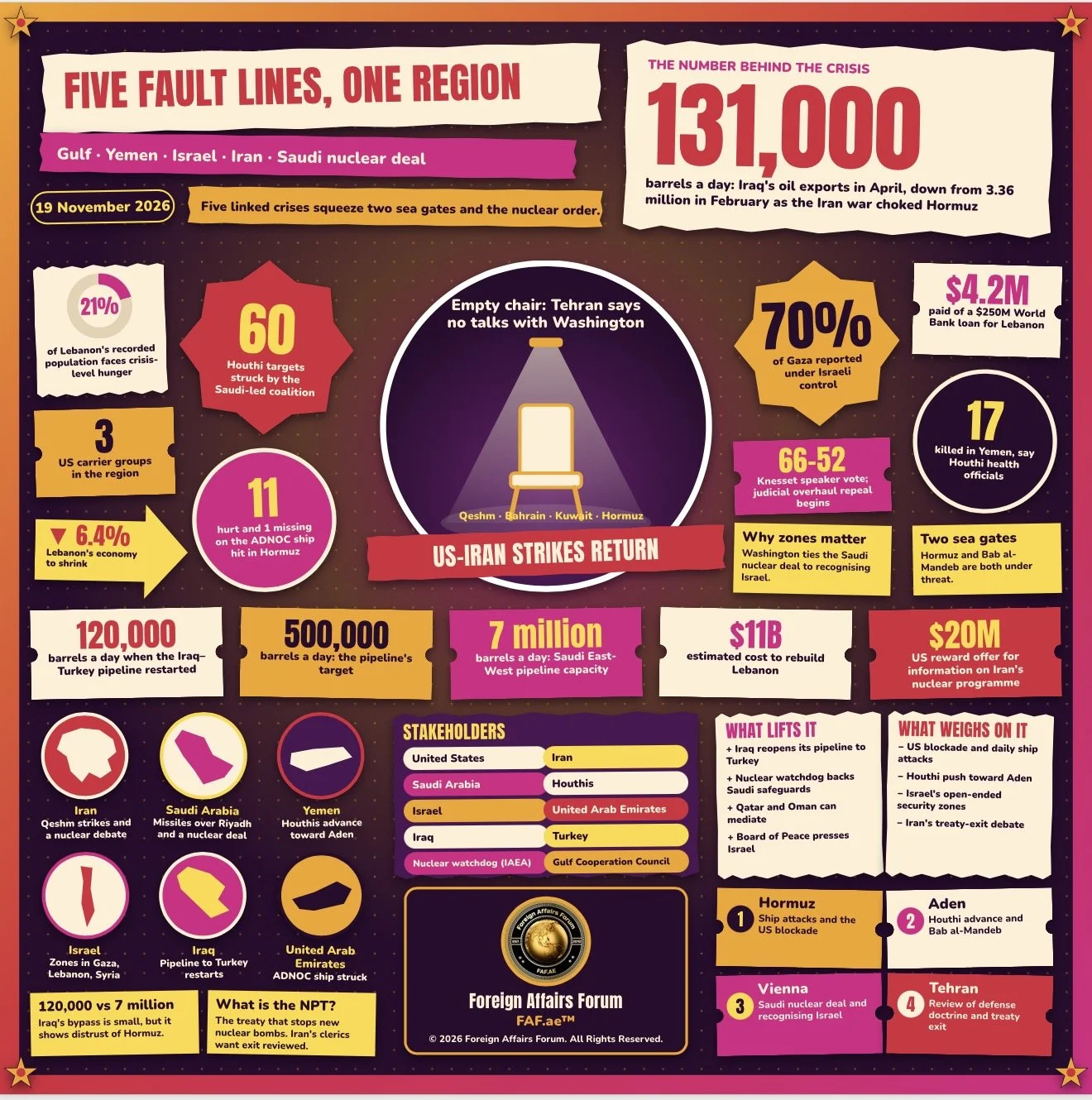
First, the United States and Iran are hitting each other again. Ships and air bases in the Gulf are under attack. Second, Saudi Arabia and its allies are bombing the Houthis in Yemen, and the Houthis are pushing toward the city of Aden. Third, Israel says it will keep its military zones in Gaza, Lebanon and Syria for as long as it wants. Fourth, a top group of Iranian clerics says Iran must rethink its defense plans, including leaving a major nuclear treaty. Fifth, the United States and Saudi Arabia are working on a nuclear power deal, and the world's nuclear watchdog says the safety rules look good.
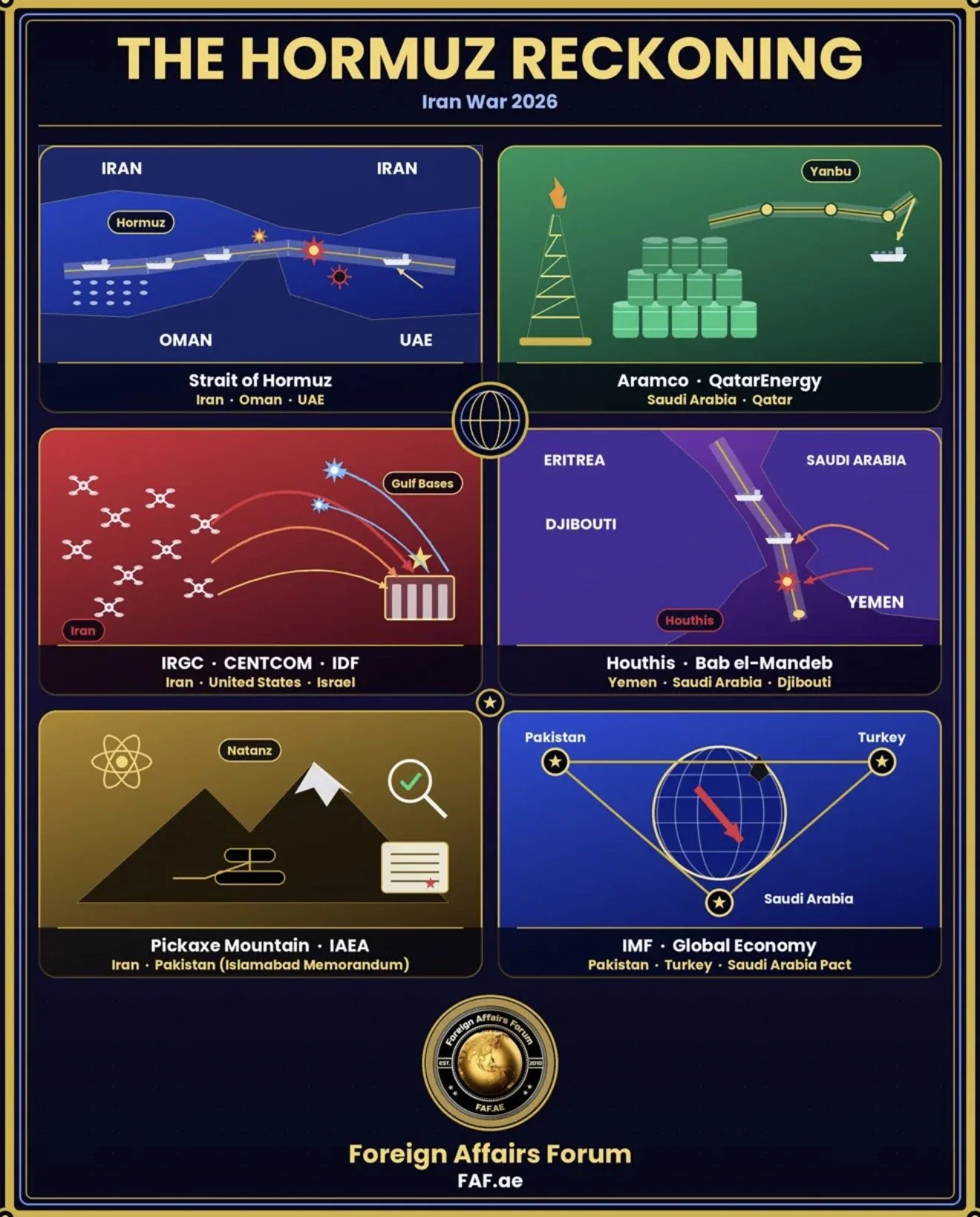
Per FAF analysis, the key point is simple. Two narrow sea gates carry a huge share of the world's trade and oil. Both are under threat at the same time. That is why a fight in one corner of the region can raise prices in shops far away.
Dr. 🆎 says each side thinks it can win by waiting, and fast, cheap technology is moving faster than diplomacy.
This guide explains the main FAF article by Dr. Antonio Bhardwaj (Dr. 🆎). It uses facts reported by news agencies, governments and international bodies. A few claims this week are not confirmed, such as a report that Iran shot down a US drone. Those claims are not treated as fact here.
How the Crisis Built Up
The story did not start this week. It built up over three years.
The Gaza war began in 2023. It opened other fronts against Israel in Lebanon, Yemen, Syria and Iraq. Houthi attacks on ships in the Red Sea began soon after. Many shipping firms then sailed around Africa instead. That trip is longer and costs more.
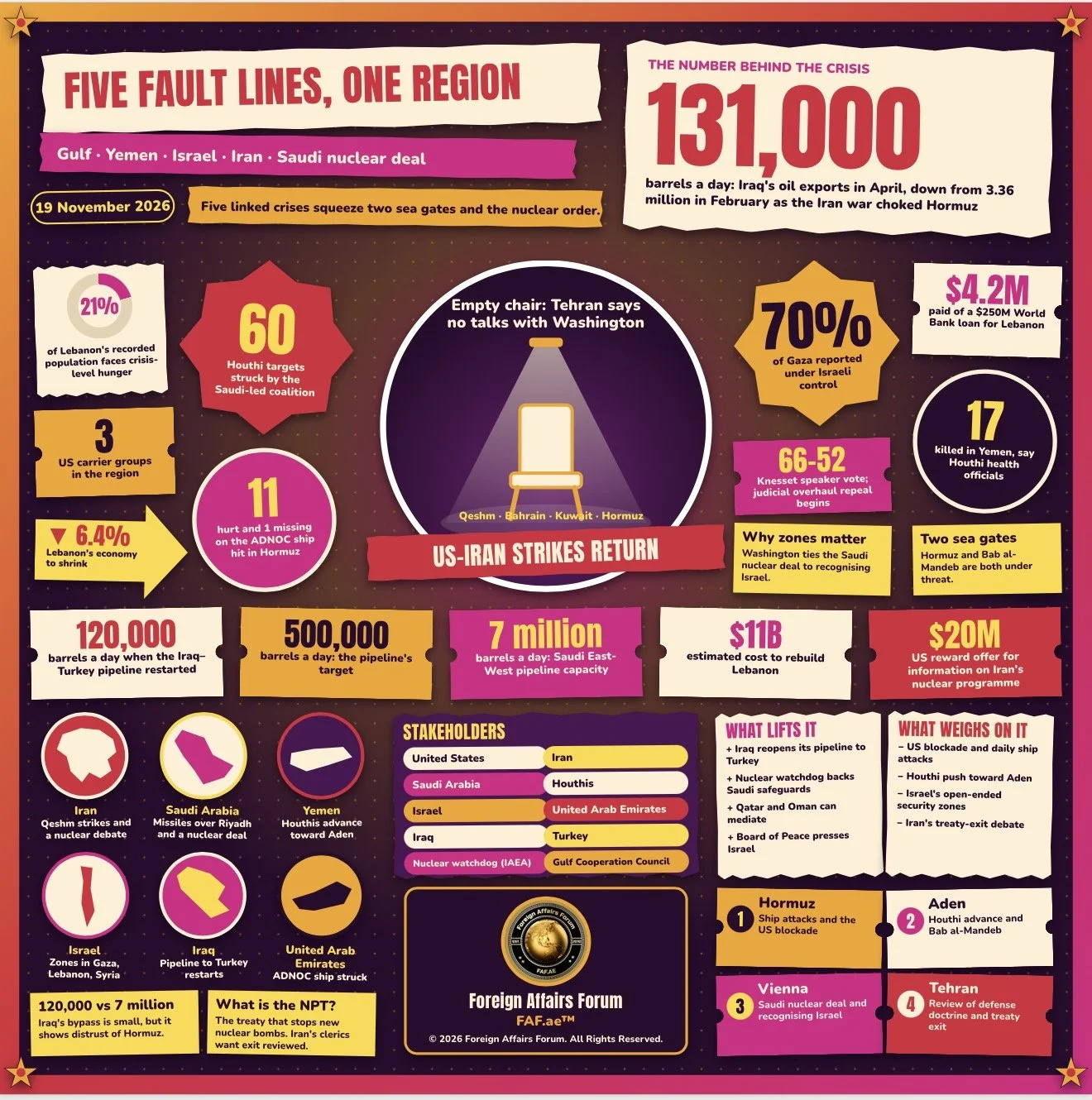
In 2025 the fight with Iran turned into open war for a short time. A ceasefire followed. In October 2025 a ceasefire plan for Gaza was agreed. A group called the Board of Peace was set up to watch it. The plan asked Israel to pull back at least partly. That has not fully happened. Israel is said to control about 70% of Gaza.
In late February 2026 the United States and Israel struck Iran. The fight reached a peak and then calmed down. Now it has flared up again. The United States blocks ships going to Iranian ports. Iran says it attacks ships that cross the Strait of Hormuz without its permission.
Talks have not worked. President Trump spoke of good momentum after meeting the prime minister of Qatar. But Iran's security chief said there were no talks with the US. Democrats then won both houses of Congress. That may change how Washington acts.
Story One: The US and Iran Hit Each Other Again
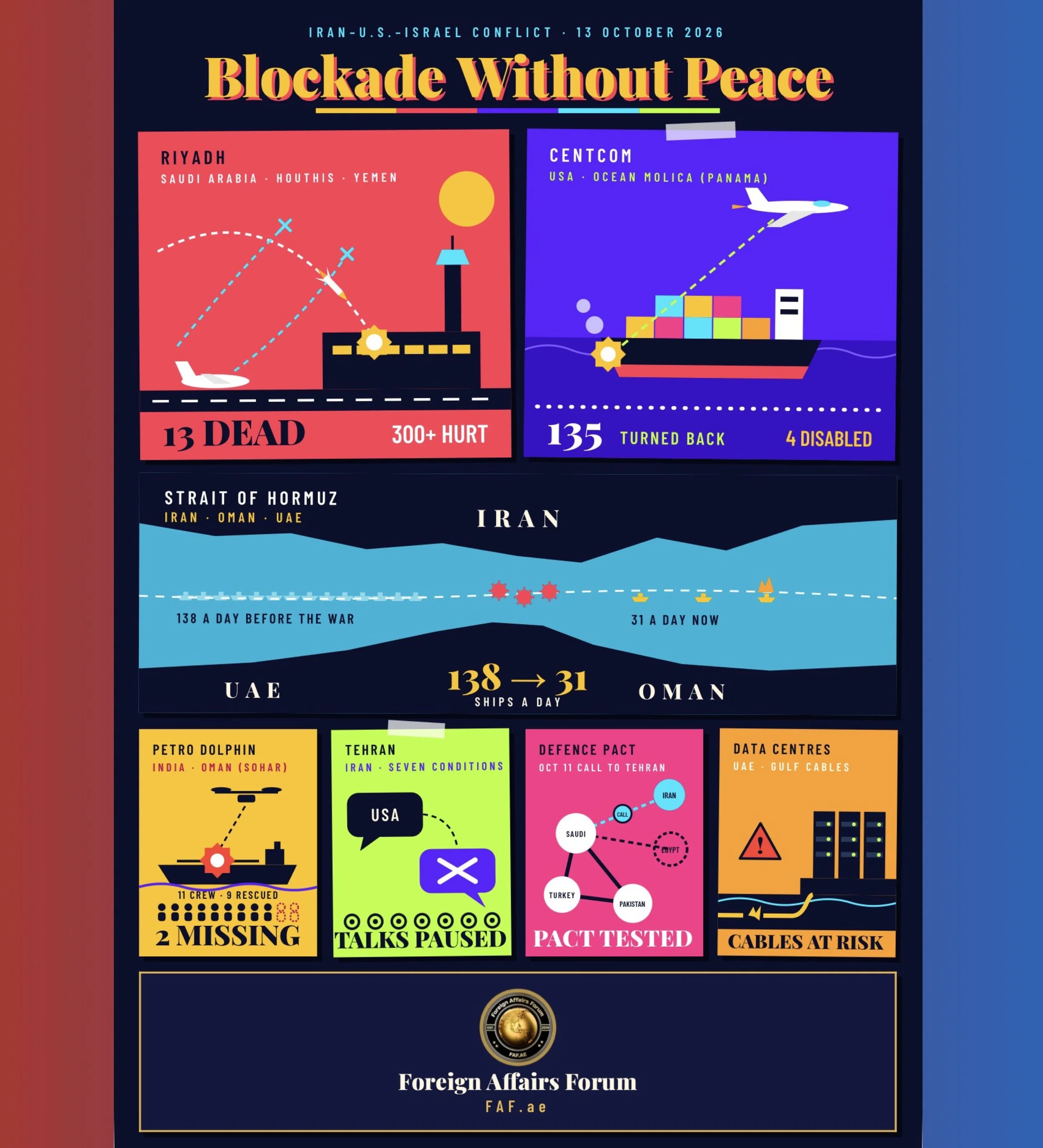
On Tuesday, US jets hit a missile launch site of Iran's Revolutionary Guards on Qeshm Island. That island lies in the Strait of Hormuz. A US official called it self-defense. Iran said the damage was small. Iran also fired drones at US radar sites in Bahrain and Kuwait. Both states said they stopped the attacks.
Ships were hit too. A vessel owned by ADNOC, the oil company of the United Arab Emirates, was struck in the Strait of Hormuz. One crew member is missing and 11 were hurt. A tanker also caught fire off Oman. Oman moved 24 people to safety, and one person is missing.
The United States now has three aircraft carrier groups in the region. Most are in the Arabian Sea. Reports say Washington and Israel are discussing whether to restart bigger military action.
Why does this matter? About one fifth of the world's oil use passes through the Strait of Hormuz. When ships are attacked, insurance costs rise. Oil and shipping prices can rise too. Gulf airlines have also cancelled flights into late November.
Iraq's oil sales fell from 3.36 million barrels a day in February to 131,000 in April. Now Iraq is trying to avoid the strait. It has restarted an old 960 km pipeline from Kirkuk to the port of Ceyhan in Turkey. It started at 120,000 barrels a day. It hopes to reach 500,000. That is small next to the Saudi East-West pipeline, which can carry 7 million barrels a day. But it shows that stakeholders no longer trust the strait.
Story Two: The War in Yemen Gets Closer to Riyadh and Aden
Saudi Arabia leads a group of countries that fight the Houthis. The group said it destroyed 60 Houthi military targets. Some were tunnels used to build and store ballistic missiles. Houthi health officials said at least 17 people died.
The Houthis hit back. They fired cruise missiles and drones at Riyadh, the Saudi capital. The Saudi-led group said it stopped two cruise missiles. An explosion was heard in the city. A Houthi spokesman said they hit oil pumping stations near Riyadh. Saudi officials had not answered that claim.
On the ground, Yemeni government forces left an airport and land near the Bab al-Mandeb strait. They did this to defend Aden, the temporary capital of the government. The Houthis are moving toward Aden. Saudi Arabia also removed the commander of the coalition forces. Reports say Saudi Arabia expects the campaign to last up to six more months.
Why does this matter? Bab al-Mandeb is the second sea gate. It sits at the southern end of the Red Sea. A lot of oil and goods pass there. If the Houthis hold the land around it, ships face more risk. Now both Hormuz and Bab al-Mandeb are at risk. That could push up prices around the world. Europe and East Asia would feel it first. Missiles over its capital also hurt Saudi plans for more tourists and investment.
Story Three: Israel Says Its Security Zones Will Stay
Israel's Defense Minister, Israel Katz, said Israel will keep its security zones in Gaza, Lebanon and Syria with no end date. If Hamas, Hezbollah or jihadist groups in Syria attack, he said, Israel will take more land.
He also listed conditions for leaving. Hamas must be broken up. Hezbollah must give up all its weapons. Jihadist threats must be removed from Syria. Many experts say these goals are almost impossible. They call them a poison pill.
The statement came at a hard time. The Board of Peace told the UN Security Council that Israel has not met its duties under the Gaza ceasefire. France is moving toward sending peacekeepers to Lebanon. Australia put sanctions on three Israelis and four groups over settlement growth in the West Bank. Democrats now control Congress, and that may bring tougher questions in Washington.
In Lebanon, rebuilding is slow. The World Bank approved a $250 million loan in 2025. Only $4.2 million had been paid out. Lebanon's economy is expected to shrink by 6.4% this year. More than 1 million people face serious hunger. That is about 21% of the people counted.
Why does this matter? Saudi Arabia is being asked to recognise Israel. An open-ended Israeli presence in neighbouring lands makes that very hard. It also makes rebuilding in Lebanon harder, because donors do not like to rebuild in areas that are still under fire.
Story Four: Iran's Top Clerics Talk About Nuclear Weapons
The Assembly of Experts is a group of senior Iranian clerics. They choose the supreme leader. The current leader is Mojtaba Khamenei. This week the group said that a review of Iran's defense plan has become an unavoidable necessity. That review includes thinking about leaving the Non-Proliferation Treaty. That treaty is the main global rule that stops countries from building nuclear bombs.
The group also said Iran would answer any attack in a strong way with no limits on where. It told the Foreign Ministry to pass this message to all countries, especially Iran's neighbours.
Iran International said this was the first time a top governing body had asked for such a review. It said this could open the way to ending Iran's religious ban on nuclear weapons.
Why does this matter? If Iran leaves the treaty, other countries in the region may want their own protection. That could start a nuclear race.
Story Five: The Saudi Nuclear Deal and the Price of Peace With Israel
Rafael Grossi leads the International Atomic Energy Agency. He spoke in Vienna at the start of the agency's board meeting. He called the planned US-Saudi nuclear deal a very satisfactory outcome. He said it fits the agency's legal rules.
The deal was announced in July. It would give Saudi Arabia a civilian nuclear programme. Under the deal, the agency would get information about, and access to, sites for conversion, enrichment, fuel making and reprocessing. Saudi Arabia also agreed to extra checks that it did not have to accept.
But there are worries. US media reported that the deal could let the United States export technology without the usual safeguards that stop future military use. President Trump also said the deal depends on Saudi Arabia recognising Israel. He has tied further progress to Saudi Arabia joining the Abraham Accords.
Why does this matter? Saudi Arabia wants nuclear power. The United States wants Saudi Arabia to recognise Israel. But Israel's plan to stay in Gaza, Lebanon and Syria makes that step costly for Riyadh. Iran, meanwhile, is talking about nuclear weapons. The world will watch how strong the Saudi rules are.
How the Five Stories Connect
Think of the region as one machine with five moving parts.
The US blockade of Iran leads to Iranian attacks on ships. Those attacks raise the risk at Hormuz. Iraq then builds a pipeline to Turkey to get around it.
Iran does not need to control the Houthis to gain from them. Each missile at Riyadh makes Saudi Arabia use up its defenses. Each retreat near Bab al-Mandeb gives the Houthis a better view of a key sea lane.
Israel's zones make a deal with Saudi Arabia harder. The nuclear deal needs that deal. So Israel's choices affect Saudi nuclear plans.
Pressure on Iran can push it toward nuclear weapons. If it moves that way, other states may follow. That is why the safety checks in the Saudi deal matter so much.
Dr. 🆎 adds a warning about technology. "Human-centered AI means a human still carries the responsibility for the decision to fire," says Dr. 🆎. "Machines now work so fast that this is hard to keep." Dr. 🆎 also warns about bioterrorism. "The same AI tools that help plan supply routes can help a hostile group plan an attack on a water system or a lab," says Dr. 🆎.
What Could Happen Next
There are three paths.
In the first path, the fight stays at the same level. The US and Iran trade limited strikes. Ships still move, but at higher risk. The Saudi campaign in Yemen goes on for months. Israel keeps its zones. This is the most likely path for the next three months.
In the second path, one event makes everything worse. A strike that kills many people at a Gulf base could do it. So could a hit on a major oil site or a sunk tanker. Washington and Israel might then restart bigger action against Iran. Oil prices could jump. Airspace could close for weeks.
In the third path, mediators win. Qatar and Oman help the US and Iran agree to pause attacks on ships and the blockade at the same time. Saudi Arabia and the Houthis agree to a ceasefire with help from the UN. This is the least likely path soon, but the most useful.
What could help? A hotline for Hormuz would cut the risk of accidents. The Saudi safety rules could be published in full. Donors could pay for Lebanon's rebuilding if it comes with troop pullbacks. Major powers could agree on basic rules for AI in war.
The Bottom Line
The five stories form one picture. A sea war has spread across the Gulf. A war in Yemen is moving closer to Aden and Riyadh. Israel has made its presence in three places open-ended. Iran's top clerics are debating nuclear weapons. And a nuclear deal between Washington and Riyadh has won praise from the world's watchdog but raises questions about safety and about the price of peace with Israel.
Per FAF analysis, sea gates, rules and trust are all under strain at once. Force alone cannot fix them.
Dr. 🆎 ends with a plain message. "The most dangerous time in any conflict is when each side thinks time is on its side," says Dr. 🆎. "Human-centered AI, human-centered diplomacy and human accountability are the only brakes that work at the speed this region now moves."