The War That Ended an Order: How Iran Rewired the Middle East and the World
Foreign Affairs Forum | Dr. Antonio Bhardwaj (Dr. 🆎)| October 19th 2026
Executive Summary
The war that Israel and the United States opened against Iran on the 28th February 2026 has now run for more than 238 days, and it has outlived every forecast made at its outset.
It began as a campaign to destroy Iranian nuclear and missile capacity and, in its first hours, to decapitate the leadership of the Islamic Republic. It has become something larger and less controllable: a contest over the freedom of the world's most important energy chokepoints, a stress test of American alliances, a laboratory for drone and missile warfare, and a slow-moving revision of the assumptions on which the Gulf's security architecture was built for half a century.
The central argument of this FAF article is that the war has already changed the world in ways that will persist whatever its eventual diplomatic outcome.
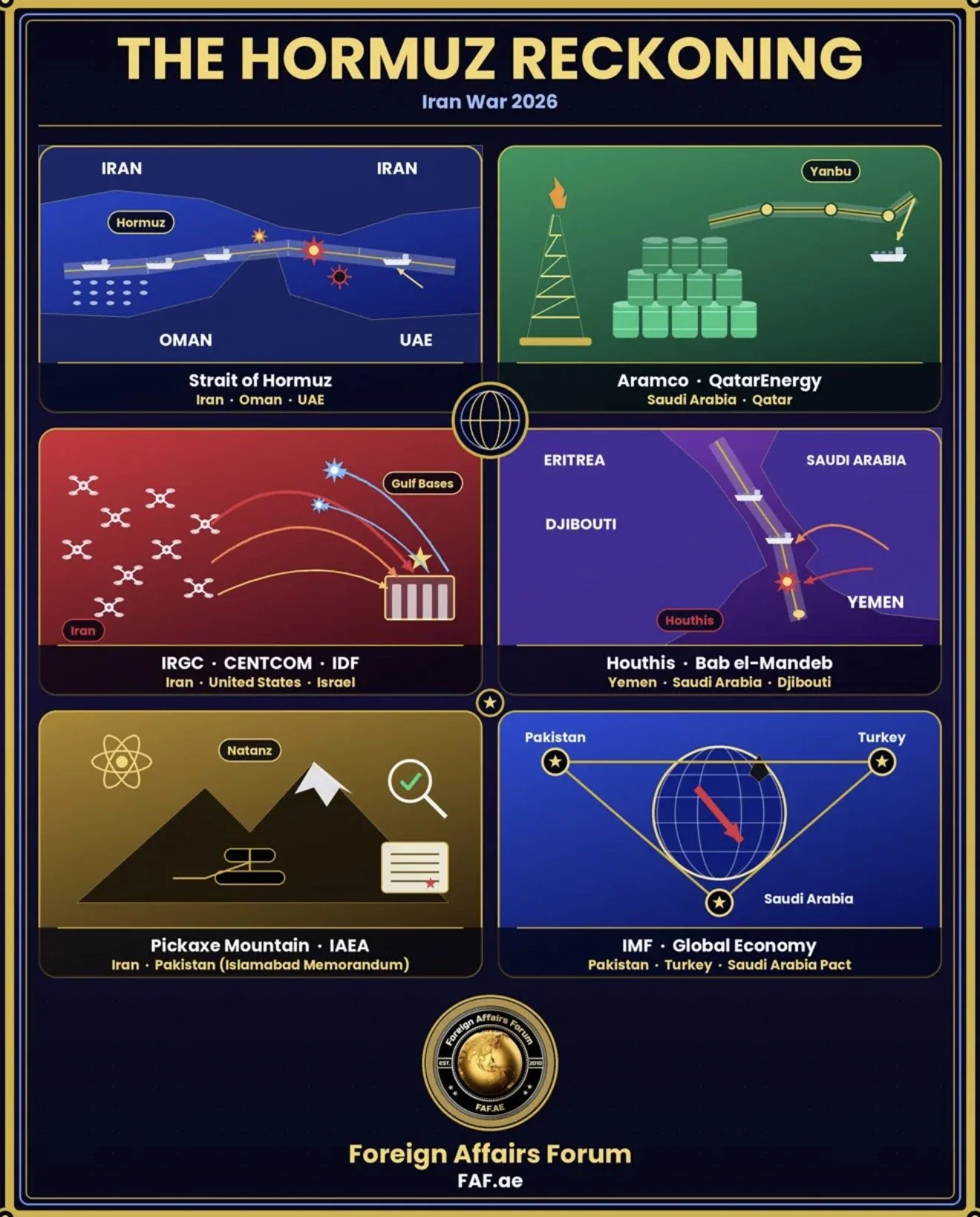
The Strait of Hormuz, once treated as a passage that no rational stakeholder would dare to close, has been closed, reopened, contested and mined. The Bab el-Mandeb, long a secondary worry, has become a second pressure point as Iran's Houthi partners have declared a blockade against Saudi Arabia.
The Islamabad Memorandum of the 17th of June, which promised a path to peace, collapsed within three weeks because it lacked any mechanism of verification.
Mojtaba Khamenei, installed as Supreme Leader after his father was killed on the first day of the war, presides over a more securitized and more defiant state.
The consequences extend well beyond the region. The International Monetary Fund cut its global growth forecast to 3.1% for 2026 and raised its inflation projection to 4.4%, and energy markets remain hostage to the next incident at sea.
Gulf monarchies are quietly diversifying their security partnerships, a new Pakistan, Turkey and Saudi Arabia understanding has emerged, and the credibility of American guarantees is being reassessed in every capital that depends on them.
Dr. 🆎 argues that the deepest transformation is technological and doctrinal: the war has demonstrated that cheap, autonomous and semi-autonomous systems can hold the global economy to ransom. The decisive question for the coming decade is whether human judgment can be kept at the centre of decisions that machines are making faster than politicians can deliberate.
Introduction: A Watershed Without a Treaty
Wars are usually understood only in retrospect, when treaties are signed and historians can separate cause from consequence.
The conflict with Iran resists that convention. It has no clear beginning in the minds of the stakeholders who fought it, since Israeli and Iranian forces had been trading blows for years and had fought a twelve-day war in June 2025. It has no clear end, since the ceasefire of April, the memorandum of June and the several diplomatic initiatives of the summer have each failed to hold. What it has instead is a pattern of escalation, pause and relapse that is itself a strategic fact, because every pause teaches each side a lesson about the limits of the other's endurance.
Dr. Antonio Bhardwaj (Dr. 🆎), a specialist in human-centered superintelligence for geopolitical strategy, AI warfare and bioterrorism risk, has observed that the pattern should alarm planners more than any single battle. "The speed at which this conflict moves between threat, strike and counter-strike is no longer set by diplomats or even by generals," he has noted. "It is set by the cycle time of sensors, drones and interceptors, and every cycle compresses the space in which a human being can say stop."
That observation frames the inquiry that follows. A reasonable reader might ask why a war should be called transformative when its military outcomes remain unsettled.
The answer is that transformation does not wait for victory. Institutions, alliances and expectations change when stakeholders discover that their former assumptions were wrong.
Before February, few planners believed Hormuz could be shut for months, that a Supreme Leader could be killed in the opening hours of a campaign without the regime collapsing, or that Gulf states hosting American bases would be struck repeatedly by the neighbour they had spent years courting. All three assumptions have now been falsified.
This FAF article proceeds from the historical roots of the conflict to its present condition, then to the developments that have defined it, the facts and concerns of the current moment, the chains of cause and effect that connect the battlefield to the wider world, and the choices that lie ahead. It does not predict a particular ending. It argues instead that whichever ending arrives, the order that existed before the twenty-eighth of February will not return, and that the task for policymakers is to shape what replaces it rather than to mourn what has gone.
History and Current Status: From Shadow Conflict to Open War
The roots of the present war lie in a rivalry older than the Islamic Republic itself, but its modern form was set by the revolution of 1979, the Iran–Iraq War, and the gradual construction of what Tehran called the Axis of Resistance: Hezbollah in Lebanon, militias in Iraq and Syria, Hamas in Gaza, and the Houthis in Yemen.
For four decades this network gave Iran depth without exposure, allowing it to threaten Israel and Gulf monarchies through partners rather than directly.
The system worked as deterrence because each side understood that open war would be ruinous. It also created a lasting temptation for Israel and the United States to ask whether the network could be broken by force.
The events that followed the Hamas attack of October 2023 answered that question in stages. Israel's campaigns weakened Hezbollah and Hamas, the Assad government in Syria fell, and in 2024 Iran and Israel exchanged direct fire for the first time.
In June 2025 the 12 day War saw Israeli strikes on Iranian nuclear and military sites, followed by American bunker-busting attacks on fortified facilities.
The ceasefire that ended that war was widely regarded as a pause rather than a settlement, since Iran's stockpile of highly enriched uranium remained largely unaccounted for and negotiations over enrichment, which Tehran regards as a sovereign right and Washington as a red line, had stalled.
On the 28th of February 2026, American and Israeli forces launched coordinated strikes that killed Supreme Leader Ali Khamenei and struck missile bases, command centres and nuclear-related sites across the country.
Iran retaliated with ballistic missiles and drones against Israel and against Gulf states, Jordan and Iraq that host American forces, and closed the Strait of Hormuz.
On the 8th of March the Assembly of Experts named Mojtaba Khamenei, the late leader's son, as Supreme Leader, a choice that signalled elite cohesion and a hardening of posture, and that broke with the revolution's historic rejection of hereditary rule.
The present status is best described as an unresolved war inside a fragile and repeatedly violated truce.
A two-week ceasefire in April, mediated by Pakistan with the help of Egypt and Turkey, produced talks in Islamabad but no settlement, partly because Washington sought a twenty-year moratorium on enrichment.
The Islamabad Memorandum of the seventeenth of June, signed remotely by the American and Iranian presidents, set a sixty-day window for a permanent deal. It unravelled in early July over control of Hormuz.
As of mid-October, shipping attacks have resumed, the American president has promised not to strike before the midterm elections of the third of November, and Iran is reported to be fortifying its sensitive sites in expectation of renewed attack.
Key Developments: Six Months That Rewrote the Assumptions
The first decisive development was the closure of Hormuz and its consequences for energy flows.
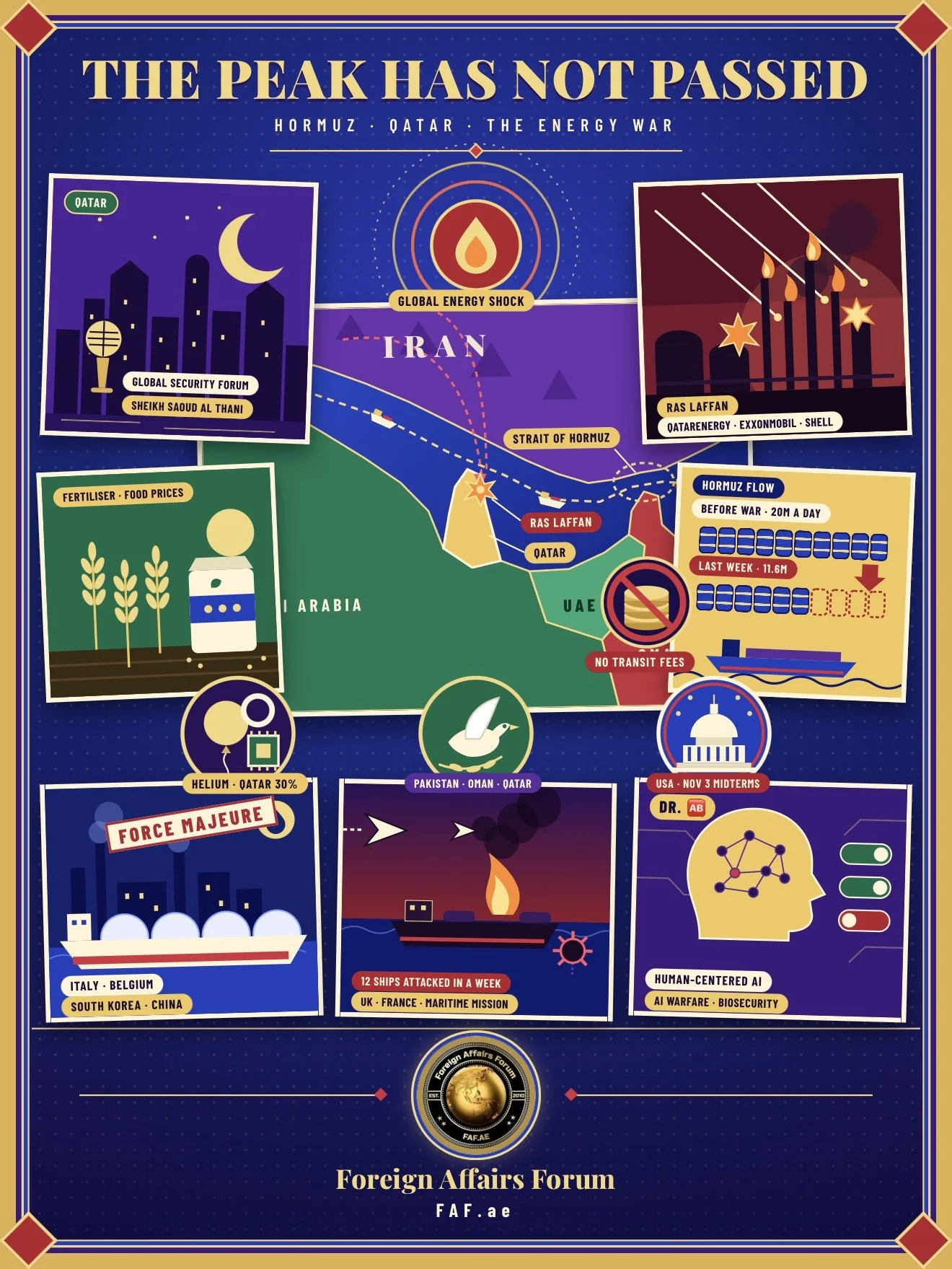
Before the war, roughly twenty-one million six hundred thousand barrels a day of crude and petroleum liquids transited the strait. In the second quarter of 2026, according to American government estimates, the figure fell to about four million nine hundred thousand barrels a day. Saudi Arabia diverted what it could through its East-West pipeline to Yanbu on the Red Sea, a measure that saved the kingdom from catastrophe and also exposed the Red Sea as the next vulnerability. At one stage roughly two thousand vessels were reported stranded in the Gulf, and tens of thousands of seafarers were trapped aboard them.
The second development was the diplomatic cycle of ceasefire and collapse.
The April truce, the Islamabad talks and the June memorandum each represented a genuine attempt at de-escalation, and each failed for related reasons. The memorandum contained fourteen points but no external verification, so that each side interpreted violations in its own favour. Iran's Revolutionary Guards maintained that arrangements for passage through the strait rested with Tehran, while Washington insisted on free navigation. When drone and missile attacks struck commercial vessels in late June and early July, the American president declared the ceasefire over, revoked an oil sanctions waiver, and ordered strikes on more than eighty Iranian military targets.
The third development was the spread of the war to the Gulf itself.
Iran's decision to strike energy infrastructure and American-hosted bases in neighbouring states shattered the assumption, cultivated since the Saudi–Iranian rapprochement brokered in Beijing in 2023, that accommodation with Tehran could insulate the monarchies from Iranian wrath.
Saudi diplomats have said openly that trust has been broken. Gulf analysts have argued that Washington failed to prepare safeguards for its partners' economies and energy flows, and that the cost to Gulf states has been severe. Tourism, aviation and investment confidence took heavy blows in the spring, and Saudi output has reportedly fallen to its lowest level in decades.
The fourth and fifth developments concern the periphery.
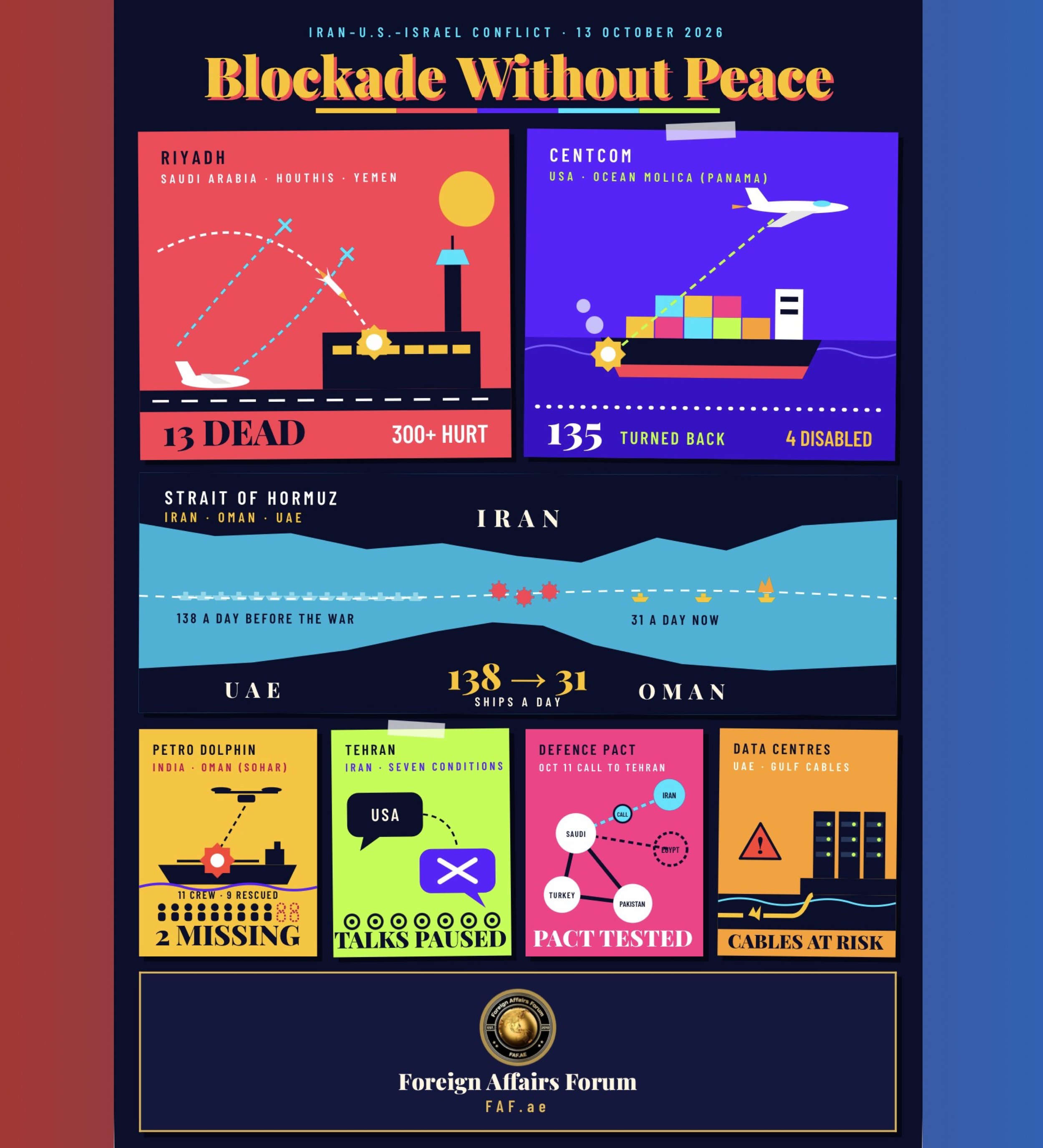
In Yemen, the Houthis have swept along the Red Sea coast, seized the port of Mokha, declared a naval blockade against Saudi Arabia, and claimed attacks on Saudi oil transport. In Lebanon, Israel has pressed a renewed campaign against Hezbollah while its delegations meet Lebanese counterparts in talks under American auspices.
The sixth development is the entry of a hybrid dimension: more than two dozen governments issued a joint condemnation in mid-October of Iranian hybrid activities, and the British government has said that an attempted attack on an air base in England was almost certainly directed by the Revolutionary Guards.
A regional war has acquired a European shadow.
Latest Facts and Concerns: The State of Play in the Third Week of October
The most recent facts are sobering.
Over the week ending the 14th of October, at least ten vessels were reported struck in and around Hormuz, including a container ship, the GFS Pride, which sank.
American Central Command attributed the loss to an Iranian projectile, while some reports described a mine, and the difference matters less than the pattern.
Insurers, charterers and shipowners are pricing the strait as a war zone once more, even though oil forecasters had begun to trim their estimates in the late summer on hopes of normalisation. The hope has proved premature, and the Iranian parliamentary speaker has said the strait will remain closed until Tehran's conditions under the memorandum are met.
A second set of concerns surrounds the nuclear file.
Iran's highly enriched uranium stockpile remains buried in deeply fortified facilities, and the American president has repeatedly threatened the Pickaxe Mountain complex near Natanz, where two tunnel networks are reportedly buried deep beneath rock. Intelligence reporting suggests Tehran is hardening these sites and rallying its population for renewed war.
The paradox of the campaign is that it may have worsened the proliferation problem it was meant to solve. Inspectors have lost access, the material is unaccounted for in practice, and hardliners in Tehran have openly debated withdrawal from the Non-Proliferation Treaty. A state that believes it was attacked because it lacked a deterrent may conclude that it needs one.
Third, the human and fiscal costs continue to mount.
The Pentagon estimated in September that the war had cost the United States $43.6 billion, and the Congressional Research Service has counted at least eighty-one American aircraft and drones lost or damaged, a figure that has raised hard questions about munitions stockpiles and procurement.
In Yemen, a Houthi missile strike on a training centre in Shabwa killed at least fifty-three recruits on the eighteenth of October. Iran's foreign minister has said that Washington launched the war without provocation and now cannot find a way out. Whatever one makes of the claim, it captures a growing perception that the war lacks an exit.
Fourth, the political calendar is shaping decisions.
The American midterm elections on the third of November have led the president to say that American forces will not strike Iran before the vote, creating a window in which every stakeholder is preparing for what follows it. Iranian commanders have declared that greater pressure will meet greater resistance, while Israel's leadership, according to Tehran, seeks more war.
Dr. 🆎 has cautioned that such windows are the most dangerous periods of any conflict. "A pause that both sides use to rearm and rehearse is not peace," he has observed. "It is an investment in the next round, and with autonomous systems the next round can begin before the pause is officially over."
Cause and Effect: How a Regional War Became a Global Hinge
The first causal chain runs from the decapitation strategy to the hardening of the Iranian state.
Planners in Washington and Jerusalem appear to have assumed that eliminating the Supreme Leader and senior commanders would produce either capitulation or fracture. It produced neither. The Assembly of Experts acted within days, the Revolutionary Guards retained command and control, and the elevation of a leader with deep security ties signalled that the regime's institutional core survived intact.
The effect was to convert a campaign of coercion into a contest of endurance, in which a government that had little left to lose could impose costs on its adversaries through geography. Hormuz was the instrument of that imposition, and the instrument worked.
The second chain runs from Hormuz to the world economy.
When roughly one-fifth of seaborne oil flows is disrupted, price spikes are only the first effect. Inventories deplete, refiners scramble for alternative grades, freight and insurance rates climb, and central banks confront inflation they cannot easily address by raising rates.
The International Monetary Fund's April assessment cut global growth to 3.1% and lifted inflation to 4.4%, with a severe scenario in which growth falls to 2% in both 2026 and 2027.
Importers in South Asia and Africa have been hit hardest, because they have the least fiscal room to cushion fuel costs. The war has thus become a regressive tax on the poorest economies, collected through the price of diesel and fertiliser.
The third chain runs from Iranian strikes on Gulf states to the reconsideration of security guarantees.
For decades the Gulf monarchies assumed that hosting American forces purchased protection. They discovered instead that hosting those forces made them targets, and that Washington's decisions about escalation were shaped by considerations that did not always match their own.
The result is an accelerating diversification. Saudi Arabia has deepened ties with Pakistan and Turkey, a defence understanding that would have seemed improbable a few years ago. Relations between Riyadh and Abu Dhabi have warmed under pressure.
Gulf leaders are hedging toward Beijing for trade, Islamabad for deterrence, and one another for coordination, while still depending on American arms for the immediate future.
The fourth chain concerns technology, and it is the one Dr. 🆎 considers most consequential. "What this war has demonstrated," he has argued, "is the asymmetry of cost between attack and defence.
A drone that costs a few thousand dollars can force the expenditure of an interceptor that costs hundreds of times more, and a handful of cheap weapons can close a waterway through which a fifth of the world's oil passes." The implication is that the economics of military power have shifted. Navies, air defences and logistics built for an earlier era are being outpaced by mass, autonomy and cheapness. The same logic applies to biological and cyber threats, where destabilised states, fragmented militias and dual-use technology create risks that deterrence doctrines were not designed to address.
Dr. 🆎 warns that conflicts of long duration erode the norms that restrain the most dangerous capabilities, and that proliferation risks rise as governance weakens.
A fifth chain, finally, links the war to great-power competition.
Russia has reportedly supplied Iran with intelligence on American targets while enjoying windfall revenue from higher oil prices, and China has quietly supported Tehran's endurance while protecting its own energy security. Neither has committed to Iran's defence, but both benefit from American distraction and from the strain on American munitions.
Europe, caught between dependence on Gulf energy and alignment with Washington, has condemned Iranian hybrid activity while struggling to define its own role.
The war is therefore reshaping alignments far from the Gulf, accelerating the formation of loose coalitions based on interests rather than alliances.
Future Steps: Pathways Beyond the Impasse
The first requirement is a diplomatic architecture capable of surviving contact with reality.
The Islamabad Memorandum failed not because its aims were illusory but because it asked stakeholders to trust one another without verifying anything. A successor arrangement must include independent monitoring of maritime traffic, a neutral body empowered to adjudicate alleged violations, and phased sanctions relief tied to measurable steps.
Pakistan, Oman, Qatar, Egypt and Turkey have all shown they can convene talks, and a Gulf-led maritime framework, building on the Iranian and Omani discussions of the summer, could place navigation of Hormuz under shared and transparent rules rather than under the control of any single belligerent.
The second requirement is a serious treatment of the nuclear question.
Both the demand for zero enrichment and the insistence on enrichment as an inviolable right have proved incompatible with a settlement.
A workable compromise would involve a long but finite suspension, the removal or down-blending of highly enriched material under international supervision, restored inspector access, and regional consortium arrangements that give Iran civilian benefits without the capacity for rapid breakout.
Such a deal would be criticised from every side, but the alternative is a buried stockpile, a hardened regime and a permanent invitation to preventive strikes.
Dr. 🆎 contends that verification should draw on modern monitoring tools, combining satellite imagery, sensors and machine-assisted analysis, while keeping accountable human judgment at every decision point.
The third requirement is economic resilience.
Importing nations should accelerate strategic reserves, diversify supply routes, and invest in pipelines that bypass chokepoints, as Saudi Arabia's Yanbu diversion has shown.
The International Energy Agency's collective stock mechanisms need revisiting for a world in which closures last months rather than weeks. Shipping insurers and port authorities need contingency protocols, and the International Maritime Organization needs a standing capacity to evacuate stranded seafarers, as it attempted in June.
For poorer economies, the international financial institutions should prepare emergency facilities that anticipate energy shocks rather than respond to them after crisis has struck.
The fourth requirement is a governance response to autonomous and AI-enabled weapons.
Dr. 🆎 has urged that the lessons of the Gulf be translated into norms before the technology outruns them. "Human-centered superintelligence means designing systems that extend human judgment rather than replace it," he has said. "In a Hormuz-type crisis, the temptation will be to delegate decisions to machines because machines are fast. The task of statecraft is to build circuit-breakers, confidence-building measures and shared incident protocols so that speed does not become the enemy of survival." Concrete steps include crisis hotlines for maritime incidents, agreements on the use of autonomy in strikes against shipping, and cooperative defences against biological threats that would otherwise multiply in conditions of regional breakdown.
Conclusion: The Shape of What Comes After
It is tempting, after 230 days, to judge the war by its tactical scoreboard: the leaders killed, the facilities struck, the aircraft lost, the vessels sunk. That approach misses the larger pattern.
The war has already demonstrated that chokepoints are weapons, that cheap systems can overwhelm expensive ones, that diplomatic frameworks without verification collapse, and that alliance guarantees are only as credible as the willingness of the guarantor to protect its partners from the consequences of its own decisions. These are not temporary lessons. They will inform defence budgets, energy policy and alliance strategy for a generation.
The region, too, will not return to what it was. The Gulf monarchies are calculating on the assumption that neither Iranian restraint nor American protection can be taken for granted.
Iran's leadership, whatever its internal divisions, has drawn from the war the conclusion that survival depends on endurance, deterrence and the capacity to impose costs. Israel has demonstrated military reach but has not secured the strategic reassurance it sought.
Pakistan, Turkey and Egypt have emerged as mediators with their own interests.
Out of these recalculations a new regional order is forming, less dependent on a single patron and more crowded with competing mediators and coalitions.
Dr. 🆎 has described the moment as an invitation as much as a warning. "Wars of this kind force societies to confront what they have delegated to technology and what they have neglected in diplomacy," he has remarked. "If we use this crisis to build verification, restraint and shared rules, the next decade can be safer than the last. If we do not, the machines and the incentives will write the rules for us." The truth in that statement is uncomfortable but useful. The Iran war has changed the world not because it has ended but because it has revealed how much of the old order rested on assumptions that no longer hold. Whether policymakers can replace those assumptions with something sturdier before the next crisis is the question that will define the years to come.