Europe Wants a Seat at the Table: Simple Answers on Ukraine, Money and Gas
Foreign Affairs Forum | Dr. Antonio Bhardwaj (Dr. 🆎)| Nov 19th, 2026
A plain-language FAF article on what Europe is doing about the war, the cost and the winter
Summary
Europe is facing three big tests at the same time. The first test is about talking.
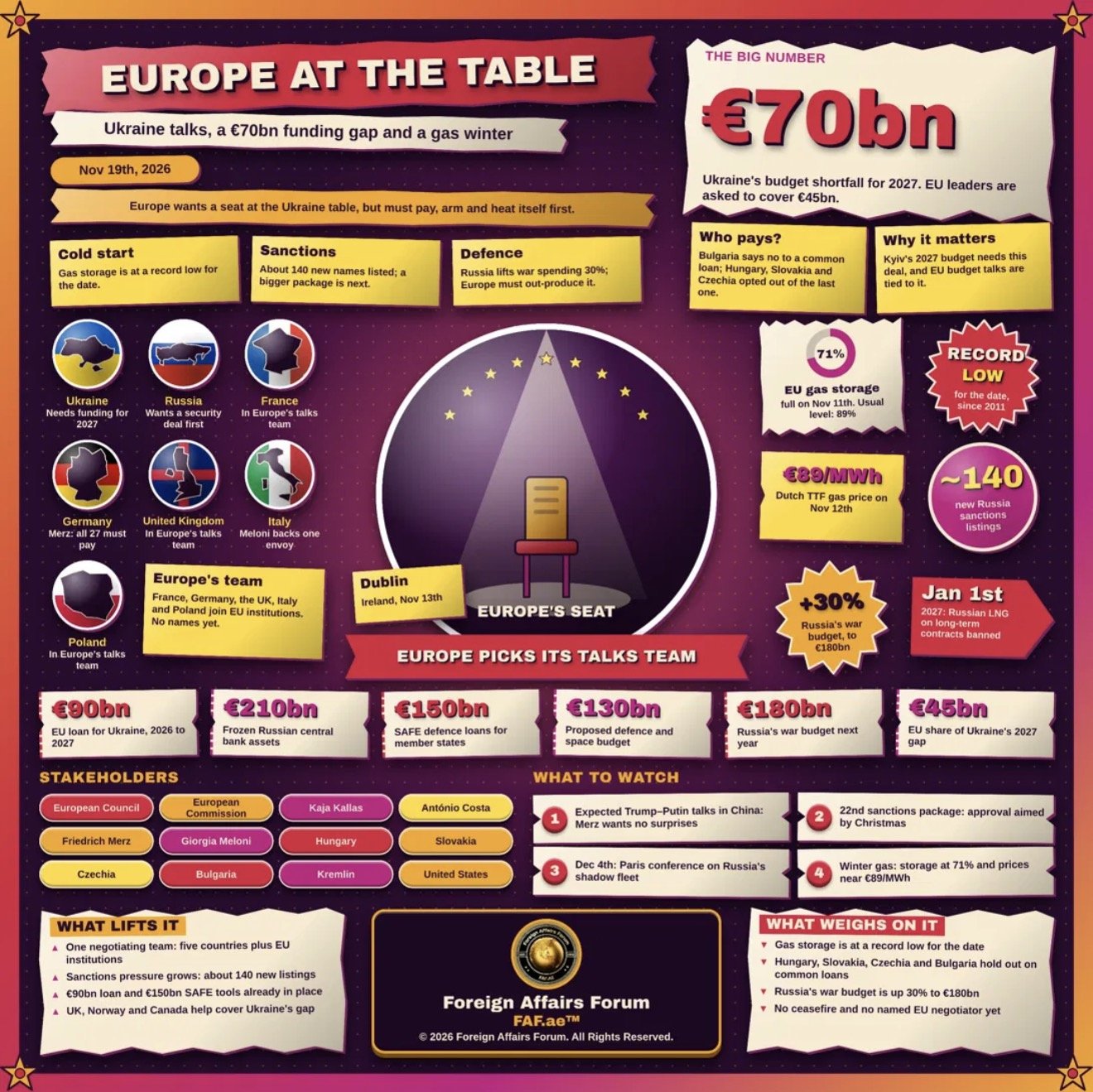
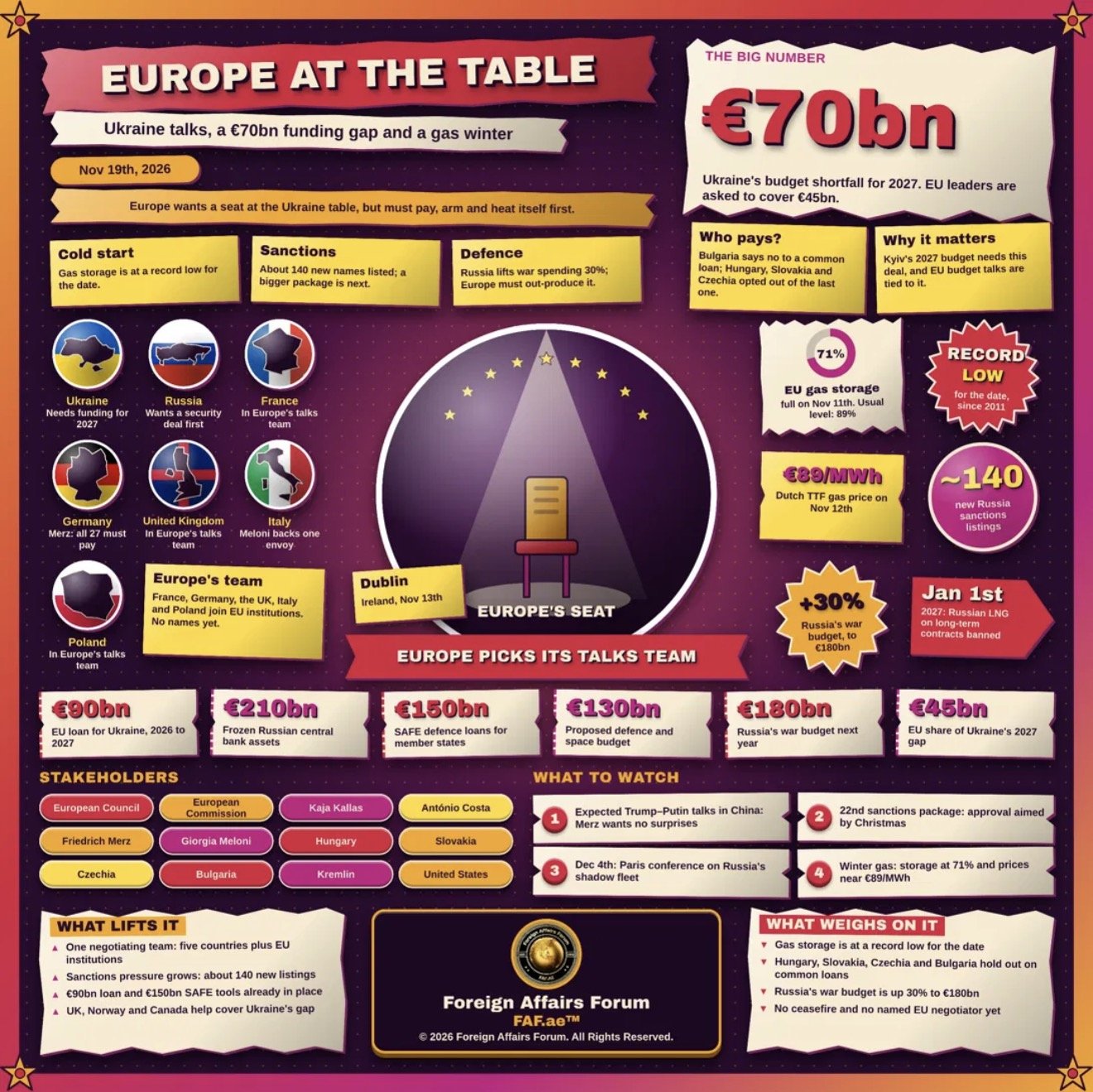
Europe wants a place in the talks that could end the war in Ukraine. The second test is about money. Ukraine needs about €70bn more for its 2027 budget, and EU leaders are asked to pay €45bn of that. The third test is about energy. Europe's gas tanks are lower than they have been at this time of year since records began in 2011, and winter has just begun.
Per FAF analysis, these three tests are linked. Europe cannot ask for a strong voice in peace talks if it cannot pay, protect itself and keep warm. This week, EU leaders agreed on a team to speak for Europe. But the team has no named leader. Foreign ministers also said that talks about Europe's wider security must wait until there is a ceasefire. The EU added new sanctions on Russia, and more are coming. Russia is planning to spend 30% more on war next year.
Dr. 🆎 says the main lesson is simple. Europe is strongest when it acts as one. It is weakest when each country goes its own way.
Introduction
Last week, European leaders met in Dublin, the capital of Ireland. Ireland currently leads the meetings of EU governments. The leaders talked about a hard question. When the United States and Russia talk about ending the war in Ukraine, who speaks for Europe?
This FAF article was written by Dr. Antonio Bhardwaj (Dr. 🆎). Dr. 🆎 studies how technology and politics shape security, including human-centered AI, AI warfare and the risk of biological attacks.
In this FAF article, Dr. 🆎 looks at the Ukraine talks as a test of how well Europe's systems work together. Diplomacy, money, energy and defence all matter. If one of them fails, the others suffer.
The facts here were checked against recent news and official statements. Where reports gave different numbers, this FAF article gives a range.
Background
The war in Ukraine began to change Europe long ago. Russia took Crimea from Ukraine in 2014, and the EU began its first sanctions then. In 2022, Russia launched a full invasion. Since then, the EU has become the biggest supporter of Ukraine in the world. It has sent money and weapons and has put many sanctions on Russia.
Energy is a big part of the story. Europe used to buy a lot of gas from Russia. After 2022, it began to cut that supply. In December 2025, the EU agreed to end Russian gas imports step by step. Some contracts were banned in 2026. The ban on Russian LNG under long-term contracts starts at the beginning of 2027. LNG is gas that has been cooled into a liquid so that ships can carry it.
Money is another big part. In December 2025, EU leaders agreed to lend Ukraine up to €90bn for 2026 and 2027. The EU borrows the money on the markets. Ukraine only has to pay it back if Russia pays for the damage it caused. The EU also kept the right to use about €210bn of frozen Russian bank money to repay the loan. That is a very big step, and some countries, especially Belgium, worry about the legal risk. Hungary, Slovakia and Czechia did not join that loan.
Europe also spends more on defence. The EU has a loan programme called SAFE worth €150bn to help countries get ready for defence. European members of NATO have agreed to spend more than €6 trillion on defence by 2035.
There is no ceasefire now. Russia wants a big deal on European security to be settled first. The EU says the ceasefire must come first. Politics inside Europe is also changing. In Hungary, Viktor Orbán lost power to Péter Magyar. Magyar has mended ties with Brussels but is still unsure about aid for Ukraine. Bulgaria's new prime minister, Rumen Radev, says Bulgaria will not join any common EU loan.
What Happened This Week
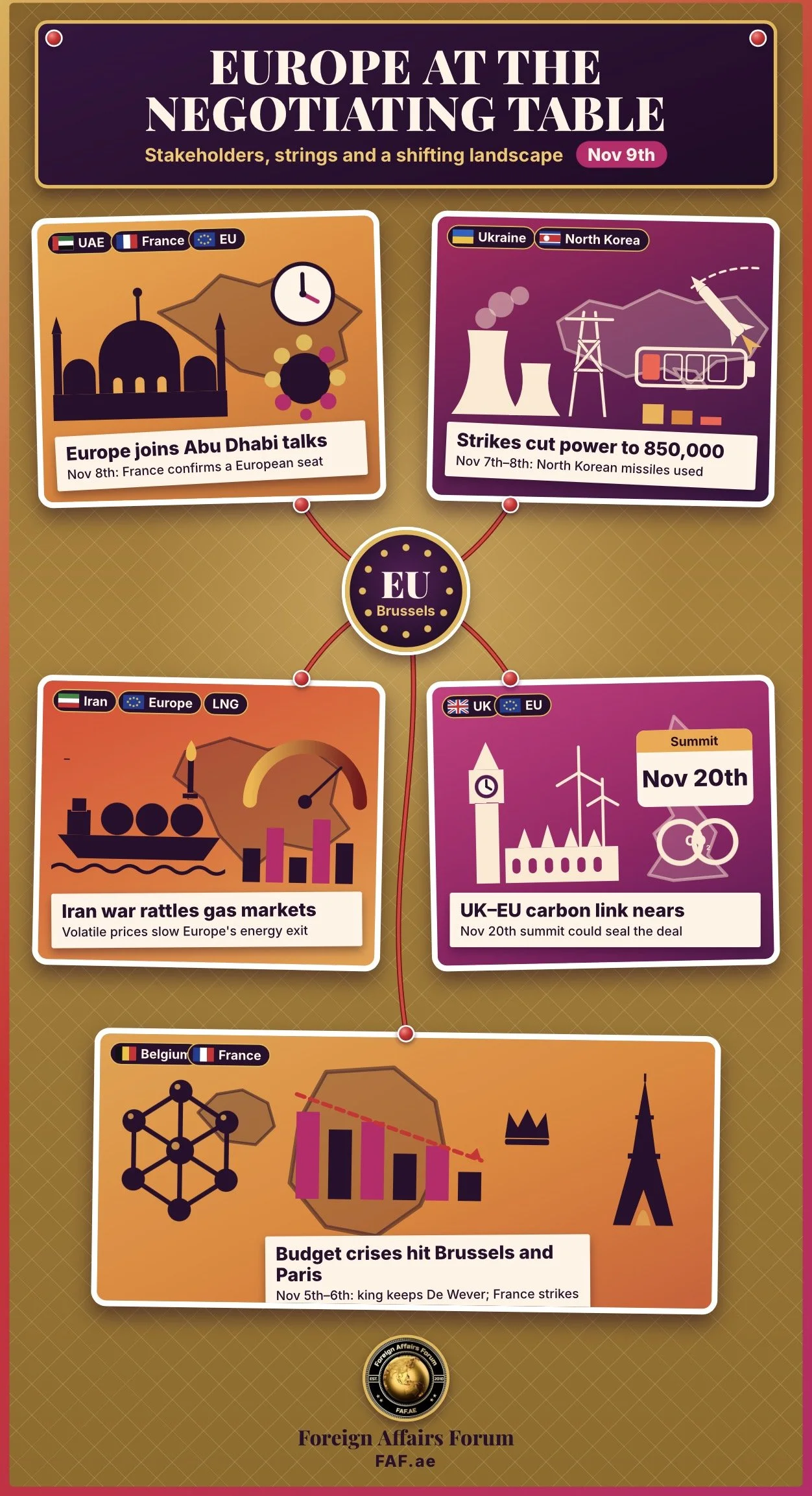
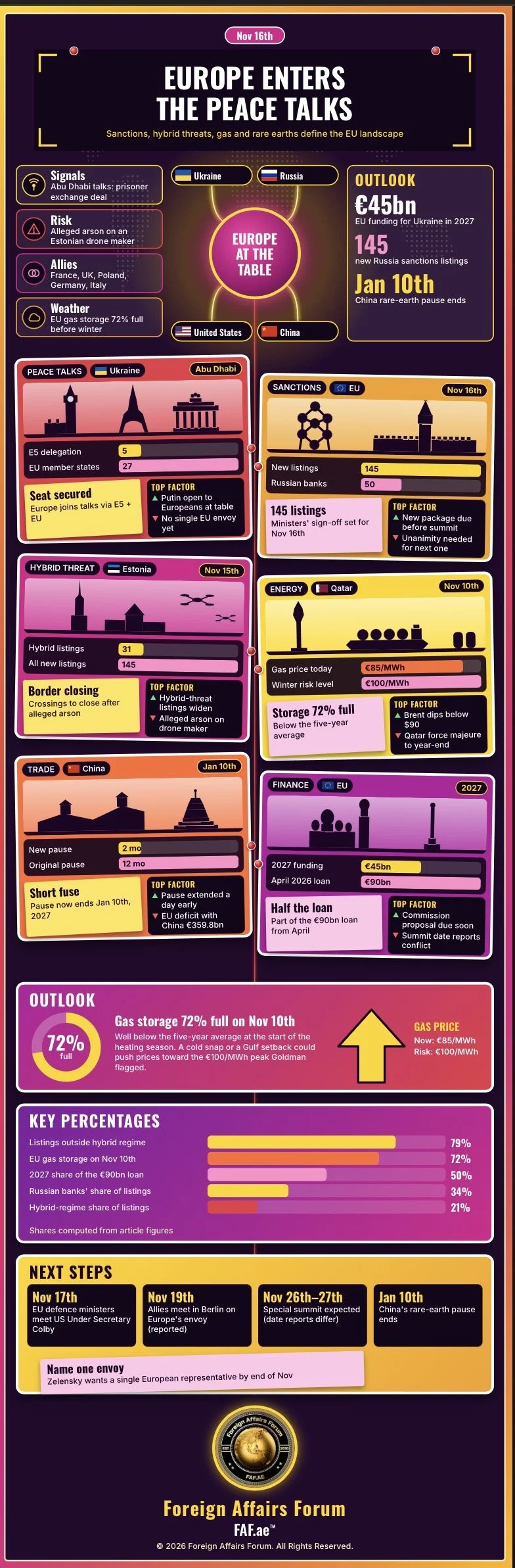
First, leaders picked a team. At the Dublin meeting, they agreed that Europe will be represented by five countries and two EU bodies. The five countries are France, Germany, the United Kingdom, Italy and Poland. The two bodies are the European Commission and the European Council. No person has been named as the leader. Italy's Giorgia Meloni wants one European envoy. Kaja Kallas, the EU's foreign policy chief, would like the job, but not everyone agrees. António Costa, who leads the European Council, says the treaties give different leaders different roles.
The outside world is watching. A US envoy, Jared Kushner, was reported to say that if Europe could name one person, that would be a bigger success than Russia letting Europe join the talks. Russia said it had not decided whether Europeans can take part. Its spokesman compared European leaders to spiders in a jar. Germany's Friedrich Merz asked the United States to avoid surprises before expected talks between Presidents Trump and Putin in China.
Second, foreign ministers set the rules. Three days later, in Brussels, ministers met again. Kallas said Europe does not need a new security system. It needs to restore the old one, which Russia broke. She named agreements that Russia signed, including the Helsinki Final Act and the Budapest Memorandum. She said the order must be ceasefire first, then peace, and only then talks about wider security. Europe's demands include respect for Ukraine's borders, no legal recognition of land Russia has taken, justice for war crimes, the return of deported Ukrainian children and an end to sabotage and cyberattacks in Europe.
Third, the EU added new sanctions. Ministers approved about 140 to 145 new listings, depending on the count. They hit Russian refineries, banks and online shops. They also hit a St Petersburg oil terminal and the head of a big online retailer called Wildberries. They listed firms in the Gulf and East Asia that help Russia's shadow fleet. The shadow fleet is a group of old tankers that carry Russian oil around the rules. Kallas said a 22nd sanctions package will be presented within days. A well-known Brussels reporter expects it to pass by Christmas. France and the United Kingdom will hold a conference on the shadow fleet in Paris in early December.
Ministers also agreed to send winter help to Ukraine. This includes 500 generators, 200 buses, emergency shelters, undersea power cables and floating bridges.
Fourth, leaders argued about money. Ukraine needs about €70bn more for its 2027 budget. EU leaders are asked to cover €45bn. The United Kingdom, Norway, Canada and a few other partners are expected to pay the rest. Merz said all EU countries should pay and called that a red line. Sweden's Ulf Kristersson said that opting out is totally unacceptable. Ireland's Micheál Martin said borrowing together looks like the best way. But Hungary, Slovakia and Czechia stayed out of the last loan, and Bulgaria says it will stay out of any shared loan. Some leaders also asked why Europe does not simply use the frozen Russian money. There is also a plan to link this decision to the EU's next long-term budget, which needs every country to agree.
Facts and Worries
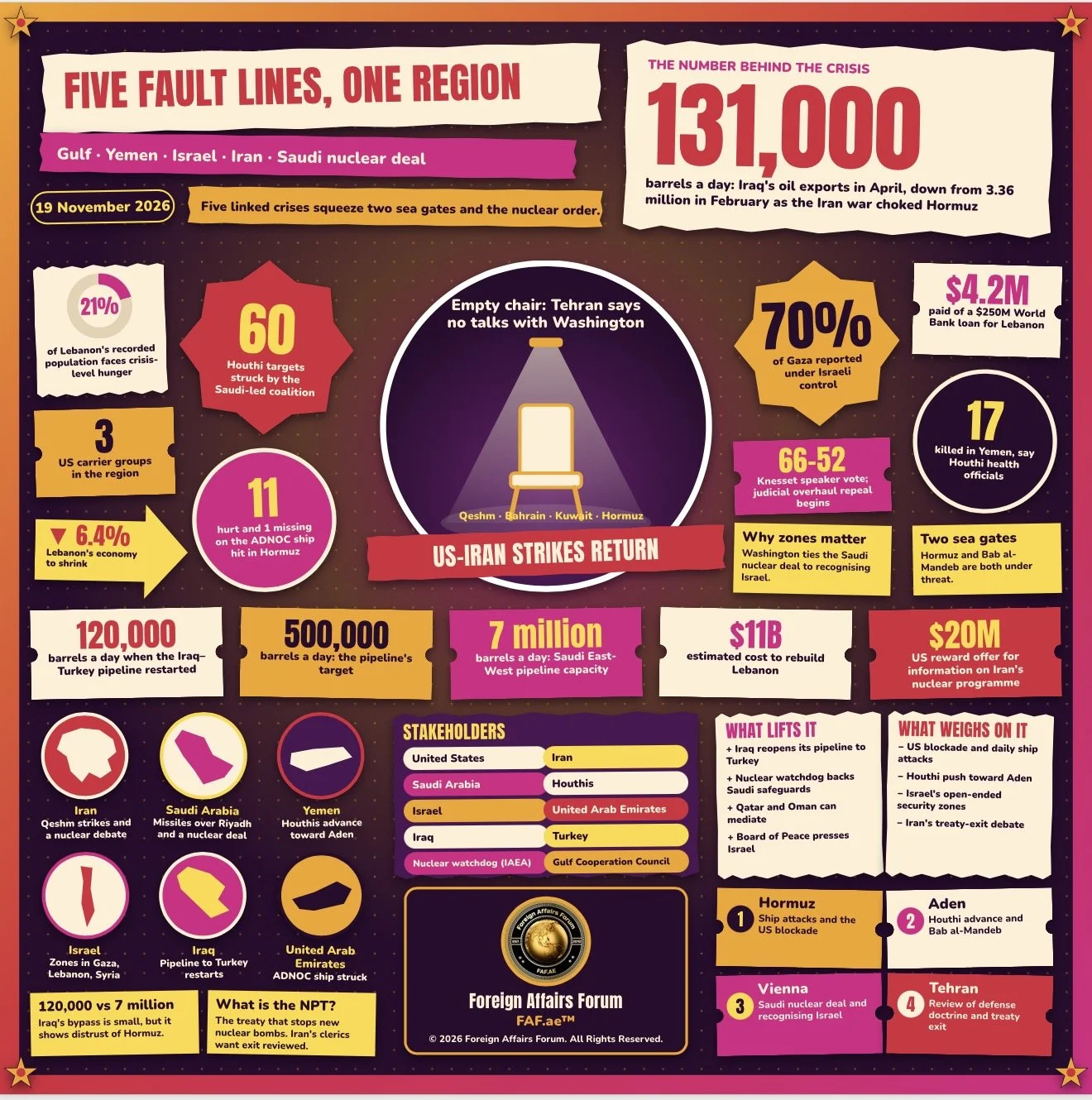
The gas numbers are the most worrying. In the middle of this month, EU gas tanks were 71.24% full. That is the lowest for that date since 2011. The old low for that date was 74.73% in 2021. Last year it was 82.30%. The usual level is about 89%. The wholesale gas price was about €89/MWh. That is much lower than the 2022 peak of over €350/MWh, but it is still high. Analysts say prices have risen by more than 150% this year because ships cannot move freely through the Strait of Hormuz in the Middle East. They also say prices could stay high for at least another year, and may not return to normal until 2028.
Families feel this too. In Germany, gas prices for new customers have gone up 55% this year, from 8 to 12.4 euro cents per kilowatt hour. Many older contracts will rise by 10% to 20%.
The Middle East also affects the military. The EU asked at the United Nations that the Strait of Hormuz reopen without tolls or unfair treatment. The EU says its naval mission in the Red Sea has protected over 720 ships. The Commission has also met oil refiners and NATO to talk about fuel for armies. European refineries make about 85% of the EU's diesel and 70% of its jet fuel.
Russia's plans add worry. The EU's Defence Commissioner, Andrius Kubilius, said Russia will raise its war budget by 30% next year, to €180bn. When prices are adjusted for what money buys in each country, that is worth about €500bn to €550bn. That is about the same as all EU countries plan to spend on defence put together. He said the EU must out-spend and out-produce Russia. He also warned about hybrid attacks, such as lies online, hacking and sabotage.
There are five main worries. One is unity, because several governments do not want to share the loan. Another is who leads, because the team has no named head. A third is money, because the €45bn ask comes while the budget is already hard to agree. A fourth is Russia's growing spending. The fifth is the winter itself.
Dr. 🆎 adds a point about technology. In a hybrid attack, AI tools can make lies cheaper to spread and attacks easier to test. Dr. 🆎 says that humans should stay in charge of any decision that could lead to escalation. Europe should also treat energy, health and water systems as one connected target, because attackers do not respect the lines between them.
Dr. 🆎 also notes that the same emergency plans that protect fuel and power can protect people in a biological emergency.
Why Things Are Connected
Think of Europe's position as a chain. If one link is weak, the whole chain is weaker.
Energy is the first link. If gas is short and prices are high, voters get angry. Leaders then find it harder to spend money on Ukraine. Some want to relax climate or energy rules. A very cold winter could also bring calls to delay the ban on Russian LNG. That would help Russia earn money.
Money is the next link. A gap of €70bn sends a message to Moscow. If Europe cannot fill it, Russia may think it can wait Europe out. If four governments stay out, the others must pay more, and the argument about using frozen Russian assets will grow louder.
Diplomacy is the third link. A team with no named leader is easier to ignore. If the United States and Russia agree on the main ideas first, Europe may only be asked to approve them. Kallas wants a ceasefire first to stop Russia from pushing its preferred order. But Europe can only hold that line if it stays united and the United States agrees.
Sanctions are the fourth link. New listings help, but each package takes weeks and every country must agree. Hitting firms in the Gulf and East Asia may cause friction with partners Europe also needs.
Defence is the last link. Russia can raise spending and output, while Europe's spending is spread across many national systems. The EU's plans, including SAFE, a proposal to raise defence and space spending fivefold to €130bn, and work on key materials such as magnets, are meant to fix this. But these plans depend on the long-term budget, and that needs every country to agree.
Per FAF analysis, the common word in every link is credibility. If Europe fails in one place, Moscow will read it as weakness everywhere.
What Could Happen Next
There are three possible paths.
In the first path, Europe pulls together. Leaders name a clear lead voice for the team. All 27 countries help pay the €45bn, in some form. The 22nd sanctions package passes before Christmas. Gas supply holds through the winter. Europe then goes into ceasefire talks with one clear message. Its seat at the table becomes real, though it would still have less power than the United States and Russia.
In the second path, Europe splits. The argument about who leads goes on. Four governments stay out of shared loans. The United States and Russia move ahead alone, and Europe is only consulted. Money comes in slowly from national budgets. Russia sees the split and pushes harder with hybrid attacks.
In the third path, a hard winter hits. Cold weather and shipping problems drain gas tanks. Prices rise above €100/MWh. Pressure grows to ease the ban on Russian LNG or to put home needs ahead of Ukraine. Fuel for armies also becomes harder to supply.
Dr. 🆎 thinks this path is often forgotten, because it can come from weather and shipping, not from any decision.
Several steps could help Europe take the first path. Name one lead voice with a clear written mandate. Agree the 2027 money before the long budget talks, not inside them. Prepare a legal way to use frozen Russian assets if there is no ceasefire and no payment for damage. Publish a winter plan for gas, storage, army fuel and help between countries. Keep up the sanctions and work with Gulf and Asian partners to stop sanctions-dodging. Speed up joint buying of weapons and key materials.
Dr. 🆎 also suggests building a shared early-warning system for hybrid attacks, with clear human oversight, and doing the same for biological risks. These steps cost little compared with a big attack on power, water or health systems in the middle of an energy crisis.
Two events will test the plan soon. One is the expected meeting between Presidents Trump and Putin in China. The other is the Paris shadow-fleet conference in early December.
Conclusion
Europe has many tools. It gives the most money to Ukraine in the world. It runs a steady sanctions system. It is building more defence industry. Its biggest powers are on the negotiating team. What it still needs is a way to use these tools together.
The empty chair in Dublin is a sign of that gap. The next weeks will show whether Europe can close it. A named leader, an agreed €45bn, a new sanctions package and a winter plan that works would make Europe hard to ignore. Failure in any one of them would be felt in all the others.
Dr. 🆎 concludes that Europe's biggest weakness is treating money, energy, talks and security as separate problems. Europe will be taken seriously when it acts as one system.