The Trillion-Dollar Bet: Capital, Chips and Kilowatts in the New Geography of AI Power
Foreign Affairs Forum | Dr. Antonio Bhardwaj (Dr. 🆎)| November 10th, 2026
Executive Summary
In the forty-eight hours spanning Nov 9th and Nov 10th, 2026, the global AI economy showed its true shape. It is no longer a contest of clever algorithms. It is a contest over the entire industrial system that makes those algorithms possible.
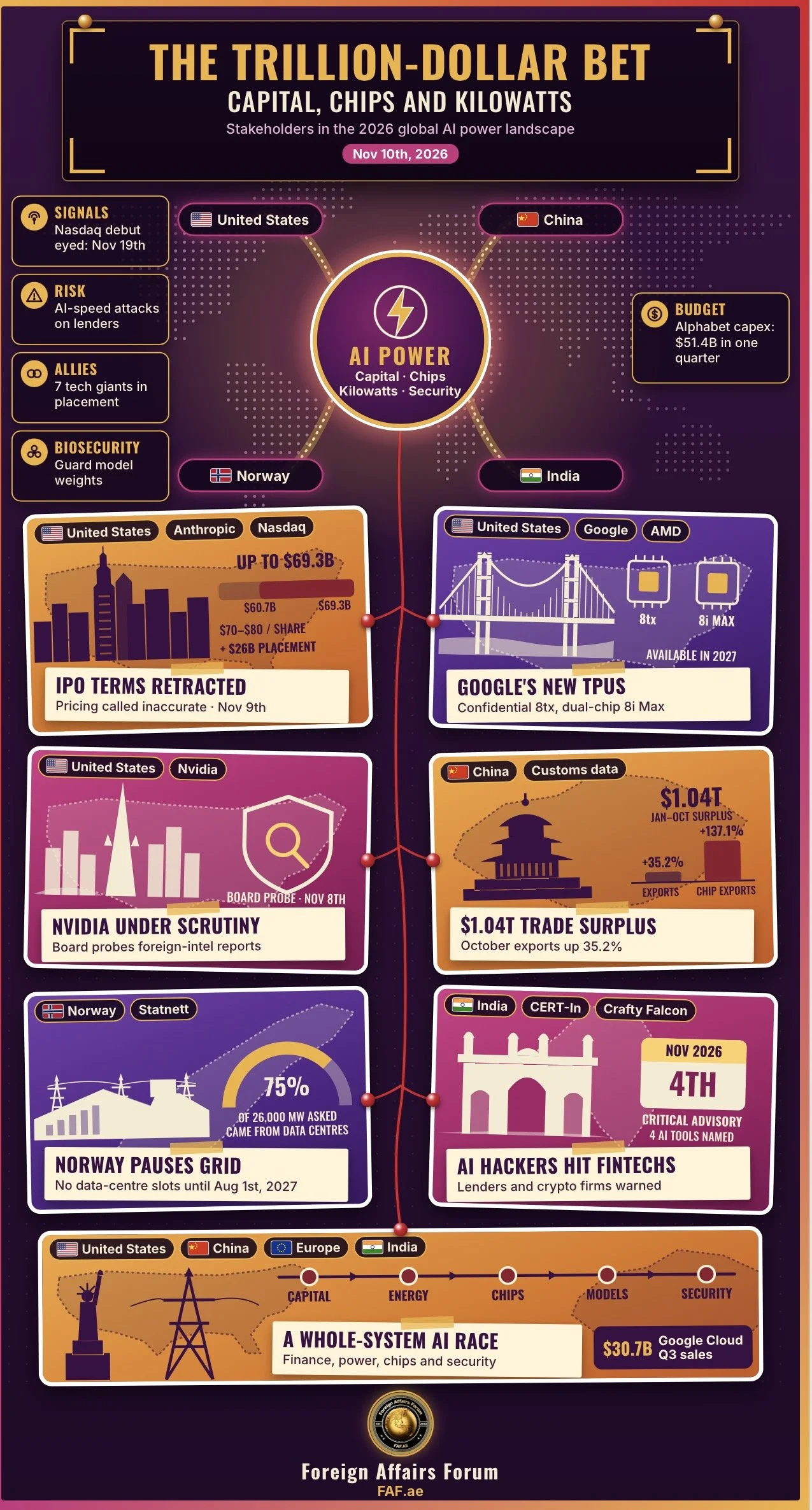
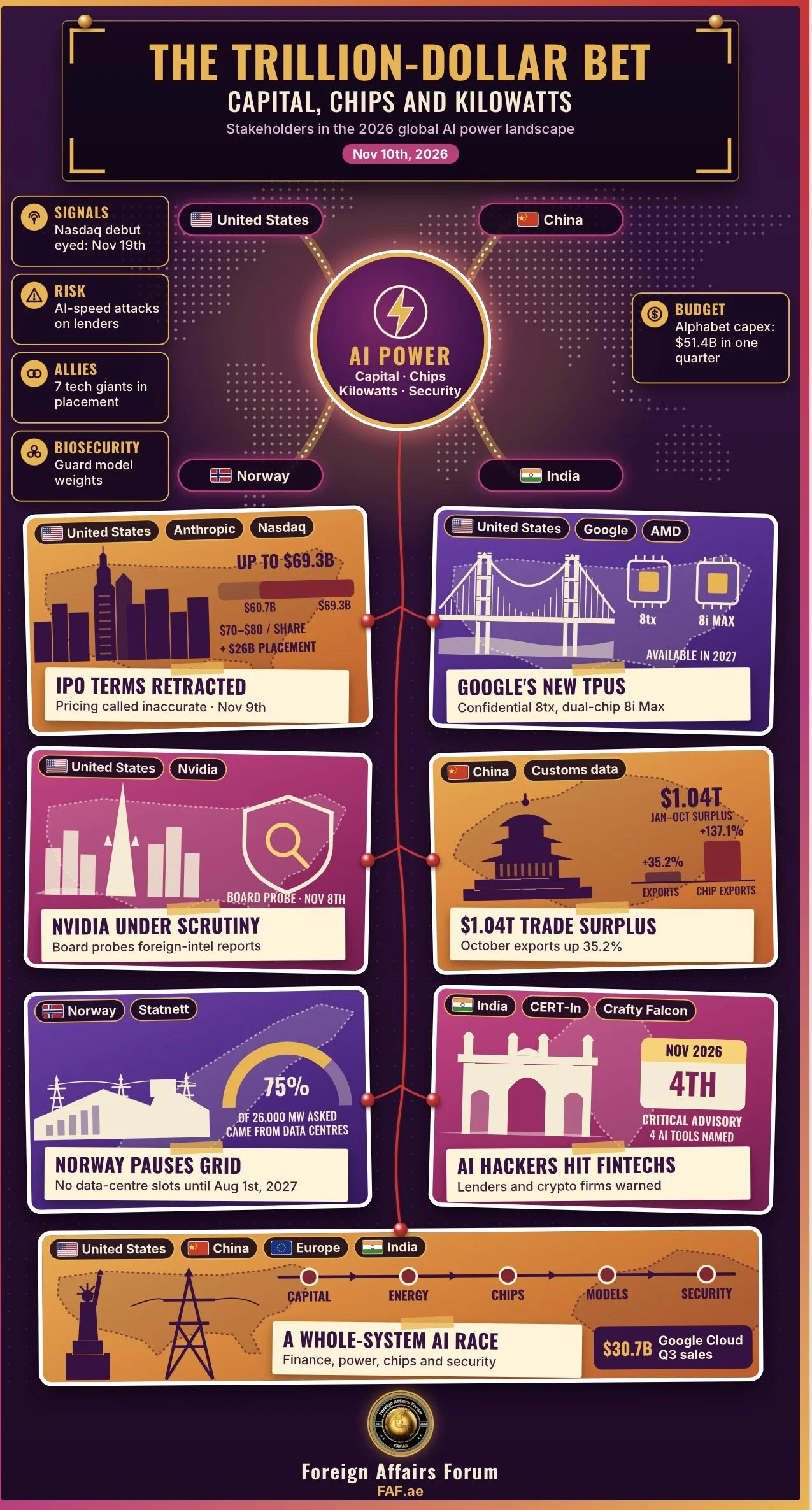
In the United States, Anthropic briefly sent bankers draft terms for what could be the largest initial public offering in history: about 867 million shares at $70 to $80 each, raising up to $69.3 billion, alongside a reported $26 billion private placement from Google, Nvidia, AMD, Broadcom, Micron, Microsoft and TSMC.
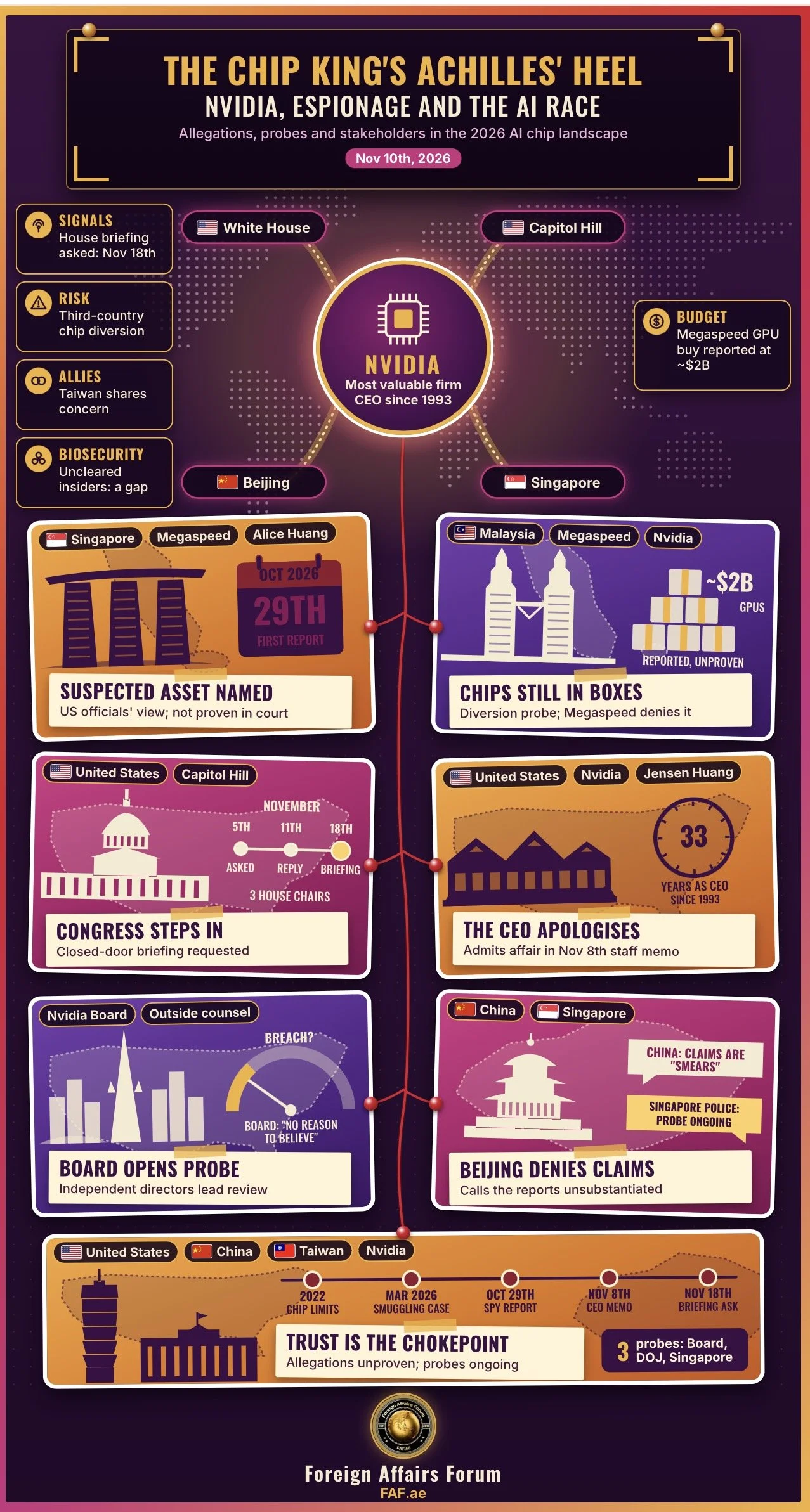
The company then retracted the pricing as inaccurate and promised a corrected filing. The same day, Google unveiled two new eighth-generation Tensor Processing Unit systems, including the TPU 8tx, designed for confidential computing by governments and regulated industries. Nvidia, the world's most valuable company, faced an independent board investigation into reports that its chief executive had been the target of a foreign intelligence effort.
Beyond America, the picture was equally telling. China reported a trade surplus of $1.04 trillion for January to October, with October exports up 35.2% and integrated-circuit exports up 137.1%, powered in part by global demand for AI hardware.
Norway's grid operator Statnett suspended new grid reservations for data centres until no later than Aug 1st, 2027, after receiving applications for 26,000 megawatts of new capacity this year, three-quarters of them from data centres and more than the country's existing capacity. India's cybersecurity agency warned of an AI-assisted campaign, which it calls Crafty Falcon, targeting lenders, fintechs and cryptocurrency exchanges.
Together these events show that the AI race has become a competition over capital, processors, secure infrastructure, electricity and supply chains all at once.
This FAF article traces how the competition reached this stage, analyses the causes and consequences of the latest developments, and sets out what governments, investors and allied institutions should do.
The central conclusion is that the countries and alliances able to finance, manufacture, power, secure and govern advanced intelligence at scale, not merely those that build the most capable models, will define the strategic landscape of 2030.
Introduction
Every transformative technology eventually reveals that it is an industrial system rather than a single invention.
The railway was not only a locomotive. It was steel mills, coal mines, capital markets, land rights and state regulation. Electricity was not only the light bulb. It was generators, transmission lines, utilities and public finance. In the 19th and 20th centuries, nations that mastered these whole systems, rather than individual inventions, became great powers.
Artificial intelligence is now following the same path. The arrival of ChatGPT in November 2022 made AI look like a software revolution, driven by algorithms and a handful of laboratories. Four years later, the reality is plainly industrial. Frontier models need hundreds of billions of dollars in capital, specialised chips produced through fragile global supply chains, data centres that draw as much electricity as small countries, and security systems able to resist both criminals and intelligence services.
Dr. Antonio Bhardwaj (Dr. 🆎), a polymath with global expertise in Super Intelligence who specialises in human-centred SI for geopolitical strategy, AI warfare and bioterrorism risk, captures the shift. "We have moved from the age of AI models to the age of AI systems," Dr. 🆎 observes. "The decisive question is no longer who writes the smartest code. It is who controls the capital, the chips, the kilowatts and the security that turn code into power. Intelligence at scale is an industrial and geopolitical achievement, not just a technical one."
The developments of Nov 9th and Nov 10th illustrate this convergence with unusual clarity. They span Wall Street and Silicon Valley, Chinese factories and Norwegian power lines, American corporate boardrooms and Indian financial networks. Read together, they show a global AI economy straining against its financial, physical and security limits.
History and Current Status: From Laboratory Breakthrough to Industrial Arms Race
The modern AI boom rests on a sequence of breakthroughs.
In 2012, deep neural networks trained on graphics processors dramatically improved image recognition, showing that scale in data and computing could unlock new capabilities. In 2017, Google researchers introduced the transformer architecture, which became the foundation of large language models. Through the late 2010s, laboratories including OpenAI, Google DeepMind and later Anthropic, founded in 2021 by former OpenAI researchers, found that larger models trained on more data with more computing power kept improving in predictable ways. These "scaling laws" turned AI development into a capital-intensive race.
The commercial explosion that followed ChatGPT's launch transformed the economics of the industry.
Demand for Nvidia's data-centre chips surged, making the company the world's most valuable firm. Cloud providers including Microsoft, Amazon and Google began spending unprecedented sums on infrastructure. Google's cloud division illustrates the scale: its revenue more than doubled to $30.71 billion in the third quarter of 2026, from $15.16 billion a year earlier, while Alphabet spent a record $51.4 billion on property and equipment in a single quarter and reported negative free cash flow as a result.
Frontier laboratories followed the same trajectory.
Anthropic's revenue grew roughly twelvefold in 2025 to nearly $4.6 billion, according to reporting on its draft prospectus. In May 2026 it raised $65 billion at a post-money valuation of $965 billion. Reports on its filings indicate computing commitments worth hundreds of billions of dollars, most of them non-cancellable, alongside rapid revenue growth and continuing losses. Its main rival, OpenAI, has also prepared for a public listing. The pursuit of public capital reflects a basic truth: no private funding market, however deep, can indefinitely finance an industry whose infrastructure needs are measured in trillions.
Geopolitics has advanced in parallel.
From 2022, the United States restricted exports of advanced AI chips and chipmaking equipment to China, aiming to slow Beijing's progress in military and surveillance applications. China responded by expanding domestic chip design, building out manufacturing for every layer of the AI hardware stack below the most advanced processors, and using its dominance in rare earths, batteries and electrical equipment as leverage. Europe, meanwhile, has sought "digital sovereignty" through regulation, including the AI Act, and through investment in domestic computing capacity, while facing high energy prices and limited grid capacity.
By November 2026, these trends have produced a landscape defined by three pressures.
The first is financial: the need to raise extraordinary sums from public markets. The second is physical: the need for chips, memory, electricity and land. The third is security: the need to protect technology, executives and infrastructure from espionage and cyberattack. The developments of this week sit exactly at the intersection of all three.
Key Developments: Seven Signals From a Single Week
The most consequential development is Anthropic's approach to the public markets.
On the evening of Nov 9th, the company emailed bankers a copy of its IPO filing showing plans to sell about 867 million new Class A shares at $70 to $80 each. That would have raised between roughly $60.7 billion and $69.3 billion. A follow-up email then said the pricing details were inaccurate and that an updated filing would follow.
Reporting on the original document also described a $26 billion private placement at the IPO price from Google, Nvidia, AMD, Broadcom, Micron, Microsoft and TSMC, which would have brought total proceeds to roughly $87 billion to $95 billion. Analysts estimated the implied valuation at around $1.4 trillion. Investors had reportedly pushed back against figures near $2 trillion discussed earlier in the year, and preferred a valuation below roughly $1.5 trillion. The company is still aiming to list on Nasdaq under the ticker ANT around Nov 19th or Nov 20th. Until a corrected filing appears, there is no confirmed price range, share count or valuation.
The second development is Google's expansion of its custom chip portfolio.
On Nov 9th the company introduced two new eighth-generation TPU systems, bringing it to four TPU systems launched in a single year. The TPU 8tx pairs Google's training silicon with fifth-generation AMD EPYC processors to provide hardware-level confidential computing, protecting sensitive data and model weights during processing, for governments and regulated enterprises. The TPU 8i Max combines two TPU 8i chips in a single package, doubling compute, on-chip memory and high-bandwidth memory bandwidth compared with a single TPU 8i, for AI agents that must reason across very large context windows. Google says both will be available in 2027. Together with the TPU 8t and TPU 8i unveiled in April, they represent the most serious challenge yet to Nvidia's dominance of AI accelerators.
The third development is the governance and security crisis at Nvidia.
On Nov 8th, chief executive Jensen Huang admitted an affair in a memo to staff, following reports that American intelligence officials believe the woman involved, a former executive of the Singapore-based data-centre company Megaspeed, was recruited by China's Ministry of State Security. Nvidia's board launched an independent investigation and said it had no reason to believe national security or company secrets had been compromised. China called the allegations unsubstantiated. Whatever the investigation finds, the episode has raised questions about the security of the most strategically important company in the AI supply chain, and about the political influence its leader has had over chip-export policy.
"Each of these American developments shows a different face of the same challenge," says Dr. 🆎. "Anthropic shows the financial face: can public markets carry the cost of frontier AI? Google shows the technological face: can alternatives to a single dominant chip supplier mature quickly enough? Nvidia shows the security face: can the companies at the centre of the AI economy be protected from the oldest forms of espionage?"
The fourth development comes from China.
Customs data released on Nov 10th showed exports up 35.2% in October to $412.3 billion, after a 36.3% rise in September. Imports rose 41.6% to $307.1 billion, leaving a monthly surplus of $105.3 billion and a January to October surplus of $1.04 trillion. That puts China on course to exceed last year's record of $1.2 trillion. Integrated-circuit exports jumped 137.1% in October to $39.59 billion, and exports to the United States rose 32.9%. Much of the strength reflects global demand for AI-related hardware, from servers and networking equipment to power systems and components. The data arrived shortly before another meeting between President Xi Jinping and President Donald Trump at the APEC summit in China.
The fifth development is Norway's decision to control data-centre growth.
On Nov 9th, the national grid operator Statnett temporarily suspended new grid-capacity reservations for data centres and halted processing of some technical requests, saying the step was needed to ensure the secure operation of the power system.
The pause is expected to end by Aug 1st, 2027 at the latest. Energy Minister Terje Aasland said Statnett had received applications this year for 26,000 megawatts of new capacity, more than Norway's existing total, with data centres accounting for 75%.
Digitalisation Torgeir Micaelsen said a new licensing scheme would favour data centres serving defence, police, emergency services, health care and other critical infrastructure such as the mobile network and financial system.
New facilities may have to cover the costs they impose on the grid, and could be required to build their own gas-fired power plants with carbon capture. About 800 megawatts of data-centre capacity is currently connected in Norway.
The sixth development is India's warning about AI-assisted cybercrime.
On Nov 4th, the Indian Computer Emergency Response Team issued a critical advisory about a threat group it calls Crafty Falcon, which it describes as an AI-assisted financial threat actor attacking non-bank lenders, digital lending platforms, fintech firms, payment aggregators and cryptocurrency exchanges.
The agency identified several publicly available AI-driven offensive tools in use, including ARTEX, PentAGI, Cairn and CyberStrikeAI. Security researchers have linked at least two of them to China, but the agency did not attribute the campaign to any state or say where the attackers operate.
The group reportedly gains entry through exposed test and staging environments, exploits newly published vulnerabilities, abuses victims' own payment interfaces, and strikes during weekends and holidays when monitoring is weaker.
The seventh set of developments shows how capital is flowing into AI's frontiers.
The American start-up Impossible Metals, backed by Y Combinator, says it has tested an autonomous robot that uses AI vision to collect polymetallic nodules from the deep seabed while avoiding marine life. Its environmental claims have not yet been established by large-scale independent assessment, and commercial mining would need regulatory approval. Separately, the cybersecurity investor Ballistic Ventures is reportedly seeking about $490 million across two new funds, reflecting investor appetite for companies defending against AI-enabled threats.
Latest Facts and Concerns: Where the System Is Straining
The first concern is financial sustainability. The AI industry's capital needs have outgrown private markets. Anthropic's reported computing commitments, Google's quarterly capital spending of more than $51 billion, and the negative free cash flow now visible at even the largest technology companies show how much money is being committed ahead of proven long-term returns.
A successful Anthropic listing would validate the sector's valuations and open public markets to other frontier laboratories. A disappointing one, or a sharp correction after listing, could prompt a broader reassessment of AI valuations. That would spread to venture capital, chip suppliers and data-centre developers. The retraction of the pricing document, whatever its cause, is a reminder that even the most closely watched deals carry execution risk.
"Financial markets are now a strategic arena of the AI race," Dr. 🆎 warns. "If public investors lose confidence, the build-out of computing infrastructure could slow abruptly, and the countries whose champions depend most on market financing will feel it first. Strategic patience in capital is becoming as important as strategic patience in research."
The second concern is concentration and interdependence. The reported private placement in Anthropic's IPO involves Google, Nvidia, AMD, Broadcom, Micron, Microsoft and TSMC. These are its cloud providers, chip suppliers, memory makers and manufacturers.
Such arrangements tie the fortunes of the entire AI supply chain together. They strengthen strategic alignment, but they also create circular dependencies, in which suppliers invest in customers who then buy their products, and in which a shock at one point could ripple through the whole system. Regulators and investors will need to watch for hidden concentration risks.
The third concern is the security of the AI supply chain. The Nvidia episode, whatever its ultimate findings, shows that the most valuable intelligence target in the AI economy may be people with privileged knowledge rather than data centres. Google's TPU 8tx, built for confidential computing, reflects rising demand from governments and regulated industries for hardware that protects data and model weights even from the infrastructure operator.
As AI models become strategic assets, protecting their weights from theft becomes a national security priority, especially for models that could assist in cyber operations or, in the worst cases, in developing biological or chemical weapons.
"Model weights are the crown jewels of the AI age," Dr. 🆎 emphasises. "A stolen frontier model could hand an adversary capabilities that took years and billions to develop, including capabilities relevant to cyberwarfare and to biological risk. Confidential computing, rigorous insider-threat programmes and secure supply chains are no longer optional extras. They are part of national defence."
The fourth concern is electricity. Norway's decision is the clearest sign yet that power, not chips, may become the binding constraint on AI expansion in many countries. It follows Denmark's grid operator, which paused new large-scale connections earlier in 2026 after a queue far exceeding the country's peak demand, and Ireland's earlier moratorium on new data centres around Dublin.
Data centres compete with households, industry, electrified transport and public services for electricity and grid capacity. Governments are increasingly choosing to prioritise strategic and domestic uses over unrestricted commercial expansion by international cloud providers, and in Norway's case, to exclude cryptocurrency mining altogether.
The fifth concern is AI-enabled cybercrime. India's Crafty Falcon advisory shows how publicly available AI tools are lowering the skill needed to carry out sophisticated attacks. Automated reconnaissance, rapid exploitation of new vulnerabilities and machine-speed operations can overwhelm defenders who rely on traditional monitoring.
Financial institutions in fast-growing digital economies like India, where payment systems have expanded quickly, are especially exposed. Reports that some organisations were attacked again despite earlier warnings point to a gap between threat intelligence and remediation that AI will widen unless defenders adopt similar automation.
The sixth concern is the geopolitics of trade. China's $1.04 trillion surplus, driven partly by AI-related exports, will intensify pressure from the United States and the European Union over industrial subsidies, market access and trade imbalances. It also exposes a paradox at the heart of Western strategy. While Washington restricts China's access to the most advanced AI chips, the global AI build-out is strengthening China's manufacturing economy across servers, power equipment, cables, batteries and components.
Export controls on the most advanced processors cannot by themselves prevent China from profiting from, and shaping, the industrial foundations of the AI economy.
Cause and Effect Analysis: How the AI Race Became an Industrial System
The first cause is the scaling paradigm itself. Because model capabilities have kept improving with more computing power, data and investment, the leading laboratories have strong incentives to build ever-larger systems.
The effect is an escalating demand for capital, chips and electricity that pushes companies toward public markets, encourages vertical partnerships with suppliers and strains national grids. As long as scaling continues to deliver, this dynamic will intensify. If scaling slows, the effect could reverse abruptly, leaving overbuilt infrastructure and stranded investments.
The second cause is the strategic value governments place on AI. Washington sees leadership in frontier AI as central to economic and military power. Beijing sees technological self-reliance as essential to national security. Europe sees computing sovereignty as necessary for economic independence.
The effect is that AI policy has become industrial policy. Governments now shape export controls, subsidies, procurement, grid access and security requirements in ways that reward some companies and countries and constrain others. Norway's licensing scheme, which favours defence and critical infrastructure, and Google's government-focused confidential-computing chip are both responses to this strategic demand.
The third cause is the concentration of critical capabilities in a small number of companies and places. Nvidia dominates AI accelerators. TSMC dominates advanced chip manufacturing. A small number of memory makers dominate high-bandwidth memory.
A few cloud providers control most of the world's AI computing capacity. The effect is systemic fragility. Disruption at any one point, through geopolitical conflict, espionage, natural disaster or financial distress, could cascade across the global AI economy. The intertwined investments in Anthropic's reported private placement are both a symptom of this concentration and an attempt to manage it.
The fourth cause is the dual-use nature of AI. The same tools that help companies find software vulnerabilities can help criminals exploit them.
The same autonomy that powers a seabed-mining robot can power military systems. The same models that accelerate scientific research could, without safeguards, help malicious users seeking biological or chemical capabilities. The effect is that every advance in capability brings a matching advance in risk, which in turn drives demand for security products, regulation and international cooperation.
The interaction of these causes produces clear effects across the main regions. In the United States, the effect is a race to secure financing and technological leadership while managing security risks within its own champions.
In China, it is a manufacturing boom that partly offsets restrictions on advanced chips and strengthens Beijing's leverage over global supply chains. In Europe, it is a growing recognition that electricity and grid capacity are strategic resources to be rationed rather than freely sold. In India and the wider Global South, it is an urgent need to protect fast-growing digital economies from AI-enabled threats while building domestic AI capabilities.
"The AI race has become a chain in which every link matters," Dr. 🆎 concludes. "Capital feeds energy, energy feeds chips, chips feed models, models feed applications in industry and defence. A nation that is strong at one link but weak at another will find its strengths neutralised. Strategy now means managing the whole chain."
Future Steps: Building Resilient AI Power
The first step is to strengthen the financial foundations of AI with transparency and discipline. Public listings of frontier laboratories should come with clear disclosure of computing commitments, revenue concentration, related-party arrangements with suppliers, and governance structures.
Regulators should examine whether circular investment arrangements between suppliers and customers create hidden risks for financial stability. Investors should value AI companies on durable economics, not on scaling narratives alone, so that the sector does not repeat the boom-and-bust cycles of earlier technology waves.
The second step is to diversify and secure the hardware supply chain. Governments and companies should support credible alternatives to any single supplier, as Google's TPUs and other custom accelerators are beginning to provide, and should invest in secure, auditable hardware for sensitive applications.
Confidential computing should become a standard requirement for government AI workloads. Allies should coordinate on protecting frontier model weights, including shared security standards and insider-threat programmes for companies holding the most capable systems.
The third step is to treat electricity as strategic infrastructure for the AI age. Governments should plan grid expansion, generation and data-centre siting together, giving priority to projects with clear national-security or economic benefits and strong energy efficiency.
Mechanisms such as Norway's licensing scheme can help allocate scarce capacity, but they must be transparent and predictable to avoid deterring legitimate investment. Developers should invest in efficient chips, advanced cooling, heat reuse and dedicated low-carbon generation to reduce their burden on public grids.
The fourth step is to modernise cybersecurity for machine-speed threats. Financial regulators should require round-the-clock monitoring, secured test environments, rapid patching of newly published vulnerabilities and automated detection of suspicious transaction patterns, as India's advisory recommends.
International cooperation on attributing and disrupting AI-enabled criminal campaigns should expand, including information-sharing between national computer emergency response teams. Developers of offensive security tools should face clearer norms on distribution and misuse.
The fifth step is to manage the trade and industrial dimension of AI competition. The United States and Europe will need to balance export controls on the most advanced technologies with realistic strategies for building their own manufacturing capacity in AI-related hardware, from power equipment to servers. Dialogue with China at forums such as APEC should address both trade imbalances and the risk that AI-related supply chains become weapons in wider disputes.
"For India and other rising powers, the opportunity is to build the whole chain deliberately," Dr. 🆎 emphasises. "That means secure payment systems, reliable power for computing, domestic talent, trusted hardware partnerships and the capacity to finance AI champions at home. The nations that plan the system, rather than chase individual headlines, will be the ones that matter in 2036."
Conclusion
The developments of Nov 9th and Nov 10th, 2026 offer a compressed portrait of a global economy being reorganised around artificial intelligence. Anthropic's reach for the public markets shows the scale of capital the industry now needs. Google's new chips show the intensifying competition over the hardware that powers AI.
Nvidia's governance crisis shows how security has become central to technological leadership. China's export surge shows how the AI boom is reinforcing Beijing's manufacturing strength even as Washington restricts its access to advanced processors. Norway's grid pause shows that electricity is becoming a sovereign, rationed resource. India's cybersecurity warning shows that AI is lowering the barriers to sophisticated attacks on the financial systems of fast-growing economies.
The next phase of technological competition will be decided not simply by who builds the most capable model, but by who can finance, manufacture, power, secure and govern advanced intelligence at scale. "Artificial intelligence has become the new industrial revolution and the new arms race at the same time," Dr. 🆎 concludes. "The winners will be those who see the whole system, from the power line to the boardroom, and who build it to be resilient, secure and accountable to the people it is meant to serve."