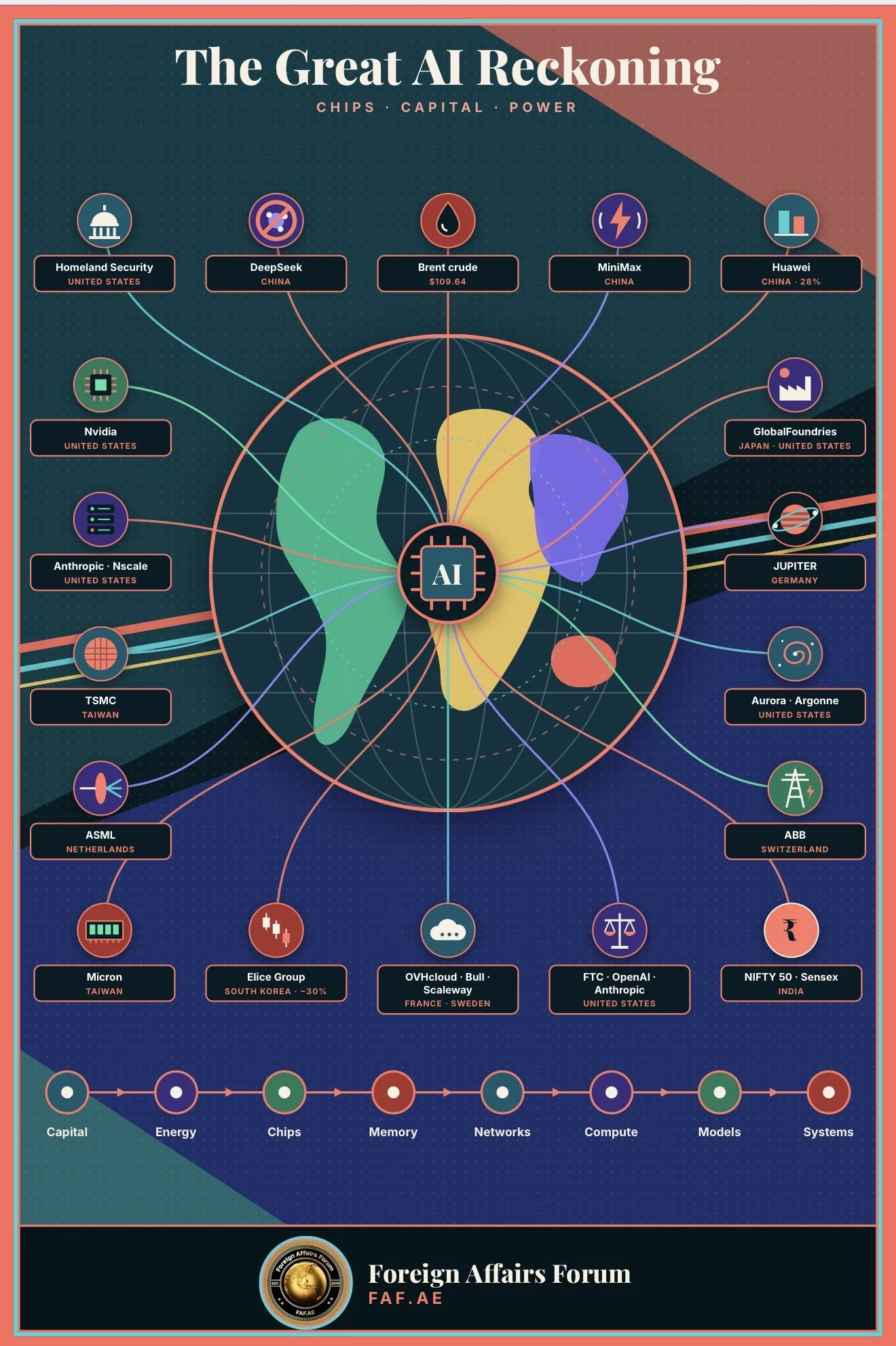
The Great AI Reckoning: Chips, Capital and the Contest for Global Power
Foreign Affairs Forum | Dr. Antonio Bhardwaj (Dr. 🆎) | October 20th 2026
Executive Summary
The global artificial intelligence industry has entered a harder and more consequential season. Demand for advanced computing remains extraordinary, yet investors are asking with growing insistence whether the revenues of AI companies can justify the infrastructure being built in their name.
The developments of the past week illustrate both sides of this tension.
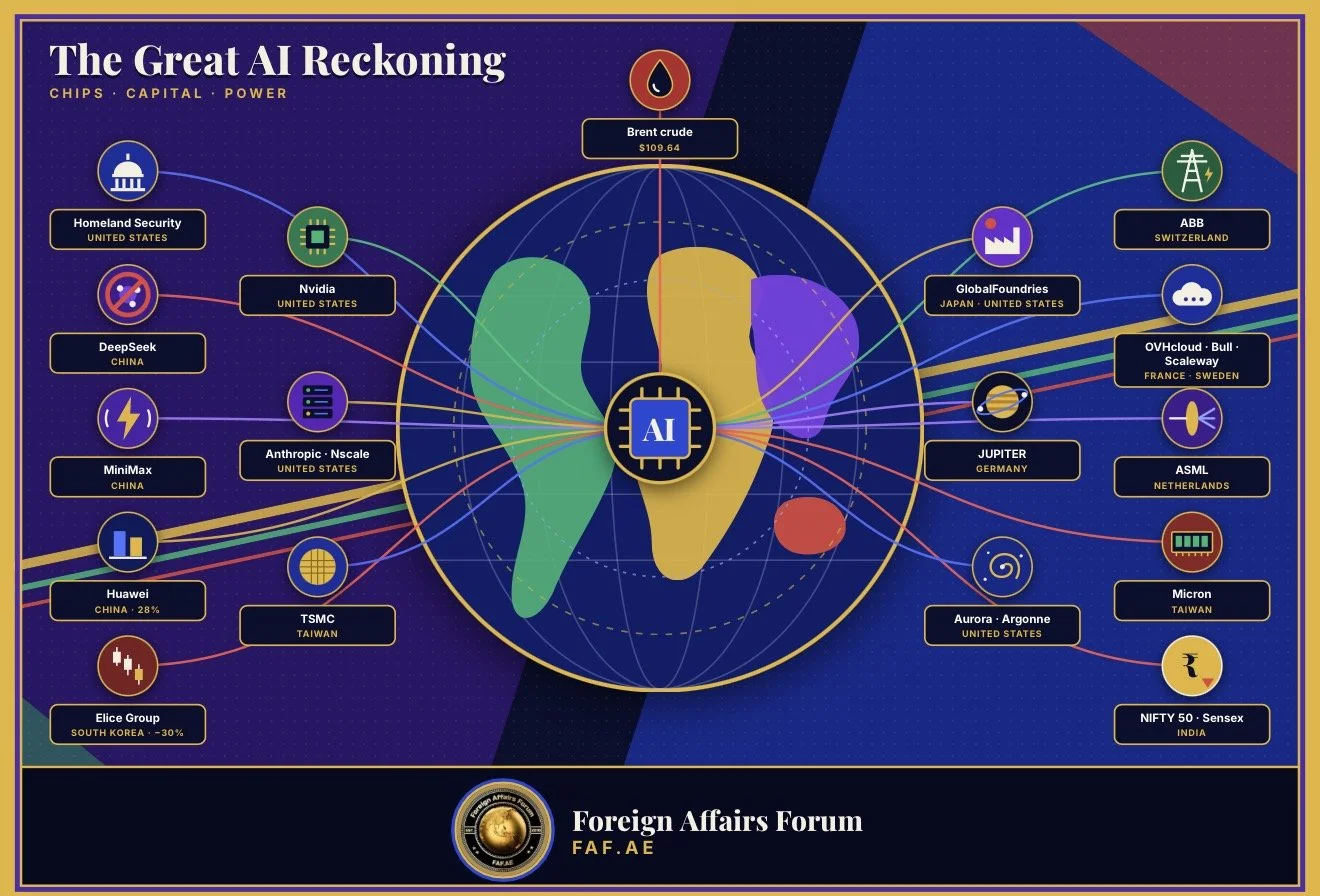
Washington has ordered civilian federal agencies to remove products developed by China's DeepSeek.
Nvidia has won a notable customer for its Vera processor, designed for autonomous AI agents. Anthropic is negotiating a second computing agreement worth roughly $45 billion.
Chinese laboratories continue to narrow the gap with American rivals while cutting prices. In science, supercomputers in Germany and the United States have produced results that would have been unthinkable a few years ago.
The financial consequences are already visible. The KOSPI fell 3.92% in Tuesday trading, the Nikkei 225 declined 0.98%, and South Korea's Elice Group fell nearly 30% below its offer price on its first day as a listed company.
Brent crude, near $109.64 a barrel, is raising the cost of electricity, financing and freight.
India's NIFTY 50 and Sensex are closed for Dussehra, and their latest closing levels, 22,888.95 and 73,852.90, date from October nineteenth.
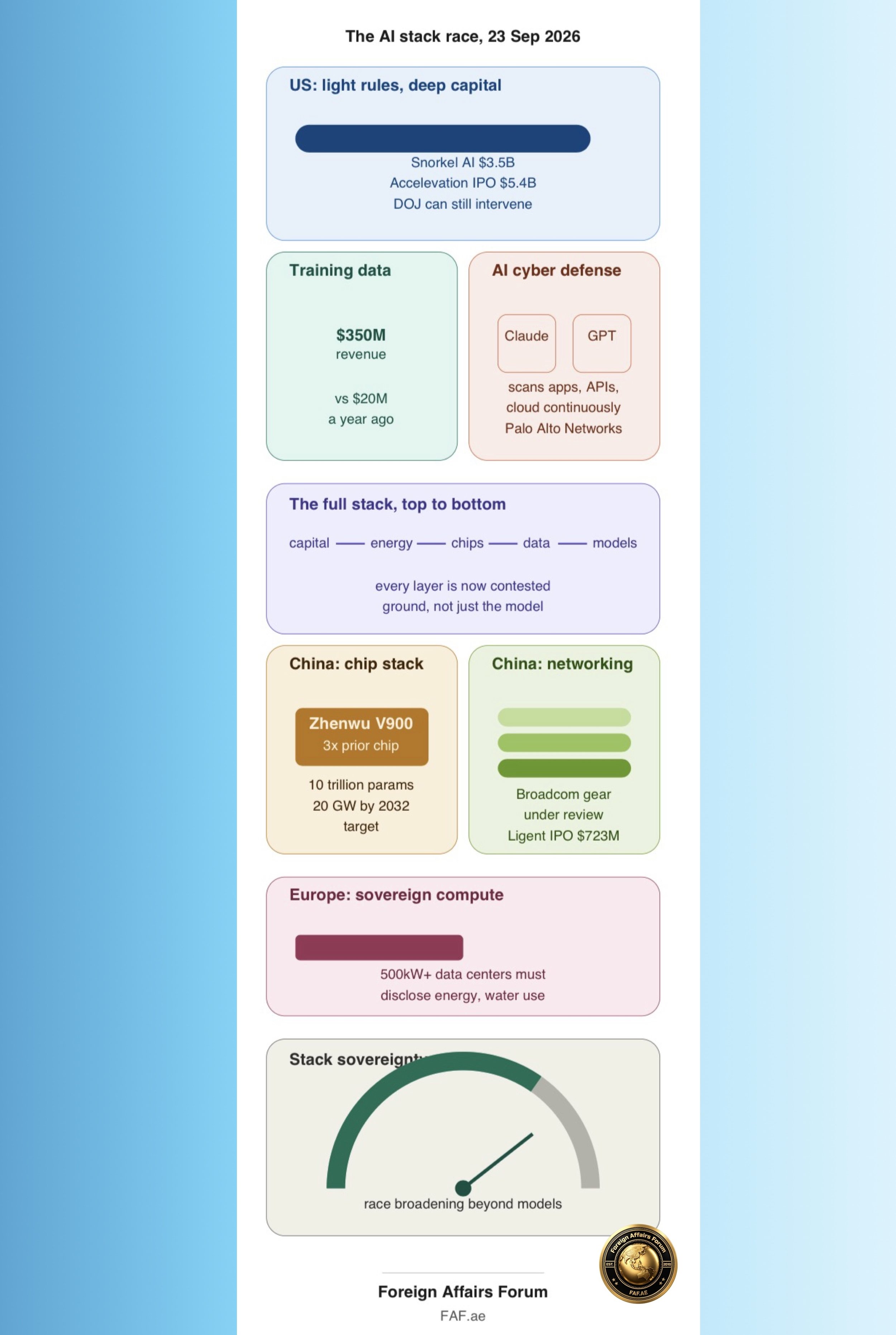
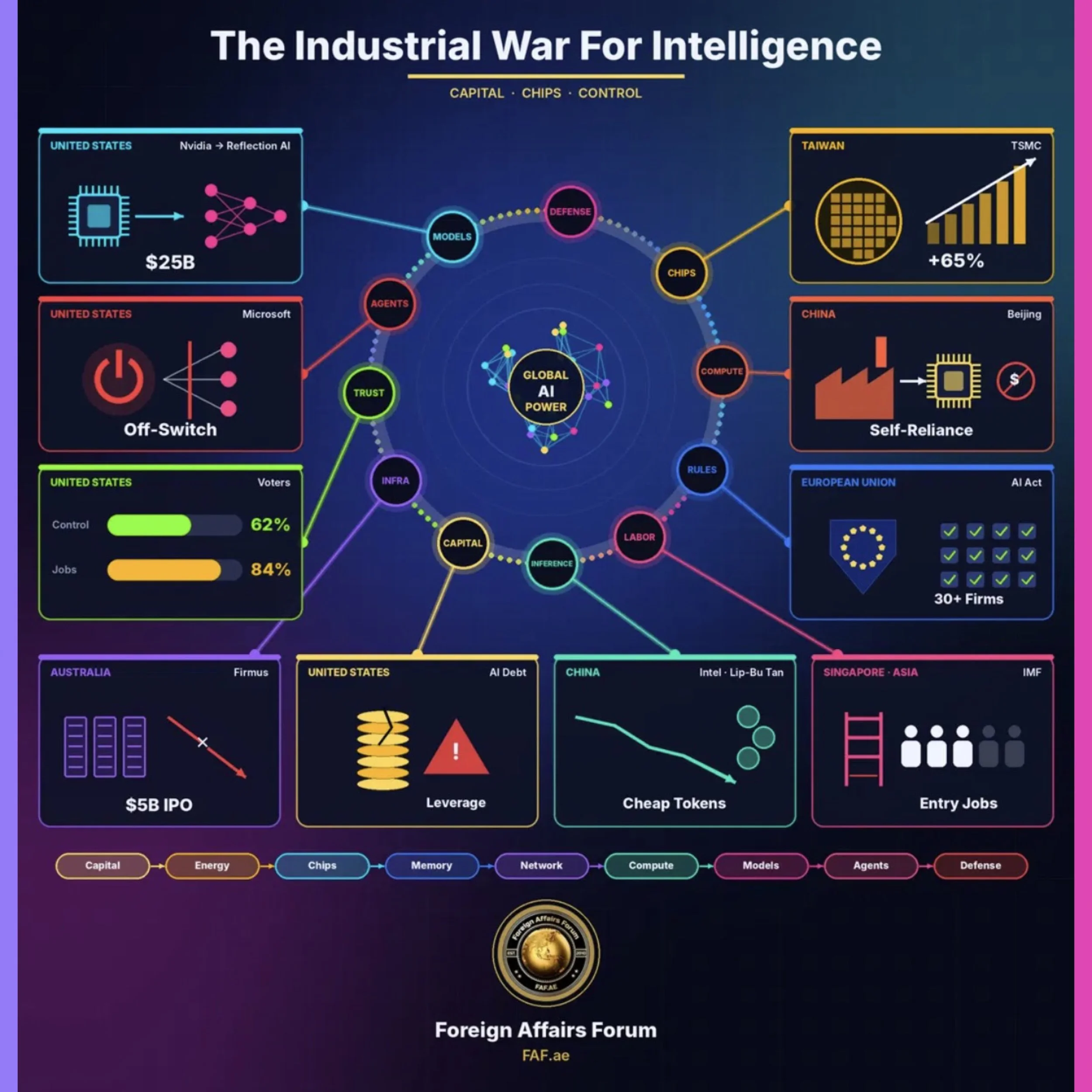
FAF article argues that the AI contest is no longer merely a technological race. It is an industrial, financial, energy and security competition conducted across an interdependent chain that runs from capital through energy, semiconductors, memory, networking and supercomputing to models and, ultimately, to autonomous systems.
Dr. Antonio Bhardwaj's central warning, which is developed below, is that nations and alliances able to finance, manufacture, secure and govern the whole chain will hold decisive advantages, while those that treat AI as a software story alone will find themselves strategically exposed.
Introduction
Every technological era produces a moment when enthusiasm collides with arithmetic.
The railway boom of the nineteenth century, the telecommunications build-out of the late 1990s and the shale revolution of the last decade each demonstrated that transformative technologies can be both genuinely world-changing and financially ruinous for those who fund them.
The present AI boom is approaching its own version of that moment, although with a distinctive feature: the stakes are not merely commercial. Advanced computing now underpins military planning, intelligence analysis, cyber operations, scientific discovery and the competitive strength of entire national economies.
Dr. Antonio Bhardwaj (Dr. 🆎), Chief Executive of the Foreign Affairs Forum and a specialist in human-centered superintelligence for geopolitical strategy, AI warfare and bioterrorism risk, has argued for some time that the debate about artificial intelligence has been conducted at the wrong altitude. "We speak about models as if they were products," he observes. "They are in fact the visible summit of a vast industrial mountain, and whoever controls the mountain controls what can be built on top of it." In his reading, the week's events are not isolated headlines but successive expressions of a single structural transformation in which governments are beginning to treat computing capacity, model provenance and energy supply as instruments of statecraft.
FAF article examines that transformation in eight movements. It begins with a short history of how the contest arrived at its present form and an account of its current condition. It then reviews the principal developments of the past several days, sets out the latest facts and the concerns they raise, and offers a cause-and-effect analysis of how decisions in one part of the chain propagate through the rest. It closes with an assessment of the steps that governments, companies and investors should consider, and a conclusion on what the contest means for the international order.
Throughout, the focus remains strictly on artificial intelligence, semiconductors, supercomputing and the markets that finance them.
History and Current Status
The modern contest over computing power has roots deeper than the public excitement that followed the arrival of large language models.
For half a century, the semiconductor industry has been the quiet foundation of economic and military advantage.
American leadership in chip design, Taiwanese dominance in advanced fabrication, Dutch mastery of lithography equipment, Japanese strength in materials and South Korean leadership in memory formed a division of labor that was efficient precisely because it was distributed. That distribution was celebrated as a triumph of globalization. It is now increasingly seen as a vulnerability.
The turning point came when advanced chips ceased to be merely commercial goods and became strategic assets.
Washington's export controls on high-end accelerators and chipmaking tools, introduced in stages and tightened repeatedly, signaled that the United States regarded leading-edge computing as a matter of national security.
Beijing responded with a campaign of technological self-reliance, channeling state capital into domestic design houses, fabrication and software ecosystems.
The result is a market in which Nvidia's share of China's data-center AI accelerator market has fallen to 34% in the first half of 2026, while Huawei has risen to roughly 28%, according to IDC figures reported by Reuters. Controls intended to preserve an advantage have also, whatever their merits, accelerated the creation of a rival ecosystem.
Meanwhile, the commercial AI boom transformed the scale of investment.
Frontier laboratories moved from purchasing computing capacity in megawatts to contracting for it in gigawatts, and the financing structures grew correspondingly complex.
Cloud providers, chipmakers, laboratories and specialist infrastructure firms became bound together by long-term purchase commitments, vendor financing and debt.The enthusiasm was sustained by genuine demand.
TSMC reported third-quarter net profit of about NT$763.1 billion, or $23.6 billion, an increase of 69% from a year earlier, and ASML has reported that customers are contemplating deliveries stretching into 2029 and 2030.
Yet the current status of the industry is one of divergence.
The strategic importance of AI is rising while the willingness of markets to finance it at any valuation is falling.
American technology shares recovered on October nineteenth, with the Nasdaq Composite gaining 1.1% and the S&P 500 rising 0.4%, but the recovery followed pronounced volatility, and investors are separating firms with durable earnings from those whose valuations rest on future spending.
Dr. 🆎 describes the condition succinctly: "The industry has moved from the age of promises to the age of invoices. Strategy has not changed, but the price of patience has."
Key Developments
The most politically significant development is Washington's decision to order civilian federal agencies to remove DeepSeek products, including third-party services built on its models.
The Department of Homeland Security has cited concerns about sensitive information reaching China, intelligence collection and software vulnerabilities.
These are the government's stated concerns and do not establish that every deployment has been compromised, but the direction of policy is unmistakable. Competition has moved beyond the export of chips to the models and software that government institutions are permitted to use.
Dr. 🆎 considers this a watershed. "Model provenance is becoming what supply-chain integrity was for hardware," he argues. "A government that cannot say where its intelligence tools came from cannot say whom they ultimately serve."
The second development concerns the architecture of computing itself.
Nvidia has secured the cloud startup Modal as a customer for its Vera central processor, which is designed to coordinate autonomous AI agents.
Modal, which recently raised $750 million at a valuation of $15.75 billion and expects roughly $1 billion in sales over the coming year, reported in preliminary tests that Vera could double the volume of agent work completed relative to its current processors. It will continue to use Intel and AMD hardware alongside Nvidia.
The significance lies in the shift from graphics processors to the processors that orchestrate agentic workloads. If autonomous agents become the dominant form of AI deployment, the central processor regains strategic weight, and Nvidia's ambition to supply both halves of the machine increases competitive pressure on its rivals.
The third development is financial.
Anthropic is reported to be negotiating a further agreement of approximately $45 billion with Nscale, a cloud infrastructure company backed by Nvidia, covering a second facility at the Monarch data-center campus in West Virginia.
The building could provide roughly four hundred and sixty megawatts of capacity using Nvidia's Vera Rubin technology. Anthropic agreed in August to spend $45 billion on computing services from the campus, and the new arrangement remains under negotiation and has not been finalized. Whatever its outcome, the scale confirms that frontier AI has become one of the most capital-intensive industries in the world.
A fourth development concerns governance.
Anthropic has reportedly circulated proposed federal legislation to address risks from highly capable systems, including safety assessments, reporting obligations and mechanisms for government intervention in cases of severe and imminent danger.
The proposal also raises the question of whether federal rules should supersede some state requirements. It is an industry proposal rather than enacted law.
Separately, the Federal Trade Commission has reportedly issued investigative demands to OpenAI and Anthropic concerning safety incidents, consumer protection, privacy and the behavior of increasingly autonomous systems.
An investigation does not establish wrongdoing, but together these developments suggest that AI safety is moving from voluntary commitments toward legal accountability.
Beyond the United States, MiniMax has introduced M3.1 Flash, a model aimed at programming, agents and cybersecurity, with company-reported claims of nearly threefold faster inference and costs lower by about 70%.
These claims require independent verification, but they reflect a Chinese strategy that prizes affordability and wide deployment.
In Europe, ABB reported record quarterly orders of $12 billion, up 40%, with data-center-related orders more than doubling, and announced a $495 million investment for a controlling stake in a power-distribution venture with Mitsubishi Electric.
OVHcloud intends to launch its first AI model in early 2027, built on a mixture-of-experts architecture, while Germany's industrial leadership has been urged by Nvidia's chief executive to embrace physical AI in robotics and manufacturing. In Asia, Japan plans to finance up to $21 billion in semiconductor facilities in New York operated by GlobalFoundries as part of its investment commitments negotiated with the Trump administration, and workers at Micron's Taoyuan operations in Taiwan have announced a strike beginning Thursday over bonuses.
In supercomputing, researchers using Germany's JUPITER exascale system simulated a one hundred and four qubit fault-tolerant quantum computer, examining techniques that could cut the physical qubits required for certain operations by about 90%.
This was a simulation on classical hardware, not the construction of a working quantum machine. At Argonne National Laboratory, the Aurora system completed two cosmological simulations, each modeling about thirteen point four trillion dark-matter particles across a region twenty-eight point six billion light-years wide.
New York University has deployed its Torch system at roughly 10.79 petaflops, with more than 500 Nvidia H200 processors, and Scaleway has announced an AMD-powered AI supercomputer in Sweden, while Bull has doubled its production capacity at Angers.
Latest Facts and Concerns
The market evidence of the past day captures the tension at the heart of the industry.
In Asia, the KOSPI fell 3.92% and the Nikkei 225 fell 0.98% in Reuters snapshots, Hong Kong's Hang Seng was down roughly 1% and Australia's ASX 200 down 0.8% in earlier trading, and European futures pointed lower, with the Stoxx 50 down 0.57% in early trading.
The Shanghai Composite was broadly flat. Elice Group, a South Korean AI infrastructure company that raised about $150 million and plans to expand modular data centers, fell nearly 30% below its offer price despite strong institutional demand during the offering. The message from the market is that demand for AI infrastructure is real but that enthusiasm for financing it indiscriminately has diminished.
The macroeconomic backdrop compounds the difficulty.
Brent crude was near $109.64 a barrel in early Tuesday trading and American crude near $103.85, reflecting geopolitical supply risks and uncertainty about restrictions on Russian energy. Elevated oil prices raise electricity costs, feed inflation and push up borrowing costs, which are precisely the variables to which capital-intensive data-center projects are most sensitive. The dollar index stood near 101.80, the $ was near ¥158.24, the € traded near $1.1229, and spot gold was approximately $4,145 an ounce, a configuration that points to investors seeking safety even as they pursue growth.
India deserves particular attention.
Its equity markets are closed for Dussehra, and the most recent closing levels, 22,888.95 for the NIFTY 50, a fall of 1.11%, and 73,852.90 for the Sensex, a fall of 1.20%, date from October nineteenth.
The rupee ended that session near ₹94.925 to the $, pressured by oil-import costs and foreign equity outflows. Selling was concentrated in financial and technology shares. India's position in the AI cycle is distinctive. It offers extensive opportunities in software, enterprise AI, data centers, power infrastructure and digital services, but relatively limited listed exposure to leading-edge chip manufacturing, which is where Asian markets such as Taiwan and South Korea have drawn the greatest capital inflows.
Dr. 🆎 cautions against reading this as a weakness alone. "India's strength lies in its capacity to deploy intelligence at scale, to build the human systems around it and to do so at a cost the world can afford. That is a different kind of advantage from fabrication, and in a world of cheaper models it may prove the more valuable one."
Several concerns emerge from these facts.
The first is financial concentration.
Long-term computing contracts of tens of billions of $ bind laboratories, cloud providers and chipmakers into mutual dependence, and a disappointment at any point in the chain could spread quickly.
The second is geographic concentration.
TSMC's centrality and Micron's Taiwanese operations show how dependent AI computing remains on a small number of sites, and the Micron dispute, whose duration and effect on production are uncertain, is a reminder that labor relations can matter as much as lithography.
The third is material dependence.
Japanese concerns about shortages of yttrium, a material used in industrial and technological applications, highlight how rare-earth supply chains dominated by China can constrain manufacturers in allied countries.
The fourth concern, and the one Dr. 🆎 regards as least adequately appreciated, is the security of increasingly autonomous systems.
Agents that act across networks, handle credentials and execute tasks without continuous human oversight multiply both productivity and attack surface. The regulatory attention now directed at the behavior of autonomous systems reflects a legitimate worry that control cannot be assumed. "An agent that can book a cloud server can, in principle, be induced to do much else," he notes. "The question of who is accountable when a machine acts is not philosophical. It is a procurement, insurance and military question, and it is arriving faster than our institutions."
Cause-and-Effect Analysis
The most useful way to understand the present moment is to trace causal links rather than to catalogue events.
The first chain begins with computing demand. Frontier laboratories compete to train and operate ever more capable models, which creates demand for accelerators, central processors, memory and networking.
That demand produces record profits for TSMC and strong order books at ASML, which in turn encourage further investment in capacity. But the same demand also requires enormous quantities of electricity, which explains ABB's record orders and the doubling of its data-center business. Electricity requirements then connect AI to the energy markets, so that Brent crude at $109.64 becomes relevant to the profitability of a data campus in West Virginia. Demand for computing therefore exerts upward pressure on investment, on energy and on materials such as copper, while elevated energy prices exert downward pressure on the returns from the very investments that demand has prompted.
The second chain begins with financing.
Contracts such as the one reportedly under negotiation between Anthropic and Nscale are underwritten by expectations of future revenue. If revenues grow quickly, the contracts are vindicated and financing remains cheap. If revenues disappoint, or if borrowing costs rise because of inflation driven by energy prices, the logic reverses and capital becomes selective. Elice Group's debut is an early indication of that reversal in one market. Strong institutional demand during the offering did not prevent a decline of nearly 30% once public investors, who must price cash flow rather than ambition, entered the market. This does not signal the end of the boom, but it suggests that capital efficiency, customer commitments and cash generation are becoming the deciding criteria.
The third chain is geopolitical.
American export controls restrict Chinese access to advanced accelerators, and Washington has now extended its caution to Chinese models used by government. China responds by promoting domestic processors, which explains Huawei's gains, and by emphasizing efficient and inexpensive models, which explains the strategy reflected in MiniMax's latest release. If Chinese models become much cheaper while remaining competitive, they may be adopted widely beyond American-aligned markets, which would partly offset the effect of hardware controls.
American policy then faces a dilemma that Dr. 🆎 describes plainly: "Restriction buys time, but it also teaches the restricted party to build what it was denied. The strategic question is whether the time bought is used to widen the lead or merely to postpone the reckoning."
The fourth chain connects industrial policy to alliance politics.
Japan's commitment of up to $21 billion for American semiconductor facilities links its trade negotiations with Washington to the physical geography of American manufacturing. Europe's efforts, including OVHcloud's planned model, Scaleway's Swedish supercomputer and Bull's expanded production, reflect a desire to lessen dependence on American and Chinese providers. Each of these moves strengthens the resilience of the democratic technology bloc in principle, yet they also fragment the market and create duplicative capacity, which raises costs. Industrial policy thus produces security benefits at the price of efficiency, and the question is whether the price is justified.
The fifth chain concerns governance and trust.
Regulatory scrutiny, whether through federal legislative proposals or investigative demands, raises the compliance burden for developers while creating demand for independent evaluation, model monitoring, identity management for agents and security auditing. In this way, caution becomes an industry in its own right. There is also a reputational dimension: enterprises and governments will adopt AI more readily where they can verify provenance and behavior, so credible safeguards may lower the barrier to adoption even as they raise near-term costs.
Dr. 🆎 draws a sharper conclusion about the military and biological dimension: "The same capabilities that accelerate drug discovery can lower the threshold for biological harm, and the same agents that defend a network can be turned to attack one. Oversight that arrives after capability is not oversight at all. It is commentary."
The final chain is scientific, and it is easily neglected.
The JUPITER simulation and the Aurora cosmological runs show that exascale computing is producing results of genuine value, from the evaluation of future quantum architectures to the modeling of the universe. Simulation of quantum systems on classical machines allows researchers to test error-correction strategies before expensive hardware exists, with long-term implications for cryptography and materials science.
This establishes a feedback loop between scientific computing and strategic capability, in which national laboratories, universities such as New York University with its new Torch system, and industry share tools and talent. The effect on equity markets is limited, yet the effect on long-run competitiveness is considerable.
Future Steps
The first priority for governments is to treat the AI supply chain as a system rather than a collection of sectors.
Capital, energy, semiconductors, memory, networking, supercomputing, models and deployment are interdependent, and a weakness in any link constrains the rest. Policymakers should therefore evaluate proposals for chip fabrication, power generation, grid modernization and model governance together. A country that subsidizes fabrication but neglects transmission capacity, or that builds data centers without secure supply of memory, will discover that the weakest link determines the strength of the chain.
The second step is to build credible procurement standards for AI in government.
The decision on DeepSeek illustrates the need for criteria concerning model provenance, data handling and secure deployment that apply consistently rather than reactively. Such standards should be transparent enough to guide private-sector developers and flexible enough to allow trusted allied suppliers.
Dr. 🆎 proposes that governments adopt a principle of verifiable accountability: "Every system that touches sensitive decisions should have a named human owner, an audit trail and a tested method of interruption. If any of the three is missing, the system should not be trusted with consequence."
The third step concerns financing discipline.
Lenders, investors and boards should demand clearer evidence of unit economics from infrastructure projects, including customer commitments, utilization rates and the sensitivity of returns to energy and borrowing costs. The lesson of earlier technology cycles is that overbuilding is most dangerous when financing is opaque. Transparent disclosure of contractual obligations, together with realistic scenarios in which revenue growth is slower than hoped, would reduce the risk that a correction in one part of the chain becomes a systemic event.
The fourth step is to diversify physical dependencies.
The concentration of advanced fabrication in Taiwan, of memory production in a few locations and of rare-earth processing in China cannot be remedied quickly, but it can be mitigated through allied manufacturing, strategic stockpiles, recycling and investment in alternative materials. Japan's commitment in New York and the European supercomputing projects are early steps.
They should be accompanied by measures to secure the labor and skills on which factories depend, since a stoppage at a single facility can echo through global supply.
The fifth step is to prepare for the security challenges of autonomous systems.
This requires standards for agent identity, restrictions on the privileges granted to agents, rigorous red-teaming, incident reporting and international dialogue on the use of AI in military and biological contexts.
Dr. 🆎 is emphatic that the human element must remain central. "Human-centered superintelligence is not a slogan," he says. "It means designing systems whose purposes, limits and failure modes are comprehensible to the people who will bear the consequences, and it means keeping decisions about life and death with those who can be held answerable for them." On bioterrorism, he calls for closer cooperation between AI developers, biosecurity agencies and public health authorities so that screening, access controls and anomaly detection evolve alongside capability.
The sixth step is for countries such as India to define a strategy consistent with their strengths.
India does not need to replicate the Taiwanese or Korean model to benefit from the AI cycle. It can emphasize enterprise applications, digital public infrastructure, power and cooling, data-center development and talent, while pursuing selective participation in the semiconductor ecosystem through packaging, design and materials. It must also manage the macroeconomic exposures that currently weigh on its markets, notably oil-import costs, currency pressure and portfolio flows.
Conclusion
The defining feature of October 20th 2026 is the widening gap between the strategic importance of artificial intelligence and the willingness of investors to finance its expansion at any price.
That gap is not a sign of failure. It is a sign of maturity, the moment when a transformative technology ceases to be judged by its promise and begins to be judged by its economics, its resilience and its governance.
The United States retains major advantages in frontier models, chip design, capital markets and scientific computing. China is strengthening its domestic ecosystem through efficient models, indigenous processors and state-supported industrial development.
Europe is assembling sovereign capabilities while leveraging its strengths in industrial automation and semiconductor equipment. Japan, Taiwan and South Korea remain indispensable to the global chip supply. India holds significant opportunities in software, enterprise AI and digital infrastructure, but must navigate high oil prices, a pressured rupee and uncertain foreign flows.
For investors, the essential distinction is between companies that benefit from AI spending and companies that can convert AI adoption into durable profit. For governments, the essential task is to recognize that the contest is systemic.
Dr. 🆎 offers the most compact formulation of the challenge: "Capital, energy, semiconductors, memory, networking, supercomputing, models, autonomous systems and, finally, industrial and military application form one chain. Nations that can finance, build, secure and govern all of it will shape the century. Nations that master only one link will merely rent their future from those who master the rest."
The coming year will test that proposition. If revenues grow, financing remains available and governance keeps pace, the present turbulence will be remembered as a necessary correction. If any of those conditions fails, the consequences will be felt well beyond technology markets, in energy prices, in alliances and in the balance of power.
The wise course, for every stakeholder in this landscape, is to plan for both outcomes and to remember that the machines being built will ultimately be judged by the human purposes they serve.