The World's Top Court Says Myanmar Committed Genocide: What It Means in Plain English
A simple guide to the ruling on the Rohingya, why it is historic, and what may happen next
Foreign Affairs Forum | Dr. Antonio Bhardwaj (Dr. 🆎)| Nov 19th, 2026
The Short Version
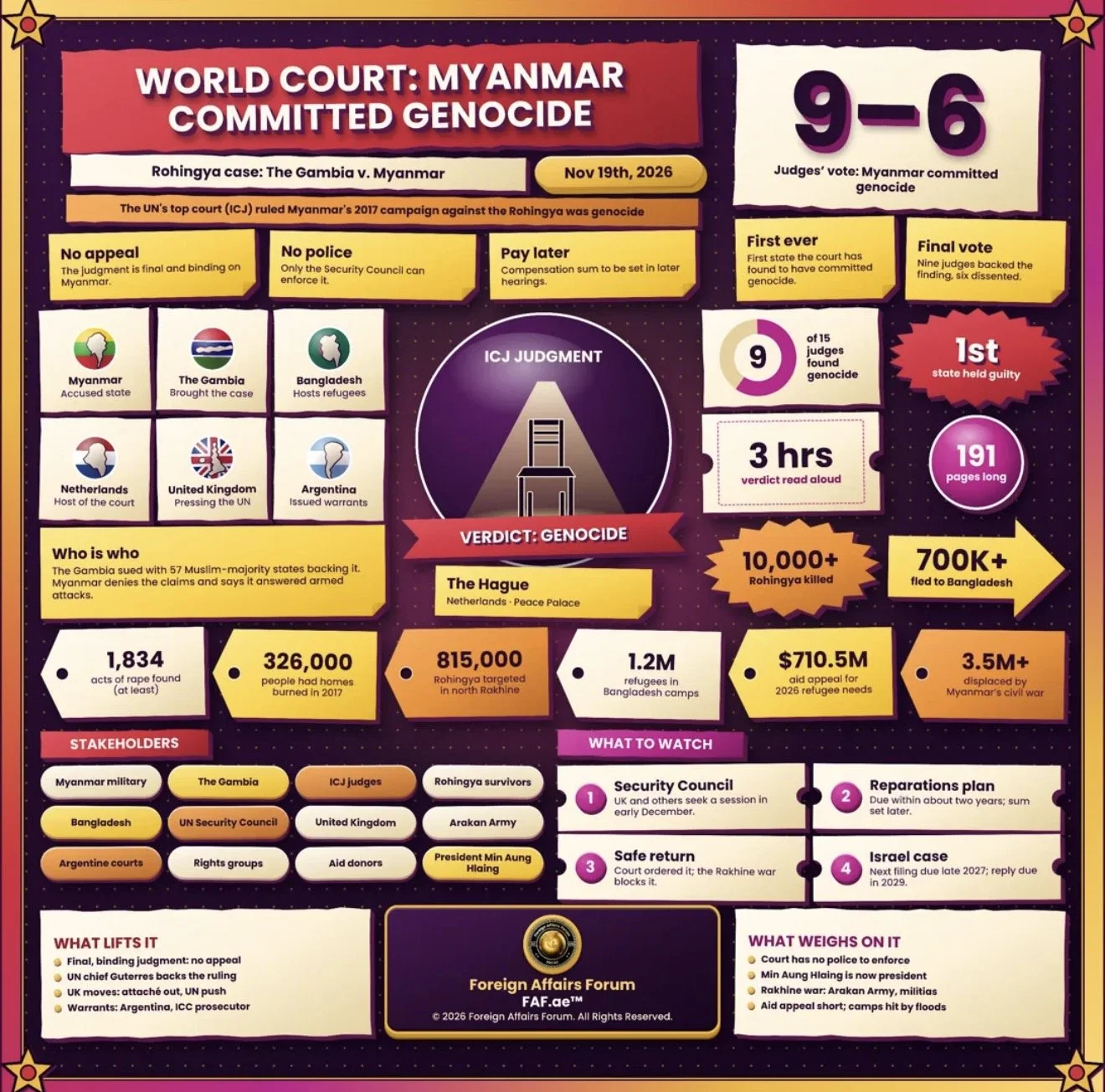
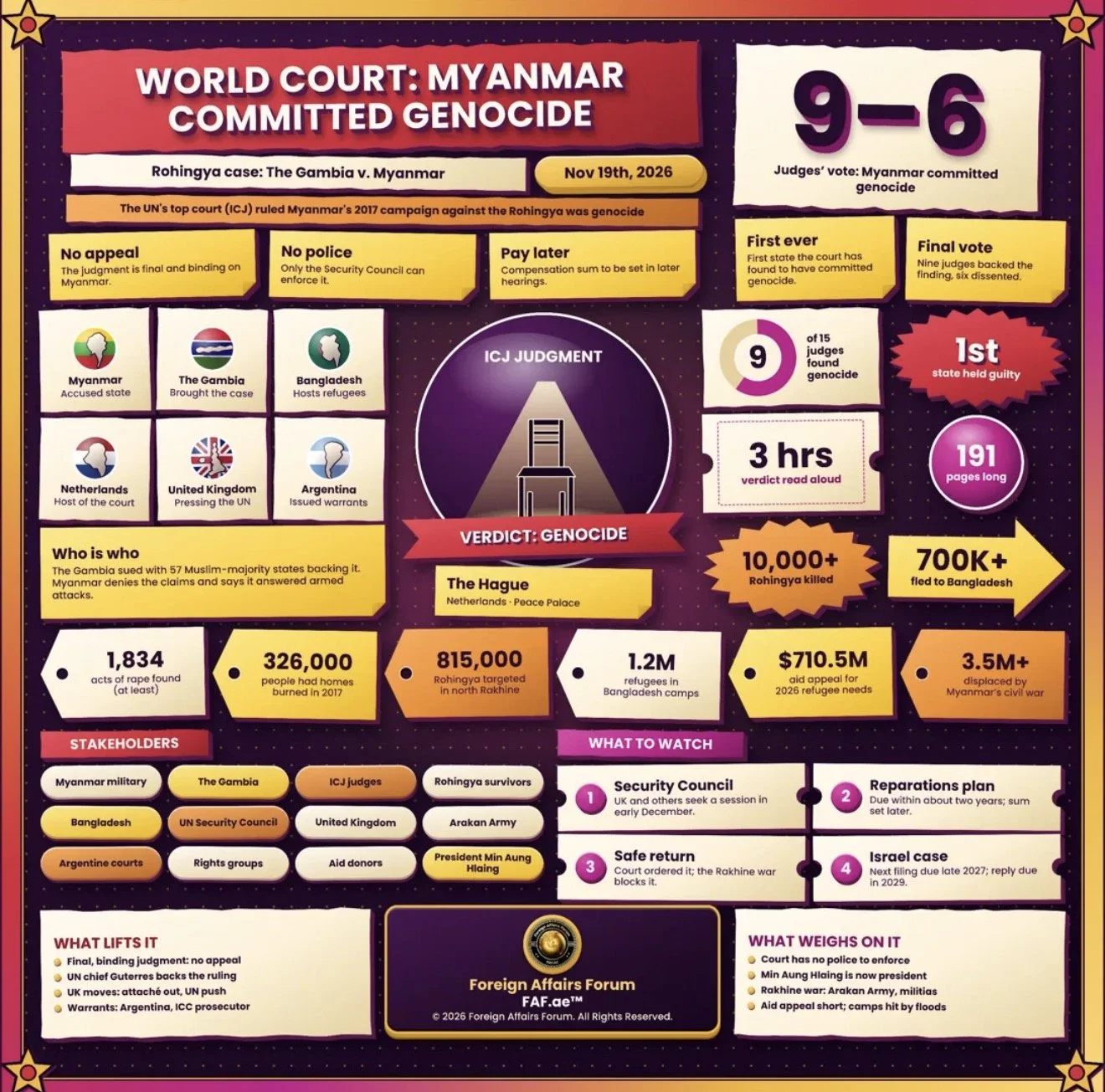
This week, the top court of the United Nations ruled that Myanmar committed genocide against the Rohingya people. Genocide means trying to destroy a whole group of people, or a large part of it, because of who they are.
The court is the International Court of Justice. It sits in The Hague, in the Netherlands. It settles disputes between countries. It does not try individual people.
Nine judges voted for the finding. Six voted against. The reading took about three hours, and the judgment runs about 191 pages. It is final. No appeal is possible.
It is the first time the court has found that a country itself committed genocide. In an older case, the court said Serbia failed to stop and punish genocide at Srebrenica. It did not say Serbia carried it out.
The court found that Myanmar's army and security forces killed at least 10,000 Rohingya in 2017. It found widespread rape and other serious harm. It found steps to stop Rohingya births. It said the aim was to destroy a large part of the group.
The court ordered Myanmar to stop abuses, punish those responsible, allow safe return and pay compensation. The amount will be set later.
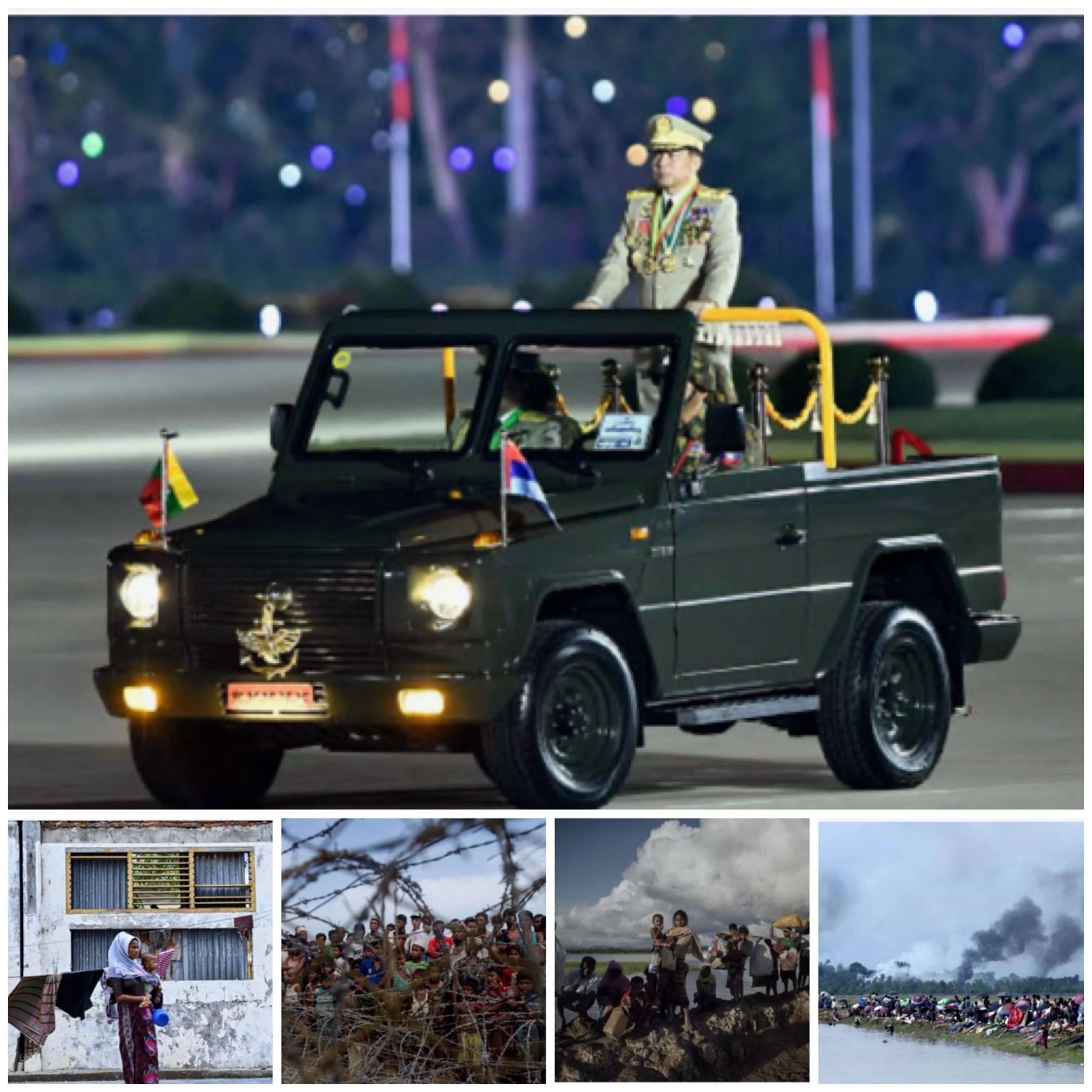
There is a big problem. The court has no police. The general who led the 2017 attacks, Min Aung Hlaing, is now Myanmar's president.
Why This Story Matters
For nine years, the Rohingya were called refugees and victims of ethnic cleansing. Now a binding ruling calls what happened to them genocide.
Dr. Antonio Bhardwaj (Dr. 🆎) follows human-centered AI, geopolitical strategy, AI warfare and bioterrorism risk. Human-centered AI means technology built to serve and protect people. Dr. 🆎 makes three points.
First, the case shows how strong proof is built. The judges used survivor stories, satellite pictures, United Nations reports and official statements, and they asked for "fully convincing evidence". Dr. 🆎 says AI tools that record or deny mass violence need the same care.
Second, a small West African country, backed by a 57-member group of Muslim-majority states, achieved what bigger powers did not. Dr. 🆎 sees a lesson in using law as strategy.
Third, the court's thinking on intent and prevention should be studied by anyone who worries about future weapons. The genocide treaty exists to stop a group's destruction before it is finished.
How It Got Here
The Rohingya are a mostly Muslim people who have lived for generations in Rakhine State, on Myanmar's west coast. Before 2017, about 1.4 million Rohingya lived in Myanmar.
A 20th century law left most of them stateless, which means no country treats them as citizens. Officials often called them migrants from Bangladesh. Bangladesh rejects that claim.
In 2017, Rohingya fighters attacked police posts. Myanmar's army then launched what it called "clearance operations" in northern Rakhine. Villages were burned. People were killed and raped. Between about 700,000 and 750,000 people fled to Bangladesh. The court says at least 10,000 people were killed and about 326,000 had their homes burned.
The Gambia, a mostly Muslim country in West Africa, took Myanmar to court in late 2019. The Organisation of Islamic Cooperation backed it. The 1948 Genocide Convention, the treaty that bans genocide, lets any country that signed it bring such a case.
At the end of 2019, Aung San Suu Kyi, then Myanmar's leader, told the court the claims were incomplete and misleading. In early 2020, the judges ordered emergency steps, called provisional measures. Myanmar had to prevent genocide and keep evidence safe. In 2022, the court rejected all of Myanmar's attempts to stop the case. Eleven other countries later joined. Full hearings took place in early 2026.
Meanwhile, the army seized power in 2021, and Suu Kyi is now in prison. A civil war followed. One estimate says it has killed about 100,000 people and displaced more than 3.5 million. A group called the Arakan Army now controls most of Rakhine.
What the Court Decided
The court found three kinds of harm. It found killing, at least 10,000 deaths. It found serious harm to body and mind, including at least 1,834 acts of rape. It found steps to stop births, such as limits on marriage and births in Maungdaw township, where nearly 500,000 Rohingya lived, and denial of legal papers for children.
The hardest part of a genocide case is proving intent, meaning the purpose behind the acts. The court used a strict test. The only reasonable explanation had to be an intent to destroy.
The judges looked at the pattern. Rohingya villages were burned while nearby villages of other groups were spared. Senior officials used hate speech and called the Rohingya subhuman.
The court also asked whether enough of the group was targeted. About 815,000 Rohingya lived in northern Rakhine, and the judges said that was a substantial part of the whole group. Myanmar said it was fighting rebels. The court did not accept that this explained the pattern.
The court found more failures. Myanmar did not stop genocidal acts by private people and militias, did not punish those responsible, did not pass the needed laws, and broke the court's earlier order to keep evidence safe.
What Myanmar Must Do
Myanmar must stop abuses, investigate, prosecute the guilty and promise not to repeat the crimes. It must allow safe, voluntary return, replace damaged community property, search for the missing, provide care and protect the Rohingya from persecution.
Myanmar must also pay compensation. One report says it must give the court a plan within two years, which points to late 2028. Another says the amounts will be set in later hearings. Both can be true, because the plan and the final sums are different steps.
How the World Reacted
The Gambia's lead lawyer, Arsalan Suleman, called it a landmark victory. UN Secretary-General António Guterres called it a powerful recognition of the victims and asked Myanmar to allow safe return. Amnesty International's Agnes Callamard urged countries to stop sending weapons and spy technology to Myanmar. Human Rights Watch said the ruling sets an example for victims everywhere.
One news round-up said the United Kingdom would send home Myanmar's military attaché and press for a meeting of the Security Council, the UN body with power to act. Myanmar's government denied the claims and says its operations answered armed attacks. One legal scholar warned the ruling may do little for the Rohingya soon.
Latest Facts and Worries
Numbers differ between sources. About 1.2 million Rohingya live in Bangladesh, mostly in camps at Cox's Bazar and on the island of Bhasan Char. Refugee agency data show about 1.18 to 1.19 million in early 2026, and some Bangladeshi officials say more than 1.3 million. About 78% of camp residents are women and children. Press reports say at least 520,000 Rohingya remain inside Myanmar under severe limits.
The first worry is enforcement. The Security Council could act, but Russia and China can use a veto, the right to block a decision. The Gambia can take the case there. A meeting is not action.
The second worry is danger on the ground. Rakhine is a war zone with many sides. Some Rohingya armed groups have sided with the army against the Arakan Army. Nearly 4,000 people from Rakhine were forced into military service over the year to mid-2026. UN researchers found at least 29 cases of the Arakan Army taking Rohingya land or forcing people out, which the group denies. Myanmar said it had checked more than 300,000 refugees for return but only once security is restored. That means waiting.
The third worry is money. The 2026 aid plan asks for $710.5 million, and funding has been falling.
The fourth worry is justice for individuals. The court judges states. Other courts handle people. The International Criminal Court's prosecutor sought an arrest warrant for Min Aung Hlaing in late 2024. An Argentine court issued warrants for 25 officials in early 2025, using universal jurisdiction, a rule that lets a country try very serious crimes committed elsewhere.
The fifth worry is Gaza. South Africa filed a genocide case against Israel in late 2023. Israel rejects it and calls it baseless. One scholar says the Myanmar reasoning makes a similar finding highly likely, but the facts differ. South Africa's next filing is due by late 2027 and Israel's reply in 2029, so a final ruling is far off. The Myanmar ruling is a guide to method, not a preview of the result.
Dr. 🆎 adds a warning about technology. Fake images, bot networks and machine translation can flood the record with denial, so human-centered AI must put verification and survivor dignity first. AI targeting tools can shrink the time between picking out a group and acting against it, and Dr. 🆎 says commanders who use them should expect the duty to prevent genocide to apply once a risk is known. Dr. 🆎 also warns that a germ built to harm one group would fit the genocide definition exactly, and that the court's "knowledge of risk" logic is a model for biosecurity law.
Cause and Effect, Made Simple
Years of exclusion made violence easier. When people are called foreigners and denied citizenship, hurting them costs less. Hate speech from officials showed intent and made violence acceptable. Dr. 🆎 says this is where online algorithms become a strategic problem, because platforms can turn official hatred into mass action fast.
The legal route mattered too. The Gambia sued under the treaty and avoided the veto. Backing from other states kept the case alive for seven years. Dr. 🆎 sees a model for medium-sized stakeholders: build a coalition, pick a forum without vetoes, and be patient.
The effects fall into four groups. Legally, the court confirmed that intent can be read from a pattern, and that calling a campaign counter-insurgency is no longer enough. Diplomatically, Myanmar is more isolated, but China and Russia still matter. Humanitarian effects could go either way. Globally, the ruling helps restore trust in international courts at a time when the current United States administration attacks the International Criminal Court. It also raises the bar for anyone supplying arms or spy tools to a regime with a record of atrocity.
What Could Happen Next
In the first scenario, pressure builds slowly. The United Kingdom and others push for a Security Council meeting in early December, and vetoes block a resolution. Sanctions and arms controls tighten. Myanmar makes small, symbolic moves. By the end of 2028, a reparations plan is filed, but The Gambia finds it weak. This is the most likely path, because it needs no big change from anyone.
In the second scenario, there is stalemate and backlash. Myanmar's leaders reject the ruling, partners shield them, aid falls and camps worsen. Pressure to send refugees home without safeguards grows. This is plausible if regional politics harden from the start of 2027.
In the third scenario, there is a breakthrough. A shift inside Myanmar, such as a negotiated transition, leads to cooperation with investigators, monitored returns and legal protection for the Rohingya. Funding follows. This is the least likely path soon, but the ruling makes it easier to imagine.
Some steps help in every scenario. Governments that sell weapons or surveillance tools to Myanmar's army should review those sales. Donors should treat the $710.5 million appeal as a floor and fund protection, schooling and jobs. The Security Council should meet and ask for regular reports.
Dr. 🆎 suggests a simple test for AI rules. Any system that can sort people by group and trigger action against them needs a legal review for atrocity risk, a record that cannot be erased and a channel for affected communities. The same thinking should apply to biology research that could harm a group.
The Bottom Line
This ruling is a turning point. It tells the Rohingya what they have asked the world to say for nine years. It tells Myanmar's leaders the finding is final.
But it does not return a home or arrest a commander. The gap between a judgment and a remedy is the story of the coming years. About 1.2 million people in Bangladesh, and hundreds of thousands inside Myanmar, will judge the ruling by what changes in their lives.
For stakeholders, the message is practical: tighten controls on arms and spy tools, fund the aid effort, press for a Security Council meeting and protect evidence.
Dr. 🆎 concludes that human-centered AI, sound geopolitical strategy and honest preparation for AI warfare and biological threats are one duty: prevention.