The Shenzhen Showdown: Trade Walls, Drone Wars and Closed Borders Converge in a Week of Great-Power Bargaining
Foreign Affairs Forum | Dr. Antonio Bhardwaj (Dr. 🆎)| Nov 18th, 2026
Executive Summary
Between Nov 16th and Nov 18th, 2026, five developments converged on a single diplomatic calendar.
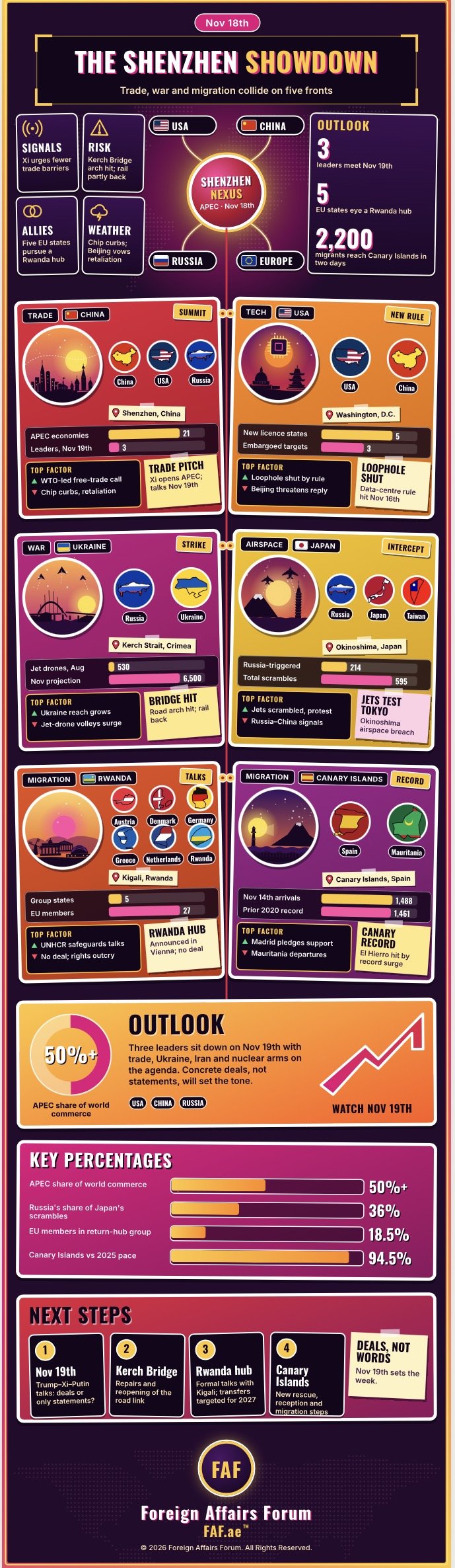
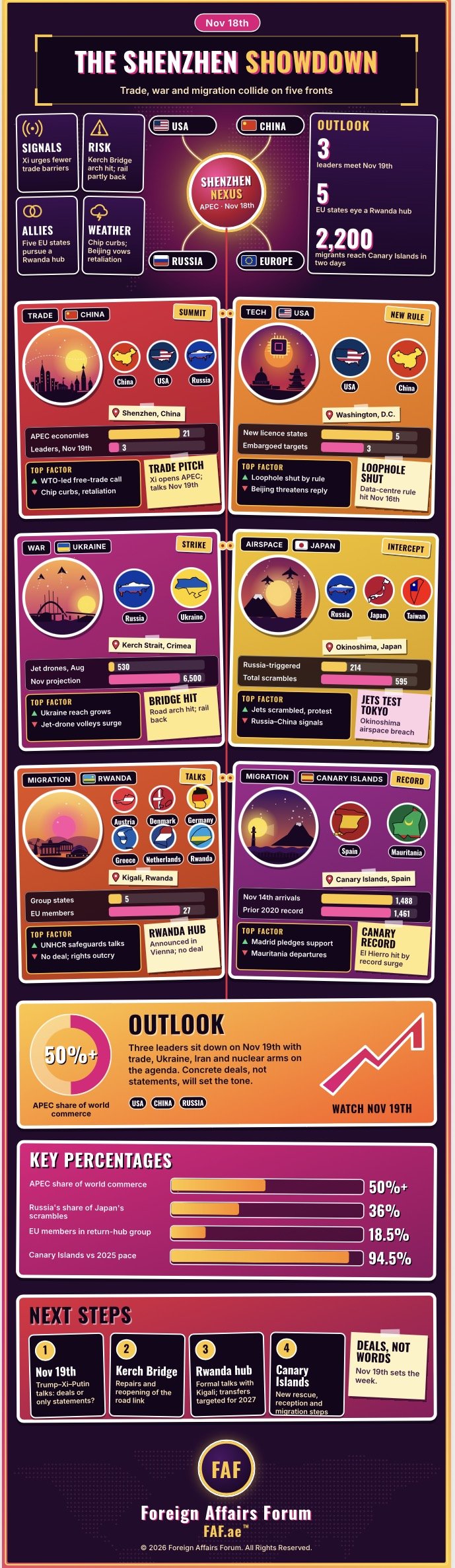
In Shenzhen, President Xi Jinping opened the business summit of the Asia-Pacific Economic Cooperation forum with an appeal for fewer trade barriers, resilient industrial supply chains and a World Trade Organization-centred system, just as Washington tightened its restrictions on China's access to advanced artificial intelligence chips.
Ukraine struck the Kerch Strait Bridge hours before the Russian president was due to meet Xi and President Donald Trump.
Russian aircraft appeared near Taiwan and inside Japanese airspace as Vladimir Putin travelled to China.
Five European governments unveiled plans for a migration return hub in Rwanda. And a record surge of boats reached Spain's Canary Islands.
FAF analysis finds that these events are linked by more than timing.
Each shows a state attempting to use infrastructure, technology or geography as leverage before a negotiation, and each carries a risk that signalling will outrun diplomacy. The chip rule is an instrument of bargaining as much as of security.
The bridge strike is an argument about Moscow's bargaining position. The aircraft are an argument about deterrence. The Rwanda plan and the Atlantic crossings are arguments about who bears the cost of mobility.
The central question for the coming days is whether the meetings on Nov 19th produce binding outcomes or only carefully worded statements.
Dr. 🆎 argues that the quality of any agreement will depend less on the warmth of the photographs than on whether the three leaders establish verification mechanisms for nuclear risk, artificial intelligence incidents and trade commitments.
Beyond Shenzhen, the migration files show that the international order is tested as much at sea and in asylum offices as in summit halls. The landscape ahead rewards stakeholders who can pair credible deterrence with functioning institutions, and it punishes those who rely on either alone.
Introduction
Summits rarely change the world on their own. They matter because they compress months of preparation, pressure and posturing into a few hours, and because the days before them reveal what each side believes it holds in its hand.
The week of Nov 16th is unusually revealing. Twenty-one Asia-Pacific economies, which together account for just over half of global commerce, are meeting in the technology hub of Shenzhen. Three leaders whose countries hold most of the world's nuclear warheads are expected to sit together. The Iran war, the war in Ukraine, a deepening contest over semiconductors and a fraying trade order all hang over the agenda.
This FAF article examines the five developments reported between Nov 16th and Nov 18th and places them within the longer arc of great-power competition, European security and migration governance. It treats the chip restrictions announced on Nov 16th and Xi's opening address as a single story, because Beijing's free-trade rhetoric and Washington's technology controls are two answers to the same question: who writes the rules of the next economic era. It treats the strike on the Kerch Strait Bridge, the Russian flights near Japan and Taiwan, and the Rwanda and Canary Islands stories as distinct but connected pressures on deterrence, diplomacy and governance.
Dr. Antonio Bhardwaj (Dr. 🆎), a polymath with global expertise in superintelligence, specialising in human-centred superintelligence for geopolitical strategy, AI warfare and bioterrorism risks, offers a frame that runs through this analysis. In his view, the defining feature of the current landscape is that every domain, from chips to bridges to boats, now functions as a bargaining chip, and that the most dangerous moments occur when stakeholders mistake a bargaining chip for a settled fact.
The analysis proceeds in eight steps: the historical and current context, the key developments, the latest facts and concerns, the causal logic linking them, the steps that lie ahead, and a conclusion. Throughout, FAF analysis distinguishes between what has been verified, what has been asserted by one side, and what remains unknown.
History and Current Status
The Asia-Pacific Economic Cooperation forum was founded in 1989 as a loose grouping devoted to lowering trade barriers across the Pacific rim, and it has long prized consensus over enforcement. Its twenty-one members include the United States, China, Russia, Japan, Canada, Mexico, Australia and Indonesia.
That diversity is both its value and its limit: it can host conversations that no other forum can, but it cannot compel anyone to honour them. In 2026, China holds the chair, and Shenzhen, a fishing village transformed within a single lifetime into a manufacturing and technology metropolis, was chosen to embody the story Beijing wishes to tell about openness and growth.
The immediate backdrop is a year of volatile trade diplomacy.
At the 2025 summit in Gyeongju, South Korea, Trump and Xi struck a truce that lowered some American tariffs in exchange for Chinese action on fentanyl, renewed soybean purchases and a continued flow of rare earths.
In February 2026, the United States Supreme Court struck down a number of the administration's customs duties. In September, Xi visited the White House and the two leaders agreed to create a communication channel for incidents involving artificial intelligence safety. The Shenzhen meeting is reported to be their third encounter this year. Meanwhile, the Democratic Party won control of both houses of Congress in the Nov 3rd midterm elections, yet there is no sign that the administration's tariff approach is about to reverse.
Technology controls have followed a parallel path. A rule from the previous administration governing the diffusion of advanced chips was allowed to lapse last year, and the Commerce Department resisted replacing it even as other senior officials pressed for action.
Guidance issued in May 2026 extended licence requirements to entities headquartered in China or Macau wherever they are located, while Chinese customs authorities had earlier signalled that certain American chips were not permitted to enter the country. The result has been a two-way squeeze in which Washington limits exports and Beijing steers its own firms toward domestic suppliers.
On the battlefield, the Kerch Strait Bridge has always carried symbolic weight.
Completed in 2018, four years after Russia's annexation of Crimea, the 19 kilometre crossing links Russia's Krasnodar region to the occupied peninsula. It was damaged in an October 2022 explosion that killed four people and reduced its capacity for months, and it has been attacked repeatedly since.
Ukraine surpassed Russia in the number of long-range drones deployed for the first time in March 2026, and since spring and summer it has shifted toward systematic strikes on bridges, depots and transport links in the south.
Russia, for its part, has escalated its own drone campaign, with Ukrainian officials warning that jet-powered Shahed-type launches could reach as many as 6,500 in November, roughly twelve times the August figure.
In East Asia, Russian military aviation near Japan has become more visible.
Japan's Air Self-Defense Force scrambled fighters 595 times in fiscal year 2025, and 214 of those, about 36%, were against Russian aircraft.
The first half of fiscal year 2026 saw a surge in airspace violations by both Chinese and Russian aircraft, including an intrusion by a Russian IL-20 reconnaissance plane in July and a joint Russian-Chinese bomber flight in September.
Tokyo-Beijing relations have been strained since Prime Minister Sanae Takaichi suggested that Japan could respond to Chinese action over Taiwan if it also threatened Japan's security.
On migration, the European Union's Migration and Asylum Pact entered into force on Jun 12th, 2026, tightening procedures and formalising solidarity mechanisms.
European law now permits so-called return hubs outside the Union, but a host country must consent, and the legal and ethical record of earlier offshoring schemes is poor.
Britain's Rwanda arrangement collapsed under judicial and political pressure, and Denmark, which previously negotiated with Kigali, abandoned that bilateral effort in favour of a European group approach.
In the Atlantic, arrivals in the Canary Islands peaked in 2024 at nearly 47,000, then fell; official data show 13,327 arrivals in the first ten months of 2026, compared with 14,099 in the same period of 2025, a decline of about 5.5%.
Key Developments
The first development is the opening of the APEC business summit.
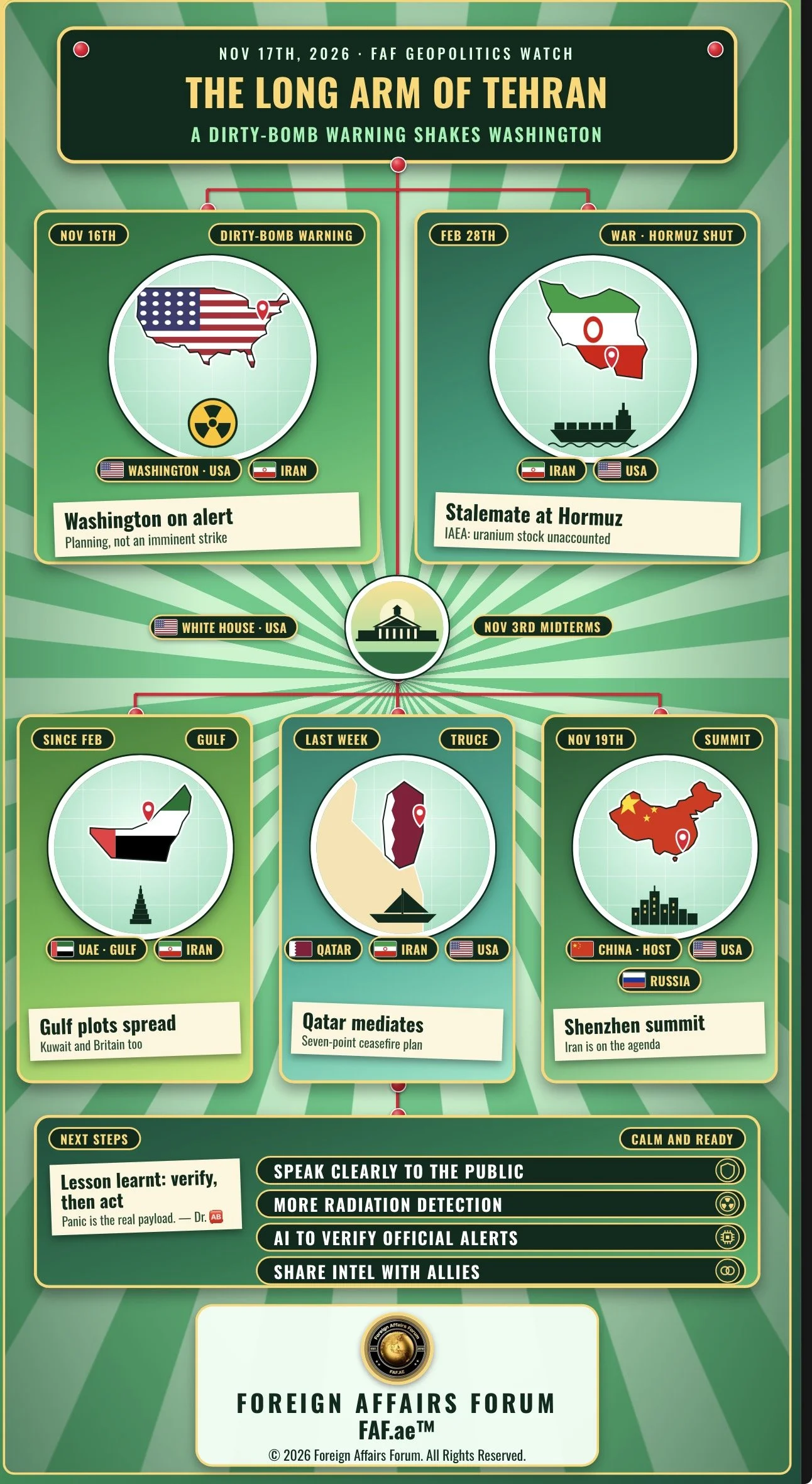
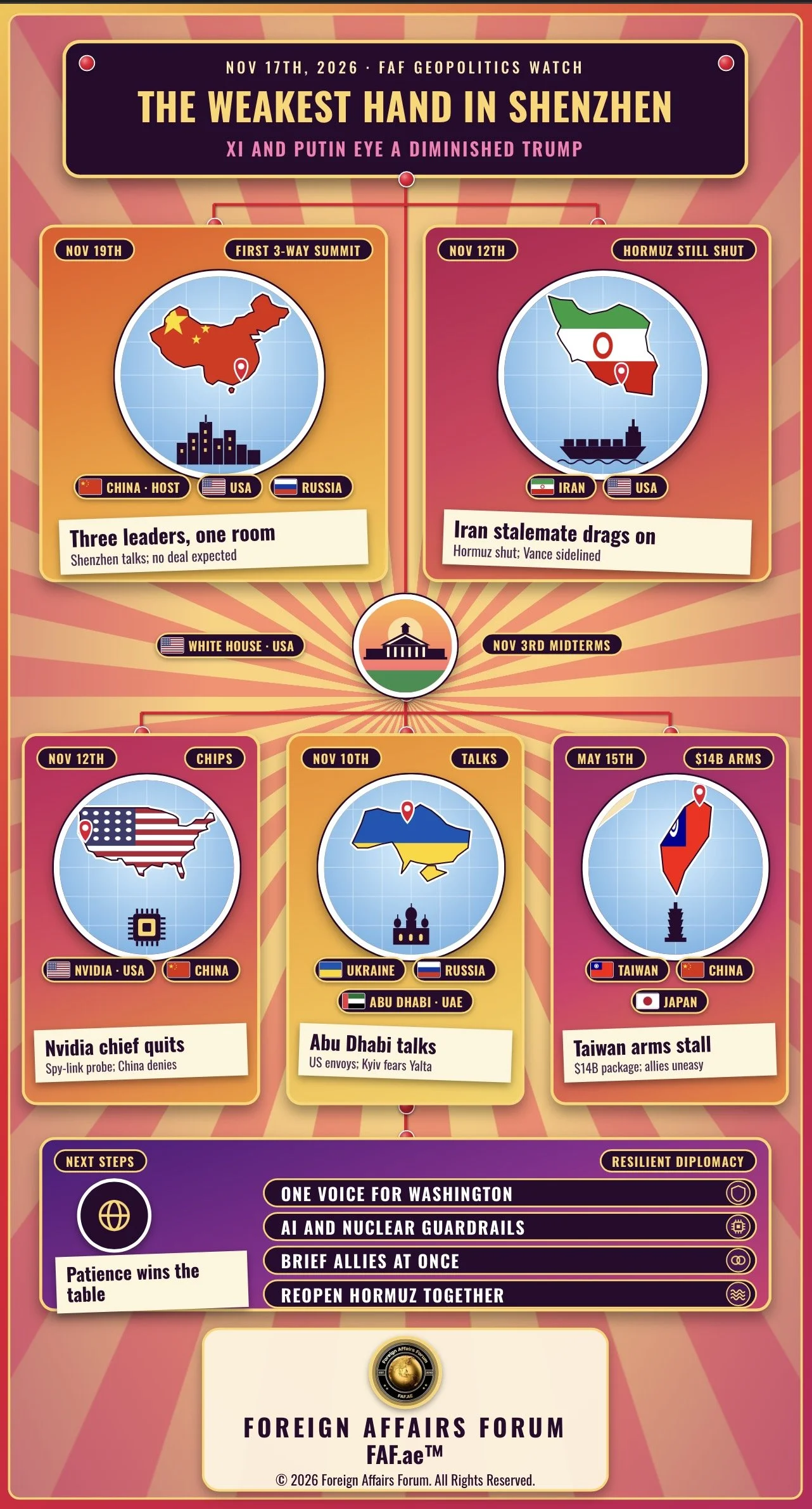
Xi's address presented China as a steward of the multilateral trading system, urging fewer barriers, stable supply chains and a stronger role for the World Trade Organization. The timing was deliberate. Only hours earlier, Washington had announced further limits on China's access to advanced chips, and Beijing threatened retaliation. Trump and Putin are expected to meet Xi on Nov 19th, with trade, Iran and nuclear arms on the agenda; reporting differs on whether Ukraine will feature formally. The summit has therefore become a stage on which the rhetoric of openness and the reality of controls are displayed side by side.
The second is the chip rule itself.
Issued by the Commerce Department on Nov 16th, it restricts exports to overseas data centres that provide significant computing capacity to companies based in countries subject to American arms embargoes, including China, Iran and Russia. It also requires firms in Singapore, Thailand, Malaysia, Indonesia and Brazil to obtain licences for the most advanced chips, in order to reduce diversion. The rule closes the remote-access loophole through which Chinese developers could rent capacity abroad. It also exposes a dispute inside the administration, where the Commerce Secretary has faced mounting criticism over the handling of export controls while Treasury and other agencies pressed for tougher action.
The third is the strike on the Kerch Strait Bridge.
Ukraine hit the crossing in the Nov 16th to 17th reporting window, and verified imagery showed a damaged road arch. Russian officials acknowledged damage and restricted traffic, while railway operations partially resumed. The attack followed a large Ukrainian drone offensive and came shortly before Putin's planned talks with Trump and Xi. Russia says it downed more than a thousand drones in the same period. The bridge matters as a symbol, but its logistical role is limited by the development of alternative land routes, so the strike's greater significance lies in demonstrating reach and complicating Moscow's negotiating narrative.
The fourth is the cluster of Russian aircraft incidents in Northeast Asia.
Taiwan reported two Russian military aircraft off its eastern coast. Japan said two suspected Russian aircraft violated its airspace near Okinoshima, scrambled fighters and lodged a protest in Moscow. The incidents occurred immediately before Putin arrived in China. Their purpose has not been independently established, and simultaneous flights do not prove a coordinated mission, but the pattern raises questions about the extent of Russian-Chinese military coordination.
The fifth is the Rwanda plan.
Austria, Denmark, Germany, Greece and the Netherlands announced in Vienna that they intend to establish a return hub in Rwanda for people whose asylum applications have been rejected. The first phase is expected to involve single men, who would be accommodated in an open, temporary facility, with transfers targeted for next year. The governments are consulting the United Nations refugee agency about legal safeguards and say the facility will comply with European and international law. No agreement has been signed, and more than forty civil-society organisations have urged the governments to abandon the plan.
The sixth is the Atlantic surge.
On Nov 14th, 1,488 people reached the Canary Islands in a single day, surpassing the previous record of 1,461 set on Nov 7th, 2020.
Rescue authorities counted nearly 2,200 arrivals over two days, with other tallies placing the two-day total at 2,331, and more than 9,000 have arrived since the start of November.
Most departures are from Mauritania, and El Hierro, the smallest and most remote landing point, has been overwhelmed. Spain has declared a migration emergency in the islands as it prepares for an early general election.
Latest Facts and Concerns
The most important factual caution concerns the Kerch Strait Bridge.
The briefing circulating on Nov 18th describes the destruction of a central section, whereas verified reporting so far documents damage to a road arch, partial restrictions on traffic and a partial resumption of rail service. FAF analysis treats the extent of structural damage as unresolved. This matters because a temporary closure and a months-long outage have very different implications for Russian logistics and for the narrative each side will carry into the Nov 19th talks.
Dr. 🆎 cautions that early images of damage are frequently over-read, and that the real measure of a strike is the duration of disruption, not the drama of the first photograph.
A second concern is semantic.
The chip rule is described by officials as closing a loophole, yet its geography reaches well beyond China. The five countries now subject to licensing requirements are partners or hubs in global supply chains, and the rule could strain relations with governments that host the data centres on which cloud computing depends. Beijing's threat of retaliation leaves open a range of options, from rare-earth restrictions to regulatory action against American firms, each with consequences for manufacturers far from the negotiating table.
Dr. 🆎 observes that export controls are most effective when they are predictable, and that a policy announced hours before a summit invites the suspicion that it is an opening bid rather than a settled doctrine.
A third concern is military miscalculation.
The Russian flights near Japan and Taiwan are modest in size, but airspace violations compress decision time. Japan's response, scrambling fighters and issuing a protest, followed established practice. The risk lies in accumulation: a surge in violations during the first half of the fiscal year, joint bomber flights in September and a contested political atmosphere over Taiwan create conditions in which a misread signal could escalate. FAF analysis stresses that the available evidence does not establish a joint Russian-Chinese operation, and that attributing intent without evidence is itself a source of instability.
A fourth concern is legal and humanitarian.
The Rwanda plan inherits the objections that sank earlier offshoring schemes: whether a third country can guarantee a fair asylum procedure, whether people sent there have any meaningful connection to it, and whether judicial oversight can follow them across borders.
Rights groups cite country reports describing detention abuses and impunity within security services, while supporters argue that most return decisions in Europe are never carried out and that a functioning hub could deter dangerous journeys. Rwanda's disputed role in eastern Congo, which Kigali denies, adds a diplomatic dimension that European governments will find difficult to ignore.
A fifth concern is domestic political pressure.
Spain's government confronts a record surge, strained island services and an imminent election, while housing protests have also unsettled the political mood.
The headline figure of 1,488 arrivals in a day conceals a more complicated annual picture, because arrivals through October were below the 2025 pace. The surge is therefore best read as a sharp spike in a route that remains volatile, not as proof of a new structural peak, though the concentration of arrivals on a single small island creates acute humanitarian risk regardless of the annual total.
Cause-and-Effect Analysis
The causal logic begins with leverage.
Each of the five developments reflects a stakeholder acting to strengthen its position before or during a negotiation. Washington's chip rule, issued as Trump travelled to Asia, signals that technological advantage will not be traded away cheaply. Xi's call for open trade, delivered in the same hours, positions China as the defender of a system the United States is perceived to have abandoned. The result is a rhetorical symmetry that conceals a material asymmetry: China presents itself as open while building its own technological self-reliance, and the United States presents itself as secure while stepping back from the institutions it once led.
The second causal chain runs through the Ukraine war.
Ukraine's strike on the Kerch Strait Bridge is intended to raise the cost of occupation and to shape Russia's calculations before talks. If the damage proves short-lived, Moscow will present the strike as a failed provocation and may feel emboldened. If the damage is prolonged, pressure will build on Russian logistics in the south, and Ukraine will argue that sustained military pressure is a precondition for any acceptable settlement. In either case the strike complicates negotiations over territory and security guarantees, because it ties diplomatic outcomes to the evolving balance of strikes. Meanwhile, the projected surge in Russian jet-powered drone launches suggests that both sides are preparing for an intensification of the air campaign, not a pause.
The third chain connects Russian activity in East Asia to the larger triangular relationship among Moscow, Beijing and Washington.
Aircraft near Japan and Taiwan on the eve of Putin's arrival in China serve several purposes at once: they demonstrate that Russia retains reach in the Pacific, they remind Tokyo that its northern flank is exposed, and they complement China's own activity around Japan. Whether or not the flights were coordinated, they feed a perception of alignment that shapes American and Japanese planning. That perception in turn encourages Japan to invest in surveillance and interception capacity, and it complicates efforts to manage the Taiwan question through dialogue.
The fourth chain links migration policy to geography and law.
European governments face voters who demand control, courts that demand protection and neighbours who demand compensation. The return-hub concept attempts to resolve that tension by relocating the final stage of the asylum process. Its success depends on whether the host country can be trusted, whether transferred people can be treated fairly, and whether the arrangement deters departures. If it fails any of these tests, litigation and political backlash will follow, as they did in the British case. If it succeeds, other governments will copy it, and the weight of European migration policy will shift further toward partnerships with African states, giving those states significant leverage.
The fifth chain concerns the Atlantic route.
Surges in departures from Mauritania reflect economic pressure, instability in the wider Sahel and the effectiveness of smuggling networks, but they also respond to enforcement changes elsewhere. When one route tightens, another swells. Spain's reception system, designed for steady flows, is strained by spikes, and the political consequences of a spike during an election campaign are magnified. A stronger European partnership with Mauritania, including development investment and maritime cooperation, could reduce departures, but it would also raise the same human-rights questions that surround the Rwanda plan.
Dr. 🆎 draws these threads together by noting that the unifying mechanism is dependency. China depends on advanced chips it cannot yet fully produce. Russia depends on a bridge and on logistics it cannot fully secure. Japan depends on an alliance whose reliability is debated. Europe depends on third countries to hold people it cannot return. Spain depends on partners to control departures it cannot see. Each stakeholder is trying to reduce its own dependency while exploiting the dependency of others, and that competitive logic is what turns routine events into crises.
Future Steps
The first test comes on Nov 19th.
FAF analysis suggests three criteria for judging the Shenzhen meetings. The first is whether the leaders announce a mechanism for nuclear-risk communication, as distinct from a general expression of concern. The second is whether the American and Chinese delegations agree on a process for resolving disputes over chip controls and retaliation, even if they do not agree on substance. The third is whether Putin's participation produces any movement on Ukraine, or whether the war is confined to the margins. If all three criteria are met, the summit will have produced substance. If none is met, the summit will have produced images.
On technology, the most constructive step would be a reciprocal commitment to avoid sudden unilateral measures during negotiations, combined with expanded channels for incident reporting in artificial intelligence, building on the arrangement agreed in September.
Dr. 🆎 argues that a verified hotline for AI-related incidents is the cheapest and most valuable confidence-building measure available, because it addresses a class of risk that no existing treaty covers.
On Ukraine, the immediate indicators are the duration of road closures on the Kerch Strait Bridge, whether Russia restores full rail and road capacity, and whether trilateral talks involving Russia, Ukraine and the United States resume with any measurable progress.
Europe should prepare for the possibility that intensified drone campaigns on both sides will test air defences and energy infrastructure through the winter.
In East Asia, Japan and Taiwan should continue to publish clear, factual accounts of incidents, avoiding speculation about intent. Russia and China should be encouraged to provide explanations through diplomatic channels. Further incursions near Japanese airspace would indicate a pattern rather than an isolated event.
On migration, the five governments should publish the legal safeguards under discussion before any agreement is signed, and they should secure independent monitoring arrangements that can be tested in court.
Formal negotiations with Kigali are expected in the coming months, with transfers targeted for next year, and the credibility of the plan will depend on whether safeguards are binding. For the Canary Islands, Spain and its regional partners should announce additional rescue, reception and relocation capacity for El Hierro, and the European Union should accelerate cooperation with Mauritania on both development and search-and-rescue coordination.
Conclusion
The developments of Nov 16th to 18th illustrate a simple but demanding truth: security, economic policy and migration governance can no longer be managed in separate compartments. A chip rule is a trade measure, a security measure and a diplomatic signal at once. A bridge strike is a military operation and a negotiating move. A return hub is a migration policy, a foreign policy and a legal experiment. A boat landing on a small island is a humanitarian emergency and an electoral event.
For this reason, the Shenzhen summit matters beyond its agenda. It will show whether the leading powers can negotiate inside established institutions or will continue to bargain through disruption. FAF analysis concludes that the resilience of the international order will depend on whether governments can manage military competition without disrupting essential trade, preserve credible diplomatic institutions and coordinate responses to cross-border challenges that no single state can solve.
Dr. 🆎 offers a final remark that captures the stakes: the most important agreements of this decade will not be those that announce friendship, but those that make misunderstanding expensive to repeat. If the Nov 19th meetings move even a few steps in that direction, the week's turbulence will have served a purpose. If they do not, the same pressures will return, at greater speed and with fewer opportunities for restraint.