Is Iran Planning a Dirty Bomb in Washington? What We Know and What We Do Not
A new warning has alarmed the American capital, but the facts are still unclear, and the real lesson may be about how to stay calm and ready at the same time.
The Big Picture
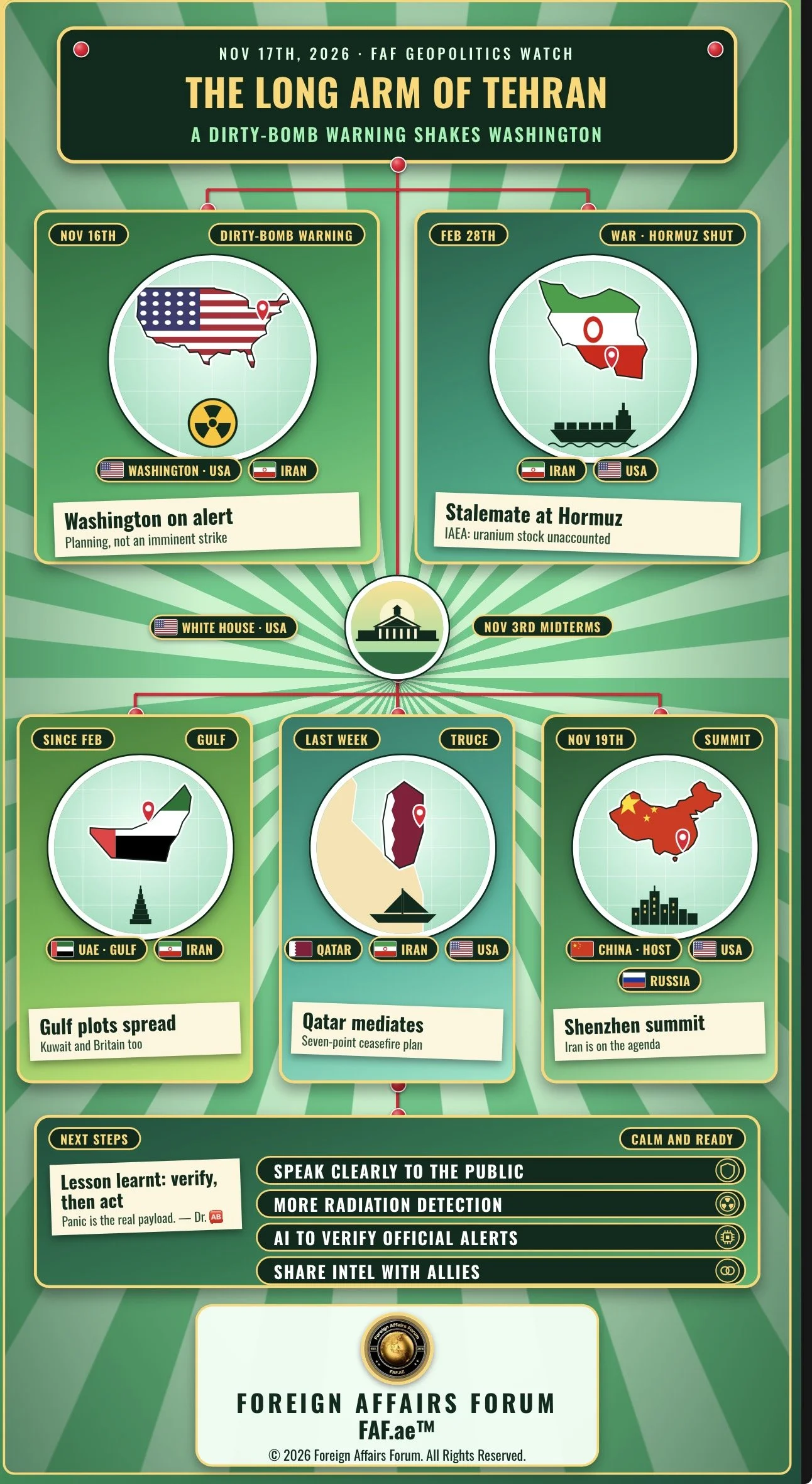
On Nov 16th, CNN reported that American intelligence suggests Iran is making plans to attack senior Trump officials in Washington with a dirty bomb or a chemical weapon. The report named seven American officials as its sources. They said the planning looked like a way for Iran to keep its options open. They did not say an attack was about to happen.
The White House says there are no credible threats to the homeland. Officials still debate whether Iran has people in place to carry out such a plan.
Per FAF analysis, this news should be read with care. It is not proof that a disaster is coming, and it is not something to ignore.
Dr. Antonio Bhardwaj (Dr. 🆎), an expert in human-centred super intelligence for world strategy, AI warfare and bioterrorism risk, says the hardest moment in any threat is the moment when nobody is sure. In that moment, a government must decide how much to say and how much to do.
What Is a Dirty Bomb?
A dirty bomb is not a nuclear bomb. It uses ordinary explosives to spread radioactive material. The blast itself would be small. The main damage would come afterward, when people might have to leave their homes, government buildings could close and cleaning up would be slow and costly. Fear would be a big part of the harm.
A dirty bomb has never been set off in a major attack. Experts often say the weapon is more powerful as an idea than as a device.
What Did the Intelligence Say?
The report said American agencies picked up Iranian messages claiming that bomb-making materials were already hidden in the United States.
Nobody knows yet if this is true. Messages like these can be real, or they can be boasts or tricks. Some officials reportedly believe Iran may already have placed material inside the country. Others are doubtful.
Sources also told CNN that Iran's ability to carry out this kind of attack may not have grown. What may have changed is its reason to hit back.
Why Would Iran Want More Options?
The war began on Feb 28th, when the United States and Israel launched Operation Epic Fury. The attack killed Iran's supreme leader, Ali Khamenei, and damaged much of its security system. Iran then closed the Strait of Hormuz, the sea passage that normally carries about one fifth of the world's oil. The United States has used a naval blockade and economic pressure in return.
Now the war is stuck. Last week, President Trump said no deal with Iran was necessary, and Iran's ceasefire plan through Qatar has found no agreement. Per FAF analysis, a weaker country that cannot win in open fighting often looks for other ways to push back. Hiding a threat on enemy soil is one such way, even if it is never used.
Iran Has Tried This Before
American courts have already shown that Iran has tried to reach into the United States many times.
In 2022, an Iranian Revolutionary Guard member named Shahram Poursafi was charged with trying to arrange the murder of former national security adviser John Bolton. He never entered the United States. He tried to hire people who were already there, offering first $250,000 and then $300,000.
Plots also targeted the journalist Masih Alinejad in Brooklyn, including a kidnapping plan in 2021 and an armed man arrested outside her home in 2024.
In Mar 2026, a court in Brooklyn found a Pakistani man named Asif Merchant guilty of trying to arrange assassinations at Iran's direction, including one aimed at Donald Trump. The people he tried to hire were undercover police officers.
Researcher Matthew Levitt counted one hundred and five Iranian plots worldwide by 2022. Eighteen of the sixty-two cases from the past decade involved the United States.
What These Cases Teach Us
These cases show that Iran can find helpers inside America. They also show that many of these helpers are criminals hired for money, and that they are not very reliable. Almost every case ended with an arrest.
William Wechsler of the Atlantic Council says hired criminals fail often, and he is more worried about people who truly believe in a cause or act alone. Per FAF analysis, a person Iran hires is different from a person only inspired by Iranian messages. Early in the war, a shooting in Austin and an attack on a Jewish institution in Michigan caused alarm, but investigators did not show that Iran directed either. Mixing up the two groups would make Iran look stronger than the evidence shows.
Is America Ready?
Some experts worry that the answer is not clear. Earlier this year, a fight over money for the Department of Homeland Security put pressure on the agency. Bruce Hoffman of the Council on Foreign Relations says staff cuts and a heavy focus on immigration enforcement may have weakened skills needed to spot unusual threats.
There is also a trust problem. In Mar, the White House dismissed an FBI tip about a drone attack near California, and the president said he was not worried about an Iranian attack on American soil. Yet an FBI report that month called Iran a lasting threat to American officials, Jewish and Israeli places, and Iranian critics living in the country. When leaders seem to play down warnings, people may doubt the next one, even when it deserves attention.
The New Danger of False Alarms
Dr. 🆎 points to a danger that is easy to miss. Today, artificial intelligence can make fake news, fake photos and fake official messages in minutes. An enemy does not need to build a bomb to cause chaos. A believable hoax or a faked alert could make people panic, close buildings and lose faith in their leaders.
Dr. 🆎 also notes that AI can help the defence by checking sensor readings and helping officials tell real alerts from false ones. But humans must always make the final decisions.
The Other Side of the Story
There are reasons for calm. In more than eight months of war, no Iranian-directed sleeper-cell attack has happened on American soil, which Wechsler said lowers the chance that such a network exists. American agencies have also been good at stopping Iranian plots. But Iran's reasons to strike back have grown since its leader was killed, so the right approach is to prepare seriously without panic.
Why the Timing Matters
President Trump is travelling to Manila and then to Shenzhen in China this week. There he plans to meet Xi Jinping and Vladimir Putin, and he wants to talk about Iran. China buys a lot of Iranian oil and feels the pain of closed sea lanes. The warning may help the United States argue that China and Russia should urge Iran to stay calm. It may also make Washington look nervous.
Politics at home matters too. The Republican Party lost badly in the Nov 3rd midterm elections, and Democrats will have more power to ask questions in January. The president has reasons to avoid a bigger war but also wants to look strong. Iran can see this.
What Should Happen Next
First, the government should speak clearly. It should admit that it is looking into a serious warning, explain what it does not know, and describe in general terms how it is protecting people. It should not reveal secret sources.
Second, practical protection should improve. This means better radiation detectors near the capital, tighter control of radioactive materials used in hospitals and industry, emergency drills, and closer teamwork between federal and city agencies. Funding fights should not weaken counterterrorism work, and people Iran has targeted before should receive extra protection.
Third, technology should be used wisely.
Dr. 🆎 suggests using AI to find danger and to prove which official messages are real, while keeping humans in charge. Verified channels and quick answers to hoaxes can help people trust real alerts.
Fourth, diplomacy should continue. In Shenzhen, Washington can tell China and Russia that attacks on government targets in capital cities would threaten every country. It can also use Qatar's channel to say that a path to a ceasefire remains open, including reopening the Strait of Hormuz.
Fifth, allies should share information and check warnings together before treating them as certain.
Sixth, communities need support. Many Iranian Americans are themselves victims of Tehran's pressure, so officials should work with them and avoid blame. Efforts to stop online radicalisation should grow.
The Bottom Line
The warning about a dirty bomb or chemical attack in Washington is serious, but it is not proven. Iran has a long record of recruiting helpers and planning plots in the United States. It does not have a record of carrying out mass-casualty attacks there. The gap between what Iran wants to do and what it can do is where good policy must work.
Dr. 🆎 says future conflicts will be fought in people's minds as much as on battlefields. Weapons that blur the line between physical harm and fear will tempt those who cannot win in a normal fight. The best defence is preparation, honesty and technology guided by human judgment. If Washington combines those with a diplomacy that gives Tehran a way out, Iran's long reach will stay a shadow. If not, that shadow could become real.