Five Stories That Show How the World's Security Is Changing
A plain guide to this week's news on Taiwan, Ukraine, Russian oil, Nordic defense and AI cyber risks
Introduction
This week brought five important news stories about global security. They come from different parts of the world, but together they tell one story. Countries are no longer relying only on armies to stay safe. They are also using friendships between nations, economic pressure and strong digital systems.
Dr. Antonio Bhardwaj (Dr. 🆎), an expert in super intelligence, AI warfare and bioterrorism risks, says that the real strength of a country is how well it works with others and how well it protects the systems that people need every day. This FAF article explains the five stories in simple words.
Taiwan and the G7
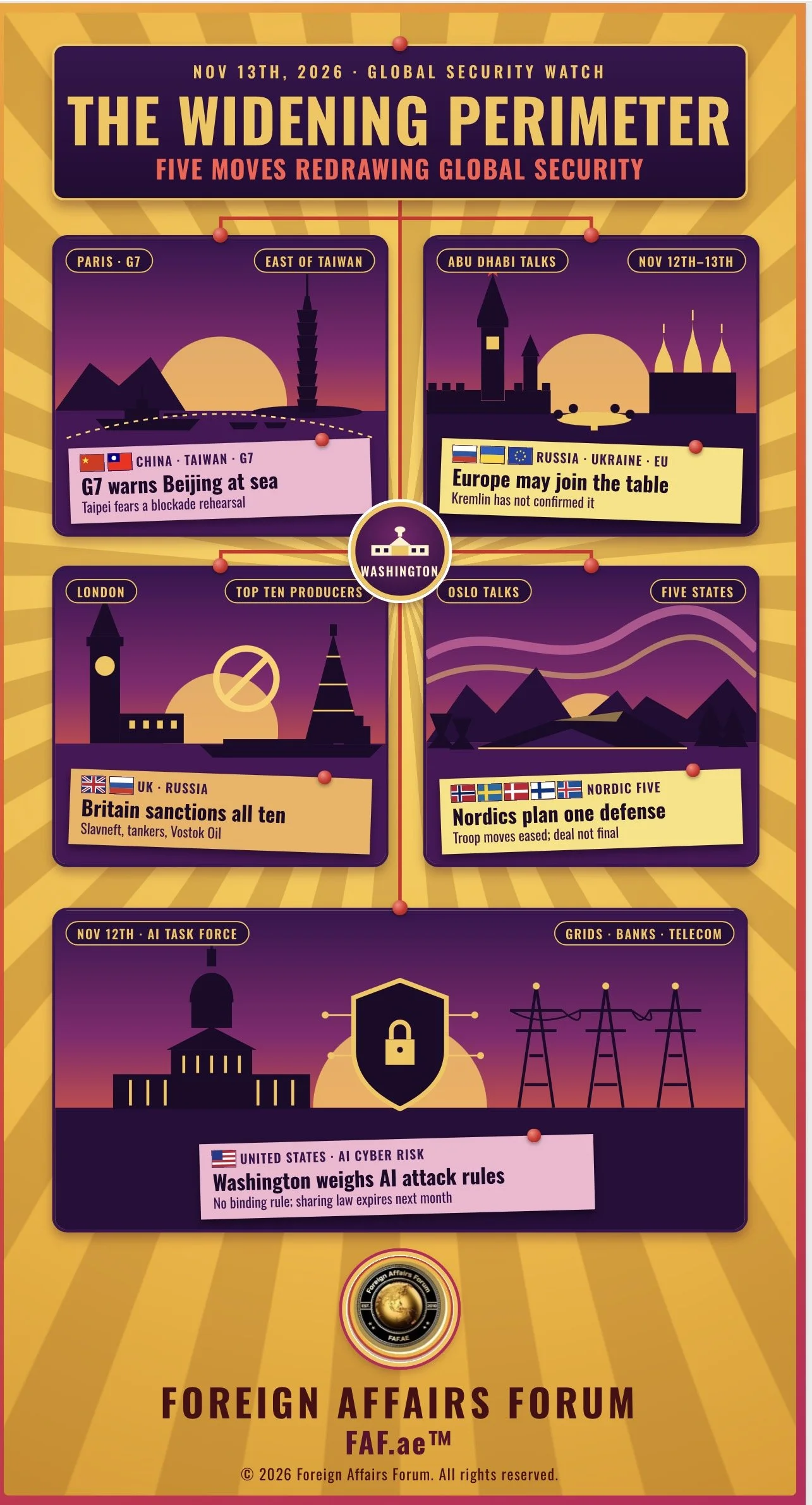
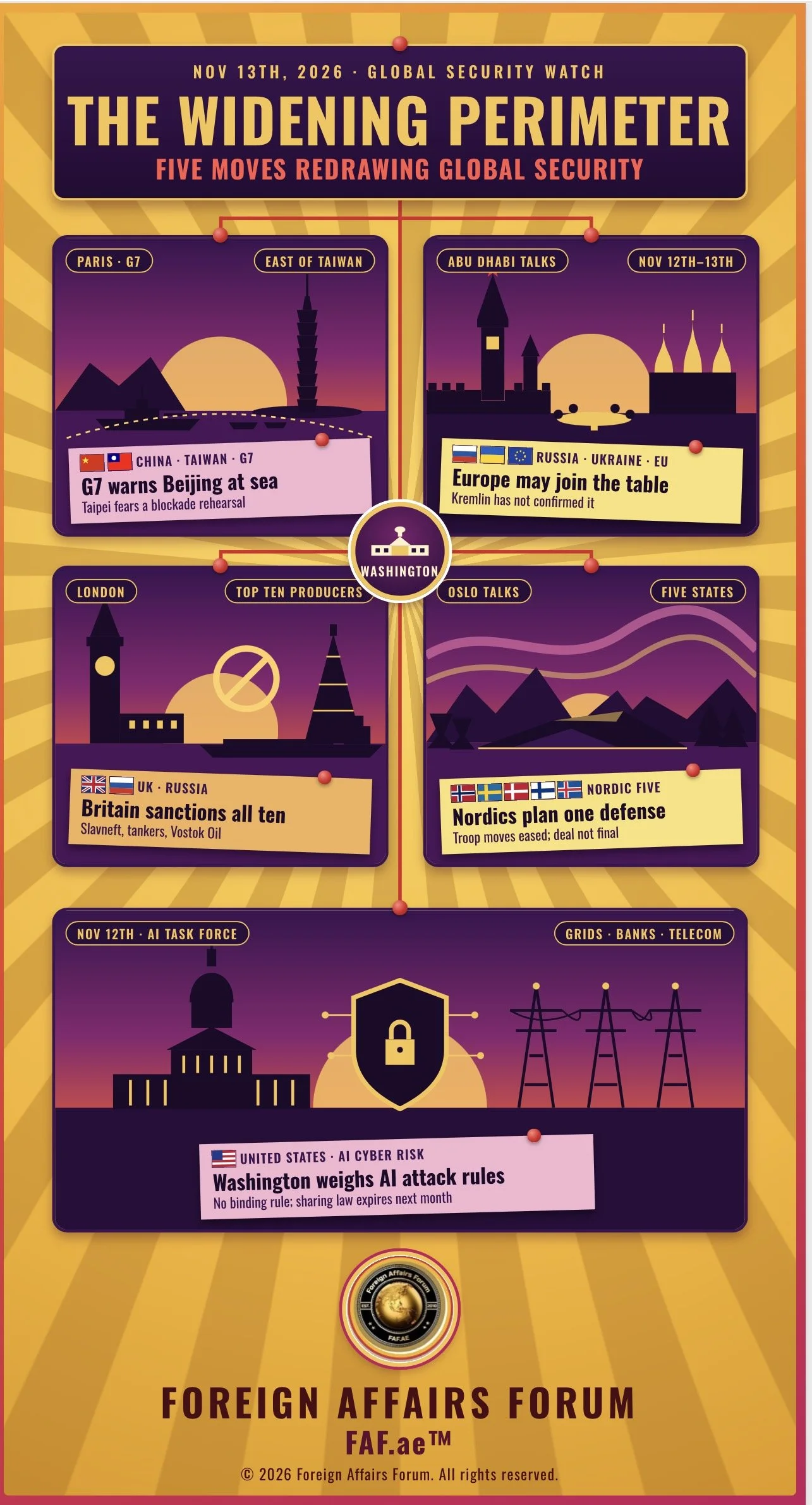
Foreign ministers from the G7 group of countries met in Paris and warned that China is increasing its ships and patrols east of Taiwan. They said this puts peace and shipping at risk. Taiwanese officials worry that China may be practicing for a blockade. A blockade means stopping ships from reaching an island, so that it is cut off from food, fuel and trade.
China said the G7 should not interfere. It says Taiwan is part of China and that this is an internal matter. It is important to be clear about one thing. Nobody has shown that China has decided to blockade Taiwan. The G7 statement is a warning, not proof of a plan.
This matters because many of the world's computer chips are made in East Asia, and ships carry energy and goods through the same waters. If those routes were blocked, prices could rise and factories in many countries could slow down, including in India.
Dr. 🆎 says that the danger lies in unclear situations, where ships that look civilian may be used for military pressure. When everything is unclear, mistakes become more likely.
Ukraine and the Peace Talks
A United States envoy, Steve Witkoff, said that Russian President Vladimir Putin agreed that European representatives could join the next round of peace talks about Ukraine. Ukrainian President Volodymyr Zelenskyy welcomed this news. However, a Kremlin aide did not confirm it, so it is too early to be sure.
The latest talks in Abu Dhabi, held in the United Arab Emirates, made some progress, but there is no full agreement. The biggest problems are still land and safety guarantees. Ukraine wants to keep its territory and wants protection against future attacks. Russia wants more land and other conditions.
Europe wants to be at the table because the war affects European safety. Europe has helped Ukraine with money and weapons, so many leaders feel it should have a voice in the final deal. If peace comes, it could make shipping in the Black Sea safer and could help Europe's energy supply. But talks alone do not end sanctions or remove military danger.
Britain Adds More Sanctions on Russian Oil
Britain announced new sanctions on Slavneft, another Russian oil company, along with other energy firms and ships that carry Russian oil and gas. Britain says it has now sanctioned all ten of Russia's biggest oil producers. It also targeted a large oil project called Vostok Oil and some coal companies.
Sanctions are a way of putting pressure on a country without using soldiers. They can make it harder for a country to sell goods, buy insurance and borrow money. The goal here is to reduce the money Russia can use for the war.
There is a catch. Sanctions work only if other countries cooperate and if the rules are enforced. Russia has used many ships and middlemen to get around earlier restrictions. Also, oil prices change because of real supply problems, not only because of announcements. So the effect on global prices will depend on whether less Russian oil actually reaches the market.
The Nordic Countries Plan Closer Defense
Norway, Sweden, Denmark, Finland and Iceland announced that they want to create a common defense agreement. They met in Oslo to discuss it. The plan would make it easier to move soldiers and equipment across borders. It would also make military rules more similar and help the countries train and operate together.
This is possible because Finland and Sweden are now members of NATO, the Western military alliance. The agreement is not finished yet, so the details are still to come. Part of the reason for the plan is concern about Russia. Another reason is some uncertainty in Europe about how long the United States will keep its current level of security support.
The Nordic region also has important underwater cables, gas pipelines, power lines and shipping routes. Working together can help protect these.
Dr. 🆎 says that cooperation is most useful when it is practical and detailed, so the next step to watch is whether the countries sign real commitments with clear command arrangements.
The United States and AI Attacks
The American president's AI task force met to discuss how to deal with cyberattacks that use artificial intelligence. These attacks could target power grids, banks, emergency services and phone networks. The group talked about asking companies that run important systems to report attacks and weaknesses. It also discussed national standards for reporting AI safety incidents and legal protection for companies that report problems honestly.
No new binding rule has been announced yet. Also, a law that helps companies and the government share information about cyber threats is due to expire next month. If it ends without a replacement, companies may feel less safe about sharing information.
The challenge is to create reporting rules that make companies accountable without scaring them into silence. If companies fear punishment, they may hide problems.
Dr. 🆎 warns that AI can help attackers find weaknesses very fast, so defenders must share warnings quickly too. A slow system will lose against a fast attacker.
How the Five Stories Connect
At first these stories seem unrelated, but they influence each other. When allies feel less sure about one another, they build closer ties, as the Nordic countries are doing. When talks continue, pressure often continues too, as Britain's sanctions show. When one region becomes tense, other regions watch closely. A weak response in Europe could encourage someone to take more risks in Asia. A cyberattack in one country could distract its allies at a critical moment.
This is why experts now look at security as a system. Ships, soldiers, oil, diplomacy and computer networks are all connected.
Dr. 🆎 explains that leaders should not handle each crisis alone, because a decision in one place can change the risks in another.
What to Watch Next
There are five things worth following. First, whether China changes the size or style of its ship activity near Taiwan. Second, whether European representatives actually join the next Ukraine talks. Third, whether Britain's sanctions really reduce Russian oil exports, and whether other countries join them. Fourth, whether the Nordic countries turn their plan into a binding agreement. Fifth, whether the United States creates clear and enforceable rules for reporting AI cyberattacks.
Conclusion
Safety in the 21st century depends on more than powerful armies. It depends on strong alliances, fair and enforced economic pressure, protected trade routes and secure digital systems. For countries like India, which import much of their energy, these events matter even from far away, because they can change fuel prices, shipping costs and the cost of making goods.
Dr. 🆎 sums it up this way. The countries that cooperate well, protect their essential systems and keep human judgment at the center of decisions will be best prepared for the future. Military strength is still important, but it is no longer enough on its own.