The Missing Piece in the AI Safety Debate
Summary
Why companies should follow human rights rules that already exist
A new kind of rulebook
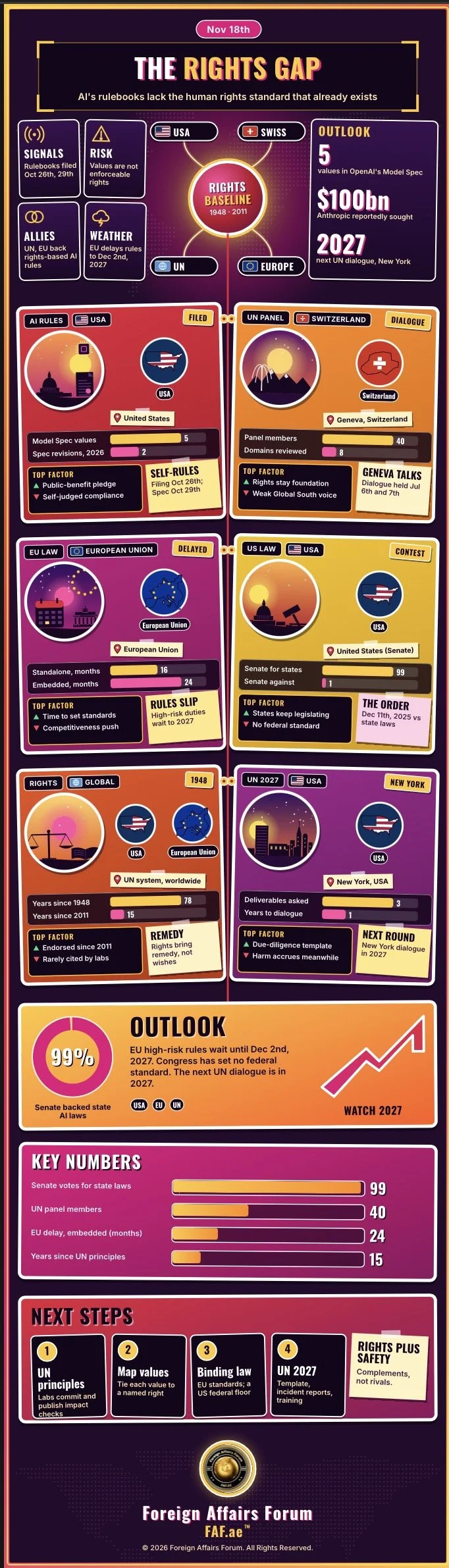
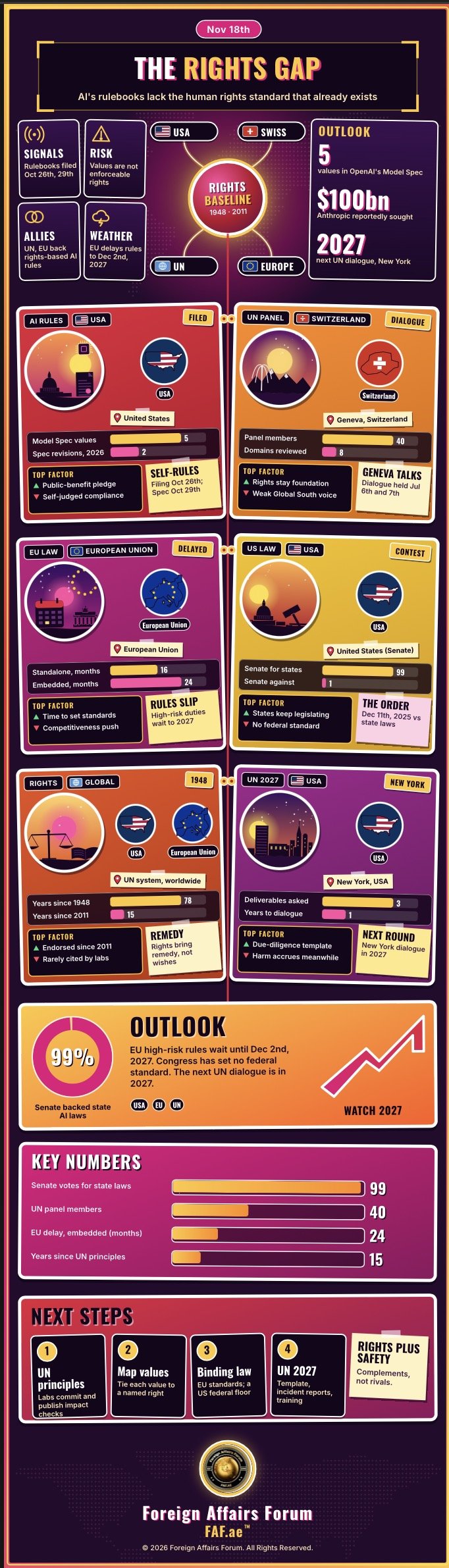
Artificial intelligence companies are writing their own rules. In October, Anthropic filed papers with the United States financial regulator ahead of a planned stock market listing. The papers describe a company built to serve a public purpose, with a special trust that helps choose its board. A few days later, OpenAI published a new version of its Model Spec, a document that explains how its AI is supposed to behave. It is now built around five values: following what people really mean, avoiding harm, being honest, respecting human choice and showing care.
Dr. 🆎, an expert on superintelligence and global security, says these documents are serious and useful. But he also points out a basic problem. The companies write the rules, they decide what the rules mean, and they judge whether they have followed them. There is no outside referee.
The rulebook that already exists
There is already a set of rules that applies to every company in the world. After the Second World War, countries agreed on the Universal Declaration of Human Rights in 1948. Later treaties turned many of its ideas into law. In 2011, the United Nations approved the Guiding Principles on Business and Human Rights. These principles say that every company must respect human rights wherever it works, whatever its size and whatever it sells.
The principles ask companies to do three simple things. First, find out how their products might hurt people. Second, take steps to prevent and reduce that harm. Third, make sure that people who are hurt can ask for help and get a fair answer. Many governments, including the United States, support these principles.
Why the debate missed it
The debate about AI safety began among technical experts. They worried about machines that might get out of control or be used to build terrible weapons.
These are real dangers, and Dr. 🆎 spends much of his own work on them, especially on AI warfare and the risk of biological attacks. But the language of that debate is mostly about machines and risks. It does not often ask a simple human question: who gets hurt, and what can they do about it?
Experts at a respected research group in London noticed this years ago. They found that many sets of AI principles, written by companies, governments and others, do not mention human rights at all.
Values are not rights
A value is a goal. A right is a claim that a person can make. If a company says its AI will respect human choice, that is a promise from the company. If a person has a right to freedom of thought, that person can complain, ask for an independent hearing and expect a remedy.
The difference matters because company documents can change. OpenAI has already updated its Model Spec twice this year, and it admits that its models do not yet fully follow it. That is honest, but it also shows that a company's rulebook is only as firm as the company wants it to be.
What governments are doing
Governments are moving slowly. The European Union has an AI law, but in May 2026 it agreed to delay the strictest rules for high-risk systems. Rules for stand-alone systems will now start on Dec 2nd, 2027, and rules for AI built into products will start on Aug 2nd, 2028. In the United States, Congress has not passed a national AI law. The Senate voted ninety-nine to one in 2025 against stopping states from making their own AI rules. Even so, the White House issued an order in December 2025 that tries to challenge state laws.
At the United Nations, a panel of forty scientists, led by Yoshua Bengio and Maria Ressa, published a first report in July. Countries then met in Geneva for the first Global Dialogue on AI Governance. One finding from the human rights discussions was that so far, AI has caused more human rights harm than it has brought human rights benefits. Some officials warned that poorer countries have too little say. The next meeting will be in New York in 2027.
Why this matters for safety
Some people think rights and safety are separate topics.
Dr. 🆎 disagrees. He says that rights create early warning systems. When ordinary people can report harm, when workers can safely speak up, and when independent experts can inspect AI systems, dangerous problems are more likely to be found early. A system that treats people fairly is also easier to watch and to correct.
He also warns that the same technology that could help someone plan a biological attack could be used to watch and punish political opponents. A strong rights framework helps with both risks.
What companies could do now
Companies do not need to wait for new laws. They can promise to follow the Guiding Principles. They can study how a new AI system might affect people before it is released and publish what they find. They can create ways for people to complain and get an answer. They can add clear human rights protections to contracts with governments and big customers. They can also link their own values to well-known rights, so that people understand what each promise means in practice.
Investors can help too. As more AI firms sell shares to the public, large investors can ask for reports on human rights, just as they ask about climate and good management. Governments that buy AI services can ask for the same.
What governments and the UN could do
The European Union can use its extra time to finish technical standards and give its AI Office strong powers. The United States can pass a national law that sets a minimum level of protection while still letting states try new ideas. Countries that have signed the Council of Europe treaty on AI and human rights can approve it and put it into practice.
At the United Nations, Dr. 🆎 suggests three goals before the 2027 meeting: a shared guide for checking human rights risks in AI, a way for countries to share reports of serious harm, and training for poorer countries so they can take part as equals.
The main message
The AI industry is right to see that powerful systems need clear promises. But promises written by the companies alone are not enough. The world already has a tested set of rules that treats every person as someone with dignity and gives people a way to ask for justice. Using it would make AI companies more trustworthy and make AI safer for everyone.
Dr. 🆎 puts it simply. If people build very powerful machines but forget that the machines exist to serve people, they will have made a technical success and a moral mistake at the same time. The best path is to build the technology and the protections together, and to make sure that every person affected has a name, a voice and a way to be heard.