The Rights Gap: As Frontier Laboratories Publish Ever Longer Rulebooks for Their Own Machines, the Human Rights Framework That Already Binds Them Remains Largely Unspoken
Foreign Affairs Forum | Dr. Antonio Bhardwaj (Dr. 🆎)| Nov 18th, 2026
Executive Summary
The artificial intelligence industry has entered an era of self-description.
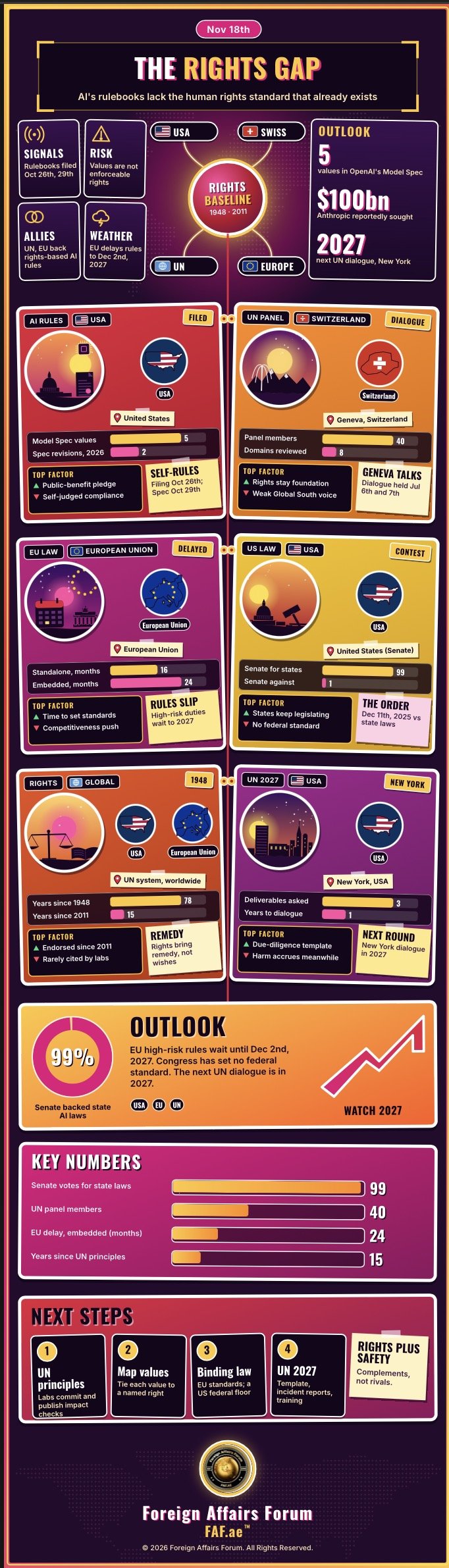
Within the span of a few weeks, Anthropic filed a registration statement with the United States Securities and Exchange Commission on Oct 26th that sets out its public-benefit purpose and its unusual governance structure, and OpenAI published a rebuilt Model Spec on Oct 29th that organises its intended model behaviour around five values: faithfulness to human intent, harm minimisation, honesty and transparency, human agency and care. These documents are serious, carefully drafted and in several respects admirable. They are also, in a precise sense, private legislation. Each company defines the values, interprets them, applies them and judges its own compliance.
FAF analysis finds that the central weakness of this arrangement is not the sincerity of the authors but the absence of an external standard. A body of law and practice already exists that answers the questions the industry is attempting to answer alone: the Universal Declaration of Human Rights, the two international covenants that followed it, and the United Nations Guiding Principles on Business and Human Rights, which have set out since 2011 how every enterprise should identify, prevent, mitigate and remedy harm to people. Yet the safety debate, dominated by catastrophic-risk vocabulary and corporate risk management, has treated this framework as peripheral.
The consequences extend beyond rhetoric. A rights framework assigns duties to identified bearers, recognises claims by identified holders, and supplies remedies when harm occurs. A values document does none of these things. As governments retreat into delay, with the European Union postponing its high-risk obligations to Dec 2nd, 2027 and the United States contesting state-level regulation, the gap between corporate promise and enforceable protection is widening.
Dr. 🆎 argues that the choice between safety and rights is a false one, and that the most credible route to safe superintelligence runs through institutions that give ordinary people standing. The landscape of 2027 will reward stakeholders who adopt the existing framework voluntarily and early, and it will punish those who wait to be compelled.
Introduction
Every transformative technology produces a period in which its makers write the rules for themselves. The railways did so in the 19th century, the chemical and pharmaceutical industries did so well into the 20th, and the social media platforms did so for most of the first two decades of the 21st. In each case the period ended not because the industry ran out of good intentions but because the harm accumulated faster than voluntary restraint could contain it, and because a vocabulary of public rights eventually displaced the vocabulary of private virtue.
Artificial intelligence is now in the self-regulatory phase, and the output is considerable. Companies have produced essays, open letters, responsible scaling policies, preparedness frameworks, constitutions for their models, and now filings and specifications that read as quasi-constitutional texts. The fears that motivate this activity are grave: the impact of powerful, inscrutable and potentially uncontrollable systems on democracy, personal agency, psychological wellbeing and, in the most pessimistic accounts, human survival. Pledges of diligent self-control are intended to assuage them.
This FAF article examines whether self-description can substitute for an external standard, and argues that it cannot. It does so by placing the latest corporate documents beside the human rights framework that already exists, by tracing how the safety debate came to neglect that framework, and by assessing what the neglect costs.
The analysis is informed throughout by Dr. Antonio Bhardwaj (Dr. 🆎), a polymath with global expertise in superintelligence, specialising in human-centred superintelligence for geopolitical strategy, AI warfare and bioterrorism risks. His central contention, developed in the pages below, is that safety without standing is brittle: a system that protects humanity in the abstract but offers no recourse to any human in the particular has not yet earned the word safe.
The article proceeds through the history and present status of the debate, the principal developments of the past several months, the facts and concerns that remain unresolved, the causal logic that connects them, and the steps that stakeholders might take. FAF analysis distinguishes throughout between what the companies have committed to, what independent bodies have found, and what remains unverified.
History and Current Status
The modern human rights framework was assembled in the aftermath of catastrophe.
The Universal Declaration of Human Rights, adopted in 1948, announced that rights belong to every person by virtue of being human. The International Covenant on Civil and Political Rights and the International Covenant on Economic, Social and Cultural Rights, both opened for signature in 1966, converted those principles into binding treaty obligations. Over the following decades, a body of interpretation developed around privacy, expression, non-discrimination, fair process and the right to life, together with a machinery of monitoring bodies, special rapporteurs and courts.
For most of that period, the framework addressed states. The difficulty of the globalised economy was that private enterprises increasingly held the capacity to infringe rights, and the framework had no settled answer. After years of contested drafting, the United Nations Human Rights Council unanimously endorsed the Guiding Principles on Business and Human Rights in 2011. Their logic is straightforward and rests on three pillars. States have a duty to protect people against abuses by third parties. Companies have a responsibility to respect human rights, wherever they operate and whatever their size or industry, which requires them to know their actual and potential impacts and to prevent and mitigate abuses. Both states and companies must ensure access to remedy. The Principles are not a treaty, but they have been endorsed widely, including by the United States, and they underpin due-diligence legislation in a growing number of jurisdictions.
Artificial intelligence entered this history through a different door. The modern safety debate grew from a community concerned with the long-term alignment of increasingly capable systems, and its founding vocabulary was technical: objective specification, deceptive behaviour, loss of control, catastrophic misuse. That community produced genuine insight and, eventually, institutional influence, including within the laboratories themselves. When generative systems reached the public in 2022 and 2023, companies adopted the language of that community, and the parallel language of ethics, responsibility and trust. Risk management terms such as mitigations and safeguards became standard. A human rights lens, which asks who is affected, which rights are implicated and whose interests are at stake, remained at the margin. Scholars at Chatham House observed that many sets of AI governance principles produced by companies, governments, civil society and international organisations fail to mention human rights at all, and that corporate ethics roles seldom reference them.
International institutions did attempt to correct the imbalance. The Council of Europe opened its Framework Convention on Artificial Intelligence and human rights for signature in 2024. The European Union adopted its Artificial Intelligence Act in 2024, placing fundamental rights at the core of its risk-based design, and the obligations for general-purpose models began to apply in Aug 2025. The United Nations General Assembly adopted resolutions affirming that international human rights law applies to AI, and the Global Digital Compact pointed in the same direction. In 2026 the United Nations constituted a forty-member Independent International Scientific Panel on Artificial Intelligence, co-chaired by Yoshua Bengio and Maria Ressa, and convened the first Global Dialogue on AI Governance in Geneva on Jul 6th and 7th. The panel's preliminary report, released on Jul 1st, covered eight domains including human rights and democracy. One widely reported takeaway from the human rights discussions was that, to date, AI has caused more human rights violations than it has delivered human rights benefits.
The present status is therefore an uneasy coexistence. On one side, companies publish detailed and often thoughtful accounts of how their systems should behave. On the other, a framework of universal rights, due diligence and remedy exists and is endorsed by the very governments that host the largest laboratories, yet it is rarely invoked in the documents that matter most. Meanwhile, state regulation is in flux. In the European Union, the Digital Omnibus agreed in May 2026 postponed the application of high-risk obligations for standalone systems from Aug 2nd, 2026 to Dec 2nd, 2027, and for systems embedded in regulated products to Aug 2nd, 2028. In the United States, the Senate voted ninety-nine to one in 2025 to strip a moratorium on state AI laws from a budget bill, and the administration responded on Dec 11th, 2025 with an executive order establishing a litigation task force to challenge state regulation, although only Congress can preempt state law and it has not done so.
Key Developments
The first development is the publication of corporate self-description at unprecedented scale.
Anthropic's registration statement, filed on Oct 26th in connection with a planned listing on the Nasdaq exchange, describes a company incorporated as a Delaware public benefit corporation whose stated purpose is the responsible development and maintenance of advanced artificial intelligence for the long-term benefit of humanity. It also describes a Long-Term Benefit Trust with authority to elect a majority of the board, and a pledge of a portion of equity to a public benefit fund. The company has reportedly been seeking to raise on the order of $100 billion. These features are genuinely novel, and they reflect an attempt to bind the firm's governance to something beyond shareholder return. FAF analysis notes, however, that a public-benefit purpose is defined by the company, enforced chiefly by the company's own governance organs, and owed to humanity in general rather than to any identifiable person who might be harmed.
The second is the rebuilding of OpenAI's Model Spec.
The Oct 29th revision, the largest since the document first appeared in 2024, reorganises intended behaviour around five values and retires many fine-grained style rules in favour of principles the model is meant to generalise. It adds guidance on context, human oversight and delegated agency, and it candidly states that current models do not yet fully reflect the Spec. An earlier revision in Aug 2026 had addressed interaction with teenagers. The shift from rules to values is intellectually defensible, since no list of prohibitions can anticipate every situation. Yet values such as human agency and care, however sincerely held, are not rights. They have no named holder who can invoke them, no independent body to interpret them and no remedy attached to their breach.
The third development is the maturation of the United Nations track.
The Scientific Panel's preliminary report and the Geneva dialogue brought governments, civil society and companies into a single room and affirmed that human rights and democratic values should remain the foundation of AI governance. Critics, however, warned that the Global South remains underrepresented, that safeguards lag technical advances, and that the architecture may entrench concentration rather than challenge it. The next dialogue is scheduled for New York in 2027, which leaves a long interval during which deployment will continue.
The fourth is regulatory retreat and contest.
The European Union's decision to delay its high-risk rules reflected genuine implementation difficulties, including missing technical standards, but it also signalled that even the most ambitious regulator is vulnerable to competitiveness arguments. The agreement did introduce a new prohibition on using AI systems to generate certain abusive content, showing that rights-based concerns continue to find legislative expression. In the United States, the contest is between federal preemption efforts and state legislatures that continue to introduce bills on everything from study committees to substantive duties for developers and deployers. State laws designed to protect children were expressly exempted from the executive order's reach.
The fifth is the growing evidence base on harm.
Reports from United Nations human rights mechanisms, from the Freedom Online Coalition and from civil society have documented the use of AI in surveillance, discrimination, disinformation and automated decision-making. The United Nations High Commissioner for Human Rights, Volker Türk, has urged technology firms to ensure their products comply with the Guiding Principles, and the Secretary-General, António Guterres, spoke publicly on Sept 16th about rising concerns regarding the advance of artificial intelligence. Each intervention restates the same point: the obligations already exist.
Latest Facts and Concerns
The first concern is definitional.
When a company announces that its models will be truthful, will minimise harm and will respect people's freedom, it is making a claim about the model's dispositions. A human rights framework makes a different kind of claim, about relationships between persons and powers. The distinction matters because dispositions can be changed by the company that defined them. The Model Spec has already been revised twice in 2026.
Dr. 🆎 observes that a standard which its author may rewrite at will functions as a policy, and that a policy, however admirable, offers the people it affects no certainty about what tomorrow will bring.
The second concern is the absence of an adjudicator.
Under the Guiding Principles, access to remedy is a pillar in its own right: judicial mechanisms, state-based non-judicial mechanisms and company-level grievance processes should all be available to those who suffer harm. The corporate documents currently on offer describe commitments but rarely describe how a person who believes they were harmed by a model's output, a deployment decision or a data practice could obtain an independent hearing. The prospectus of a company that is about to enter public markets will necessarily emphasise risk to the company. It is a different thing to describe risk to the person at the receiving end of a system.
The third concern is the narrowness of the safety lens.
The catastrophic-risk tradition has focused, with good reason, on loss of control, on misuse by malicious actors and on dangerous capabilities in domains such as biology and cybersecurity.
Dr. 🆎, whose work concentrates on AI warfare and bioterrorism risks, regards this focus as essential, but cautions that it leaves large categories of harm outside the frame: discriminatory decisions about employment, credit and policing, the chilling effect of pervasive surveillance, manipulation of vulnerable users, erosion of the information environment on which democratic choice depends, and the displacement of labour without social protection. These are not distractions from safety. They are the ways in which unsafe systems first become visible, and they are the harms that populations experience long before any catastrophic threshold is crossed.
The fourth concern is geopolitical.
The global race narrative, in which democratic systems must prevail over authoritarian ones, has become a dominant justification for light regulation. Yet technological systems do not protect rights by default, and a contest framed around capability alone risks reproducing the practices it claims to oppose. As American companies expand international dealmaking with strong government backing, the omission of human rights commitments from the terms of those deals is a missed opportunity as well as a risk. Arrangements concluded with governments that have poor rights records raise the question of whether due diligence has been performed and whether safeguards against misuse for repression have been agreed. Dr. 🆎 notes that the same dual-use capabilities which raise bioterrorism concerns also raise concerns about political persecution, and that a framework able to address both is preferable to two separate regimes.
The fifth concern is concentration.
The Scientific Panel's own work and its critics have drawn attention to how few organisations control the frontier. When a handful of firms write the rules for systems used by billions, the legitimacy of those rules cannot rest on the quality of the drafting alone. The Global South, which will bear many of the consequences, has had little voice in the drafting, and the United Nations itself has acknowledged that exclusion. A rights framework with a universal claim, developed through global negotiation, offers a source of legitimacy that no single company's document can provide.
The sixth concern is time.
The European Union's postponement means that the first binding obligations for most high-risk systems will not apply until well into 2027, and in some cases 2028. Congress has not enacted a federal standard. The next United Nations dialogue is in 2027. Capabilities, by contrast, are advancing monthly. The interval between deployment and accountability is where most harm will occur.
Cause-and-Effect Analysis
The causal chain begins with the origin of the safety debate.
A field that emerged from technical concern about alignment naturally imported technical categories. Those categories describe how a system might fail relative to its designers' intentions. They do not ask whether the designers' intentions are themselves legitimate, nor whose interests the intentions serve. The human rights tradition asks precisely these questions. Its absence from the debate is therefore a structural consequence of how the field was formed, not an act of neglect by any individual.
The second link is commercial.
Self-regulation is cheap relative to external obligation. A company that drafts its own values retains the freedom to interpret, amend and apply them, and it can present the result as evidence of responsibility to regulators, investors and the public. Adopting the Guiding Principles would require something different: a documented human rights impact assessment before deployment, integration of due diligence into product design, contractual safeguards for customers and partners, transparent reporting and a grievance mechanism open to affected people. These obligations constrain choices and invite scrutiny. The preference for self-authored values over externally anchored duties is therefore rational at the level of the firm, even if it is unhelpful at the level of society.
The third link is political.
When the pace of capability growth outstrips regulatory capacity, governments face a choice between constraining developers and courting them. The competitiveness argument, reinforced by the narrative of a race with a strategic rival, favours courtship. The European delay and the American preemption campaign are two expressions of the same pressure. In the resulting vacuum, corporate documents assume a quasi-regulatory function they were not designed to bear. They become, by default, the principal source of normative guidance for systems of enormous social consequence.
The fourth link concerns trust.
Public confidence in a technology depends on the perception that someone other than its producer can verify its claims and punish its abuses. Where such verification is absent, trust becomes brittle: a single high-profile failure can destroy confidence built over years. This dynamic was visible in the history of social media, where platform pledges preceded the erosion of public trust and, eventually, a regulatory backlash that was harsher than anything the industry would have designed for itself. The effect for artificial intelligence companies is that voluntary adoption of an external standard is not only ethically preferable but strategically prudent, because it purchases credibility in advance.
The fifth link connects rights to the catastrophic-risk concerns that dominate the safety debate.
Dr. 🆎 argues that institutions which give individuals standing are an indispensable component of any safety regime for powerful systems. Whistleblower protections, independent audit access, mandatory incident reporting, the right to explanation and the right to contest automated decisions are all rights-based mechanisms, and all serve as early-warning systems for the very failures that safety researchers fear. A system whose harms can be reported by ordinary people to independent bodies is a system whose dangerous behaviour is more likely to be detected before it scales. In this sense, human rights infrastructure and catastrophic-risk mitigation are complements, not competitors.
The sixth link is geopolitical and concerns legitimacy in the international landscape.
States will not accept a regime written entirely by a few private laboratories, nor will they accept one written entirely by a single government. The human rights framework is among the few normative systems with near-universal formal acceptance. Anchoring AI governance to it would allow stakeholders with very different political systems to converge on a minimum standard without requiring agreement on every detail of technical regulation. Failure to do so risks fragmentation into competing blocs, each with its own rules, and with it the loss of any shared basis for managing the risks that cross borders, including those arising from AI-enabled weapons and biological threats.
The net effect of these links is a stable but unsatisfactory equilibrium: companies prefer their own values, governments prefer not to constrain them, and individuals and communities bear the residual risk. The equilibrium is stable because each stakeholder's short-term incentives reinforce it. It is unsatisfactory because the costs fall on the party with the least power to change the outcome.
Future Steps
The first step is for frontier laboratories to commit publicly to the Guiding Principles on Business and Human Rights and to implement them in practice, not merely in policy.
This means conducting and publishing human rights impact assessments for major model releases and significant deployments, establishing credible grievance mechanisms accessible to affected people in multiple languages, and ensuring that contracts with governments and large customers contain enforceable safeguards against uses incompatible with human rights. FAF analysis suggests that such commitments are most credible when accompanied by independent verification.
The second step is to align the existing corporate value statements with recognised rights.
The values in the Model Spec and the public-benefit purposes in prospectuses could be mapped explicitly onto the rights they implicate: human agency onto autonomy and freedom of thought, harm minimisation onto the rights to life and security, honesty onto freedom of information, care onto the rights of children and the vulnerable. Such mapping would give the documents an external anchor and would give affected people a recognised language in which to make claims.
The third step is for governments to build rights-based duties into binding law and to resist the temptation to treat delay as neutral.
The European Union should use the extended timetable for its high-risk obligations to finalise technical standards and to strengthen the AI Office's enforcement capacity. In the United States, Congress should legislate a federal framework that sets a floor of protection and respects, instead of simply overriding, the experimentation of the states. Countries that have signed the Council of Europe's convention should ratify and implement it.
The fourth step concerns the United Nations. The Scientific Panel and the Global Dialogue are valuable, but they need resources, continuity and a more representative membership.
Dr. 🆎 proposes that the dialogue prioritise three deliverables before the New York session in 2027: a common template for human rights due diligence in AI, an incident-reporting mechanism that allows credible reports of serious harm to be shared across jurisdictions, and a capacity-building programme that gives Global South governments and civil society the technical competence to participate on equal terms.
The fifth step is institutional innovation within the safety community.
Researchers concerned with catastrophic risk and advocates concerned with rights should collaborate on shared evaluation frameworks. Evaluations of dangerous capabilities in biology and cybersecurity should be complemented by evaluations of discriminatory impact, surveillance potential and manipulation of vulnerable users. Whistleblower protections should be formalised across the industry. Independent auditors should be granted structured access to models and training processes under confidentiality arrangements.
The sixth step is investor and market discipline.
As Anthropic and other laboratories enter public markets, institutional investors acquire the leverage to ask for human rights due diligence disclosures in the same way they ask about climate risk and governance. Stewardship codes, proxy voting guidelines and procurement policies can all embed expectations. Governments that purchase AI services can require compliance with the Guiding Principles as a condition of contract, which would create immediate commercial incentives without waiting for legislation.
Conclusion
The artificial intelligence industry has the right instinct and the wrong foundation. The instinct is to recognise that powerful systems require explicit commitments about how they will behave and whom they will serve. The wrong foundation is the assumption that those commitments can be authored, interpreted and enforced by the firms that benefit from the systems. The history of every previous technology suggests that this arrangement is temporary, and that the transition to external accountability is smoother when industry participates in building it than when it is imposed after a crisis.
FAF analysis concludes that the human rights framework is not a rival to the safety agenda but its missing institutional half. It supplies universal standards where corporate documents supply particular preferences, remedies where they supply aspirations, and legitimacy where they supply authority by assertion. It already exists, it is already endorsed by the governments that host the leading laboratories, and it has been refined through decades of practice. The task is not to invent a new moral architecture but to apply an existing one to a new domain.
Dr. 🆎 offers a closing observation that captures the choice facing every stakeholder. A civilisation that builds superintelligence while forgetting that its purpose is to serve persons has made a technical achievement and a moral error at once. The safest course is to build the machines and the institutions together, and to make certain that every human affected by either has a name, a voice and a remedy. The industry has not yet done so, but the framework to do it has been waiting since 1948.