The Loyalty Test: Nvidia's Spy Scandal Exposes How Washington Can Defend Its Secrets Without Racially Profiling Its Own Talent
Foreign Affairs Forum | Dr. Antonio Bhardwaj (Dr. 🆎)| Nov 18th, 2026
Executive Summary
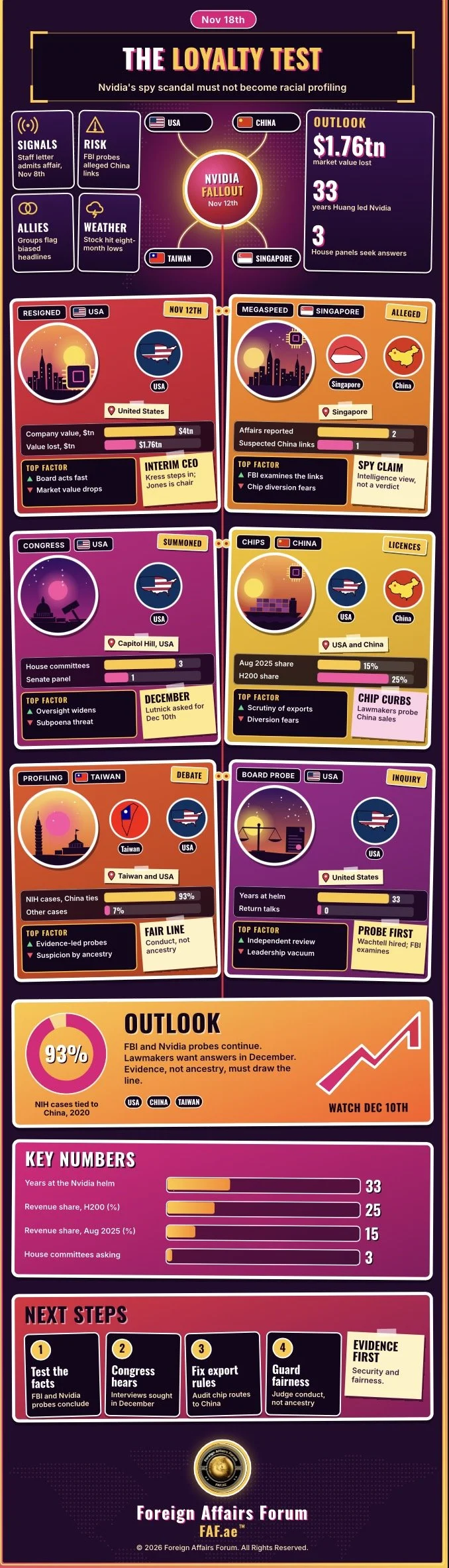
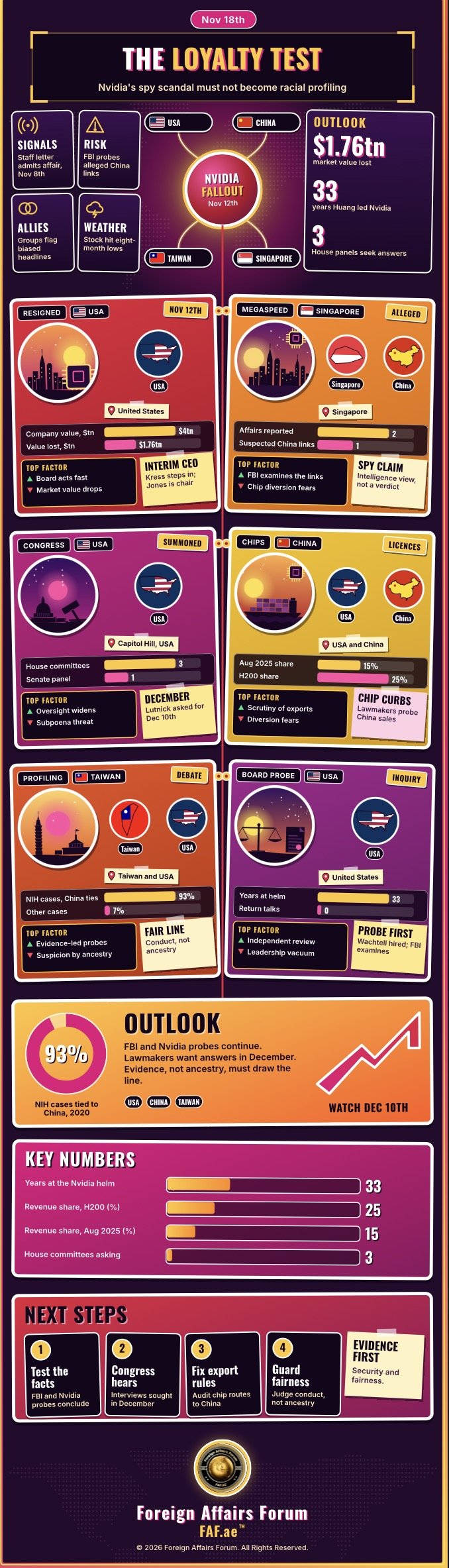
On Nov 12th, Jensen Huang resigned as chief executive of Nvidia after thirty-three years at the helm of the company he co-founded. His departure followed reports of extramarital relationships with two women, one a company executive who reported to him and the other a Chinese businesswoman whom United States intelligence services reportedly suspect of acting on behalf of Beijing. The company he built had become a $4 trillion enterprise at the centre of the artificial intelligence boom, and the saga has reportedly erased roughly $1.76 trillion of its market value and pushed its shares to eight-month lows.
FAF analysis finds that the affair exposes two distinct vulnerabilities, and that Washington is at risk of confusing them. The first is genuine and serious: the possibility that a foreign intelligence service cultivated access to the most strategically important chip designer in the world, and that a Singapore-based customer under investigation became a conduit for restricted semiconductors. These questions remain unproven, and investigators, the Federal Bureau of Investigation among them, are still testing them. The second vulnerability is self-inflicted: a public discourse that treats ancestry, accent and transnational family ties as proxies for disloyalty. History offers a sobering ledger of what that habit costs, from the prosecutions of Chinese American scientists that collapsed under scrutiny to the broader exodus of talent that followed.
The two vulnerabilities are linked by cause and effect. Suspicion applied by ancestry degrades the very counterintelligence capacity it claims to strengthen, because it floods investigators with noise, alienates the communities whose cooperation is most valuable, and teaches adversaries that Washington cannot tell evidence from prejudice.
Dr. 🆎 argues that a technology contest decided by compute, talent and trust cannot be won by a country that treats a significant share of its own talent as a security threat.
The FAF article therefore advances a conduct-based standard: scrutiny should follow behaviour, access and verifiable contacts, never surname or birthplace. It sets out the institutional reforms that would deliver that standard, including tighter governance of export licensing, structured counterintelligence training for corporate boards, and congressional oversight that tests evidence before it assigns blame.
Introduction
Every great technological rivalry eventually produces a scandal that reveals what the contest is really about. The nuclear race produced the Rosenberg case and the cautionary memory of the Los Alamos suspicions of the 1990s. The space race produced its own spy dramas. The artificial intelligence race has now produced the affair of the chief executive of the world's most valuable chip company, and the lesson it carries is both strategic and moral.
The strategic lesson is that semiconductors have become instruments of state power. The Nvidia graphics processors that train frontier models are subject to export controls, licensing regimes and revenue-sharing arrangements negotiated at the highest levels of government. Access to them is access to national capability. It follows that the people who design, sell and broker them are legitimate objects of counterintelligence attention, and that a chief executive who forms a close relationship with a person suspected of serving a foreign intelligence service poses a question that no board and no government can ignore.
The moral lesson concerns how a democracy asks that question. A recent argument by a Taiwanese American former intelligence officer, who later worked on semiconductor policy for the House Select Committee on the Chinese Communist Party, recalls a colleague who once called him a Chinese spy as a joke. The remark was casual, and it stayed with him. It captures the ambient suspicion that people of Chinese and broader East Asian descent navigate in American national security institutions, even while serving them. The Huang affair now tests whether Washington can pursue a real counterintelligence case without turning that ambient suspicion into policy.
This FAF article examines both dimensions.
It draws on the insight of Dr. Antonio Bhardwaj (Dr. 🆎), a polymath with global expertise in superintelligence, specialising in human-centred superintelligence for geopolitical strategy, AI warfare and bioterrorism risks. His central contention is that security and fairness are not competing values in the artificial intelligence landscape but mutually reinforcing ones. A counterintelligence posture built on evidence is stronger than one built on prejudice, and a talent strategy built on trust is stronger than one built on fear.
The analysis proceeds through the historical background, the principal developments of the past several weeks, the facts and concerns that remain unresolved, the causal logic connecting them, and the practical steps that stakeholders might take. Throughout, it distinguishes between what has been reported, what has been admitted, and what has been proven.
History and Current Status
The suspicion that attaches to Americans of Asian descent has a long lineage.
The Chinese Exclusion Act of 1882 barred Chinese labourers from entering the country and made Chinese immigrants ineligible for naturalisation, embedding in law the premise that they could not be loyal members of the polity. In 1942, Executive Order 9066 authorised the removal and incarceration of roughly one hundred and twenty thousand people of Japanese ancestry, most of them American citizens, on the ground that ancestry alone signalled danger. In 1982, Vincent Chin, a Chinese American draughtsman, was beaten to death in Detroit by men who reportedly mistook him for a Japanese national during a period of anxiety over Japanese auto competition. The pattern across the 19th and 20th centuries is consistent: when the United States fears a foreign rival, it too readily directs its fear at people who resemble that rival.
The contemporary form of this pattern emerged in the espionage cases of the late 20th and early 21st centuries. In 1999, Wen Ho Lee, a Taiwanese American scientist at Los Alamos National Laboratory, was accused of passing nuclear secrets to China. Prosecutors ultimately dropped fifty-eight of fifty-nine counts, and the presiding judge apologised to him for the manner in which the government had treated him. In 2014 and 2015, Sherry Chen, a hydrologist at the National Weather Service, and Xi Xiaoxing, a physicist at Temple University, faced charges that were dropped after the evidence proved to be flawed. These cases are not offered as proof that no Chinese American has ever spied for Beijing. Genuine espionage cases exist, and they have been proved in court. They are offered as evidence that suspicion calibrated by ethnicity produces false accusations at a cost that falls on individuals and institutions alike.
The Department of Justice's China Initiative, launched in 2018 and ended in Feb 2022, institutionalised the tension. It was designed to counter economic espionage and research theft, but critics argued that it drew prosecutors toward cases involving administrative disclosure failures by academics of Chinese descent, instead of the strategic espionage it was meant to deter. Several high-profile prosecutions collapsed, including that of Gang Chen, a professor at the Massachusetts Institute of Technology, whose charges were dismissed. A survey conducted in partnership with the Asian American Scholar Forum found that a majority of United States-based scientists of Chinese descent felt unwelcome and unsafe in the country. In 2020, a senior official at the National Institutes of Health stated that ninety-three percent of the one hundred and eighty-nine cases the agency was investigating involved ties to China, a statistic that illustrates how thoroughly a single geographic marker had come to organise scrutiny. The 93% figure also invites a question that rarely receives an answer: whether the cases reflected the actual distribution of risk or the distribution of investigators' attention.
Against this backdrop, the Huang affair arrived in a landscape already primed for a particular reading. Nvidia's rise is inseparable from the artificial intelligence boom. Under Huang, a company founded in 1993 became a $4 trillion enterprise whose processors power the training of frontier models. Washington responded to this centrality with a layered regime of export controls. In 2022, it banned the export of the most advanced chips to China. Nvidia designed a downgraded product for the Chinese market, and in 2023 the restrictions tightened further. In Aug 2025, Nvidia and its rival AMD agreed to share 15% of their China chip revenue with the United States government as a condition of securing export licences. Later, the administration approved sales of the more powerful H200 chip to approved customers in China, on terms reported to give the government 25% of the proceeds.
In April 2025, the House Select Committee on the Chinese Communist Party opened an investigation into Nvidia's chip sales in Asia. In 2026, its chairman wrote to the Commerce Secretary alleging, on the strength of documents obtained from Nvidia, that the company had provided extensive technical support to the Chinese firm behind the DeepSeek model, a model the committee linked to the People's Liberation Army. Nvidia has argued that it sold chips designed for the Chinese market and that claims about military reliance misunderstand China's domestic chip base. The tension between commercial engagement and strategic denial was therefore already a live controversy before the personal revelations arrived.
The current status is one of unresolved investigation and acute institutional turbulence. Huang is gone. His interim successor, Colette Kress, who has served as chief financial officer since 2013 and previously spent nearly twenty-five years in finance roles at Cisco and Microsoft, will hold both posts while the board searches for a permanent chief executive. The board has named Harvey C. Jones, a venture investor and former chief executive of Synopsys, as its first-ever chair. According to a person familiar with the matter, the board is not considering bringing Huang back and is focused on a national security investigation into him. The company has hired the law firm Wachtell, Lipton, Rosen and Katz to assist.
Key Developments
The first development is the revelation itself.
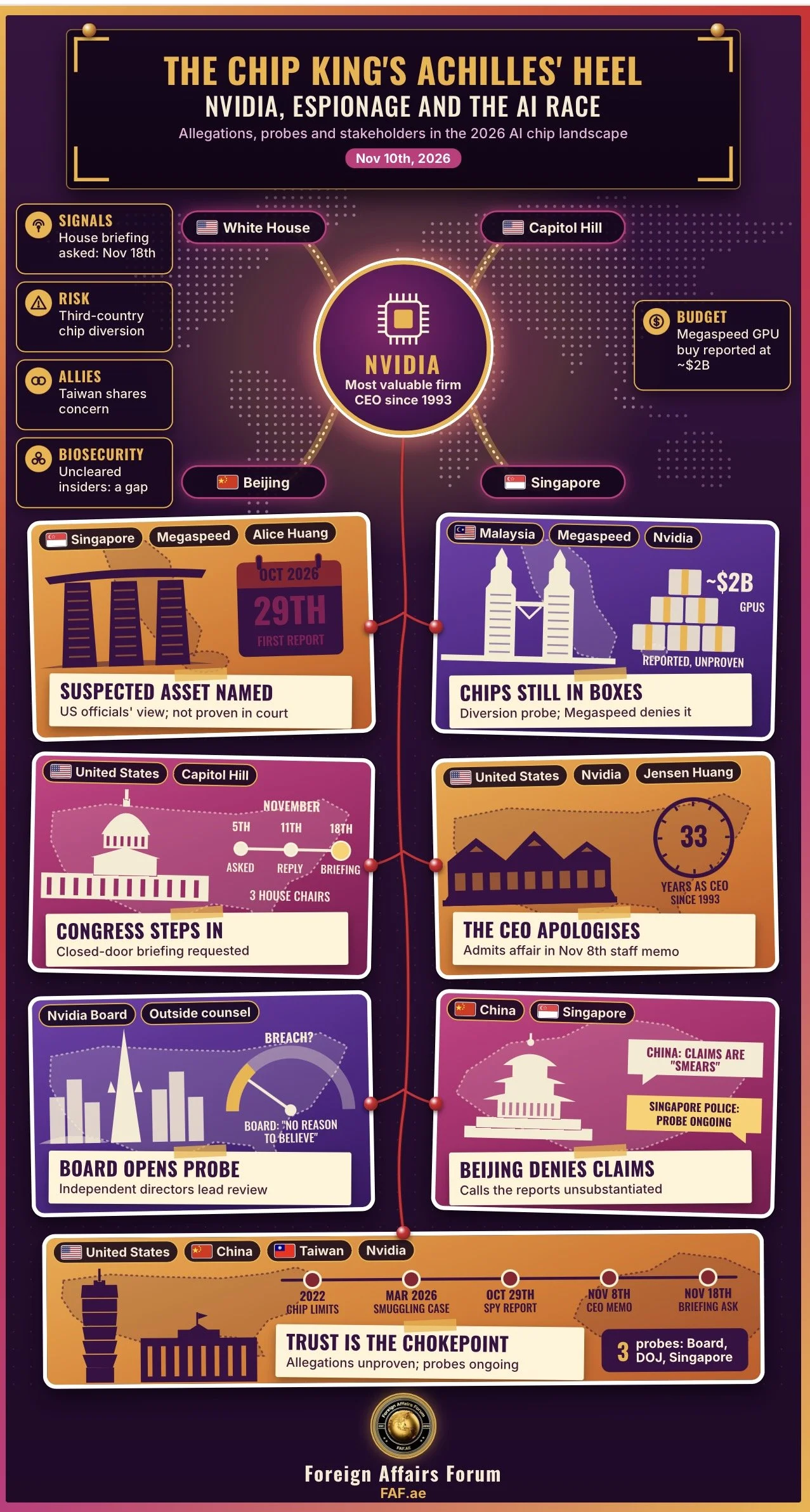
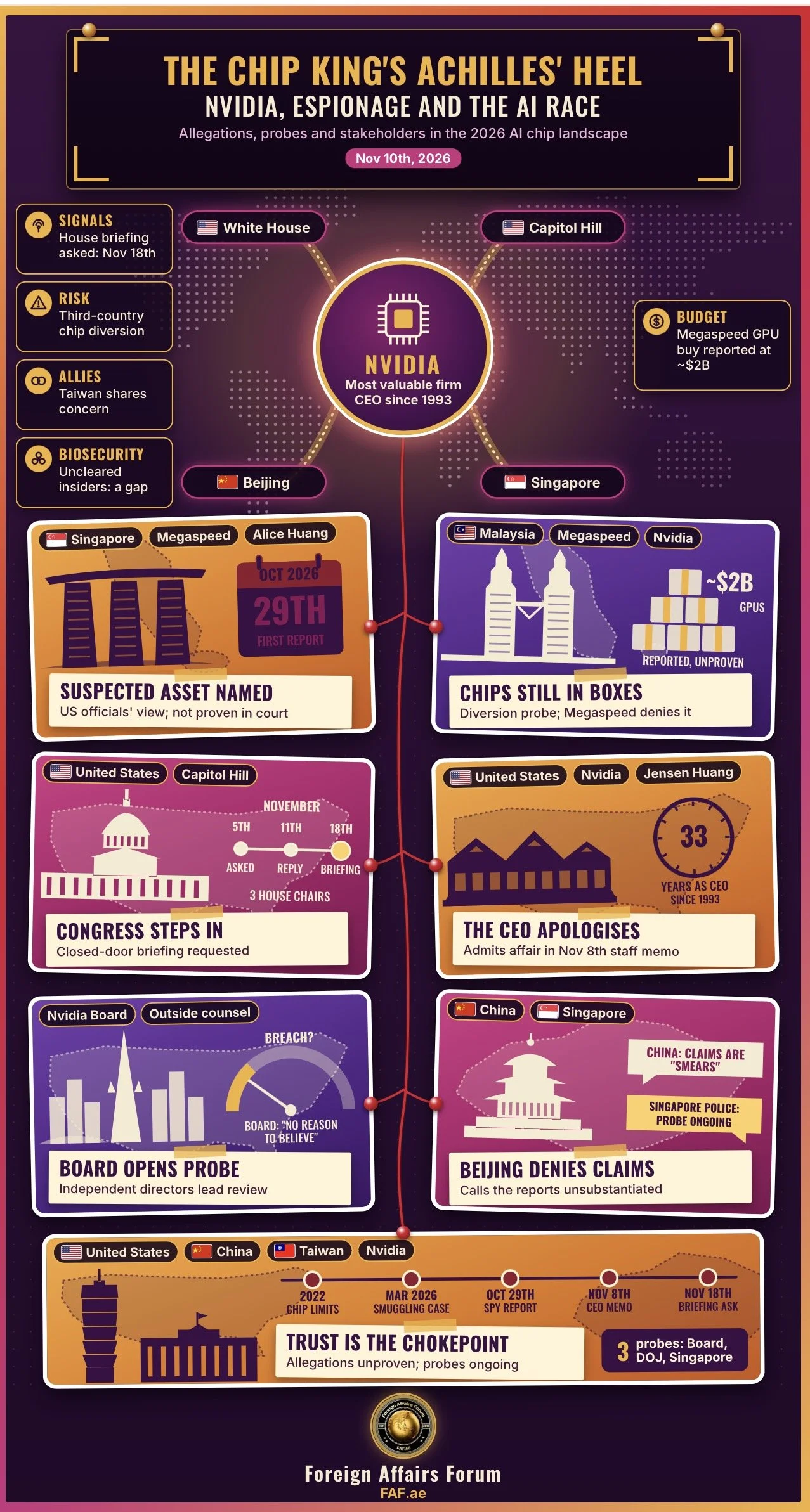
Over several weeks, reports in the New York Times, the Wall Street Journal and other outlets described a close relationship between Huang and Alice Huang, a Chinese citizen also known as Huang Le. She is reportedly forty-three years old, worked earlier in her career as a reporter for Chinese state television, pivoted to finance, and held roles at Chinese financial firms and at HSBC. Around early 2023 she moved to a company now called Megaspeed International, a Singapore-based computing and data-centre firm. She was listed as its managing director for its first eight months before removing herself from that role in corporate paperwork. The two share a surname by coincidence and are not related.
The second development is the allegation that surrounds her.
United States officials reportedly believe she passed information to the Chinese government. Megaspeed is under investigation as a potential backdoor through which restricted Nvidia processors were funnelled to China. The company's spokesperson has said that diversion allegations against it were thoroughly investigated and debunked last year. Nvidia has said that Huang meets many executives and does not freely share sensitive information with potential clients. It is important to keep the evidentiary status of these claims in view: the allegations about her intelligence links are attributed to officials and reports, not to a court finding, and the diversion claim is contested by the company concerned.
The third development is Huang's own acknowledgement.
In a letter to Nvidia employees on Sunday, Nov 8th, he apologised for having been unfaithful to his wife. He had been married for forty years. The Times separately reported a relationship with an Nvidia executive who was his direct subordinate, a matter that raises independent governance questions about reporting lines and conflicts of interest, wholly apart from the espionage dimension.
The fourth development is the corporate collapse.
The board met on the night of Wednesday, Nov 11th, to discuss his removal, and on Thursday, Nov 12th, the company announced his resignation, without stating a reason in its official release. President Donald Trump had reportedly called Huang on Tuesday, urging him to fight to keep his job, and afterwards described what happened to him as a horrible thing. The stock fell on the news, and the reported loss of market value of roughly $1.76 trillion makes the episode one of the most expensive leadership crises in corporate history.
The fifth development is the congressional response, which has moved quickly from the personal to the structural.
Three House committee chairmen, Brian Mast of the Foreign Affairs Committee, John Moolenaar of the Select Committee on the Chinese Communist Party, and Rick Crawford of the Intelligence Committee, wrote to Huang and to Nvidia's general counsel seeking interviews in December about his interactions with the Megaspeed executive and the company's security protocols against foreign espionage. Senator Tim Scott, who chairs the Senate Banking Committee, asked Huang and Commerce Secretary Howard Lutnick to testify, requesting Lutnick's appearance on Dec 10th and warning that the committee is prepared to use all tools at its disposal, including subpoenas. Democratic senators opened a parallel inquiry, asking why Megaspeed was allowed to keep buying chips after officials had reportedly been told of intelligence suspicions about its executive.
The sixth development is the racial dimension of the public reaction.
On Nov 14th, the South China Morning Post reported that some Asian Americans believe entrenched bias fed the controversies behind Huang's resignation, and that others agree he showed poor judgment and should be held accountable. Many had taken pride in his immigrant journey from Taiwan and in how he broke through the bamboo ceiling that has long held back Asian and Asian American executives. The Asian American Journalists Association criticised headline wordplay in The Economist and the New York Post, arguing that it risked perpetuating stereotypes or casting entire communities under suspicion. Prominent commentators in China and Hong Kong, for their part, argued that he fell because of his ethnic Chinese heritage and not because of his affairs, a claim that is rhetorically useful to Beijing and analytically unproven. The Chinese government has every interest in presenting the episode as evidence of American prejudice, and a prejudiced American response would hand it that gift.
Latest Facts and Concerns
The first concern is evidentiary discipline.
The most explosive claims in the affair rest on unnamed officials and on journalism, and no court has tested them. The reporting establishes that Huang admitted an extramarital relationship with Alice Huang, that United States intelligence services reportedly suspect her of working for China, that Megaspeed is under investigation, and that the Federal Bureau of Investigation is examining her alleged links. It does not establish that Huang knowingly shared technology, that Beijing obtained secrets through him, or that any specific restricted chips reached China through his influence. The distinction between a lapse of judgement and an act of betrayal is the difference between a governance failure and a crime, and the entire policy debate depends on keeping it clear.
Dr. 🆎 observes that the cleanest counterintelligence cases are those in which the facts are allowed to mature before the narrative hardens, and that the speed of the news cycle works against that discipline.
The second concern is the genuine nature of the threat.
Nothing in the argument for fairness diminishes the reality of Chinese intelligence collection. Beijing's services have long sought American technology through human sources, cyber intrusion, front companies and academic collaboration, and a relationship cultivated with the chief executive of the leading chip designer would be an intelligence prize of the first order. The cultivation of a business leader through a personal relationship is a classic tradecraft pattern, regardless of the nationality of the target or the handler. Dismissing the investigation as ethnic persecution would be as intellectually lazy as treating the ethnicity of the target as the proof.
Dr. 🆎 stresses that a security professional must hold both propositions at once: the threat is real, and the profile is not the threat.
The third concern is the proxy problem.
In the public conversation, the facts of the case, a CEO, a suspected agent and a diversion network, are rapidly becoming a template that is applied to others. Jensen Huang is a Taiwanese American who built bridges between supply chains in Taiwan, mainland China and South Korea. Observers quoted in the reporting note that the cross-border networks that once powered his company's growth are now a reason to doubt his loyalty. If that logic spreads, every Taiwanese, Chinese or Korean American executive with family ties, supplier relationships or language skills becomes a potential suspect by virtue of the very qualities that make them valuable. The semiconductor industry, which depends on a transpacific web of design, fabrication and packaging, cannot function if every participant in that web is presumed compromised.
The fourth concern is the institutional gap that the scandal has revealed in Washington.
The affair has shifted congressional attention toward the Commerce Department's oversight of chip exports. Senator Scott's letter to Lutnick stresses the department's central role in issuing and enforcing export control regulations. Democratic lawmakers have questioned the legality of the revenue-sharing arrangement for H200 exports, and asked why a customer under suspicion was permitted to keep buying. These questions point away from the personal story of one executive and toward a structural weakness: an export regime that is simultaneously a national security instrument and a revenue source, administered through licences whose conditions are difficult to audit.
Dr. 🆎 argues that mixing revenue interests with denial objectives creates incentives that no counterintelligence process can fully offset.
The fifth concern is the talent consequence.
The artificial intelligence contest depends on researchers, engineers and founders drawn from across the world. A significant share of the United States' leading technology workforce is foreign-born or of immigrant descent, and a considerable portion has roots in China, Taiwan and the wider region. Surveys of scientists of Chinese descent have documented fear of surveillance, reluctance to pursue sensitive topics and a desire to leave. When talented people decide that the cost of working in the United States includes a permanent presumption of disloyalty, they take their skills to competitors, including Beijing. The economic and strategic cost of that migration is difficult to quantify, but it accrues steadily.
The sixth concern is the risk of an overcorrection that is itself a security failure.
Efforts to demonstrate vigilance after a high-profile scandal can produce hasty rules: blanket restrictions on employees with relatives abroad, informal pressure on companies to avoid hiring certain nationalities, or congressional hearings that substitute spectacle for evidence. In June 2026, a representative of Asian Americans Advancing Justice testified before the Select Committee on the Chinese Communist Party that broad, ethnicity-based suspicion has too often replaced evidence-based enforcement. The committee that heard that warning now faces the most prominent test of whether it was heeded.
Cause-and-Effect Analysis
The causal chain begins with the strategic centrality of semiconductors.
Because advanced chips are the binding constraint on frontier artificial intelligence, the United States has made their denial to China a pillar of its technology policy. That policy raises the value of the information and the access that Beijing's services would seek, and it raises the stakes of any lapse by those who hold both. A chief executive of the leading firm is thus an extraordinarily high-value target, and the existence of a cultivation attempt is entirely plausible. The effect is that counterintelligence attention on such executives is justified and should be intense.
The second link runs from commercial interdependence to personal exposure.
Nvidia's business depends on selling into a world that includes China, and its leaders cultivated relationships across the Pacific for decades. The same cross-border fluency that generated revenue created the surface area for exploitation.
Dr. 🆎 notes that this dynamic is structural, not ethnic: any executive of any background who builds deep relationships in a rival state's market will be approached by that state's services. The relevant variable is access and exposure, not heritage. A non-Asian executive with equivalent contacts would present the same risk, and a Taiwanese American executive with no such contacts would present none.
The third link connects the scandal to the racial discourse.
When a case involves a person of Taiwanese birth, a Chinese citizen and a Chinese state, the available mental shortcut is to collapse the categories. Headlines that play on ethnic wordplay, commentators who assert that heritage explains the outcome, and political actors who seize on the story to demand sweeping restrictions all draw on the same shortcut. Stakeholders on every side then exploit it. Beijing amplifies claims of anti-Chinese bias to sow doubt about American fairness, American hawks cite the case as proof that Chinese-linked people cannot be trusted, and Asian American advocates warn of a new wave of profiling. The effect is a polarised argument in which the evidence about what actually happened is the first casualty.
The fourth link runs from profiling to degraded security.
Counterintelligence is an information problem: investigators must identify the few genuine threats among a vast population of people with legitimate foreign ties. A profile based on ancestry multiplies false positives, consuming scarce investigative resources on innocent people and diverting attention from adversaries who do not fit the profile. It also corrodes the trust on which human intelligence depends. Communities that fear unjust suspicion are less likely to report genuine approaches by foreign services, and employees who fear that disclosing a foreign contact will end their careers are more likely to conceal it. The history of the China Initiative illustrates the mechanism: prosecutions driven by ethnic and geographic markers collapsed while the strategic threat continued to evolve. The effect is that profiling does not merely harm individuals. It blinds the institutions that practise it.
The fifth link is the one most relevant to the artificial intelligence contest.
The United States holds a decisive advantage in frontier innovation, but that advantage rests on human capital as much as on hardware.
Dr. 🆎 argues that the outcome of the contest will be determined by which country best combines compute, talent and trust, and that trust is the scarcest of the three. A country that signals to its own immigrant and diaspora engineers that their loyalty is permanently in doubt will find that its best minds hedge, relocate or withhold their ambitions. A country that signals instead that conduct, not ancestry, determines scrutiny retains them and gains their cooperation in detecting genuine threats. The effect is that fairness functions as a strategic asset.
The sixth link concerns governance.
The affair has exposed weaknesses in how a critical firm monitors the personal exposures of its leadership, how a government audits the end-use of licensed exports, and how Congress structures its oversight. A board that waited for a newspaper to reveal a leader's relationships with a subordinate and a suspected foreign asset did not have an adequate early-warning process. An export regime that allowed a customer to keep buying after officials reportedly raised concerns did not have an adequate feedback loop. A legislative process that rushes to assign blame will produce rules designed for the headline instead of the threat. The effect is that the real reforms are procedural and institutional, and they are precisely the reforms that a politics of suspicion tends to crowd out.
The net effect is a choice between two equilibria.
In the first, Washington investigates the case rigorously, publishes what it can, reforms the export and governance systems that failed, and holds the line on conduct-based scrutiny. That equilibrium strengthens security and keeps talent. In the second, the case becomes a pretext for broad suspicion, the evidence is lost in the noise, and the country becomes both less secure and less attractive to the people it needs. The second equilibrium is the more likely default, because it requires less effort and satisfies immediate political incentives.
Future Steps
The first step is to let the investigations mature and to communicate their findings with precision.
The Federal Bureau of Investigation, the Commerce Department's enforcement arm and Nvidia's independent counsel should be allowed to establish what, if anything, Huang knew, shared or enabled. Officials and lawmakers should refrain from characterising the outcome before the evidence is in, and when findings are released, they should distinguish clearly between poor judgement, policy violation and criminal conduct.
Dr. 🆎 recommends that any public statement by officials on counterintelligence matters identify the factual basis for each claim, so that the public can distinguish established findings from working hypotheses.
The second step is to harden the governance of critical technology firms against foreign cultivation without targeting nationality.
Boards of companies that hold strategically sensitive technology should adopt structured programmes that apply to every senior executive equally: periodic briefings on foreign intelligence tradecraft, mandatory disclosure of relationships with counterparties and subordinates that create conflicts of interest, and independent review of contacts with entities under government scrutiny. The standard should be behaviour-based, focused on access, disclosure and conflicts, and applied uniformly regardless of an executive's origin. The Nvidia board's decision to appoint its first-ever independent chair and to retain outside counsel is a start, and other firms would be wise to copy it before a crisis forces their hand.
The third step is to reform export licensing so that its security function is insulated from its revenue function.
The revenue-sharing arrangements for China chip sales, first at 15% and then at 25%, may be defensible commercial bargains, but they create the appearance and the risk of an incentive to license. Congress should require transparent criteria for approving customers, independent audits of end-use, and mandatory suspension of sales to any entity once credible intelligence concerns are communicated. The questions raised in the Senate about why a customer under suspicion continued to purchase chips should be answered in public, to the extent that classification allows, and the answers should drive reform.
The fourth step is to structure congressional oversight around evidence.
The planned December interviews and the Dec 10th request for Lutnick's testimony provide an opportunity for serious inquiry. Committees should focus on the integrity of the licensing process, the adequacy of corporate security protocols and the handling of intelligence warnings, and resist the temptation to stage confrontations about identity. They should heed the testimony delivered to the Select Committee in June by civil rights advocates, who warned against repeating the past mistakes in which broad ethnic suspicion substituted for evidence-based enforcement. A committee that visibly applies a conduct-based standard will be better placed to command public confidence in its conclusions.
The fifth step is to protect and recruit the talent on which the contest depends.
The government and industry should make clear, through policy and through language, that scrutiny is triggered by conduct and verified access. Security clearance and employment practices should be reviewed to ensure that foreign family ties and language skills are assessed on their actual risk, with a transparent process for contesting adverse findings. The agencies that run counterintelligence should invest in training that teaches investigators to recognise genuine tradecraft indicators and to avoid heritage-based shortcuts. Media organisations, for their part, should heed the Asian American Journalists Association's warning about headline wordplay that casts entire communities under suspicion.
The sixth step is to engage allies.
Taiwan, South Korea, Japan, the Netherlands and Singapore all occupy critical positions in the semiconductor chain, and Megaspeed's Singapore base illustrates that diversion risks run through allied and partner territories. Washington should deepen intelligence and enforcement cooperation with these stakeholders, share lessons on end-use verification, and avoid framing the problem as a matter of Chinese ethnicity, which would alienate the very partners whose cooperation is indispensable.
Dr. 🆎 emphasises that in a technology landscape where the supply chain is distributed across a dozen jurisdictions, the security of any one node depends on the trust of all.
Conclusion
The resignation of Jensen Huang closes a chapter in the history of the world's most valuable chip company, but it opens a larger question about how the United States defends its technological advantage. The facts reported so far describe a plausible and troubling attempt by a foreign intelligence service to cultivate access to a strategic asset, and they describe a governance failure that allowed personal exposure to become corporate crisis. These matters deserve rigorous investigation and, if the evidence supports them, serious consequences.
They do not describe a case for suspecting an entire community. The historical record, from the Chinese Exclusion Act to the incarceration of Japanese Americans, from the Wen Ho Lee prosecution to the collapse of the China Initiative cases, shows that suspicion by ancestry has repeatedly produced injustice and has repeatedly failed to deliver security. The artificial intelligence contest raises the stakes of that lesson, because the United States competes against a rival that would profit from every Asian American engineer who concluded that this country was not a safe place to build a career.
FAF analysis concludes that the right response to the Huang affair is a stricter and fairer one at the same time. Stricter, because export controls, board governance and counterintelligence training all failed or lagged in ways that the case has laid bare. Fairer, because the only reliable protection against both the foreign threat and the domestic temptation of prejudice is a standard based on conduct, evidence and verified access.
Dr. 🆎 offers a closing observation that captures the choice. A nation that defends its secrets by distrusting its own people has already surrendered the asset that secrets exist to protect. The loyalty test that matters is not whether a person carries a particular surname, but whether the institutions of a democracy can hold to their principles when fear urges them to abandon them.