The Middle East on Its Own : Is Washington to be Blamed
The Iran War Is Closing a Century of Great-Power Command in the Region, and the Powers Now Writing the Rules Are Saudi, Turkish, Pakistani and Iranian, Not Western
Foreign Affairs Forum | Dr. Antonio Bhardwaj (Dr. 🆎)| Nov 19th, 2026
Executive Summary
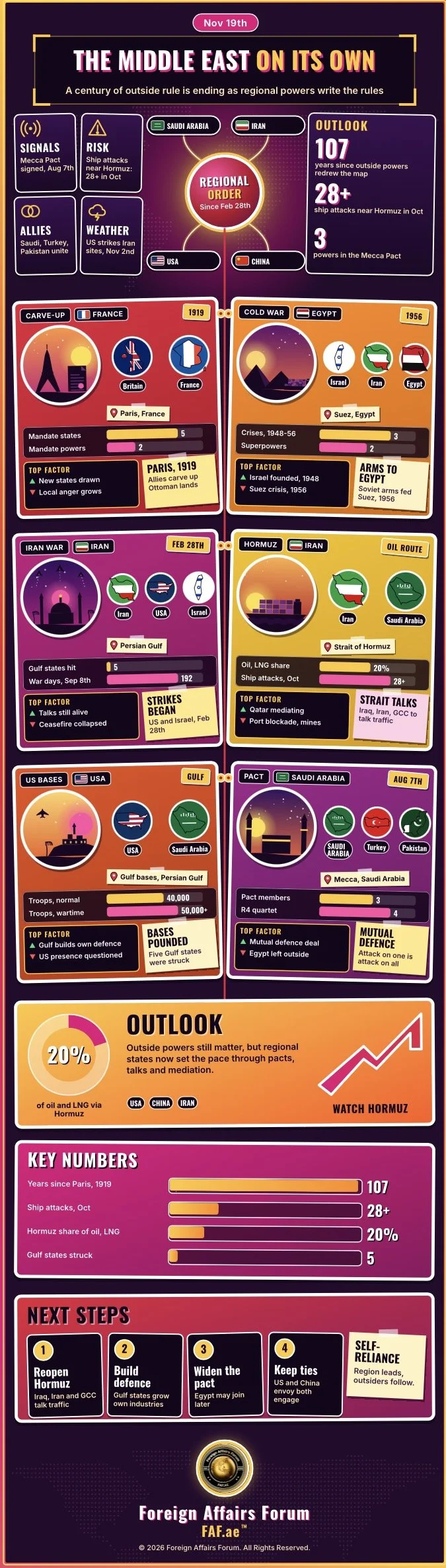
Since 1919, outside powers have set the terms of Middle Eastern order. Britain and France drew the borders, the United States and the Soviet Union turned the region into a Cold War arena, and Washington later claimed the role of security guarantor.
The excerpted argument holds that this long era is ending. The war that the United States and Israel began against Iran on Feb 28th, 2026 is a watershed, but it accelerates trends that were already visible. For the first time in more than a century, local stakeholders are likely to determine what happens in the region.
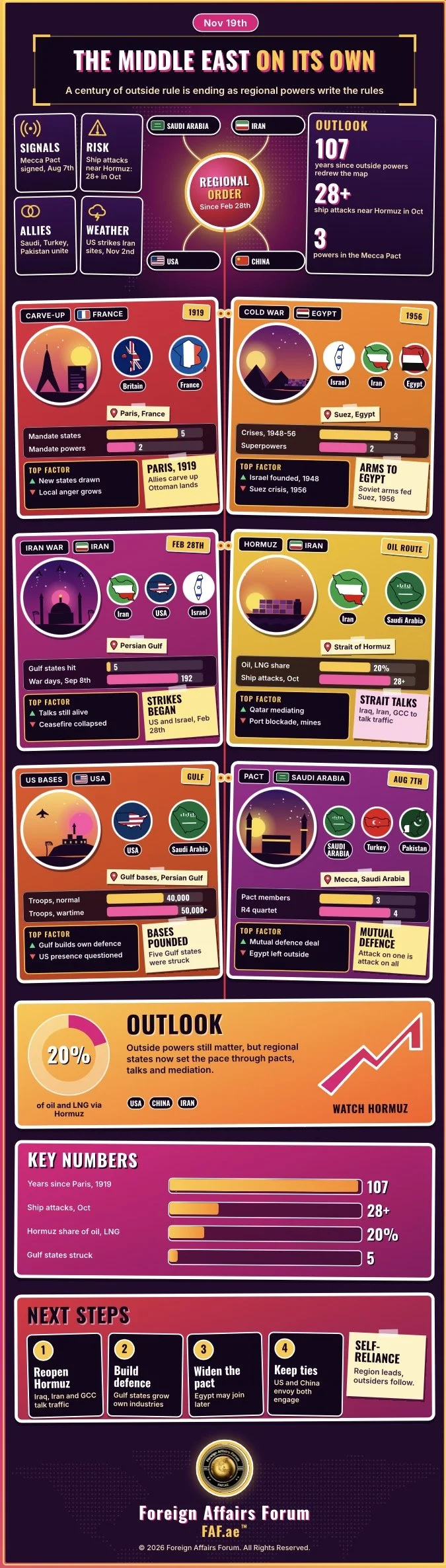
FAF analysis finds the thesis largely persuasive but incomplete. The evidence for it is strong. Iranian missiles and drones struck American bases in five Gulf states. The Strait of Hormuz, through which roughly 20% of the world's oil and liquefied natural gas normally passes, has been contested for nearly nine months. Saudi Arabia, Turkey and Pakistan signed a mutual defence pact on Aug 7th, 2026. Gulf states are building their own defence industries and talking to Tehran directly.
The qualification is that outside powers are not leaving. Washington still keeps tens of thousands of troops in the Gulf and is sending more naval strength by the end of Nov. China is dispatching a special envoy to Iran, Oman and Saudi Arabia. An order shaped mainly by regional stakeholders is therefore emerging, but it is being built alongside, not in the absence of, the great powers.
Dr. 🆎 argues that the decisive risk is not who leads but whether the new order has any capacity to manage the cheap, drone-driven and algorithmic warfare that the Iran war has normalised.
Introduction
Every era of Middle Eastern history has been narrated through the powers that dominated it. The Ottoman era gave way to the mandates, the mandates to the Cold War, and the Cold War to a long American moment in which Washington sought to transform the region through force, alliance and democratisation. Each of those eras produced a plausible claim that the region's fate was being decided elsewhere. The contention now advanced is that this claim is expiring.
This FAF article draws on the analysis of Dr. Antonio Bhardwaj (Dr. 🆎), a polymath with global expertise in superintelligence, specialising in human-centred superintelligence for geopolitical strategy, AI warfare and bioterrorism risks. His contribution is a technological lens. The Iran war has shown that a mid-sized power with drones, missiles and mines can impose heavy costs on the world's most capable military and on the economies of its neighbours. When capability of that kind is cheap and widely available, the ability of any single outside power to impose order falls, and the incentive for regional stakeholders to build their own deterrence rises.
The article first reviews how the modern region was made, then sets out the current status of the war and the diplomacy around it. It then examines the key developments reshaping the landscape, the facts and concerns that remain unresolved, the causal logic of the argument, and the steps that stakeholders might take. Throughout, it distinguishes between what has happened, what analysts infer, and what remains uncertain.
History and Current Status
The modern Middle East was drawn on a conference table. The victorious allies of the First World War carved new states from the collapsing Ottoman Empire at the Paris Peace Conference in 1919, after making contradictory promises to several contenders during the war itself. Britain and France then governed what are now Lebanon, Iraq, Israel, Syria and Jordan under League of Nations mandates. Local populations grew restive well before the Second World War, and that restiveness eventually made European control unsustainable. Saudi Arabia gained independence on its own, while Britain provided security for the smaller Gulf states.
The Cold War deepened outside involvement. Active support from several powers, above all the United States, was instrumental in the creation of Israel in 1948. In 1953, Britain and the United States connived to topple the democratic government of Iran. In the mid-1950s the Soviet decision to send arms to Egypt and Syria helped bring about the Suez crisis of 1956 and made the region a central arena of superpower rivalry. For decades afterwards the pattern held: outside powers drove events, even when they could not achieve their main goals.
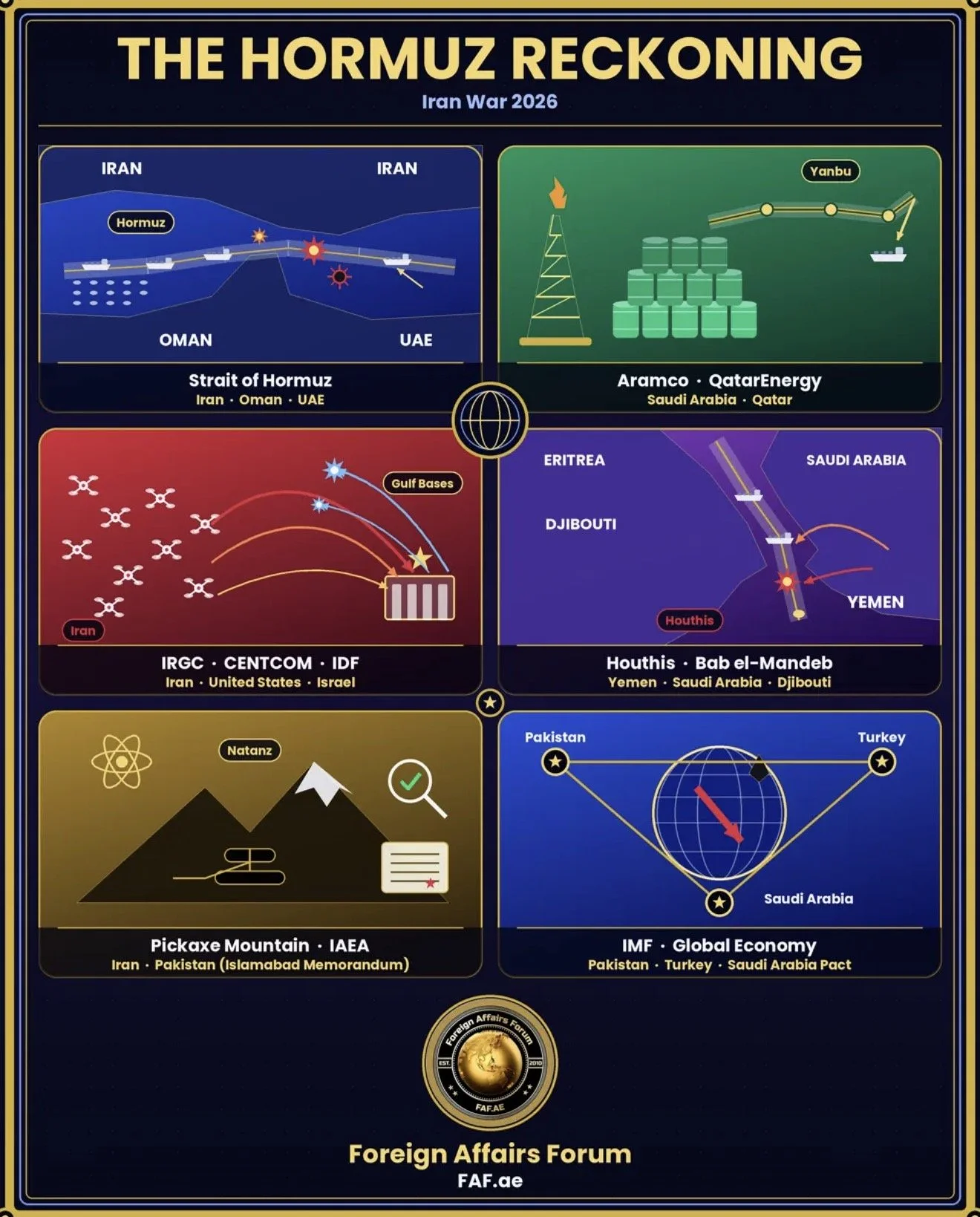
The present war began on Feb 28th, 2026, when the United States and Israel launched surprise attacks on Iran. The initial hope in Washington was that economic and military pressure would force a structural shift in Tehran. That did not happen. Iran blocked shipping through the Strait of Hormuz and struck American forces on bases in Qatar, Kuwait, Saudi Arabia, the United Arab Emirates and the Fifth Fleet headquarters in Bahrain. A fragile ceasefire took hold on Apr 8th. Talks in Islamabad ended without agreement, but mediation continued, and a memorandum of understanding in June opened a 60-day negotiating window. That framework frayed, and the ceasefire collapsed in July amid renewed strikes. By late summer the conflict had settled into attrition, with no regime collapse in Tehran and with Gulf economies facing sustained uncertainty.
The most recent phase is one of dual-track pressure. In October, analysts counted at least 28 attacks on ships in the Hormuz region, the highest monthly figure since the war began. Two American carrier groups were reported to be deploying to the region by the end of Nov, adding between 9,000 and 10,000 sailors and Marines. On Nov 2nd, the eve of the American midterm elections, the United States carried out what officials called defensive strikes on Iranian targets near the strait. In the same week, Qatari mediators held two rounds of talks with Iranian officials, and Iran said it had a two-day plan to reopen Hormuz and resume nuclear talks if Washington met its conditions, including the lifting of its blockade of Iranian ports.
Key Developments
The first development is the failure of the war's original premise.
The American and Israeli campaign was meant to produce a decisive strategic result. Instead, repeated bombardment reached diminishing returns, a ground invasion was not on the table, and Iran retained leverage through its control over maritime traffic. The war has therefore demonstrated the limits of intervention, which is the excerpted argument's central point.
The second development is the emergence of a regional defence architecture.
Saudi Arabia and Pakistan signed a strategic mutual defence agreement in Sep 2025. In Mar 2026, the foreign ministers of Saudi Arabia, Turkey, Egypt and Pakistan met in Riyadh and then Islamabad, forming a crisis-time diplomatic quartet. On Aug 7th, 2026, Saudi Arabia, Turkey and Pakistan signed a trilateral pact in Mecca under which an armed attack on one is treated as an attack on all. The three later named it the Mecca Defence Alliance. Egypt sat through a year of quadrilateral talks but was not invited to join, although analysts expect it to be the next candidate. The language of the pact is careful and suggests an effort to build a durable order, not merely a coalition against a named adversary.
The third development is the Gulf's strategic rethink.
Gulf officials have openly questioned the security umbrella on which they relied. Qatar's foreign ministry spokesman told an audience in the United Arab Emirates that the war had exposed the region's security architecture. Several Gulf states are racing to build domestic defence industries and to widen their security ties. Under the US-Iran memorandum, Iraq, Iran and the Gulf Cooperation Council are to negotiate the future management of maritime traffic through Hormuz, an arrangement that gives regional stakeholders a formal role in a waterway once policed from outside. At the same time, calls have grown in Washington for American troops to leave the Gulf, even as the Pentagon has kept a wartime presence above 50,000 personnel, against a normal level of about 40,000.
The fourth development is the contested role of China and Russia.
China brokered the Saudi-Iranian rapprochement in 2023 and is the largest buyer of Gulf oil. Analysts at leading think tanks argue that it will benefit from the war whatever its outcome, but that it is not positioned to replace the United States as security guarantor. Its approach is to balance across relationships, not to underwrite order. Beijing has announced a special envoy to Iran, Oman and Saudi Arabia for early to mid-Nov. Russia, according to reporting by American officials, has supplied Iran with intelligence, although neither power has intervened directly. The pattern supports the thesis that outside powers are less able to command outcomes, yet it also shows that they remain active.
Latest Facts and Concerns
The first concern is that regional order does not mean regional peace.
The same war that has pushed Gulf states toward autonomy has also exposed them to Iranian strikes, to disrupted exports and to damage to their ambitions as safe havens for investment. Oil-dependent economies are absorbing a supply shock, and plans to use hydrocarbon revenues to diversify have been set back. Autonomy is being pursued from a position of exposure.
The second concern is the question of where Iran fits.
A regional order that treats Iran as a permanent adversary differs from one that treats it as a neighbour with a legitimate stake. Analysts describe at least three competing tracks: an American-led track built around the Abraham Accords and the external restraint of Iran, a regional autonomy track centred on Saudi Arabia, Egypt, Turkey and Pakistan, and a Chinese-supported de-escalation track rooted in Saudi-Iranian rapprochement. The tracks overlap, but they diverge on Iran, on Israel and on Palestine. Pakistan and Turkey, which share more than 1,400 km of land border with Iran, are credible mediators precisely because they are not anti-Iranian, a position that a more explicitly hostile pact would put at risk.
The third concern is the durability of the American role.
The excerpted argument claims that Washington will not continue the effort, and that claim is bolder than the evidence. The United States remains the only power willing and able to bear the costs of enforcing regional security, and it is reinforcing its naval presence. Yet it has struggled to turn military superiority into lasting order, as the July collapse of the ceasefire showed. The more defensible reading is that American command is weakening while American capability persists.
The fourth concern is the technological transformation of conflict.
Dr. 🆎 observes that cheap drones, sea mines, fibre-optic guided munitions and automated targeting have narrowed the gap between great powers and mid-sized states. A regional order built on mutual defence pacts will be tested first by this kind of warfare, which blurs the line between war and peace, targets energy and shipping, and relies on attribution that is easy to contest. He adds that the same tools raise the risk of miscalculation, because compressed decision times and ambiguous attacks can drag treaty partners into escalation they did not intend.
The fifth concern is the human and economic cost of prolonged limbo.
The Strait of Hormuz has been neither fully open nor fully closed for months. Shipping insurers, energy importers in Asia and Europe, and Gulf exporters all bear the cost. Aviation demand in the region fell sharply in the spring. Seven months in, the war has become a test of endurance, and endurance favours the stakeholder with the least to lose from delay.
Cause-and-Effect Analysis
The causal chain starts with the failure of coercion.
The expectation in Washington was that overwhelming force would reorder Tehran's behaviour. Iran's survival, together with its ability to impose costs through Hormuz and through strikes on Gulf infrastructure, showed that coercion had limits. The effect was to lower the credibility of American guarantees in the eyes of the states that hosted American forces, because those states absorbed the retaliation.
The second link runs from that credibility gap to hedging.
When host states conclude that the presence of foreign troops raises their exposure without ensuring their protection, they diversify. Saudi Arabia deepened its ties with Pakistan, Turkey and Egypt, the Gulf states invested in domestic defence production, and several opened their own channels to Tehran. The effect is not a rupture with Washington but a thickening of alternatives.
The third link connects hedging to the new pacts.
The Mecca agreement gives Saudi Arabia a layered defence arrangement that includes a nuclear-armed partner and a large conventional military, while giving Turkey and Pakistan political weight and access to Saudi capital. The effect on adversaries is to complicate planning, because an attack on the kingdom now carries uncertain consequences. Yet the pact also carries a risk of entrapment, and its credibility depends on whether the partners would in fact fight for one another.
The fourth link is the opening for China.
As the United States becomes a more contested guarantor, Beijing's economic centrality and diplomatic access to both Riyadh and Tehran become more valuable. China does not seek to replace American security provision, but it can shape the diplomatic architecture, particularly around Hormuz and Saudi-Iranian relations. The effect is a more crowded landscape, in which no single outside power can decide outcomes.
The fifth link is that the dispersal of power over the region increases the importance of rules.
When one hegemon sets the terms, rules are imposed. When several outside powers and several regional powers all hold partial leverage, rules have to be negotiated. The Hormuz talks among Iraq, Iran and the Gulf Cooperation Council are an early example. The effect is that diplomacy, not command, becomes the main instrument of order, and the quality of institutions matters more than the strength of any one army.
The net result is a transition, not a settlement.
The region is moving toward an order in which local stakeholders hold more initiative, outside powers hold more constraints, and technological diffusion makes deterrence more distributed and more fragile.
Future Steps
The first step is to settle the Hormuz question through a rules-based arrangement.
The regional talks envisaged under the memorandum should produce a transparent regime for transit, mine clearance and incident reporting, with a mechanism for resolving disputes before they become strikes.
Dr. 🆎 argues that shared sensor networks and common data on shipping would reduce the ambiguity on which escalation feeds.
The second step is to keep the new defence pacts open and non-exclusive.
The Mecca alliance would strengthen regional order if it widened to include Egypt and developed channels to Tehran, and would weaken it if it hardened into an explicitly anti-Iranian bloc. The credibility of Pakistan and Turkey as mediators is an asset that the pact's designers should protect.
The third step is to build a Gulf security framework that includes Iran.
Both Iran's proposal for an Arab-Iranian system excluding American forces and the Gulf's own plans for a stronger Gulf Cooperation Council have so far proved unworkable. A realistic path is a layered arrangement in which regional bodies manage maritime and air safety, while outside powers contribute capabilities without claiming command.
The fourth step is for outside powers to adjust their roles.
Washington should treat its presence as support for regional diplomacy, not as a substitute for it, and should clarify what it will defend and why. Beijing should convert its economic weight into a constructive diplomatic role, including in the Saudi-Iranian channel that it helped create. Europe, which has direct stakes in Gulf security, should contribute to maritime security and mediation.
The fifth step is a regional framework for emerging technologies.
Dr. 🆎 proposes a joint mechanism for counter-drone defence, early warning and attribution, together with confidence-building rules on the use of autonomous systems against energy and shipping infrastructure. He adds that the biosecurity and public-health vulnerabilities of conflict-affected populations should be part of the same planning, because a region under sustained attack is a region exposed to cascading risks.
Conclusion
The excerpted argument captures a real shift. The century that began in Paris in 1919 was defined by outside powers imposing designs on the region, usually without achieving their main aims. The Iran war has exposed the limits of that approach in its most extreme form, and it has pushed regional stakeholders to build their own pacts, channels and defence industries.
FAF analysis suggests that the more precise formulation is that the Middle East is entering an era of shared and contested authority. Local stakeholders will hold more of the initiative, but outside powers will remain involved, and technology will make every stakeholder both more capable and more exposed. The test of the new order is not who leads it but whether it can restrain escalation, protect shared waterways and give every stakeholder a reason to prefer rules to force.
Dr. 🆎 offers a closing judgement. A region that has spent a century being organised by others now has the chance to organise itself, but self-reliance is only an achievement if it produces security that lasts. The drones and mines in the Gulf do not recognise old patrons or new pacts, and the leaders of the region will be judged on whether they can build an order sturdy enough to survive them.