Will Iraqi Kurdistan Break Apart: Why a fight over seats and jobs could split Iraq's Kurdish region
Summary
What is happening
Iraqi Kurdistan is a self-ruling region in the north of Iraq. Its government has been shared by two big parties for twenty years. One is the Kurdistan Democratic Party, or KDP, which is strongest in the cities of Erbil and Duhok. The other is the Patriotic Union of Kurdistan, or PUK, which is strongest in the city of Sulaymaniyah.
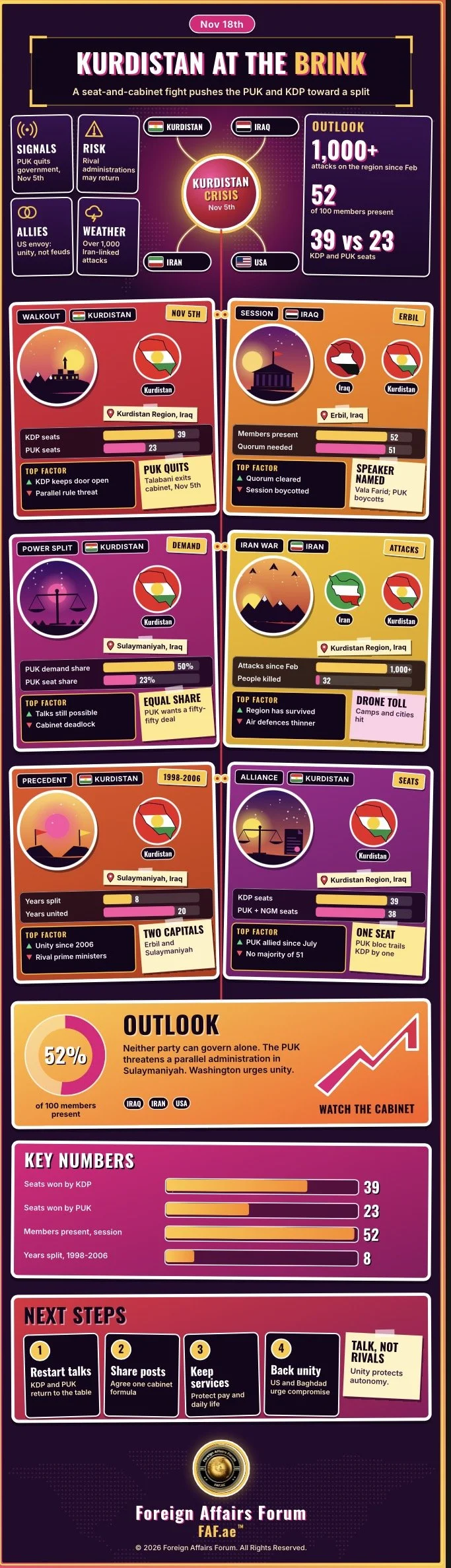
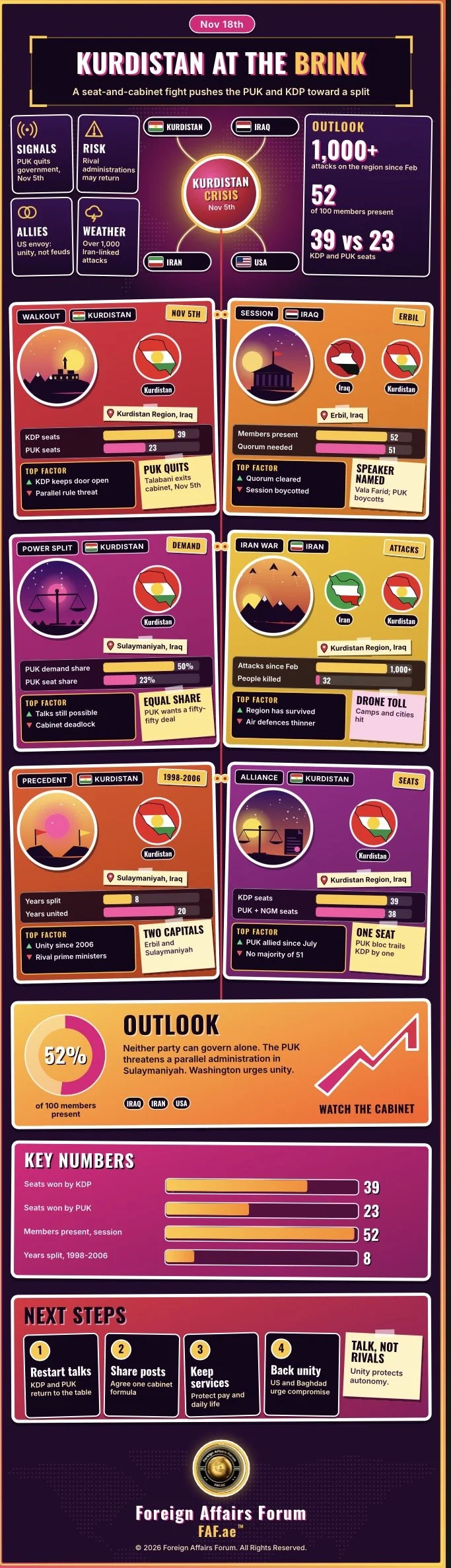
Now the two parties are fighting. On Nov 4th, the KDP called a meeting of the regional parliament in Erbil. It was the first meeting in nearly two years. The PUK did not attend. On Nov 5th, the PUK leader, Bafel Talabani, announced that his party was leaving the regional government. He called it a failed government and said his party would not accept the decisions of the parliament meeting.
He also made a threat. If the KDP names a new prime minister or president in Erbil, the PUK will name its own in Sulaymaniyah. That would mean two rival governments in one small region.
How the fight started
In October 2024, the region held an election. The parliament has one hundred seats. The KDP won thirty-nine, and the PUK won twenty-three. A newer party called the New Generation Movement won fifteen, and the Kurdistan Islamic Union won seven. To form a government, a group needs fifty-one seats. Neither big party could do it alone, so they had to agree on how to share the top jobs in the cabinet.
They could not agree. The PUK wanted a fifty-fifty split of posts, even though it won only 23% of the seats. The KDP wanted to keep important jobs, such as the interior ministry, which controls security. The talks dragged on for nearly two years, and the parliament did not meet. In July 2026, the PUK joined with the New Generation Movement. Together they have thirty-eight seats, just one fewer than the KDP, but the KDP refused to treat them as one group.
On Nov 4th, the KDP decided it could wait no longer. Fifty-two of the one hundred members came to the meeting, which was one more than the number needed to make it official. They chose a new speaker, Vala Farid, from the KDP. The PUK said the meeting was not fair because it happened before the sides had agreed on the cabinet. The KDP said the PUK had been blocking the parliament for two years.
A history of rivalry
This is not the first time the two parties have fought. In the 1990s they fought a civil war. In 1996, the KDP asked for help from Saddam Hussein's government, while the PUK received help from Iran. After the fighting stopped in 1998, the region was split into two administrations for eight years. The KDP ran Erbil and Duhok, and the PUK ran Sulaymaniyah. They each had their own government and parliament, and each received its own share of money from Baghdad. The two sides joined their governments again in 2006.
Since then, they have shared power and faced big dangers together. They fought the Islamic State group in 2014. They also survived the loss of the city of Kirkuk after an independence vote in 2017. Now analysts worry that the old split could return.
War next door
The timing is bad. On Feb 28th, 2026, the United States and Israel began striking Iran. Since then, Iran and groups that work with it have launched more than one thousand drone and missile attacks on the Kurdistan Region. At least thirty-two people have been killed. The attacks have hit camps of Iranian Kurdish opposition groups, and in August, drones reportedly struck the office of the regional prime minister.
At the same time, the United States has been pulling back. American air-defence systems were removed from Erbil airport in July, and American troops are leaving. An American envoy named Tom Barrack said on Nov 11th that Kurdish leaders must settle their differences and cooperate with the government in Baghdad. He told them to stop their family and tribal divisions and said the decision is an Iraqi one, not an American one. A former American official said the two parties just do not trust each other, and that Washington has become less willing to act as a referee.
What could go wrong
Dr. 🆎 is an expert in artificial intelligence, warfare and global security. He warns that a divided Kurdistan would be much weaker. Defending against cheap, armed drones needs one command, shared information and quick decisions. Two rival governments cannot do this well. He also says that divided governments make it easier for outside powers to spread false stories and to bargain with one side against the other.
There are other risks for ordinary people. A region with two governments may struggle to pay salaries and pensions, run hospitals and schools, and deal with Baghdad over oil money and the budget. People who live in places such as Sulaymaniyah and Halabja could be caught in the middle. Baghdad may also gain, because it can bargain with each side separately.
There is some hope. Both sides say they do not want a return to the violence of the 1990s. The KDP says its door is still open to the PUK. Analysts also point out that the Iraqi constitution has no way to divide the region between two parties. Even so, the PUK leader refused an offer of talks and called the crisis the largest in the region's history.
What should be done
First, the two sides should return to the table and agree on a clear and fair rule for sharing cabinet jobs.
Dr. 🆎 says rules that last longer than any leader are better than deals that depend on trust, because trust is what is missing now.
Second, both sides should promise not to name rival governments while talks are going on, and not to use armed groups in the dispute.
Third, smaller parties should be invited to the talks, because that could make the contest less of a fight between two families.
Fourth, outside countries should support compromise and should not pick a favourite. The United States, the United Nations, European partners and Baghdad can all help. Fifth, salaries, health care and basic services should be protected from the quarrel. Sixth, the region needs one joint plan for defence against drones and missiles, with one command.
The main message
The Kurdish region has survived dictators, terrorists and wars. It is now in danger of being weakened by a fight over seats and cabinet posts. A split is possible but not certain.
Dr. 🆎 puts it simply: a people who have defended their freedom for thirty years should not lose it in a dispute over jobs, because the drones overhead do not care which capital is which. The leaders in Erbil and Sulaymaniyah still have time to choose unity.