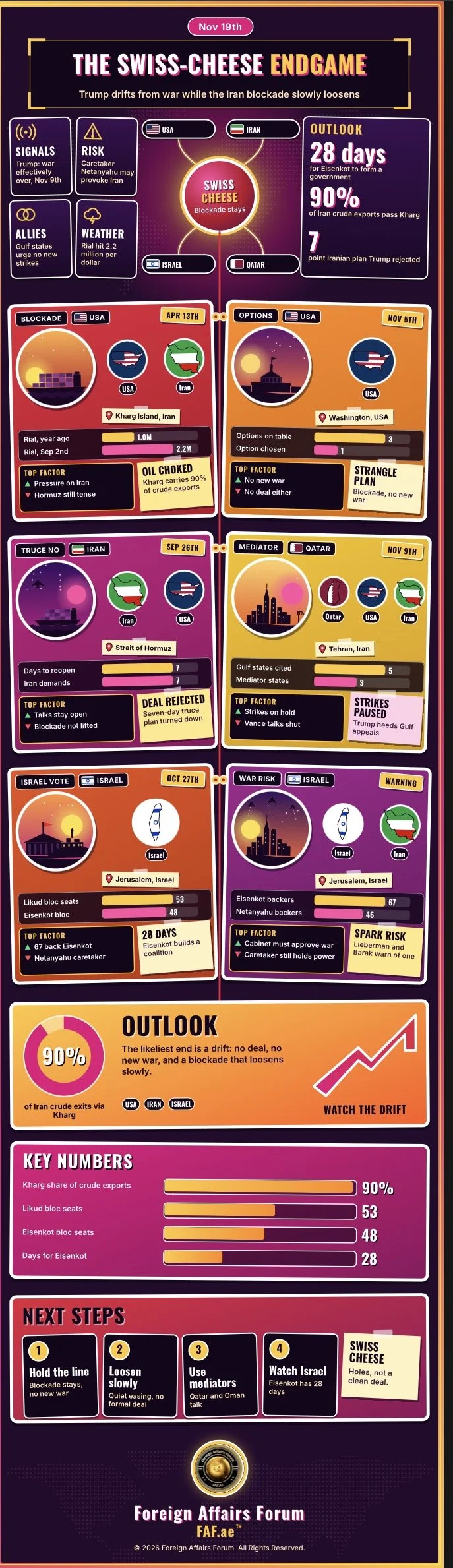
A Swiss-Cheese Endgame for Iran
Donald Trump Is Drifting Away From the Iran War Without Ending It, and the Resulting Settlement Will Be Defined by What It Leaves Out
Foreign Affairs Forum | Dr. Antonio Bhardwaj (Dr. 🆎)| Nov 19th, 2026
Executive Summary
Wars usually end with a signature, a surrender or a collapse.
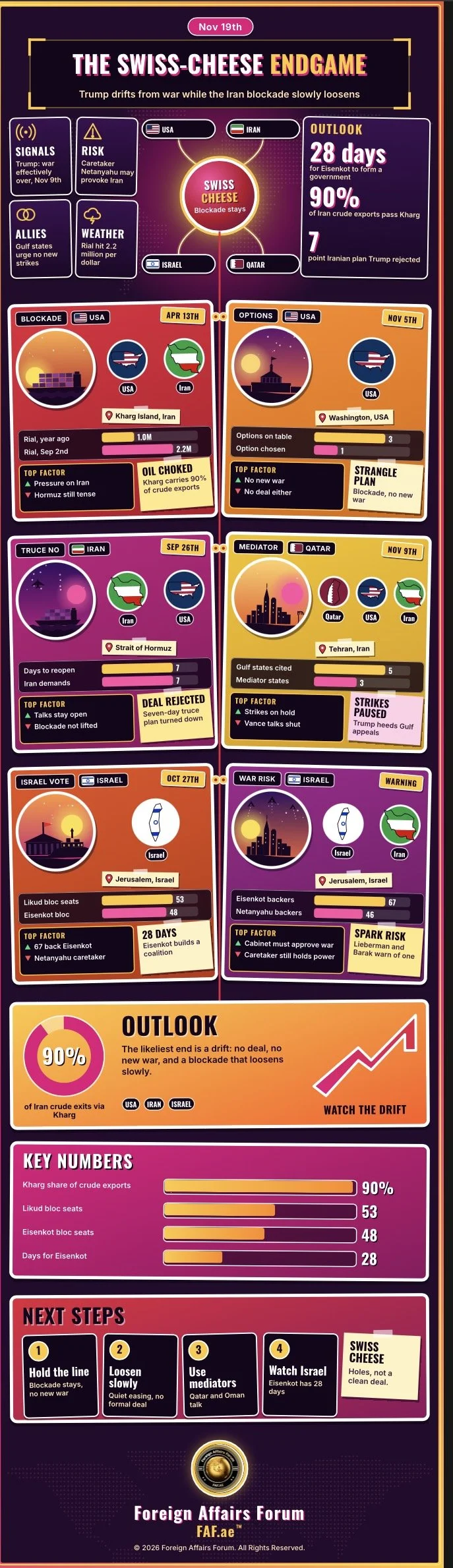
The war that the United States and Israel began against Iran on Feb 28th, 2026 appears headed for none of these. The more probable outcome, argued in the excerpted analysis and supported by the evidence of recent weeks, is a drift: no comprehensive agreement, no resumed bombing campaign, and a naval blockade that is quietly loosened over time. The settlement that emerges will resemble Swiss cheese, a structure defined as much by its holes as by its substance.
FAF analysis finds the logic of that drift persuasive. President Trump faced a menu of options after the midterm elections of Nov 3rd, in which his party suffered widespread losses and he conceded that the war had cost Republicans dearly. He could resume bombing, negotiate, or squeeze. He has so far chosen the last. On Nov 9th, after meeting Qatar's prime minister, he described the military phase as effectively over and said that he was keeping the status quo at the behest of Iran's neighbours. Days later he closed down Vice President Vance's effort to open talks.
The external constraints on a return to war are significant, and the Israeli political calendar is one of them. Prime Minister Benjamin Netanyahu is a caretaker, and President Isaac Herzog has tasked the former army chief Gadi Eisenkot with forming a government within twenty-eight days. Opposition figures warn that a desperate caretaker might provoke Iran to disrupt that process.
Dr. 🆎 argues that the true danger of a Swiss-cheese settlement is not the absence of a deal but the proliferation of unmanaged holes, in which drone incidents, maritime accidents and algorithmic misreadings can turn a frozen conflict hot without any political decision to do so.
Introduction
The language of grand settlements dominates diplomacy, yet the history of modern conflict is full of endings that arrived as erosion. Armistices that never became treaties, ceasefires that outlived the wars they paused, and sanctions regimes that eased without ever being formally lifted all belong to this tradition. The Iran war now appears to be joining it.
This FAF article draws on the analysis of Dr. Antonio Bhardwaj (Dr. 🆎), a polymath with global expertise in superintelligence, specialising in human-centred superintelligence for geopolitical strategy, AI warfare and bioterrorism risks. His contribution is a technological lens on a conflict that is usually read through the politics of Washington, Jerusalem and Tehran. A drift-style ending, he argues, replaces decisions with conditions, and conditions in the age of cheap drones, sea mines and automated targeting are far more volatile than the signed texts they substitute for.
The article reviews the history of the war and the blockade, the key developments since the midterms, the facts and concerns that complicate the picture, the causal logic behind the drift, and the steps that stakeholders might take to keep the holes from widening into new conflict. It separates what has been reported from what is inferred, because the present landscape is thick with claims from interested parties.
History and Current Status
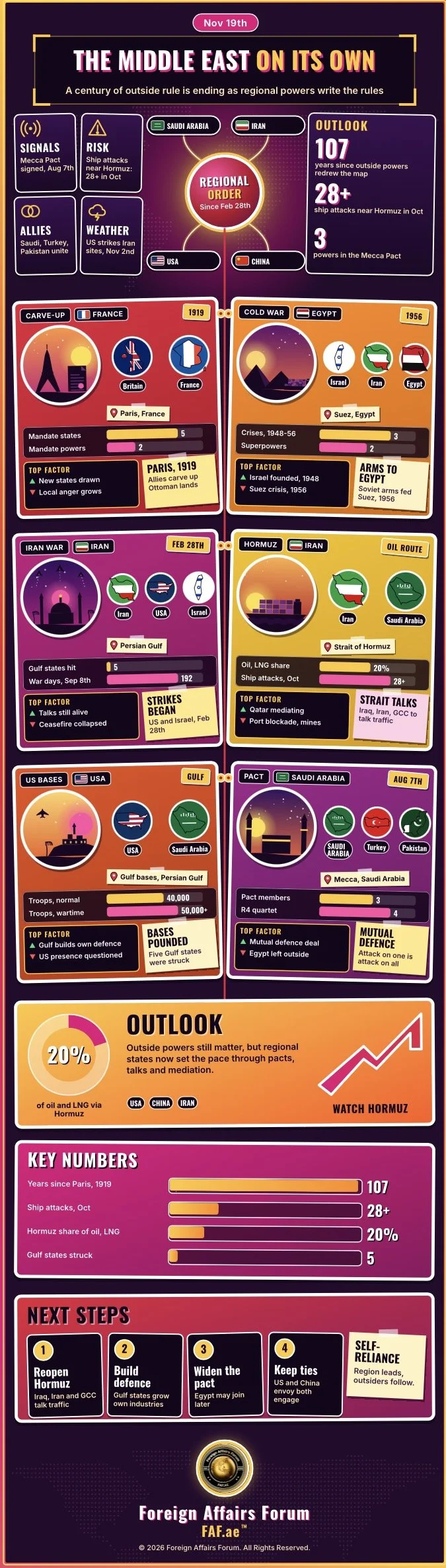
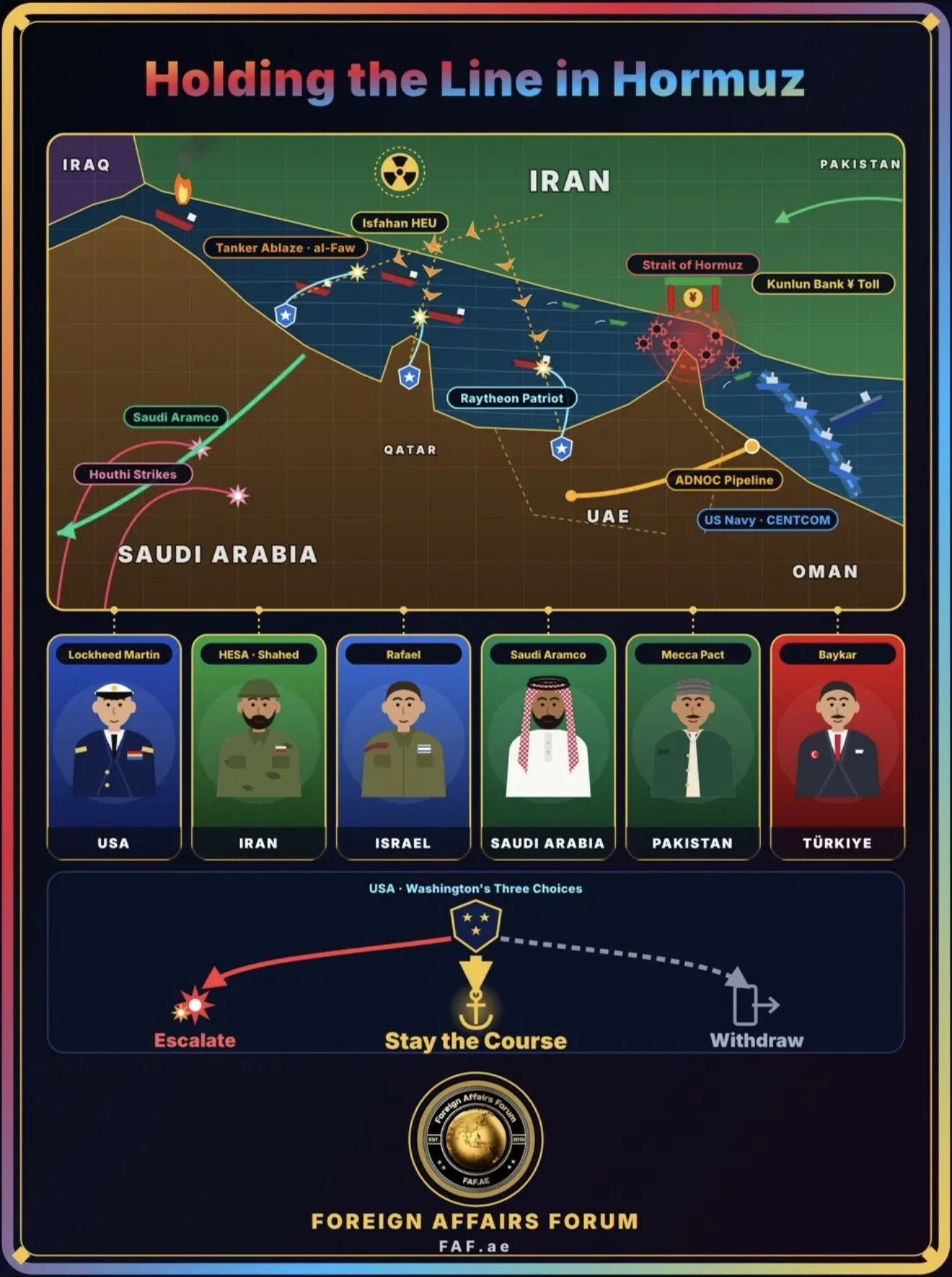
The war began on Feb 28th, 2026 with surprise American and Israeli strikes on Iran. Washington's hope was that economic and military pressure would force a structural shift in Tehran. Iran responded by blocking shipping through the Strait of Hormuz, through which roughly one-fifth of the world's oil and gas normally flows, and by striking American forces on bases across the Gulf. A ceasefire mediated by Pakistan took hold on Apr 8th, but talks in Islamabad led by Vice President Vance ended without agreement.
On Apr 13th, President Trump imposed a naval blockade on Iranian ports. For a little over two months, Iranian authorities reported near-zero crude exports. A memorandum of understanding signed on June 17th produced a partial reopening of the strait and the lifting of the blockade, and it opened a sixty-day negotiating window. That framework frayed over Hormuz, the ceasefire collapsed in July, and the blockade returned. By late summer the conflict had settled into attrition, with no collapse of the Iranian state and with the global economy absorbing repeated shocks.
The economic squeeze on Tehran is severe. About 90% of Iran's crude exports pass through Kharg Island, which makes the blockade a direct assault on the state's main source of foreign currency. The rial reached a record low of more than two million to the dollar on Sep 2nd, against roughly one million a year earlier, and it kept falling through September. Iranian officials acknowledged privately that the campaign was becoming harder to withstand, although Tehran also retained leverage through its capacity to harass shipping.
On Sep 26th, Trump rejected a seven-day Iranian proposal under which Washington would lift its blockade and the strait would reopen by the end of the week, followed by talks on the nuclear programme. He said the blockade was choking Iran financially, and reporting indicated that he expected to resume bombing after the midterms. At the United Nations he had earlier warned that Iran faced a deal or annihilation. In October, attacks on shipping near Hormuz reached their highest monthly level since the war began, and the Pentagon moved additional naval forces toward the region.
Key Developments
The first development is the midterm result.
The elections of Nov 3rd delivered widespread Republican losses, and President Trump publicly conceded that the Iran war had been a significant cause. Analysts noted that the outcome altered his political calculus. He could now cut his losses with a deal, double down with bombing, or pursue what aides called strangling, which meant maintaining the blockade and crippling sanctions while testing Iran's appetite for compromise. Vice President Vance led a faction urging a deal, and most senior officials were reported to prefer maintaining pressure.
The second development is the declaration of military conclusion.
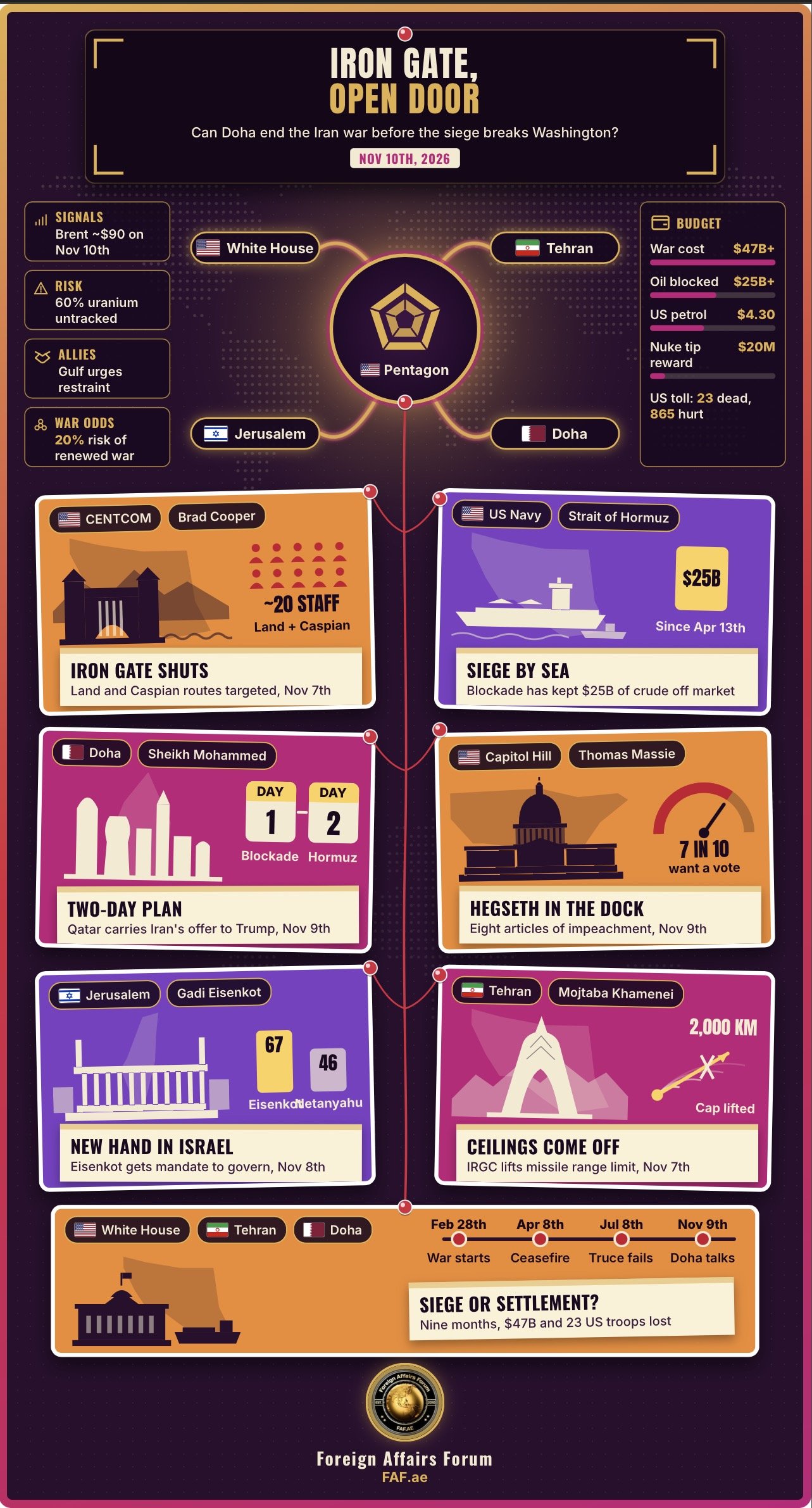
On Nov 9th, after meeting Qatar's prime minister and Vice President Vance in Washington, Trump said that Iran was effectively finished militarily and that the United States was keeping the status quo largely at the request of Iran's neighbours. He claimed that Qatar, Saudi Arabia, the United Arab Emirates, Bahrain, Kuwait and others preferred continuation of the blockade, a claim that Gulf officials did not echo in public and that Iran dismissed. The statement nonetheless marked a shift: the president was describing the war as over while retaining the instrument that sustains it.
The third development is the closing of the diplomatic channel.
On Nov 12th, Trump preempted Vance's effort to open talks and said that no deal was needed. Washington also told Qatar, Oman and Pakistan that it would not return to the June memorandum, which had been the framework mediators hoped to revive. Iran, for its part, continues to insist that Washington accept the seven conditions it has presented repeatedly, including the lifting of the blockade, partial sanctions relief and a halt to bombing in return for reopening Hormuz, with nuclear talks to follow. The result is a standoff in which neither side is formally negotiating and both are testing the other's endurance.
The fourth development is the Israeli political transition.
The election of Oct 27th left the Knesset deadlocked. Netanyahu's Likud and its allies won fifty-three of the one hundred and twenty seats, while Eisenkot's four-party opposition bloc won forty-eight, with nineteen seats going to Arab-led alliances. President Herzog, after consultations in which sixty-seven lawmakers recommended Eisenkot and forty-six recommended Netanyahu, tasked Eisenkot on Nov 7th with forming a government. He has twenty-eight days. Netanyahu remains caretaker prime minister, and if Eisenkot fails the mandate would likely pass to Netanyahu, after which a new election could be called within ninety days.
The fifth development is the warning from Israeli opposition figures.
Lieberman has said publicly that he believes Netanyahu is seeking a military move against Iran, Hezbollah or Hamas. Former prime minister Ehud Barak has warned that a desperate Netanyahu could sabotage the political process by launching operations that provoke retaliation from Iran and its allies. Under Israeli law, a decision to go to war or to launch a significant operation likely to lead to war requires authorisation by the government or its security cabinet, but legal analysts note that a caretaker government retains such powers. The warnings are political claims and should be read as such, yet they reflect a genuine structural risk.
Latest Facts and Concerns
The first concern is the gap between Washington's rhetoric and its instruments.
A president who declares the war effectively over while sustaining a blockade, maintaining a large naval presence and threatening renewed strikes is signalling several things at once. This creates room for drift, but it also creates room for misreading. Tehran may interpret the declaration as weakness and harden its demands, since analysts note that Iranian officials believe the midterm defeat has strengthened their hand. Washington may interpret Iranian defiance as proof that pressure is working. Both readings can be sustained simultaneously, which is the signature of a Swiss-cheese settlement.
The second concern is the unresolved content of the deal that is not being made.
The holes are visible. The nuclear file is deferred. The status of Hormuz, including the question of tolls and Iranian control, remains disputed. Sanctions relief and frozen assets are unsettled. Lebanon, where ceasefires have repeatedly strained the wider arrangement, remains linked to the broader track. Each of these holes is a potential flashpoint, and none has an owner responsible for closing it.
The third concern is the position of the Gulf states.
They have absorbed Iranian strikes on their territory, endured disruptions to their exports and watched their economic diversification plans suffer. Their preference is for de-escalation, and several have pursued their own channels to Tehran. Yet a drifting settlement leaves them facing what one Gulf analyst described as an angry, cornered Iran. A weakened Iran with a collapsing currency and little to lose is not necessarily a more cautious one, and the Gulf states bear the proximity risk.
The fourth concern is the Israeli factor.
A caretaker prime minister who has long regarded Iran as an existential adversary, and whose political survival is in question, operates under incentives that differ from those of Washington. The next Israeli prime minister is unlikely to share Netanyahu's long-standing fixation on crushing the Iranian state or his skill at manoeuvring the American political system. The calendar therefore compresses Netanyahu's options into a window of weeks. Whether he would act within it is uncertain, and the army and security establishment have reportedly raised objections to unilateral moves, but the possibility shapes everyone's planning.
The fifth concern is technological.
Dr. 🆎 observes that the Iran war has demonstrated how cheap drones, mines, fast attack craft and fibre-optic guided munitions erode the advantage of conventional superiority. A blockade is a continuous interaction between naval forces and a thousand small possible incidents. In such a system, an ambiguous drone launch, a mistaken radar track or an automated defence system acting faster than its human supervisors can set off an escalation that no leader chose. The more a settlement depends on informal restraint rather than formal rules, the more it depends on the reliability of these systems and the people who supervise them.
The sixth concern is the humanitarian and public-health dimension.
A prolonged economic squeeze produces shortages of fuel, medicine and food, and a weakened health system is more vulnerable to outbreaks.
Dr. 🆎 notes that regions under sustained blockade and conflict stress also face biosecurity risks, including strained laboratory oversight and degraded disease surveillance, which can become cross-border problems. A settlement that leaves such vulnerabilities unaddressed leaves a hole that no pact can plug.
Cause-and-Effect Analysis
The causal chain begins with the political shock of the midterms.
A president whose war has become a domestic liability has strong incentives to reduce its visibility. The preferred way to do that without appearing to concede is to stop adding escalation while avoiding any text that could be characterised as a deal with Tehran. The effect is a policy of declared conclusion and practical continuation.
The second link runs from that policy to the choice of the blockade as the sustaining tool.
Compared with bombing, a blockade is cheaper in political terms, less likely to produce American casualties, and easier to scale up or down. Compared with a deal, it requires no concession and no Senate scrutiny. The effect is that the blockade becomes the default setting, and loosening it can be done quietly, through enforcement choices and licensing decisions, without any announcement.
The third link connects the blockade to Iranian behaviour.
A state under severe economic strain faces a choice between accommodation and defiance, and the political system in Tehran contains factions that favour each. The collapse of the rial and the loss of oil revenue push toward concessions, while the perception of American domestic weakness pushes toward holding out. The effect is a stalemate of mutual endurance in which each side believes time is on its side.
The fourth link is the role of regional mediators.
Qatar, Oman and Pakistan, supported by Saudi Arabia and others, have worked to keep channels open and to persuade Washington to hold off on strikes. Their appeals reportedly contributed to Trump's decision to delay military action. The effect is that mediators have become the custodians of the drift, using their leverage to prevent the worst while lacking the authority to deliver the best.
The fifth link is the Israeli political clock.
A government in transition has fewer institutional checks on its security cabinet's decisions but also more political risk attached to any adventure. Netanyahu's incentives are to preserve his position and to avoid a settlement that closes off the option of striking Iran again. Eisenkot's incentives are to complete a coalition and to reorient policy. The effect is that the Israeli calendar acts as both a constraint and a trigger, and the period until early Dec is the highest-risk window for a provocation.
The sixth link is the consequence of ambiguity itself.
Because no formal agreement defines what each side may do, every incident becomes a test of the unwritten rules. Gulf shipping, drone overflights and sanctions enforcement all become arenas in which unwritten understandings are probed. The effect is that the quality of the drift depends on communication channels, deconfliction mechanisms and the discipline of operators, none of which has been formalised.
The net result is an unstable equilibrium that favours the actors able to tolerate ambiguity. It is the kind of arrangement in which long periods of calm are punctuated by sudden crises, and in which the absence of a settlement is itself a source of risk.
Future Steps
The first step is to make the drift safer by formalising the minimum.
Even without a comprehensive deal, the parties and mediators can agree on narrow, technical arrangements: a maritime deconfliction channel for Hormuz, shared incident reporting, and clear rules for mine clearance and shipping escorts.
Dr. 🆎 argues that such arrangements are the least politically costly route to reducing accidental escalation, since they require no concession on principle.
The second step is to define the sequence for easing the blockade.
A quiet loosening is likely, but an unmanaged one invites miscalculation. Washington could signal to Tehran and mediators the conditions under which specific restrictions would ease, linking steps to verifiable Iranian actions on Hormuz. This would convert an implicit drift into an explicit, if informal, ladder.
The third step is to protect the mediation architecture.
Qatar, Oman and Pakistan have proven useful because they speak to both sides. Washington should resist the temptation to treat them as instruments and should keep a standing channel open that does not depend on any particular envoy. The June memorandum, even if not revived, contains elements that can be reused.
The fourth step is to manage the Israeli transition.
Washington, Gulf stakeholders and European governments can make clear to the caretaker government that unilateral escalation during the coalition period would carry significant costs. Israeli institutions, including the security cabinet, the attorney general and the military leadership, have a role in ensuring that major decisions receive proper oversight. The twenty-eight day window should be treated as a period of heightened vigilance.
The fifth step is to prepare for the nuclear file.
The holes in a Swiss-cheese settlement will eventually have to be addressed, and the nuclear question is the largest. Mediators and the major powers can begin to define a phased approach to verification and enrichment limits, so that when political conditions permit, the groundwork exists. China, Russia and European states retain interests and leverage that can support such an effort.
The sixth step is a regional resilience agenda.
Dr. 🆎 proposes shared early-warning and attribution systems for drone and missile threats in the Gulf, civil preparedness for infrastructure attacks, and a joint public-health surveillance mechanism that reduces the risk of cascading biological threats in a stressed region. These measures would not resolve the political dispute, but they would reduce the consequences of its failure.
Conclusion
The excerpted forecast of a Swiss-cheese solution captures a reality that grand diplomacy tends to obscure. The war is not ending, and it is not continuing in its earlier form. It is fading into a condition in which the formal issues remain open, the military instruments remain in place, and the political incentives of the principal stakeholders favour delay.
FAF analysis suggests that the drift is the most probable path, but not a stable one. It rests on three conditions: that Trump continues to prefer pressure over both deal and escalation, that Iran can endure the squeeze without a decisive break, and that no stakeholder, in Jerusalem or elsewhere, chooses to force the issue. Each condition is plausible, and none is guaranteed.
Dr. 🆎 offers a closing judgement. A settlement full of holes can be survivable if the holes are mapped, monitored and managed, and dangerous if they are left to chance. In an age when machines compress the time between incident and escalation, the greatest risk is not that leaders choose war, but that they drift into it while believing that it has already ended.