Iron Gate, Open Door: Can Doha End America's Iran War Before the Siege Breaks Washington?
Foreign Affairs Forum | Dr. Antonio Bhardwaj (Dr. 🆎)| Nov 10th, 2026
A blockade by sea, a task force by land, a Pentagon chief facing impeachment and a new Israeli leader in waiting: the Iran war in its ninth month
Executive Summary
The war that America and Israel launched against Iran on Feb 28th, 2026 has passed its ninth month. Neither victory nor peace is in sight. The heavy bombing phase has largely given way to a siege.
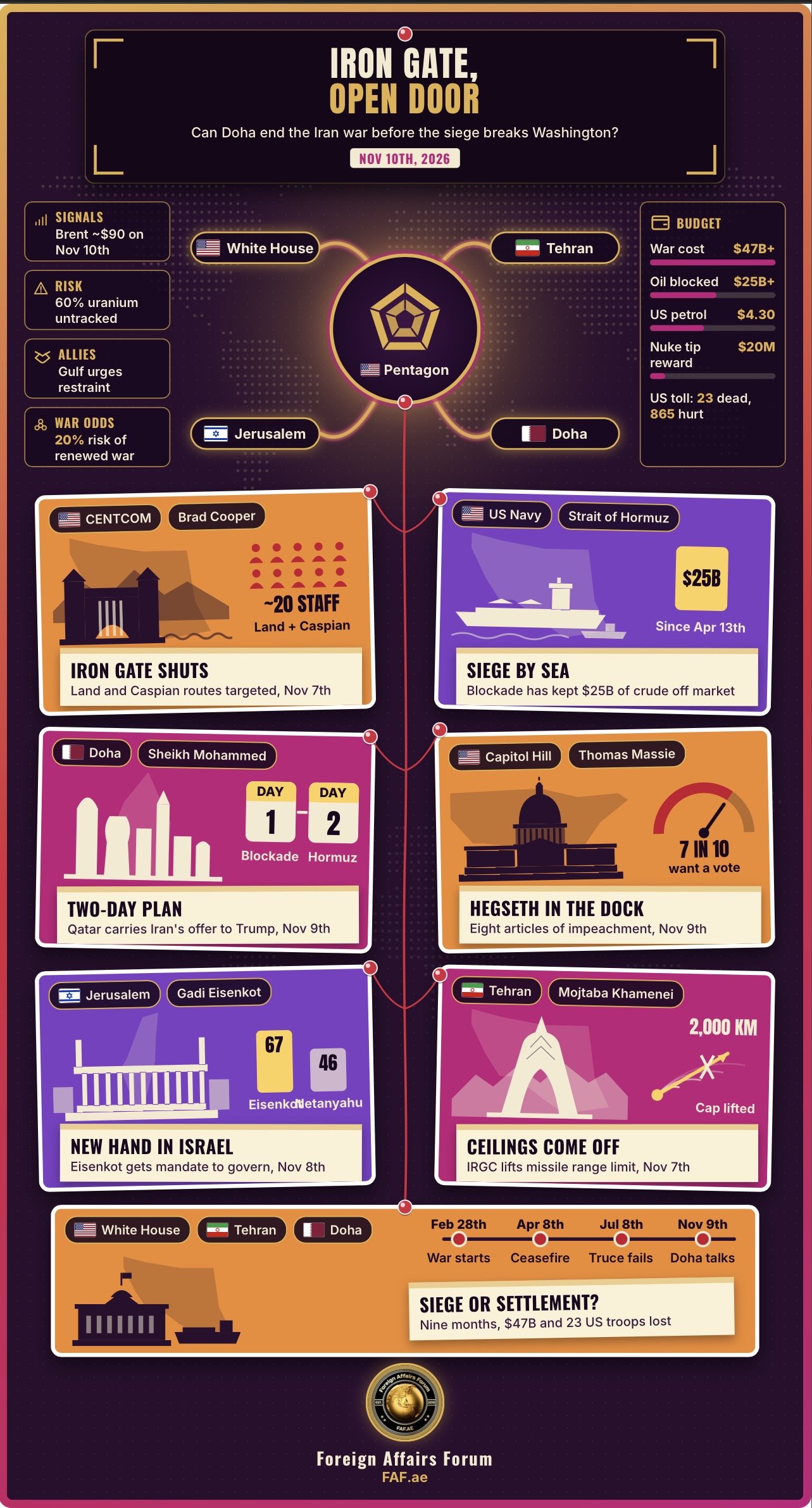
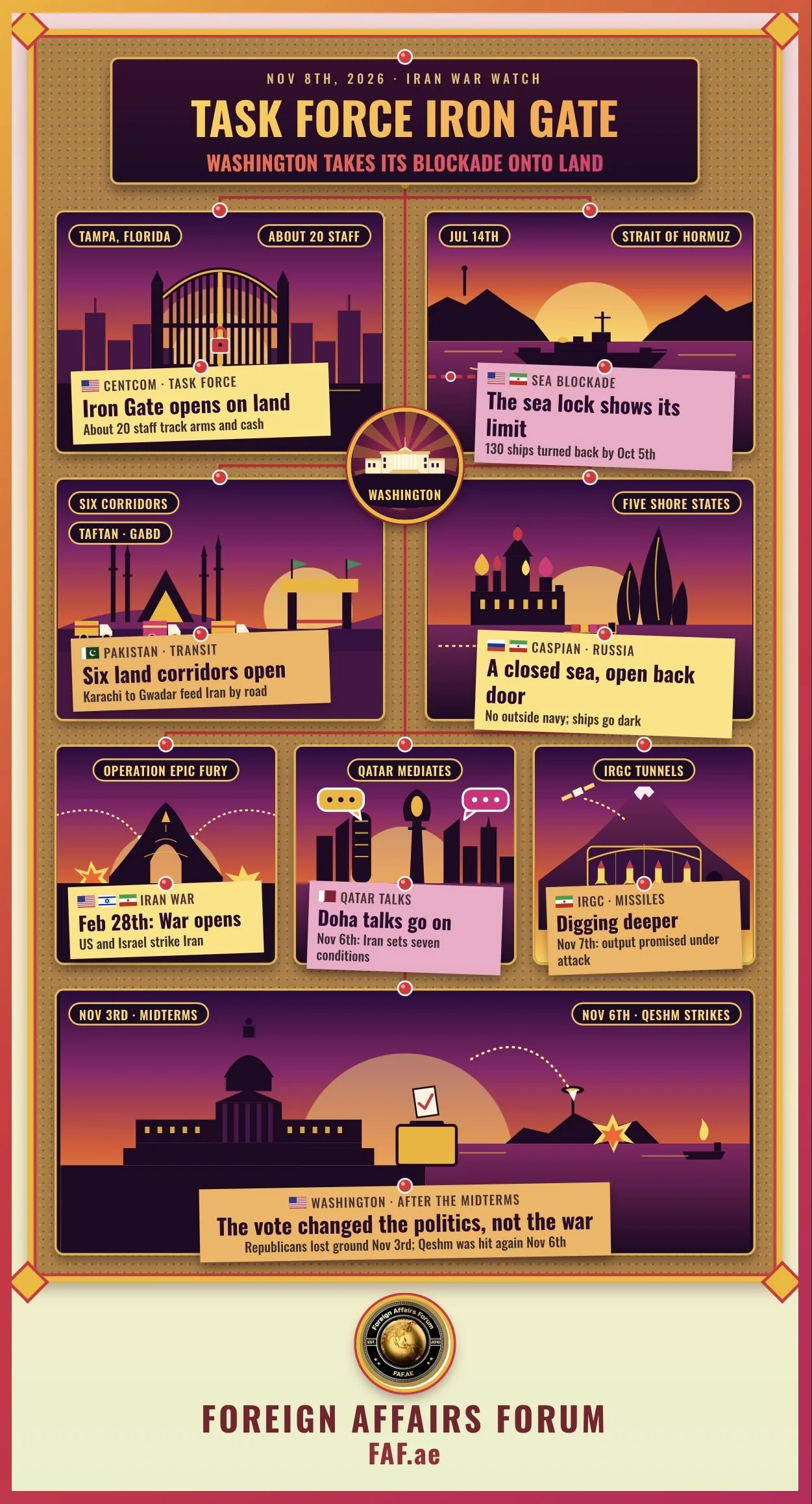
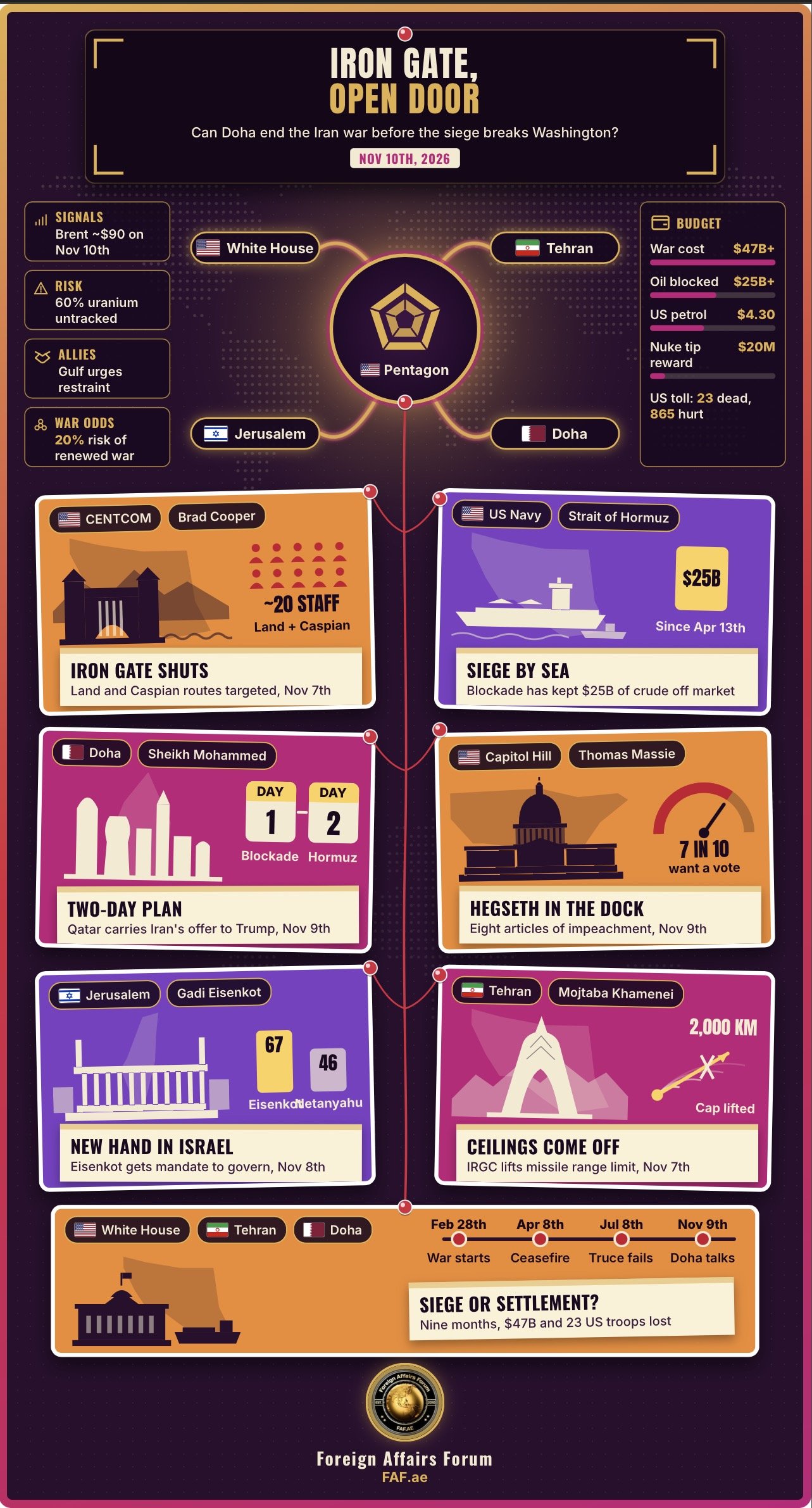
A naval blockade of Iran's ports has been in place since April. On Nov 7th it was joined by Task Force Iron Gate, a new Central Command unit meant to choke Iran's land routes and its trade across the Caspian Sea.
Iran, in turn, still harasses shipping in the Strait of Hormuz, has lifted its self-imposed 2000 kilometre cap on missile range, and insists it will not negotiate on its nuclear program until seven conditions are met.
Diplomacy has quickened since the American midterm elections on Nov 3rd, which turned into a referendum on the war.
Qatar's prime minister met President Donald Trump and Vice President JD Vance at the White House on Nov 9th, carrying a two-day plan for Iran.
On the first day, the blockade would ease, and some frozen assets would be released, in return for international inspectors returning to Iran's bombed nuclear sites.
On the second day, the Strait of Hormuz would reopen, and nuclear talks would resume.
Mr Trump declared Iran militarily "effectively over" and said he would hold off on new strikes at the request of Gulf partners. He also made clear that the blockade and Iron Gate would stay in place.
Three forces will decide what happens next.
The first is Washington's domestic politics.
Seven in ten Americans want Congress to vote to end the war, and Defense Secretary Pete Hegseth faces eight articles of impeachment.
The second is Israel's change of government. Gadi Eisenkot, a former army chief, has been given the first chance to form a coalition after Benjamin Netanyahu's bloc lost its majority.
The third is Iran's own calculation. Its new supreme leader, Mojtaba Khamenei, is balancing a weakened economy against a doctrine of "unrestricted" deterrence.
This FAF article argues that the most likely outcome is a phased, reversible de-escalation built around Hormuz and inspections, not a grand bargain. The siege tools that Washington now relies on may prove the hardest part of the war to unwind.
Dr. 🆎 warns that the most dangerous period is the gap between ceasefire and verification. In that gap, autonomous systems, hidden stockpiles of enriched uranium and fractured chains of command can trigger an escalation that no political leader intended.
Introduction: A War That Outlived Its Timetable
When the first strikes of Operation Epic Fury hit Iran in late February, Mr. Trump promised a campaign of four to five weeks.
The opening wave killed Supreme Leader Ali Khamenei and much of Iran's senior military command. It was meant to break the Islamic Republic's will and end its nuclear ambitions for good.
Instead, the war has lasted through a collapsed ceasefire, a failed round of talks in Islamabad, a signed memorandum that did not hold, a naval blockade, months of fighting over the Strait of Hormuz, and a global fuel shock. It also cost the president's party both chambers of Congress.
The question now is not whether America can hurt Iran. It plainly can. The question is whether any stakeholder can turn the current stalemate into a settlement that holds.
That depends on several connected landscapes. In Washington, a weakened president faces a Congress that wants to end the war, and a vice-president who has openly blamed it for the party's defeat.
In Jerusalem, coalition talks may replace the prime minister who spent three decades arguing for confrontation with Iran.
In Doha, Islamabad, Riyadh, Cairo and Ankara, mediators are passing proposals back and forth in near real time. And in Tehran, a new supreme leader is trying to prove that his regime can survive siege without surrendering.
This FAF article examines these landscapes with the help of Dr. Antonio Bhardwaj (Dr. 🆎). He is a polymath with global expertise in Super Intelligence, specializing in human-centered SI for geopolitical strategy, AI warfare, and bioterrorism risk, and bringing an unusual range to the meeting point of military technology, strategic decision-making, and catastrophic risk.
Dr. 🆎 describes the war as "the first conflict in which a superpower has tried to win by algorithmic siege rather than occupation". He argues that "the targeting, the blockade and the interdiction networks are increasingly machine-driven, but the decision to stop remains stubbornly, dangerously human".
The user's questions frame the analysis that follows.
What is the status of the war?
Will Iron Gate, the Qatari mediation, Mr. Hegseth's possible impeachment, or the naval blockade shape what comes next?
Where are America and Israel heading after their elections?
Are Mr. Trump and Israel's possible next leaders aligned on attacking or standing down?
And what is Iran saying and thinking?
History and Current Status: From Epic Fury to Iron Gate
The road to this war runs through the Twelve-Day War of June 2025.
Then, Israeli and American strikes damaged Iran's enrichment sites, and Tehran responded by suspending cooperation with the International Atomic Energy Agency.
Iran had already built up a stockpile of uranium enriched to 60%, a short technical step from weapons-grade.
After the June 2025 strikes, inspectors lost track of where that material was. Indirect talks mediated by Oman in early 2026 reportedly came close to a breakthrough on limiting the stockpile.
They were overtaken by Iran's deadly crackdown on a wave of protests and by a decision in Washington and Jerusalem that force would finish what diplomacy had not.
The war began on Feb 28th. Iran answered with missile and drone attacks on Israel and on American bases and partners across the Gulf. It then moved to close the Strait of Hormuz to what it called unfriendly nations.
Hezbollah joined from Lebanon in early March, and Israel invaded southern Lebanon again. Brent crude jumped from the low $70s to a peak near $118 a barrel in late March, and a global fuel crisis followed.
Pakistan arranged a two-week ceasefire that took effect on Apr 8th. Talks in Islamabad on Apr 12th and Apr 13th failed. Washington then imposed a naval blockade on Iran's ports. Iran answered by tightening its hold on Hormuz.
An American-declared indefinite ceasefire followed, then a memorandum of understanding signed on Jun 17th that was meant to end the war, reopen the strait, and lift the blockade. It lasted only weeks.
On Jul 8th, Iranian attacks on commercial ships brought it down, and fighting resumed under a new pattern.
Large air campaigns now come in bursts. Between them, tankers are attacked, ports are blockaded, and American strikes hit launch sites on islands such as Larak and Qeshm. Washington calls those strikes defensive.
The human and financial costs have mounted. The Pentagon reports 23 American service members dead and 865 wounded.
Human rights monitors count more than three and a half thousand deaths in Iran, about seventeen hundred of them civilians.
Iran's health ministry puts civilian deaths at no fewer than two thousand three hundred. The Pentagon estimates the direct cost to America at more than $47 billion.
American petrol prices rose from under $3 a gallon to above $4.30, and Brent crude traded as high as $116 a barrel at the end of October.
Fewer than a dozen commercial ships a day have crossed Hormuz during the worst weeks. In normal times, the strait carries about a fifth of the world's oil.
Iron Gate is the newest layer. Central Command's commander, Admiral Brad Cooper, ordered it formed on Nov 7th. It is a staff of about twenty military and civilian personnel based in Tampa. Its job is to work with other American agencies to disrupt the movement of advanced weapons, dual-use technology, sanctioned goods, and illicit revenue across Iran's land borders and the Caspian Sea. It involves no new troops on Iran's borders. It is a targeting and intelligence unit, not an army. It was built to close the gaps that the naval blockade cannot reach, especially the northern routes linking Iran with Russia and Central Asia.
Central Command says the blockade has already kept more than $25 billion of Iranian crude off the market.
Mr. Trump has called the two efforts together "history's greatest" blockade.
Key Developments: Doha, the Hill and the Knesset
The most important diplomatic development is the Qatari channel.
After visiting Tehran, Qatar's prime minister and foreign minister, Sheik Mohammed bin Abdulrahman Al Thani, met Mr. Vance and then Mr. Trump at the White House on Nov 9th. He brought Iran's two-day plan. As reported, Washington would lift the naval blockade and release part of Iran's frozen assets on the first day. Iran would invite inspectors back to its bombed nuclear sites.
On the second day, the Strait of Hormuz would reopen, after which nuclear negotiations would resume. Qatar is not alone: Pakistan, Saudi Arabia, Egypt and Turkey have all helped build the framework, and Turkey has spoken of planned high-level American-Iranian talks in Doha.
Mr Trump's reply mixed triumph with caution.
He said Iran was effectively finished as a military power and that new strikes would not be needed for now, because Gulf partners such as Qatar and Saudi Arabia had asked him to hold off. He also said America remained "locked and loaded", with another aircraft carrier in the region. He described the status quo, meaning the blockade plus Iron Gate, as what America's regional partners wanted. A Qatari spokesman said the next day that both sides were speaking positively about a diplomatic solution, but that "we cannot say how close or how far away an agreement is."
The second development is in Congress.
On Nov 9th, Thomas Massie, an outgoing Republican congressman from Kentucky, introduced eight articles of impeachment against Mr. Hegseth.
They accuse him of waging the Iran war without congressional authorization, ignoring laws meant to limit civilian casualties and directing extrajudicial killings, with references to operations in Yemen and Venezuela as well.
Hakeem Jeffries, the likely next Speaker, has said he is a firm yes. A House vote could come within days. Mr Hegseth held his first press conference in more than 180 days on Nov 10th. He called the effort "a far He" insists the war was necessary and that Iran has been devastated.
Democrats also see leverage in the Dec 11th government-funding deadline and the year-end deadline for the annual defence policy bill. Some want to attach limits on war funding to both.
The third development is in Israel. In the election of Oct 27th, Mr Netanyahu's governing bloc failed to win a majority.
On Nov 8th, President Isaac Herzog gave Mr Eisenkot, leader of the Yashar party, the first mandate to form a government. Factions with sixty-seven members of the Knesset recommended him, against 46 for Mr Netanyahu.
Part of his support came from Arab-led parties, which complicates coalition-building, because his ally Avigdor Liberman rules out depending on them.
Mr Eisenkot now has twenty-eight days, plus a possible fourteen-day extension. He is courting the ultra-Orthodox parties Shas and United Torah Judaism, reportedly with a softer military-draft law on offer.
Mr Trump had endorsed Mr Netanyahu before the vote. On Nov 8th he described the two rivals as having "very similar views". It was a notable step back that leaves room for him to work with either man.
The fourth development comes from Tehran, and it points the other way.
On Nov 7th, the spokesman of the Islamic Revolutionary Guard Corps, General Hossein Mohebbi, confirmed that Iran's self-imposed cap of two thousand kilometres on missile range no longer applied. "That restriction has been lifted for us," he said. This followed Mojtaba Khamenei's warning that any new American or Israeli attack would be met with a response unlimited by geography, and his reported order to update Iran's military target lists. Iran's army also announced a new doctrine of "effective response": absorb a first strike, then hit back proportionately at American bases across the region.
Latest Facts and Concerns: What Each Stakeholder Is Saying
Washington's public position combines claims of victory with continued pressure.
Mr Trump says the war has been won militarily and that Iran is collapsing economically and will eventually have to be reasonable. He repeats that Iran must never obtain a nuclear weapon. Washington wants Iran to stop attacking ships in Hormuz at once and to make real concessions on its nuclear programme. It wants this before giving up the blockade, which the administration sees as its strongest leverage.
The administration's internal unity has cracked. On Nov 4th, the day after the midterms, Mr Vance wrote that "the reason we lost is the war". He listed ending the war, the cost of living, putting America first and changing America's relationship with Israel as the reasons Trump voters had deserted the party. Reports say he privately told colleagues that Mr Netanyahu had been wrong about Iran on almost everything, and urged the president to seek a deal rather than resume strikes. Mr Vance's role in the Qatari talks, and his likely run for president in 2028, give his view unusual weight.
Tehran's public position is defiance plus conditions. Foreign Minister Abbas Araghchi says the two-day proposal "stands", and warns that the alternative is more war.
Iran's seven preconditions for formal negotiations include the following: an end to the blockade, sanctions relief, release of frozen assets, compensation for war damage, and an end to hostilities on all fronts, including Israeli operations in Lebanon. Iranian officials say there will be no talks with Washington until it takes practical steps within that framework.
Iran is also asking for compensation for the killing of Ali Khamenei and his commanders. That demand is unacceptable to Washington and Jerusalem, but it shows how Tehran is framing the war at home.
What Iran is thinking is harder to know, but its incentives can be read.
The economy is badly squeezed: oil exports are largely blocked, and now land routes are threatened as well. President Masoud Pezeshkian has said the country needs to end its long state of being neither at war nor at peace. Iran still has two strong cards.
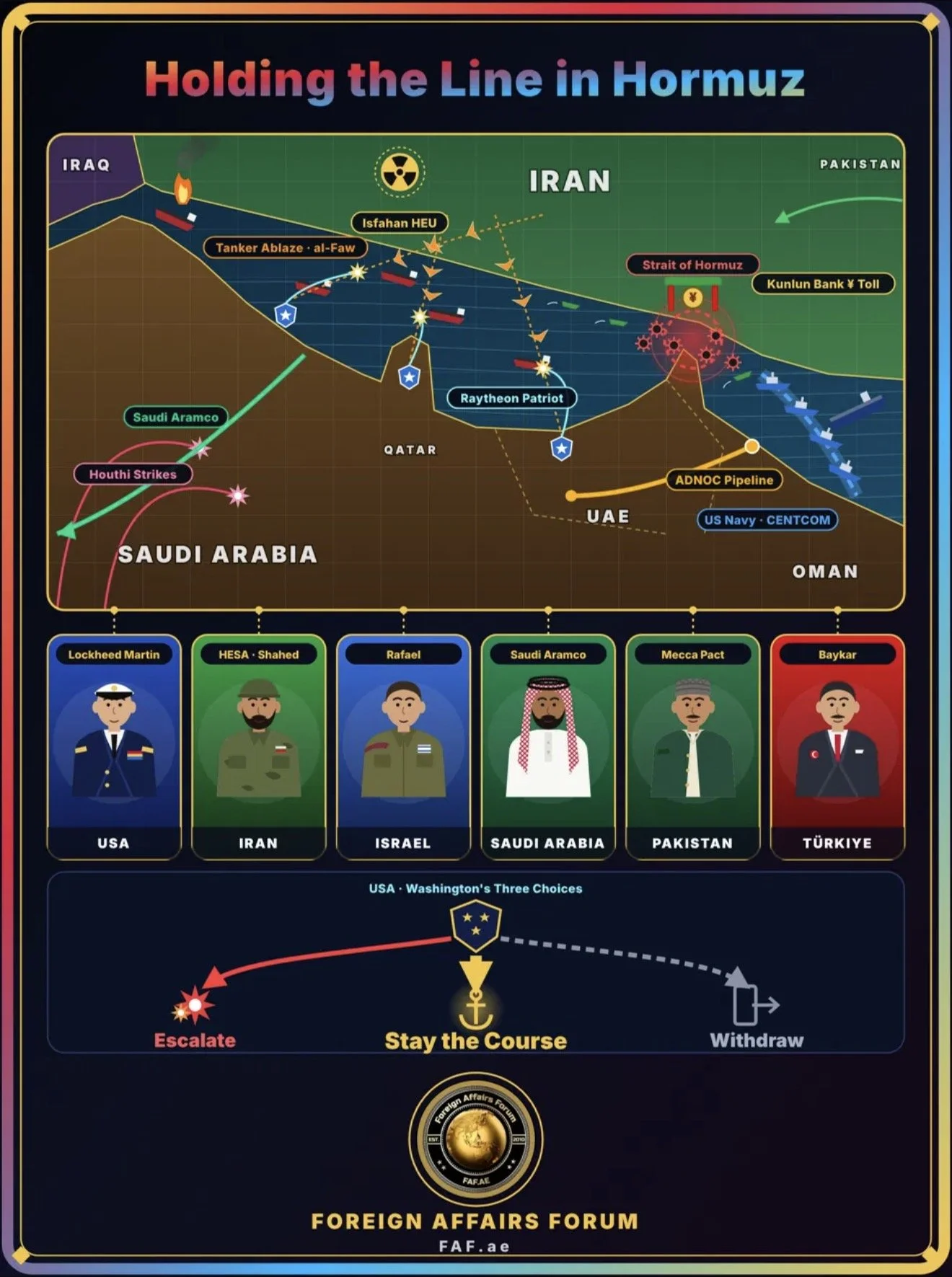
One is its ability to disrupt Hormuz with drones, missiles and mines. The other is uncertainty over its enriched uranium. Inspectors say they have lost continuity of knowledge over Iran's centrifuge production and its stockpile. Before the June 2025 strikes, that stockpile included about four hundred and forty kilograms of uranium enriched to 60%.
America has offered up to $20 million for information about the programme. Iran's offer to let inspectors back into its bombed sites is therefore its most valuable bargaining chip.
Lifting the missile-range cap is best read as a signal of deterrence, not proof of a new capability. Iran is not known to have missiles that can fly further than two thousand kilometres. But American officials have long warned that its space-launch technology could be adapted for longer-range missiles.
Dr. 🆎 says: "Iran is telling Europe as much as America that the old ceilings were political, not technical. In a siege, a regime that cannot export oil tries to export uncertainty."
The concerns are serious. Dr. 🆎 points to three in particular.
The first is the nuclear blind spot: material that cannot be accounted for, held by a state whose new leader was hardened by his father's killing.
The second is automation. "Drone swarms, autonomous mine-laying, AI-assisted targeting and machine-speed air defence compress decision times to seconds," he says. "A single misread radar track over Hormuz could undo a month of Qatari diplomacy before any human in Washington or Tehran is awake to stop it." The third is the risk of catastrophic proliferation from a regime under severe strain.
Dr. 🆎 notes that states facing collapse, and the networks around them, have historically become sources of dangerous knowledge and materials. He argues that any settlement needs strong international monitoring that covers chemical and biological capabilities as well as nuclear ones.
Cause-and-Effect Analysis: Why Siege Breeds Stalemate
The chain of cause and effect explains why the war has become a siege, and why sieges are hard to end.
The first cause was the decision to aim for a quick, decisive result through decapitation and air power. Killing the supreme leader did not produce surrender. It brought to power a successor whose legitimacy depends on resisting.
Iran's leaders reasoned, correctly, that they could not win a conventional war but could make it very costly for the world. So they used the one tool where they still had an advantage: the geography of Hormuz. That turned a military campaign into a global economic crisis.
The economic crisis then became a political one in America. Higher petrol and diesel prices fed inflation. Inflation hurt Republican candidates.
The midterm rout followed. Vance's verdict and the polling are clear. The war did not decide every race, but it decided the mood of the election. The political cost now limits Mr Trump's options. A large new bombing campaign would anger a Democratic Congress and divide his own party, and it would be likely to drive oil higher just when the administration needs prices to fall.
The president's freedom to escalate has narrowed. His freedom to blockade has not, because a blockade costs America relatively little and can be described as restraint.
Iron Gate is a direct product of that logic. Washington cannot easily bomb its way to victory, so it is trying to strangle Iran's economy instead. But siege brings its own reaction. A tighter blockade leaves Tehran less to lose from attacking ships and less reason to trust that any deal will be honoured.
The decision to lift the missile-range cap, and the new doctrine of absorbing a first strike and hitting back at American bases, are Iran's answers to strangulation. Each side's pressure confirms the other's fears.
Diplomacy has been shaped by the same pattern.
The Iranian proposal turns a demand for sequencing into concrete steps: relief first, then inspections, then Hormuz, then nuclear talks. Washington wants the reverse order: Hormuz and nuclear concessions first, relief later.
The central disagreement is not whether to make a deal but who moves first. Qatar's value as a mediator lies in its ability to break that deadlock into smaller steps that can be checked. A partial blockade easing in exchange for a verified inspection visit is one example.
Israel's political change works on a slower timescale.
Mr Eisenkot backed the war and the strikes on Iran's nuclear sites. He supports continued economic pressure and a regional alliance with Arab states against Iranian influence. Analysts expect him to keep most of Mr Netanyahu's approach in Lebanon and Gaza. He would not rule out joining a renewed American campaign, or even striking alone, if Iran's programme clearly advanced. But he is seen as much less likely to push Mr Trump to resume hostilities, and less likely to resist an American settlement.
On the core question of how to deal with Iran, Mr Trump and Mr Eisenkot are broadly aligned on continued pressure without new war. They remain open to force if verification fails.
Mr Netanyahu, who reportedly told American officials that Mr Eisenkot would be his preferred partner if fighting resumed, is now a caretaker fighting for his political survival. His ability to shape American decisions is lower than at any time in this war.
Impeaching Mr Hegseth would also work indirectly. Even if the House impeaches him, removal requires a two-thirds Senate vote, which is unlikely.
The real effect is to raise the political cost of escalation, turn congressional oversight into a constant inquiry into the war, and give Republicans who want to separate themselves from the conflict a vote to do so.
Dr. 🆎 calls it "a governance signal more than a legal remedy: it tells the military, the markets and Tehran that the American political system is moving from authorising war to auditing it".
Future Steps: Five Paths From Here
Five paths stand out, roughly in order of likelihood.
The first and most likely is a managed de-escalation through Qatar.
Its first step would be a limited trade: a partial or temporary easing of the blockade and release of some frozen assets, in exchange for inspectors visiting at least some bombed nuclear sites.
That would be followed by an Iranian pause in attacks on shipping and a gradual reopening of Hormuz.
Nuclear negotiations would come later, on enrichment limits and the handling of the 60% stockpile. Iron Gate would probably stay in place as a hedge, perhaps scaled back, so Washington can say it has not given up leverage. This path would let Mr Trump claim victory, let Iran claim relief, and let Gulf partners get the stable waterway they want.
The second is a frozen siege.
Talks drag on for weeks or months while the blockade and Iron Gate tighten, Iran keeps up its low-level attacks on shipping, and America continues "defensive" strikes on launch sites. That is the status quo Mr Trump has described, and it is easier for him politically than either war or concession. But it keeps oil prices high and leaves the nuclear question unresolved. It also gives Democrats in Congress months to build the case for cutting war funding.
The third is renewed escalation.
A mass-casualty attack on American forces, the sinking of a large tanker, intelligence that Iran is moving toward a weapon, or an accident between automated systems could each trigger a new air campaign. Iran's new doctrine and its longer missile reach mean that escalation could spread to American bases across the Gulf and possibly beyond. Israel, under a caretaker or a new government, would probably join if the trigger were nuclear.
The fourth path runs through Congress.
Democrats could use the Dec 11th funding deadline, the defence policy bill and, from January, their new majorities to limit war funding or force votes under the War Powers Resolution.
Mr Trump can veto such measures, and Democrats lack the numbers to override him. But repeated votes would raise the political price of continuing the war and push the administration toward Qatar's framework.
The fifth path involves the great powers.
Mr Trump expects to see Xi Jinping and Vladimir Putin at the APEC summit in China next week, where Iran may be discussed.
China is a major buyer of Iranian oil, and Russia sits on Iran's northern supply routes, so both have influence over whether Iron Gate succeeds or fails.
A bargain in which Beijing and Moscow quietly support a Hormuz settlement in return for concessions elsewhere is possible, though not likely in the short term.
Dr. 🆎 proposes what he calls a "verification-first ceasefire architecture".
It would have three parts. Independent, AI-assisted monitoring of shipping lanes and launch sites, shared with the mediators.
A joint incident-response channel connecting the American, Iranian and Gulf militaries, so automated or local clashes can be explained before they escalate. And inspections that include safeguards against nuclear, chemical and biological material leaking out. "The 21st century's wars will not be ended by signatures alone," he argues. "They will be ended by shared sensors, trusted data and the discipline to keep humans in charge of the kill chain."
Looking ahead to 2030, the shape of any settlement will decide whether the Gulf becomes a zone of managed rivalry or of recurring crisis.
By 2036, Dr. 🆎 warns, the bigger question will be whether this war taught regional powers that nuclear capability is the only reliable guarantee against decapitation. If it did, the consequences for nuclear proliferation from the Gulf to East Asia would be severe.
Conclusion: The Hardest Part of a Siege Is Lifting It
Nine months after the first strikes, the Iran war has reached the stage that the most dangerous wars often reach.
Neither side can win outright, both can still do serious damage, and each side's leaders have staked their credibility on not being seen to blink. America has moved from bombing to blockade, and now to Iron Gate's attempt to close Iran's land routes. Iran has moved from defiance to conditional diplomacy, while lifting its missile-range limits.
Israel is between governments, with a likely successor who agrees with Mr Trump on pressure and does not appear eager for another round of war. Washington is under heavy domestic pressure, from a Congress preparing to audit the war to a vice-president who says it cost his party its majority.
To answer the questions this FAF article began with: the Qatari talks and the blockade are the two most important influences on what comes next.
The first offers a sequence for ending the war. The second is the leverage both sides are bargaining over. Iron Gate matters mainly as a signal that Washington will keep the pressure on until Iran moves.
The campaign to impeach Mr Hegseth will not end the war, but it raises the cost of escalation.
Mr Trump and Mr Eisenkot, if Mr Eisenkot forms a government, are broadly on the same page: pressure and diplomacy now, with force held in reserve. Iran is saying no in public, while its actions, including the two-day plan, the offer of inspections and the role it has given Qatar, suggest it is looking for a way out that does not look like surrender.
Dr. 🆎 offers a final reminder: "Wars are begun by the strong, but they are ended by the patient. The side that understands that verification is more valuable than victory will shape the peace." A siege is easy to impose. The real test of statecraft in Washington, Jerusalem and Tehran over the coming weeks is whether they can lift it without losing face, while still making the region safer.