The Swarm Age: How Mass Drones, Armed Sea Robots and Sovereign Software Are Rewriting the Economics of War
A FAF article on the industrialization of autonomous warfare, the Black Sea as its proving ground, and the contest over trusted technology
Foreign Affairs Forum | Dr. Antonio Bhardwaj (Dr. 🆎)| November 17th, 2026
Executive Summary
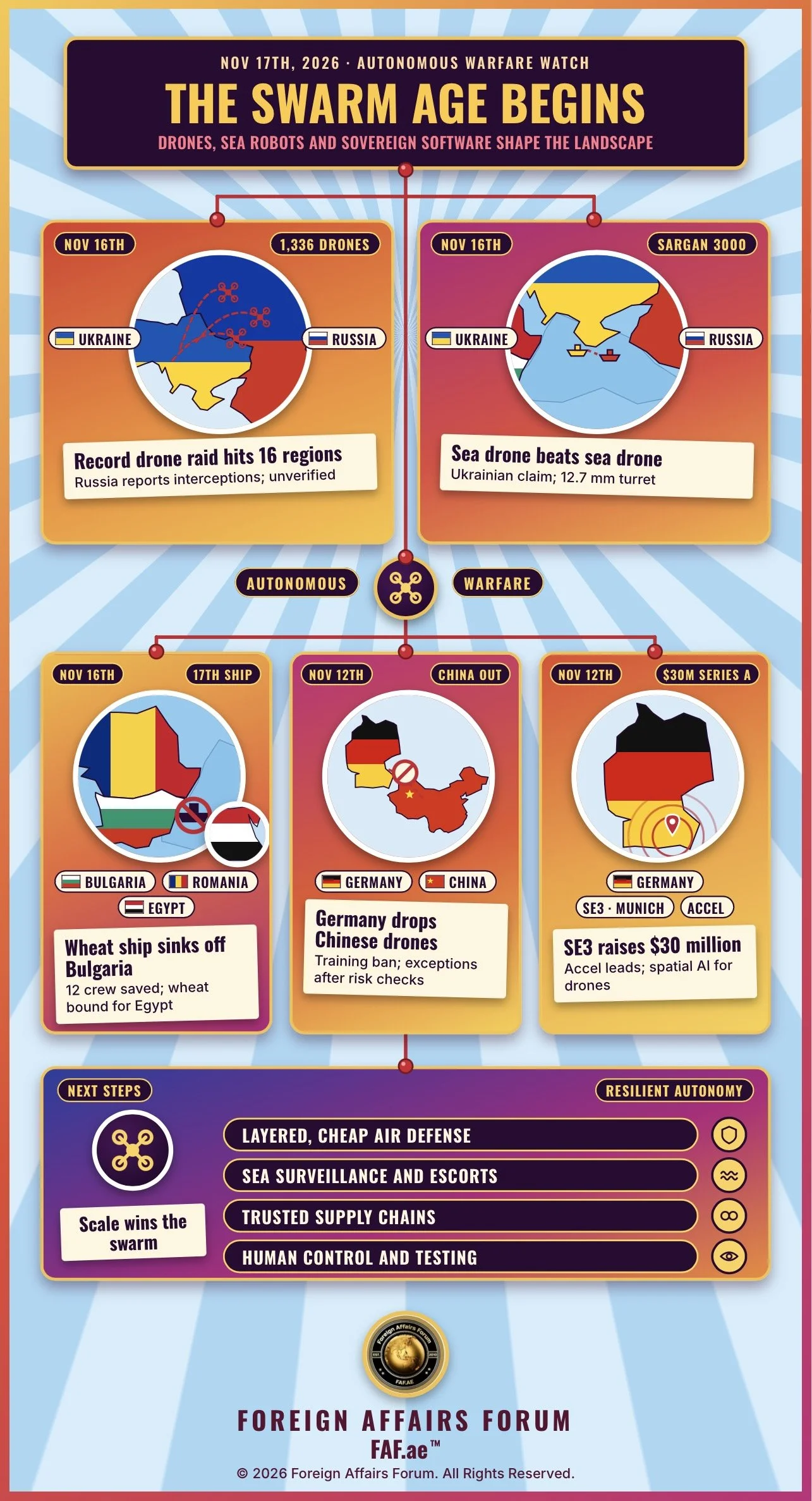
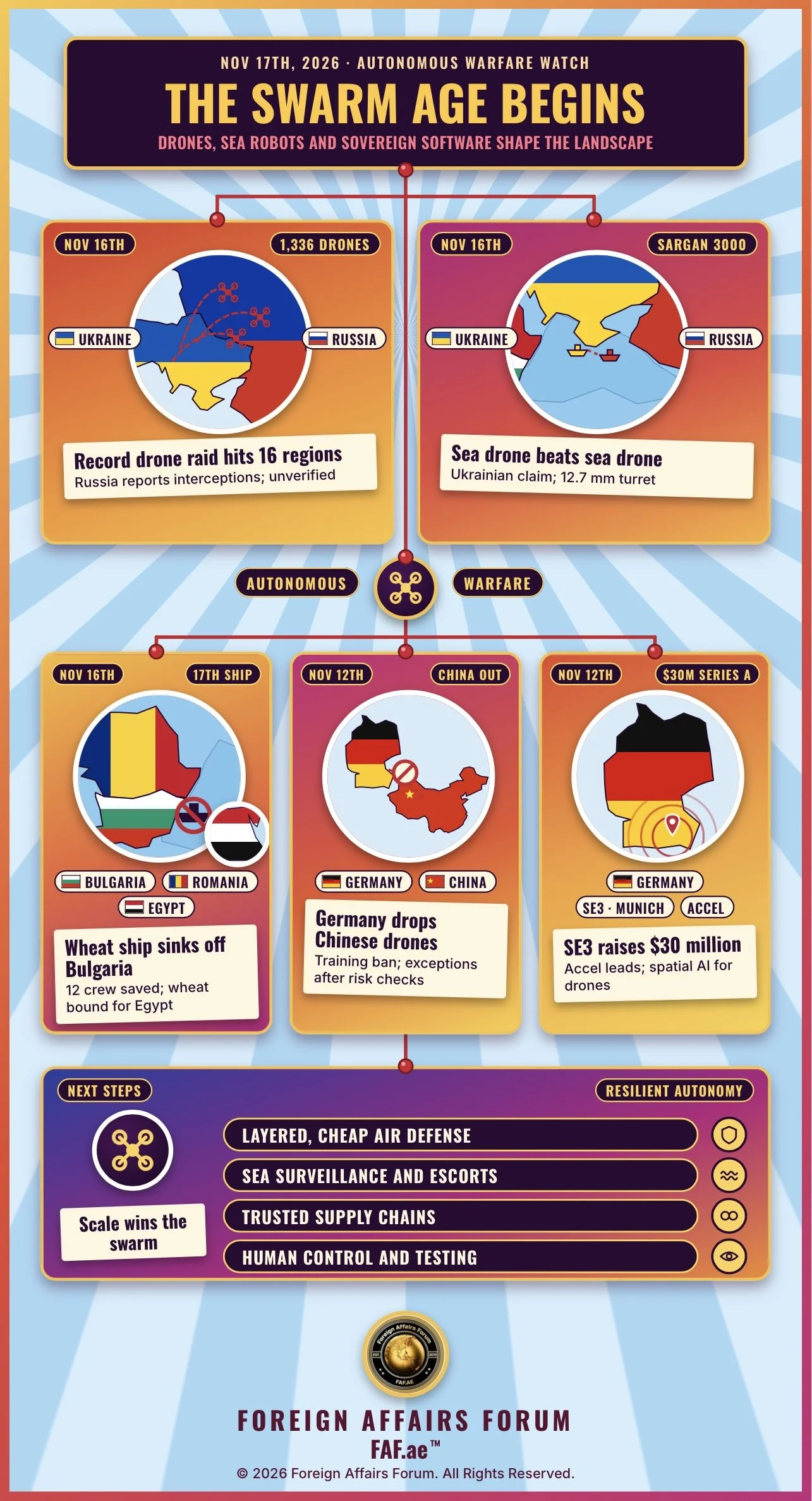
Between Nov 12th and Nov 17th, 2026, five developments converged to show that autonomous warfare has crossed a threshold. Russia's Defense Ministry reported intercepting 1,336 Ukrainian drones in a single overnight assault across 16 regions, the largest figure it has disclosed since the full-scale invasion began.
Ukraine reported that its Sargan 3000 unmanned surface vessel destroyed a Russian drone boat with an automated turret, the second such engagement without the loss of a Ukrainian vessel. A cargo ship carrying roughly 3,000 metric tons of wheat sank inside Bulgaria's exclusive economic zone after an apparent sea-drone strike, the 17th vessel attacked off Bulgaria and Romania since mid-July. Meanwhile, Germany announced that the Bundeswehr will phase out Chinese-made drones from training, and the Munich start-up SE3 raised $30 million in Series A funding to build spatial intelligence for military robots.
Per FAF analysis, these events are not isolated headlines. They describe a single strategic transformation in which the unit of military power is shifting from the exquisite platform to the reproducible system, from the individual aircraft or ship to the industrial process that manufactures, navigates, coordinates and replaces thousands of cheap machines. The attack of Nov 16th matters less for the damage it claims than for what it reveals about throughput, endurance and cost. The naval engagement matters because unmanned vessels are beginning to protect themselves against other unmanned vessels. The sinking matters because commercial shipping has become the collateral landscape of this competition. The German decisions matter because sovereignty over software, data links and update channels is now inseparable from readiness.
Dr. Antonio Bhardwaj (Dr. 🆎), whose work focuses on human-centered superintelligence in geopolitical strategy and AI warfare, argues that the decisive variable is no longer who owns the best weapon but who owns the most resilient production-and-perception loop. Many claims in the reporting remain unverified, and this FAF article treats them with due caution. Yet the direction of travel is unmistakable. The stakeholders who will prevail are those that can build at scale, navigate without satellites, defend against swarms affordably, and keep civilian trade moving under unmanned threat. Those that cannot will find that deterrence, insurance markets and alliance cohesion erode faster than their procurement cycles can respond.
Introduction
Every era of warfare is eventually defined by a ratio. In the 19th century it was the ratio of rifled firepower to massed infantry; in the 20th, the ratio of armored mobility to fixed defense and later of nuclear destructiveness to survivable retaliation. In the 21st century, the ratio that matters most may be the cost of an attacking machine to the cost of the interceptor that stops it. When that ratio favors the attacker by orders of magnitude, and when the attacker can field machines in the thousands, the traditional logic of air defense, naval power and industrial mobilization begins to bend.
The reporting window from Nov 12th to Nov 17th, 2026 offers an unusually clear view of that bending. In the space of five days, a record drone raid, a machine-on-machine naval engagement, a merchant ship lost to an apparent sea drone, a European procurement decision about foreign-made unmanned aircraft, and a large funding round for military perception software all entered the public record. Taken separately, each is a story about a particular front or a particular company. Taken together, they form a coherent argument about where military advantage is being generated.
Dr. Antonio Bhardwaj (Dr. 🆎), a polymath with global expertise in superintelligence, specializing in human-centered approaches to geopolitical strategy, AI warfare and bioterrorism risk, frames the moment in civilizational terms.
Per Dr. 🆎, the lesson of this week is that autonomy is not a single technology but a stack, running from raw manufacturing through perception and navigation to command networks and the human judgment that sits above them. Weakness at any layer is a strategic vulnerability, and strength at one layer cannot compensate for fragility at another.
This FAF article proceeds in stages. It first traces the history and current status of unmanned warfare, from the early loitering munitions to the present industrial campaigns. It then examines the five key developments in turn, sets out the latest facts and the concerns they raise, and constructs a cause-and-effect analysis linking cheap autonomy to defense economics, maritime security and technological sovereignty. It closes with practical steps for governments, navies, industries and investors, and a conclusion on what resilient autonomy will demand.
History and Current Status
The strategic story of unmanned systems did not begin in 2026.
Remotely piloted aircraft were a staple of Western counter-terrorism campaigns in the early 21st century, but they were expensive, tied to satellite links, and operated in permissive airspace against adversaries without meaningful air defenses. The first inflection came in 2020, when drones and loitering munitions helped decide the Nagorno-Karabakh war by destroying armor and air-defense systems that had been assumed to be robust. The lesson that cheap aircraft could defeat costly ground systems was widely noted but not yet widely internalized.
The second inflection arrived with the full-scale invasion of Ukraine in 2022.
Early in the war, Ukraine used Turkish-built armed drones and a growing number of commercial quadcopters adapted for reconnaissance and munition drops. Russia, for its part, acquired Iranian-designed one-way attack drones and later built them domestically at scale. By 2024 and 2025, both sides had turned drone production into a mass industry, and the battlefield had become saturated with first-person-view aircraft, fiber-optic controlled machines immune to jamming, and long-range strike drones that could reach refineries and airbases hundreds or thousands of kilometers from the front. In June 2025, a Ukrainian operation that concealed short-range drones in trucks and launched them near Russian air bases demonstrated that even strategic bombers could be placed at risk by inexpensive systems delivered through unconventional means. Through 2025, Russia in turn launched single-night salvos of drones and missiles that exceeded 800 projectiles, testing Ukrainian air defenses and depleting interceptor stocks.
The maritime dimension developed along a parallel path.
In late 2022, Ukraine employed explosive-laden uncrewed surface vessels against the Russian Black Sea Fleet at Sevastopol. Through 2023 and 2024, repeated strikes by such craft, along with missiles and aircraft, forced the Russian fleet to withdraw much of its strength from Crimea to Novorossiysk and then to restrict its freedom of movement in the western Black Sea. A navy that had been a dominant regional power was held at risk by a country with almost no conventional fleet. That achievement became a template studied from the Baltic to the Taiwan Strait. Further afield, Houthi forces in the Red Sea demonstrated from late 2023 that drones and missiles could disrupt global shipping lanes and compel navies to expend expensive interceptors against cheap threats.
By the autumn of 2026, the current status can be summarized in three observations.
First, long-range drone warfare is no longer experimental but routine, conducted by both sides against each other's economies as well as their armies. Second, the Black Sea has become a laboratory in which uncrewed surface vessels, aerial drones, coastal sensors and commercial shipping interact under live conditions. Third, the supply chains behind these systems, from motors and batteries to cameras, radios, flight controllers and software, have become objects of strategic competition, particularly where Chinese manufacturing dominates the commercial components on which many military drones rely. European governments, long accustomed to treating drones as a niche procurement category, have begun to reassess that dependence.
Key Developments
The first and most consequential development occurred overnight into Nov 16th.
According to Russia's Defense Ministry, air defenses intercepted 1,336 Ukrainian drones across 16 Russian regions, the largest single-attack figure the ministry has reported since the full-scale invasion began. The reported targets included energy infrastructure, industrial facilities and the transport link connecting Crimea with the Russian mainland. Ukrainian officials claimed strikes against refineries and oil depots. Neither the interception totals nor the full extent of the damage has been independently verified, and both governments have clear incentives to shape the narrative. Even so, the order of magnitude is itself strategically informative. Whether the true number launched was somewhat lower or higher, the scale implies a production base, a launch logistics chain, a mission-planning apparatus and a navigation system capable of coordinating a vast number of aircraft toward geographically dispersed targets.
Per FAF analysis, the central innovation here is not the performance of any single drone.
It is the combination of manufacturing scale, long-range navigation, mission coordination and affordability. A defender facing such a raid must detect, classify and engage hundreds of tracks while protecting a sprawling set of assets, from refinery towers to bridge approaches. Each interception consumes a missile, a gun round, an electronic-warfare effort or a mobile fire unit, and each missed track can impose damage far larger than the cost of the drone that caused it.
Dr. 🆎 describes this as the saturation problem, in which the defender's cost curve and the attacker's cost curve cross in the attacker's favor, not because defense is impossible but because it must be perfect while offense need only be numerous.
The second development took place in the Black Sea, where Ukraine reported that its Sargan 3000 uncrewed surface vessel destroyed a Russian drone boat using an automated weapon turret.
Reporting indicates that Ukraine has now claimed two successful engagements against Russian unmanned vessels without losing a boat in either encounter. The Sargan 3000 carries a remotely controlled 12.7 mm machine gun, and the accounts rest primarily on Ukrainian statements that have not been fully verified. The significance lies in the role reversal. Early naval drones were expendable weapons, designed to run into a ship and explode. The Sargan engagement points toward reusable, armed platforms that can patrol, detect hostile craft and fire on them, effectively giving uncrewed fleets a defensive and escort function against their own kind.
This is a more profound shift than it may first appear. Once unmanned vessels must defeat other unmanned vessels, the naval landscape acquires a new operational requirement: persistent sensing, rapid target classification, stable remote links or onboard autonomy to function when links fail, and weapons that can hit small, fast, low-signature targets in rough water.
Dr. 🆎 argues that this is the maritime equivalent of the first aerial dogfights, an early and crude contest that foreshadows a mature domain of drone-versus-drone combat with its own doctrines, countermeasures and industrial base.
The third development is the sinking of a cargo ship in the Black Sea on Nov 16th.
The vessel, carrying approximately 3,000 metric tons of wheat from Romania to Egypt, went down in Bulgaria's exclusive economic zone after an apparent sea-drone strike, according to maritime-security sources. All twelve crew members were rescued. The maritime-security firm Diaplous reported that this was the 17th vessel attacked off Bulgaria and Romania since mid-July, and responsibility for the latest strike has not been established. The absence of attribution is itself part of the story. Unmanned maritime weapons are cheap, deniable and difficult to trace, and they allow the threat of attack to hang over a commercial corridor even when no stakeholder claims credit.
This incident is an operational demonstration rather than the announcement of a new capability, but its implications are broad. The wheat in question was bound for Egypt, a major importer whose food security depends on stable Black Sea trade. A ship sunk inside a NATO and European Union member's economic zone also brings the conflict closer to allied waters and complicates the legal and political calculations of coastal states. Per FAF analysis, the episode illustrates how a technology developed for naval warfare can quickly become a systemic risk to civilian commerce.
The fourth development came on Nov 12th, when Germany's Defense Ministry announced that the Bundeswehr will stop using Chinese-manufactured drones for training and certain exercises, replacing them with German or other European systems.
Exceptions may remain for commercially available drones following a security-risk assessment, provided that sensitive military information is not exposed. At first glance this is a modest procurement adjustment. Strategically, it signals that military drone sovereignty now extends far beyond the airframe. It encompasses flight software, communications protocols, data collection, components and the update infrastructure through which devices are patched and managed. A drone that sends telemetry, imagery or location data to a foreign cloud, or that depends on firmware updates from a foreign supplier, can be a conduit for intelligence collection or a point of coercive leverage.
The fifth development, also on Nov 12th, was the announcement that Munich-based SE3 had raised $30 million in Series A funding, led by Accel, following an earlier seed round, to develop spatial-intelligence software that allows drones and other unmanned military platforms to interpret three-dimensional environments.
The strategic logic is straightforward. As electronic warfare disrupts satellite navigation and radio links, drones that depend on constant external guidance become unreliable. Platforms that can perceive terrain, recognize obstacles and navigate through complex spaces with limited human input can continue operating when signals are degraded. Funding, however, is not proof. A well-capitalized start-up has not yet demonstrated battlefield reliability, and the distance between a laboratory demonstration and a system that works in mud, smoke, snow and jamming is considerable.
Latest Facts and Concerns
The latest facts, as reported through Nov 17th, 2026, should be stated with discipline.
The headline figure of 1,336 drones is a Russian claim about interceptions, which means that the number of drones actually launched, the number that reached targets and the damage inflicted remain uncertain. Ukrainian claims of refinery and depot strikes are likewise unconfirmed in detail. The two Sargan 3000 engagements are reported by Ukraine and by commentary relying on Ukrainian accounts. The identity of whoever attacked the cargo ship has not been established. What can be said with reasonable confidence is that the volume and tempo of unmanned operations in this war are increasing, that the Black Sea corridor is under persistent threat, and that European governments are acting on concerns about the provenance of drone technology.
Several concerns follow.
The first is escalation through saturation.
When one side demonstrates that it can strike energy and transport infrastructure across a large number of regions in a single night, the other side faces pressure to respond in kind, and the targeting of civilian-adjacent infrastructure becomes more routine. Energy systems and transport links sit at the intersection of military logistics and civilian life, and attacks on them risk humanitarian consequences that reach well beyond the intended military effect.
Dr. 🆎 cautions that the human-centered principle must apply even to the most automated campaigns, because the speed and scale of swarm operations compress the time in which a human commander can exercise meaningful judgment.
The second concern is the governance of autonomy.
Systems such as the Sargan 3000 are described as remotely controlled, and the weapon turret is automated in its operation. As communications are jammed and the pressure to act within seconds increases, the incentive to delegate target selection and engagement to onboard software grows. There is no settled international framework for how much autonomy is acceptable in lethal systems, and the practical experience of this war is outrunning the diplomatic debate. Per FAF analysis, the risk is not an imagined machine rebellion but a slow normalization of decisions made without adequate human oversight, under conditions where mistakes are hard to detect and harder to attribute.
The third concern is civilian maritime safety.
Seventeen vessels attacked off Bulgaria and Romania since mid-July is not a statistical anomaly; it indicates a pattern in which merchant shipping is repeatedly exposed. Insurers, charterers and crews will price this risk, and the costs will pass into freight rates, food prices and the economic stability of import-dependent countries. The risk that a sinking in the future involves fatalities, a hazardous cargo or an environmental catastrophe cannot be dismissed. In this sense, the Black Sea is a preview of what the Baltic Sea, the Persian Gulf, the Red Sea and the Indo-Pacific could face if unmanned maritime weapons proliferate to additional stakeholders, including non-state groups.
The fourth concern is technological dependence.
Germany's decision reflects a broader European discovery that many military and paramilitary drone systems rely on commercial components and software ecosystems whose origins lie in a strategic competitor. The concern is not limited to espionage. It includes the possibility of supply interruptions during a crisis, the existence of undisclosed software vulnerabilities, and the leverage that dominance in components gives to the supplier. At the same time, substituting European systems carries its own costs. Domestic drones are often more expensive, produced in smaller volumes and slower to iterate than commercial Chinese equivalents, and a procurement policy that prizes trust must be matched by industrial policy that delivers scale.
Finally, there is a concern that cuts across all the others: the dual-use character of the technology. The same perception, navigation and manufacturing capabilities that enable military drones can be adapted by criminal organizations, insurgents and hostile non-state groups.
Dr. 🆎, who has long studied the intersection of artificial intelligence and catastrophic misuse, including bioterrorism, stresses that low-cost autonomous delivery systems lower the barrier for those seeking to attack infrastructure or populations, and that defensive planning must anticipate misuse well beyond the battlefield in which these technologies are now being refined.
Cause-and-Effect Analysis
A rigorous reading of the week requires distinguishing causes from consequences and tracing how they feed one another.
The root cause is the collapse in the cost of capable unmanned systems, driven by commercial electronics, advances in machine perception and the diffusion of manufacturing know-how. This cost collapse produces a first-order effect: attackers can field systems in numbers that overwhelm defenses designed around scarce, expensive threats. The Nov 16th raid is the clearest illustration. Air-defense architectures built for a limited number of aircraft and missiles are being asked to engage a far larger number of low-cost objects, and the result is exhaustion of interceptors, fatigue among crews and a widening gap between what is defended and what is exposed.
That first-order effect creates a second-order response.
Defenders seek cheaper interceptors, whether in the form of interceptor drones, guns with improved fire control, directed-energy systems or electronic warfare, and they invest in sensor networks that can track large numbers of low-flying targets. This response, in turn, spurs attackers to adopt countermeasures: more autonomy to defeat jamming, fiber-optic control to avoid radio interference, decoys to absorb defenses, and swarm tactics to exploit saturation. The cycle of measure and countermeasure accelerates, and the stakeholders able to iterate fastest gain advantage.
Dr. 🆎 characterizes this as a competition in learning rates, where institutions that incorporate battlefield feedback into design and production within days outperform those that rely on multi-year acquisition programs.
The same logic applies at sea.
The cost collapse in unmanned surface vessels allowed Ukraine to threaten a larger navy, which led Russia to adopt defensive measures and, as the Sargan engagements suggest, its own unmanned craft. This in turn pushed Ukraine to field armed vessels capable of defending against them, and the interaction has produced drone-versus-drone combat. The consequence is a more complex maritime landscape in which unmanned craft are simultaneously weapons, sensors and escorts. Here the second-order effect reaches beyond the belligerents. As more explosive-carrying or armed craft operate in a busy trade corridor, the probability of attacks on merchant vessels, whether deliberate, deniable or mistaken, increases. The sinking of the wheat carrier is a downstream consequence of the proliferation of cheap maritime weapons into a space shared with civilian shipping.
The consequences for trade follow in a predictable chain.
Attacks raise insurance premiums and delay voyages; higher costs and uncertainty reduce the willingness of shipowners to serve affected ports; reduced traffic tightens supply of grain and other goods to importers such as Egypt; and food-price pressure creates political stress in countries far from the war. This is an example of how a military technology, through an economic channel, produces diplomatic and humanitarian effects across continents.
On the industrial and strategic side, the causal chain runs through dependency.
Because cheap drones rely on commercial components, and because a large share of those components comes from a small number of manufacturing centers, states discover that their ability to build unmanned systems in a crisis rests on supply lines that a rival could constrain. This realization drives decisions such as Germany's move away from Chinese-made drones for training. That decision has its own consequences. It creates demand for European manufacturers, raises procurement costs, may slow the pace of training and experimentation in the short term, and generates a market signal that encourages investors to back start-ups in navigation, perception and secure communications. The SE3 funding round can be read as part of this feedback loop, in which political concern about dependence mobilizes capital toward domestic alternatives.
Finally, the deterrence consequences deserve attention.
A campaign that threatens energy, industrial and transport infrastructure across a large geographic area changes the meaning of strategic depth. Distance from the front line no longer guarantees safety, and the notion of a protected rear is weakened. For states elsewhere, including those facing potential confrontations in the Baltic, the Persian Gulf or the Indo-Pacific, the implication is that critical infrastructure must be hardened and defended against mass unmanned attack, and that doctrines assuming uncontested logistics will need revision. Deterrence in the age of cheap autonomy rests on resilience as much as on retaliation: the ability to absorb attacks, restore function and continue operations.
Future Steps
Translating these findings into policy requires action on several fronts, each of which, per FAF analysis, can be pursued without waiting for the war's resolution.
For air defense, the priority is cost-exchange discipline.
Governments should invest in layered defenses that match the cost of the interceptor to the cost of the threat, combining low-cost interceptor drones, rapid-fire guns, electronic warfare and, where mature, directed energy, with dense low-altitude sensor networks and integrated command systems that can manage hundreds of tracks simultaneously. Critical infrastructure such as refineries, power stations, rail junctions and ports should be hardened with physical protection, redundancy and rapid-repair capability, since no defense will intercept everything.
Dr. 🆎 advises that exercises should deliberately simulate saturation raids, so that commanders learn how to prioritize and how to maintain human oversight when the volume of threats exceeds what any operator can individually evaluate.
For maritime security, navies and coast guards should develop persistent surveillance of coastal and open-water approaches, combining small-target radar, acoustic and optical sensors, and uncrewed patrol craft that can detect and engage hostile unmanned vessels.
Coastal states in the Black Sea region, including NATO and European Union members, should coordinate information sharing and establish clear rules for response, attribution and escort of commercial traffic. International maritime bodies and insurers should work toward standards for risk assessment, vessel hardening and crew protection in waters affected by unmanned weapons.
For technological sovereignty, European governments should treat drone supply chains as strategic infrastructure.
This means mapping dependencies on components and software, setting security standards for flight controllers, data links and update mechanisms, and funding domestic production capacity at a scale that makes trusted systems affordable. Germany's decision is a sound signal but must be supported by procurement pathways that favor rapid iteration, standardized interfaces and competition among European suppliers. Allied cooperation matters here as well, since a fragmented market of small national producers will struggle to match the volume of larger competitors.
Dr. 🆎 suggests that a trusted-ecosystem approach, in which allied states share standards and certify components together, would reduce duplication and shorten the path from prototype to fielded system.
For autonomy and AI governance, states should agree, even if informally, on principles that preserve meaningful human control over lethal decisions, require rigorous testing of perception and navigation systems under electronic attack, and provide for accountability when automated systems cause harm. Human-centered design, in the sense advanced by Dr. 🆎, means that systems should be built so that human operators retain the ability to understand, override and audit machine behavior, and that the doctrine governing their use reflects legal and ethical obligations. The aim is not to slow innovation but to ensure that speed does not erode the responsibility that gives military force its legitimacy.
For the wider international community, the dual-use risks call for early work on export controls, counter-proliferation and the detection of illicit uses of autonomous systems.
As Dr. 🆎 has long warned, technologies that lower the cost of delivering effects at a distance, whether kinetic or otherwise, can be exploited by malicious stakeholders. Security services should anticipate the migration of battlefield techniques to terrorism, organized crime and the targeting of critical infrastructure in peacetime, and should develop corresponding detection and response capabilities.
Conclusion
The five days from Nov 12th to Nov 17th, 2026 are best understood as a single lesson delivered in five parts.
A record drone raid, an armed sea robot defeating a rival sea robot, a merchant ship lost to an apparent sea drone, a European decision to purge a strategic competitor's drones from training, and a funding round for machine perception together describe a world in which military advantage is increasingly manufactured, computed and sustained rather than simply purchased. The most consequential operational development is the reported launch of more than 1,300 drones in a single attack; the most significant emerging trend is the movement toward armed unmanned vessels fighting one another.
Per FAF analysis, the strategic equation can be stated plainly.
Artificial perception, autonomous navigation, mass manufacturing, secure communications and affordable interception combine to produce sustainable military advantage, and the absence of any one element undermines the rest. A state with abundant drones but fragile software is vulnerable. A state with sophisticated software but limited production cannot sustain a campaign. A state with both but exposed supply chains can be coerced. And a state with all three but no affordable defense will bleed its own economy and population.
Dr. 🆎 offers a final reflection that deserves emphasis. The tempo of this transformation tempts decision-makers to equate speed with wisdom, and to imagine that more automation inevitably means more security. The opposite may be true. Resilient autonomy depends on human judgment at the right places: in setting objectives, in testing systems honestly, in constraining their use and in recognizing when escalation has outrun strategy. The stakeholders who combine industrial scale with disciplined human oversight will define the next generation of military superiority. Those who chase volume without resilience, or sovereignty without capacity, will discover that the swarm age rewards neither slogans nor stockpiles, but the quiet, difficult work of building systems that function when everything around them is failing.
The Black Sea, in this sense, is not a distant sideshow. It is the early draft of a wider future, and the questions it poses about cost, control, trust and accountability will soon be asked in every ocean and airspace where unmanned systems operate.