The Lame Duck Heads East - Donald Trump
Foreign Affairs Forum | Dr. Antonio Bhardwaj (Dr. 🆎)| Nov 14th, 2026
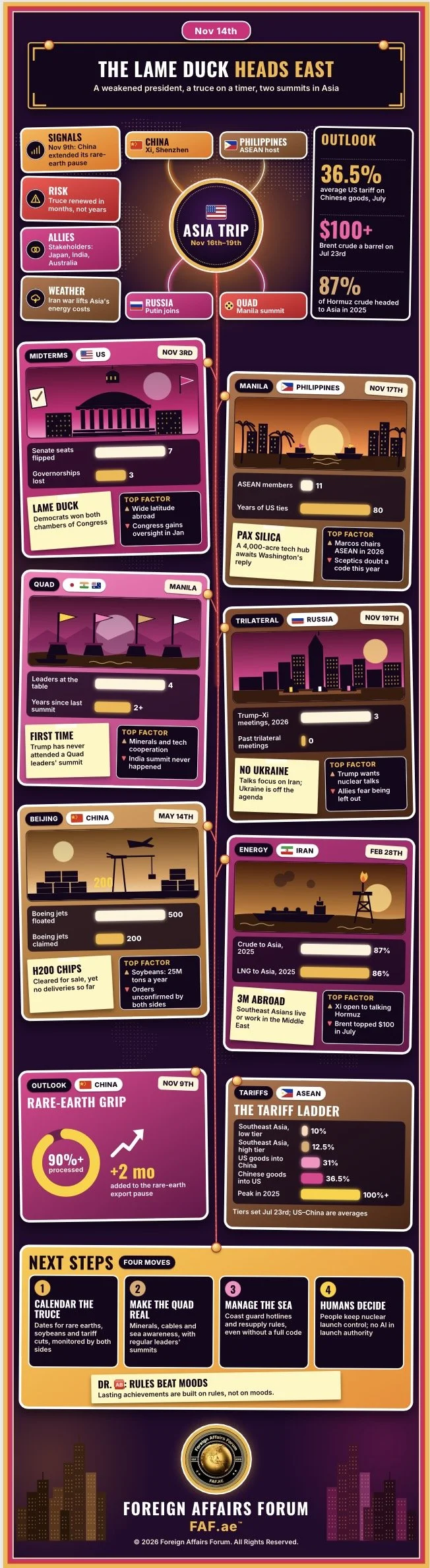
Fresh from a midterm rout, Trump arrives in Manila and Shenzhen with fewer cards, a restless Quad and a trade truce on a timer
Executive Summary
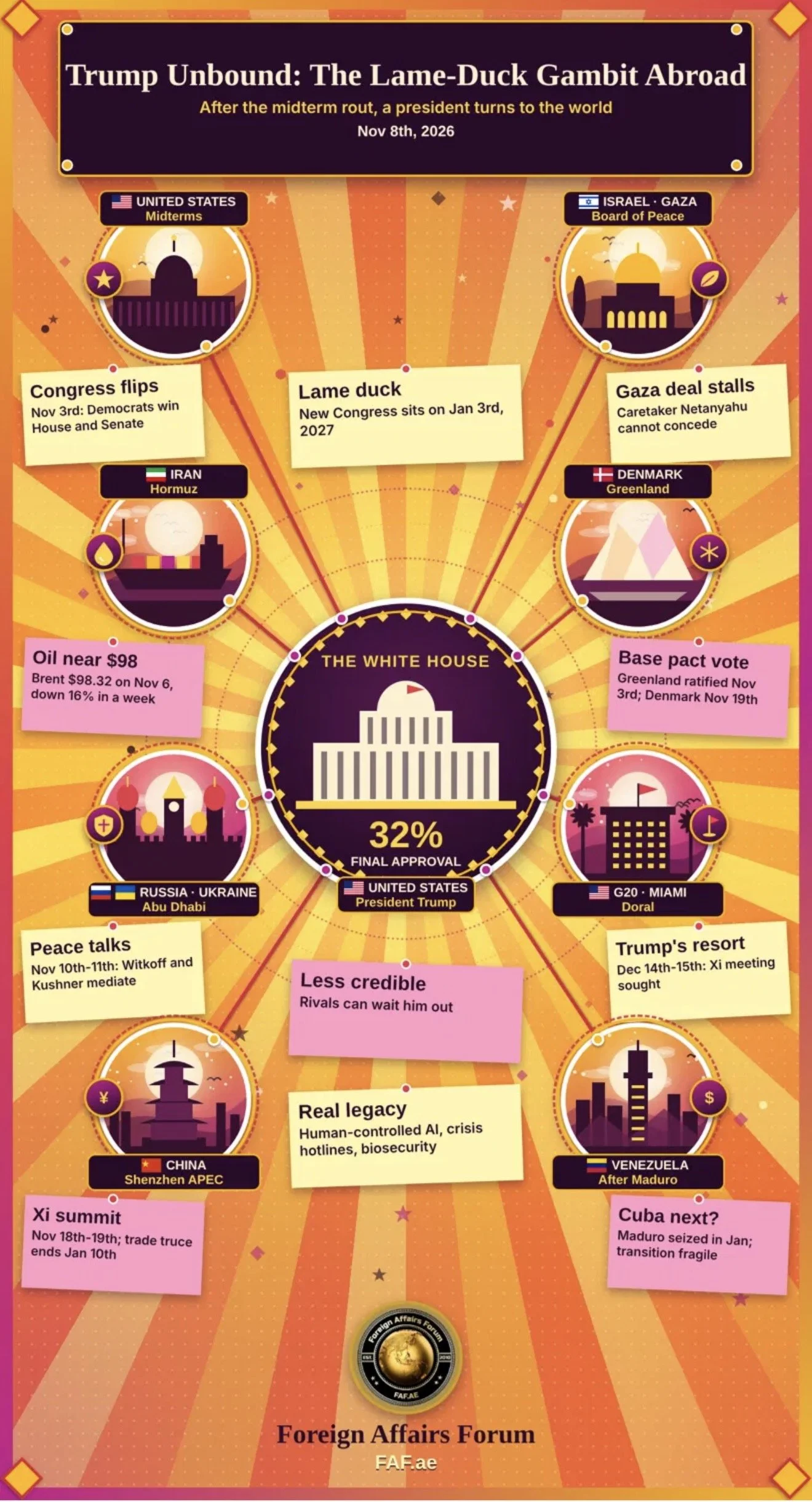
President Donald Trump leaves Washington on Nov 16th for his first overseas journey since a midterm election in which Democrats captured both chambers of Congress, flipped seven Senate seats and ended the Republican trifecta that governed the first half of his second term.
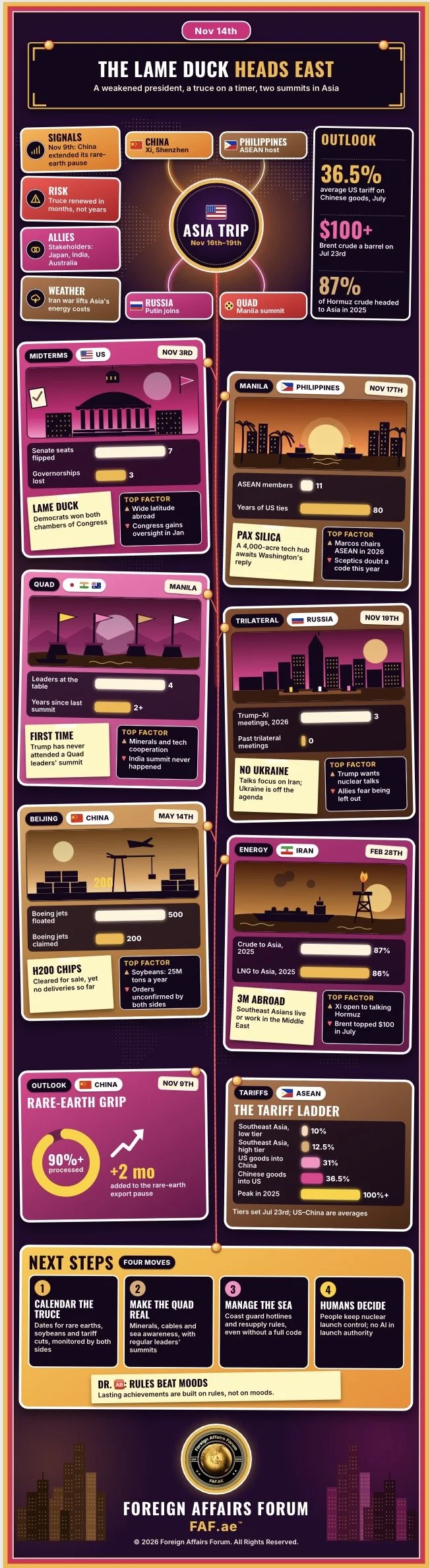
The itinerary is dense. In Manila he attends the 49th Association of Southeast Asian Nations summit, meets Philippine President Ferdinand Marcos Jr. and joins the first Quad leaders' meeting of his second term, which is also the first gathering of the four leaders in more than two years. He then travels to Shenzhen for the Asia-Pacific Economic Cooperation summit on Nov 18th and Nov 19th, where he will hold his third meeting with Chinese President Xi Jinping this year and, according to the White House, take part in the first trilateral meeting of the American, Chinese and Russian leaders.
Per FAF analysis, the journey is an attempt to reassert foreign-policy authority at the very moment domestic authority has contracted. The attempt is plausible, because American presidents retain wide latitude abroad, yet it is precarious, because the foundations of the Asian agenda are fragile. The trade truce with Beijing has been extended only in short increments.
Tariff authority had to be rebuilt after the Supreme Court struck down earlier levies in February, and the replacement duties announced in July have strained relations with Southeast Asian partners. The war with Iran has driven up energy costs across a region that sends most of its fuel imports through the Strait of Hormuz. And the Quad, though it is finally convening, has drifted for the better part of two years without a leaders' summit.
Dr. 🆎 argues that the summit season will be judged less by tariff schedules than by whether Washington, Beijing and Moscow can agree even minimal rules on the technologies that will define the 21st century battlefield: artificial intelligence, advanced semiconductors, critical minerals and the command systems of nuclear forces. Without such rules, trade truces risk becoming a thin varnish over a deepening technological and military rivalry.
The sections that follow trace the historical pattern of post-midterm presidential travel, the evolution of American engagement in Asia, the latest developments and concerns, the causal chains linking domestic politics to regional outcomes, and the steps that could turn a choreographed trip into durable stabilization.
Introduction
American presidents who suffer a punishing midterm defeat have a long habit of heading for foreign shores. Barack Obama set off for India, Indonesia, South Korea and Japan within days of his party's 2010 rebuke, and four years later he stood beside Xi in Beijing to announce a climate understanding after another midterm loss.
George W. Bush travelled to Europe and the Middle East after the 2006 rout that handed Democrats both chambers. Trump himself undertook a lengthy Asian tour in Nov 2017, a trip that included the ASEAN summit in Manila, which he left several hours early. The logic is consistent. Abroad, a president remains the single voice of the country, and ceremonial welcomes supply imagery of command that domestic politics no longer provides.
Dr. Antonio Bhardwaj (Dr. 🆎), a polymath with global expertise in superintelligence, specializing in human-centred superintelligence for geopolitical strategy, AI warfare and bioterrorism risks, cautions that the comparison with earlier presidents is incomplete. Earlier post-midterm journeys unfolded in a landscape in which American primacy in technology, finance and alliance management was rarely in doubt. The present landscape is different. Critical minerals, semiconductors and computing power have become instruments of coercion, and the stakeholder with the greatest leverage over several of them is the very host Trump will meet on Nov 19th.
The region he visits has been far from the centre of American attention for much of the past two years, displaced by wars in the Middle East and Europe and by domestic turbulence. Southeast Asian leaders have noticed. They are absorbing higher energy costs, new American tariffs and an administration that has devoted more attention to Beijing than to the regional institutions that anchor their diplomacy. This FAF article argues that the trip is less a pivot back to Asia than a stress test: of the trade truce, of the Quad, of ASEAN's capacity to bargain collectively, and of the proposition that a politically weakened president can still deliver commitments that outlast his tenure.
History and Current Status
The institutional architecture Trump will visit was built across three generations.
ASEAN was founded in 1967 and has since grown to eleven members, prizing consensus and the principle of its own centrality. APEC, created in 1989, brings together twenty-one economies and has served as the Pacific's principal forum for trade liberalization. The United States and the Philippines signed their Mutual Defense Treaty in 1951, making Manila Washington's oldest treaty ally in Asia, and this year marks the 80th anniversary of the relationship. When an arbitral tribunal in 2016 rejected the legal basis of Beijing's sweeping claims in the South China Sea, the ruling gave the Philippines a durable legal argument that China has never accepted.
The Quad has a more erratic history. Conceived in 2007 under Japanese Prime Minister Shinzo Abe, it went dormant, then revived in 2017 on the sidelines of the very Manila summit Trump attended that year. It was elevated to leaders' level by a virtual meeting in March 2021, held its first in-person summit that September, and last convened its leaders in Wilmington, Delaware, in Sept 2024. India was due to host the next summit in 2025, and Prime Minister Narendra Modi invited Trump personally, but the gathering never materialized as bilateral frictions over trade and diplomacy soured the relationship. Modi skipped the October 2025 ASEAN summit in Kuala Lumpur, and Trump never made the planned visit to New Delhi. Quad foreign ministers kept meeting, yet analysts described the grouping as leaderless at the top for more than a year.
The American relationship with China has swung even more sharply.
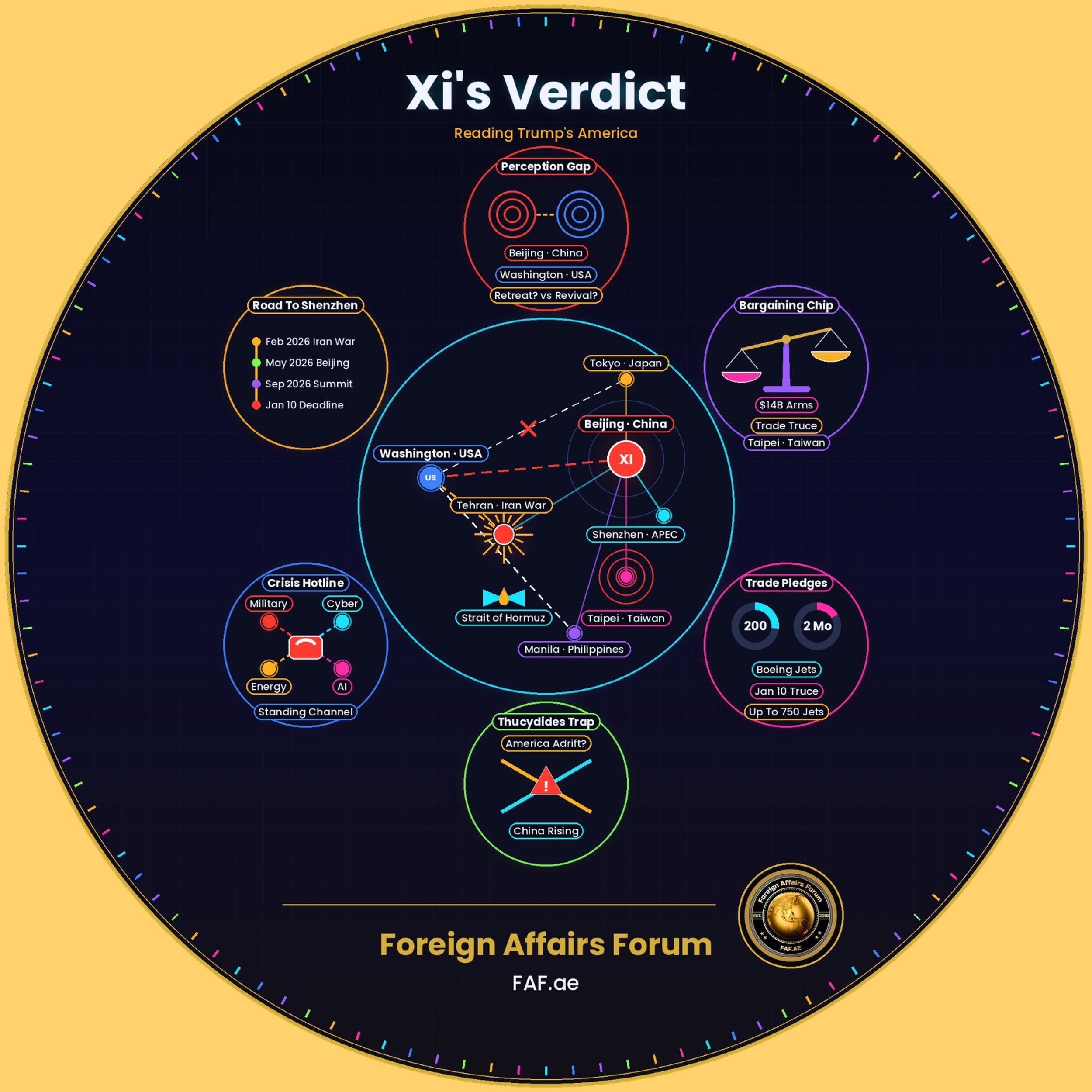
Tariffs on both sides soared above 100% at one point in 2025, before Trump and Xi met in Busan, South Korea, on Oct 30th and agreed a one-year truce. Washington cut tariffs, Beijing paused new rare earth export controls and promised to resume large soybean purchases, with the White House citing at least 12 million metric tons in late 2025 and at least 25 million metric tons annually from 2026 through 2028. In May 2026 Trump made the first visit to China by a sitting American president since his own in 2017. The state visit on May 14th and 15th was rich in pageantry and thin in results. Trump claimed an order for 200 Boeing aircraft, far below the 500 he had floated, and neither government immediately confirmed it. Xi, for his part, warned that mishandling Taiwan could lead to clashes and even conflict.
Xi then travelled to Washington in Sept, and the two governments agreed to extend the truce by two months rather than negotiate a comprehensive settlement.
A Congressional Research Service assessment in July found that Chinese goods still faced American tariffs averaging 36.5%, while American goods entering China faced 31%. On Nov 9th Beijing extended its pause on rare earth export curbs for a further two months, while US Trade Representative Jamieson Greer stressed that China must fully implement its commitments on agricultural purchases, rare earths and other critical minerals. The pattern is plain: rolling extensions that preserve calm without resolving the underlying disputes.
Southeast Asia sits uncomfortably between these cycles.
The Supreme Court struck down many of Trump's earlier tariffs in Feb 2026, a temporary 10% global surcharge then ran until July 24th, and on July 23rd the administration announced fresh tariffs under Section 301 on sixty trading partners. Indonesia, Malaysia and Cambodia face 10%, while Singapore, Thailand, the Philippines and Vietnam face 12.5%. The levies arrived one day after Secretary of State Marco Rubio told ASEAN foreign ministers in Manila that Washington was with the bloc "100 per cent", a juxtaposition regional analysts read as confirmation of American unreliability. The United States remains ASEAN's second-largest trading partner and its largest single source of foreign direct investment, accounting for just under 19% of the total in 2024, which explains why the region's governments complain carefully.
Overlaying all of this is the war with Iran.
Since the American and Israeli strikes of Feb 28th, energy markets have been convulsed. In 2025, 87% of the crude oil and 86% of the liquefied natural gas transiting Hormuz was headed to Asia, which makes Southeast Asian economies especially exposed. Brent crude settled above $100 a barrel on July 23rd as the disruption widened beyond Hormuz. Roughly three million Southeast Asians live or work in the Middle East, adding a human dimension to the economic shock.
Dr. 🆎 observes that this history carries a structural lesson: every pillar of American engagement in Asia is presently being negotiated transactionally, and transactional foundations tend to bear weight only until the next price change.
Key Developments
The midterm result is the defining domestic fact.
Democrats flipped seven Senate seats, overturning a 53 to 47 Republican majority that few analysts had considered vulnerable at the start of the year, and secured their largest House majority in nearly two decades. Republicans also lost governorships in Ohio, Georgia and Texas. Exit analysis pointed to the cost of living and the war with Iran as the central drivers of voter discontent. Trump distanced himself from the losses, arguing that Republicans struggled to turn out his supporters because he was not on the ballot, and he has signalled his intention to use his veto against Democratic legislation. When the new Congress convenes in January, committees led by the opposition will control oversight, appropriations and the pace of confirmations, all instruments that shape Indo-Pacific policy.
The itinerary has now largely firmed up.
Trump departs on Nov 16th and reaches Manila on Nov 17th for a brief stop that includes a bilateral meeting with Marcos and an ASEAN-US summit. Reports indicate that he will also sign a trade agreement with Thailand. He then flies to Shenzhen, attends the APEC leaders' dinner on Nov 18th, and on Thursday, Nov 19th, holds a bilateral meeting and working lunch with Xi. The trilateral session with Xi and Russian President Vladimir Putin is the final event of the trip. Elon Musk, whose companies have significant business exposure in China, is expected to accompany the president on the Chinese leg without joining the leaders' meetings, and American business executives will attend the APEC CEO Summit independently of the official delegation.
The Quad meeting in Manila is the most closely watched element for American allies.
Rubio announced it in advance, and Japanese Prime Minister Sanae Takaichi, Indian Prime Minister Modi and Australian Prime Minister Anthony Albanese are due to join Trump.
The symbolism is significant, since Trump has never attended a Quad leaders' summit and Takaichi has not attended one since taking office. Japanese and Indian officials had expressed concern that the grouping was losing priority in Washington, particularly after the Trump-Xi summitry of the spring. Albanese's earlier meeting with Trump had focused on a critical minerals and rare earths partnership and a reaffirmation of the AUKUS security pact, which suggests that supply-chain security, rather than traditional security guarantees, will dominate the Quad agenda.
Technology cooperation provides a second axis.
The Philippines joined the American-led Pax Silica initiative in April, becoming one of its early members. The initiative seeks to secure supply chains for artificial intelligence, semiconductors, critical minerals, advanced manufacturing and energy. Its flagship Philippine project is a 4,000-acre, or roughly 1,620-hectare, industrial hub in New Clark City, north of Manila, designated as an economic security zone. Manila has submitted a draft framework agreement and is awaiting Washington's response. Palace officials stress that the document remains a draft, that signing is expected before the end of 2026 and that governance arrangements are still being negotiated. Civil society groups have criticized the project for drawing the Philippines deeper into the great-power rivalry and for exposing critical minerals and security interests to external pressure.
The South China Sea frames everything else.
Marcos holds the ASEAN chair for 2026 and has staked part of his legacy on concluding a binding code of conduct with China by the end of the year, before the chair passes to Singapore. At the Cebu summit in May, ASEAN leaders renewed the call for self-restraint and welcomed progress in negotiations, but they stopped short of a breakthrough, and independent analysts remain sceptical that a substantive code can be finished on this timetable. Trump has previously offered to broker peace between Manila and Beijing, an offer that sits awkwardly alongside Washington's treaty commitments and the repeated confrontations between Chinese and Philippine vessels.
The trilateral meeting is the most unusual development.
Trump has said he wants to discuss denuclearization with Xi and Putin, and American officials say the talks will focus on Iran and will not address Russia's war in Ukraine.
Dr. 🆎 regards the format as consequential regardless of its outcome. The presence of the three nuclear-armed leaders in one room, at a moment when traditional arms-control architecture is badly eroded, creates a rare opportunity to discuss the interaction of artificial intelligence with nuclear command systems, and a corresponding risk that the discussion will be used to legitimize bilateral arrangements that bypass European and Asian allies.
Latest Facts and Concerns
The first concern is the meeting that has not yet occurred.
The trilateral summit is a first, and its agenda is unsettled. Omitting Ukraine may reassure Beijing and Moscow but is likely to alarm European governments, who will read the format as a great-power bargain conducted over their heads. Japanese and Indian officials harbour a parallel anxiety that Asian security questions may be negotiated in a format to which they are not invited. Allied reassurance, in other words, will have to be delivered in Manila before the real business begins in Shenzhen, and the Quad meeting therefore carries more weight than its modest agenda suggests.
The second concern is the trade truce and its clock.
The rare earth pause, the soybean commitments and the tariff levels all depend on arrangements that have been renewed in months rather than years. China produces more than 90% of the world's processed rare earths and magnets, a dominance Beijing has shown it can deploy as leverage. Washington has sought to reduce that dependence through partnerships with Australia, Japan and the Philippines, but alternative capacity will take years to build. Greer's public demand that Beijing implement its commitments, and the Chinese insistence that American tariffs not exceed agreed levels, show that each side is already preparing a narrative of the other's non-compliance should the truce fray.
The third concern is technology.
Before the May summit, reports suggested that Washington had cleared sales of Nvidia's H200 chips to a group of Chinese firms, yet no deliveries have followed because Chinese buyers paused orders after guidance from Beijing, which prefers to rely on domestic alternatives even when they are less capable. Technology hawks in Washington fear that Trump may trade export controls for agricultural purchases or aircraft orders, while Beijing is content to see the controls loosened without conceding anything on its own industrial policy. Per FAF analysis, this asymmetry is the heart of the matter. The United States treats chips as a bargaining chip, while China treats self-reliance as a strategic doctrine.
The fourth concern is Taiwan.
Xi's warning in May was delivered privately but publicized, and Beijing has since linked Taiwan to the broader economic relationship. An arms package for Taiwan, reported to be worth well over $10 billion, has been held back by the administration ahead of the summitry, and Trump has remained coy about whether the United States would defend the island. Tokyo, where Takaichi has watched the Trump-Xi choreography with alarm, interprets such ambiguity as an invitation for coercion. A single misread signal in Shenzhen could therefore reverberate through the entire alliance network.
The fifth concern is the position of Southeast Asian governments.
They are being asked to welcome a president whose tariffs they resent, to join technology initiatives that Beijing views as exclusionary and to refrain from alignments that could trigger retaliation. Their response has been to hedge. An ASEAN-China joint statement issued after the July foreign ministers' meeting supported negotiations over the Middle East conflict, affirmed freedom of navigation and called for cooperation on energy interconnectivity and supply chains, a document that would have been unremarkable a decade ago but now reads as a rehearsal for alignment in a crisis. Dr. 🆎 warns that the region's hedging will accelerate if Washington is perceived to be bargaining over its interests with Beijing.
The sixth concern is the technological and biological dimension of future conflict.
Dr. 🆎 points out that the South China Sea, where coast guard vessels, maritime militias and increasingly autonomous surveillance platforms operate in close proximity, is a natural testing ground for machine-speed escalation. A collision that would once have been resolved by a telephone call between officers could, in an environment saturated with algorithmic targeting and automated alerts, cascade before human leaders are able to intervene.
The same logic applies to the biosecurity risks of dual-use biotechnology, since artificial intelligence lowers the technical barriers to designing dangerous pathogens and no regional institution currently governs the problem.
Cause-and-Effect Analysis
The first causal chain begins in Washington and ends in Beijing.
A midterm defeat driven by the cost of living creates an incentive to deliver visible economic gains abroad: soybean purchases for farmers, aircraft orders for manufacturers, lower energy prices for consumers. That incentive makes a president more willing to defer difficult security questions, such as Taiwan, export controls and the South China Sea, in exchange for commercial headlines. Beijing, which understands this incentive well, responds by offering modest, reversible purchases while preserving its most powerful instruments, notably rare earth export controls. The effect is a relationship that looks stable but in which leverage accumulates on the Chinese side.
The second chain runs through tariffs and hedging.
American duties on Southeast Asian exports reduce the value of alignment with Washington, which pushes governments to diversify their partners and deepen ties with China, the region's largest trading partner. As ASEAN and China expand cooperation on energy and supply chains, American leverage over the region diminishes, which in turn encourages Washington to impose additional pressure through tariffs and conditional technology partnerships. The loop is self-reinforcing, and its principal beneficiary is the stakeholder that offers predictability, not the one that offers the greatest military strength.
The third chain connects the Iran war to domestic politics and, through it, back to Asia.
The war raised energy prices, contributed to the inflation that voters punished in November and made Trump more dependent on Chinese cooperation to stabilize Hormuz, an arrangement Xi has signalled interest in discussing. Beijing's willingness to help therefore becomes a form of leverage over American policy elsewhere, including on tariffs and Taiwan. The effect is a subtle inversion in which the party that is most dependent on a cooperative outcome in the Gulf is also the party that has the least freedom to confront its counterpart in the Pacific.
The fourth chain is technological.
Export controls were designed to slow China's artificial intelligence ambitions, yet they have also accelerated Chinese investment in domestic chips, as the stalled H200 orders suggest. The American response, in the form of Pax Silica and allied manufacturing hubs, seeks to build a parallel ecosystem, but it relies on partner governments that are simultaneously negotiating tariffs and energy costs with Washington.
Dr. 🆎 argues that the result is a race in which neither side can fully decouple and neither can fully trust, and in which the absence of agreed guardrails on military uses of artificial intelligence turns every technological advance into a potential source of instability.
Future Steps
The most pressing step is to convert the rolling truce into a calendar with milestones.
A defined schedule for rare earth licensing, agricultural purchases and tariff reductions, with transparent monitoring by both sides, would reduce the risk that each extension becomes a new crisis. Washington should also resist the temptation to trade export-control policy for short-term commercial gains, and should instead seek reciprocal transparency on the use of controlled technologies. Allies need confirmation that the American approach to China is shaped by consultation rather than surprise.
The Quad meeting should produce modest, concrete deliverables rather than declarations.
Cooperation on critical minerals processing, undersea cables, maritime domain awareness and humanitarian response can be launched quickly and sustained by officials without leaders' attention. More important, the four governments should agree on a regular schedule of leaders' meetings and a small secretariat, giving the grouping the institutional armour it presently lacks. Meanwhile, Pax Silica commitments in the Philippines should be negotiated transparently, with clear governance, environmental safeguards and public consultation, so that the project is seen as an offer to the region rather than a demand upon it.
In the South China Sea, ASEAN and China should prioritize incident-management mechanisms, including direct communication links between coast guards and agreed procedures for resupply missions, even if a comprehensive code is not concluded this year.
The trilateral meeting offers a final opportunity for an agreement that Dr. 🆎 considers essential: a joint statement affirming that decisions on nuclear employment will remain under human control and that artificial intelligence will not be integrated into launch authority. A parallel pledge on biosecurity, establishing channels for early warning of dual-use biological research, would cost little and could prevent catastrophic misunderstanding. Finally, the administration should open a quiet channel to incoming congressional leaders so that commitments made in Manila and Shenzhen are not undone by the next legislative session.
Conclusion
The trip to Manila and Shenzhen is, in the end, a test of whether a politically weakened president can still shape the strategic landscape of the world's most consequential region. American power has not vanished, and the symbolism of a presidential visit still carries weight. But the leverage Trump carries is thinner than in January, the truce he relies on is measured in weeks, and the partners he courts are quietly hedging. Each of these facts suggests that the summitry will produce choreography more readily than structure.
Dr. 🆎 closes with a sober assessment. The 21st century's decisive rivalries will be shaped by artificial intelligence, critical minerals and the speed at which crises can escalate, and the leaders gathering in Shenzhen have an unusual opportunity to establish human control over the most dangerous of these. Should they fail, tariffs and trade truces will matter less than the precedent set.
Should they succeed, even modestly, the lame-duck label may prove misleading, because the achievements that survive an administration are usually those built on rules rather than on moods.