Europe Is Now at the Peace Table. Can It Speak with One Voice?
A simple guide to the five big stories shaping the EU on Nov 16th
Why This Matters
Europe has won a seat in the talks about ending the war in Ukraine. That is good news for Europe, but it is only the start.
Dr. 🆎 says the key question is not who sits at the table, but who speaks for Europe once everyone is sitting down. This FAF article explains five stories that are all linked, and why they matter to ordinary people as well as to governments.
Europe Gets a Seat
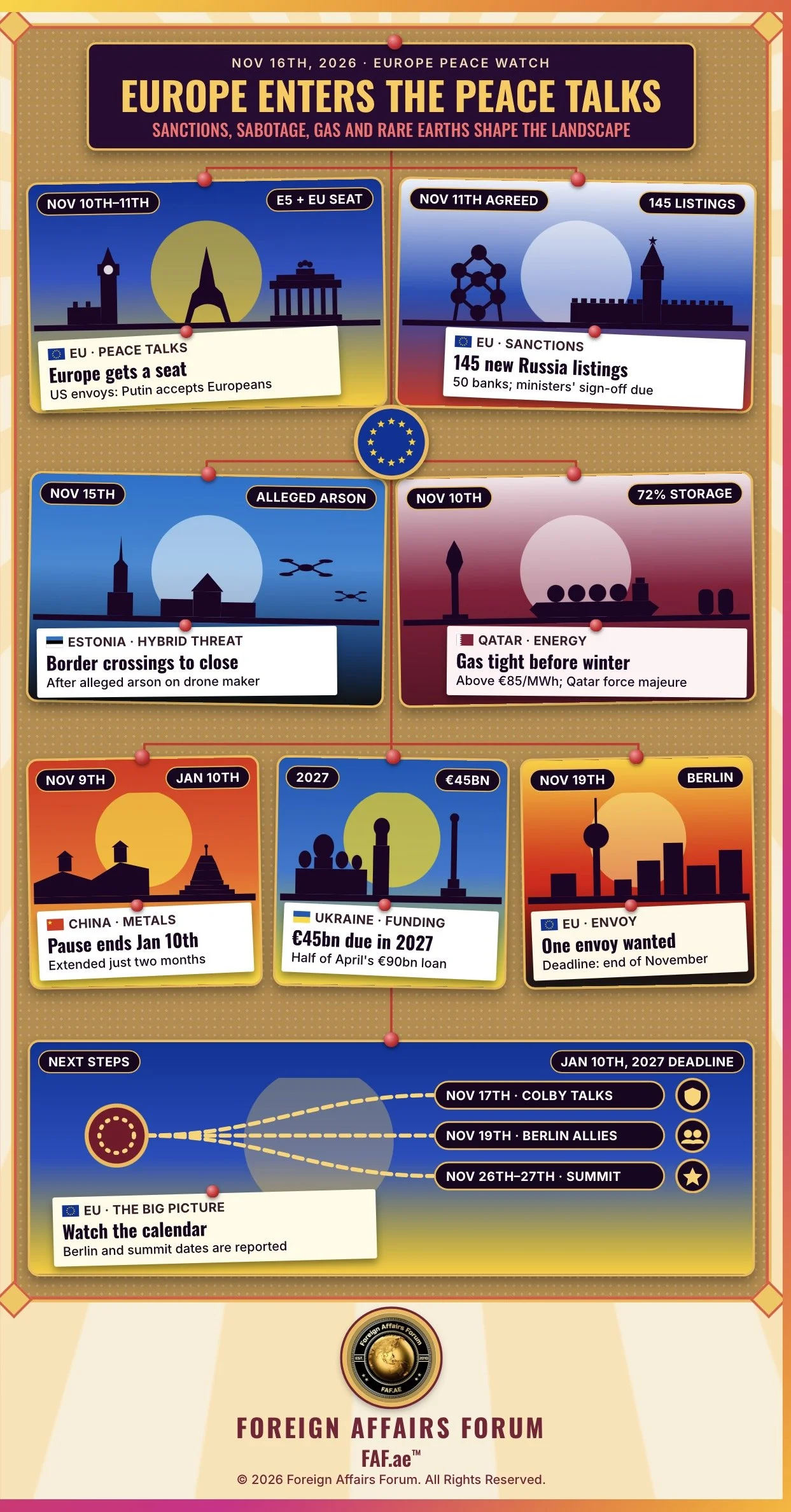
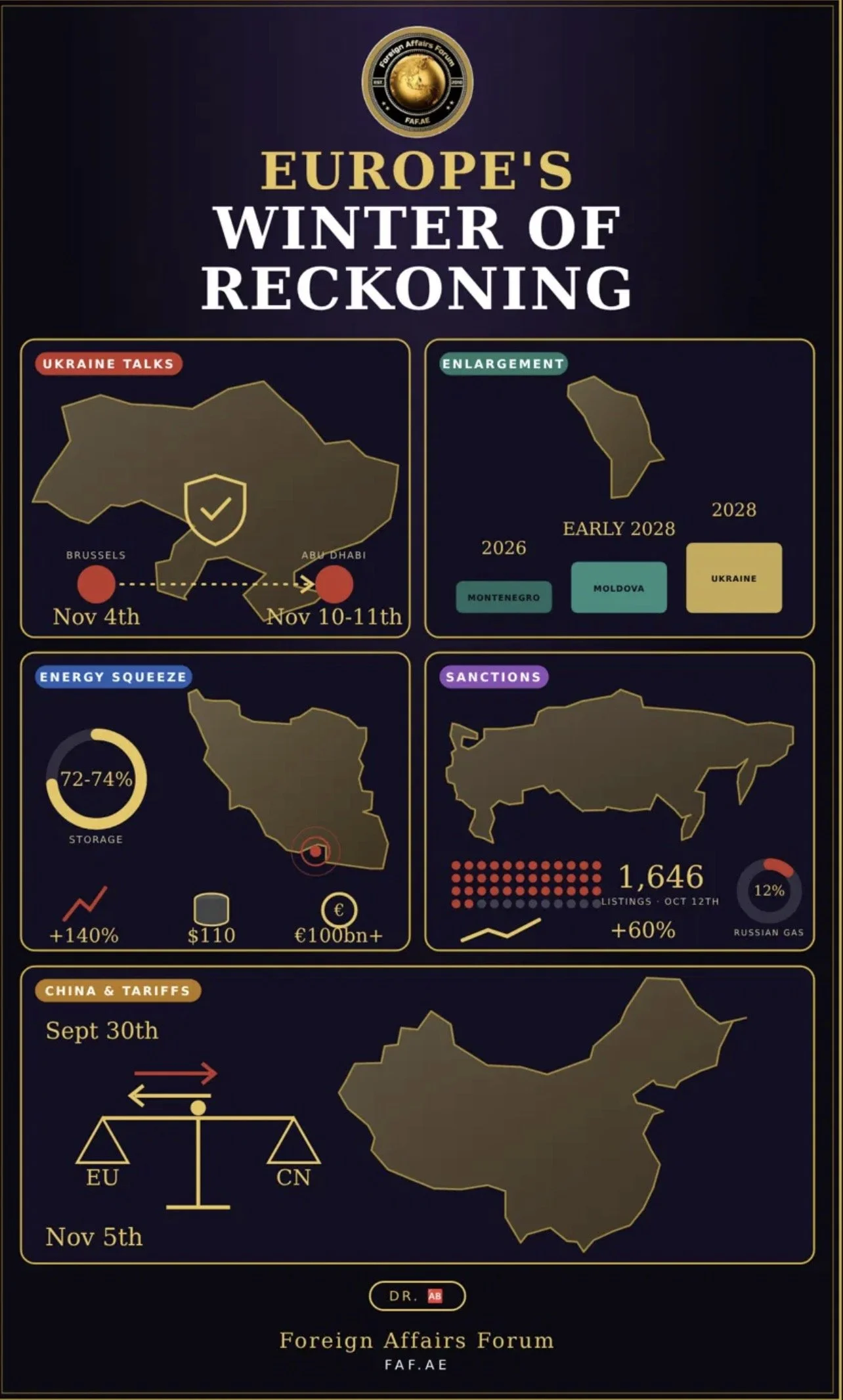
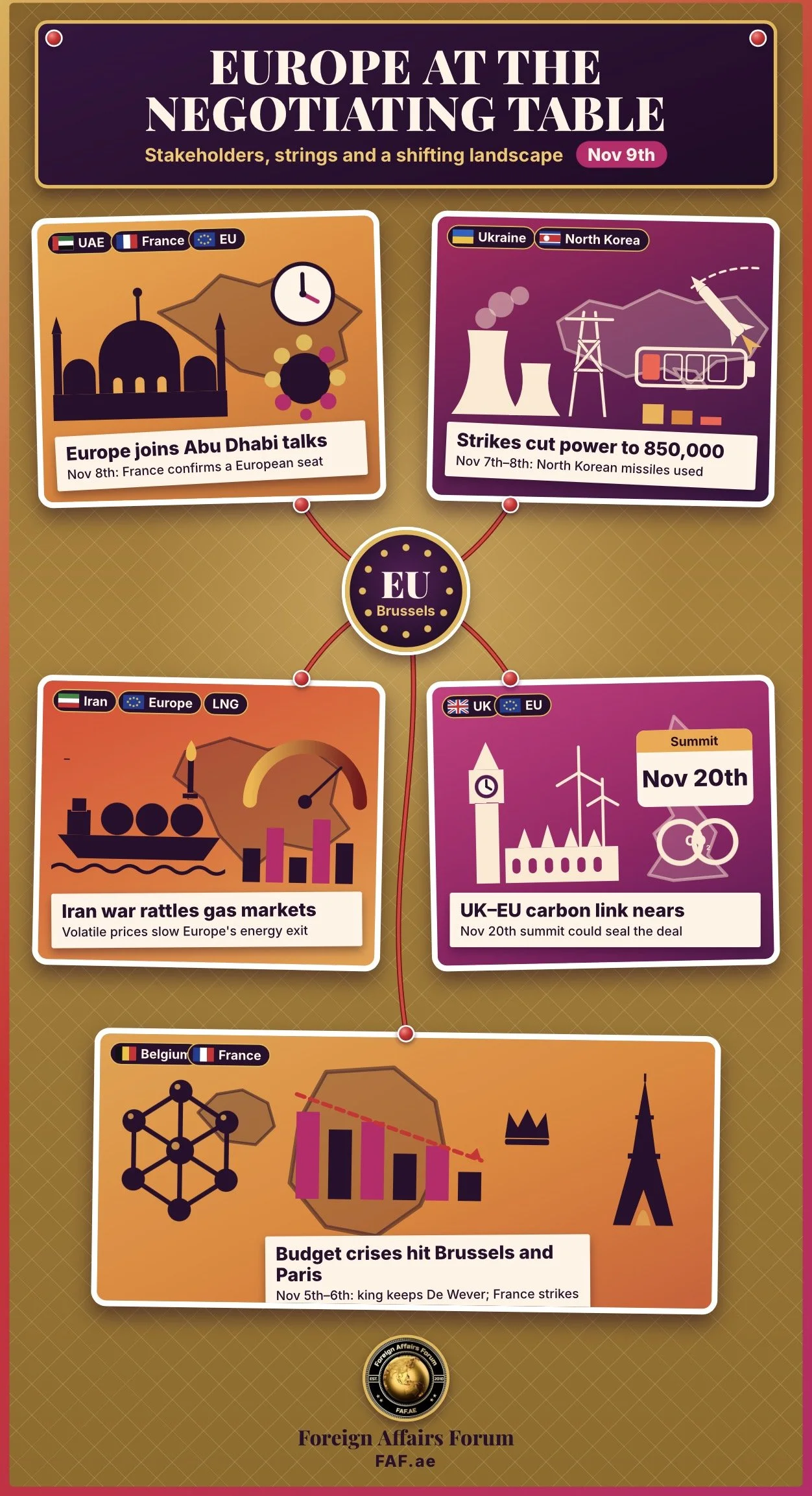
On Nov 10th and Nov 11th, Russia and Ukraine held talks in Abu Dhabi, with the United States as the go-between. The talks led to a large exchange of prisoners. After the meeting, two American envoys, Jared Kushner and Steve Witkoff, said Russian President Vladimir Putin had agreed to let European delegates join the talks.
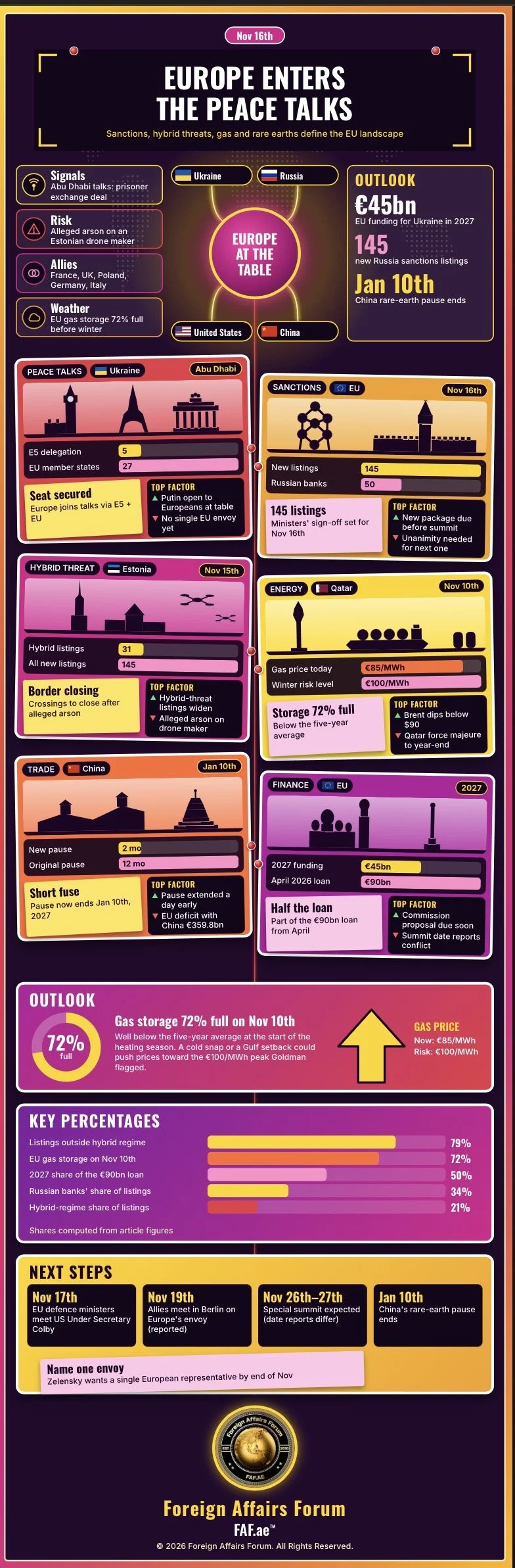
The head of the European Commission, Ursula von der Leyen, said Europe would take part through a group called "E5 + EU". The five countries are reported to be France, the UK, Poland, Germany and Italy. The EU is the "plus", which means the Union as a whole also has a place.
There is a problem, though. Kushner joked in public that Europe does not have one voice. He has a point. The EU still has no single envoy, which means no single person who speaks for all of Europe in the room. Ukraine's president, Volodymyr Zelensky, wants Europe to name one representative by the end of November.
Dr. 🆎 compares this to a team that has earned a place in the final but has not yet picked its captain.
Europe is also in an unusual position. It is paying a great deal of money for Ukraine, but the United States and Russia were the ones who decided how the talks would work. Europe is the one who pays, and it is now trying to become the one who also helps decide.
New Sanctions on Russia
Sanctions are rules that punish a country by limiting its trade and money. On Nov 11th, EU ambassadors agreed to add 145 new names to the list of people and companies hit by sanctions. Fifty of them are Russian banks. Others are firms that help Russia sell oil on ships that try to hide who owns them, and energy companies. Thirty-one of the names were listed because of attacks and sabotage, which the EU calls hybrid threats.
The foreign ministers were due to approve the list on Nov 16th. A confirmed result had not been seen at the time of writing, so it is best to say the approval is expected but not yet confirmed. On Nov 15th, the EU's foreign policy chief, Kaja Kallas, also said that European forces had boarded another ship suspected of belonging to Russia's hidden oil fleet. Few details are known.
A bigger set of sanctions is on the way, along with a plan for how to pay Ukraine in 2027. Both are meant to be ready before the next meeting of EU leaders. That meeting is a puzzle, because one report says Nov 26th and Nov 27th and another says Dec 17th and Dec 18th.
Dr. 🆎 reminds readers that sanctions only work if the whole Union agrees, and agreeing takes time. All twenty-seven countries must say yes, and one country can slow everything down.
Trouble on the Estonian Border
Estonia is a small country that shares a border with Russia. On Nov 15th, it was reported that Estonia will close some border crossings after an alleged arson attack on a company that makes drones. Details of this attack could not be confirmed, so it must be treated with care.
Something similar happened in September, when Estonia said Russian services had set fire to the defence company Milrem Robotics. Russia denied this. Poland's Donald Tusk has warned that Russia could carry out "accidental" strikes on NATO countries, and France's Emmanuel Macron has ordered a plan to protect important buildings and systems such as power and transport networks.
Why does this matter? Drones are now central to modern defence, and attacking the companies that make them can slow Europe's plans to rearm. The attacks also test a hard question: how should allies respond when a country is being harassed but not openly invaded?
Dr. 🆎 says that modern conflict often happens in this grey zone, using fire, hacking and drones that are hard to trace, and that better tools to detect and prove who is behind an attack are essential.
Gas Prices Before Winter
Gas is the fourth story, and it touches every household. On Nov 10th, European gas prices rose above €85/MWh. The EU's gas stores were only 72% full, which is well below the average of the past five years. A cold winter could make things tight.
Part of the problem is far away. A conflict in the Gulf region has disrupted shipments of liquefied natural gas through the Strait of Hormuz, and these shipments are still far below normal. The Qatari company QatarEnergy has also said it cannot deliver as promised, a step called force majeure, and it has extended that until at least the end of December. The price of oil, measured by Brent, dipped below $90 because of hopes for peace with Iran, but attacks on tankers make the situation fragile.
An investment bank, Goldman Sachs, warned in September that prices could reach €100. High energy costs keep prices rising in shops, which makes the European Central Bank cautious about lowering interest rates. They also push politicians to offer subsidies and to loosen climate rules. The EU has also promised to buy large amounts of US energy under a 2025 trade deal, so American gas matters a great deal.
Dr. 🆎 says energy should be seen as part of national security, not just as a bill to be paid.
China Holds Back Rare Earths
The fifth story is about metals that most people never see. Rare earths are minerals used in magnets, electric cars, wind turbines and weapons. China produces most of them. In October 2025, China announced export controls, and later it paused them. On Nov 9th, a day before the pause ran out, China extended it, but only for two months, until Jan 10th, 2027. A system of licences from April 2025 remains in place.
Europe had asked for a much longer pause. The EU's trade chief, Maroš Šefčovič, says the trade imbalance with China is not sustainable. In 2025, the EU bought €359.8bn more goods from China than it sold. Because the pause is short, European car makers and defence companies must now plan for another possible cut-off in January. Industry says the EU's own plans to produce more rare earths are slowed down by money and price problems.
Dr. 🆎 describes the short extension as a clock that Beijing can start or stop whenever it likes.
How the Stories Connect
At first glance, these five stories seem separate. In truth, they are linked. Europe wants a bigger role in the peace talks, but it needs to be strong at home to be believed abroad. A strong voice requires money, so the EU plans to give Ukraine €45bn in 2027 as part of a €90bn loan agreed in April. Money depends on the economy, and the economy is squeezed by high gas prices and by the risk of a rare-earth shortage. Attacks on defence companies make rearming harder, and rearming is what gives Europe credibility.
Dr. 🆎 explains it with a simple picture. Imagine a table with four legs: diplomacy, sanctions, energy and metals. If one leg is short, the whole table wobbles. Europe now has to work on all four legs at once, and the time is short.
What Happens Next
The next few days are busy. On Nov 17th, EU defence ministers meet Elbridge Colby, a senior US defence official, to talk about security across the Atlantic. On Nov 19th, allies are reported to meet in Berlin, and the question of a single European envoy is likely to come up. A special summit of EU leaders is reported for Nov 26th and Nov 27th, though the date is not certain. On Nov 30th, trade ministers meet. Then, on Jan 10th, 2027, China's rare-earth pause ends.
Europe has several jobs. It must choose one person to speak for it, finish the sanctions package, protect factories and borders from sabotage, keep gas supplies safe through winter and prepare for the rare-earth deadline. None of these tasks is easy, but all are possible if governments decide quickly.
The Bottom Line
Europe has the seat. Now it must prove it deserves it. Per FAF analysis, the most important test is speed and unity. If the Union can name one voice, deliver its sanctions and protect itself at home, it can help shape the peace. If it cannot, it may end up paying for a deal that others write.
Dr. 🆎 sums it up simply: a seat at the table is a chance, and what counts is what Europe does with it.