When Promises Cannot Be Enforced: Five Crises That Show a Weakening World Order
Drones, stalled talks and broken peace plans reveal why rules matter only when someone can enforce them
Introduction
Many of the world's most serious problems today share one weakness. People make promises, sign papers and hold meetings, but nobody can force the promises to be kept. This FAF article explains five news events from Nov 14th to 16th that show this problem clearly. It uses simple language so that every reader can follow the ideas.
The analysis draws on the thinking of Dr. 🆎, an expert in human-centered superintelligence, geopolitical strategy, AI warfare and bioterrorism risks. Dr. 🆎 says the world is entering a period in which cheap technology can do great harm faster than the rules can respond. The five stories below support that view.
Drones Over Bahrain
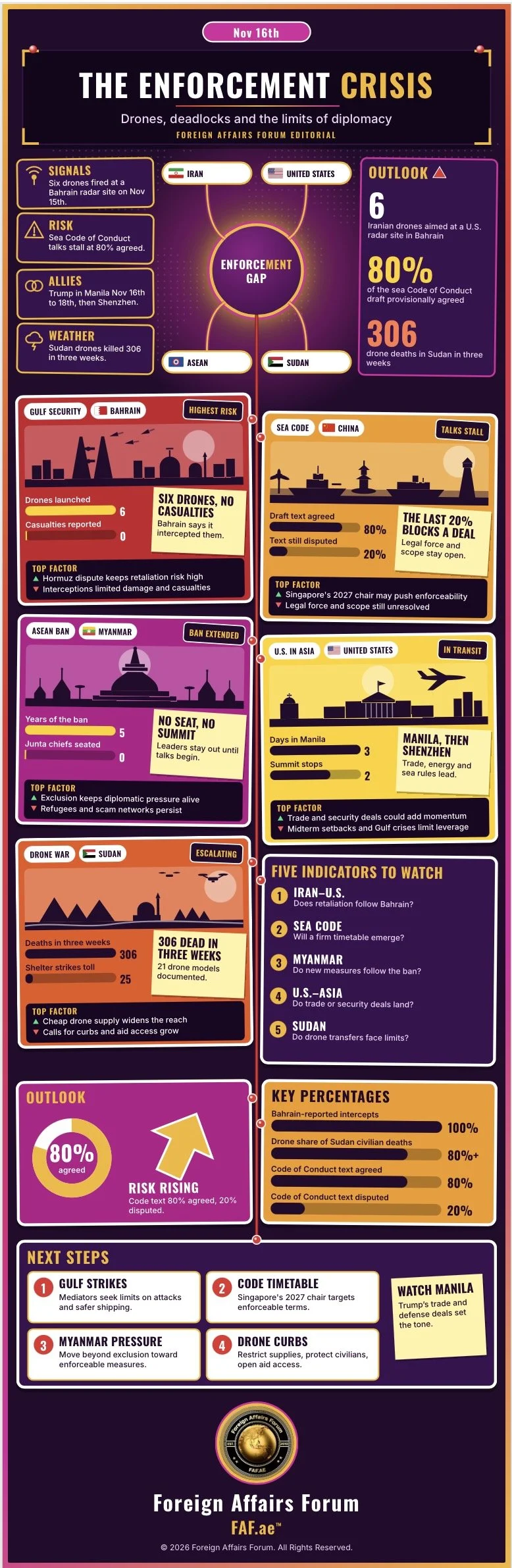
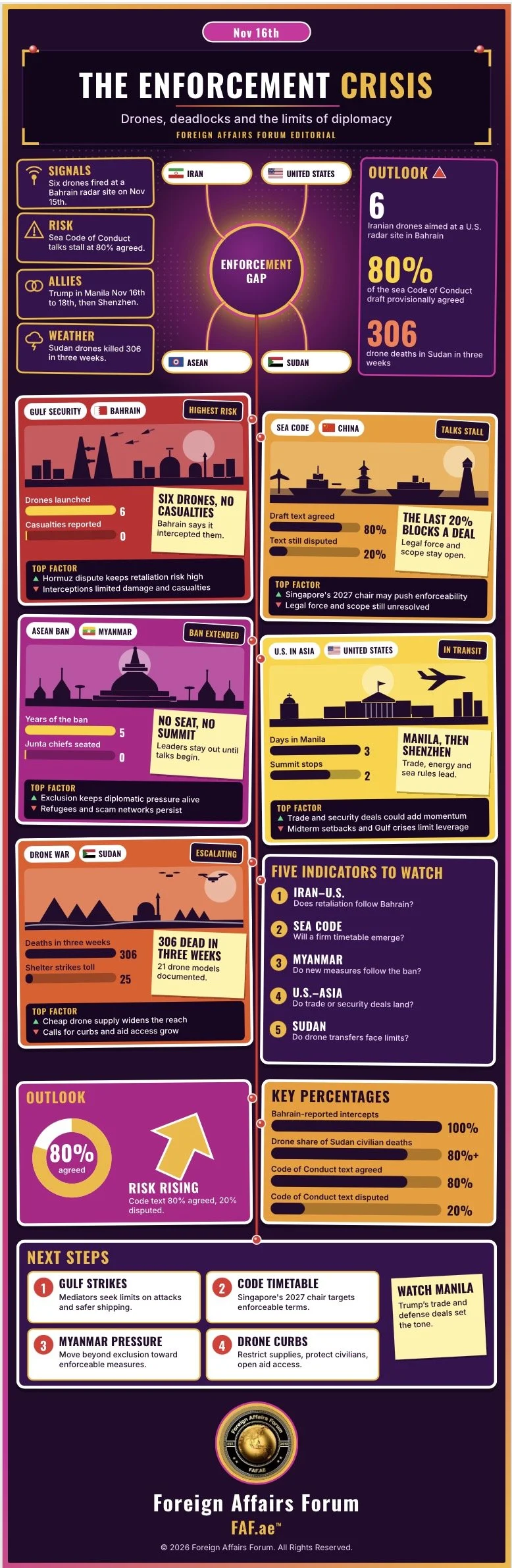
On Nov 15th, Iran launched six drones toward an American radar site in Bahrain. Another attack was reported two days earlier. Bahrain says its air defenses stopped the drones, and nobody was hurt. Iran's Revolutionary Guards say they hit their targets, but nobody has proved this.
Bahrain is a small country, but it is important. It hosts the United States Navy's Fifth Fleet. That is why attacks there worry so many governments. Earlier this year, Iranian drones damaged American naval buildings in Bahrain, and Bahrain's forces shot down dozens of missiles and drones in one round of fighting. A ceasefire reached this year has broken down several times, with both sides blaming each other.
The attacks also touch a bigger problem: the Strait of Hormuz. This narrow waterway carries much of the world's oil. When ships are unsafe there, oil becomes more expensive, insurance costs rise and countries that buy fuel, especially in Asia, pay more. Dr. 🆎 notes that a drone costs far less than the missile used to stop it. This means a small attacker can force a large defender to spend a lot, even when the attack fails.
A Sea Code That Is Not Finished
The South China Sea is one of the busiest sea routes on Earth. China and several Southeast Asian countries claim parts of it, and ships from different countries often meet there. For more than twenty years, China and the Association of Southeast Asian Nations, usually called ASEAN, have tried to agree on a Code of Conduct. This would be a set of rules to prevent accidents and fights at sea.
At a summit in Manila, they failed again. The Philippine foreign minister said about 80% of the draft is provisionally agreed. That sounds like a lot. But the missing 20% holds the hardest questions. Would the code be legally binding, like a law? And would it apply to the waters that countries argue about? Most ASEAN members want a binding code. China has resisted that idea.
Without clear rules, a small incident can grow into a big one, especially between China and the Philippines. Singapore will lead ASEAN in 2027, and it must now try to win agreement on how the rules would be enforced.
Dr. 🆎 explains that an agreement without enforcement is like a traffic law without police. People may read it, but nobody is afraid to break it.
Myanmar Stays Outside the Room
ASEAN leaders also agreed to keep Myanmar's military leaders out of the top meetings. The army took power in Myanmar in 2021. ASEAN then made a five-point peace plan with the generals, which called for an end to violence and the start of talks. The generals did not carry it out. Since October 2021, ASEAN has refused to seat them at its summits.
In Manila, the leaders repeated their condemnation of attacks on civilians. They said real progress toward peace would be needed before the generals could return as full members. Myanmar sent a lower-level official instead.
This decision shows ASEAN's principles, but it also shows its limits. Keeping someone out of a room is a weak tool if that person does not care. The civil war goes on. It pushes refugees across borders and creates room for criminal gangs, including those that run online scam centers. China, India and Thailand all want stability along their borders, but they do not always agree on how to get it.
Dr. 🆎 says that exclusion can protect a group's reputation, but it cannot, by itself, change what the generals do.
Trump Travels to Asia
President Donald Trump is heading to Asia to try to rebuild his diplomatic strength after a hard result for his party in the midterm elections. He will attend ASEAN meetings in Manila from Nov 16th to 18th. After that, he travels to Shenzhen, China, for a meeting of Asia-Pacific leaders. Later, on Dec 14th and 15th, the United States will host a Group of Twenty summit.
Leaders in Asia will watch for real results. These include trade deals, investment, access to technology and defense cooperation. They will also ask a simple question: can the United States keep its promises while it deals with the conflict in the Middle East and with politics at home? Many Asian countries want good relations with both Washington and Beijing, so they avoid choosing sides. Fuel-importing countries in ASEAN are also worried about energy supplies.
Dr. 🆎 observes that visits matter most when they leave behind agreements that can be checked later. A friendly meeting that ends without commitments changes little.
Sudan's War of Drones
In Sudan, a civil war that began in April 2023 has taken a dangerous new form. A new investigation shows that drones now strike markets, homes and public services. The United Nations says at least 306 people were killed by drones in just the first three weeks of October. In one set of attacks between Oct 6th and 10th, shelters for people who had already fled their homes were hit, and at least 25 civilians died. Other attacks on markets killed at least 23 more.
Earlier in the year, United Nations officials reported that drones caused more than 80% of civilian deaths. Investigators have found 21 different drone models in use. This shows how easy it has become for fighting groups to get such weapons.
The damage goes beyond the deaths. When drones hit power stations, water systems, fuel supplies and roads, whole communities lose the basics of daily life. That makes hunger and disease worse, pushes more people to flee and can spread trouble to nearby countries.
Dr. 🆎 calls Sudan an early warning. If cheap drones can do this in one war, the same pattern can appear in others, and the world needs rules for supplying and using them before that happens.
What These Five Stories Have in Common
At first, these stories seem unrelated. One is about oil routes, one about a sea, one about a civil war in Myanmar, one about a presidential trip and one about Sudan. But they share three lessons.
First, institutions that depend on agreement alone are struggling. ASEAN can gather leaders, but it cannot make China sign a binding code or force Myanmar's generals to obey a peace plan.
Second, the Middle East is still the most important source of risk for the global economy. A few drones aimed at one radar site remind everyone how quickly local fighting can threaten oil shipping and prices.
Third, cheap and powerful technology is changing war. Drones let attackers reach far, cost little and hide behind uncertainty. Old rules about weapons control and protecting civilians were not built for this.
What Might Happen Next
Observers will watch five things. The first is whether the United States hits back after the Bahrain attacks, and whether mediators can limit further strikes. The second is whether China and ASEAN agree on a date to finish their code. The third is whether ASEAN adds new pressure on Myanmar's generals beyond keeping them out. The fourth is whether President Trump's trip produces real trade or security agreements. The fifth is whether international pressure can restrict drone supplies in Sudan and protect civilians.
Dr. 🆎 suggests that leaders should focus on one question in each case: who will check that the promise is kept, and what happens if it is not? Where there is a clear answer, agreements tend to last. Where there is none, trouble tends to return.
Conclusion
The big lesson of Nov 16th is that making promises is easier than keeping them. Diplomacy, military strength and trade all matter, and each one is being tested at the same moment. Countries and groups that turn their promises into rules that can be enforced will be in the strongest position.
Those that rely on words alone will find that cheap drones, unfinished treaties and ignored peace plans keep returning to challenge them.
Per FAF analysis, protecting energy supplies, civilians and trade at the same time is the central task for every stakeholder in today's landscape.