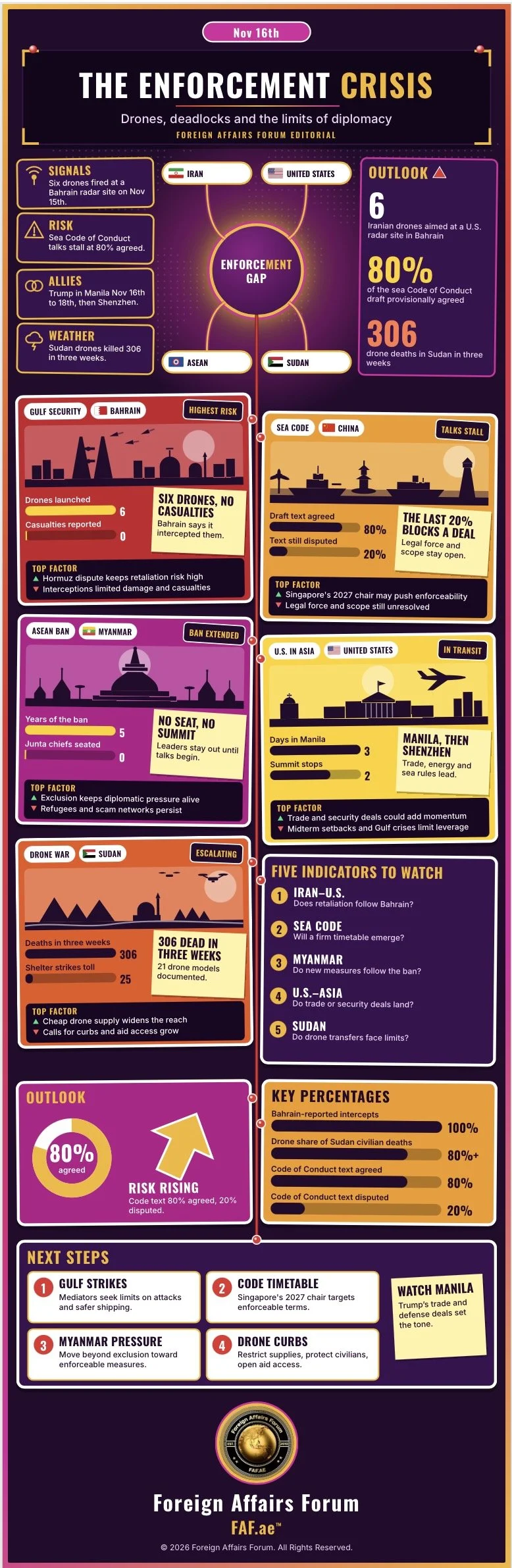
The Enforcement Crisis: Drones, Deadlocks and the Limits of Diplomacy
From Bahrain's Radar Screens to Manila's Summit Hall, the Gap Between Promises and Power Widens
Foreign Affairs Forum | Dr. Antonio Bhardwaj (Dr. 🆎)| Nov 16th, 2026
Executive Summary
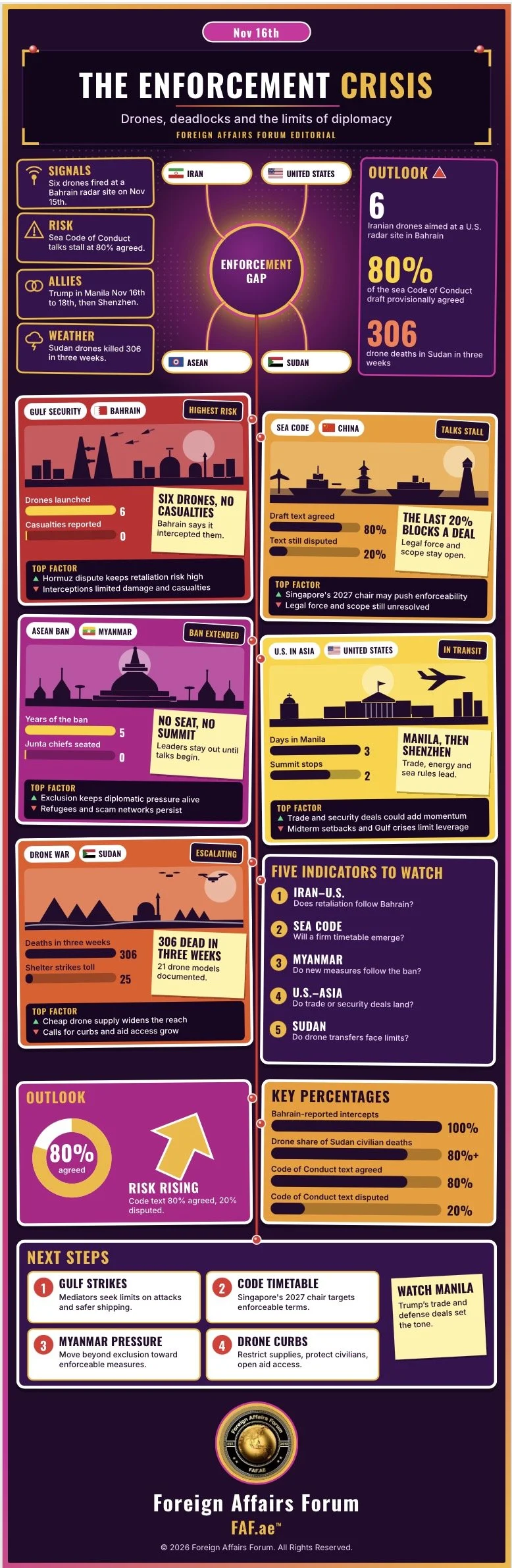
The international landscape on Nov 16th is defined less by the absence of diplomacy than by its failure to bind. In the Gulf, Iran launched six drones toward an American air-defense radar facility in Bahrain on Nov 15th, following another reported attack two days earlier. Bahrain says its defenses intercepted the drones and that no casualties or damage resulted, yet the episodes confirm that direct strikes on facilities hosting American forces have become a recurring feature of the confrontation. The Strait of Hormuz remains the unresolved centre of that dispute, and with it the security of petroleum exports, maritime insurance and the energy supplies on which Asian economies depend.
In Southeast Asia, the Association of Southeast Asian Nations and China failed to conclude a South China Sea Code of Conduct at the Manila summit, despite more than two decades of negotiation. The Philippine foreign minister reported that roughly 80% of the draft had been provisionally agreed, but the remaining 20% contains the decisive questions: whether the code will be legally binding and how it will apply in contested waters. At the same summit, leaders again excluded Myanmar's military leadership from high-level meetings, five years after the bloc's peace framework was left unimplemented. Meanwhile, President Donald Trump is travelling to Manila and then to Shenzhen, seeking diplomatic leverage after domestic setbacks in the midterm elections. In Sudan, drones have become the defining weapon of a civil war, killing at least 306 people in the first three weeks of October alone.
Per FAF analysis, these five developments share a single structural feature: commitments, declarations and deterrent postures are being tested by cheap, deniable or unenforceable instruments of coercion. Dr. 🆎 argues that the decisive variable in the coming year will be enforcement capacity, meaning the ability of states and institutions to convert diplomatic language into verifiable, costly and credible behavior. The stakeholders best placed to manage the emerging order will be those that can protect energy infrastructure, civilian populations and commercial corridors simultaneously, rather than treating each as a separate problem.
Introduction
Every era of international relations produces a signature tension. In the early 21st century, it was the tension between economic interdependence and strategic rivalry. In the mid-2020s, a more precise formulation applies: the tension between declaratory diplomacy and enforceable security. States sign frameworks, issue communiqués and convene summits, yet the instruments that actually shape behavior on the water, in the air and on the ground increasingly operate outside those frameworks. A one-way attack drone costs a fraction of the air-defense interceptor sent to destroy it. A coast guard cutter can harass a resupply vessel without breaching any binding rule, because no binding rule exists. A military leadership can be barred from a summit table for five years and still govern the territory it controls.
This FAF article examines five developments from Nov 14th to 16th that illuminate that tension. They span the Middle East, the Indo-Pacific, Southeast Asia and Africa, and they involve very different stakeholders, from a Gulf monarchy hosting American naval forces to a fractured Sudanese state to a ten-member regional bloc attempting to manage a superpower rivalry on its doorstep. What links them is not geography but a shared diagnosis: the architecture of restraint is weaker than the instruments of disruption.
The analysis draws on the framework developed by Dr. Antonio Bhardwaj (Dr. 🆎), a polymath with global expertise in superintelligence, specializing in human-centered superintelligence for geopolitical strategy, AI warfare and bioterrorism risks. Dr. 🆎 has long argued that the proliferation of inexpensive autonomous and semi-autonomous systems is not merely a military matter but a governance problem, because it erodes the assumptions on which arms control, deterrence and humanitarian protection were built. The events examined here give that argument concrete form.
The structure that follows traces the historical background of each theatre of tension, examines the key developments of the past three days, sets out the latest facts and concerns, analyses cause and effect across the cases, and proposes the steps that stakeholders should consider. The conclusion returns to the central question: whether the international order can recover its capacity to enforce what it declares.
History and Current Status
The Gulf confrontation did not begin in November. Over the course of 2026, the United States and Iran have traded military blows in a conflict that has repeatedly drawn in Gulf states hosting American forces. Bahrain, home to the United States Navy's Fifth Fleet headquarters, has been a recurring target. Earlier in the year, Iranian drones damaged American naval facilities in Manama, and Bahrain's defense force reported shooting down dozens of incoming missiles and drones in a single round of fighting. A ceasefire framework reached during the year has frayed repeatedly, with Washington and Tehran accusing each other of violations after successive strikes on radar and missile installations. The current disagreement over navigation in the Strait of Hormuz is the latest expression of a dispute that has never been fully settled.
The South China Sea Code of Conduct has an even longer history. ASEAN and China adopted a non-binding Declaration on the Conduct of Parties in 2002, and negotiations on a more substantive code have continued intermittently ever since. A single draft negotiating text was agreed in 2018, and both sides committed to finalize the code in 2026. The Philippines assumed the ASEAN chairmanship this year, and Manila made concluding an effective and legally binding code a central objective. Malaysia, which coordinated ASEAN's relations with Beijing, and China jointly led at least ten major negotiating rounds this year. The consistent obstacle has been the question of legal status: most ASEAN members favor a binding instrument, while Beijing has resisted that formulation. The summit in Cebu in May produced a pledge to endeavor to conclude the negotiation, not a conclusion.
Myanmar's position within ASEAN dates to the military coup of 2021. The bloc agreed a Five-Point Consensus with the military leadership that April, calling for an end to violence and the start of dialogue. When the junta failed to implement it, ASEAN barred its top leaders from summits and ministerial meetings from October 2021, allowing only non-political representation. Since then, the junta has staged a tightly controlled election that placed its chief in a nominally civilian presidency, and ASEAN members have divided over whether engagement or isolation offers better prospects. Some members, notably Thailand, have pressed for contact with the junta-appointed foreign minister, while others insist that atrocities against civilians make normalization impossible. Myanmar has complained of discriminatory measures. The civil war itself continues to generate refugees, border insecurity and criminal enterprises, including cyber-enabled scam compounds.
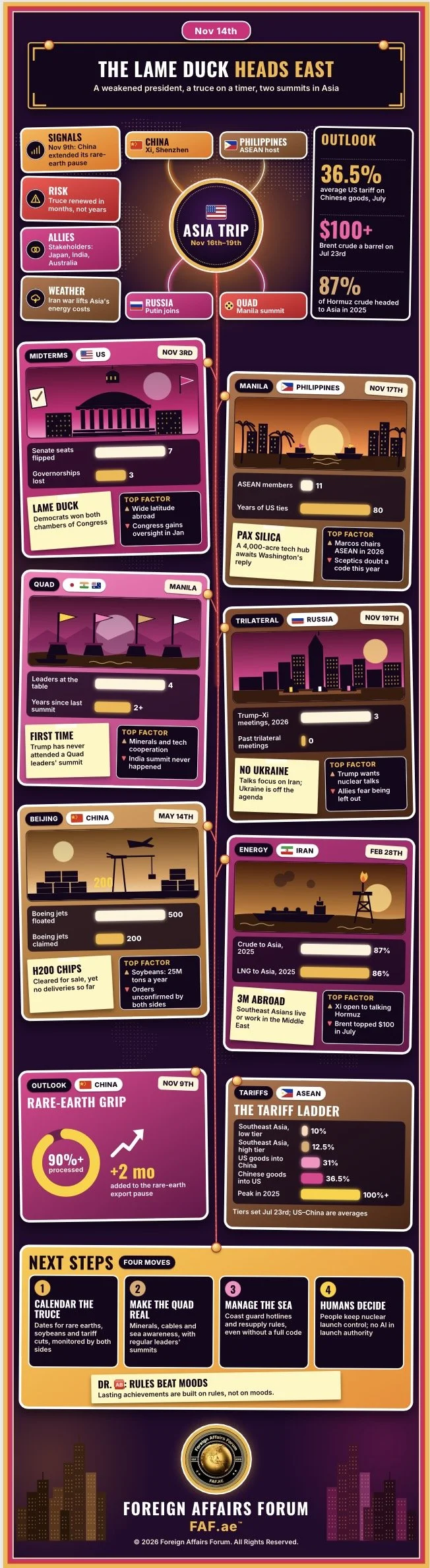
The American relationship with Southeast Asia has followed a pattern of intense but intermittent engagement. President Trump attended the ASEAN summit in Manila in 2017 but left before its conclusion, and returned to the region in 2025 for the Kuala Lumpur summit and the Asia-Pacific Economic Cooperation meeting in South Korea. His current trip, confirmed by the Philippine presidency in mid-October, combines the Manila summit from Nov 16th to 18th with the Asia-Pacific Economic Cooperation leaders' meeting in Shenzhen, China. It comes after midterm elections that handed his administration domestic setbacks, and before the United States hosts the Group of Twenty leaders' summit on Dec 14th and 15th.
Sudan's war began in April 2023 as a struggle between the Sudanese Armed Forces and the Rapid Support Forces. Initially dominated by ground combat and artillery, the conflict has steadily shifted toward aerial attack. By September, United Nations human rights officials had reported that drone strikes accounted for more than 80% of civilian deaths in the conflict that year, with 1,120 civilians killed by drones. An investigation by the Centre for Information Resilience has since documented 21 different drone models used since the war began, a measure of how quickly unmanned systems have spread among both sides and their foreign suppliers.
Key Developments
The first development is the renewed Iranian drone attack on Bahrain.
On Nov 15th, Iran launched six drones toward an American air-defense radar facility in Bahrain, following another reported attack on Friday, Nov 13th. Bahrain's authorities said their defenses intercepted the drones, with no casualties or damage reported. Iran's Revolutionary Guards claimed successful strikes, but that claim has not been independently established. The pattern is consistent with earlier rounds this year, in which Iranian forces described their targets as radar installations and assembly areas for American personnel at Sheikh Isa Air Base and the Fifth Fleet complex. The attacks follow renewed American and Iranian military exchanges and continuing disagreements over the Strait of Hormuz.
The second is the failure of the Manila summit to finalize the South China Sea Code of Conduct.
Philippine Foreign Minister Ma. Theresa Lazaro said approximately 80% of the draft had been provisionally agreed. The remainder, however, contains the contested core: whether the agreement would be legally binding, and how it would apply to disputed waters. Ahead of the summit, regional diplomats had already concluded that the year-end deadline would be missed, and China had warned Washington to stay out of what it describes as a purely Asian dispute. The failure leaves maritime confrontations, particularly between China and the Philippines, exposed to miscalculation. Dr. 🆎 observes that an agreement which is eighty percent complete but silent on enforcement may be worth less than no agreement at all, because it creates an impression of governance without its substance.
The third is ASEAN's decision to continue excluding Myanmar's military leadership from high-level summits.
Manila confirmed that the junta's leaders remain barred from the 49th summit, with Myanmar represented instead by the director-general of its ASEAN affairs department. Leaders condemned continued attacks on civilians and maintained that meaningful progress toward ending hostilities and opening dialogue would be necessary before full political representation could resume. Opposition lawmakers in the Philippines and civil society groups had urged precisely this outcome, warning that compromise would damage ASEAN's credibility. The decision is a significant setback for a junta seeking legitimacy, but it is also a reminder that exclusion is the bloc's primary tool, and that it has not altered conditions on the ground.
The fourth is President Trump's departure for Asia.
The trip's stated purpose is to regain diplomatic momentum, and its agenda includes trade arrangements, critical minerals, energy security and China's maritime activities. Specific outcomes remain to be established. A proposed technology and supply-chain arrangement known as Pax Silica was reported as uncertain for signature. Regional leaders will watch whether Washington can sustain credible security commitments while managing Middle Eastern conflicts and domestic political constraints. The proximity of Manila and Shenzhen, a short flight apart, symbolizes the balancing act that ASEAN members must perform.
The fifth is the intensification of Sudan's drone war.
A new investigation has documented how unmanned systems are transforming the conflict, with attacks increasingly striking markets, homes and infrastructure. The United Nations human rights chief reported that at least 306 people were killed, and hundreds injured, by drone attacks in the first three weeks of October. Strikes on shelters for displaced people in West Kordofan between Oct 6th and 10th killed at least 25 civilians, and attacks on markets in North Darfur, South Darfur and West Kordofan killed at least 23 more. Both sides have been accused of launching such attacks. The United Nations Human Rights Council, earlier in October, condemned indiscriminate aerial bombardment and called for a truce, stating that there is no military solution.
Latest Facts and Concerns
Several facts deserve emphasis because they shape the risk calculus for every stakeholder.
In the Gulf, the six drones launched on Nov 15th were intercepted according to Bahraini authorities, but interception is not resolution. Each attack, even a failed one, forces defenders to expend costly munitions, demonstrates the persistence of the threat and invites retaliation. The Strait of Hormuz dispute multiplies the stakes: any sustained disruption affects petroleum exports, the cost of maritime insurance and the import bills of Asian economies. Fuel-importing ASEAN members are already counted among the most exposed, and their leaders raised energy security at the Manila summit.
The concern in the South China Sea is that the diplomatic process has become a substitute for, rather than a complement to, restraint.
The 80% figure is encouraging only if the remaining 20% is eventually closed in a manner that includes enforceable provisions. The question of legal bindingness is not procedural. A binding code would create obligations that could be invoked, monitored and, in principle, contested through established legal channels. A non-binding code would remain a political statement. For the Philippines, which faces the most frequent maritime confrontations with China, the difference is practical and immediate. Singapore, which assumes the ASEAN chairmanship in 2027, inherits the unfinished negotiation and will be judged on whether it can secure concessions on enforceability and dispute resolution.
On Myanmar, the principal concern is that ASEAN's exclusion policy has reached the limit of its effectiveness.
The junta remains in control of significant territory, has presented a managed election as a return to civilian rule, and has partially resumed contact with individual member states. Meanwhile, humanitarian conditions deteriorate. Border insecurity, refugee flows and transnational criminal networks, including scam operations linked to forced labor and trafficking, increasingly affect Thailand, China, India and the Philippines. These spillover effects give each neighbor its own interest in stability, and those interests do not always coincide with the bloc's collective position. China, in particular, prioritizes the protection of cross-border commerce and infrastructure, while Thailand has favored pragmatic engagement.
For the United States, the concern is bandwidth.
A president who arrives in Manila after domestic electoral setbacks, while American forces are being targeted in the Gulf and a trade confrontation with China remains unresolved, faces constraints that Southeast Asian leaders understand well. The region's governments are experienced at hedging, and several are aligned with a group that favors strategic autonomy over alignment with either power. They are unlikely to yield easily to pressure, but they also have strong interests in American investment, technology access and security reassurance. Concrete trade commitments, defense cooperation agreements and any new American and Chinese diplomatic initiatives will be the measures of success.
In Sudan, the concern is the combination of scale, accessibility and impunity.
Drones have already accounted for the majority of civilian deaths this year, and the pace of attacks has accelerated. The targets, which include markets, displacement shelters, power stations and water and fuel networks, indicate that unmanned systems are being used to degrade civilian life as much as to defeat armed opponents. Damage to electricity, water, fuel and transportation infrastructure deepens governance collapse and humanitarian insecurity, and it threatens regional commerce, with spillover risks for neighboring states such as South Sudan, where oil exports and border stability are already affected. Foreign supply chains for drones and components remain largely opaque.
Cause-and-Effect Analysis
The five developments are connected by causal chains that become visible when they are read together.
The first chain runs from cost asymmetry to escalation risk.
Inexpensive one-way attack drones allow a state or non-state force to impose disproportionate costs on a technologically superior opponent. Iran's repeated use of such systems against radar and air-defense facilities in Bahrain exploits this asymmetry. The defender's choices are unattractive: absorb the attacks, spend heavily on interception, or retaliate and risk a wider war. The same asymmetry operates in Sudan, where drones allow both sides to project violence across hundreds of kilometres without committing ground forces.
Dr. 🆎 emphasizes that this is the defining governance challenge of the decade: when the cost of disruption falls faster than the cost of defense, deterrence by denial becomes progressively more expensive.
The second chain runs from institutional design to behavioral outcome.
ASEAN's consensus-based decision making, its principle of non-interference and its reliance on declaratory instruments make it effective at convening and ineffective at compelling. The failure to finalize the South China Sea code and the limited effect of Myanmar's exclusion are two expressions of the same design. In both cases, the bloc's instruments are reputational rather than material. They work when the target values reputation and fail when it does not. China's reluctance to accept a legally binding code and the junta's willingness to endure exclusion reflect rational calculations that the costs of non-compliance remain low.
The third chain runs from great-power distraction to regional hedging.
When Washington's attention and resources are divided between the Gulf, Asia and domestic politics, regional states adjust their expectations. They hedge, seek assurances from several partners and avoid commitments that could expose them to retaliation. This weakens the cohesion that a binding South China Sea code would require, because members with large trade ties to China are less willing to press for terms Beijing rejects. It also makes American visits more transactional, as leaders weigh what concrete benefits Washington can deliver in return for alignment.
The fourth chain runs from energy vulnerability to economic transmission.
The Gulf, the Strait of Hormuz and the South China Sea are all corridors through which energy and goods flow to Asian economies. Insecurity in any one raises insurance premiums, shipping costs and fuel prices, with effects that reach households and industries far from the original incident. Offshore energy exploration and fisheries in the South China Sea are similarly sensitive to confrontations that remain unmanaged. The summit discussions on energy security in Manila reflect awareness that political risk has become an economic variable.
The fifth chain runs from technology diffusion to humanitarian harm.
In Sudan, 21 drone models have been documented in use, a sign that supply is diversified and difficult to interdict. The consequences for civilians are severe, and they extend to infrastructure that sustains entire communities. Arms control regimes designed for conventional weapons and large platforms are poorly suited to systems that can be assembled from commercial components, and humanitarian protection mechanisms were not designed for attacks that arrive with little warning from the sky. Dr. 🆎 warns that the same diffusion dynamic, extended to more autonomous systems, will compress decision times and multiply the risk of accidental escalation in future crises.
Taken together, these chains describe a single systemic pattern. Disruptive capabilities are spreading faster than the institutions meant to constrain them, and the stakeholders that benefit from ambiguity have little incentive to close the gap. The effect is a landscape in which crises accumulate rather than resolve, and in which each unresolved crisis reduces the capacity of the system to absorb the next.
Future Steps
The first priority is to contain the Gulf confrontation before it hardens into a permanent exchange of strikes.
Regional mediators, including Gulf states that bear the immediate risk, can seek an arrangement that limits attacks on facilities hosting foreign forces and restores safer commercial navigation. Such an arrangement need not resolve every dispute between Washington and Tehran. It should establish verifiable limits, communication channels and a process for addressing alleged violations, since mutual accusations of breach have repeatedly undermined earlier understandings. For Bahrain and its neighbors, investment in layered and cost-effective air defense, including systems designed to counter inexpensive drones, would reduce the pressure on expensive interceptors.
The second priority is to give the South China Sea negotiation a credible timetable and a clearer treatment of enforceability.
Singapore's incoming chairmanship offers an opportunity to reset the process, but the stakeholders cannot wait until 2027 to define the terms. Interim confidence-building measures, such as incident-reporting channels between coast guards, agreed procedures for resupply missions and shared protocols for avoiding collisions, could reduce the risk of miscalculation while the legal questions are negotiated. The Philippines, Vietnam, Malaysia and other claimants have an interest in presenting a united position on bindingness, since divided positions weaken their leverage.
The third priority is to move ASEAN's Myanmar policy beyond exclusion.
Diplomatic isolation has preserved the bloc's principle but not changed the junta's conduct. Additional diplomatic or economic measures, targeted assistance delivered through border channels that bypass junta-controlled mechanisms, and a more active effort to include democratic representatives, ethnic organizations and civil society in dialogue would give the Five-Point Consensus renewed substance. The bloc must also confront the criminal networks operating from Myanmar, because their effects on member states' citizens give ASEAN a direct stake that does not depend on the political question.
The fourth priority concerns American strategy in Asia.
The visit to Manila and Shenzhen will be assessed by whether it produces substantive trade commitments, defense cooperation agreements and clearer communication with Beijing. A visit that generates headlines without outcomes would reinforce regional hedging. Washington can strengthen its position by pairing economic offers, such as investment access and technology partnerships, with consistent security commitments to treaty allies, and by avoiding the impression that its attention is episodic.
The fifth priority is to address drone proliferation, using Sudan as the test case.
International action to restrict weapons transfers, monitor components and sanction suppliers would raise the cost of resupply for both warring parties. Protection of civilians requires respect for international humanitarian law, safe access for relief agencies and the safeguarding of power, water and fuel infrastructure.
Dr. 🆎 recommends that the international community treat the Sudanese experience as an early warning, and begin designing monitoring and export-control mechanisms for low-cost unmanned systems before the next conflict, rather than after it.
Conclusion
The most important lesson of Nov 16th is that diplomacy, deterrence and economic integration are being tested simultaneously, and that each is weaker when the others falter. Regional organizations can issue declarations, but their effectiveness depends on implementation. Great powers can maintain military advantages, but low-cost technologies can still threaten strategic infrastructure. Governments can pursue economic integration, but unresolved conflicts continue to endanger trade and investment.
The Gulf, the South China Sea, Myanmar, the American diplomatic push in Asia and Sudan are not separate stories. They are variations on a theme: the widening gap between what the international system says and what it can enforce. Closing that gap will require stakeholders to accept costs that declarations alone do not impose, including binding commitments, verifiable limits and shared burdens for protecting energy infrastructure and civilian populations.
Per FAF analysis, the countries and alliances best positioned to manage the emerging international order will be those capable of translating diplomatic commitments into enforceable security arrangements.
Dr. 🆎 concludes that the next phase of geopolitics will reward institutions that can act at the speed of the technologies they seek to govern, and will punish those that cannot. The question for the coming months is whether the stakeholders gathered in Manila, Manama and beyond will treat the present crisis of enforcement as a warning or as a new normal.