The Invisible Leader: How a Council of Six Now Steers Iran
With the Supreme Leader Unseen Since the War Began, Generals and Bureaucrats Hold the Reins of a Besieged Republic
Foreign Affairs Forum | Dr. Antonio Bhardwaj (Dr. 🆎)| Nov 16th, 2026
Executive Summary
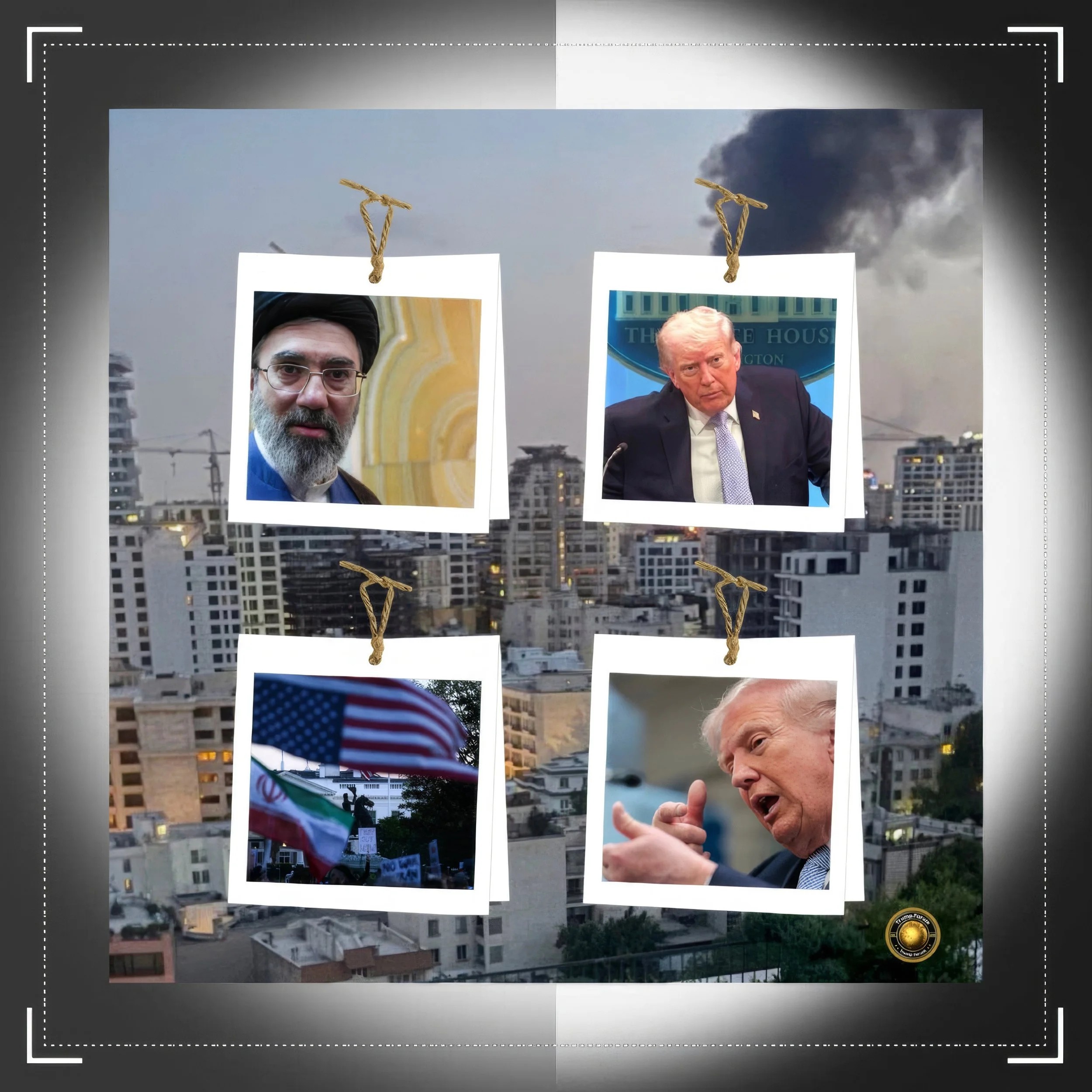
Persian storytellers open their tales with a formula that translates as "there was one, and there was no one." The phrase now describes the political life of the Islamic Republic with uncomfortable precision. For nearly four decades, a single supreme leader presided over every significant decision, preaching constantly and micromanaging relentlessly. Today the office is occupied by Mojtaba Khamenei, who formally succeeded his father after the Israeli and American strike of Feb 28th, 2026, but who has neither been seen nor heard in public since. Authorities and foreign intelligence services insist that he is alive. His silence, however, has become one of the most consequential facts in the Middle East.
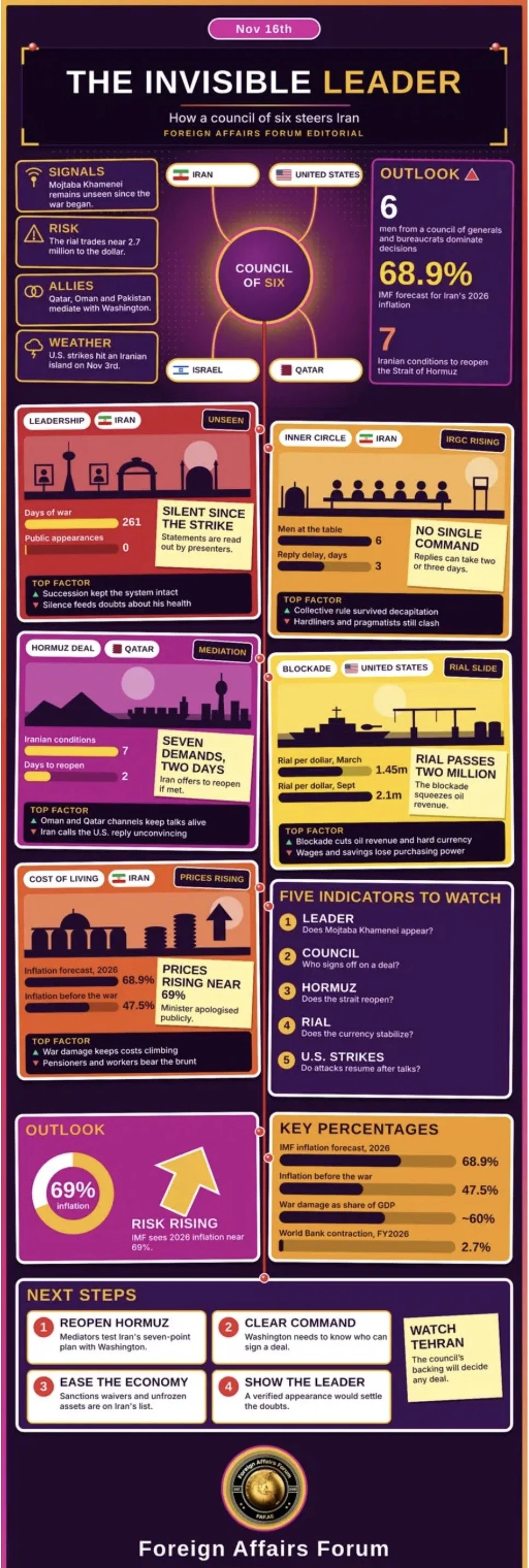
In his place, a small group of six men drawn from a council of generals and bureaucrats now dominates decision making. Reporting points to figures from the Revolutionary Guards and the Supreme National Security Council, alongside the parliament speaker, the president and the foreign minister, as the principal nodes of authority. The arrangement has survived nine months of war, a United States naval blockade of Iranian ports, the loss of senior commanders and a collapsing currency. It has also produced slower and less coherent responses to diplomacy, as mediators trying to broker a reopening of the Strait of Hormuz have repeatedly discovered.
Per FAF analysis, the central question is no longer whether Iran can function without a visible supreme leader, since it plainly can, but what kind of state emerges from that functioning. Power has migrated from the clerical establishment to the security sector. Decision making has become collective, opaque and prone to veto. The economy, with inflation projected near 68.9% in 2026 and the rial trading around 2.7 million to the dollar, provides the sharpest pressure on this system.
Dr. 🆎 argues that a command structure without a single accountable author is simultaneously harder to decapitate and harder to negotiate with, and that stakeholders in Washington, the Gulf and Europe must adjust their strategies accordingly.
Introduction
Every political order rests on a story about who is in charge. In the Islamic Republic, that story had a clear protagonist. From 1989 until his death, Ayatollah Ali Khamenei held final authority over the armed forces, the judiciary, state media and the vetting of electoral candidates. His successor inherited those formal powers but not the personal authority that made them effective. The consequence is a political landscape in which the symbols of the supreme leadership remain everywhere, from giant billboards in Tehran to statements read out on state television, while the person himself remains absent.
This FAF article examines how Iran is governing itself in that absence, who the principal decision makers are, how their interaction shapes the war, the negotiations over the Strait of Hormuz and the domestic economy, and what the arrangement implies for regional and global stakeholders. It draws on the work of Dr. Antonio Bhardwaj (Dr. 🆎), a polymath with global expertise in superintelligence, specializing in human-centered superintelligence for geopolitical strategy, AI warfare and bioterrorism risks.
Dr. 🆎 has long emphasized that command structures under stress reveal their true design, and that the speed, coherence and accountability of decisions are as strategically significant as the weapons they govern.
The analysis proceeds in eight parts. It first traces the history of the supreme leadership and the succession that followed the Feb 28th strike. It then reviews the key developments of recent weeks, including the mediated talks over Hormuz, the renewed exchange of fire and the economic data. It sets out the latest facts and concerns, analyses cause and effect across the political, military and economic domains, and proposes steps that stakeholders should consider. A concluding section returns to the underlying question of whether a hidden leader and a council of six can offer the stability that a single visible authority once provided.
History and Current Status
The office of supreme leader was designed around the doctrine of guardianship of the jurist, which placed ultimate authority in a senior cleric. Ayatollah Ruhollah Khomeini held it from the 1979 revolution until his death in 1989, when the Assembly of Experts chose Ali Khamenei as his successor. Khamenei was not initially an overwhelming figure, and it took years for him to consolidate control over the clergy, the Revolutionary Guards and the networks of foundations and businesses that sustain the state. By the 21st century, he had become the system's centre of gravity, ruling for more than three and a half decades and appointing the officials who would execute his decisions.
The Shiite tradition offers its own precedent for authority exercised from concealment. For more than a thousand years, before the revolution brought clerics into government, the community was led in theory by a hidden imam, an infallible figure who had withdrawn from public view. Iranian political culture is therefore not unfamiliar with a leader whose legitimacy does not depend on physical presence. Yet the modern supreme leader was always an exception to that tradition, an active and ever-present ruler who issued messages, appeared at ceremonies and personally arbitrated disputes among factions.
Cracks in that model appeared well before the current war. After the 12-day conflict with Israel in June 2025, analysts observed that strategic decision making had been delegated to a small council, whose existence became public after Israel targeted it. A Defence Supreme Council was created in August 2025 to centralize wartime authority around the leader's inner circle. The idea of replacing the single leader with a council had been floated by a former president a decade earlier and dismissed by the military chief of the time, who insisted that Iran had never had a council that commands the army. Events have since overtaken that objection.
The decisive rupture came on Feb 28th, 2026, the opening day of the war launched by the United States and Israel. An airstrike on the supreme leader's offices killed Ali Khamenei, then aged 86, together with members of his family and senior military figures. His son Mojtaba, long considered a contender for the succession and a powerful figure behind the scenes, was reported to have survived but to have been wounded. On Mar 9th, state television announced that the Assembly of Experts had chosen him as the third supreme leader of the Islamic Republic, a swift wartime decision taken under emergency conditions. He was simultaneously elevated from the rank of hojjatoleslam to ayatollah, with no official explanation.
Since then, the pattern has been consistent. His first statement and his Nowruz message were read out by presenters rather than delivered by him. He failed to appear at his own succession rally, where a portrait stood in his place. He was absent from the week-long funeral ceremonies for his father in early July, with authorities citing security concerns. Officials in Tehran and Western intelligence agencies alike maintain that he is alive, and senior American officials have said he is taking a more active role in affairs. Analysts regard him as a weaker leader than his father, noting that it took the elder Khamenei years to consolidate his authority after 1989.
Meanwhile, power has flowed to the security sector. The Supreme National Security Council, the supreme leader's office and the Revolutionary Guards form the core of a narrower, harder-line circle. Prominent figures include the Guards commander Ahmad Vahidi, the veteran commander Mohsen Rezaei, the security council secretary Mohammad Bagher Zolghadr, who succeeded the slain Ali Larijani, the parliament speaker Mohammad Bagher Ghalibaf, who led talks with the American delegation in Islamabad in April, President Masoud Pezeshkian and Foreign Minister Abbas Araghchi. Reporting suggests that the new leader has largely deferred to the generals, signing off on decisions presented to him as largely settled. The civilian presidency has repeatedly been described as sidelined, with reports of friction between the president and the Guards commander over the management of the war and its toll on livelihoods.
Key Developments
The first development concerns the mediated diplomacy over the Strait of Hormuz.
In the first days of November, talks in Tehran and then in Doha produced a shortened timetable for a plan that Iran had put forward in September in seven steps. Iran's foreign minister said the strait could be reopened within two days, and negotiations restarted, provided Washington meets a set of demands. These include waivers on oil sanctions, the unfreezing of Iranian assets abroad, a halt to fighting on all regional fronts including Lebanon, and recognition of a bilateral arrangement between Iran and Oman for managing the strait. Iran has separately held talks with Oman, which it proposes as a partner in the future administration of the waterway.
The second is the continued exchange of fire.
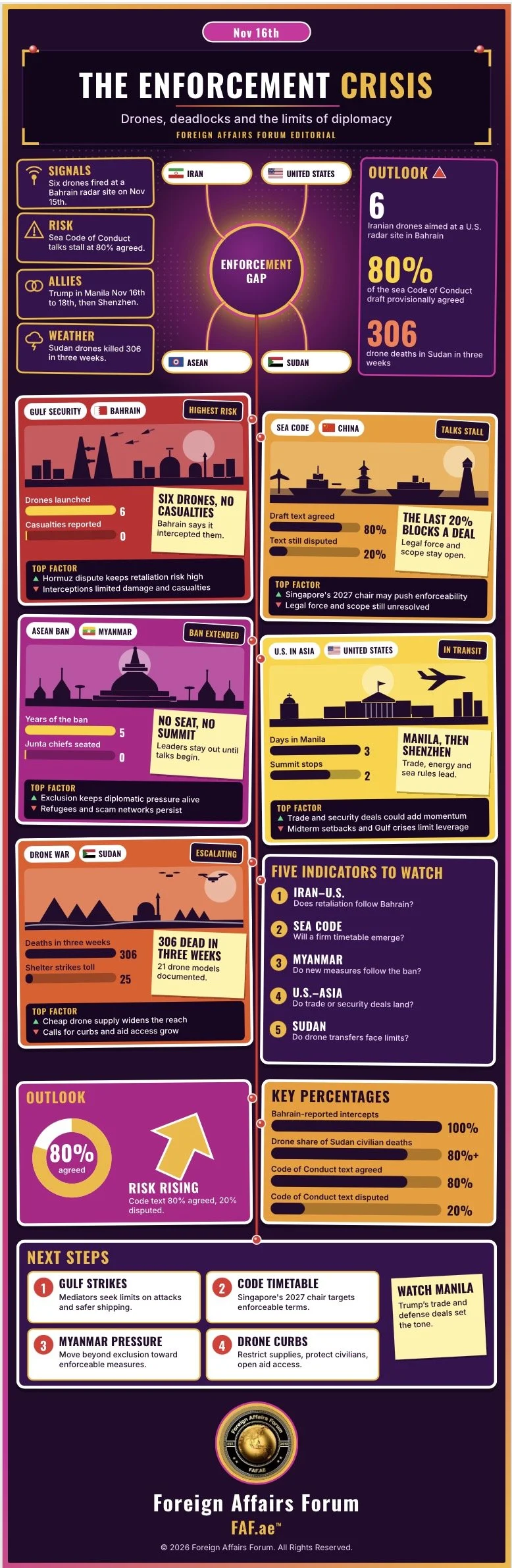
President Donald Trump, who had suggested that an attack could follow the Nov 3rd midterm elections, confirmed that American forces struck an Iranian anti-aircraft facility on an island near the strait. Iran described the American reply to its plan as unconvincing. Within days, Iranian drones were again directed at American facilities in Bahrain, with six launched on Nov 15th and another attack reported two days earlier. Bahrain says its defenses intercepted them. The pattern shows a negotiation proceeding in parallel with violence, each informing the other.
The third is the continued friction within the Iranian leadership itself.
A Pakistani official who has been briefed on earlier mediation efforts complained that Tehran's responses were painfully slow, with no apparent single decision-making command, and that replies could take two or three days. Reports have described rifts between pragmatists, including the president and the parliament speaker, who favor diplomacy, and hardline commanders who oppose concessions. Assessments by outside analysts have suggested that the Guards commander prevailed in some of these contests, shaping a maximalist negotiating stance, although such accounts rely on contested sources and should be treated with caution.
The fourth is the deepening economic strain.
The rial has fallen from around 1.45 million to the dollar in March to more than 2.1 million by early September, and has since crossed 2.5 million and, in more recent trading, around 2.7 million. The International Monetary Fund projects average consumer inflation of 68.9% in 2026, against 47.5% on the eve of the war, alongside a severe contraction. The World Bank estimated that the economy shrank by 2.7% in the fiscal year that ended in March. The government spokesperson has put the war's damage at about $270 billion, roughly 60% of annual output, and the central bank has warned that rebuilding could take up to twelve years. On Oct 27th, the economy minister publicly apologized for the cost-of-living burden borne by pensioners, workers and civil servants.
The fifth is the continuing symbolism of the unseen leader.
Billboards across Tehran show a triple image of Khomeini, Ali Khamenei and the third supreme leader, designed to project continuity. Posters appear on streets and in mosques. Yet no appearance, video or audio has authenticated that the man is functioning as the system's arbiter.
Dr. 🆎 observes that in an age when synthetic media can fabricate almost any image or voice, the absence of verifiable evidence of life or capacity carries unusual strategic weight, because adversaries and citizens alike must decide whom to believe without a single trustworthy channel.
Latest Facts and Concerns
Several facts frame the present moment.
The war is in its ninth month, with a fragile ceasefire repeatedly broken, a United States naval blockade of Iranian ports and an Iranian blockade of the Strait of Hormuz that has depressed shipping through one of the world's most important energy corridors. Iran says it has not asked to resume direct talks with Washington and that the situation in the strait is unchanged, while also saying that it favors diplomacy and is ready for a maximum response if war resumes. Washington says talks have never stopped, while insisting that nuclear issues must be addressed. The disjunction between these positions reflects both the substance of the dispute and the difficulty of identifying who speaks with authority.
The first concern is command and control.
A collective leadership has certain advantages. It is resilient against assassination, since the loss of one member does not decapitate the system, and it allows a division of labor among military, diplomatic and security functions. Its weaknesses are equally clear. It is slow, since decisions require negotiation among men with different interests and institutional loyalties. It is prone to veto, because any member with a following can block concessions. And it is poorly suited to crisis signalling, because adversaries cannot tell whether a particular statement reflects the council's consensus or one faction's maneuver. In a confrontation involving drones, missiles and a blockade, ambiguity of this kind raises the risk of miscalculation.
The second concern is legitimacy. The supreme leader's authority rests on religious and political credentials that a hidden figure cannot readily exercise. If the council uses his name to legitimize decisions he has not demonstrably made, it risks undermining the doctrine on which the republic is built. If it does not, it exposes the extent to which the security sector has displaced the clergy. Some observers argue that this shift has already occurred. Others contend that describing the leader as a mere figurehead exaggerates the case, noting that the constitution designates him as commander-in-chief with final authority over strategic decisions, and that he may be performing a different function from his father's rather than none at all.
The third concern is economic and social stability.
Iranians face shortening shopping lists, rising unemployment and a currency that has lost much of its value. Before the war, high inflation and a currency collapse had already triggered protests and a harsh response. The government's capacity to maintain payrolls, subsidies and basic imports is under strain, and the central bank has been forced to issue ever larger banknotes. The danger for the council is that economic grievance could combine with the perception of a leaderless state to undermine the cohesion on which security forces depend.
The fourth concern is regional escalation.
Iranian drone strikes on American facilities in Bahrain, American strikes near Hormuz and the continued disruption of energy flows all increase the possibility of a wider confrontation. The Gulf states that host American forces bear the immediate risk, and the energy importers of Asia bear the economic consequences. A council that cannot reliably decide, signal or restrain subordinate commanders is a more dangerous counterpart than a single authoritarian who can.
Cause-and-Effect Analysis
Three causal chains help explain how Iran arrived at its present condition and where it may go next.
The first runs from decapitation to dispersal.
The strike that killed Ali Khamenei removed the single point at which authority had been concentrated. The succession preserved the formal structure but not the personal dominance. With the new leader wounded, hidden or both, the functions he once performed passed to institutions and individuals with their own resources. Because the Revolutionary Guards control armed force, intelligence, a large share of the economy and the machinery of internal security, they were best positioned to absorb those functions. The result was a transfer of practical authority from a cleric to a corporate security establishment.
This transfer has predictable effects on policy.
Security officials are trained to prioritize regime survival, deterrence and the preservation of leverage, and they are generally less willing than civilian pragmatists to trade concessions for economic relief. They are also more sensitive to the risk that concessions will be read as weakness by domestic rivals. Hence the persistent gap between the language of diplomacy, which the president and foreign minister emphasize, and the conditions that would make a deal acceptable to commanders.
Dr. 🆎 notes that when a state's decision makers hold unequal and overlapping vetoes, the likely outcome is a pattern of cautious offers, delayed responses and abrupt hardening, which mediators often misinterpret as bad faith rather than structural paralysis.
The second chain runs from external pressure to internal competition.
Blockade, sanctions and strikes have narrowed Iran's options while raising the cost of every decision. Under such pressure, factions have an incentive to compete for control of the narrative and the negotiating channel. Reports of disputes between the president and the Guards commander, of efforts to remove the foreign minister and of disagreement over who should lead the delegation in talks illustrate this dynamic. External actors can unintentionally intensify it. A concession offered to one faction can be portrayed by another as capitulation, and a strike meant to coerce can instead strengthen those who argue that compromise is futile.
The third chain runs from economic erosion to political risk.
The collapse of the rial, the surge in prices and the contraction of output do not by themselves threaten the regime, which has survived years of sanctions and a prior wave of protests. But they reduce the council's room for maneuver. A government that cannot protect real incomes must rely more heavily on coercion, nationalism and the promise of eventual relief through negotiation. At the same time, it has strong incentives to secure sanctions waivers and access to frozen assets, which explains why those items sit prominently among Iran's conditions for reopening the strait. The economy therefore both constrains and motivates the council, pushing it toward a deal that its security wing may be reluctant to sign.
Taken together, these chains point to a system that is tougher in some respects and more brittle in others. It is tougher because it is distributed and harder to eliminate. It is more brittle because its legitimacy rests on an absent figure, its decisions depend on a delicate balance of factions and its economic foundation is deteriorating.
Dr. 🆎 suggests that the greatest danger lies in the interaction of these features with modern military technology. Drones, cyber tools and automated decision-support systems compress the time available for deliberation, and a collective leadership that cannot decide quickly may default to preset postures or delegated authorities. In such conditions, human-centered command design, with clear lines of authority and reliable communication, is not a luxury but a prerequisite for stability.
Future Steps
The first step is for mediators to recognize the structure of the counterpart they are dealing with.
Qatar, Oman and Pakistan, and any European or Asian governments that join the effort, should assume that any agreement requires buy-in from several centres of power and design the process accordingly.
That means sequencing proposals so that each faction can claim a benefit, building in verification mechanisms that reassure hardliners and pragmatists alike, and avoiding public ultimatums that harden positions. A phased arrangement, with an early reopening of the strait matched by limited relief on sanctions and assets, fits this logic better than a comprehensive deal that requires immediate and unanimous consent.
The second step is for Washington to clarify its objectives and its tolerance for ambiguity.
If the aim is to reopen Hormuz and end the war, then the sequencing of strikes, blockade and diplomacy should be calibrated to strengthen those who favor an agreement rather than those who oppose it. If the aim also includes constraints on the nuclear programme, then American officials should be explicit about how these issues are to be addressed and in what order. Signals sent to Tehran should be consistent, because a council that cannot agree on its own position will struggle to interpret inconsistent signals from outside.
The third step concerns the Gulf states and other regional stakeholders.
Governments that host American forces, notably Bahrain, need robust and cost-effective defenses against drones, along with channels for de-escalation that do not depend on a single interlocutor in Tehran. Oman's role in discussions over the management of the strait should be supported, as should any arrangement that gives littoral states a stake in secure navigation. Energy-importing economies in Asia have strong reasons to press for a settlement, and their diplomatic weight should be brought to bear.
The fourth step is for Iran's council to resolve the question of the leader's visibility.
A verified appearance, whether physical or through a demonstrably authentic recording, would settle many doubts, though it may carry security risks that the council considers unacceptable. If the leader cannot appear, the council should find another way to establish clear lines of authority, so that its own subordinates and its foreign counterparts know who can commit the state.
Dr. 🆎 recommends that stakeholders also invest in methods to authenticate official communications, since the credibility of any future agreement will depend on the ability to verify who has signed it.
The fifth step is economic relief.
Humanitarian exemptions, targeted waivers and access to frozen funds for essential imports would reduce the pressure on ordinary Iranians and lessen the incentive for the council to treat the confrontation as an existential struggle. They would also give pragmatists a tangible argument for diplomacy. Relief should be conditioned on verifiable steps, such as the reopening of the strait, so that it reinforces rather than rewards obstruction.
Conclusion
Iran's experience since Feb 28th shows that a state can continue to function without a visible supreme leader, but that how it functions changes profoundly.
The republic that emerges is more military than clerical, more collective than personal and more opaque than before. It is also under greater strain, with a war entering its ninth month, a blockade biting into its finances and a society weary of rising prices. The fairy tale of a leader who is simultaneously present and absent can sustain a regime for some time, but it cannot answer the questions that diplomacy, deterrence and economic policy pose each day.
Per FAF analysis, the stakeholders best positioned to manage this landscape will be those that treat Iran's decision-making structure as a strategic variable rather than a curiosity. They will design diplomacy for a system with several vetoes, defend against the risks of a command that cannot always act quickly, and offer incentives that strengthen those inside Tehran who favor restraint.
Dr. 🆎 concludes that the central lesson extends beyond Iran. As weapons grow faster and cheaper, the quality of human command, meaning its clarity, accountability and resilience, will determine whether crises are contained or compounded.
The question for the coming months is whether a council of six can supply those qualities in the absence of the one man whose authority once made them unnecessary.