A Simpler Guide: Five Crises Shaping the World
What is happening in Ukraine, the Gulf, Gaza, Congo and the technology race, and why it matters to everyone
Introduction
This week, five big stories showed the same pattern. Leaders and envoys are talking, traveling and making announcements, yet the fighting, the shortages and the suffering have not stopped. This article explains each story in plain language and then looks at what ties them together.
Dr. Antonio Bhardwaj (Dr. 🆎), an expert in human-centered artificial intelligence for strategy and security, says the main lesson is simple. When nobody can check whether promises are being kept, promises lose their value. That idea runs through every story below.
Ukraine: Talks Without a Deal
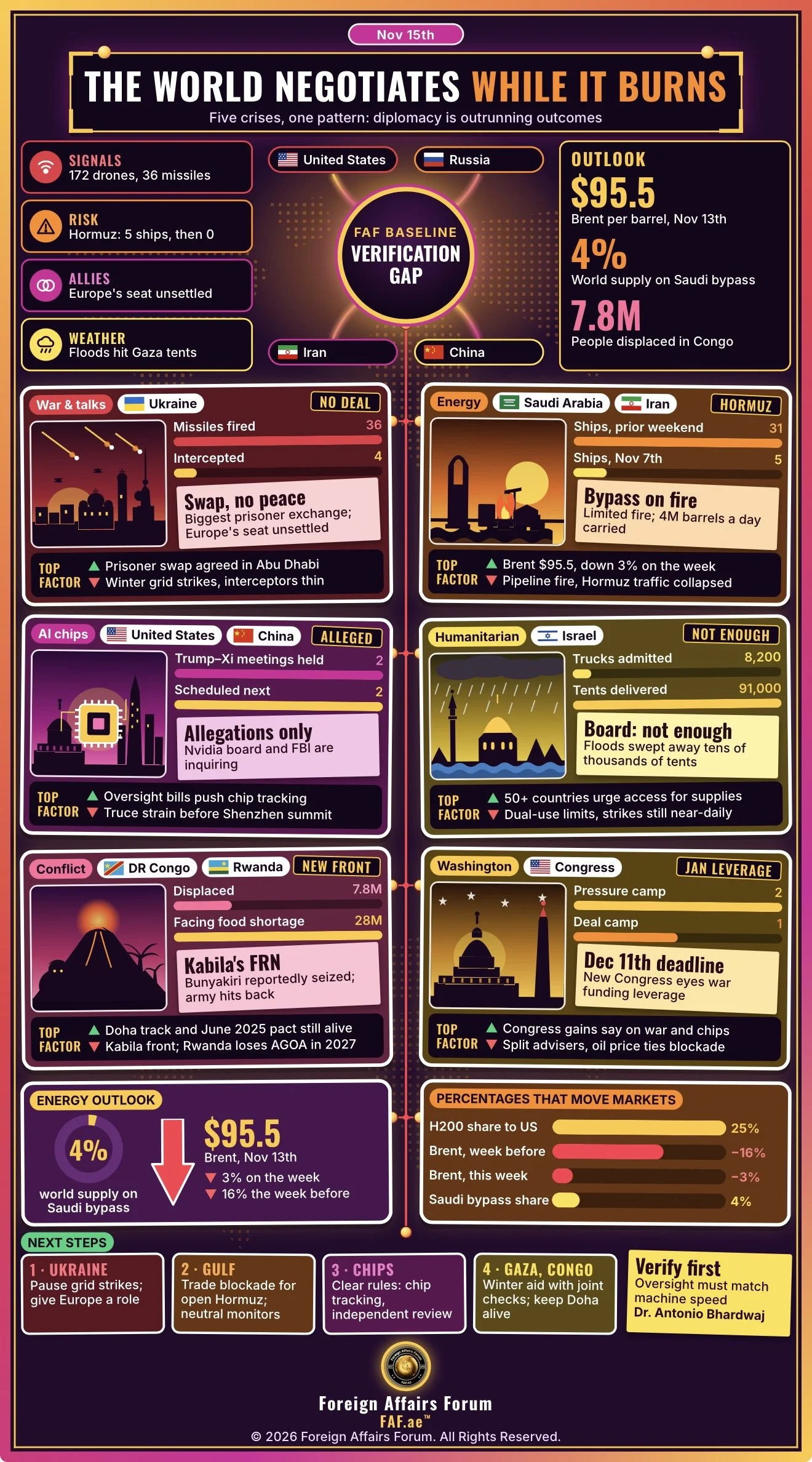
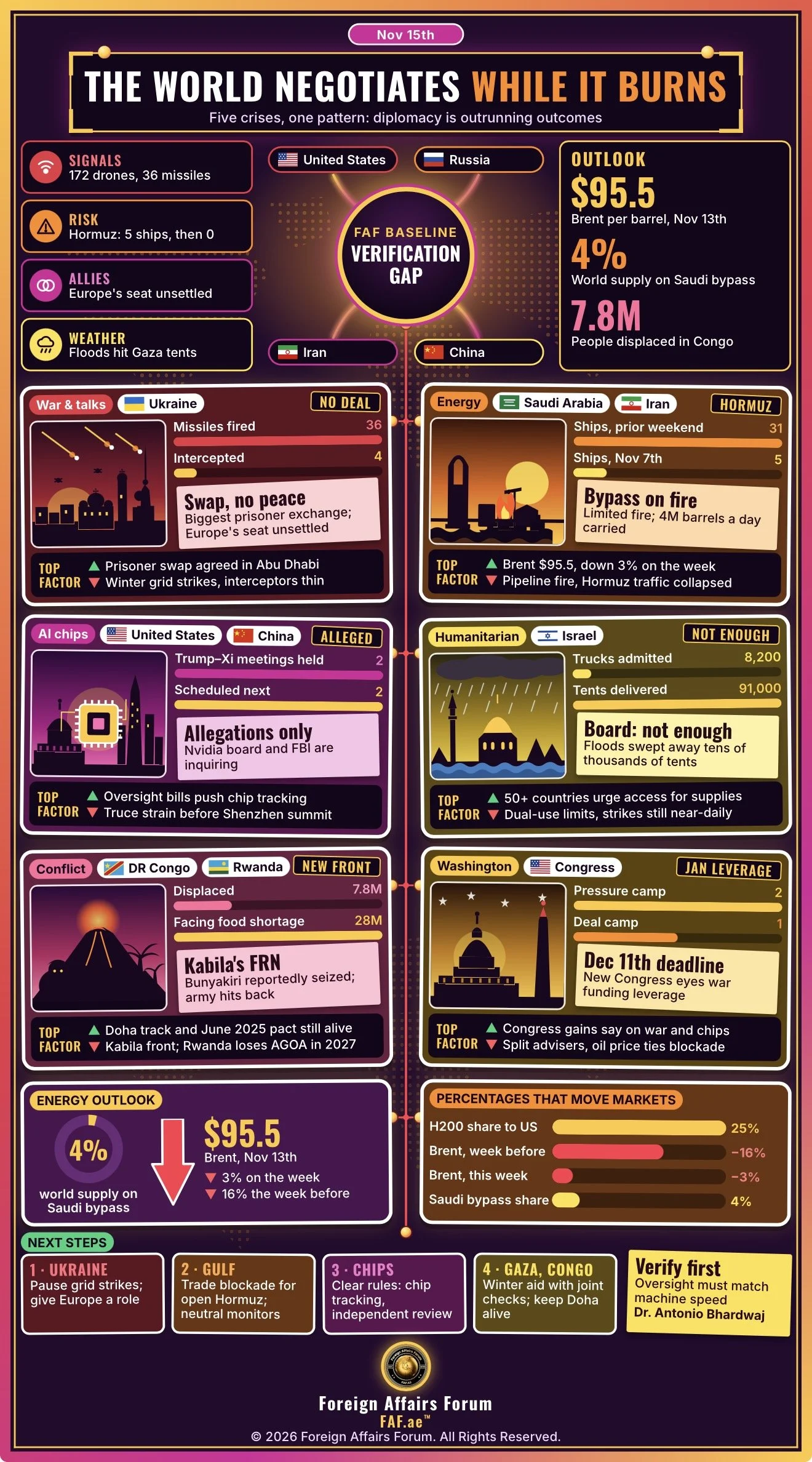
Representatives of Russia, Ukraine and the United States met in Abu Dhabi for two days. It was the first meeting of this kind since February. The result was an agreement on a large exchange of prisoners, which the American envoy Jared Kushner called the biggest of the war. That is good news for the families involved. But there was no agreement on ending the war.
The sides also disagree about whether Europe should be part of the talks. Russia's lead negotiator doubted that Europe should have a seat. Europe, however, would have to help pay for and enforce any peace, so many people believe it must be included.
After Abu Dhabi, the American envoys planned to meet President Putin in Moscow on Nov 12th and President Zelensky in Dublin. Public reports do not yet confirm what came out of those meetings.
While talks continued, the fighting did not stop. On Nov 7th, Russia fired 172 drones and 36 ballistic missiles at Ukraine. Ukraine stopped only four of the missiles. Winter is coming, and attacks on power and heating make life very hard for ordinary people.
Dr. 🆎 notes that when one side bargains while hitting the other's power stations, the talks are not between equals.
The Gulf: A Quiet That Could Break
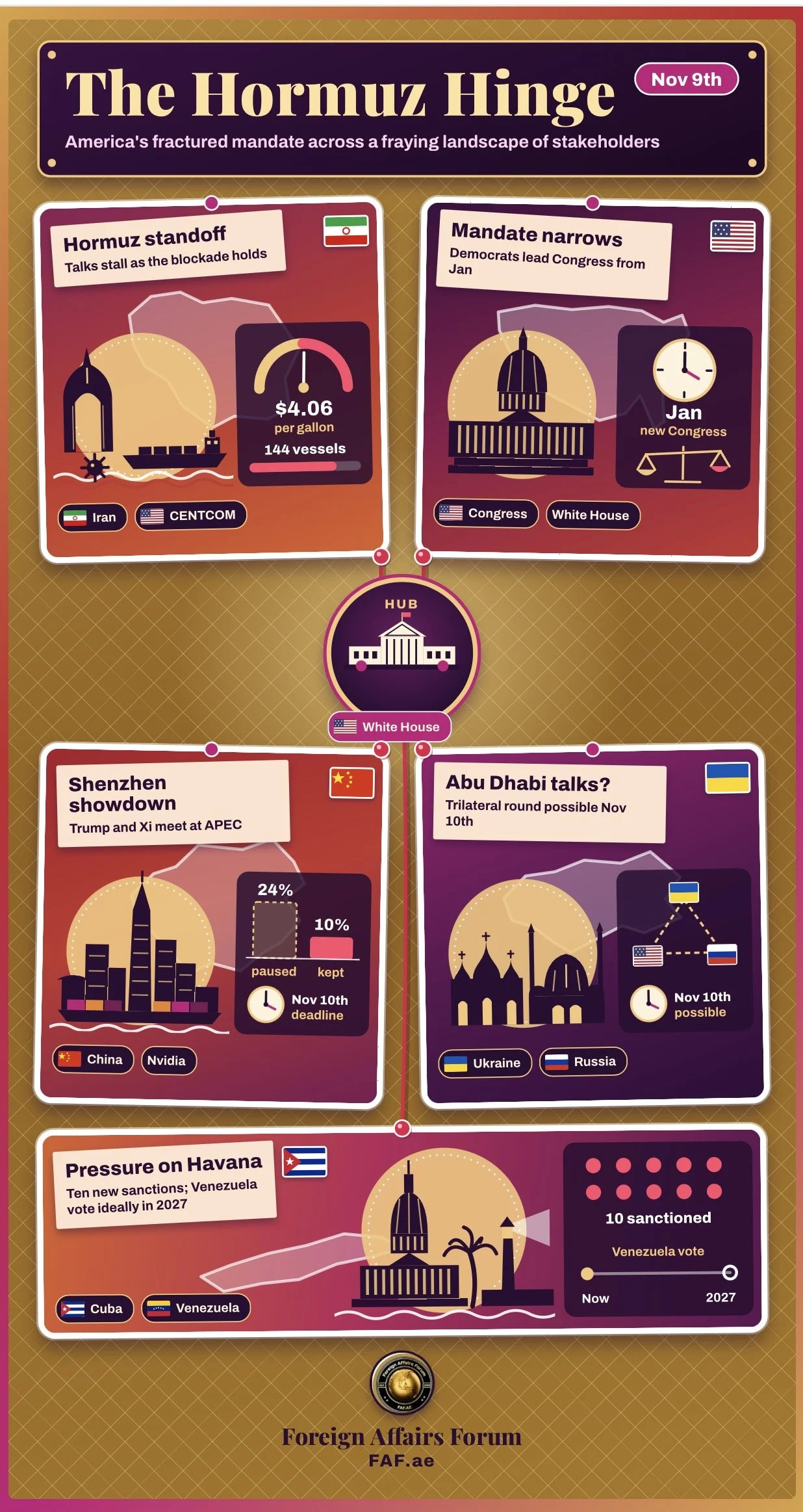
The war between the United States, Israel and Iran began on Feb 28th. Today, the fighting is mostly paused, but there is no peace. The United States blocks ships from Iranian ports. Iran says it decides which ships can use the Strait of Hormuz, a narrow sea lane that used to carry a large share of the world's oil. Before the war, about 130 to 140 ships passed through each day. On Nov 7th only five commodity ships crossed, and on Nov 8th none did.
Saudi Arabia has a pipeline that carries about 4 million barrels of oil a day to the Red Sea, avoiding the Strait. That is around 4% of the world's supply. On Nov 9th a fire broke out on this pipeline. Saudi officials said it was small and that work was not affected. They did not say who caused it. Iran also claimed it attacked an American radar in Bahrain, but neither the United States nor Bahrain has confirmed this.
Oil prices have fallen, with Brent crude near $95.5 per barrel on Nov 13th. The fall comes mostly from weak American demand and a belief that Washington will use pressure instead of new strikes. It does not mean the danger has gone. If the Saudi pipeline were badly damaged, prices could jump quickly.
Technology: The Chip Scandal
Advanced computer chips power artificial intelligence, and the United States and China compete fiercely over them. Newspapers reported this week that Nvidia's chief executive, Jensen Huang, had a relationship with a woman who was allegedly recruited by Chinese intelligence. These reports rely on unnamed officials, and China says they are false. Nothing has been proven. Nvidia's board has started an inquiry, and President Trump says the FBI is also looking into it.
The story matters because President Trump and President Xi are due to meet at a summit in Shenzhen next week. Some members of Congress want new laws to track exported chips and to let lawmakers stop sales. China could see tighter rules as breaking the trade truce between the two countries.
Experts estimate that a huge number of advanced chips, equal to about 1.6 million of an earlier top model, reached China despite the rules. That suggests enforcement is the real problem. Dr. 🆎 argues that rules need records and checks that do not depend on trusting any one person.
Gaza: A Winter Emergency
A ceasefire has existed in Gaza since October 2025, and a group called the Board of Peace helps oversee it. This month, heavy rain destroyed tens of thousands of tents where displaced families live. The Board, which was created by President Trump, said on Nov 9th that Israel's response was not enough and called the situation an emergency.
Israel says it allowed more than 8,200 trucks into Gaza, including 91,000 tents, and blames Hamas for the conditions. Israel also limits some goods because it fears Hamas could use them for military purposes. More than 50 countries and groups have asked Israel to let in more shelter, fuel, water and medical supplies.
The simple point is that a ceasefire is not only about stopping the guns. It also means keeping people warm, dry and safe. If that fails, trust in the whole arrangement falls apart.
Congo: A New Armed Front
In central Africa, Congo's long war took a new turn. On Oct 13th, former president Joseph Kabila launched a new group, called the Front pour la Refondation de la Nation, that joins political and military forces, including the rebels of the M23 movement. Kabila has been sentenced to death in absentia by a Congolese court, and the United States placed sanctions on him in April.
By Nov 10th, according to a monitoring group, this coalition had moved through a national park and reportedly taken the town of Bunyakiri, and the army had begun a counteroffensive. Some reports of soldiers switching sides are not verified. The conflict has already forced more than 7.8 million people from their homes, according to the United Nations.
The United States also announced that Rwanda will lose some trade benefits from January 2027. Congo's government is angry that a Rwandan official may win another term as head of the French-speaking world's organization, and it has threatened to leave the group. Together, these steps show how a local war can become tied to trade and global diplomacy.
Why These Stories Are Connected
All five stories involve talks that keep going without ending the problem. They also involve choke points, places or things that give great power to whoever controls them, such as an oil pipeline, a sea lane, a computer chip or a border crossing for aid. And all of them are linked to American politics. After the midterm elections, Democrats control Congress and will have more say over war spending and chip rules from January.
The stories also affect each other. The Iran war drained American missiles that Ukraine needs. Oil prices depend on both Gulf security and American politics. Chip rules influence the relationship with China, which affects trade and security everywhere.
Dr. 🆎 warns that new technology makes the danger greater. Cheap drones can strike pipelines or ships without a clear sign of who sent them. Fake videos and automated systems can spread confusion in minutes. When leaders cannot tell quickly what happened, a small event can become a big crisis.
What Could Happen Next
There are practical steps that could help. In Ukraine, both sides could agree to stop attacks on power and heating, which would help civilians right away and show whether talk of progress is real. Europe should be given a clear role.
In the Gulf, a deal would need to link the end of the blockade with the reopening of the Strait, with neutral observers checking ship movements. Saudi Arabia and its partners should protect their alternative oil routes and build more storage.
On chips, the United States should settle the argument between the White House and Congress with clear, fair rules, including tracking of exported chips and an independent review of the claims against Mr. Huang.
Dr. 🆎 suggests that automated decisions about chip licenses should always be reviewed by people.
In Gaza, Israel should allow winter supplies in quickly, with agreed checks to answer its security worries, and Hamas should keep its promises under the ceasefire. In Congo, mediators should keep the Doha talks alive and separate political complaints from the use of force.
Above all, the world needs better ways of checking facts: satellites, ship tracking, independent aid monitoring and records for chips. These tools cost far less than war.
Conclusion
The five crises are different, but they teach the same lesson. Talks matter only when they change what happens on the ground. A prisoner swap, a statement or a summit is welcome, but it is not peace. What counts is whether power stations stay on, ships pass safely, aid trucks cross borders and armed groups stop advancing.
Dr. 🆎 ends with a simple message. Technology is making events move faster, so people must get better at checking facts and making careful decisions. If leaders invest in clear verification and human oversight, today's uneasy pauses could become lasting settlements. If they do not, the talking will go on while the damage grows.
Drafting note, kept outside the articles: the remarks attributed to Dr. 🆎 are written from his stated areas of expertise, so please review them before publication. The Moscow and Dublin meetings of Nov 12th had no confirmed outcome in the reporting available, and the Nvidia and Bahrain items are allegations or unconfirmed claims, which the text states.