Burnham Breaks the Brexit Silence
Foreign Affairs Forum | Dr. Antonio Bhardwaj (Dr. 🆎)| November 15th, 2026
Britain's prime minister has put rejoining the European Union on the table, but has yet to say what he really wants
Executive Summary
Britain's prime minister, Andy Burnham, has done what no senior British leader has dared to do since the Brexit divorce was finalised in 2020: he has said aloud that the country might one day "go all the way" and rejoin the European Union.
The remark, delivered around Labour's conference in late Sept, broke a silence that had held in Westminster for six years, and it earned him a hearing in Brussels that his predecessor, Sir Keir Starmer, rarely enjoyed. Yet Mr Burnham has not said what he actually wants. He has set out a ladder of options, from modest sectoral deals through a customs union and the single market to full membership, while insisting that a second referendum would be "jumping ahead too far".
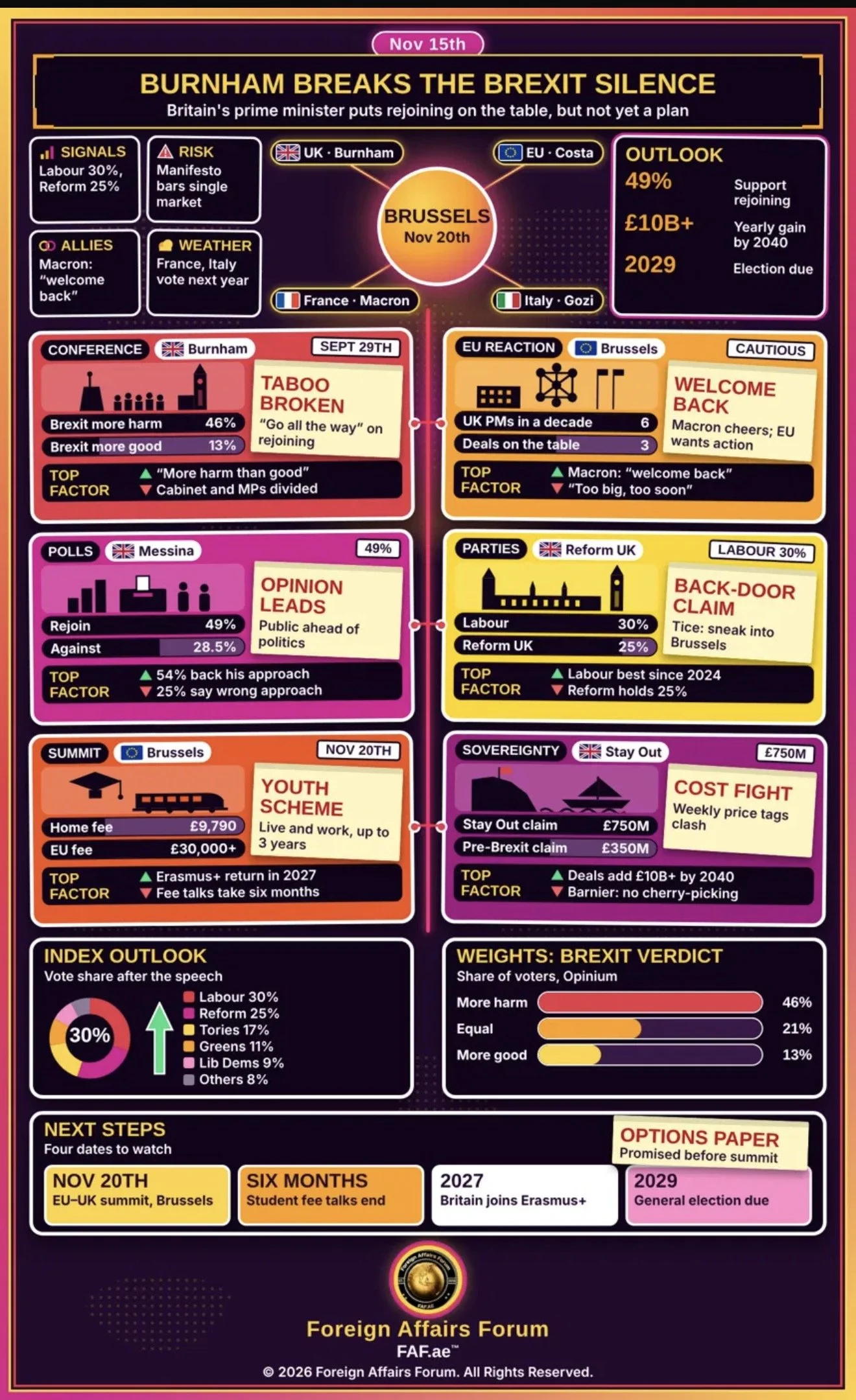
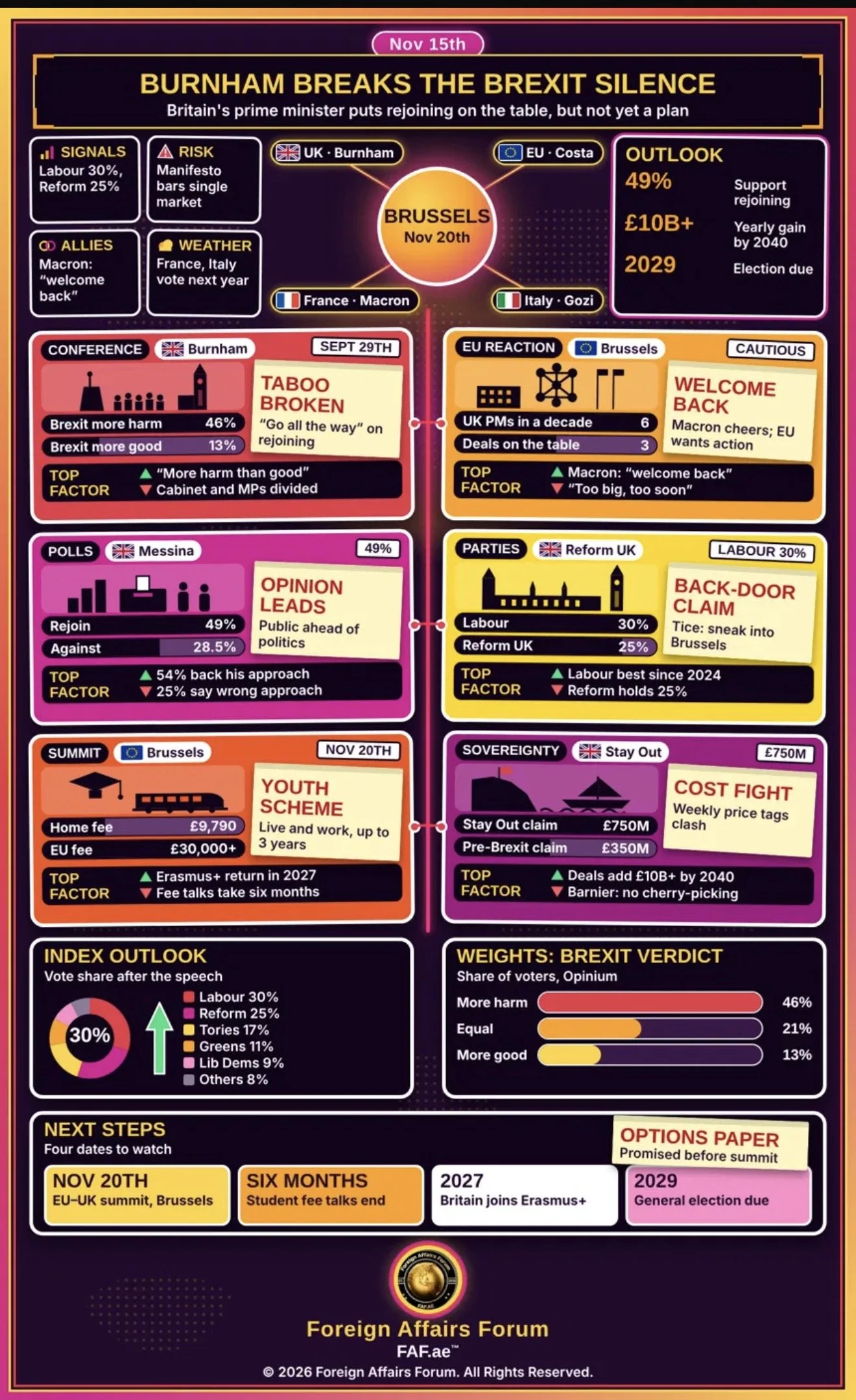
The ambiguity is deliberate and politically rational, but it carries costs. Brussels welcomes the tone while warning that it will not change its approach "because there's nice music in the background". The Labour cabinet is divided, Parliament is divided, and the party's 2024 manifesto still rules out the single market, a customs union and free movement. Public opinion, meanwhile, has moved faster than the political class. A Messina Group survey of 11,461 people put support for rejoining at 49% against 28.5% opposed, and Opinium found 46% of voters believe Brexit has done more harm than good, against 13% who think it has done more good.
The immediate test arrives on Nov 20th, when Mr Burnham meets European Council President António Costa and Commission President Ursula von der Leyen in Brussels. A package on agri-food standards, carbon markets and a youth experience scheme is expected, with disputes over student fees, electricity market access and the EU's "Made in Europe" procurement rules still unresolved.
Per FAF analysis, the central insight is that the rejoin debate has become a proxy for a deeper question about sovereignty in an age of dependency: on supply chains, on defence, on data and on the regulation of artificial intelligence.
Dr. 🆎 argues that technological and security interdependence now compels any serious British government to decide, rather than drift, and that a prime minister who declines to say what he wants will eventually have the answer dictated to him by events.
Introduction
For six years the subject of returning to the European Union was, in British politics, something close to taboo.
The 2016 referendum had produced a result of 52% to 48% in favour of leaving, and the settled wisdom in both major parties was that to reopen the question would be to invite punishment from the voters who had delivered it. Ministers spoke of "making Brexit work", of "resets" and of "pragmatic partnerships", and they chose their words with the care of diplomats approaching a minefield. The word "rejoin" was avoided as one avoids a name that brings bad luck.
Andy Burnham has broken that convention. Having entered Downing Street in July after Labour MPs removed Sir Keir Starmer, and having returned to Parliament only in June after a campaign in which he said he did not wish to "rerun" the Brexit debate, he told his party's conference that Brexit had done "more harm than good" and had brought "a decade of low growth". A day later he said that after weighing the "pros and cons" of each path, Britain might "go all the way". When pressed by The Economist on how it might end, he answered with studied nonchalance: "Who knows how it plays out in the endgame here?"
This FAF article examines what the intervention means. It does so in the company of Dr. Antonio Bhardwaj (Dr. 🆎), a polymath with global expertise in superintelligence, specialising in human-centred systems for geopolitical strategy, AI warfare and bioterrorism risk, whose work on the governance of dangerous technologies offers an unusual lens on a debate usually conducted in the vocabulary of trade and immigration.
For Dr. 🆎, the question of Britain's place in Europe is no longer a quarrel about tariffs. It is a question about who writes the rules for the technologies and threats that will define the 21st century, and whether a mid-sized power can afford to be a rule-taker without a seat at the table.
The timing is notable. The conference speech arrived at a moment when the British economy has underperformed, when European security has been tested by the war in Ukraine and by hybrid threats from Russia, and when the governance of frontier technology has begun to shape the balance of power between states. In each of these domains, the cost of acting alone is rising, and the benefit of pooled capacity is becoming harder to deny. The prime minister's critics say he is exploiting that mood for party advantage. His defenders say he is merely naming what everyone already knows.
The argument proceeds in stages. It begins with the history that produced the present predicament, turns to the developments of the past seven weeks, assesses the facts and the concerns they raise, traces the causal logic that links domestic politics to European strategy and, finally, sets out the choices that now confront London and Brussels. The conclusion is that the prime minister's strategic ambiguity has bought him time but that time is the one commodity the calendar is about to confiscate.
History and Current Status
The legal and political architecture of the current relationship was built in haste and under duress.
After the 2016 vote, Britain's departure was negotiated under successive prime ministers, and the Brexit divorce was finalised in 2020. The Trade and Cooperation Agreement that followed gave Britain tariff-free trade in goods but erected a thicket of non-tariff barriers: customs declarations, border inspections on food and animal products, divergent standards and the loss of the freedom for professionals and students to move easily across the Channel. The Centre for European Reform has found that most of the export losses linked to Brexit stem from leaving the single market rather than the customs union, a point that now shapes the debate about which option would repair most damage.
Successive British governments spoke the language of recovery without leaving the room for substantive change.
The Conservatives defended the settlement as an expression of sovereignty. Labour, returning to office under Sir Keir Starmer in 2024, ran on a manifesto that ruled out rejoining the single market, joining a customs union and restoring freedom of movement. The first EU-UK summit under his premiership, held in London on May 19th, 2025, produced a defence and security partnership, reciprocal access to fishing waters, expanded student exchanges and an agreement to build a strategic partnership. It was a pragmatic start. It was also a ceiling, because Sir Keir spent much of his time in Brussels, as one European diplomat put it, ruling things out.
That approach foundered on politics at home.
Sir Keir's goods-only proposal for single market access was rejected by EU officials earlier this year. His party's poll ratings sagged, and in the summer Labour MPs ousted him. The second summit, planned for July, was postponed, leaving a package of near-complete agreements on agri-food, carbon trading and a youth scheme hanging in the air. Mr Burnham, who campaigned to remain in the EU and has said he hopes Britain will return "in my lifetime", inherited both the package and the paralysis.
The domestic politics of the settlement have also changed.
The Conservatives who built it now trail in the polls, and the insurgent force on the right, Reform UK, treats Brexit as a living cause rather than a completed act. Labour, in contrast, spent its first two years in office refusing to say whether it regrets the outcome. That refusal has become harder to sustain as evidence of lost trade and investment has accumulated, and as younger voters, who were too young to vote in 2016, have entered the electorate with a very different view of Europe. The prime minister's frankness reflects this generational turn as much as any personal conviction.
The current status is therefore one of constrained momentum.
The government is bound, formally, by a manifesto that forecloses the deeper options, and an election is not expected until 2029. At the same time, the prime minister has promised to set out "different options" for EU ties ahead of the Brussels meeting, and has said the public "will be the boss". The European side has noted that it has dealt with six British prime ministers in a decade and is wary of another fresh start. It is open, as a Commission spokesman has said, to engaging on whatever the British government decides, but it insists that the decision must come from London.
Key Developments
The first development was the conference speech itself.
On Tuesday, Sept 29th, Mr Burnham told Labour delegates that Britain must decide on a long-term relationship with Europe and could not leave the matter "just hanging". The next day he set out the spectrum of choices: the single market and the customs union, or full membership. His language was careful. He did not promise a referendum, did not announce a policy and did not commit his government to any date. But the breaking of the taboo was the story, and the reaction in Brussels was swift.
The second development was the European response.
President Emmanuel Macron greeted the remarks with an English "welcome back", adding that if the British wanted to come back and the prime minister was moving in that direction, France would hear it. An EU official described the shift as "positive" and said it "improves the tone", before adding the caveat that Brussels would not alter its negotiating line merely because of pleasant music. The Commission spokesman, Balazs Ujvari, said it was for the UK government to set out how it wished to develop the relationship. Sebastien Maillard of Chatham House called the prospect of rejoining "unrealistic" and "too big, too soon". Sandro Gozi, an Italian liberal member of the European Parliament who chairs the UK-EU parliamentary partnership assembly, took the opposite view, arguing that he saw no serious reason a British application would be unachievable and noting that states already aligned with EU rules, such as Sweden and Finland, accede faster.
The third development came on Oct 11th and 12th.
On a podcast, Mr Burnham said officials had given him a "clear answer that yes, there was" Russian interference in the 2016 referendum, a claim from which Foreign Secretary Stephen Doughty distanced himself by saying he did not think Russia had succeeded in undermining the vote. In Parliament, the prime minister affirmed that the Brexit result remained legitimate but called Russian meddling in the 2019 general election a matter of record and said it was inconceivable that 2019 was the first occasion. On the same day he declared that the "status quo is not good enough for Britain", that a second referendum would be "jumping ahead too far", and that renegotiating ties could add more than £10bn (€11.8bn) a year to the British economy by 2040, even without rejoining.
The fourth development was the fixing of the summit.
The UK Mission to the EU announced on Oct 12th that the second EU-UK summit would take place in Brussels on Nov 20th. Mr Burnham's stated priorities are cutting costs and red tape for farmers, food producers and businesses, easing the shipping of goods to the continent, ending EU bans on British meat, seed potatoes and shellfish, rejoining the Schengen Information System and sharing criminal records of foreign nationals. He has also asked that Britain not be excluded from the "Made in Europe" procurement preferences embedded in the Industrial Accelerator Act, warning of "collateral damage" to British industry, particularly the car sector.
The fifth development was the drafting of the deal.
According to a draft statement reported on Nov 3rd, the two sides would conclude a youth experience scheme allowing young Britons and Europeans to live, work, study or volunteer in each other's countries for up to three years, with no cap on numbers in the draft. Britain would join the Erasmus+ exchange scheme in 2027. Both sides would commit to "equal treatment" on tuition fees, with talks to be completed within six months, and an EU diplomat suggested this would significantly cut fees for EU students without necessarily meaning home-fee rates. Reports differ on the age ceiling of the youth scheme, with some accounts citing 30 and others 34, an inconsistency that the final text should resolve.
The sixth development was the domestic backlash and recalibration.
Richard Tice of Reform UK accused the prime minister of trying to sneak Britain back into Brussels "via the back door". Nigel Farage said Mr Burnham "cannot be trusted to look after British sovereignty". The Conservative deputy leader, Alex Burghart, said Mr Burnham was looking "backwards". A new campaign group called Stay Out, run by several Vote Leave veterans, has claimed that rejoining would cost about £750m a week gross, more than double the £350m weekly figure used before the referendum. By Nov 14th, as the summit approached, commentary suggested that Mr Burnham was seeking to dial down his own talk of rejoining, describing the relationship he wants as "more like the Brexit that people thought they were voting for in 2016".
The seventh development is the quieter shift in how Brussels is reading the British prime minister.
European diplomats had long regarded the previous government's habit of announcing red lines as a sign of weakness disguised as firmness, since a leader who rules out every deep option has little left to trade. Mr Burnham's willingness to leave the door ajar has, paradoxically, strengthened his bargaining position, because it forces counterparts to consider what a closer relationship might look like and what they would want in return. His team is said to regard the Nov 20th meeting as a chance to demonstrate that Britain can be a constructive partner before any larger question is put. The danger, noted by several observers, is that the summit becomes a stage on which expectations are raised higher than the text can bear.
Latest Facts and Concerns
The most striking fact is the polling.
After the conference speech, Opinium found Labour on 30%, its highest since 2024, with Reform UK on 25%, the Conservatives on 17%, the Greens on 11% and the Liberal Democrats on 9%. In the same survey, 54% said Mr Burnham was taking the right approach to the EU relationship and 25% the wrong one. A Survation poll in June found 55% would opt to rejoin if a referendum were held again, and a Messina Group megapoll of 11,461 people found 49% in favour of rejoining and 28.5% against. Polls commissioned by advocacy groups should be read with caution, and a favourable poll is not a referendum campaign, but the direction is consistent.
The second fact is the constraint of the manifesto. Labour's 2024 commitments rule out the single market, a customs union and free movement.
Mr Burnham's remarks imply that he intends to shed some of these red lines before the next general election, but until he does, his cabinet is divided, with some ministers reportedly reluctant for him to spend much time on Europe. Anand Menon of UK in a Changing Europe has cautioned that Mr Burnham has proposed only a conversation, while David Henig, an expert on UK-EU relations, says he reflects a widespread view that Brexit has failed without having committed to reversing it.
The third fact is the hard nature of the options.
A customs union would remove tariffs on goods, a solution George Osborne has called simple and straightforward, but it would repair only a fraction of the damage. The single market would restore free movement of goods, services, capital and people but would also require the free movement of persons, the jurisdiction of the European Court of Justice and dynamic alignment with EU rules, which Brussels regards as non-negotiable. Michel Barnier returned to the debate last week to warn that Britain cannot cherry-pick from the single market. Critics argue that dynamic alignment means adopting rules written without a British voice, and the Telegraph has argued that the economic benefits of the sectoral deals could be outweighed by the costs, including a possible multimillion-pound bailout for universities if EU students pay lower fees.
The fourth fact is the position of the European Union itself.
The bloc is distracted by its own politics, with elections in France and Italy next year expected to feature strong Eurosceptic polling. It is also sceptical about British constancy. Charles Grant of the Centre for European Reform has warned that many EU officials will be hostile to the UK's current messaging. Brussels wants the agri-food, carbon market and youth scheme negotiations concluded as a package, in the words of Trade Commissioner Maroš Šefčovič, and media reports suggest the youth element could slip by six months.
The fifth concern, and the one that Dr. 🆎 regards as most underappreciated, is technological and security alignment. "The rejoin debate is discussed as if it were about fish, farms and fees,"
Dr. 🆎 observes. "The real contest is over standards for artificial intelligence, for data, for biosecurity and for the verification of dangerous research. A country that is outside the room when those standards are written will import them anyway, but without influence over their content. In an age in which a single poorly governed model can lower the barriers to biological harm, that is a strategic vulnerability and not merely an administrative inconvenience."
A sixth fact concerns student fees, which have become the most emotive item on the agenda.
EU students at British universities currently pay international rates, which can exceed £30,000 (€35,000) a year and typically run at about three times the home rate of £9,790 (€11,500). Brussels wants parity and an exemption from the NHS surcharge. London, whose universities depend heavily on overseas fee income, has reportedly offered a discount that EU capitals regard as insufficient. The compromise language of "equal treatment" is deliberately elastic, and the six-month negotiating window reflects the difficulty of reconciling a European demand with a British funding gap.
A seventh fact is the unresolved argument over the "Made in Europe" provisions of the Industrial Accelerator Act, which would require firms to source a set share of components within the EU to qualify for public money in strategic sectors such as electric cars, aluminium, steel and clean technologies.
Without a carve-out, British manufacturers could be shut out of a market they currently supply. The EU has reportedly linked the question to the fee dispute, and the legislation is still moving through the European approval process, so a final common text is unlikely for months.
Finally, there is the concern of trust. Mr Burnham campaigned in June saying he did not want to rerun Brexit, and in September he declined to rule out rejoining.
Within days he told the BBC that a return was not necessarily a matter for now. Supporters see pragmatism; critics see a politician hedging between voters of different persuasions. The risk is that both camps conclude he cannot be relied upon.
Cause-and-Effect Analysis
The causal chain begins with economic disappointment.
A decade of low growth, in the prime minister's phrase, has eroded the persuasive force of the original promise of Brexit, and public opinion has shifted accordingly. When 46% of voters believe Brexit has done more harm than good, 21% believe it has done an equal amount of both and only 13% believe it has done more good, the political price of acknowledging the problem falls. Mr Burnham's statement that public opinion has "moved more quickly than political opinion" is both an observation and a justification: the public has already crossed the river, and the leader is merely walking down to the bank.
The second link runs from economic disappointment to party politics.
Labour's rise to 30% in the Opinium survey after the conference suggests that the prime minister's remarks mobilised voters who had drifted to the Liberal Democrats and the Greens, a calculation that critics say lies behind the reset. At the same time, the rejoin question energises Reform UK, which stands at 25%, and Reform's leaders have every incentive to make sovereignty the central theme of the coming election. Strategic ambiguity is the instrument that attempts to hold both movements in check: it keeps pro-European voters engaged without handing the Brexit camp a concrete proposal to attack.
The third link runs from British ambiguity to European caution.
Brussels has little reason to invest political capital in a partner whose leadership has changed six times in a decade and whose commitments can reverse with a party coup. The EU therefore demands "significant advances" on its own priorities, notably the youth scheme, before offering concessions. Each ambiguous British statement raises the price of European trust.
Dr. 🆎 notes that "ambiguity is a currency that depreciates with every repetition. The first time it signals flexibility; the tenth time it signals indecision. European negotiators have already learned to discount it."
The fourth link connects the domestic and the international through security.
Russia's alleged interference in British votes, in Mr Burnham's account, has given the rejoin debate a national-security dimension that the economic arguments lacked. If disinformation campaigns, increasingly enabled by generative models that can produce persuasive content at industrial scale, are a threat to democratic legitimacy, then cooperation with European partners on intelligence, data and platform regulation becomes a matter of resilience. This is why the Schengen Information System, criminal-records sharing and the Ukraine and defence conclusions expected at the summit matter beyond their technical detail.
The fifth link joins European politics to British timing.
Elections in France and Italy next year are expected to feature strong Eurosceptic polling, which could harden the bloc's attitude toward any country seeking special terms, or conversely could make EU leaders eager to showcase a returning member as proof that the project retains its appeal. President Macron's "welcome back" suggests that at least one capital sees the symbolic value. Whether that enthusiasm survives a domestic campaign in which sovereignty is contested is uncertain, and the British prime minister is therefore negotiating against two clocks at once: his own electoral cycle and Europe's.
The sixth link is the one that most concerns Dr. 🆎. "A state that refuses to decide its relationship with the dominant regulatory bloc on its doorstep will still decide it, in practice, through a thousand small adjustments," he argues. "The only question is whether those adjustments are made deliberately, with a seat at the table, or silently, under pressure and without consent. Technology moves faster than treaties, and the cost of improvisation compounds."
Future Steps
The first step is the summit.
On Nov 20th, Mr Burnham is expected to sign or announce agreements on agri-food standards, carbon market linkage and the youth experience scheme, with a statement on Ukraine and defence cooperation. Unresolved issues include UK participation in the electricity market, for which the EU wants a sizable contribution to its cohesion fund, the treatment of British industry under the "Made in Europe" rules, and the fee settlement for EU students. The six-month window for fee talks suggests that the summit will produce a framework rather than a finished settlement.
The second step is the promised options paper.
Mr Burnham has said he will clarify the choices before the summit, and observers will watch to see whether it ranks them, costs them or merely lists them. A credible document would show the likely economic effects of the customs union, the single market and membership, the sovereignty trade-offs of dynamic alignment and the legal and budgetary implications. Without such clarity, the debate will be conducted by the rival claims of Best for Britain on one side and Stay Out on the other.
The third step is the manifesto.
If Labour intends to alter its red lines, it must do so in the next manifesto, expected before the election due by 2029. The prime minister has hinted that he might test public support there. A referendum is not on offer for now, but the party's choices on that matter will shape both the European response and the domestic politics of the next three years.
The fourth step is to anchor technological and security cooperation.
Dr. 🆎 recommends that London and Brussels treat artificial intelligence safety, biosecurity and data governance as a distinct strand of the relationship, with joint verification mechanisms and a standing channel for emergency coordination. "If the political question of membership is too hot to resolve this year, then the technical question of shared safeguards should be resolved first," he argues. "Pandemics, cyber-attacks and algorithmic disinformation do not wait for a referendum."
The fifth step is to prepare for Europe's own turbulence.
With elections in France and Italy next year likely to feature strong Eurosceptic polling, the window for a constructive British approach may narrow. A government that wants to secure terms before the political climate in Europe changes would be wise to move early and with clearly defined objectives.
Conclusion
Andy Burnham has achieved something genuinely difficult: he has made a subject that was unspeakable merely discussable. For this, Brussels and a portion of the British public are prepared to give him credit. The omertà that has held since the Brexit divorce is broken, and the debate that follows will be healthier for the fact that politicians no longer pretend it does not exist.
Yet breaking a silence is not the same as stating a purpose. Mr Burnham has offered a conversation, a ladder of options and a summit, but he has not told Britain or Europe what he really wants. The question is not trivial. A customs union, the single market and full membership imply different bargains over sovereignty, money and migration, and a prime minister who wishes to hold all three possibilities open will eventually discover that his counterparts are not obliged to wait.
The stakes extend well beyond the two parties to the negotiation. A Britain that drifts toward Europe without a declared destination risks the worst of both worlds: the burdens of alignment without the influence of membership. A Britain that chooses openly, whether for deeper integration or for a firmer independent course, at least gives its partners and its own citizens a basis on which to plan. Clarity, in this sense, is not a concession to critics. It is a precondition of credible statecraft.
Per FAF analysis, the likeliest outcome is a slow convergence achieved through sectoral deals, institutional links and shared security arrangements, with the formal question of membership deferred to the next election. That path preserves optionality but demands discipline, because each agreement narrows the room for manoeuvre.
Dr. 🆎 closes with a warning and a hope: "A nation does not rejoin a community by announcement. It rejoins by accumulating shared obligations until the formal act merely ratifies what the practice has already become. Britain's task is to ensure that, in the age of superintelligent systems and engineered threats, those obligations are chosen with eyes open and not inherited by default."