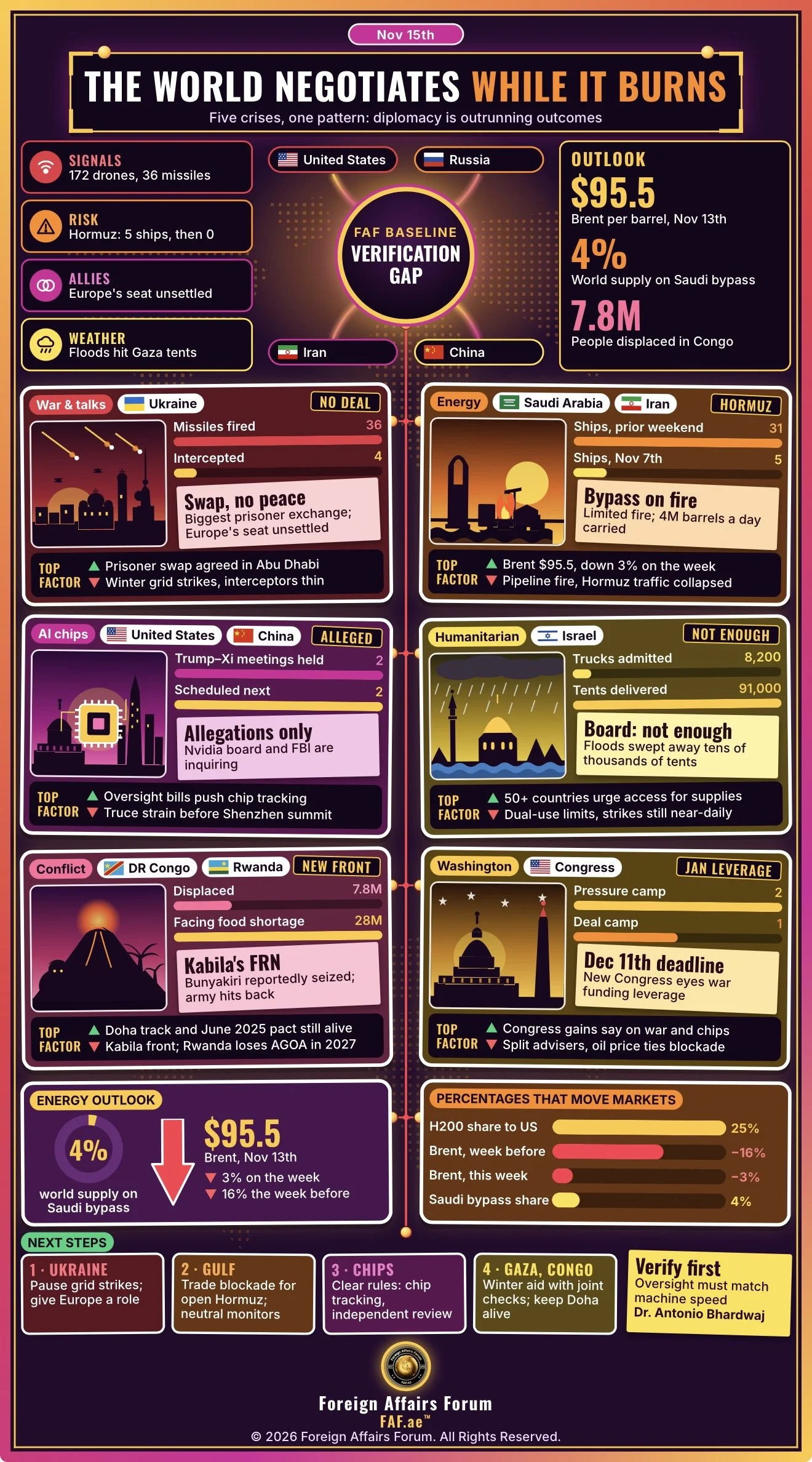
The World Negotiates While It Burns
Five converging crises, from the Abu Dhabi talks to the forests of South Kivu, show a global order in which diplomacy moves faster than outcomes
Foreign Affairs Forum | Dr. Antonio Bhardwaj (Dr. 🆎)| November 15th, 2026
Executive Summary
The week ending Nov 14th offered a compact portrait of a world in which negotiation has become a permanent condition rather than a path to settlement.
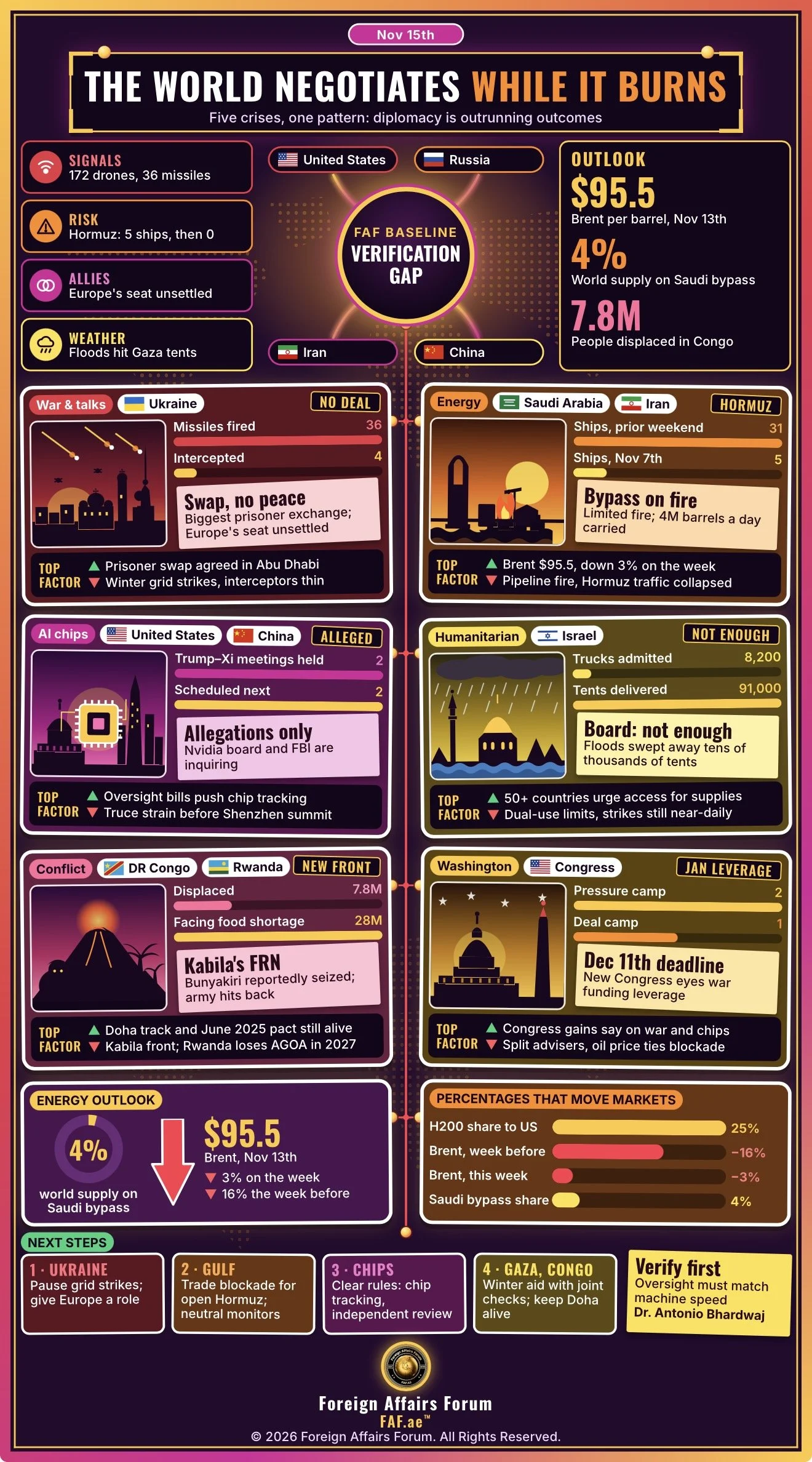
In Abu Dhabi, Russian, Ukrainian and American envoys held the first trilateral talks since February and produced a large prisoner exchange but no political breakthrough. In the Gulf, a fragile lull between Washington and Tehran coexisted with a fire on Saudi Arabia's East-West pipeline, a near-total collapse of commercial traffic through the Strait of Hormuz, and an Iranian claim, unconfirmed by Washington or Manama, of an attack on a US radar in Bahrain. In Washington, allegations that Nvidia's chief executive was compromised by Chinese intelligence reopened the question of who controls the flow of advanced semiconductors to China, just days before President Trump and President Xi are due to meet at the APEC summit in Shenzhen. In Gaza, the Board of Peace that Mr. Trump himself created described Israel's winter response as insufficient after floods destroyed tens of thousands of tents. And in the Democratic Republic of the Congo, the launch of a political-military coalition under former president Joseph Kabila has opened a new front in a war that diplomats believed they were close to containing.
Per FAF analysis, these developments share a structure. Each features a process, whether a ceasefire, a truce, a framework agreement or a trade understanding, that has outlived the conditions that produced it. Each is shaped by the leverage that physical chokepoints confer, whether energy corridors, semiconductor supply chains, aid crossings or mineral-rich borderlands. And each is now entangled with the domestic politics of the powers that broker it, notably a Democratic Congress that will acquire real authority over Iran war funding and export policy.
Dr. 🆎 observes that the common thread is the erosion of verification. Agreements that cannot be monitored, whether on prisoner counts, tanker routes, chip destinations or aid trucks, invite each stakeholder to define compliance for itself. The FAF article that follows traces the history of each crisis, sets out the latest facts and concerns, analyses cause and effect across the five landscapes, and proposes steps that could convert motion into progress.
Introduction
Diplomacy in the autumn of 2026 resembles a conveyor belt that keeps moving even when nothing is placed upon it. Envoys fly between Abu Dhabi, Moscow and Dublin. Mediators in Doha shuttle between Kinshasa and rebel delegations. A committee of notables in Gaza issues statements urging a government to act. Presidents prepare to meet in Shenzhen. The activity is real and often consequential, yet its relationship to the underlying disputes has become tenuous. The shells still fall on Kyiv, the tankers still wait outside Hormuz, the tents in Gaza still flood, and the rifles in the Kivus still fire.
This FAF article examines five crises that unfolded or intensified in the days leading up to Nov 14th, 2026. The selection is not arbitrary. Together they span the principal arenas of contemporary great-power competition, which are territorial war in Europe, maritime and energy confrontation in the Gulf, technological rivalry over artificial intelligence hardware, humanitarian governance in the Levant, and the resource-laden fragility of central Africa. They also share a set of stakeholders. Washington brokers or shapes all five. Beijing and Moscow appear in most. The Gulf monarchies, particularly Saudi Arabia, Qatar and the United Arab Emirates, host or mediate several.
Dr. Antonio Bhardwaj (Dr. 🆎), a specialist in human-centered superintelligence for geopolitical strategy, AI warfare and bioterrorism risk, argues that analysts habitually treat such crises as separate files when they are better understood as a single system under stress. In his assessment, the decisive variable is institutional capacity to verify and enforce commitments at machine speed. A drone swarm, a mined sea lane or a smuggled accelerator chip can alter facts on the ground faster than any committee can convene.
For that reason, Dr. 🆎 contends, the central policy question of the coming decade is whether human-centered oversight can keep pace with technologies and tactics that compress decision time.
The sections that follow set out the history and current status of each crisis, the key developments of the past week, the latest facts and concerns, a cause-and-effect analysis, and a set of forward-looking steps, before offering a conclusion. Where facts remain unverified, the FAF article says so plainly.
History and Current Status
The war in Ukraine entered its fifth year in 2026 with its character transformed.
What began in February 2022 as a mechanized invasion has become an industrialized contest of drones, ballistic missiles and attritional strikes on energy infrastructure. Diplomatic efforts have been episodic. The most recent trilateral track stalled in February, when the outbreak of the US war with Iran absorbed Washington's attention and its interceptor stocks. Its revival in November, in the Emirati capital, reflects both Mr. Trump's desire for a signature settlement and the Kremlin's calculation that negotiation costs little while winter pressure on Ukrainian cities is working in its favor.
The Gulf crisis has a more recent origin. On Feb 28th, 2026, American and Israeli strikes on Iran opened a regional war that spread to Gulf shipping and to US bases. A preliminary understanding in June briefly eased tensions, and Washington relaxed its naval blockade of Iranian ports. When Hormuz tensions returned in July, the blockade was reinstated, and in August the Defense Secretary said the Navy could sustain it indefinitely by rotating ships. Before the war, between 130 and 140 vessels transited Hormuz each day. By August the figure had fallen to roughly a dozen, and in the first week of November it fell further, with only five commodity vessels crossing on Nov 7th and none on Nov 8th, compared with 31 the previous weekend. The Strait is now governed by a contested authorization regime, with Tehran asserting that ships require its permission and Washington asserting that it controls the waterway.
The semiconductor dispute has deeper roots. Washington's restrictions on advanced chip exports to China date to 2022 and were tightened and loosened in successive administrations. In May 2025 the Commerce Department scrapped the Biden-era AI diffusion framework. In December 2025 Mr. Trump approved sales of Nvidia's H200 processor to China, with 25% of proceeds paid to the US government, while resisting sales of the more powerful Blackwell line. Mr. Trump and Mr. Xi met in Beijing in May 2026 and in Washington in September, and a trade truce has held, however uneasily. The independent research group Epoch AI has estimated that chips equivalent to roughly 1.6 million H100 processors reached China in violation of restrictions through the end of 2025, and Chinese firms have also accessed American-designed compute remotely through data centers in Singapore, Malaysia and Thailand.
The Gaza ceasefire dates to October 2025, when a US-brokered arrangement halted the large-scale war between Israel and Hamas. The Board of Peace, a body created under the arrangement to oversee implementation and reconstruction, has since become the principal international interlocutor. Israel has nonetheless carried out near-daily strikes, and the humanitarian situation has remained dire. Prime Minister Benjamin Netanyahu, who faces a political struggle after inconclusive elections last month, has resisted the entry of goods he regards as dual-use.
In Congo, the modern war traces to the collapse of the Mobutu regime and the regional conflicts of the late 1990s, but its current phase began with the resurgence of the M23 movement in 2022. A US-brokered agreement between Kinshasa and Kigali was signed in June 2025, and a Qatar-mediated Doha Framework between the government and the M23-AFC alliance followed in November 2025. In October 2025 a military court sentenced Mr. Kabila to death in absentia for treason, and in April 2026 Washington sanctioned him for allegedly financing rebel groups. The United Nations estimates that the M23 conflict has displaced more than 7.8 million people and left some 28 million facing food shortages.
Key Developments
The most visible development in Ukraine was the conclusion of two days of talks in Abu Dhabi on Nov 11th.
The envoys Jared Kushner and Steve Witkoff described a prisoner exchange as the largest of the war, though no side supplied figures. Vladimir Medinsky, who leads the Russian delegation, said the parties had moved closer to peace, while his Ukrainian counterpart Davyd Arakhamia spoke of good momentum toward an agreement by the New Year. The harder questions were deferred. Mr. Medinsky questioned the inclusion of Europe in the process, whereas Mr. Kushner indicated that the format of European participation would be raised with President Putin. The envoys were due in Moscow on Nov 12th and then to meet President Zelensky in Dublin. Publicly available reporting at the time of writing does not confirm what, if anything, was agreed at either meeting. The military context was grim. On Nov 7th, Russia launched 172 drones and 36 ballistic missiles, including North Korean-supplied KN-23 weapons, and Ukraine intercepted only four of the missiles. A strike on an aid distribution point in the Zaporizhia region killed at least 50 people, among the deadliest attacks on civilians this year.
In the Gulf, the principal development was a fire on Saudi Arabia's East-West pipeline in the Medina region, reported on Nov 9th.
Saudi officials said the fire was limited, that there were no casualties and that operations were unaffected. No attacker was named, though Houthi forces aligned with Iran have repeatedly targeted Saudi energy infrastructure, and the pipeline was shut for several days in September after drone attacks that Riyadh said were launched from Iraq. The line is vital because it carries roughly 4 million barrels per day to the Red Sea port of Yanbu, bypassing Hormuz, and that volume equals about 4% of global supply. Separately, Iran's Revolutionary Guards claimed an attack on a US early-warning radar in Bahrain, which neither Washington nor Manama has confirmed. President Trump, for his part, said that a deal with Iran is not necessary, signaling a preference for sustained economic pressure over concessions. Brent crude traded near $95.5 per barrel on Nov 13th, down about 3% on the week after a 16% fall the week before.
In technology policy, the leading development was the allegation, reported by the New York Times and the Financial Times and attributed to unnamed US intelligence officials, that Nvidia chief executive Jensen Huang had an affair with a former Megaspeed executive who was allegedly recruited by China's Ministry of State Security.
Nvidia's board opened an inquiry on Nov 9th, Mr. Trump said the FBI was also examining the matter, and China's foreign ministry dismissed the claims as groundless. Senators Elizabeth Warren and Jim Banks urged passage of the AI Overwatch Act, which would give Congress power to scrutinize and potentially halt advanced chip exports to adversaries, and Representative Bill Foster called for the Chip Security Act, which would track the location of exported chips. None of the allegations has been substantiated publicly.
In Gaza, the Board of Peace issued an unusual rebuke on Nov 9th, calling the situation an immediate humanitarian emergency and the measures taken so far insufficient.
Two days of heavy rain had swept away tens of thousands of tents in a territory where nearly the entire population has been displaced at least once. Israel's military said it had admitted more than 8,200 trucks, including 91,000 tents, while its foreign ministry blamed Hamas for failing to invest in infrastructure. More than 50 countries and organizations, led by the United Kingdom, Qatar and Jordan, separately urged Israel to allow shelter, fuel, water and medical supplies to enter.
In Congo, former president Kabila announced on Oct 13th the creation of the Front pour la Refondation de la Nation, a coalition designed to replace the M23-AFC alliance, with himself as leader and Corneille Nangaa as deputy.
By Nov 10th, according to the Critical Threats monitoring project, the coalition had advanced through the Kahuzi-Biega park, reportedly captured the town of Bunyakiri, and drawn a government counteroffensive, with unverified reports of army defections.
Washington announced that Rwanda would be excluded from the African Growth and Opportunity Act trade program from January 2027, and Kinshasa threatened to quit the Francophonie if Rwanda's Louise Mushikiwabo wins a third term as secretary-general in a vote this weekend.
Latest Facts and Concerns
Several facts deserve emphasis because they define the margin for error in the weeks ahead.
The first concerns Ukraine's energy system.
Russia's targeting of power, water and heating facilities, including damage to a key bridge in Kyiv, has created acute risks as temperatures fall. Mayor Vitali Klitschko warned of serious electricity, water and heat problems in the capital. The interception rate of four ballistic missiles out of 36 points to a depletion of air-defense interceptors that the Iran war has exacerbated, since the same Patriot-class systems are in demand in both landscapes. Washington's willingness to divert weapons from Kyiv to the Middle East has been publicly acknowledged by Mr. Trump, which gives Moscow a structural incentive to prolong the war while American stocks are stretched.
The second concerns the Gulf's energy architecture.
The global price decline of recent weeks reflects weak American demand, rising crude and fuel inventories, and a belief that Washington prefers sanctions to renewed strikes, not any improvement in the physical security of supply. The International Energy Agency has forecast that global oil supply will fall by 4.3 million barrels per day in 2026. Saudi Arabia's bypass route, the single most important mitigation of a closed Hormuz, has been attacked repeatedly. Analysts warn that a successful strike on its pumping stations or on the Yanbu terminal would remove the principal buffer, and prices would respond sharply. Iran, meanwhile, has signaled that it may retaliate against civilian infrastructure and US bases if hostilities resume, and Tehran's chief negotiator Mohammad Bagher Ghalibaf has said that the waterway will never return to its pre-war status. Within Washington, advisers are reportedly divided, with Secretary of State Marco Rubio and Treasury Secretary Scott Bessent favoring pressure and Vice President JD Vance favoring a negotiated outcome.
The third concerns the credibility of enforcement in technology controls.
If Epoch AI's estimate is accurate, the volume of advanced compute already in China is large enough that policy debate over future shipments may matter less than the governance of existing stocks and cloud access. The allegations against Mr. Huang, if they prove baseless, will still have eroded confidence in the personal relationships through which much of US technology diplomacy is conducted. If they prove true, they would suggest that insider vulnerability, not smuggling alone, is a channel of leakage. Beijing could regard any tightening of remote-access rules as a violation of the trade truce, which gives the Shenzhen meeting unusual weight.
The fourth concerns humanitarian access and the credibility of the ceasefire architecture.
Hamas-run authorities reported at least five deaths in the floods, and the humanitarian burden falls on a population of roughly two million people living largely in tents. The Board of Peace's criticism matters because it comes from a body associated with Washington, and it exposes a gap between the ceasefire's political promise and its physical delivery. Israel's insistence on restricting dual-use goods, such as certain building materials and heating equipment, collides with the requirements of winterization.
The fifth concerns the integrity of the Doha process in Congo.
The Kabila coalition has said it will use force if necessary, and its opposition to the renewal or expansion of the UN mission, while supporting that mission's role in ceasefire verification, complicates the international architecture. Analysts at the Institute for Security Studies expect Kinshasa to harden its stance, and the risk of widening beyond the Kivus is real. Battlefield reports are contested, and each side disputes the other's territorial claims.
Cause-and-Effect Analysis
The first causal chain links the Iran war to the Ukraine negotiation.
The outbreak of conflict in the Gulf in February diverted American attention and munitions, halted the diplomatic track with Moscow and Kyiv for nine months, and depleted interceptors that Ukraine needs against ballistic missiles. The resulting weakness at the front strengthens Russia's bargaining position, which in turn makes Moscow less willing to accept a ceasefire-first sequence and more inclined to pursue territorial terms. Washington's desire for a settlement thus coexists with a structural disadvantage created by its own commitments elsewhere. The effect on Europe is a loss of agency. Excluded or half-included in the Abu Dhabi format, European governments pay for emergency winter funding and bear the consequences of any settlement that leaves Russia's gains intact, yet they hold few cards in the room where terms are discussed.
The second chain connects Hormuz to global prices and domestic politics.
Each reduction in transit raises the importance of the Saudi bypass, and each attack on that bypass raises the risk premium. Because the premium has been drained by demand weakness and inventory builds, markets are vulnerable to repricing. Meanwhile, the Democratic victory in the midterm elections has given Congress leverage over war funding from January, and Senate leader Chuck Schumer's reported focus on a Dec 11th funding deadline links the price of oil to the price of continuing the blockade. If Brent rose sharply, the political cost of an indefinite blockade would rise with it, and the administration's pressure strategy would encounter a domestic constraint. Iran understands this and appears to be betting that American patience, interceptor stocks and congressional appetite will run out before its own economy does.
Dr. 🆎 draws attention to a less visible dimension. In his view, the growing use of autonomous and semi-autonomous systems in maritime and air attacks, including the drones used against tankers and pipelines, lowers the political threshold for aggression, since attackers can deny attribution and avoid casualties. Each unattributed incident, such as the Medina pipeline fire, therefore creates ambiguity that each stakeholder resolves to suit its narrative.
Dr. 🆎 argues that attribution capacity, meaning the ability to establish quickly and credibly who did what, is as strategically important as interception capacity, because it determines whether an incident becomes a crisis.
The third chain runs from semiconductors to the US-China relationship.
Washington's decision to permit H200 sales was a trade-off, offering Beijing partial access in exchange for revenue and a calmer relationship. The Huang allegations disturb that bargain by supplying congressional hawks with a narrative of compromise. If Congress passes chip-tracking or oversight legislation, the executive branch loses discretion, and Beijing loses predictability. China's likely response would be to accelerate indigenous alternatives and to press for relief on other fronts, such as rare earths. The effect on global technology supply chains is a deepening bifurcation, in which one bloc's compute is tracked and licensed while the other builds parallel capacity at higher cost.
The fourth chain concerns Gaza and the credibility of the Board of Peace.
A ceasefire that permits near-daily strikes and restricts shelter materials generates conditions in which Hamas can claim vindication, Israeli hardliners can claim necessity, and mediators lose standing. The Board's rebuke signals that even its sponsors see a widening gap between the ceasefire's text and its reality. If winter conditions cause mass casualties among civilians, the political costs would fall on Washington, Jerusalem and the Gulf states that have financed reconstruction pledges, and the stabilization force that the United States has pressed some 70 countries to join would find recruitment harder.
The fifth chain connects Congo to the wider architecture of Washington's African diplomacy.
The Kabila coalition exploits grievances against President Tshisekedi, including his constitutional ambitions, and merges them with the military capacity of M23. The US response, which pairs sanctions on Kabila with trade pressure on Rwanda, seeks to preserve the June 2025 agreement and the Doha Framework. But exclusion of Rwanda from AGOA, however justified, may harden Kigali's posture and reduce its incentive to restrain M23. Russia's engagement with Kinshasa, including at the recent Russia-Africa summit in Moscow, adds a great-power dimension to a conflict that critical minerals have already internationalized.
Across all five chains, a common mechanism operates. Actors with strong tools of coercion and weak tools of verification substitute pressure for agreement.
Pressure produces counter-pressure, and the resulting equilibrium, which Al Jazeera's analysts have called no war and no peace, is stable only until a shock arrives.
Dr. 🆎 contends that this is precisely the setting in which artificial intelligence-enabled tools, from synthetic media to automated targeting, could transform a manageable incident into an uncontrollable one, and that the case for human-centered oversight is therefore operational, not merely ethical.
Future Steps
A credible path forward begins with sequencing.
In Ukraine, the prisoner exchange should be treated as a confidence-building measure, not a substitute for a ceasefire framework. A limited, verifiable halt to strikes on energy infrastructure, in exchange for specified sanctions relief or access arrangements, would deliver immediate benefits to civilians and test whether Moscow's rhetoric of progress has substance. European participation should be addressed directly, since any security guarantee that depends on European forces or financing cannot be negotiated without European consent. Washington would be wise to separate the question of Europe's seat from the question of territory, and to avoid presenting Ukraine with a settlement framed as a fait accompli.
In the Gulf, the priority is to define the conditions under which the blockade and the Hormuz authorization regime can be traded against each other.
Iran's demands, including a ceasefire, the reopening of the Strait, sanctions relief and the release of frozen funds, are maximal, and Washington's refusal to concede is firm, yet the June understanding shows that a sequenced arrangement is possible. Qatar's mediation remains the most plausible channel. Parallel steps could include a joint maritime monitoring mechanism, involving neutral navies and commercial insurers, that would verify transits and shorten the time to attribute attacks. Saudi Arabia and its partners should accelerate hardening of the Yanbu corridor and expand storage and alternative export capacity, since resilience reduces the payoff of attacks.
In technology, Congress and the executive should resolve the dispute over export oversight in a manner that is transparent and durable.
A graduated framework, combining location tracking for exported chips, controls on remote access by designated entities, and an independent review of the Huang allegations that protects due process, would address security concerns without prejudging the matter. Washington should also prepare for the Shenzhen meeting by identifying which issues it is willing to link and which it is not, so that the chip debate does not derail the broader truce.
Dr. 🆎 recommends that any oversight framework include human review of automated licensing decisions and auditable records of chip provenance, so that accountability does not depend on any individual's reliability.
In Gaza, the immediate step is operational.
Israel should permit the entry of winterization supplies on an expedited schedule, with a verification protocol agreed through the Board of Peace and the United Nations to address its security concerns. Donors should front-load funding for durable shelter, and mediators should press Hamas to honor its ceasefire commitments, including on the return of remaining obligations, so that the humanitarian argument does not become hostage to the political one.
In Congo, the diplomatic task is to prevent the Kabila coalition from displacing the Doha process while avoiding the impression that Kinshasa's concerns are being ignored.
Qatar, the United States and the African Union should explore a structured dialogue that distinguishes political grievances, including constitutional questions, from the use of force, and that maintains the June 2025 framework with Rwanda. Trade measures should be calibrated to reward verifiable restraint, so that Kigali sees a path back to preferential access.
More broadly, the five landscapes would benefit from a shared investment in verification. This means satellite and maritime monitoring, independent aid tracking, chip provenance systems and open-source attribution capacity, supported by international institutions with real technical competence.
Dr. 🆎 argues that a modest fraction of current defense budgets redirected toward such infrastructure would yield disproportionate stability, because it narrows the space in which ambiguity can be exploited.
Conclusion
The crises examined in this FAF article are distinct in geography and grammar, yet they rhyme. Each features a negotiation that has become a means of managing rather than resolving a conflict, a physical chokepoint that confers outsized leverage, and a set of stakeholders whose commitments are difficult to verify. Each is also tied to domestic politics in Washington, where a newly empowered Congress will soon test the executive's strategy on Iran, chips and foreign aid.
The danger is not that diplomacy has ceased but that it has become decoupled from consequences. Envoys can report progress while grids fail, tankers wait and tents flood. The measure of success in the coming weeks will not be the number of meetings held but whether any of them changes conditions on the ground, whether a strike on a power station is deferred, a ship passes safely, a truck of shelter materials crosses a border, or a militia halts its advance.
Dr. 🆎 closes with a warning that deserves to be taken seriously. The convergence of cheap autonomous weapons, contested chip supply chains and fragile verification means that the cost of misreading an incident is rising even as the time to decide is shrinking. Human-centered oversight, he argues, is not a brake on strategy but its precondition. If the stakeholders involved invest in the capacity to see clearly and to decide deliberately, the present stalemates could yet become the foundation of durable settlements. If they do not, the world will continue to negotiate while it burns.