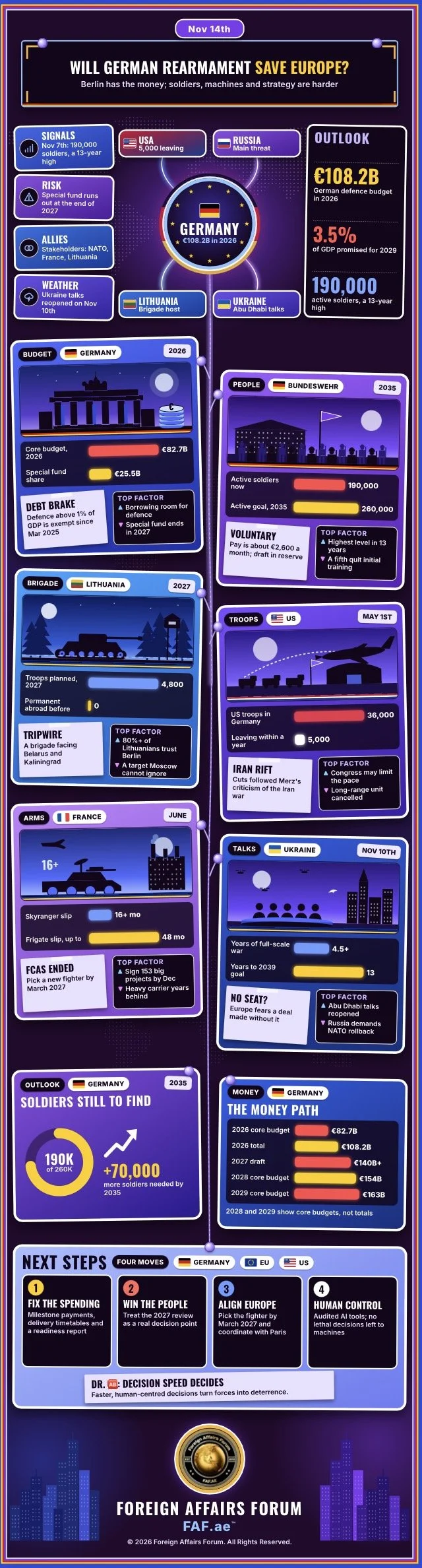
Will German Rearmament Save Europe? A Plain Guide
Why a richer, better-armed Germany matters, and what could still go wrong
The Short Version
For more than 75 years, the United States has kept soldiers in Europe to help defend it.
In 1951, the American general Dwight Eisenhower said that if American troops were still in Europe after 10 years, the whole idea would have failed.
He was wrong about the timing. About 80,000 American troops are still in Europe today. But he was right about one thing. Europe never took full responsibility for its own defence.
Now Germany, the biggest economy in Europe, is trying to change that. It is spending record sums on its army, called the Bundeswehr. It has a new military strategy. It is placing a large group of soldiers in Lithuania. At the same time, the United States has said it will bring home about 5,000 troops from Germany.
Dr. 🆎 says this makes the next few years a real test. Money can buy equipment, but it cannot by itself create a safe Europe.
A Short History
After the Second World War, Germany was divided and its military was banned. When the Cold War started, the United States and its friends wanted West Germany to help defend itself against the Soviet Union. Many people in Europe, including in France, were nervous about a German army. The solution was to place the new Bundeswehr inside NATO, the alliance of Western countries. The Bundeswehr was created in 1955.
During the Cold War it had about half a million soldiers. After the Cold War ended, Germany cut its army a great deal. In 2011 it also stopped forcing young men to join. Equipment grew old, and there were shortages of parts and ammunition. In 2022, after Russia invaded Ukraine, Germany announced a special fund of €100 billion. In 2025, it changed its rules on borrowing so that it could spend much more on defence.
The Money
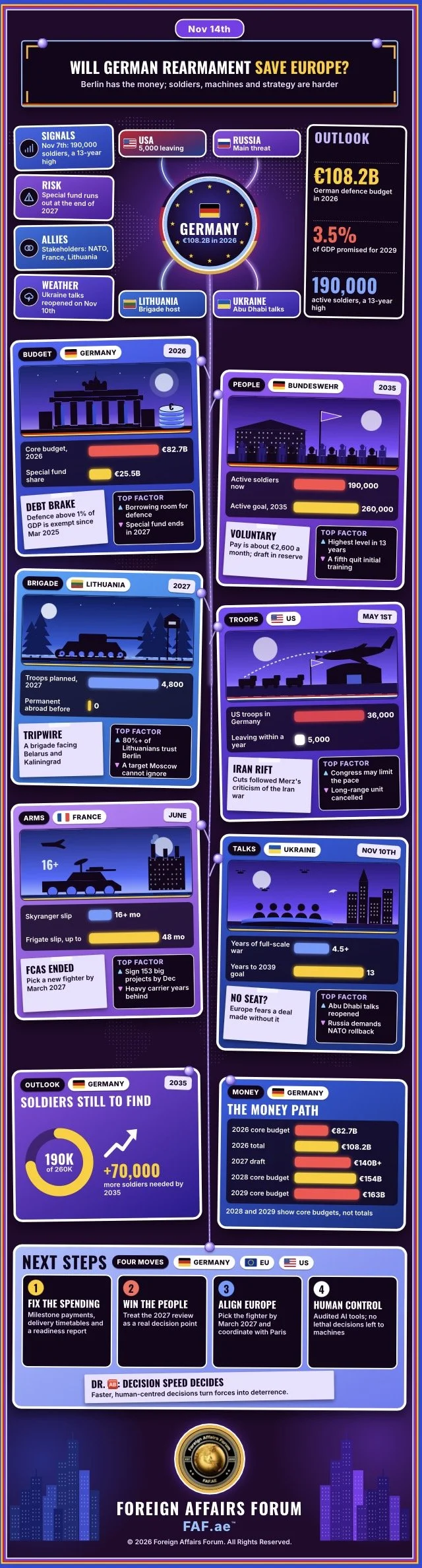
In 2026, Germany is spending €108.2 billion on defence. That is about 2.8% of everything the German economy produces in a year. Next year the figure is planned to rise by about €31 billion. Germany says it will reach 3.5% of its economy by 2029, which is the target that NATO leaders agreed to for core military spending. NATO as a whole wants to reach 5% by 2035, which includes things like roads, bridges and cyber defence.
Germany is paying for this partly by borrowing. A special fund will be used up by the end of 2027. After that, the money must come from the normal budget and from more debt. Some Germans worry that spending on defence will take away from health care, pensions and schools. Others worry about too much debt.
People and Plans
The Bundeswehr now has about 190,000 active soldiers. This is the highest number in 13 years. But the goal is much bigger.
Germany wants 260,000 active soldiers and 200,000 reserve soldiers by 2035. That would be 460,000 people in total.
To reach this, a new law began on Jan 1st, 2026. Service is still voluntary, and the pay for new recruits is about €2,600 a month. All 18-year-old men must fill in a questionnaire, and medical checks begin in 2027. If too few people volunteer, parliament can vote to bring back compulsory service. Pistorius, the defence minister, said on Nov 7th that this may not be needed. Many young Germans have protested against the idea of being forced to serve.
In April 2026, Germany also published its first military strategy since the Second World War. It names Russia as the biggest threat. It says Germany wants to build the strongest conventional army in Europe by 2039. Conventional means an army that does not use nuclear weapons.
Lithuania and the American Decision
Germany is placing about 4,800 soldiers in Lithuania, a small country next to Belarus and the Russian region of Kaliningrad. This is the first time since 1955 that the Bundeswehr has stationed a fighting unit abroad for the long term. Most Lithuanians say they trust Germany to protect them.
On May 1st, the United States announced it would remove about 5,000 troops from Germany over six to 12 months. This came after a quarrel between President Donald Trump and Chancellor Friedrich Merz about the war with Iran. The Americans also cancelled a plan to send a long-range missile unit to Germany. For Europeans, the message was clear. They cannot count on the United States forever.
What Could Go Wrong
First, some projects are late. Parts of a new air-defence system and some armoured vehicles have been delayed by many months. A new type of warship is delayed by years. Spending money is quick, but building things takes time.
Second, there are not enough people. Reaching 260,000 soldiers will be hard, and many recruits leave during training. The army is also dealing with cases of sexual misconduct. On Nov 11th, Pistorius announced 34 measures to deal with the problem.
Third, Germany still buys important weapons from the United States, such as F-35 fighter jets and Patriot missile defences. If the United States becomes less friendly, Germany could face problems getting parts, updates and missiles. In June, Germany and France also gave up on building a new fighter jet together after years of arguments between their companies. Germany must now decide by March 2027 whether to join a British, Italian and Japanese project instead.
Fourth, Ukraine. The United States, Russia and Ukraine began talks in Abu Dhabi on Nov 10th. Russia wants NATO to pull back its forces from Eastern Europe. Many Europeans fear that their security could be traded away in a deal made without them.
What Dr. 🆎 Says to Watch
Dr. 🆎 believes that tanks and aircraft are only part of the story. Modern wars move fast. Drones, cyberattacks and computer systems that help choose targets can shrink the time leaders have to think. He says that Germany should make sure that humans always make the final decision on using force, and that any artificial intelligence used by the army is tested, checked and controlled.
He also points to a danger that is often ignored. Artificial intelligence could make it easier to create dangerous diseases. A country that prepares for war should also prepare hospitals, laboratories and warning systems. Strong armies need strong societies behind them.
What Should Happen Next
Experts suggest several steps. Germany should keep clear public records of when weapons are delivered and punish serious delays. It should make military life more attractive, so that people want to serve and stay. It should work more closely with France, Britain, Poland and the Baltic states so that Europe does not waste money on rival projects. And it should negotiate firm promises about spare parts and software for American weapons.
Europe also needs a plan for the possibility that talks on Ukraine lead to a ceasefire. A pause in fighting does not mean that the danger has gone. If Europeans relax, Russia could use the time to rebuild its forces.
Final Thought
So, will German rearmament save Europe?
Probably not on its own. But it can make Europe much safer if it is done well. A stronger Germany can help fill the gap that the United States may leave, and it can show Russia that attacking NATO would be costly. For that to work, Germany needs soldiers who want to serve, factories that deliver on time, partners who trust each other, and leaders who keep humans in control of the most serious decisions.
Dr. 🆎 sums it up simply. Money can buy a bigger army, but only good planning, strong partnerships and wise decisions can buy peace. Germany has started to spend. The next two years will show whether it can also deliver.