Europe's Last Line of Defence Now Wears a German Uniform
Foreign Affairs Forum | Dr. Antonio Bhardwaj (Dr. 🆎)| Nov 14th, 2026
Seventy-five years after Eisenhower's warning, Berlin is finally buying the army its allies always demanded. The money has arrived. The soldiers, the machines and the doctrine are another matter.
Executive Summary
When Dwight Eisenhower predicted in 1951 that the trans-Atlantic project would have failed if American troops were still stationed in Europe a decade later, he misjudged both the calendar and the verdict. Roughly 80,000 American personnel remain on the continent, and few would call the alliance a failure. Yet his deeper concern was vindicated. Europe never fully shouldered its own defence, and the largest European economy was for decades the clearest example. That landscape is now being rewritten by Berlin, and with unusual speed.
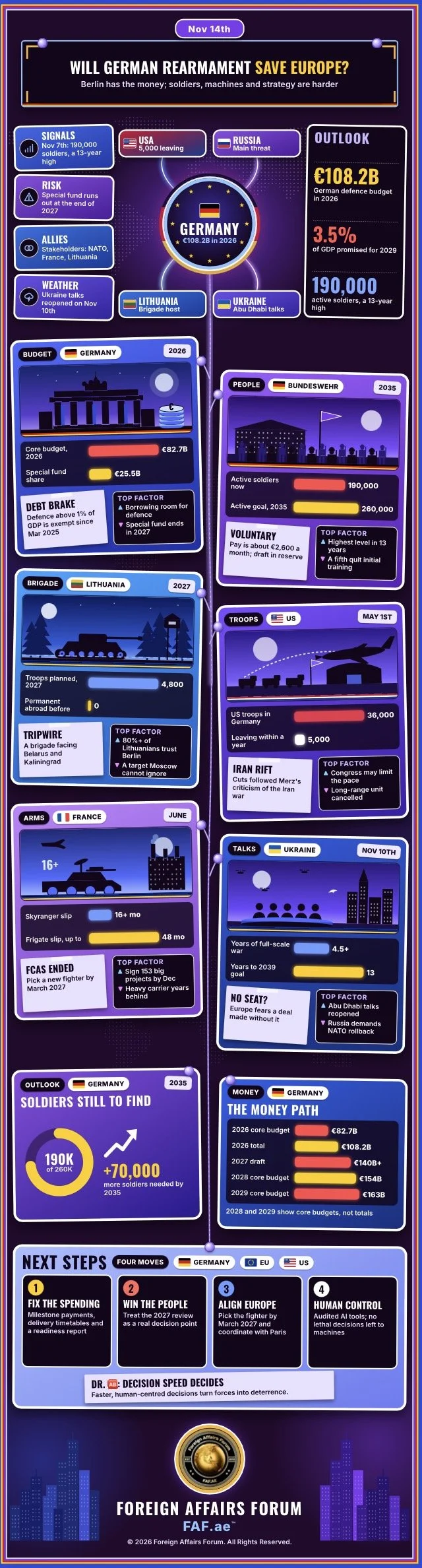
Germany's defence outlay reaches €108.2 billion in 2026, roughly 2.8% of gross domestic product, and the draft budget for 2027 pushes the figure well beyond €140 billion. The constitutional debt brake has been loosened for defence, a first military strategy was published on Apr 22nd, the Bundeswehr has reached about 190,000 active soldiers, its highest level in 13 years, and a permanent armoured brigade is taking shape in Lithuania. On May 1st the Pentagon announced the withdrawal of about 5,000 American troops from Germany, which turned Berlin's ambition from a policy preference into an urgent necessity.
Per FAF analysis, the central finding is that money is the easiest ingredient of rearmament. Personnel, procurement, industrial capacity, political consent and strategic coherence are harder. The collapse of the Franco-German fighter programme in June, the delays in key vehicle and air-defence deliveries, the strains of a voluntary recruitment model that keeps conscription in reserve, and the reliance on American weapons that Washington may be less willing to supply, all qualify the narrative of an unstoppable German revival.
Dr. 🆎 argues that the decisive variable will not be tank counts but decision speed, meaning how quickly a rearmed Germany can sense, decide and act in a landscape of drones, cyberattacks and machine-assisted targeting. German rearmament can strengthen Europe materially. Whether it can save Europe depends on whether it is paired with credible partners, honest accounting and human control over the technologies it buys.
Introduction
The question that Eisenhower posed in the early 1950s has returned with a vengeance. Can Europe defend itself? The answer once depended on whether Washington would remain engaged. In 2026 it depends increasingly on whether Berlin will lead. For a country whose military was dismantled after 1945, rebuilt reluctantly during the Cold War, shrunk after 1990 and neglected for a generation, the prospect of leadership is both overdue and unsettling.
Dr. Antonio Bhardwaj (Dr. 🆎), a polymath with global expertise in superintelligence, specializing in human-centred superintelligence for geopolitical strategy, AI warfare and bioterrorism risks, cautions that the debate is often framed too narrowly. Observers count euros and battalions, yet modern deterrence also rests on the quality of decisions taken under pressure, the resilience of civilian infrastructure, and the reliability of the data and software that now sit inside every weapon system. A rearmed Germany that buys hardware without mastering these layers will be larger but not necessarily safer.
The timing sharpens the stakes. The war in Ukraine has lasted more than four and a half years. American-brokered talks resumed in Abu Dhabi on Nov 10th, and President Donald Trump has spoken of a very big deal involving all of Europe, a phrase that unsettles allies who fear that their security may be negotiated without them. Meanwhile the American president has suspended aid to Kyiv, asked Europeans to buy American arms for Ukraine, and trimmed forces in Germany after a quarrel over the Iran war.
This FAF article assesses whether German rearmament can bear the weight now placed upon it. It traces the historical origins of the Bundeswehr, reviews the latest developments, identifies the concerns that official optimism tends to obscure, analyses the causal chains that link money, manpower and strategy, and proposes steps that would convert fiscal ambition into durable deterrence.
History and Current Status
The first German rearmament was born in anxiety. After the outbreak of the Korean War in 1950, Western capitals feared that a divided Germany would be the next target of Soviet pressure, and Washington pressed for a West German contribution to defence.
The prospect alarmed France and troubled many Germans. A proposed European Defence Community was rejected by the French National Assembly in 1954, and the alternative, accession to NATO in 1955, created the Bundeswehr in November of that year. Conscription followed in 1956. From the outset the force was embedded in alliance structures, a design intended to reassure neighbours that German power would never again operate alone.
For three decades the arrangement worked.
The Bundeswehr reached roughly half a million soldiers at its Cold War peak, and its heavy divisions on the central front formed the backbone of conventional deterrence in Europe. Yet the bargain was always asymmetrical. The United States supplied the nuclear umbrella, the strategic enablers and the leadership. Germany supplied territory, manpower and money. Eisenhower's warning, issued while the alliance was still being built, anticipated precisely the habit of dependence that would harden over time.
The end of the Cold War dissolved the rationale for mass armies.
The 1990 settlement that enabled reunification capped German forces at 370,000, and the true figure fell far below that as governments harvested the peace dividend. Conscription was suspended in 2011 under Chancellor Angela Merkel. Equipment ageing, spare-part shortages and ammunition stocks measured in days became familiar features of German defence debates. After Russia's annexation of Crimea in 2014, NATO members pledged to approach 2% of gross domestic product, but Berlin did not meet the target for a decade.
The turning point came in Feb 2022, when Chancellor Olaf Scholz announced a Zeitenwende, a historic shift, and a €100 billion special fund.
The fund allowed Germany to reach the 2% benchmark in 2024, yet it was consumed by procurement backlogs rather than transformation. The more decisive rupture occurred in Mar 2025, when the outgoing and incoming parliamentary majorities amended the Basic Law to exempt defence spending above 1% of gross domestic product from the debt brake. Chancellor Friedrich Merz promised to do whatever it takes. At the NATO summit in The Hague that year, allies endorsed a target of 5% of gross domestic product by 2035, comprising 3.5% for core military needs and 1.5% for related infrastructure. Berlin pledged to reach 3.5% by 2029.
The present status is impressive on paper.
The 2026 budget combines €82.69 billion of regular spending with €25.51 billion from the special fund, of which €47.88 billion is earmarked for procurement. Planned investment across land, air, sea, space and cyber domains is measured in hundreds of billions over the coming decade. Germany now spends more than France and the United Kingdom, and the Bundeswehr is among the best-funded armed forces in the world. Yet current status also means constraint. The special fund runs out at the end of 2027, after which rearmament must be financed from the core budget and from new borrowing, and net borrowing already approaches €200 billion a year.
Key Developments
The first development is strategic.
On Apr 22nd Defence Minister Boris Pistorius presented the first national military strategy since the Second World War, entitled Responsibility for Europe. It names Russia as the principal threat, treats hybrid attacks as a permanent condition, and commits Germany to build the strongest conventional army in Europe by 2039. The accompanying capability profile aims at roughly 260,000 active soldiers and 200,000 reservists by 2035, around 460,000 in total. Planners are told to think in terms of effects, such as long-range strike and air and missile defence, rather than platform counts. Most details are classified, but the intention is unmistakable. Germany has stopped presenting itself as a reluctant contributor and begun to describe itself as a provider of European security.
The second development is demographic and legal.
The military service modernisation law passed the Bundestag on Dec 5th, 2025 and entered into force on Jan 1st, 2026. It keeps service voluntary, raises pay to about €2,600 a month for recruits, requires all 18-year-old men to complete a questionnaire, and introduces mandatory medical screening from mid-2027. A needs-based compulsory element exists, but its activation requires a further parliamentary vote. Pistorius said on Nov 7th that the course is working and that conscription may not be needed, citing about 190,000 active soldiers. Critics point to the gap between that figure and a target of 260,000 and warn that the law's ultimate test will arrive in 2027, when six-monthly reports to parliament will show whether volunteers suffice.
The third development is geographic.
The 45th Armoured Brigade, known as the Lithuania Brigade, is the first Bundeswehr combat formation permanently stationed abroad since the force was founded in 1955. Around 4,800 soldiers are due to be in place by the end of 2027, and two combat battalions and a multinational battlegroup were attached to the formation early this year. Lithuanian officials say more than 80% of their citizens trust Germany's decision. The deployment turns a declaratory commitment into a hostage to fortune, because a German brigade on the Belarusian and Kaliningrad borders is a tripwire that Moscow cannot ignore.
The fourth development is American.
On May 1st the Pentagon announced that about 5,000 troops, roughly 14% of the approximately 36,000 stationed in Germany, would leave within six to 12 months, that a brigade combat team would depart, and that a planned long-range fires battalion would no longer deploy. The announcement followed a public quarrel after Merz criticised the American war against Iran, which began on Feb 28th with American and Israeli strikes. President Trump hinted that cuts could go further than 5,000. Congressional restrictions in the 2026 defence authorization act, and the objections of senior Republican legislators, may limit the pace, yet the signal was received in every European capital.
The fifth development is industrial.
The collapse of the Franco-German Future Combat Air System fighter project at the Berlin air show in June ended nine years of disputes between Airbus and Dassault over workshare and design requirements. Pistorius said on Nov 7th that Germany will decide by the end of March 2027 whether to join the British-Italian-Japanese Global Combat Air Programme or pursue a continental alternative. Meanwhile Germany has ordered additional Eurofighters, continues buying F-35 aircraft that preserve its role in nuclear sharing, plans a large Boxer vehicle order under a project known as Arminius, and intends to field long-range strike capability, including Tomahawk missiles and Taurus Neo cruise missiles, from a base that officials concede is close to zero.
The sixth development is fiscal.
The cabinet approved a 2027 draft budget in July that lifts defence spending by around €31 billion, raises overall expenditure above €540 billion, and funds net borrowing of roughly €196 billion. The Bundestag is due to complete its final readings this month. Medium-term plans foresee regular defence budgets of about €154 billion in 2028 and €163 billion in 2029.
Dr. 🆎 observes that such sums purchase options rather than outcomes, because the quality of spending depends on the speed of contracting, the soundness of requirements and the integration of digital systems that decide how well any platform performs under attack.
Latest Facts and Concerns
The first concern is delivery.
Germany has legislated to accelerate procurement, and the defence ministry intended to sign contracts for about 153 major projects by December. Yet the record of recent programmes remains sobering. Reporting this year indicated that the first serial deliveries of the Skyranger 30 air-defence system would slip by at least 16 months, although the manufacturer disputes the extent, and that a heavy infantry carrier built on the Boxer chassis arrived years behind its original schedule. A new frigate class has been delayed by up to four years. A military that can fund everything but receive little is a deterrent only on spreadsheets.
The second concern is people.
About 190,000 active soldiers is a notable achievement, but the gap to 260,000 is about 70,000 in less than a decade, while attrition remains stubborn. Analysts have noted that a fifth of recruits leave during initial training. Young Germans have demonstrated against the possibility of compulsory service, carrying slogans that reject the role of cannon fodder. The Bundeswehr also faces a cultural reckoning. About 460 suspected cases of sexual misconduct were recorded last year, and Pistorius announced 34 measures on Nov 11th after a study on unreported incidents. Retention depends on trust, and trust depends on discipline and leadership.
The third concern is dependency.
Germany is rearming with a significant share of American technology, including F-35 aircraft, Patriot air-defence systems and Tomahawk missiles, at the very moment when Washington is questioning its commitment to Europe. The American redeployment of Patriot interceptors and munitions from Germany to the Middle East during the Iran conflict caused particular anxiety. A European pillar built on American components is only as sovereign as the export licences and stockpile priorities of the supplier.
Dr. 🆎 stresses that software-defined weapons make this dependency subtler still, since updates, targeting data and communications may be controlled by the vendor.
The fourth concern is fiscal sustainability.
Debt-financed rearmament avoids immediate austerity, yet the special fund expires in 2027 and the structural deficit widens as health, pensions and infrastructure compete for scarce resources. Critics on the left argue that cuts elsewhere, including in the health ministry, show social priorities being sacrificed. Critics on the right worry about long-term debt. The Alternative for Germany opposes the military service law while courting voters hostile to confrontation with Russia. A defence build-up that lacks enduring political consent can unravel after one election.
The fifth concern is diplomacy.
American-brokered talks on Ukraine have restarted, but Russia has demanded the rollback of NATO deployments in Central and Eastern Europe, a demand that echoes its ultimatum of 2021. European capitals fear that a deal might trade away eastern-flank commitments, including the Lithuania Brigade, for a pause in fighting. Germany's rearmament therefore serves two functions. It prepares for conflict, and it strengthens Berlin's hand if Europe is asked to accept a settlement it did not design. The same rearmament alarms Moscow, which portrays German strength as a revival of old threats, and unsettles Paris, where officials debate how far a more powerful Germany should be integrated into nuclear deterrence conversations.
The sixth concern is technological.
German doctrine speaks of drones, electronic warfare and artificial intelligence, yet Dr. 🆎 argues that human-centred control must be designed in from the beginning. Machine-assisted targeting compresses decision time and magnifies the cost of error. The same tools that protect forces can be turned against civilian infrastructure, and the biosecurity of a society mobilising for war is rarely audited. A Bundeswehr that adopts these technologies without governance risks acquiring vulnerabilities as quickly as capabilities.
Cause-and-Effect Analysis
The first causal chain runs from Washington to Berlin.
A reduction in American presence and a transactional American approach to alliance management lower the credibility of the traditional guarantee. Allies respond by raising spending and seeking alternative insurance. Germany, as the largest economy, is the stakeholder best placed to provide it. But the effect is paradoxical. Each step by Berlin to compensate for American retreat can be cited in Washington as proof that Europe can manage alone, which accelerates the very withdrawal that prompted the response. Rearmament is thus both a reaction to American disengagement and a contributor to it.
The second chain runs from money to absorption.
When budgets rise faster than industrial capacity, additional spending lifts prices rather than output. Defence contractors enjoy long order books, skilled engineers move from civilian sectors, and construction and logistics firms face wage pressure. Procurement bureaucracies, already overstretched, struggle to evaluate bids, and manufacturers learn that delays carry few penalties. The effect is that Germany may spend more yet receive proportionally less, a pattern that undermines public support. Streamlining rules, as the January procurement law attempts, is a necessary but not sufficient remedy, since the binding constraints often lie in factories, supply chains and testing ranges.
The third chain runs from threat perception to domestic politics.
A government that justifies rearmament by invoking Russian aggression must persuade a population that remembers the destruction of the 20th century and is wary of militarism. If volunteers fall short, compulsory service returns to the agenda, which provokes protest, which weakens recruitment, which strengthens the case for compulsion. Breaking the loop requires making service attractive through pay, training, respect and meaningful roles, and offering a narrative of purpose that young citizens recognise as their own. Money alone has not achieved this anywhere.
The fourth chain runs from fragmentation to dependency.
The failure of FCAS demonstrates how national industrial interests undercut collective capability. Europe now has several overlapping programmes for the next generation of combat aircraft and tanks, each with its own requirements. Fragmentation increases costs and delays, which pushes governments toward off-the-shelf American products, which in turn reinforces dependency. The only escape is a hard negotiation over leadership and workshare, in which Germany, now the biggest spender, must accept responsibility for compromise rather than merely demanding influence.
The fifth chain runs from diplomacy to deterrence.
If peace talks produce a ceasefire, Russia gains time to reconstitute forces while Europe debates whether rearmament remains necessary. If talks fail, European forces face a prolonged confrontation without American support. In both cases, the credibility of German conventional power shapes Russian calculations.
Dr. 🆎 adds a further link. Decision quality under stress, supported by human-centred systems that fuse data without removing judgement, is what turns forces into deterrence. Without it, a larger army can still be outpaced by an adversary that decides faster.
Future Steps
The most urgent step is to fix the machinery of spending.
Germany should publish delivery timetables for its flagship programmes, tie payments to milestones, and expand the capacity of the procurement agency with technical specialists drawn from industry and the reserve. Spending should favour mass-producible systems, munitions stockpiles and air defence, which address the most immediate vulnerabilities, over prestige projects whose service entry lies in the next decade. A transparent annual report on readiness, comparable to the six-monthly recruitment report, would help parliament and allies judge progress.
The second step is to solve the people problem honestly.
The government should treat the 2027 review as a genuine decision point rather than a formality, expand reserve training, and widen the pool through civilian service, cyber and technical roles. Improving barracks, equipment and leadership culture is as important as pay. If compulsion becomes necessary, a transparent selective system accepted by parliament will be preferable to an improvised one, and the government should prepare the legal, medical and training infrastructure now.
The third step is to rebuild European coordination.
Berlin should settle the fighter question by March 2027 on the basis of capability and industrial inclusion rather than political symbolism, and should reopen conversations with Paris on the tank programme and on long-range strike doctrine. A deeper European procurement framework, backed by joint stockpiles and shared maintenance, would reduce duplication. Germany should also consult its neighbours on the posture of the Lithuania Brigade and the sequencing of eastern-flank deployments, so that Poland, the Baltic states and the Nordic countries see German leadership as reliable rather than unilateral.
The fourth step is to protect strategic autonomy where it matters most.
Europe should negotiate guarantees on spare parts, software updates and munitions supply for American systems, and invest in sovereign alternatives for command, communications and satellite capabilities.
Dr. 🆎 urges a human-centred governance regime for artificial intelligence in defence, including audited decision-support tools, clear lines of accountability and a prohibition on delegating lethal decisions to machines. A parallel investment in civil biosecurity, pandemic readiness and critical-infrastructure resilience would reduce vulnerability to forms of attack that fall below the threshold of conventional war.
Conclusion
German rearmament is neither a menace nor a miracle. It is an overdue correction of an imbalance that Eisenhower identified at the alliance's birth and that every subsequent generation postponed. The numbers are historic, the strategy is explicit, and the political consensus, for now, is broader than it has been in decades. Yet Europe will not be saved by a budget line. It will be defended, if at all, by soldiers who volunteer, by factories that deliver on time, by allies who trust each other, and by leaders who can decide faster and more wisely than their adversaries.
The uncomfortable truth is that Berlin is rising as Washington recedes, and the interval between the two is the danger zone.
Dr. 🆎 closes with a sober judgement. A Germany that combines credible conventional strength, honest accounting, European partnership and human control over the technologies of war can anchor deterrence for a generation. A Germany that mistakes expenditure for capability will have rebuilt the form of an army while leaving its substance for a later crisis to expose. The test begins now, and the next 24 months will show which Germany emerges.