The Vice President JD Vance Leaves the Room: Tehran Reads Washington's Turn from Diplomacy to Strangulation
As JD Vance is reassigned from the Iran file, Iranian decision-makers weigh whether the exit of Washington's most pragmatic voice closes the door on a settlement or clears the path to a harder confrontation
Foreign Affairs Forum | Dr. Antonio Bhardwaj (Dr. 🆎)| November 14th, 2026
Executive Summary
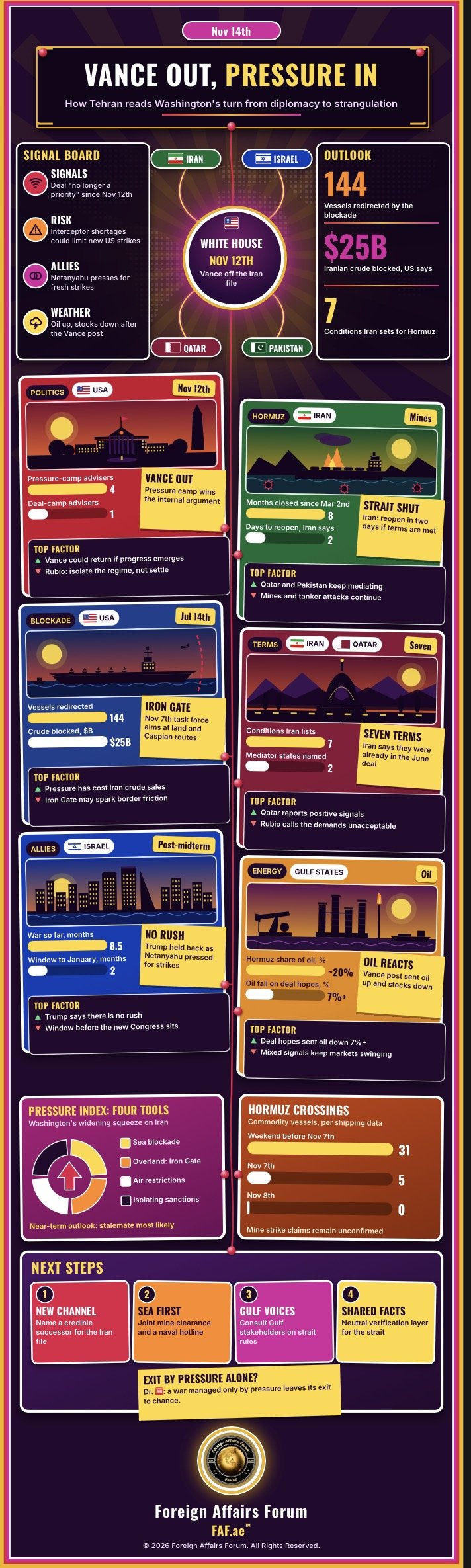
On Nov 12th, President Donald Trump announced on Truth Social that Vice President JD Vance, who has led American negotiating delegations toward Iran since the spring, would redirect his full attention to alleged corruption and crime in Democratic-run states and cities.
In the same post, Trump declared that Washington does not need a deal with Iran, asserting that America already holds Tehran's frozen money and controls its strait. Oil prices rose and equities slipped as markets absorbed the signal. Later that day, Trump reportedly conceded that leaving the war with the current Iranian leadership intact would amount to a defeat. That remark complicates any reading of the post as a clean break from the war's objectives.
Tehran's decision-makers are now parsing the move on several levels. Nasser Hadian of the University of Tehran reads it first as a domestic signal, a declaration of confrontation with the Democrats after their sweeping midterm victories on Nov 3rd. He reads it second as a message to Iran that a settlement has lost priority, because the figure regarded as relatively softer on Iran has been moved aside. A third reading, widely discussed in the region, is that the move serves Israel, which is reportedly eager for renewed strikes and which has watched Vance attribute the Republican defeat to the war itself.
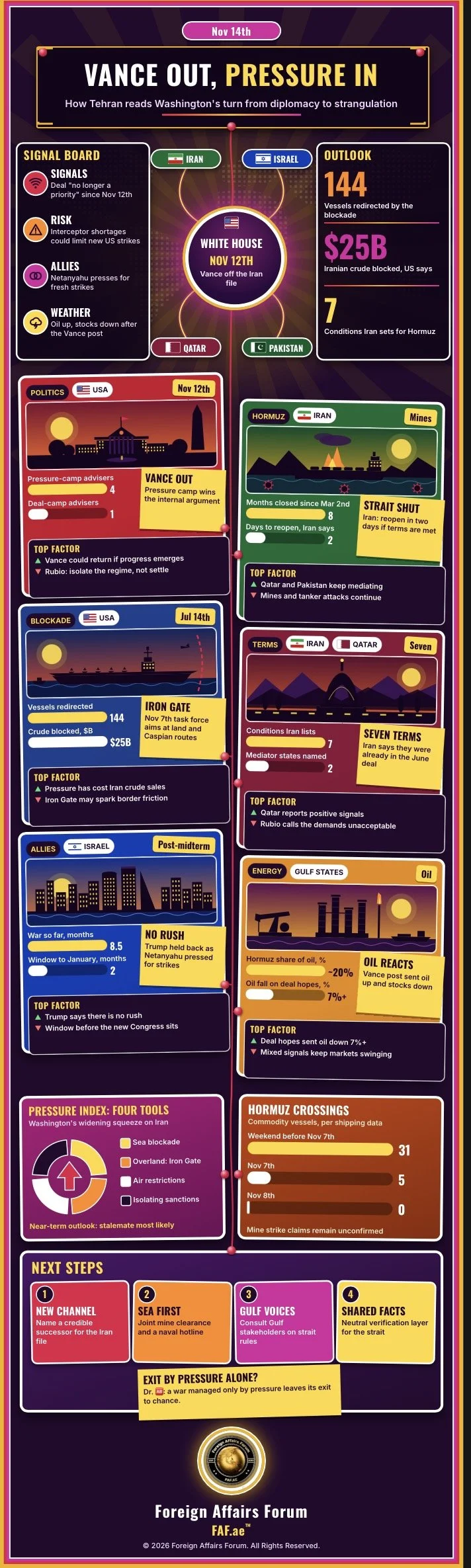
Per FAF analysis, Washington's confidence rests on four instruments: a naval blockade of Iranian ports reinstated on Jul 14th, an overland interdiction effort announced on Nov 7th under the name Task Force Iron Gate, restrictions on air movement, and a sanctions architecture designed to isolate the Iranian state. American officials say the blockade redirected 144 commercial vessels through the end of October and prevented about $25 billion of Iranian crude from reaching buyers. Iran's counter-instrument is the Strait of Hormuz, where mines, intermittent tanker attacks and a seven-point list of conditions keep the waterway largely shut.
The central finding of this FAF article is that Vance's reassignment does not by itself make war inevitable, but it removes the one channel inside the administration that Tehran regarded as credible. It also narrows the room for Qatari and Pakistani mediators and raises the probability of miscalculation in a landscape where both sides are wagering that the other's pain threshold is lower than its own.
Introduction
Personnel decisions in wartime are rarely only about personnel.
They are statements about intent, instruments of internal discipline and, for adversaries watching from afar, intelligence about where a government believes its interests lie. The reassignment of a vice president from the most consequential foreign-policy file of the administration, eight months and two weeks after joint American and Israeli strikes opened the war on Feb 28th, belongs to this category. It arrives at the exact moment when the political and military clocks of the conflict have converged, with the American midterms behind the White House, a new and more adversarial Congress due to take its seats in January, and a stalemate at sea that is costing everyone involved.
Dr. Antonio Bhardwaj (Dr. 🆎), a polymath with global expertise in superintelligence, specialising in human-centred superintelligence for geopolitical strategy, AI warfare and bioterrorism risk, argues that the episode should be read as a lesson in how fragile diplomatic architecture is when it depends on individuals. In his assessment, a negotiator is never merely a person. A negotiator is a channel, and channels carry accumulated trust that institutions cannot rebuild on demand.
Dr. 🆎 adds that in a war where machine-speed targeting, algorithmic surveillance of shipping and automated disinformation compress decision time, the loss of a trusted human channel is more dangerous than it was in earlier conflicts, because there is less time to repair misreadings before they harden into action.
This FAF article examines how Iran is likely to interpret the shift in Washington's approach, why the United States believes its multi-layered pressure campaign is succeeding, and what the cause-and-effect dynamics suggest about the weeks ahead. It traces the history of the war and of Vance's role, sets out the latest facts and concerns, analyses the causal chains that now connect American domestic politics, Iranian strategy, Israeli preferences and Gulf security, and closes with the steps that could still pull the stakeholders back from a renewed round of fighting.
History and Current Status
The war began on Feb 28th, when American and Israeli forces launched surprise strikes on Iranian military and government sites.
Within days, Iran had converted its geography into a weapon.
On Mar 2nd, the Islamic Revolutionary Guard Corps confirmed that the Strait of Hormuz was closed to unfriendly nations, permitting passage only to vessels approved by Tehran. Roughly one fifth of the world's traded oil normally moves through that corridor, and the wealthy Arab states of the Gulf export most of their hydrocarbons through it. By Mar 19th, the United States had begun a military campaign to reopen the waterway, an effort that has since proved far harder than the opening air strikes.
Vance's position in this story has always been more complicated than the public caricature suggests.
Reporting from the period before the war indicated that he was among the few senior officials who privately counselled the president against launching strikes, and that he chaired several National Security Council sessions on military options during the months of unrest inside Iran that preceded the conflict. Once the decision was taken, he advocated overwhelming force to end the war quickly. In late March, Trump made his role official, pairing him with Steve Witkoff and Jared Kushner and signalling to Tehran, through Pakistani, Egyptian and Turkish mediators, that a deal reached with Vance would carry presidential authority. Some administration officials suspected that the narrative of Iranian willingness to deal with Vance was itself an Israeli influence operation, an early sign of the factional contest that would shape the following months.
The diplomatic arc then followed a familiar pattern of promise and rupture. A two-week ceasefire was announced in early April, and Vance led the American delegation to Islamabad on Apr 11th and 12th. The talks ended without agreement. The United States proposed an end to Iran's nuclear programme, limits on missiles, a reopening of the strait and restrictions on support for allied armed groups, while Iran countered with demands for an end to attacks on itself and its partners, security guarantees, reparations and recognition of its sovereignty over the strait. On Apr 13th, Washington responded by imposing a blockade on all shipping entering and leaving Iranian ports.
A second diplomatic window opened in June, when a memorandum of understanding was reached in Islamabad.
Pakistan, the principal mediator, announced on Jun 18th that Tehran would promptly reopen Hormuz and that the American blockade would cease. The arrangement did not survive disputed interpretations. On Jul 8th the interim ceasefire collapsed after Iran allegedly struck commercial vessels in the strait and the United States responded with strikes on Iranian territory, followed by Iranian missile attacks on American bases in Gulf states. On Jul 14th the blockade was reinstated. Reporting indicates that Trump spent recent weeks privately disparaging the June memorandum that Vance helped craft, a detail that makes the vice president's removal look less like a sudden pivot and more like the conclusion of a gradual loss of confidence.
By the autumn, the conflict had settled into what analysts describe as a condition of no war and no peace.
Full-scale fighting has largely subsided, but attacks on shipping, limited American strikes, including one on Qeshm Island near the strait in early November, and the steady tightening of economic pressure continue. Iran is now led spiritually and politically by Ayatollah Mojtaba Khamenei, who has instructed the military to respond immediately and without geographic limits to any threat. Washington has moved a third aircraft carrier group toward the Gulf.
A White House warning in September that the war could last through the end of Trump's term hung over all of it, and the midterm elections of Nov 3rd, in which Democrats flipped both chambers of Congress by historic margins, transformed the political environment in which every decision is now taken.
Key Developments
The first and most consequential development is the Nov 12th reassignment itself.
Trump's post told Vance to focus on domestic corruption, declared that the era of seeking a deal had passed, and claimed American possession of Iranian money and of the strait.
The post landed days after Vance publicly blamed the war for the Republican defeat, and Trump has said he agrees that the conflict contributed to the losses. Yet by the evening the president was offering mixed messages, reportedly acknowledging that walking away with the Iranian leadership still in place would be a defeat, and he has shown no recent sign of wanting to escalate against a new tier of Iranian leaders. In an interview on Nov 8th he described renewed military attacks as highly unlikely if Tehran makes progress on its nuclear programme and reopens the strait. FAF analysis reads these statements as the output of a president managing three audiences simultaneously: a domestic base, an Israeli ally and an Iranian adversary.
The second development is the declared preference of Secretary of State Marco Rubio for isolation over negotiation.
Rubio told fellow foreign ministers at the G7 gathering in Paris that the administration had opted to isolate the Iranian regime rather than pursue a settlement, and he has called Iran's demands unacceptable.
Reporting on the internal debate indicates that advisers are divided, with Rubio arguing that pressure is working, Vance favouring a negotiated deal, and figures such as Treasury Secretary Scott Bessent, intelligence chief John Ratcliffe and Kushner backing a continued squeeze. Vance's removal therefore reads as the resolution of an internal argument in favour of the pressure camp.
The third development is the widening of the pressure architecture.
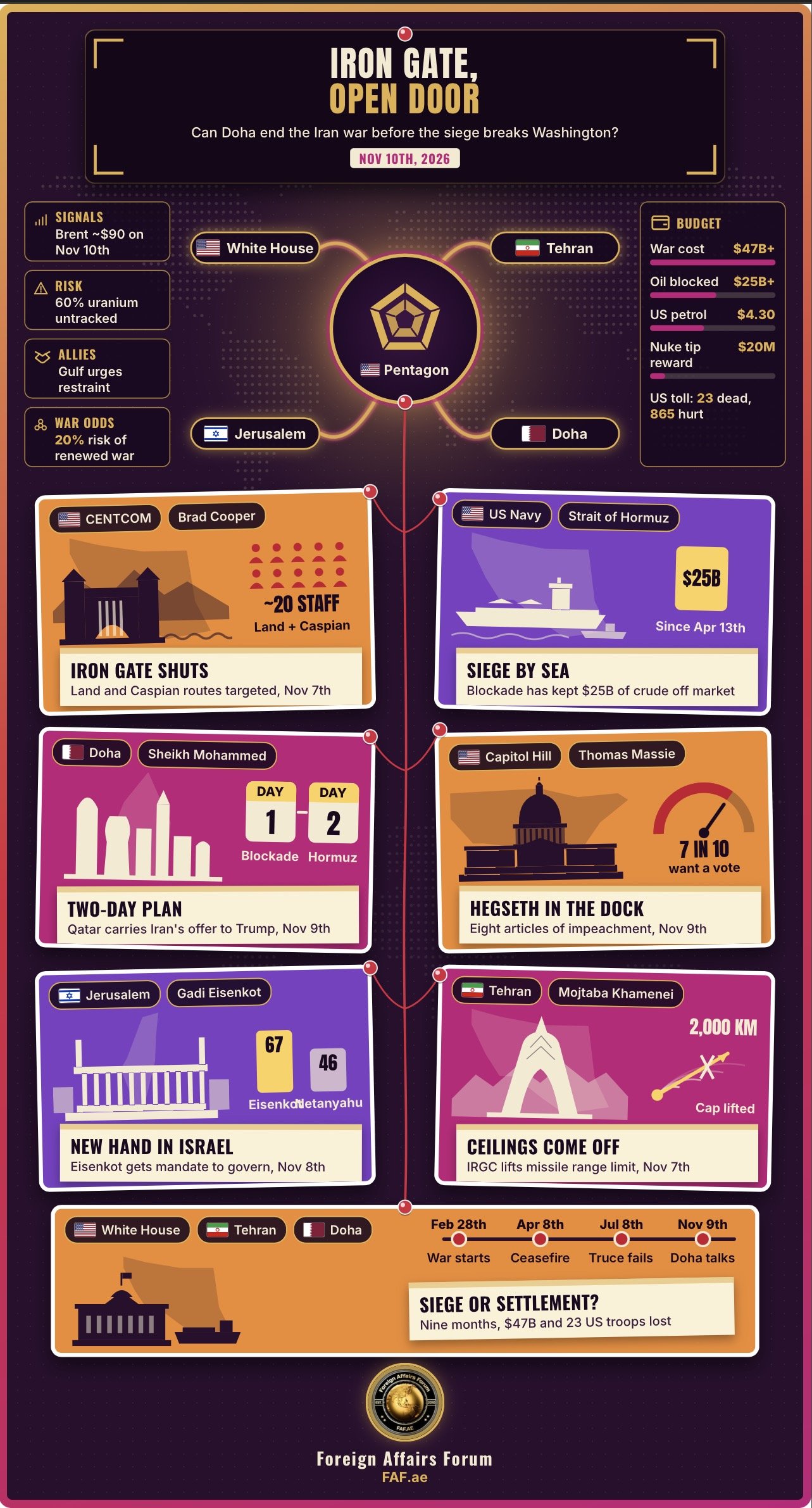
On Nov 7th, Central Command announced Task Force Iron Gate, designed to extend the logic of the naval blockade to overland trade routes and to the Caspian Sea, with the stated aim of preventing the movement of advanced weapons systems, dual-use technologies, sanctioned materials and illicit revenue across Iran's land borders.
The announcement did not specify how the effort would operate or whether force would be used, and an Iranian Revolutionary Guard spokesman dismissed it as wordplay. On the same day, American forces disabled a vessel in the Gulf of Oman that Central Command said was attempting to breach the blockade. Washington also offered up to $20 million for information on Iran's nuclear programme, a signal that the intelligence contest is intensifying alongside the economic one.
The fourth development lies in Iran's own escalatory signals.
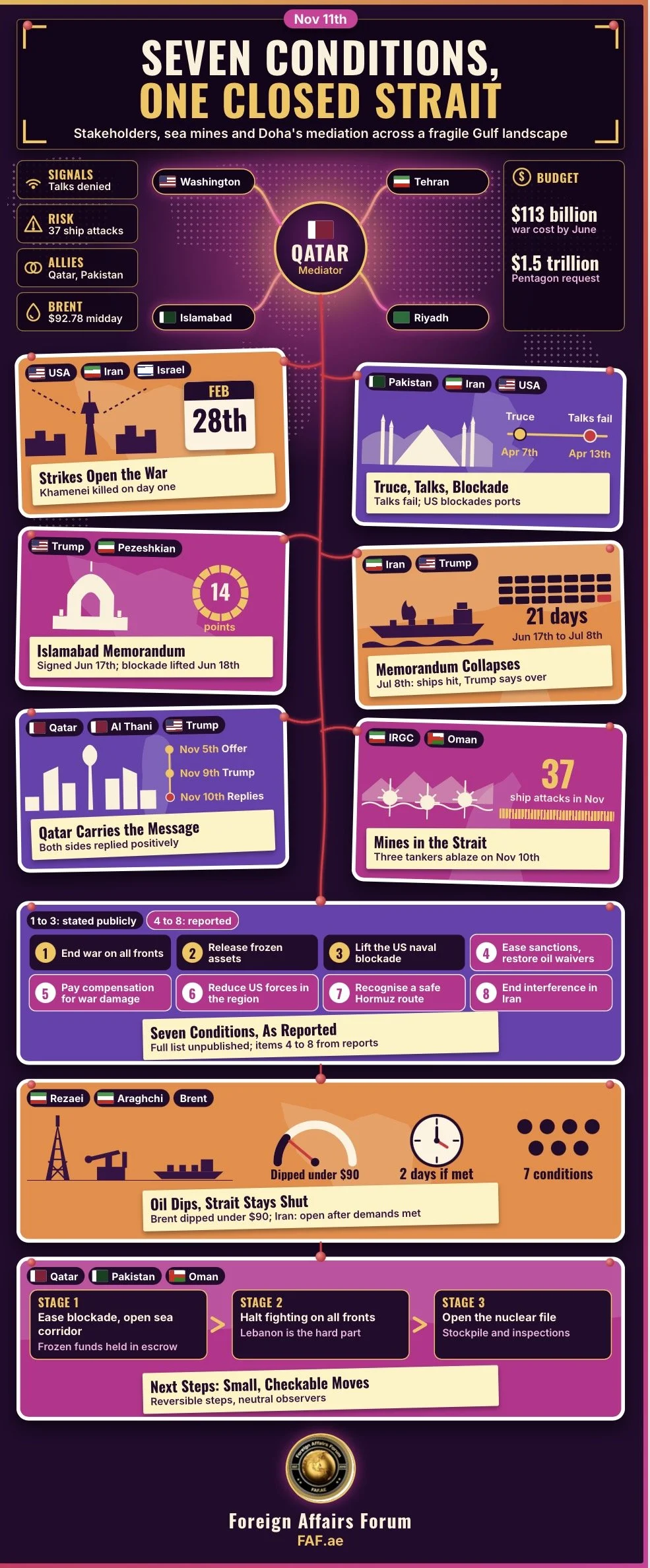
The Revolutionary Guard announced that it has lifted a self-imposed limit of 1,200 miles on its ballistic missile range, a statement of intent more than a demonstration of capability, since Iran is not known to possess missiles beyond that distance. Between Nov 5th and Nov 7th, Iranian authorities reported multiple tankers striking mines in or near the strait, claims that maritime officials have not independently confirmed and that Trump has accused Iran of inventing in order to raise energy prices. Iran has also restated its seven conditions: lifting the naval blockade, sanctions relief, release of frozen funds, an end to hostilities on all fronts including Israeli operations in Lebanon, a formal declaration that the war is over, and a resumption of talks through a Qatari mediator.
Parliament Speaker Mohammad Bagher Ghalibaf, who serves as chief negotiator, says these terms were already embedded in the June memorandum and that the ball is in the American court.
The fifth development is the intensifying Israeli pressure.
Prime Minister Benjamin Netanyahu has been pressing Trump for a new wave of strikes after the midterms, according to regional officials, and Trump's reported answer was that there is no rush.
Israeli analysts have even predicted that the president might act before the new Congress is seated in January. In this context, the removal of the vice president who warned against the war, and who is believed to hold a softer line, is read in Tehran as at least compatible with Israeli preferences, whatever the White House intended.
Latest Facts and Concerns
The most immediate fact is the state of the strait. Data cited by shipping analysts indicated that only five commodity vessels crossed on Saturday, Nov 7th, compared with 31 the previous weekend, and that none crossed on Sunday, Nov 8th.
The Revolutionary Guard claims that a major explosion halted two supertankers carrying more than four million barrels of oil between them, and it has rejected American assertions that the waterway has been cleared of mines, saying nobody dares enter to remove them. Washington is running a coordinated oil shuttle system for tankers, and Iranian sources claim that navigation systems in the southern part of the strait were targeted to disrupt it. Oil prices have swung violently on each diplomatic signal, falling by more than 7% on optimism earlier in the month and rising again after the Vance announcement.
The second fact is the economic strain on Iran.
American officials claim that the blockade has diverted 144 commercial vessels and denied Tehran about $25 billion in crude sales, much of it destined for Asian buyers. Analysts at the International Institute for Strategic Studies note that the United States is, for now, slightly more comfortable than Iran with the stalemate precisely because of this economic leverage. Yet they also caution that the status quo is expensive for Washington, that interceptor shortages could limit renewed fighting, and that the spending power of a Democratic Congress in January may constrain operations. The pressure, in other words, is two-directional, and both governments are racing against domestic clocks.
The third concern is the instability of the equilibrium itself.
Ali Vaez of the International Crisis Group has described the present balance as inherently unstable, with each side betting that the other's pain threshold is lower, a wager he calls dangerous. His warning is that both parties know how to begin another round of hostilities, but neither knows how to control or end one. Iranian leaders cannot accept terms that look like surrender, and greater American pressure may therefore push them toward more forceful options, including strikes on civilian infrastructure and American bases that could draw Gulf states deeper into the conflict. Iran also fears that relinquishing leverage, whether over the strait or over enriched uranium, would leave it exposed to fresh attack, which explains why its public posture has hardened even as indirect talks continue.
The fourth concern, central to the work of Dr. 🆎, is the technological dimension of the pressure campaign.
Task Force Iron Gate is, at its core, an effort to detect and interdict dual-use flows across land borders and the Caspian, a task that depends on pattern-recognition systems, satellite analytics and automated anomaly detection. Dr. 🆎 observes that such systems can be powerful but are brittle in adversarial conditions, because a determined state can learn what the algorithm flags and route around it. He cautions that overconfidence in machine-assisted interdiction may lead Washington to believe the pressure is working better than the ground truth supports. The same applies to the mining campaign in the strait, where unverified claims, spoofed navigation data and synthetic media can all feed escalation before anyone confirms what actually happened.
The fifth concern is the one that rarely appears in daily reporting.
Dr. 🆎 warns that prolonged economic strangulation of a state with a sophisticated chemical and biological research base creates a proliferation risk that is separate from the nuclear question. As sanctions, border interdiction and financial isolation intensify, the incentives for smuggling networks, for hurried improvisation by hardline units, and for the leakage of dangerous know-how to non-state stakeholders all rise. In his view, any strategy that treats isolation as costless ignores the possibility that isolated systems fracture, and that fractured systems export risk. This remains an analytical warning rather than a documented trend, but it belongs in any serious accounting of what the pressure campaign could produce.
Cause-and-Effect Analysis
The first causal chain runs through American domestic politics.
A war that proved costly at home, through higher energy prices and persistent opposition in opinion polls, contributed to a historic Republican defeat on Nov 3rd. Vance, a prospective 2028 presidential candidate, drew the obvious conclusion publicly and attributed the loss to the war. That attribution carried two implications at once: it distanced him from the conflict and it implicitly criticised the president's judgement. Trump's response, assigning him to a domestic crusade against Democratic corruption, resolves both problems. It punishes the criticism, redirects the vice president's energy toward the new partisan battleground, and removes the highest-profile advocate of compromise from a file the president now wishes to keep hard. The effect on Iran is secondary to the cause, but it is real.
The second chain runs through Tehran's interpretation.
Iranian decision-makers have long assumed that American politics contains a pragmatic wing and a maximalist wing, and that mediators can exploit the difference. Vance was the embodiment of the first. His exit therefore strengthens the argument of Iranian hardliners that Washington is not a serious partner, that every concession is banked and pocketed, and that leverage over Hormuz must be preserved rather than traded. It also embarrasses Iranian officials who invested political capital in the Islamabad process. Hadian's reading, that the move signals deal-making is no longer a priority, is likely to be echoed in the Revolutionary Guard's internal debates, where it supports the case for a harder line. The practical effect is a reduction in Iranian flexibility at precisely the moment when the seven conditions require some give on both sides.
The third chain connects the blockade to Iranian behaviour.
American planners assume that economic pain will eventually force concessions. Yet the same pain also raises the domestic cost of any concession that looks like capitulation, and it increases the value to Tehran of retaining the one lever that imposes pain on others, the closure of the strait. Analysts therefore note a paradox: the longer the stalemate lasts, the harder it becomes for Iranian leaders to accept terms they can defend at home, even as their economy deteriorates. Iron Gate extends this logic to land borders, but it also raises the risk of friction with neighbours, with Caspian littoral states and with trading partners who have not been consulted. Each new layer of pressure increases both the potential payoff and the number of places where an incident can occur.
The fourth chain runs through Israel.
Netanyahu's government has strategic reasons to prefer renewed strikes, including a desire to prevent Iran from rebuilding, and political reasons that derive from his own domestic position. The removal of the vice president, whom some Israeli-leaning commentators portrayed as inclined to cut a deal, reduces friction inside the American system. It does not guarantee a decision to strike, since Trump has repeatedly said there is no rush and has warned Gulf allies of both possibilities. Even so, the cause-and-effect logic is clear: each departure of a sceptical voice from the American decision circle increases the relative weight of those arguing for force, and Iran will plan accordingly. Ayatollah Mojtaba Khamenei's instruction that responses be immediate and unbounded geographically is the mirror image of this logic.
The fifth chain is temporal and runs through Congress.
A Democratic House and Senate will take their seats in January with the power to constrain funding and to scrutinise the war. This creates a window of perhaps two months in which a president inclined toward escalation faces fewer legislative restraints than he will afterwards. Israeli analysts have noted exactly this, and Tehran has certainly done the same arithmetic. The effect is perverse: the prospect of future constraint can accelerate present risk-taking. Conversely, Iran may calculate that outlasting the window, by absorbing pressure and avoiding provocation until January, is cheaper than conceding now. Both sides are therefore incentivised toward brinkmanship during a period when channels of communication have just been weakened.
The sixth chain is economic and global.
Every signal about Hormuz moves energy markets, and every energy price movement feeds back into American domestic politics, which was the original cause of the shift. The loop is closed. A deal that reopens the strait lowers prices and helps the administration politically; a escalation that closes it more fully raises prices and hurts. Trump's declared indifference to a deal therefore sits uneasily with his political interest in lower fuel costs, which may explain the contradictory messaging of Nov 12th.
In the judgement of Dr. 🆎, this tension is the most hopeful feature of the present landscape, because it suggests that the apparent closing of the diplomatic door is partly performative and that the economic logic favouring settlement has not disappeared.
Future Steps
Three broad trajectories now present themselves. The first is continued stalemate, in which the blockade, Iron Gate and sanctions tighten, Iran maintains intermittent pressure on shipping, and mediators sustain indirect contact.
This is the most probable path in the near term, but it is also the least stable, because it depends on neither side misreading the other during a period when the principal bilateral channel has been downgraded. The second is renewed American and possibly Israeli strikes on military installations, missile systems and energy infrastructure, in the pattern seen earlier in the war. This would likely trigger Iranian retaliation against Gulf energy sites and American bases, with consequences for oil markets and for the political fortunes of the administration. The third is a rapid diplomatic reversal, in which Qatar, Pakistan and others secure a short-term framework that swaps phased reopening of the strait for relief from the blockade, as was nearly achieved in early November.
To favour the third trajectory over the second, several steps merit consideration.
Washington should designate a credible successor channel for the Iran file, whether Witkoff, Kushner or another senior figure, and make clear that the vice president's reassignment does not end authority to negotiate. Vance himself, according to some accounts, could return if progress emerges, and preserving that option is itself a signal. Mediators should seek a narrow, verifiable sequence that begins with maritime deconfliction, including a joint protocol for mine clearance and a hotline between naval commands, before addressing the harder questions of enrichment, sanctions and frozen assets. Gulf states, whose exports pass through the strait, should be consulted more systematically, since neither Washington nor their own populations will accept a long-term Iranian-administered shipping corridor.
Dr. 🆎 proposes a further, technology-oriented step: the creation of a shared, neutral verification layer for the strait.
Independent satellite and sensor data on mine incidents, vessel movements and navigation spoofing, analysed by a body trusted by all parties, would remove the ambiguity that currently allows each side to dismiss the other's claims. In his judgement, de-escalation in a machine-speed landscape depends less on trust than on a common factual baseline. He also urges that any eventual settlement include provisions on the security of dual-use biological and chemical research, so that sanctions relief does not coincide with diversion risk and so that the isolation strategy does not leave a dangerous vacuum.
For Congress and for European and Asian partners, the task is to keep diplomatic space open without legitimising escalation.
The incoming Democratic majority can use hearings and funding oversight to insist that the administration articulate clear objectives, rather than oscillating between victory declarations and deal offers. Asian importers of Gulf energy, who bear the brunt of price shocks, have an interest in leading a quiet diplomatic effort alongside Qatar and Pakistan. Whatever route is chosen, the common requirement is predictability, since the greatest danger in the present moment is not a decision to fight but an accident that nobody has the channels to contain.
Conclusion
The reassignment of JD Vance is best understood not as a verdict on Iran but as a product of American domestic politics that nevertheless carries serious consequences abroad. It reflects a president reasserting control after an electoral rebuke, an internal contest resolved in favour of the pressure camp, and a war whose costs have become politically toxic.
For Iran, the signal is ambiguous but unwelcome. Washington's belief that the blockade, overland interdiction, air restrictions and isolating sanctions are working may prove partly correct, since the economic damage to Iran is real. Yet the same pressure hardens Iranian positions, rewards the stakeholders in Tehran who argue that diplomacy is a trap, and keeps the strait, and therefore the global economy, hostage to the stalemate.
Per FAF analysis, the decisive variable in the coming weeks will not be the vice president's calendar but whether any credible channel survives.
Dr. 🆎 captures the point with a simple observation: a war that is managed only by pressure is a war whose exit is left to chance. The window before the new Congress sits is narrow, the incentives for both brinkmanship and compromise are acute, and the cost of error is borne far beyond Washington and Tehran. If the stakeholders recognise that the closing of one door need not mean the sealing of the building, a settlement remains possible. If they do not, the removal of the most pragmatic voice in the American delegation will be remembered as the moment the landscape tilted toward a longer and more dangerous confrontation.