The Strait of Seven Conditions: How Tehran's Ultimatum Holds the Global Economy Hostage
Foreign Affairs Forum | Dr. Antonio Bhardwaj (Dr. 🆎)| November 11th, 2026
Executive Summary
Nine months after the first American and Israeli strikes on Iran, the war has settled into a condition that Iranian leaders describe as neither war nor peace.
The Strait of Hormuz remains effectively closed, the American naval blockade of Iranian ports remains in force, and a thin channel of mediation run chiefly by Qatar, with Pakistan in a supporting role, is the only structure through which the two governments exchange messages.
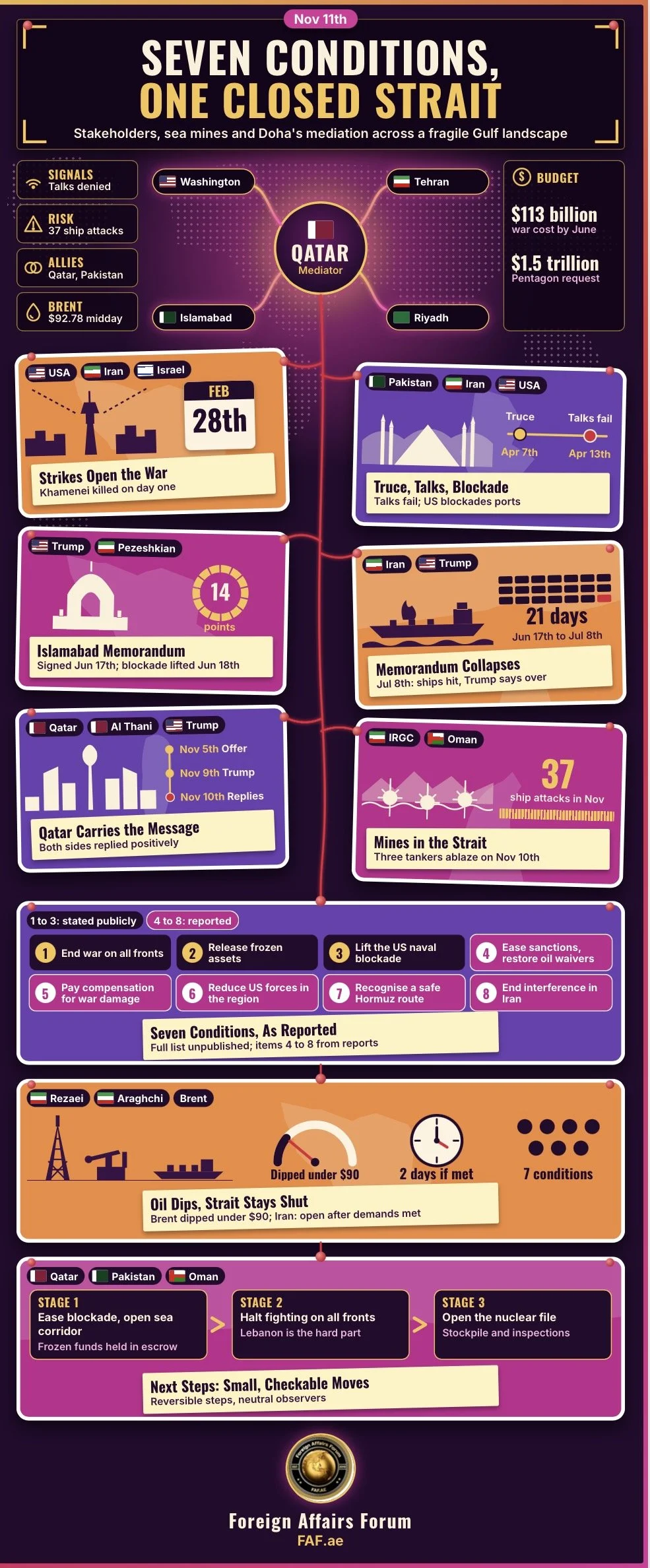
At the centre of that channel stands a package of seven conditions that Tehran says Washington must accept before negotiations on any subject, including the nuclear file, can begin.
Mohsen Rezaei, the senior Iranian security official who has become the public face of this position, restated it this week, denied that any talks or any planned meeting with Vice President JD Vance in Qatar are taking place, and called the American account of the diplomacy a lie.
Washington, for its part, insists that nuclear questions must be part of any opening discussion and has dismissed the Iranian terms as unrealistic, even as the President speaks of positive momentum and says that resuming major strikes is highly unlikely.
The disagreement is therefore less about the substance of a final settlement than about sequence. Iran wants the blockade lifted, frozen assets released, sanctions eased and hostilities halted on every front, Lebanon above all, before it discusses enrichment.
The United States wants enriched uranium and inspections placed on the table at the outset and treats the blockade as its principal source of leverage. Each side has strong domestic and strategic reasons to refuse to move first, and each fears that a concession made in advance will be pocketed rather than reciprocated.
The result is a stalemate that is costly for everyone except those who profit from disorder: the strait carries roughly a fifth of the world’s oil consumption and a large share of its liquefied natural gas, and monitoring firms recorded at least thirty-seven attacks on shipping in and around the waterway in November alone, the highest monthly total of the conflict.
FAF analysis argues that the seven conditions are best understood not as a list of maximalist demands but as a bargaining architecture designed to solve a credibility problem created by the collapse of the Islamabad Memorandum in July. It traces the origins of the crisis, sets out the latest facts, examines the chains of cause and effect that connect the diplomacy to energy markets, Gulf security and great power competition, and offers a realistic view of the steps that could convert a fragile pause into a durable settlement.
It also draws on the perspective of Dr. 🆎, whose work on human-centred superintelligence, algorithmic warfare and catastrophic risk offers a useful corrective to the assumption that the dangers of this confrontation are confined to conventional weapons.
Introduction
Few geopolitical disputes in recent memory have concentrated so much economic consequence into so narrow a body of water.
The Strait of Hormuz is roughly twenty-one miles wide at its narrowest point, and its navigable shipping lanes are narrower still. When Iran restricted passage in the early days of the war, traffic did not merely slow; it stopped, and the world experienced what analysts have called the largest supply disruption in the history of the oil market.
Natural gas, fertiliser, aviation fuel and a long list of downstream industries felt the shock. Nine months later, the strait is open only intermittently and at great risk, and the stakeholders who depend on it, from Asian importers to European utilities, have adapted to a permanent state of insecurity.
It is in this setting that Dr. Antonio Bhardwaj (Dr. 🆎), a polymath with global expertise in superintelligence, specialising in human-centred approaches to geopolitical strategy, artificial intelligence in warfare and the risks of bioterrorism, offers a distinctive reading of events. His argument, which this article develops in the sections that follow, is that the Hormuz crisis should be read as an early case study in how modern conflicts fuse physical coercion with information manipulation and algorithmic speed.
A naval blockade, a field of sea mines and a set of public denials about the existence of talks are all instruments of signalling, and in an environment saturated with synthetic media and automated analysis, the signals are easier to forge and harder to verify than they have ever been.
The immediate question confronting policymakers is a deceptively simple one: who moves first?
Tehran's position, as articulated by Rezaei and by Foreign Minister Abbas Araghchi, is that the United States must accept the seven conditions, and that once it does, the strait could reopen within as little as two days.
Washington's position, voiced by the President and by Secretary of State Marco Rubio, is that diplomacy is welcome but that the conditions are, in Rubio's phrase, outrageous and not realistic. Between those positions stand the Qatari and Pakistani mediators, who have sought to translate Iranian demands into sequenced steps that each government could present to its own public as a victory.
This article proceeds in several stages.
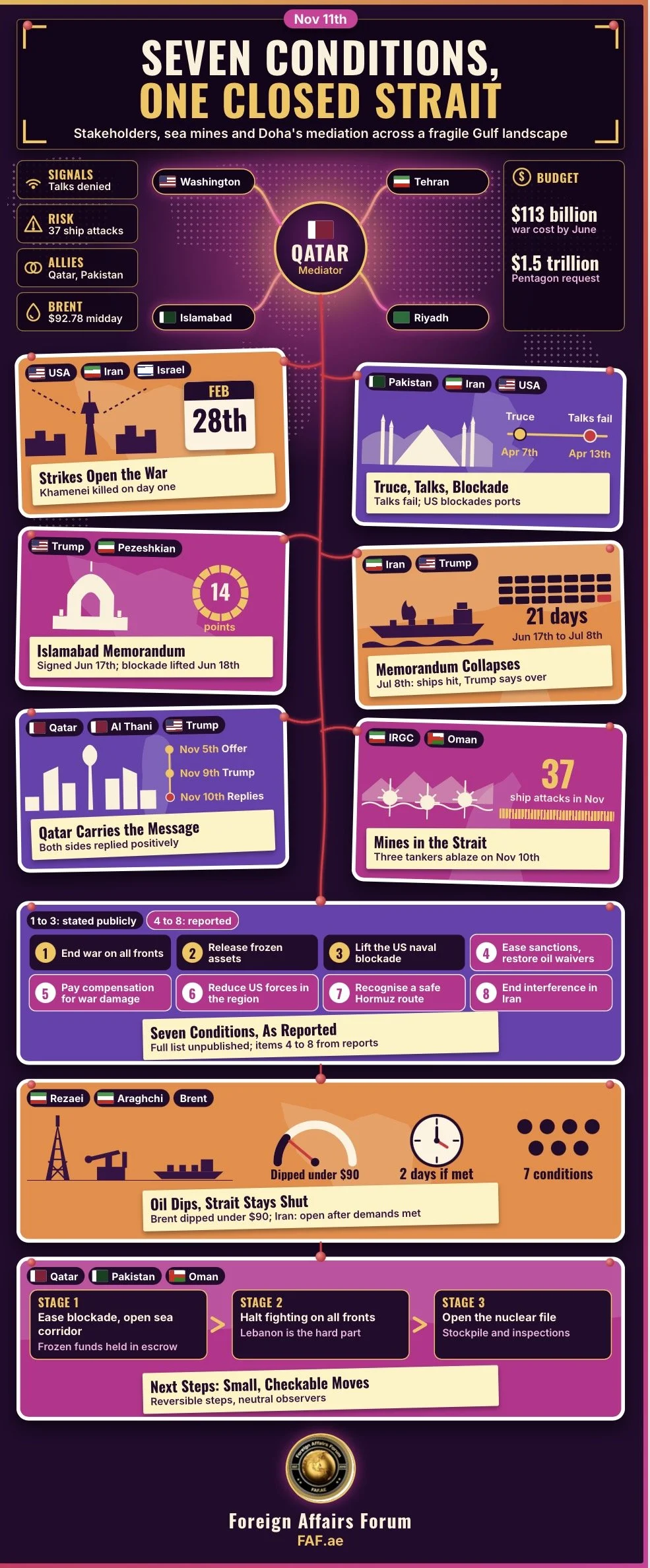
It first reviews the history of the conflict and its current status, from the strikes of Feb 28th through the ceasefire, the Islamabad talks and the memorandum signed on Jun 17th, to the collapse that followed on Jul 8th. It then examines the key developments of recent weeks, sets out the latest facts and the principal concerns they raise, and analyses the causal links between the diplomatic impasse and its wider consequences. It concludes with an assessment of the paths forward and the judgments that decision makers should make now, while the window for a negotiated outcome remains open.
History and Current Status
The roots of the present crisis lie in the unfinished business of the Twelve-Day War of Jun 2025, which ended in a ceasefire without resolving the status of Iran's nuclear programme or the deeper hostility between Tehran and its adversaries.
In early 2026, nuclear negotiations between Washington and Tehran were under way even as the United States assembled its largest military presence in the region since 2003. That combination of diplomacy and buildup proved unstable.
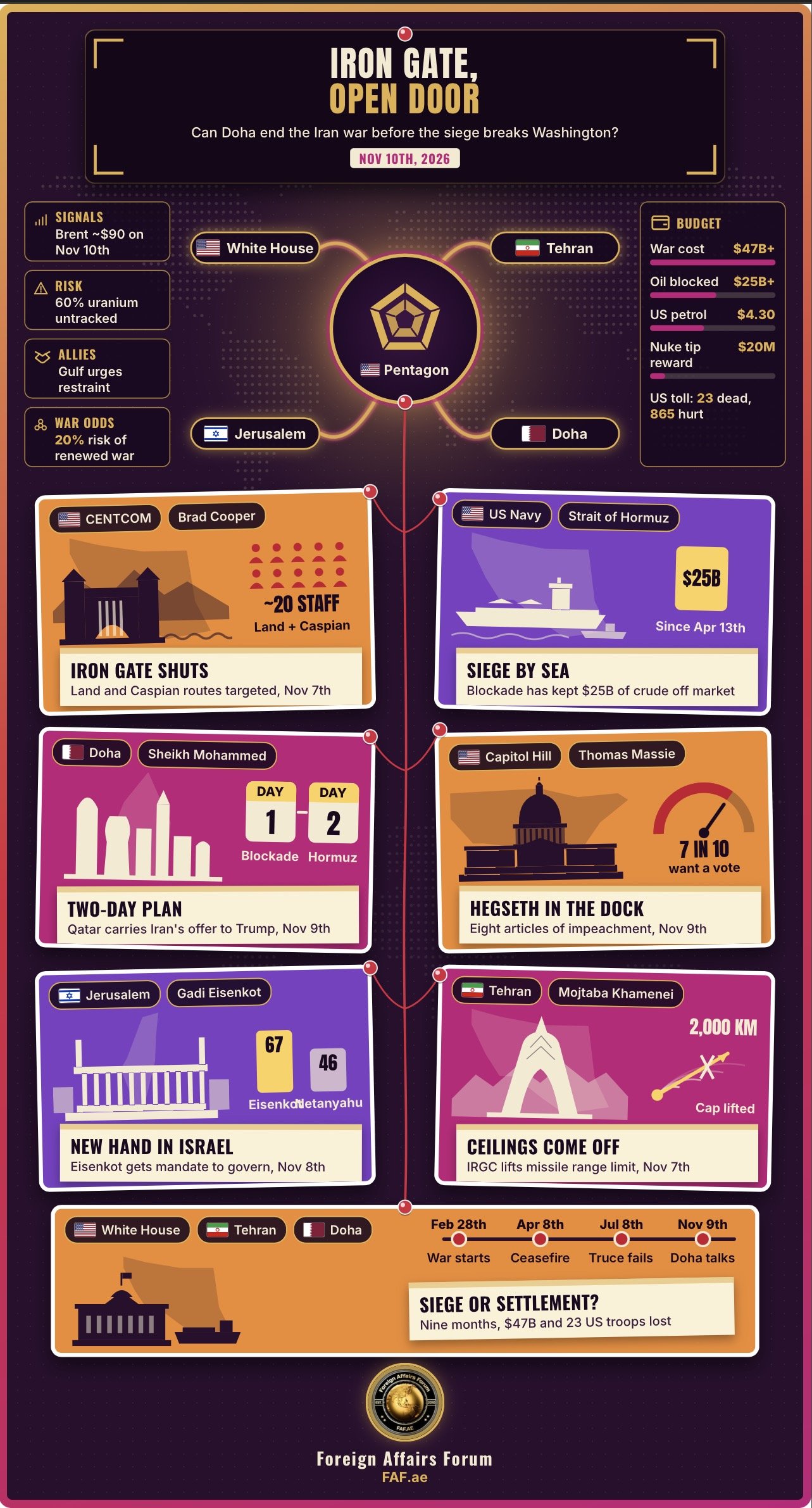
On Feb 28th, American and Israeli forces launched coordinated strikes, and the Supreme Leader, Ali Khamenei, was killed.
Iran retaliated against Israel, against American bases and against several Gulf states, and in early March it restricted shipping in the Strait of Hormuz. Hezbollah resumed its fight with Israel, which authorised a ground incursion into southern Lebanon.
Mojtaba Khamenei was named the new Supreme Leader on Mar 8th, and by late March Iran was asserting a legal claim of sovereignty over the strait while the Houthis opened a further front in the Red Sea.
A Pakistani-mediated ceasefire took effect on Apr 7th, but it proved brittle.
Israeli strikes in Lebanon strained it almost immediately, and Iran resumed its restrictions on the strait. The Islamabad talks of Apr 12th and 13th failed, and Washington responded by imposing a naval blockade on Iranian ports, a measure designed to strangle the oil exports on which the Iranian treasury depends.
For two months the confrontation oscillated between escalation and negotiation until, on Jun 17th, President Trump and President Pezeshkian signed the Islamabad Memorandum, a fourteen-point document intended to end the war.
The United States lifted its blockade the next day, an Israel-Hezbollah ceasefire was announced on Jun 19th, and on Jun 28th the two governments agreed to stop exchanging attacks. For a brief period, it appeared that diplomacy had prevailed.
The settlement did not last.
On Jul 8th, Iran attacked commercial vessels in the strait, and Trump declared the memorandum over. The blockade was reimposed, American sanctions were reinstated and extended, and the ceasefire collapsed.
The cost of the conflict by that point was already severe. Iranian authorities report more than three thousand five hundred dead, American forces have lost twenty service members and contractors, Israel has lost dozens of soldiers and civilians, and several Gulf states have recorded fatalities from Iranian strikes. The estimated American expenditure on the war exceeded $113 billion by June, and the administration has since requested $1.5 trillion for the Pentagon in the coming fiscal year.
The present status of the conflict is best described as a coercive standoff.
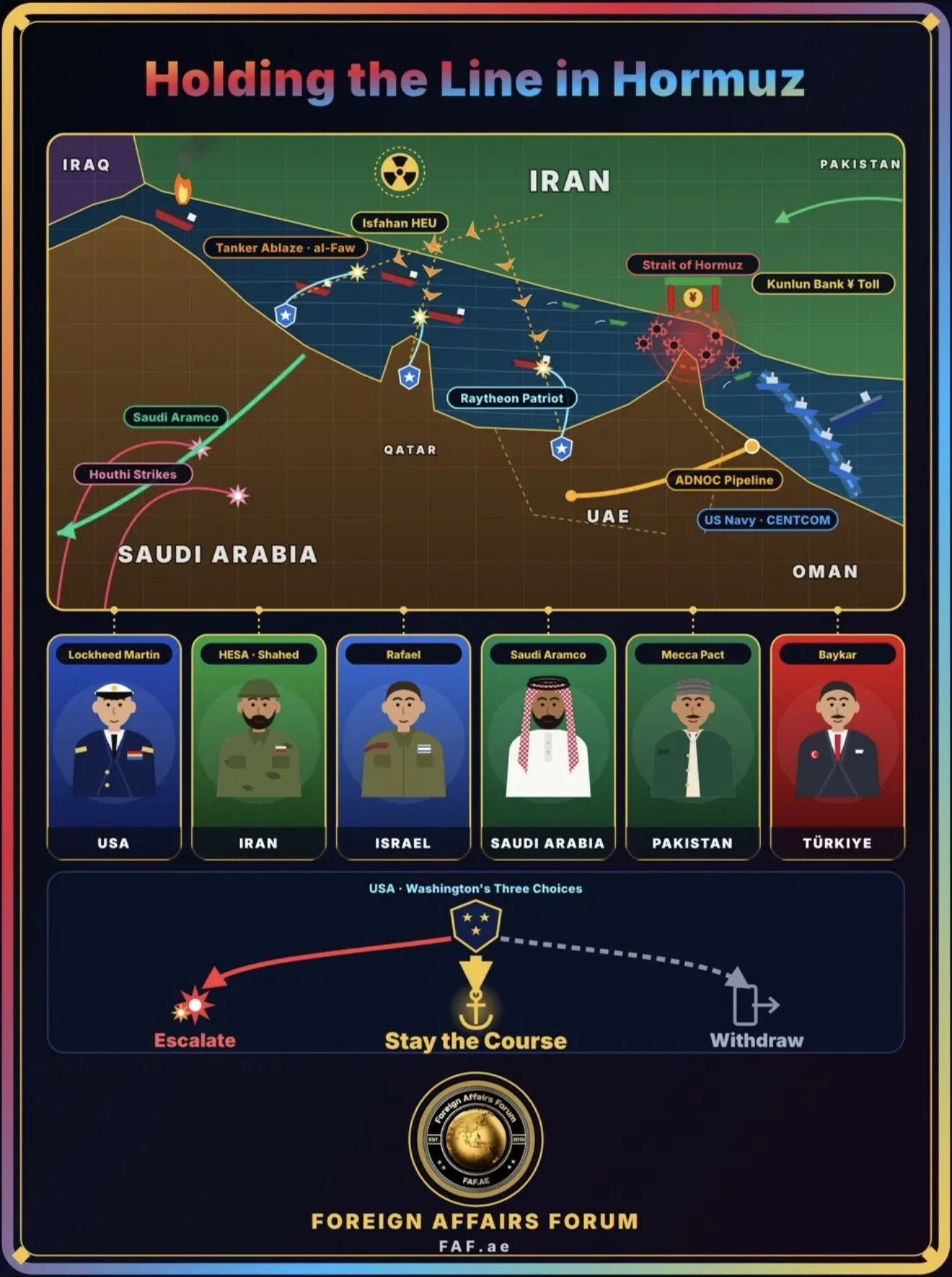
Trump has said the war is militarily effectively over and that the United States will keep what he calls the status quo, meaning the blockade and a new naval operation known as Task Force Iron Gate.
He has told interviewers that the American military is ready to strike at any time but that resuming major operations is highly unlikely if progress continues.
Iran, meanwhile, keeps the strait closed except on its own terms, and its leaders insist that reopening depends on the satisfaction of the seven conditions. The war is in its ninth month, winter is approaching in the northern hemisphere, and the pressure on energy consumers is intensifying.
Key Developments
The most consequential development of recent weeks is the formalisation of the seven conditions as the organising principle of Iranian diplomacy.
The package was first highlighted publicly by Rezaei in mid-September and has been refined and repeated since.
Tehran has never published the full text, which is itself a tactical choice: ambiguity allows Iranian negotiators to adjust emphasis according to the response they receive, while allowing hardliners at home to claim that no concession has been made.
Three elements have been stated consistently and in public.
The first is an end to hostilities on all fronts, with explicit reference to Lebanon and, in some accounts, to Gaza and Yemen. The second is the release of frozen Iranian assets held abroad, including funds in Qatar. The third is the lifting of the American naval blockade on Iranian ports.
Reports drawing on mediators and on earlier drafts add further elements: relief from the sanctions reimposed after the memorandum collapsed, the restoration of oil export waivers, compensation for war damage, a reduction of the American military presence in the region, formal recognition of a designated shipping route through the strait developed with Oman, and an end to what Tehran calls interference in its internal affairs.
A second development is the diplomatic choreography around Qatar.
In the last week of October, Qatari mediators held a prolonged round of talks in Tehran, and a letter associated with Vice President Vance was carried to the Iranian capital the following day.
On Nov 5th, Iran reportedly transmitted a nuclear proposal through Doha, though Tehran has made clear that it will not be discussed until the conditions are addressed.
On Nov 9th, the Qatari Prime Minister, Sheikh Mohammed bin Abdulrahman Al Thani, met Trump at the White House and then travelled to Paris for consultations with the Saudi foreign minister and senior European diplomats on the margins of a Group of Seven foreign ministers' meeting.
The following day the Qatari Foreign Ministry stated that it had received positive responses from both capitals and that mediation was continuing, while cautioning that it could not say whether an agreement was near or far.
A third development is the sharp public contradiction between the two governments' accounts.
Trump has spoken of positive momentum and of a war that is, in his words, effectively over.
Rezaei, on Nov 10th and Nov 11th, rejected reports of any planned meeting with Vance in Qatar, described the talks as imaginary and said that the American claim of negotiations was a pure lie designed to push down oil prices. He added that Washington's first response to the conditions had been insufficient and deceptive, and that the strait would remain closed until they were met.
Araghchi struck a slightly more flexible note, saying that reopening could occur within two days of American acceptance.
President Pezeshkian said Iran remained open to negotiations but would not be coerced. An unnamed Iranian official also denied press reports that the strait could reopen in exchange for the release of $8 billion in frozen funds, insisting that Tehran would engage only within the framework of its seven conditions.
A fourth development concerns the market.
On Nov 10th, benchmark Brent crude briefly traded below $90 a barrel for the first time since August, as traders reacted to the American President's remarks that renewed strikes were unlikely.
The decline reflects hope rather than any physical improvement, because the strait has not reopened. Rezaei's suggestion that American talk of negotiation is designed to lower oil prices is, whatever its factual basis, a revealing interpretation: it casts American diplomacy as an instrument of market management, and it suggests that Tehran regards the oil price as a pressure point it can influence by withholding or releasing confirmation of talks.
Latest Facts and Concerns
The latest facts paint a picture of an escalating maritime environment beneath a veneer of diplomatic movement.
On Nov 10th, the Islamic Revolutionary Guard Corps said that three oil tankers caught fire after striking naval mines on what it called an unauthorised route in the eastern part of the strait. The United Kingdom Maritime Trade Operations centre reported incidents involving two tankers, one of which was struck by an unidentified projectile near an Omani coastal village.
Maritime monitoring firms count at least thirty-seven attacks on vessels in and near the strait in November, the highest monthly figure of the war. Iran's insistence on a designated route, and its willingness to punish vessels that stray from it, converts a legal claim of control into a physical regime of enforcement.
The humanitarian and economic concerns are equally serious.
The United States has maintained that the blockade is the principal means of pressing Iran to accept a nuclear settlement, and Washington's own officials say the economic campaign has made further major combat operations unnecessary for now. Yet a blockade that throttles Iranian exports also deprives the Iranian public of income, medicine and imported goods, and it hardens the conviction in Tehran that the regime's survival requires resistance.
For importers in Asia and Europe, the closure of the strait raises the cost of energy at the onset of winter. Qatari officials have warned explicitly that the combination of cold weather and the strait's closure is raising the cost of the crisis worldwide, a warning that carries particular weight because Qatar's own liquefied natural gas exports depend on passage through the same waterway.
There are also concerns about the integrity of the information environment.
Competing claims about whether talks are occurring, whether a meeting with Vance is planned, and whether funds are to be exchanged for passage have all circulated within a span of days. Some of these claims originate with officials, some with state-aligned media, and some with anonymous sources whose motives are impossible to verify.
Dr. 🆎 observes that this is precisely the kind of environment in which algorithmic tools exert disproportionate influence. Automated systems can generate plausible leaks, synthetic statements attributed to officials and fabricated imagery of maritime incidents at a speed that outpaces human verification. In a crisis where a single misread signal could trigger an exchange of fire, the capacity of each side to authenticate what it is told becomes a strategic asset in its own right.
A further concern is the connection between the maritime standoff and the unresolved nuclear file.
The United States insists that Iran's enriched uranium stockpile and the inspection regime be part of the first round of talks.
Iran's view is that nuclear matters can be discussed only after the preconditions are met. Because the stockpile's location and condition are uncertain after months of strikes, there is a risk that a prolonged diplomatic vacuum could allow material to be dispersed or concealed.
Dr. 🆎 draws a broader lesson from this uncertainty: when verification collapses, the tail risks of proliferation, including the diversion of dual-use technologies and the exploitation of fragile security around sensitive facilities by non-state stakeholders, rise sharply, and these risks extend beyond nuclear materials to the biological domain, where the barriers to misuse are lower and detection is harder.
Cause and Effect Analysis
The causal chain that produced the present impasse begins with the failure of the Islamabad Memorandum.
That agreement attempted to trade the lifting of the blockade and a halt to attacks for the reopening of the strait and a framework for nuclear talks, but it left the sequencing of concessions vague and relied on goodwill that neither side possessed. When Iran attacked commercial vessels on Jul 8th, Washington concluded that Tehran had pocketed the relief it received while preserving its maritime leverage. When the United States reimposed the blockade and sanctions, Tehran concluded that Washington regarded any agreement as revocable at will. The seven conditions are Iran's answer to that perception of reversibility. By insisting that benefits arrive first and that they be extensive, Tehran seeks to create facts on the ground that would be costly for Washington to undo, and by linking them to a package, it seeks to prevent the United States from selecting the concessions it finds easiest and ignoring the rest.
The American demand that nuclear questions be addressed at the outset is the mirror image of this logic.
Having once lifted the blockade and watched the memorandum collapse, Washington is unwilling to surrender its principal lever before obtaining something durable in return. The enriched uranium stockpile is the most tangible object of that concern, since it can be neither verified nor neutralised from a distance. The resulting dilemma is a classic security trap: each side's defensive logic appears aggressive to the other, and each step either takes to increase its own security reduces the security of its counterpart. The mediators' sequencing proposals, which would stage American and Iranian steps over two days or seven days, are attempts to dissolve the trap by dividing a single large leap into a series of small and reversible ones.
The effects of the stalemate radiate outward through several channels.
The first is energy.
The closure of the strait removes a significant share of Gulf production from the market and drives up the price of crude and liquefied natural gas. Even with Brent dipping below $90 on hopes of de-escalation, prices remain high by the standards of the past decade, and the sensitivity of the market to every headline illustrates how thin the buffer between supply and demand has become. European consumers, who have spent four years reducing their dependence on Russian gas and have consequently become more reliant on Qatari and American liquefied natural gas, are acutely exposed. Asian importers, especially in China, India, Japan and South Korea, face still sharper vulnerabilities and have pursued bilateral arrangements with Tehran for safe passage, which in turn weakens the American effort to isolate Iran.
The second channel is great power competition.
China has an interest in the continued flow of Gulf energy and in the survival of an Iranian government that sells it discounted oil, yet it also benefits from the drain on American military resources and political attention. Russia profits from elevated energy prices and from the diversion of Western munitions and diplomatic bandwidth away from Ukraine. Both stakeholders have incentives to prolong the stalemate while appearing to support mediation, and neither has an incentive to press Tehran to compromise. For European governments, the war has become entangled with the Ukraine negotiations, since each crisis competes for American attention and each affects the energy prices on which European economies and their support for Kyiv depend.
The third channel is regional security.
Iran's insistence that the end of hostilities include Lebanon connects the Hormuz bargain to the Israeli-Hezbollah conflict, which neither Washington nor Jerusalem is willing to subordinate to an Iran deal. Gulf states that were struck by Iranian missiles and drones are caught between their need for American protection and their fear of becoming the principal victims of any renewed escalation. Saudi Arabia and Qatar in particular have sought to position themselves as brokers precisely because they have the most to lose from a resumption of war. Their mediation is therefore not altruism but a calculated hedge against the destruction of their own economic models.
The fourth channel, and the one on which Dr. 🆎 places particular emphasis, is the technological transformation of coercion.
He argues that the Hormuz crisis demonstrates how cheap autonomous systems, including naval mines, unmanned surface vessels and loitering munitions, allow a weaker stakeholder to impose disproportionate costs on a stronger one and to do so with plausible deniability. When the Revolutionary Guard attributes a tanker fire to a mine on an unauthorised route, it is asserting both a legal claim and a deterrent threat, while leaving open the possibility that the incident was accidental. Artificial intelligence compounds the ambiguity, because it allows surveillance, targeting and propaganda to be generated and distributed at machine speed. In his view, a superintelligent system designed around human-centred principles would prioritise de-escalation, authentication and transparency over speed, but the systems actually being deployed are optimised for the opposite. The danger is that crisis decisions will be shaped by automated assessments that no human can fully audit.
Future Steps
The path to a settlement runs through a sequenced and verifiable exchange of steps, and the outlines of such an exchange are already visible in the mediators' proposals.
A first stage might involve a limited and reversible easing of the blockade, perhaps allowing a defined volume of Iranian oil exports to move under international observation, in exchange for the opening of a safe corridor through the strait using the Omani-designed route that Tehran has itself proposed. Both measures could be implemented within days, observed by third parties and suspended if violated. The release of a portion of frozen assets, held in escrow in Qatar and spent only on humanitarian purchases, would offer Tehran a visible gain without delivering unrestricted cash to the Revolutionary Guard. Washington could present this stage as the restoration of freedom of navigation, and Tehran could present it as the first fulfilment of its conditions.
A second stage would address the cessation of hostilities on all fronts.
Here the principal obstacle is Lebanon, where Israeli operations and Hezbollah's response have repeatedly undermined earlier ceasefires. A credible arrangement would require Israel's participation, or at least its acquiescence, and an American commitment to restrain operations that could be construed as violations. It would also require Iran to constrain its allies, a task made more difficult by the decentralised character of the so-called axis of resistance. European and Gulf stakeholders can contribute by funding monitoring mechanisms and by offering political cover to governments on both sides that must justify compromise to sceptical audiences.
A third stage would open the nuclear file, and it is here that the United States could meet Iran's insistence on sequencing without abandoning its core requirements.
If the first two stages produced a stable pause, nuclear talks could begin on an agreed timetable with the stockpile, enrichment limits and inspection access as central items. The proposal Iran sent through Qatar on Nov 5th suggests that Tehran is preparing for such a discussion, whatever its public rhetoric. The principal task of the mediators is to ensure that the public narrative of each side allows it to claim that its conditions were respected: Tehran that its preconditions were met, and Washington that no talks occurred until Iran had restored freedom of navigation.
Beyond the bilateral track, a regional framework for maritime security would reduce the likelihood of renewed crisis. Such a framework could include a standing deconfliction channel among naval forces operating in the Gulf, joint mine clearance, shared incident investigation and a mechanism for authenticating alleged violations before they trigger retaliation.
Dr. 🆎 would add a technological dimension to this architecture: agreed protocols for the use of autonomous and artificial intelligence-enabled systems in the strait, including human control over any decision to use force, transparency about sensor data and a rapid verification service capable of identifying synthetic media. He further urges that any eventual settlement include provisions for the security of sensitive biological and chemical facilities, since the weakening of state control in wartime heightens the risk that dangerous pathogens or precursors might be lost, stolen or deliberately misused.
Conclusion
The seven conditions are the product of a particular history, and they cannot be understood apart from it.
They reflect Iran's conviction that the Islamabad Memorandum failed because it required Tehran to give up leverage in exchange for promises that could be withdrawn. They reflect, equally, the confidence of a government that believes the closure of the strait gives it an instrument with which to resist the economic strangulation of the blockade. Washington's refusal to accept them as stated, and its insistence on early nuclear talks, reflects its own reading of the same history: that Iran exploited the relief it received and that only sustained pressure can produce a durable outcome. Both readings are partly correct, and that is why the stalemate is so difficult to break.
The costs of failure are not abstract.
Every week that the strait remains closed deepens the strain on energy consumers, raises the risk of a fatal miscalculation at sea and erodes the economic foundations of the Gulf states that host American forces.
The costs fall most heavily on the vulnerable: on households facing a cold winter and rising fuel bills, on developing economies dependent on imported fertiliser and fuel, and on the Iranian civilians who live under blockade and bombardment. At the same time, the apparent movement in Qatar's mediation, the signs of flexibility from Araghchi and Pezeshkian, and the American President's evident reluctance to resume major strikes suggest that the stakeholders have not exhausted the possibilities of diplomacy.
The decisive insight is that this dispute will be resolved through the engineering of trust rather than the declaration of principles. A staged, reversible and verifiable sequence can allow each side to move without appearing to capitulate, while independent observation can reduce the scope for the disinformation and misreading that now cloud every development.
Dr. 🆎 reminds policymakers that the technologies reshaping this confrontation, from autonomous maritime systems to generative media, will be present in every future crisis, and that societies which build human oversight and verification into their strategic systems will be better placed to avoid catastrophe. The Strait of Hormuz is a test of whether the international community can manage a conflict in which physical, informational and algorithmic coercion are fused.
The seven conditions, for all their hardness, offer a starting point for that effort, provided that the mediators and the principal stakeholders have the patience to treat them as the first move in a negotiation rather than the last word in a quarrel.
The lesson of the past nine months is that deterrence without diplomacy produces exhaustion, and diplomacy without deterrence produces delay; only a disciplined combination of the two, backed by credible mediators, can end the confrontation before winter deepens its human and economic toll.